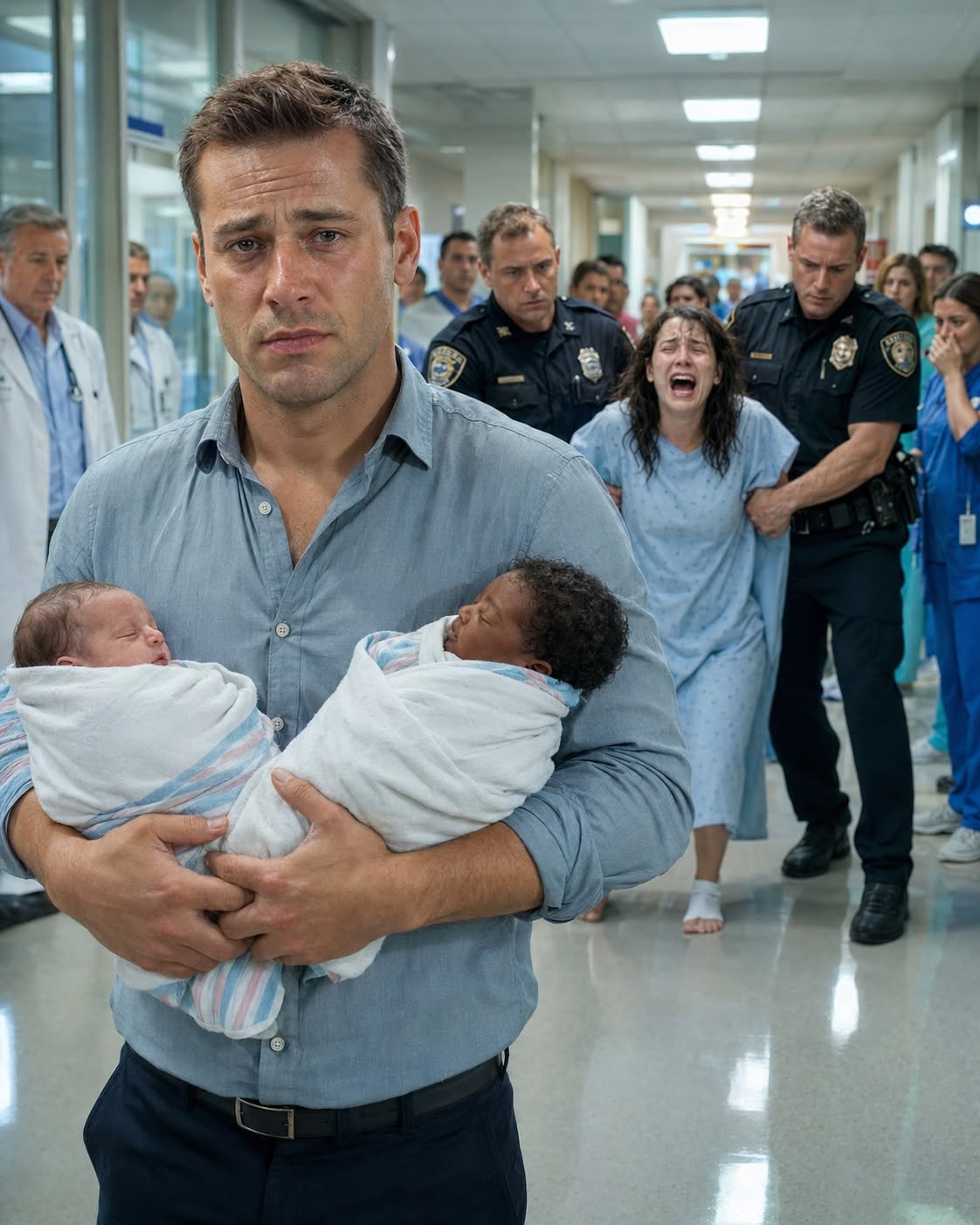
If anyone had warned me that the greatest day of my life would also become the moment everything I believed was torn apart, I would have laughed at them. But disaster does not usually knock politely.
It crashes through the door without warning.
The delivery room at Mercy General Hospital smelled of antiseptic, sweat, and sterile plastic. Machines beeped around us while nurses moved quickly beneath the harsh white lights. My wife, Claire, squeezed my hand so tightly that I was certain she would break my fingers.
We had survived a long and painful battle to reach that room.
Five years of failed pregnancy tests. Three miscarriages that left wounds neither of us knew how to discuss. Countless nights when I woke and found Claire sitting on the bathroom floor, crying into a towel because she did not want me to hear her.
Those losses had nearly broken us.
But now we were finally there.
The monitors pulsed with a quick, reassuring rhythm, and the doctor kept telling us that everything looked good.
Standing near the corner was my mother-in-law, Margaret. She watched the room with the cold attention of someone inspecting property she already believed belonged to her.
Margaret came from an old, wealthy Philadelphia family. She carried herself with rigid elegance and dressed as though photographers might appear at any moment. Even inside a hospital delivery room, she wore a tailored coat, pearl earrings, and an expression of permanent disapproval.
Claire had quietly begged me not to let her mother attend the birth.
Margaret had insisted that being present was her responsibility as the family matriarch.
“One more push, Claire,” Dr. Harris called. “You’re doing wonderfully. Just one more.”
Claire released a deep, primal scream that seemed to come from somewhere far beneath the pain.
Then our first son entered the world.
He was tiny, slippery, furious, and absolutely perfect. His skin was pale, his cheeks were pink, and a soft layer of light hair covered his head.
“A boy,” I whispered as tears blurred my vision.
I bent over and kissed Claire’s damp forehead.
“He’s beautiful,” I told her. “He’s absolutely beautiful.”
Before either of us could catch our breath, Dr. Harris looked down again.
“We’re not finished,” he said. “The second baby is coming.”
Only a few minutes later, another cry rang through the room.
The nurse lifted our second son and began clearing his airway.
That was when the entire atmosphere changed.
It happened so suddenly that it felt as though someone had drained the oxygen from the room.
Our second son was just as loud and healthy as his brother. But his skin was deep brown, and thick black curls covered his tiny head.
I stared at him.
For several seconds, my mind refused to understand what my eyes were seeing. The difference between the two babies was impossible to ignore.
Before I could form a question, Margaret gasped from the corner.
It was not an ordinary gasp of surprise. It was sharp, ragged, and filled with horror.
She rushed forward, nearly pushing the nurse out of the way.
“What is this?” she demanded.
Her face had lost all its color. The controlled, aristocratic woman I had known for years had vanished. In her place stood someone wild with panic.
She turned toward the doctor.
“This hospital has made a terrible mistake. You switched the babies. My daughter did not give birth to this child.”
“Ma’am, you need to step back,” Dr. Harris said firmly. “There has been no switch. These are fraternal twins, and both children were delivered directly from your daughter.”
Margaret whipped around and stared at Claire.
Her expression changed from fear to pure disgust.
Claire lay exhausted on the bed, pale and trembling. She reached weakly for her mother’s wrist.
Margaret jerked away as though Claire’s touch had burned her.
“You disgusting little liar,” she whispered.
The cruelty in her voice made something inside me turn cold.
“Mom, please,” Claire sobbed.
Her breathing became quick and shallow. She looked at me with a kind of terror I had never seen in her before.
“Daniel, please don’t listen to her,” she cried. “Don’t look at his skin and believe what she’s saying. I swear to you, Daniel. I swear on my life.”
I could not move.
My wife was begging me to trust her. My newborn sons were crying in the arms of nurses. Margaret was staring at us as if our family had become something shameful and diseased.
Margaret pulled her coat tightly around herself.
“I will take care of this,” she said with a sneer.
Then she looked directly at me.
“If you possess even the smallest amount of dignity, Daniel, you will demand a paternity test. Once you receive the results, you will leave her.”
Before I could answer, she turned and walked out.
The door closed behind her, leaving a silence so heavy that even the cries of our newborn sons could not break it.
We named the boys Noah and Caleb.
Noah was pale, with light hair and features that looked unmistakably like mine.
Caleb had deep brown skin, dark curls, and beautiful eyes. He felt like a miracle wrapped inside a mystery none of us could explain.
Taking the boys home should have been a celebration.
Instead, our house felt like a place under quarantine.
Margaret’s accusation followed us into every room. I trusted Claire. I knew her heart, and I knew the woman she was. Yet the question still clawed at the back of my mind.
How was this possible?
It seemed to contradict everything I understood about genetics.
Claire slowly withdrew from the world.
She moved through the house like a shadow. She spoke only when necessary and rarely looked directly at me. At night, I often found her sitting in the nursery with the lights off, holding Caleb against her chest.
She would rock him and whisper desperate apologies through her tears.
He was too young to understand why she was sorry.
But Claire already understood how cruel the world could be.
Whenever I took the boys outside, people stared.
At the park, strangers looked from Noah to Caleb and then back at me. Neighbors hesitated before speaking. Mothers at the pediatrician’s office leaned toward one another and whispered.
Some were bold enough to ask questions.
“Are they both your children?”
“Was the darker baby adopted?”
“They don’t look like brothers at all.”
Every comment felt like a small blow.
Eventually, we agreed to take a DNA test.
We told ourselves it was to silence everyone else, but I knew part of me wanted to destroy the doubt Margaret had planted in my mind.
The results were unambiguous.
I was the biological father of both children.
Noah and Caleb were fraternal twins with the same father, yet they had inherited radically different physical traits. The specialist described it as an extraordinarily rare genetic outcome.
I believed that would finally end the nightmare.
The next afternoon, I carried the report into Margaret’s home and dropped it onto her polished dining table.
“They are both my sons,” I said. “You owe Claire an apology.”
Margaret barely looked at the report.
She calmly lifted her teacup and took a sip.
“Tests can be altered,” she replied. “Or perhaps nature produced some unfortunate accident.”
“It wasn’t an accident.”
She placed the cup back onto its saucer.
“Whatever the explanation, that child does not belong in this family. He does not fit our image. He is a mark that will never disappear from the family portrait.”
Margaret kept her promise.
For the next six months, she and the rest of Claire’s wealthy relatives treated Caleb as though he did not exist.
They sent expensive clothes and toys for Noah.
They asked for photographs of Noah.
At family gatherings, they crowded around Noah’s stroller and admired his eyes, his smile, and his resemblance to me.
When Claire entered carrying Caleb, some of them physically turned away.
The pressure was destroying my wife.
But the worst part of our ordeal had not yet begun.
Shortly after the boys turned six months old, Caleb developed a fever that would not go away.
At first, we assumed he had caught a virus. Then he stopped eating. He became weak and slept almost constantly. His skin began to look pale and gray beneath its natural color.
We rushed him to the emergency department at Franklin Children’s Hospital.
What followed was a blur of blood tests, scans, whispered consultations, and sleepless nights in sterile corridors.
After several days, a pediatric blood specialist asked Claire and me to meet with her inside a small office with no windows.
She closed the door and sat across from us.
“Caleb has a rare form of aplastic anemia,” she said gently. “His bone marrow is no longer producing enough healthy blood cells.”
The words struck me like repeated punches.
“What does that mean?” Claire asked, barely able to speak.
“He needs a bone marrow transplant,” the doctor explained. “And he needs one as soon as possible. Immediate family members usually provide the strongest chance of finding a match.”
“We’ll do it,” I said without hesitation. “Test us now.”
They took blood from both of us that same day.
Three days later, I was sitting beside Caleb’s hospital crib, watching his small chest rise and fall, when my phone rang.
The transplant coordinator asked me to come to her office alone.
A cold feeling tightened inside my stomach.
When I arrived, the doctor did not immediately look at her notes. She looked directly at me with an expression that combined confusion and pity.
“Daniel,” she began, “you are a partial match for Caleb. The testing also confirms without question that you are his biological father.”
Relief escaped me in a broken breath.
“Thank God,” I said, covering my face. “Take whatever you need. I’ll do the procedure today.”
“Please wait.”
I lowered my hands.
“There is something unusual in Claire’s results,” the doctor continued. “We repeated the panel three times because we thought there had been a laboratory error.”
“Is Claire sick?”
“No. That isn’t the problem.”
The doctor leaned forward.
“According to the bloodwork, Claire’s DNA does not match Caleb’s DNA at all. The test shows that she shares no detectable genetic material with him.”
I stared at her.
The fluorescent lights buzzed above us, suddenly so loud that I could barely think.
“That isn’t possible,” I said. “I watched her give birth to him.”
“I understand.”
“He came directly out of her body.”
“I know,” the doctor said. “That is why these results are so unusual. There are only a few medical explanations that could account for this. We need to conduct additional tests on Claire immediately.”
She paused before continuing.
“But you should prepare yourself. According to the current genetic report, your wife is not Caleb’s biological mother, even though she physically gave birth to him.”
The world I understood collapsed.
I barely remembered leaving the hospital.
During the drive home, traffic lights blended into one another as panic tightened around my chest.
How could Claire give birth to a baby who was not genetically hers?
Had the fertility clinic implanted the wrong embryo?
Could another woman’s embryo somehow have been transferred alongside ours?
Had a doctor made a mistake so terrible that it defied explanation?
When I pulled into our driveway, a black luxury sedan was parked near the porch.
Margaret’s car.
I rushed through the front door.
Claire was curled into a ball on the living room sofa, her face hidden against her knees. She was crying so hard that her entire body shook.
Margaret stood over her holding a thick manila envelope.
She looked perfectly composed.
“Get away from her,” I said.
I stepped between them.
Margaret raised an eyebrow.
“Daniel. Your timing is excellent. I assume the hospital informed you about the fascinating discovery concerning the boy’s genetics.”
My body went cold.
“How do you know?”
Margaret’s lips curved into a thin smile.
“I know several members of the hospital board. Privacy is a privilege enjoyed by people without influence.”
She glanced at Claire.
“Now that the truth has been confirmed, it is time to end this humiliation.”
She dropped the envelope onto the coffee table.
It landed with a heavy thud.
“Those are divorce papers,” Margaret said. “Very generous divorce papers. You will receive full custody of Noah. The other child can be surrendered to the state or returned to his actual mother.”
I stared at her in disbelief.
“There is also a check for two million dollars,” she continued. “In exchange, you will leave quietly, avoid scandal, and never discuss this matter publicly.”
“You’re insane.”
“Am I?”
Margaret stepped closer.
“My daughter’s reputation is already collapsing. People are discussing her possible affairs. Once they learn that the child she delivered is not even biologically hers, she will become the subject of every dinner conversation in this city.”
She lowered her voice.
“Take the money, Daniel. Take your real son. Leave the mistake behind.”
“He is my son!” I shouted.
My voice shook the room.
I grabbed Margaret by the arm and marched her toward the door.
“If you come near my wife or either of my children again, I will make sure everyone knows exactly what kind of person you are.”
I pushed her onto the porch, slammed the door, and locked it.
When I returned to the living room, Claire had disappeared.
I found her in our bedroom.
The closet doors were open, and several old boxes were scattered around her. Claire sat on the floor holding a fragile leather journal. The cover was cracked, and the pages had turned yellow with age.
I knelt beside her.
“Claire, please talk to me. The doctor explained the DNA results, but we can fix this. It must be a fertility clinic error. We can investigate. We can sue them.”
“It wasn’t an error,” she whispered.
Her voice sounded empty.
She slowly lifted her face.
The life had vanished from her eyes. She looked like someone crushed beneath a secret she had carried for far too long.
“I didn’t know how to tell you,” she said. “My mother promised she would ruin our lives if I ever revealed it.”
“Revealed what?”
“She told me it was better for everyone to think I had cheated on you than for them to discover the truth.”
I took her cold hands.
“What truth, Claire?”
She pressed the journal against my chest.
“The condition is called chimerism,” she said, breaking into sobs. “The doctor explained it after they ran the additional tests.”
I waited, barely breathing.
“When I was developing inside my mother, there was another embryo. A fraternal twin. I absorbed that twin before birth.”
I stared at her.
“People with this condition can carry two different genetic profiles,” Claire continued. “My blood contains one set of DNA, but some of my reproductive tissue contains another.”
The room seemed to tilt around me.
Two genetic blueprints inside one person.
“Caleb inherited the second set,” Claire whispered. “He inherited DNA from the twin I absorbed.”
She looked at the journal in my hands.
“And that DNA carries the part of our family history my relatives have spent generations trying to hide.”
Her finger shook as she pointed toward the book.
“Open it.”
I untied the worn leather strap and carefully lifted the cover.
The pages were filled with faded cursive handwriting. The journal had belonged to a woman named Ruby, Claire’s great-grandmother.
As I read, a terrible truth began taking shape.
Ruby had been a mixed-race Black woman with African-American ancestry. Because her complexion was light, she had lived publicly as a white woman and married into Margaret’s wealthy Philadelphia family.
When Ruby gave birth to Claire’s grandfather, the baby was pale enough for the secret to remain hidden.
The family buried the truth.
They locked away every photograph and letter that could expose Ruby’s ancestry. In the segregated social circles of that era, they feared losing their money, influence, and status.
Caleb’s dark skin and curls were not evidence of an affair.
They were not the result of a hospital switch.
They were not a mistake.
Through Claire’s chimerism, Caleb had inherited the genetic traits of a woman the family had tried to erase.
He had reached into the past and brought Ruby’s hidden legacy into the light.
And Margaret had known the entire time.
“She knew,” Claire said against my shoulder. “My mother found the journal when she was a teenager.”
Claire’s tears soaked through my shirt.
“She hated knowing that Ruby was part of us. She hated the idea that our family wasn’t completely white. When Caleb was born, everything she feared became visible.”
Claire pulled away and looked at me.
“She made me remain silent. She said people could believe I had cheated, but they could never be allowed to know about Ruby. She was willing to destroy our marriage rather than let her friends discover that her grandson is Black.”
Rage tightened every muscle in my body.
Margaret had allowed her own daughter to be branded unfaithful. She had rejected her grandson and watched our family suffer, all to protect a racist lie.
I pulled out my phone and activated the recorder.
“Do you have proof?” I asked. “Messages, emails, anything showing that she threatened you?”
Claire wiped her face and reached into her pocket.
“She left a voicemail the day after we brought the boys home. She believed I was alone when she called.”
She opened the recording and pressed play.
Margaret’s controlled, arrogant voice filled the bedroom.
“Listen carefully, Claire. You will not humiliate this family. Tell people it was a fertility clinic mistake, a sperm donor mix-up, or an affair. I don’t care which story you use. But you will never speak Ruby’s name. If you allow that dark-skinned mistake to become part of our family legacy, I will have Daniel removed from his job, I will destroy both of you financially, and I will make certain you are never welcomed in respectable society again. Bury the truth, or I will bury you with it.”
When the voicemail ended, the fear that had been suffocating me for months disappeared.
In its place came a calm, focused anger.
Margaret valued her social standing more than anything. She believed she had the power to determine who was accepted and who was erased.
“Get dressed,” I told Claire, helping her stand.
She stared at me.
“Why?”
“Your parents’ fortieth-anniversary celebration is tonight.”
Claire’s face went pale.
“Daniel, I can’t go there.”
“Yes, you can.”
“What are you planning?”

