At nineteen, Hannah Parker stood in the living room of her family’s home in Asheville, North Carolina, holding a positive pregnancy test in trembling hands.
Her mother, Linda, stared at her as though Hannah had just placed an explosive device on the coffee table.
Her father, George, switched off the television and leaned toward her.
“Who is the father?”
Hannah lowered her gaze.
“I can’t tell you yet.”
Linda pressed one hand against her chest.
“What do you mean you can’t tell us? Is he married? Is he much older than you? Have you gotten involved with someone dangerous?”
“It isn’t anything like that. But I’m not ending this pregnancy. If I do, it won’t affect only me. Someday, every person in this family will regret it.”
George rose so quickly that his chair scraped against the floor.
“Don’t stand there speaking in riddles, young lady.”
“Dad, please. Give me a few days. He was planning to come talk to you.”
“Who was?”
Hannah remained silent.
She was not protecting an irresponsible man who intended to disappear. She had made a promise. The baby’s father had an urgent reason for wanting to speak to George first, and Hannah believed he would keep his word.
But he never came.
George pointed toward the front door.
“You either deal with this the way your mother and I are telling you to, or you leave my house today.”
An hour later, Hannah sat on the curb with a backpack, sixty dollars, and a heart that felt completely shattered.
Linda cried behind the iron gate.
But she did not open it.
She did not challenge her husband.
She did not step outside and hold her daughter.
Hannah spent that night at the home of a friend from high school. Several days later, she moved to Charlotte, changed her phone number, and began rebuilding her life from nothing.
She worked mornings in a coffee shop, cleaned office buildings at night, and attended accounting classes on weekends.
Her son was born healthy.
She named him Caleb.
For ten years, Caleb became the reason Hannah got out of bed every morning, even when exhaustion had emptied her completely.
He was intelligent, funny, and far too observant for his age. He loved robots, dismantling toys to see how they worked, and asking why all his friends had grandparents living nearby.
Hannah always found a way to change the subject.
Until the day Caleb turned ten.
“Mom,” he said, “I want to meet your parents. Even if they don’t want to meet me.”
The sentence hurt more deeply than any memory Hannah had tried to bury.
She realized her son should not be forced to carry shame that had never belonged to him.
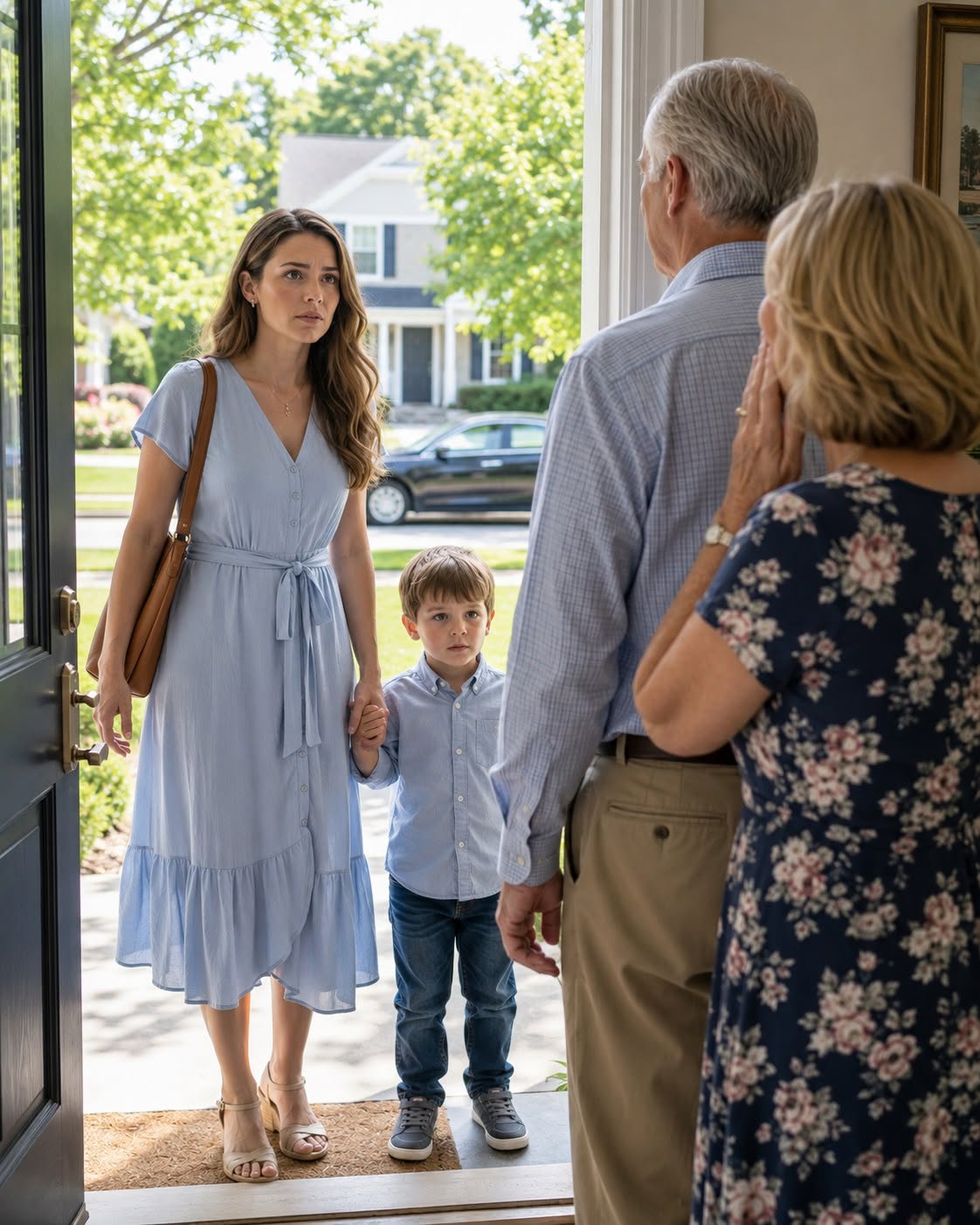
The following Saturday, they drove to Asheville.
The house looked almost unchanged.
The paint was peeling near the windows. Purple wisteria climbed over the front gate. The wooden swing George had built when Hannah was little still hung from the oak tree in the yard.
Hannah knocked.
George opened the door and froze.
“Hannah?”
Linda appeared behind him.
The moment she saw Caleb, she gasped and covered her mouth.
Several long seconds passed before anyone managed to speak.
Then Hannah rested one hand on her son’s shoulder.
“I came here to tell you the truth. Caleb is Ryan Bennett’s son.”
George staggered backward as though someone had struck him in the chest.
Linda grabbed the doorframe.
Ryan was the young man who had died three days before Hannah’s parents forced her from the house.
But recognizing Ryan’s eyes in Caleb’s face was not what completely unraveled Linda.
It was what Hannah said next.
“And before Ryan died, he uncovered the secret you’ve been hiding since you were seventeen.”
The color drained from Linda’s face.
George looked at his wife and then back at Hannah.
“What secret is she talking about?”
“Let us come inside,” Hannah replied. “Caleb shouldn’t have to hear this while standing on the sidewalk.”
The same door that had been closed in Hannah’s face ten years earlier now remained open.
She walked through it without feeling as though she had returned home.
It felt more like she was walking toward a debt that had never been paid.
The living room still contained the loud grandfather clock and rows of framed family photographs.
The pictures of Hannah stopped when she was eighteen, as though she had simply ceased to exist after that age.
Caleb pointed toward a graduation photograph.
“Is that my mom?”
“Yes,” George answered. “She always got nervous before important things, but she never backed away from them.”
Those words hurt Hannah more than an apology would have.
Linda brought Caleb a glass of water.
When he smiled at her, she saw Ryan’s dimple.
“Do Ryan’s parents know about him?” George asked.
“No.”
“Carol and William lost their only son,” Linda whispered. “Carol was devastated. She was never the same afterward.”
“I was nineteen, completely alone, and you had just thrown me out,” Hannah replied. “How was I supposed to walk into the home of a grieving mother and tell her that her son had left behind a baby?”
Linda began crying.
Hannah opened her purse and removed a clear folder containing eight yellowed envelopes.
“I wrote to both of you for almost a year. Every letter was returned unopened and stamped ‘Refused.’”
George picked one up.
“I never saw any of these.”
Linda lowered her eyes.
The silence in the room changed.
George slowly turned toward his wife.
“You refused them?”
“Not here,” Linda whispered.
“So you did?”
Caleb placed his glass on the table.
“Grandma, my mom was afraid too.”
Linda released a broken sob.
That simple sentence, spoken without blame or anger, shattered something inside her.
Hannah had not returned to humiliate her mother in front of a child.
She put the letters back into the folder and said they needed to visit the Bennett family first.
The truth about Ryan belonged to them too.
Carol answered the door of her home three streets away.
When she saw Hannah, she smiled with confused recognition.
Then she looked at Caleb.
The gardening shears slipped from her hand and struck the porch.
She did not need an explanation.
Grief recognizes familiar details before reason can catch up.
“His name is Caleb,” Hannah said. “He is Ryan’s son.”
Carol lowered herself to her knees in front of the boy without touching him.
“May I hug you?”
Caleb looked toward Hannah.
When she nodded, he stepped forward.
Carol wrapped her arms around him with desperate tenderness, repeating Ryan’s name through her tears.
William entered from the hallway.
The moment he understood what he was seeing, he reached for the wall to steady himself.
After everyone went inside, he brought out a wooden box.
“Ryan left this for you,” he told Hannah. “After the accident, we found a note. We brought the box to your parents’ home.”
George frowned.
“We never received anything.”
William looked directly at him.
“I delivered it myself.”
Everyone turned toward Linda.
She shook her head, but her voice trembled.
“I don’t remember that.”
Carol opened the box.
Inside were a guitar pick, a photograph of Hannah and Ryan, a pair of tiny baby socks, and two sealed envelopes.
The first envelope was addressed to Hannah.
The letter had been written one day before the accident.
Ryan explained that he intended to speak with George, publicly acknowledge the baby, and make sure his child was never born as a secret.
He also wrote that he had discovered old files from Willow Creek Children’s Home in Richmond, Virginia.
“There is something connecting our families,” the letter said. “We are not related by blood. I already confirmed that. But your mother knows one part of the story, and mine knows another. Once our baby is born, I don’t think anyone will be able to hide it anymore.”
The second envelope was addressed to Linda.
Carol held it toward her.
Linda refused to take it.
“Read it,” George demanded.
The letter had been written by Carol’s late mother.
It explained that Linda had given birth at seventeen at Willow Creek Children’s Home after being pressured by her parents.
The baby had been placed for adoption and temporarily cared for by one of Carol’s relatives.
Ryan had located the records and learned that Linda’s son was still alive.
He had attempted to contact her.
George collapsed into a chair.
“You had a son before you met me?”
Linda nodded.
“My parents forced me to surrender him. They told me no man would ever marry me if people learned the truth. Years later, he tried to contact me, and I rejected him.”
“Why would you do that?”
“Because I was afraid of losing the life I had built.”
At that moment, Hannah understood the cruelest part of everything.
Her mother had known exactly what it meant to be seventeen, terrified, pregnant, and trapped beneath someone else’s judgment.
She understood Hannah’s fear better than anyone.
And still, she had repeated the same cruelty against her own daughter.
“What about my letters?” Hannah asked.
Linda closed her eyes.
“I received every one of them.”
George stood.
“You told me she had abandoned us.”
“I saw Ryan’s name written on the first envelope. I thought if I opened it, everything from my past would come out. I hid the box too. I was a coward.”
“You allowed our daughter to raise a baby alone,” George said. “You allowed the Bennetts to grieve for ten years without knowing they had a grandson. And you let me believe Hannah wanted nothing to do with us.”
Linda did not defend herself.
No one comforted her.
Some truths must remain completely exposed before forgiveness can begin to cover them.
William removed an old newspaper clipping from the wooden box.
It featured a middle school teacher named Andrew Collins, who was searching for his biological family after receiving part of his adoption file.
Linda touched the photograph.
The man had her eyes.
“That’s my son,” she whispered.
Ryan had found Andrew and written to him.
He had wanted to reunite Andrew with Linda before revealing Hannah’s pregnancy to both families.
That was why Ryan had gone to speak with George the night before his accident.
George’s face became pale.
“Ryan did come to see me. He said he needed to tell me something about Linda and about both families. I thought he was trying to damage her reputation, so I ordered him to leave.”
“He told me that after speaking with you, everything would become easier,” Hannah said.
George covered his face with both hands.