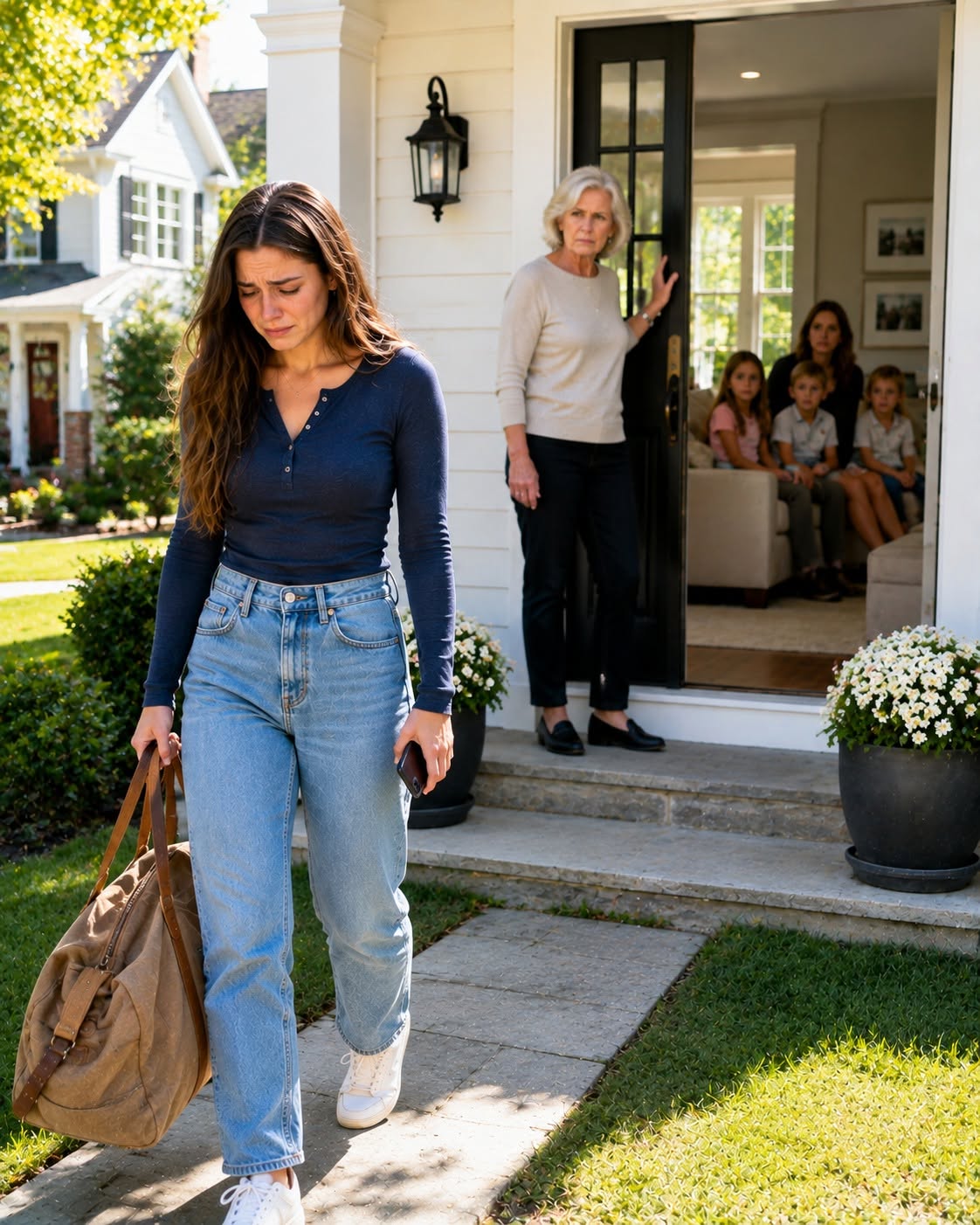
“Your daughter can stay outside. This house isn’t a shelter.”
That was what my mother told me over the phone while my sixteen-year-old daughter stood beyond her gate, her backpack drenched, her hands trembling, and the air still carrying the raw scent of shattered wood and rain after the tornado.
My name is Lauren Mitchell, and I work as an emergency physician in Tulsa, Oklahoma. That week, a tornado tore through several communities outside the city as though some invisible animal had been released across rooftops, utility poles, and highways. It didn’t destroy everything, but it ripped open enough homes to make entire neighborhoods look wounded.
The hospital was overflowing.
People arrived with deep cuts, fractures, panic attacks, and clothes coated in mud and insulation. Children were searching for their parents. Elderly patients had lost their medication. Entire families crowded the hallways carrying everything they had managed to save.
I had barely slept in three days.
My husband, David, was also a doctor and was working in another section of the hospital.
That was why we sent our daughter, Ava, to stay with my parents in Broken Arrow.
It seemed like the safest choice.
At least, that was what I believed.
I had called my mother the night before.
“Mom, it will only be for a few days. Ava can’t stay at home alone while David and I are working at the hospital.”
She answered in that dry, controlled voice she used whenever she wanted to sound reasonable.
“Well, if you have no other option, send her.”
She didn’t sound happy about it.
But she had agreed.
And I was exhausted enough to convince myself that agreement was the same thing as care.
I missed Ava’s first call.
Then I missed the second.
I noticed the third because my phone vibrated against a stainless-steel tray, and the sound cut through me like an alarm.
I stepped into the hallway, pressed my back against the wall, and answered.
“Mom?”
Her voice wasn’t frightened.
It was worse than fear.
She sounded embarrassed.
“I’m outside. They won’t let me in.”
For a moment, I thought I had misunderstood her.
“What do you mean, outside? Outside where?”
“At Grandma and Grandpa’s house. I knocked and called. I told them you sent me. Grandma opened the window and said there wasn’t enough space because Aunt Megan and the kids were already there.”
Every sound around me seemed to disappear.
“Ava, listen carefully. Don’t move. Are you standing near the street?”
“Yes. I’m beside the gate.”
“I’m calling Aunt Ruth. She lives nearby. She’ll come get you.”
“I’m sorry, Mom. I didn’t want to bother you.”
That sentence broke something inside me.
My child was standing alone outside after a natural disaster, and she was still worried that she had inconvenienced me.
I ended the call and immediately phoned my Aunt Ruth, my father’s younger sister.
She never had children of her own, but she had always shown more kindness than the rest of my family combined.
“What happened, sweetheart?”
“My mother left Ava outside.”
There was a brief silence.
Then her voice turned hard.
“Tell me exactly where she is. I’m leaving now.”
After that, I called my mother.
She answered with the calmness of someone discussing a grocery list.
“What did you do?”
“Lauren, don’t start being dramatic.”
“My daughter is outside your house.”
“There is no room for anyone else. Megan is here with the children. You know how crowded things are.”
“Megan has lived there rent-free for nearly two years.”
“She’s going through a difficult period.”
“And Ava isn’t? She is sixteen years old, standing outside during an emergency. Does that mean nothing to you?”
My mother sighed.
“Ava is old enough to wait. Besides, you and David earn more than enough money. I don’t understand why you always expect other people to solve your problems.”
I didn’t shout.
I didn’t cry.
I listened to those words the way someone listens to a lock turning on a door they will never enter again.
“You said you would take her.”
“And you told me you would help us more this month. You didn’t send the full amount, Lauren.”
That was when everything became clear.
This had never been about space.
It was punishment.
That month, I had refused to send the extra money my mother wanted for a trip to Gulf Shores with Megan and the children.
I gripped the phone.
“My daughter is not something you can use to negotiate with me.”
“Then perhaps you should learn to speak respectfully to your mother.”
I ended the call.
I returned to the emergency room with a dry face and a fire burning beneath my ribs.
Twenty minutes later, Aunt Ruth sent me a message.
“I have her. I made hot chocolate. She’s still shaking, but she is safe.”
That night, I continued stitching wounds, setting fractures, and comforting frightened strangers while one thought repeated inside my mind.
My parents had left my daughter outside to remind me who they believed held the power.
What they didn’t realize was that the moment they closed that door, they had started the worst storm of their own lives.
Ava returned home three days later.
She entered slowly, as though she wasn’t sure she had permission to make noise. She placed her wet backpack beside the door and looked at me with swollen eyes.
“Are you angry with me?”
She didn’t ask what would happen to her grandparents.
She didn’t ask whether we would ever see them again.
She wanted to know whether I blamed her.
I pulled her into my arms and held her until I felt the tension finally leave her body.
“You did nothing wrong, Ava. Nothing. They failed you. And I failed you by believing they could be trusted.”
She didn’t cry immediately.
First she swallowed.
Then a small broken sound escaped her, as though she had spent hours holding the entire world between her teeth.
David found us sitting together in the living room.
He didn’t ask questions.
He sat beside us and wrapped a blanket around all three of us.
Later, after Ava fell asleep, I opened my laptop.
David sat beside me.
“Are you certain?”
“Yes.”
The first thing I did was cancel the monthly transfer I sent my parents for their so-called household expenses.
Then I stopped paying part of their mortgage.
Because the truth was that I had been making payments on the same house where they had left my daughter outside for the last five years.
Next, I removed my parents from our medical insurance plan.
My hands didn’t shake.
I didn’t insult them.
I wasn’t acting out of revenge.
I was clearing away something rotten before it poisoned the rest of my life.
Then I logged into the university billing portal for Megan’s oldest daughter, Chloe.
I had been paying her tuition because, according to my mother, Megan had “never been given a fair chance.”
I canceled the automatic payment.
I also stopped paying my parents’ internet service, electricity, and a personal loan my father had taken out under my name because he promised it would only be for a few months.
With every payment I removed, years of mistreatment disguised as family loyalty came rushing back.
I had always been the serious daughter.
The strange one.
The child who studied medicine.
The one who supposedly didn’t need affection because I was strong.
Megan was the charming daughter.
The fragile one.
The woman who was always going through something.
If Megan broke a dish, she was overwhelmed.
If I earned perfect grades, I had merely done what was expected.
When Ava won robotics competitions, my family barely reacted.
If Megan’s children learned a song, my mother covered social media with photographs, heart emojis, and religious blessings.
For years, I had paid for my place in that family.
I paid, and they allowed me to sit at the table.
I paid, and my mother treated me kindly for a few days.
I paid, and Megan called me her wonderful little sister.
But the first month I refused to send extra money, they left my daughter outside.
Two weeks later, the panic began.
My father called first.
“Lauren, did you forget to send the mortgage payment?”
I ignored him.
Then my mother called.
“I don’t understand this childish reaction. Ava is fine, isn’t she? Ruth picked her up. What exactly is the problem?”
I didn’t answer.
Then Megan called.
“Sweetheart, Chloe’s university says there’s an issue with her tuition. It has to be a banking mistake, right?”
I ignored that call too.
By the third day, I had thirty-two unread messages.
“We’re being charged late fees.”
“Your father’s blood pressure is dangerously high.”
“Megan has been crying all day.”
“The children are innocent.”
“Family means forgiveness.”
That was when I recorded a voice message.
My voice came out completely calm.
“You knew Ava was coming. You knew David and I were working at the hospital after the tornado. You knew she was a minor. You still refused to let her inside. For years, I paid your mortgage, your utilities, your insurance, your vacations, and Megan’s lifestyle. You treated me like an ATM wearing a doctor’s coat. That is over. Do not contact me for money again. The moment Ava knocked on your door and you left her outside was the moment you stopped being my responsibility.”
I sent it to the family group chat.
My mother responded almost immediately.
“You will regret this. No daughter humiliates her mother this way.”
I said nothing.
That evening, Aunt Ruth called me.
“Sweetheart, prepare yourself. Your mother is not going to let this end quietly.”
She was right.
The next morning, my family turned my silence into a public scandal.
The post appeared on Friday.
It was shared by a cousin who had not spoken to me in years but always seemed available when someone else’s life needed judging.
The headline read:
Successful Doctor Abandons Her Elderly Parents After They Sacrificed Everything for Her
The story appeared on a local Facebook page that mixed neighborhood gossip, missing pets, restaurant complaints, and accusations no one bothered to verify.
It had been written by my mother’s friend, Mrs. Dalton, who called herself a community reporter because she owned an expensive camera, wrote badly, and desperately needed people to believe she mattered.
The main photograph showed my parents sitting on their porch.
My mother wore a knitted shawl.
My father looked down at the ground.
The entire image had been arranged to make them look helpless.
The article was poison disguised as sympathy.
It said I was a wealthy physician who had forgotten her roots.
It claimed my parents had given me an education, morals, and unconditional love.
According to the story, I had become greedy and stopped helping them, leaving them in danger of losing their home.
It didn’t mention Ava.
It didn’t mention the tornado.
It didn’t mention the closed gate.
It didn’t mention Megan living in the house with three children while paying nothing.
And it certainly didn’t mention the years of bills I had covered.
I read the article in the hospital break room.
A nurse handed me her phone with the care someone might use to pass a piece of broken glass.
“Doctor, I’m sorry. I think this is about you.”
My face became hot.
Then cold.
Then I felt nothing at all.
That kind of calm arrives when someone crosses such an obvious line that uncertainty is no longer possible.
I called David.
“They published something.”
He read it in silence.
“Do you want our lawyer involved?”
“Yes. But first, I want people to see the truth they left out.”
That afternoon, I gathered six years of records.
Bank transfers.
Mortgage statements.
Utility payments.
Internet bills.
Chloe’s tuition receipts.
Insurance documents.
Messages from my mother requesting money for repairs, medication, vacations, birthdays, gifts, and countless emergencies that somehow always included a visit to a shopping mall.
With Ava’s permission, I also saved a short audio statement from her.
Not the recording where she cried.
That moment belonged to her.
She agreed to record only this:
“My mother sent me to my grandparents’ house because she and my father were working at the hospital after the tornado. I knocked several times. My grandmother saw me through the window and told me there was no room. I stayed outside until Aunt Ruth came for me.”
Hearing her voice hurt.
But she insisted.
“I don’t want people calling you the bad person anymore, Mom.”
The next morning, I posted my response.