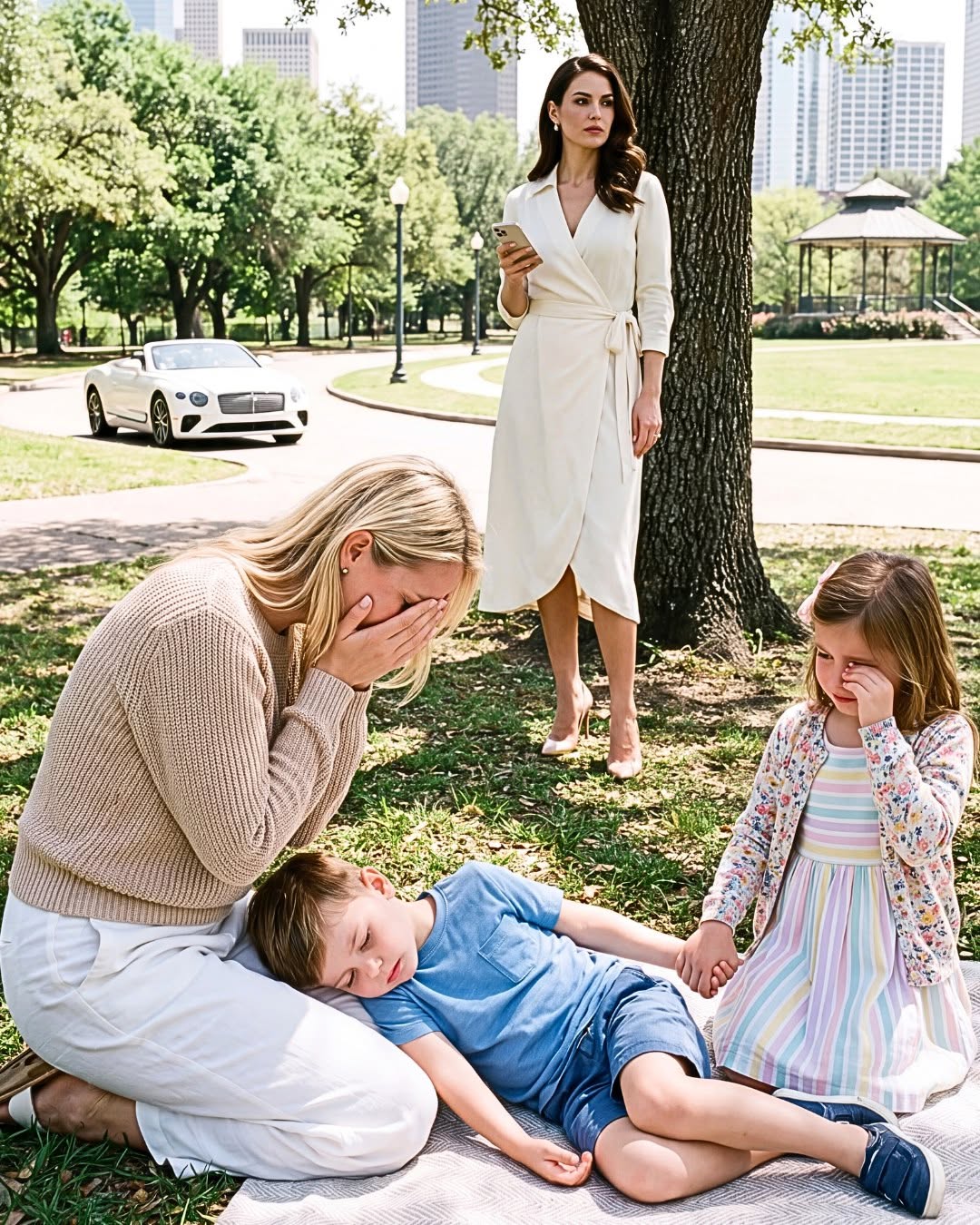
“It was only a joke. Stop making such a big deal out of it.”
That was the first thing my sister-in-law, Vanessa, said to me while my nine-year-old son lay on the grass, pale, motionless, and barely breathing.
Two hours earlier, I never would have imagined the day ending that way.
For months, Vanessa had criticized the way I raised Noah. She said he was too energetic, talked too much, that I spoiled him, and that “kids today have no discipline.”
So I was surprised when she showed up at my house in Plano, Texas, that Saturday afternoon with a smile and an unexpected offer.
“I’m taking Chloe to the park. Why doesn’t Noah come with us? Let them have some fun.”
Chloe, her eight-year-old daughter, sat in the SUV with a small purple backpack resting on her lap.
I thought maybe Vanessa was finally trying to repair our relationship.
I was wrong.
Almost two hours later, my phone rang.
The call came from Chloe’s smartwatch.
“Hello?”
At first, all I could hear was wind and ragged breathing.
“Aunt Emily…”
Chloe’s voice shook.
“Come fast. Noah won’t wake up.”
My whole body went cold.
“What happened?”
“Mom said it was just a joke to make him calm down… but now he’s not moving.”
I grabbed my keys without even properly closing the front door behind me.
“Chloe, stay beside him. Where are you?”
She gave me their location near a wooded trail in Oak Point Park.
Before hanging up, she whispered:
“Mom told me not to call you.”
I called 911 while driving.
When I arrived, I ran through the trees until I found Noah.
He was lying on his side in the grass. One sneaker was almost off his foot. Chloe was kneeling beside him, crying quietly.
Vanessa, meanwhile, stood several yards away staring at her phone.
I dropped to my knees beside my son.
“Noah… sweetheart, wake up.”
Nothing.
He was breathing.
But barely.
I touched his neck.
His pulse was weak and uneven.
I looked up at Vanessa.
“What did you give him?”
She sighed.
“Don’t start.”
“What did you give him?”
“Something to help him settle down. He was being impossible.”
“Medicine?”
“It’s not like I gave him poison.”
Chloe started crying harder.
“Mom…”
Vanessa shot her a sharp look.
“Be quiet, Chloe.”
I turned back toward my son.
“What was in it?”
“Just something to help him sleep. It’ll wear off.”
“He’s not asleep! He’s not responding!”
Vanessa rolled her eyes.
“You turn everything into a crisis. Noah is used to you rushing over every time he throws a fit.”
The paramedics arrived minutes later.
One of them immediately asked what Noah had taken.
Vanessa changed her story.
First, she said it was a “natural sleep syrup.”
Then she claimed she couldn’t remember exactly what product it had been.
When the paramedic asked for the container, she said:
“I threw it away.”
A police officer who had arrived with the ambulance stepped closer.
“Where?”
“I don’t know. Somewhere around here.”
I saw Chloe glance toward a trash can beside the trail.
She didn’t say anything.
But I saw it.
Noah was placed on a stretcher.
When the paramedics lifted one of his arms, it dropped limply before they positioned it.
That image stayed with me all the way to the hospital.
In the emergency department, they asked about allergies, medical conditions, and medications.
Noah didn’t take any sedatives.
I had never given Vanessa permission to give him medication of any kind.
Hours later, a doctor explained that Noah had a sedative in his system mixed with alcohol.
The combination had dangerously slowed his breathing.
“He’s stable,” the doctor told me. “But this was serious.”
Vanessa kept insisting that everyone was overreacting.
“He’ll wake up, and Emily is going to feel ridiculous.”
Chloe stood behind her, hugging herself.
When Vanessa stepped away to speak with an officer, I walked over.
“Aunt Emily… I’m sorry.”
“You didn’t do anything wrong.”
“I should’ve called you sooner.”
“You called when Noah needed help. You did the right thing.”
Chloe lowered her eyes.
“Mom said he was pretending.”
My stomach tightened.
“Did you see what she put in his drink?”
She nodded.
“She took a little bottle out of her purse and poured something into his fruit punch.”
“And after that?”
Chloe glanced toward her mother.
“When I called you, she wrapped the bottle in napkins and threw it away.”
I told the police immediately.
They returned to the park.
Inside the trash can Chloe had looked toward, they found a small medication bottle.
The moment Vanessa learned that police had recovered it, she changed her story again.
She said maybe Noah had taken the medicine himself.
Then she claimed the bottle belonged to me.
According to her, I had prepared the drink before they left, and she had simply panicked when Noah passed out.
I couldn’t believe what I was hearing.
My sister-in-law hadn’t just endangered my son.
Now she was trying to blame me.
A detective named Officer Grant showed me a photograph of the bottle.
“The label is damaged, but the pharmacy traced the prescription number.”
“Is it under Vanessa’s name?”
“No.”
“Then whose?”
Grant slid the photograph toward me.
Beneath a torn section of the label, a name was still visible.
CHLOE BENNETT.
I looked up.
“The medicine belonged to Chloe?”
“That’s what it appears to show.”
“What was it prescribed for?”
Grant stayed quiet for a few seconds.
“That’s the problem.”
Something inside me began fitting together.
Chloe had always been “the perfect child.”
She never interrupted.
Never argued.
At family gatherings, she would fall asleep on the couch with strange ease.
Vanessa loved bragging about how well behaved her daughter was.
Then Grant told me something worse.
“The pharmacy recorded three refills in four months.”
“Three?”
He nodded.
“But we already contacted Chloe’s pediatrician.”
He leaned toward me.
“He never prescribed that medication.”
And in that moment, I understood that what happened to Noah might not have started with Noah.
Child protection ordered that no one question Chloe informally.
A psychologist trained in forensic child interviews spoke with her while protective services staff remained nearby.
Vanessa was furious.
“You’re putting words in my daughter’s mouth!”
Nobody answered.
This time, shouting couldn’t erase the evidence.
I stayed beside Noah.
He was still unconscious.
I held his hand.
Almost an hour later, Officer Grant returned.
His expression had changed.
“Chloe says her mother used to give her something she called ‘sleepy juice.’”
I closed my eyes.
“For how long?”
“She can’t give exact dates, and nobody is going to pressure her. But she remembers it happening many times.”
Before family visits.
Before long drives.
Whenever Vanessa said she was too restless.
Chloe explained that sometimes her mother crushed something into sweet drinks.
Other times, she poured liquid from small bottles.
When Chloe complained that it made her dizzy, Vanessa told her that “good girls trust their mothers.”
Then she began warning her:
“Family problems stay inside the family.”
I remembered hearing Vanessa say that sentence countless times.
Chloe also said she had sometimes woken up on the couch without remembering how she got there.
She thought it was normal.
The pharmacy investigation uncovered something even more disturbing.
The prescriptions had been obtained through an online medical appointment using Chloe’s name, date of birth, and insurance information.
Vanessa claimed her daughter had severe sleeping problems.
Chloe had never appeared on the video consultation.
And the strength of the medication obtained was not typical for an eight-year-old.
Investigators obtained a warrant to search Vanessa’s home.
They found another bottle hidden inside a makeup bag.
A dropper.
Several packets of flavored drink mix.
But the worst discovery was in a kitchen drawer.
A regular notebook.
It contained grocery lists.
Utility payments.
School reminders.
And among them were short notes.
“Chloe, half dose before dinner.”
“Long trip, full dose.”
“Visitors coming, keep her calm.”
My hands shook when I saw the photographs.
Vanessa didn’t even seem to think she needed to hide it.
To her, sedating her daughter had simply become a way to control her behavior.
Child protective services ordered medical testing for Chloe.
The results were consistent with recent exposure to the same substance found in Noah.
That same night, Chloe was placed under temporary protection.
When Vanessa realized she wouldn’t be allowed to take her home, she began shouting in the hallway.
“She’s my daughter!”
Officer Grant stepped between them.
“That’s exactly why we’re investigating.”
Vanessa pointed at me.
“You took her away from me!”
I looked at her.
“Chloe called me because Noah wouldn’t wake up.”
“He wasn’t dying!”
A brutal silence fell around us.
Vanessa realized too late what she had just said.
The next morning, Noah opened his eyes.
“Mom…”
I nearly broke down when I heard him.
“I’m here.”
He blinked several times.
“Where’s Chloe?”
“She’s safe.”
Noah frowned.
“She told me not to drink the punch.”
My heart stopped for a second.
“Why?”
“She said it makes you sleepy.”
Later, during a formal interview, Noah remembered something else.
Vanessa had told him:
“Chloe drinks it all the time. Don’t be a baby.”
She had used her own daughter as proof that it was safe.
Then investigators found security footage from the park.
1:18 p.m.: Vanessa took something out of her purse.
1:20: she handed Noah the drink.
1:43: Noah began stumbling.
1:47: he collapsed onto the grass.
1:50: Chloe desperately pointed toward him.
Vanessa did not call for help.
1:56: Chloe used her smartwatch to call me.
Then investigators recovered deleted messages from Vanessa’s phone.
Three days before the outing, she had written to a friend:
“Emily lets that kid control every place they go. Give me one afternoon and I’ll show her what a calm child looks like.”
Her friend replied:
“What are you going to do, tie him up?”
Vanessa answered:
“Nothing that dramatic. I already know what works.”
When Grant finished reading the message, I knew everything had changed.
Vanessa had not made some impulsive mistake.
She had taken Noah to the park already knowing what she intended to do.
And Chloe had been the practice run.
Three days later, a judge reviewed Chloe’s temporary placement.
Vanessa’s defense insisted the entire incident had been “a terrible mistake by an exhausted mother.”
Her attorney argued that separating a child from her mother could cause serious emotional harm.
The child protection attorney responded:
“Chloe didn’t speak before because she didn’t know she had the right to.”
The courtroom went silent.
The judge reviewed the pharmacy records.
Medical tests.
The notebook.
The messages.
The park video.
Chloe did not have to enter the courtroom.
Her recorded forensic interview was enough.
When she was asked where she wanted to stay temporarily, her answer was simple.
“Somewhere Noah can find me.”
I was already caring for my son during his recovery, so child protective services initially hesitated to place Chloe with me too.
But after home evaluations and interviews, the judge approved temporary kinship placement.
That afternoon, Chloe arrived at my house carrying her purple backpack.
She stood just inside the doorway.
“Am I here because Mom is being punished?”
“You’re here because the adults need to make sure you’re safe.”
She lowered her head.
“Is she mad at me?”
“I don’t know.”
Her eyes filled with tears.
“I told them everything.”
“I know.”
“What if she doesn’t love me anymore?”
I crouched in front of her.
“Telling the truth does not make you responsible for what adults decide to do.”
Then she asked something I will never forget.
“Do I have to take something before I sleep?”
My chest broke.
“No.”
“What if I’m not tired?”
“You can read. You can get up and get water. You can come talk to me. You can just stay awake.”
She looked surprised.
“You’re not going to make me sleep?”
“No.”
That night, I left two glasses of water in the kitchen.
One for Noah.
One for Chloe.
Neither of them drank.
For weeks, both children distrusted any drink they hadn’t watched being poured.
Noah checked bottle caps.
Chloe watched me open juice cartons.
The smell of fruit punch made Noah leave the room.
Doctors told me he would recover physically.
Emotionally, it would take longer.
I never pushed either of them to “go back to normal.”
Normal no longer meant what it once had.
A month later, Chloe appeared in my bedroom doorway holding her smartwatch.
“Aunt Emily…”
“What happened?”
She sat beside me.
“Is Mom in trouble because I called you?”
“No.”
“But if I didn’t call, nobody would have known.”
“That still doesn’t make it your fault.”
Chloe rubbed the screen of the watch with her thumb.
“She told me not to call because you would make everything worse.”
“What did you think?”
“That maybe she was right.”
She was quiet.
“But Noah stopped talking. I shook him and he didn’t move. I told Mom to call a doctor.”
“What did she do?”
“She said I was overreacting… just like you.”
That was when I understood.
Vanessa hadn’t only trained Chloe to obey.
She had taught her that asking for help was betrayal.
“Did I do the right thing when I called you?” she asked.
“Yes.”
“Even though Mom told me not to?”
“Yes.”
“Even if she gets angry?”
“Yes.”
She remained silent for a long time.