The moment my son told me there was no room for me in his car, I realized there had probably been no room for me in his life for years.
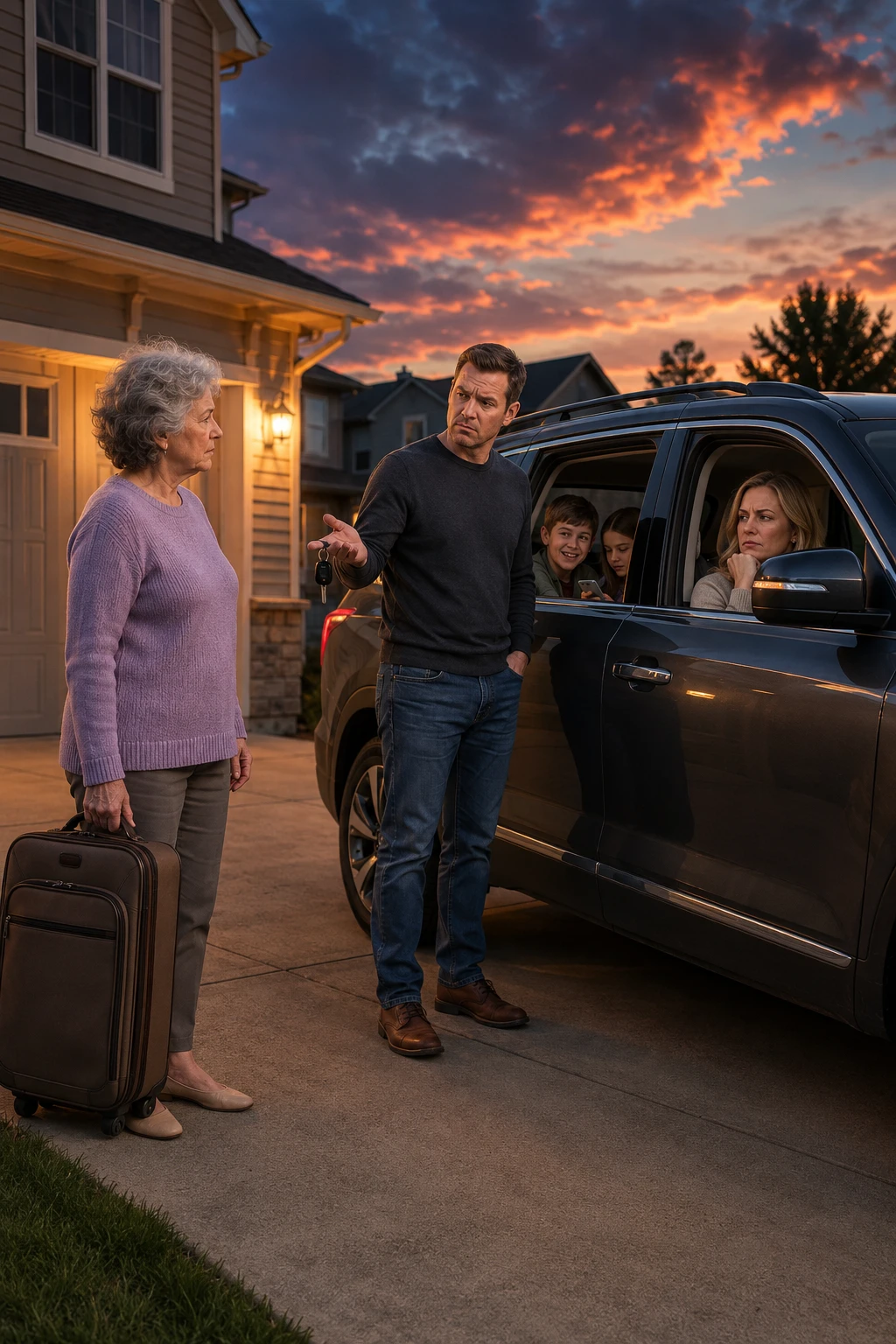
“Mom, there’s no room for you in the car. You’d better stay home and eat whatever’s in the fridge.”
Carter said it casually, twirling the keys to his black SUV around one finger.
His wife, Karla, sat in the front passenger seat wearing the cream coat I had bought her for Christmas.
My grandson Bowen leaned between the seats.
“Come on, Dad. We’re gonna lose the reservation.”
My granddaughter Monica stared down at her phone.
I stood on the driveway wearing the lavender sweater my late husband, Thomas, had given me on our final birthday together.
For one humiliating second, I wondered if Carter would laugh and say he was joking.
He didn’t.
Karla lowered the window.
“The reservation is for four, Marissa,” she said with that polished smile of hers. “And you get tired so easily.”
Bowen snickered.
“Grandma takes forever to eat anyway.”
Monica’s eyes flicked toward me.
Then immediately back to her screen.
At sixty-eight, I had learned how to hide pain behind manners.
So I smiled.
“Have a nice dinner.”
Carter climbed into the SUV.
The engine started.
No one said goodbye.
Not one of them looked back as they drove away.
I remained on the driveway until the taillights disappeared around the corner.
Then I went inside.
The house felt strangely peaceful without them.
Five years earlier, after Thomas died, Carter had begged me to leave Tucson.
“I don’t want you alone, Mom,” he had said. “Come to San Diego. We’ll take care of you.”
At the time, those words had sounded like love.
I sold the house Thomas and I had lived in for nearly forty years.
When Carter said he and Karla were struggling with their new mortgage, I gave them $200,000.
No contract.
No repayment schedule.
He was my only son.
I never imagined I would need protection from him.
At first, living with them was wonderful.
Bowen hugged me every afternoon.
Monica asked me to braid her hair.
Karla called me “Mom.”
Then, gradually, affection became obligation.
I started making breakfast.
Then lunches.
Then dinners.
Then laundry.
Then school pickups.
Then utility bills.
Then extracurricular expenses.
Eventually, Karla asked if she could use one of my credit cards “for groceries.”
I agreed.
The thank-yous vanished shortly afterward.
“You live here too, Marissa,” Karla once told me when I hesitated over paying another household expense. “It’s only fair.”
Carter had heard her.
He stared into his coffee.
That silence should have told me everything.
But mothers are experts at translating neglect into excuses.
He’s stressed.
He’s tired.
He has a family to support.
I repeated those explanations until they became a prison.
That January night, after they left me behind, I walked upstairs and pulled a suitcase from the closet.
It was already half packed.
I had been preparing to leave for several days.
I added my identification, bank statements, the deed to the small Albuquerque apartment my sister had left me, and a photograph of Thomas.
As I carried the suitcase downstairs, I noticed a stack of New Year’s cards on the dining table.
The front showed Carter, Karla, Bowen, and Monica smiling beneath a bright holiday banner.
I checked another.
Then another.
The same photograph.
I wasn’t in a single one.
The landline rang.
I almost ignored it.
Instead, I answered.
“Marissa?”
I recognized the voice immediately.
Margaret.
Thomas’s sister.
“Oh, thank goodness,” she said. “I thought you were still in the hospital.”
I froze.
“What hospital?”
Silence.
Then Margaret lowered her voice.
“Karla told me your dementia had gotten much worse. She said you barely recognize people.”
My fingers went numb around the receiver.
“I don’t have dementia.”
Another silence.
This one heavier.
“Marissa… what is happening?”
I didn’t know.
But I suddenly intended to find out.
After ending the call, I went to the kitchen cabinet where Karla kept household documents.
I had never searched through it before.
That night, I did.
Inside was a folder labeled with my name.
I opened it.
A geriatric assessment.
A draft application for admission to a private care facility.
Copies of my financial information.
And one handwritten note in Carter’s unmistakable handwriting:
“After Mom is admitted, look for the deeds, accounts, and documents for the Albuquerque apartment.”
Underneath it was a second note.
Karla’s handwriting.
“Once we sell the apartment, we’ll have enough for the down payment on the new place.”
I sat down slowly.
Every cold remark.
Every conversation that stopped when I entered the room.
Every question about my bank accounts.
Every comment about my memory.
They weren’t taking care of me.
They were building a case against me.
My phone vibrated.
A family-calendar notification appeared.
9:00 A.M. — Transfer Mom to care facility. Check her room before leaving.
Created by Carter.
I stared at those words.
My son had scheduled my disappearance like a dentist appointment.
Something inside me became very still.
I didn’t call him.
I didn’t cry.
I grabbed my coat, suitcase, and documents.
Then I left.
By the time Carter and Karla were ordering dessert, I was sitting on a train headed east.
Before boarding, I called the bank and canceled the credit card Karla had been using.
A petty move, perhaps.
But I smiled imagining the moment their expensive steakhouse bill was declined.
That smile disappeared when I began reviewing my accounts.
Something about the $200,000 transfer bothered me.
Carter had always claimed the money went toward the mortgage.
So I searched old statements.
I found the original transfer.
Then subsequent transfers.
Only $40,000 had ever gone to the mortgage company.
The remaining $160,000 had been moved into other accounts.
One name appeared several times.
Karla Jensen Holdings LLC.
I had never heard of it.
My heart pounded.
I called my bank’s fraud department.
After nearly twenty minutes of verification, a representative named Denise came back on the line.
“Mrs. Hayes, there’s something else I should mention.”
“What?”
“There was an attempted authorized-user change on one of your investment accounts three weeks ago.”
“By whom?”
A pause.
“The request named Carter Hayes.”
My son.
I pressed my forehead against the train window.
Outside, darkness swallowed the landscape.
Then my phone started ringing.
Carter.
I declined it.
Again.
Declined.
Karla.
Declined.
Then a message.
Mom, where are you? We need to talk before you make a terrible mistake.
I almost laughed.
Then another message appeared from an unknown number.
No text.
Only a photograph.
I opened it.
My breath stopped.
Standing beside Carter in the photograph was a man I had not seen in twenty-seven years.
A man Carter believed was dead.
A man almost everyone believed was dead.
My brother.
Daniel.
I stared so long that the image blurred.
Daniel had vanished in 1999.
His car was found near a canyon outside Flagstaff.
Blood on the driver’s seat.
His wallet inside.
No body.
After years with no trace, he had been declared legally dead.
Thomas had helped me survive that grief.
And now Daniel was standing in a recent photograph next to my son.
I typed with shaking fingers.
Who are you?
The reply came immediately.
You already know. Don’t call Carter. Get off in Albuquerque. I’ll explain everything.
I didn’t sleep that night.
At sunrise, I arrived in Albuquerque.
My apartment had been empty for months, but I kept utilities running.
I took a taxi there.
The moment I stepped inside, the smell of dust and old wood made me think of my sister.
I locked the door.
Then someone knocked.
Three slow knocks.
I looked through the peephole.
Daniel.
Older.
Thinner.
Gray-haired.
But unmistakably Daniel.
I opened the door only a few inches.
“You have five seconds.”
His eyes filled.
“Rissa.”
No one had called me that since our mother died.
My knees weakened.
“Prove it.”
He swallowed.
“When you were nine, you broke Mom’s blue vase and blamed the cat. I helped you bury the pieces behind the shed.”
My hand flew to my mouth.
He continued.
“Thomas proposed to you twice because the first time you thought he was joking.”
I opened the door.
Then slapped him.
Hard.
He accepted it.
“You let me think you were dead.”
“I know.”
“For twenty-seven years.”
“I know.”
“You let me bury an empty coffin!”
“I know.”
I hit him again.
Then I collapsed into his arms.
For several minutes, I cried like a child.
When I finally pulled away, anger returned.
“What does Carter have to do with this?”
Daniel’s face changed.
“That’s why I came.”
He sat across from me at the small kitchen table.
Then he told me a story so unbelievable I nearly ordered him out.
In 1999, Daniel had become involved with a group of businessmen running investment scams across Arizona and Nevada.
He had discovered they were laundering money through shell companies.
When he threatened to expose them, someone tried to kill him.
The blood in his car had been his.
He survived.
A federal investigator persuaded him to disappear while the case was being built.
The investigation collapsed after a witness was murdered.
Daniel stayed gone because he believed returning would put us in danger.
“Then why come back now?”
“Because three months ago, I saw a company name I recognized.”
He slid a folder across the table.
Jensen Holdings.
I looked up sharply.
“Karla?”
“Her mother’s maiden name was Jensen.”
Daniel nodded.
“The company isn’t really hers. It’s part of a network descended from the same operation I ran from.”
My stomach twisted.
“You’re saying Karla is laundering money?”
“I’m saying someone has been using her company to move money, and your $160,000 went through it.”
I thought of Carter.
“Does he know?”
Daniel looked away.
“Yes.”
That hurt more than I expected.
I stood and walked to the window.
“So my son stole from me.”
“There’s more.”
I turned.
Daniel’s face had gone pale.
“The money wasn’t the reason they wanted control of your Albuquerque apartment.”
“What was?”
He hesitated.
“Something Thomas hid there.”
I stared at him.
“Thomas?”
Daniel nodded.
“Your husband knew I was alive.”
The room seemed to tilt.
“No.”
“Marissa—”
“No.”
“He knew.”
I backed away.
“You’re lying.”
“Thomas was the only person in the family I contacted.”
I could barely breathe.
“My husband let me mourn you for twenty-seven years?”
“He believed it was safer.”
“Safer for whom?”
“For you.”
I laughed bitterly.
“You men have always had extraordinary definitions of protection.”
Daniel accepted that quietly.
Then he said, “Before Thomas died, he told me he had kept evidence from the original case. He said if anything happened to him, it would eventually belong to you.”
I remembered Thomas’s final months.
His repeated insistence that I never sell my sister’s apartment.
I had assumed sentimentality.
“Where?”
“I don’t know exactly.”
We searched.
Kitchen cabinets.
Closets.
Floorboards.
Old furniture.
Nothing.
By evening, I was exhausted.
Then I noticed the framed photograph of Thomas I had carried from San Diego.
Something about it bothered me.
The frame was unusually thick.
Thomas had bought it himself shortly before his death.
I turned it over.
The backing had been glued.
Daniel helped me pry it loose.
Inside was a tiny brass key.
And a handwritten message.
M, if you ever need this, trust the place where your sister kept what mattered most. — T
My sister had kept jewelry in an old sewing cabinet.
We opened it.
At the bottom was a locked compartment.
The brass key fit.
Inside was a flash drive.
And a sealed envelope.
My name was written across the front.
I opened it.
Thomas’s handwriting filled three pages.
The first sentence destroyed me.
Marissa, if you are reading this, then Carter has probably learned the truth.
I sank into a chair.
Daniel stood behind me.
I kept reading.
Thomas explained that years earlier, he had discovered Daniel was alive.
He had also discovered something else.
Something about Carter.
I looked at Daniel.
“No.”
His eyes filled.
“Keep reading.”
My hands trembled.
Thomas wrote that when Carter was a teenager, he had secretly done genetic testing after a school biology project raised questions about blood types.
Thomas had discovered that Carter was not biologically his son.
I covered my mouth.
That was impossible.
I had never been unfaithful.
Never.
Then the next paragraph made my entire past crack open.
Thomas wrote:
You never betrayed me. The hospital did.
Carter had been born during a chaotic night at a small Tucson hospital.
Two babies had been delivered minutes apart.
According to records Thomas later uncovered, identification bands had been mixed up during an emergency evacuation caused by an electrical fire.
I stared at the page.
Daniel whispered, “Marissa…”
I shook my head.
“No.”
Thomas had secretly investigated.
He learned there had been another family.
Another baby boy.
And decades later, DNA had confirmed the truth.
Carter was not our biological child.
My biological son had gone home with another family.
I could barely process the words.
“Who?” I whispered.
Daniel pointed toward the flash drive.
On it were scanned records.
Birth certificates.
Hospital files.
DNA results.
Photographs.
And one name.
Evan Mercer.
I searched the folder.
A photograph opened.
A man in his early fifties stared back at me.
He had Thomas’s eyes.
My mother’s smile.
My hands began to shake uncontrollably.
“No…”
Daniel touched my shoulder.
“Thomas found him.”
“Did Evan know?”
“Eventually.”
My chest tightened.
“Where is he?”
Daniel didn’t answer.
“Where is my son?”
Then someone knocked on the apartment door.
I froze.
Daniel looked at me.
Another knock.
I approached carefully.
A man stood outside.
The man from the photograph.
Evan.
When I opened the door, neither of us spoke.
He stared at me.
I stared at him.
Then his eyes dropped to my lavender sweater.
His face crumpled.
“My father gave you that.”
I stopped breathing.
Thomas had met him.
Evan’s voice broke.
“He told me you wore lavender when you were nervous.”
I reached toward his face before I could stop myself.
He leaned into my hand.
And for the first time in fifty-one years, I touched the son I had given birth to.
We both cried.
But the reunion lasted less than ten minutes.
Because headlights swept across the window.
Daniel looked outside.
A black SUV had pulled up.
Carter and Karla stepped out.
Carter began pounding on the door.
“Mom!”
Evan stiffened.
I wiped my tears.
For the first time, I wasn’t afraid of Carter.
I opened the door.
He stormed inside.
“What the hell are you doing?”
Then he saw Daniel.
His face drained.
“You.”
Daniel stood.
Karla entered behind him.
The moment she saw the flash drive on the table, panic flashed across her face.
That expression told me everything.
“You knew,” I said.
Carter looked at me.
“Mom—”
“You knew about Evan.”
He said nothing.
“You knew Thomas wasn’t your biological father.”
Still nothing.
“And you knew what was hidden here.”
Karla stepped forward.
“Marissa, this can all be explained.”
I laughed.
“You were going to have me declared mentally incompetent.”
“That wasn’t—”
“You told people I had dementia.”
Karla’s mouth closed.
Carter finally spoke.
“We were protecting the family.”
“From what?”
He looked at Evan.
“From him.”
Evan’s jaw tightened.
Carter continued.
“Dad was going to change everything.”
“What do you mean?”
“Before he died, he told me he wanted Evan included in the estate.”
I stared.
Thomas had left me nearly everything.
Carter had received a separate inheritance.
Carter shook his head angrily.
“He was going to tell everyone I wasn’t his real son.”
“He raised you,” I said. “That made you his son.”
“You don’t understand.”
“No, Carter. I understand perfectly.”
His face twisted.
“I spent my whole life being his son, and suddenly some stranger appears and gets half of everything?”
Evan stepped forward.
“I never asked for anything.”
Carter laughed bitterly.
“Sure.”
Then Daniel spoke.
“This was never about inheritance.”
Everyone looked at him.
He picked up the flash drive.
“The financial records on this contain evidence of fraud involving Jensen Holdings.”
Karla went white.
Carter turned to her.
“What is he talking about?”
For the first time, Karla looked genuinely terrified.
And I understood something shocking.
Carter didn’t know everything.
“Karla?” he said.
She backed toward the door.
Daniel continued.
“Your wife moved Marissa’s money through shell companies. But she wasn’t doing it for you.”
Carter stared at her.
“Karla?”
She ran.
Evan moved quickly and blocked the doorway.
“Move!”
“No.”
She reached into her purse.
Daniel shouted, “Don’t!”
For one terrifying second, I thought she had a gun.
Instead, she pulled out her phone.
But before she could unlock it, sirens sounded outside.
Red and blue lights flooded the windows.
Karla went rigid.
Carter looked at me.
“You called the police?”
I shook my head.
Daniel smiled without humor.
“No.”
The apartment door opened behind two federal agents.
One of them held up identification.
“Karla Hayes?”
Karla sank into a chair.
Everything happened quickly after that.
Agents entered.
Phones were seized.
Documents collected.
Carter was questioned.
Karla was taken away in handcuffs.
I thought the story was finally over.
I was wrong.
The next morning, an investigator sat across from me.
“Karla Hayes has been under investigation for eight months,” he explained. “Your brother has been assisting us.”
I looked at Daniel.
“You came back because of the investigation?”
“Yes.”
The agent continued.
“But there’s something you need to understand about your son.”
I braced myself.
“Carter did attempt to access your accounts. He participated in the plan to place you in a care facility.”
Pain pierced me.
Nothing could erase that.
“But,” the agent said, “he did not know Karla had taken most of your $160,000.”
I frowned.
“Then where did he think it went?”
“He believed it had been invested for you.”
I almost laughed.
“That doesn’t excuse what he did.”
“No. It doesn’t.”
The agent slid another document toward me.
“But this may explain why he suddenly became desperate to control the Albuquerque property.”
It was a medical report.
Carter’s name was at the top.
Diagnosis:
Stage III pancreatic cancer.
I stared at it.
The room disappeared around me.
“No.”
Carter had known for four months.
Karla had convinced him that expensive experimental treatment overseas might save him.
They needed money.
She told him my Albuquerque property and investments would cover it.
He agreed to the guardianship plan.
Not because he wanted a new house.
Not entirely.
Karla had written that note knowing I might find it.
She had manipulated everyone.
But Carter had still made his choice.
He had still agreed to erase me.
That afternoon, I visited him.
He sat alone in an interview room.
He looked smaller somehow.
For the first time, not like my son.
Like a frightened boy.
“You know,” he said.
“Yes.”
Tears filled his eyes.
“I was going to tell you.”
“When? After they locked me in a facility?”
He looked down.
“I was scared.”
“So you sacrificed me.”
He began crying.
“I thought if I could get the treatment, I’d fix everything afterward.”
I stared at him.
“That is what people tell themselves before doing unforgivable things.”
He whispered, “Are you going to abandon me?”
The irony was so brutal I almost laughed.
Instead, I said, “No.”
His head lifted.
“But I’m not saving you from the consequences either.”
I arranged for an attorney.
I paid for a legitimate medical consultation.
I did not give him control of another dollar.
Over the following months, Karla pleaded guilty to several financial crimes.
Most of my stolen money was recovered.
Carter was charged with attempted financial exploitation and fraud-related offenses, but his cooperation and medical condition affected the outcome.
He received supervised probation and restitution requirements.
Then something unexpected happened.
Evan stayed.
Not for money.
Not for inheritance.
For me.
He called every morning.
He fixed the broken kitchen faucet.
He brought photographs of his childhood.
I showed him photographs of Thomas.
We grieved the years stolen from us.
Monica began visiting secretly.
One afternoon, she burst into tears.
“Grandma, I’m sorry I didn’t say anything that night.”
I held her.
“You were a child caught between adults.”
Bowen took longer.
But eventually, he came too.
Carter began treatment.
Some days, I visited.
Some days, I didn’t.
Forgiveness, I learned, did not mean pretending nothing happened.
It meant refusing to let bitterness own whatever remained of my life.
Six months later, Daniel called me.
“Rissa, you need to come to the apartment.”
His tone was strange.
I drove there.
Evan was waiting.
So was Margaret.
On the table sat a sealed envelope I had never seen.
“What is this?”
Daniel smiled.
“The final thing Thomas left.”
I opened it.
Inside was one handwritten page.
And a legal document.
I read the page first.
Marissa, there is one truth I never had the courage to tell you while I was alive.
I held my breath.
Carter is not the child the hospital accidentally gave us.
I stopped.
Evan frowned.
“What?”
I read on.
Thomas had investigated the hospital records years earlier.
There had indeed been a baby mix-up.
But not the one we believed.
Evan was not my biological son either.
My head spun.
I looked at Daniel.
He said nothing.
The letter continued.
Thomas had ordered additional DNA testing shortly before his death.
The results proved that Evan was biologically related to me.
But the paternal match was not Thomas.
My hand began trembling.
There was only one person in the room who suddenly refused to meet my eyes.
Daniel.
I looked at him.
“No.”
His face collapsed.
“Marissa…”
I stepped backward.
“No.”
Then the memory came.
A summer party fifty-two years earlier.
I had been nineteen.
I had drunk too much.
There had been confusion.
Fragments.
A room.
Someone I trusted.
I had spent decades believing nothing significant had happened that night.
Daniel looked sick.
“I didn’t know,” he whispered.
The room went silent.
I realized what Thomas had discovered.
Evan was my biological son.
But his father was not Thomas.
His father was Daniel’s identical twin brother, David.
David.
The brother who had died in a motorcycle accident two weeks after that summer party.
The brother whose face Daniel had shared.
I stared at Daniel, horrified.
He understood immediately.
“It wasn’t me,” he said. “It was David.”
I remembered David bringing me water that night.
Sitting beside me when I felt dizzy.
The memory fractured open.
I felt ill.
Thomas’s letter explained that DNA between identical twins had initially made the results impossible to distinguish.
But preserved medical samples and later sequencing clarified what had happened.
David had assaulted me while I was impaired.
I had blocked much of the memory.
Thomas discovered the truth decades later.
He never told me because he feared destroying me.
I sank into a chair.
Evan knelt beside me.
Neither of us spoke.
Then I unfolded the legal document.
Thomas had established a private trust.
Not for Carter.
Not for Evan.
For me.
Every remaining asset he had hidden from the original fraud network had been recovered and placed into it.
The amount listed at the bottom made me gasp.
$4.8 million.
But that wasn’t the shocking part.
The trustee’s name was.
Carter Hayes.
I stared at the paper.
“No.”
Daniel nodded slowly.
“Thomas named Carter years ago.”
“Why?”
Then I saw a handwritten note beneath the signature.
Because blood never made him my son. Choice did. And one day, he may need to decide whether he deserves that choice.
Carter had known about the trust.
That was what he had truly been searching for.
Not my apartment.
Not merely my savings.
The trust.
But there was one condition.
If Carter ever attempted to have me declared incompetent for financial gain, his trustee status would terminate immediately and every dollar would pass irrevocably to me.
Thomas had anticipated the possibility.
He had protected me from beyond the grave.
And Carter?
By trying to steal what he thought was mine, he had unknowingly handed me everything.
I sat in silence for a long time.
Then I laughed.
Not because anything was funny.
Because Thomas had always been three moves ahead of everyone.
Months later, I sold the San Diego house interest Carter had tried to claim through me.
I kept the Albuquerque apartment.
I created a scholarship for older women rebuilding their lives after financial abuse.
I paid for Carter’s treatment—but directly to the hospital, never into his hands.
I helped Evan open the woodworking shop he had dreamed about for years.
And one evening, almost exactly a year after that terrible January dinner, I invited everyone who still belonged in my life to a steakhouse.
Evan came.
Monica came.
Bowen came.
Margaret came.
Daniel came.
And Carter arrived slowly, thinner from treatment, leaning on a cane.
At the entrance, the hostess smiled.
“Reservation name?”
“Hayes,” I said.
“How many?”
I looked at the people around me.
Then at Carter.
He lowered his eyes.
“I’m sorry, Mom.”
I knew what he was remembering.
The driveway.
The SUV.
The words that had started everything.
There’s no room for you.
I reached for his hand.
“There’s room,” I said.
His eyes filled.
“But understand something.”
He looked at me.
“A seat at my table is not the same thing as ownership of my life.”
He nodded.
“I know.”
We went inside.
For decades, I believed family meant the people whose names appeared beside yours on birth certificates, bank accounts, holiday cards, and wills.
I had been wrong.
Family was Thomas loving a child who wasn’t biologically his.
Family was Evan finding me after fifty-one stolen years and asking for nothing.
Family was Monica choosing courage after years of silence.
Family was even Carter, in the complicated, painful way love sometimes survives betrayal without excusing it.
And family was me.
The woman everyone had treated like furniture.
The woman they thought could be quietly removed.
The woman they believed would never question a missing $200,000, a false diagnosis, or a locked drawer.
I had spent years believing getting older meant becoming less important.
Instead, I learned something far more powerful.
Sometimes the moment people decide you are easiest to erase is the moment you finally discover exactly how much of yourself is still left.
And on January 10, when my son drove away because there was “no room” for me in his car, he thought he was leaving an old woman behind.
He had no idea that I was the one about to leave his version of me behind forever.