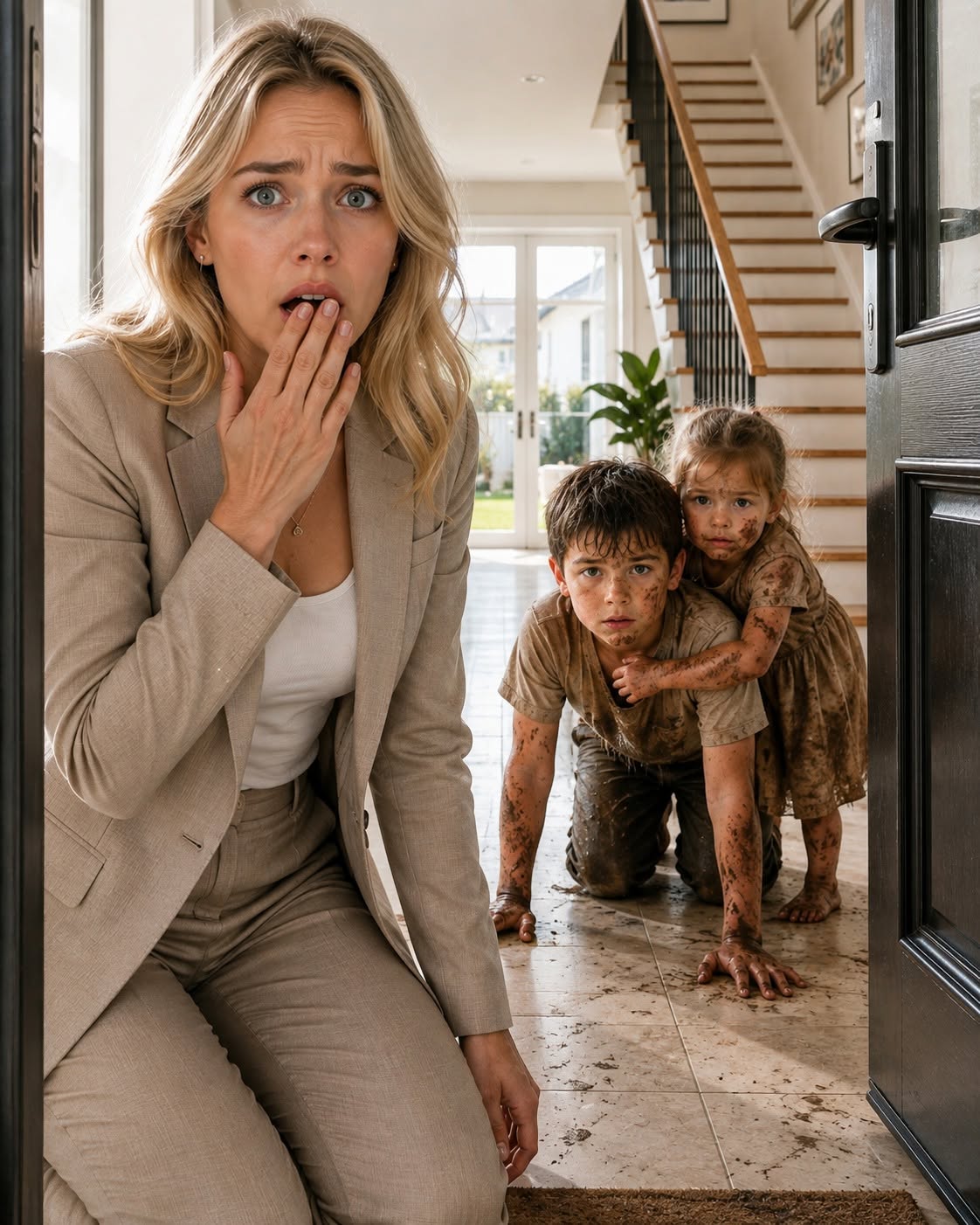
My 6-year-old nephew dragged himself to my house with a broken leg, while my 3-year-old niece followed behind, clutching the back of his shirt because she was terrified of being left alone.
I was repairing a loose hinge on the front gate of my house in a quiet neighborhood in Austin when I heard an odd scraping noise coming from the sidewalk. It wasn’t a dog. It wasn’t trash blowing across the pavement. It was a rough, desperate sound, like someone scraping their hands against concrete.
The moment I stepped outside, the screwdriver slipped from my fingers.
Noah, the oldest son of my late brother, Daniel, was pulling himself toward my driveway.
His face had turned almost gray. His hair was soaked with sweat, and one leg dragged uselessly behind him. Every time he moved forward, his arms trembled like they were about to give out.
A few feet behind him was Emma, his 3-year-old little sister.
She was barefoot and unsteady, her clothes filthy, both tiny hands gripping Noah’s T-shirt as she followed him.
They lived seven blocks away.
Neither child should have been outside alone.
I ran toward them.
“Noah, what happened?”
He lifted his head.
His eyes were glazed with pain.
“She locked us downstairs again,” he whispered.
Again.
That word hit me harder than anything else.
He didn’t say it had happened accidentally.
He didn’t say it had happened only that morning.
He said again.
“I had to get Em out,” he murmured. “She was hungry.”
I picked Emma up first.
She felt frighteningly light in my arms.
Then I carefully lifted Noah, doing everything I could not to move his injured leg.
He clenched his teeth.
But he didn’t scream.
That frightened me even more.
I carried both children inside and settled them in the living room.
Emma spotted a package of cookies on the coffee table and grabbed it immediately. She began stuffing them into her mouth so quickly that I moved closer, afraid she might choke.
Noah could barely breathe through the pain, but he still reached over and rested one hand against her back.
“Slow down, Em. Slow down.”
He was 6 years old.
Yet he was caring for his 3-year-old sister as though keeping her alive had somehow become his responsibility.
I pulled my phone from my pocket.
“I’m calling for help.”
Noah’s eyes widened.
“Karen is going to be mad.”
I crouched down in front of him.
“Karen is never going to touch you again.”
I called 911.
I told the dispatcher that my niece and nephew had arrived at my house alone, that Noah appeared to have a serious leg injury, that Emma looked weak and severely hungry, and that Noah had just told me their stepmother had locked them downstairs.
While we waited for the ambulance, my thoughts went back three years.
My brother Daniel died from a heart attack at 35.
It had been sudden.
Brutal.
Impossible to understand.
Noah was only 3 at the time, and Emma had barely started walking.
Karen, Daniel’s wife, cried beside his coffin and promised that all she wanted was to give the children stability.
I believed her.
For months afterward, I called regularly.
I brought groceries.
I bought birthday presents.
I offered to fix things around the house.
At first, Karen told me the children were asleep.
Later, she said they were sick.
Then she began saying Noah didn’t want visitors.
One day, she said the sentence that finally made me stop pushing.
“You remind them too much of their father.”
It hurt.
But I respected what she said.
I told myself that forcing my way into their lives might make their grief worse.
So I left gifts outside the door.
I sent messages.
I offered to pick them up for ice cream.
But whenever Karen said no, I accepted it.
Now I looked at Noah lying on my couch, protecting a package of cookies for Emma, and every excuse Karen had given me over the last three years suddenly sounded completely different.
The ambulance arrived within minutes.
Two police officers arrived shortly afterward.
Paramedics stabilized Noah’s leg, examined Emma, and began asking me questions.
I gave them Karen’s address.
The same house where I had been told over and over that the children were sleeping.
I followed the ambulance to the hospital.
Noah was taken for X-rays.
Emma was placed on an IV.
I paced the waiting room while guilt tore through me.
I thought about every birthday when I hadn’t been allowed to hug them.
Every Christmas when I had left bags of presents at the front door.
Every message from Karen saying:
“Not today. They’re having a hard time.”
I thought I had been respecting their grief.
Maybe all I had really been respecting was a lie.
When the doctor finally came out carrying Noah’s chart, I immediately stood.
I expected him to say Noah had injured himself escaping.
Maybe he had fallen climbing through a window.
Maybe he had hurt his leg somewhere along the street.
But the doctor’s expression made my stomach drop.
“The fracture didn’t happen today.”
For a second, I couldn’t process what he had said.
“What do you mean it didn’t happen today?”
“The bone is already showing early signs of healing. This injury happened several days ago.”
The hallway seemed to tilt beneath my feet.
Noah had not broken his leg while escaping.
He had escaped with an already broken leg.
And somehow, he had dragged himself seven blocks because Emma was hungry.
That was when I realized the question was no longer what Karen had done that morning.
The real question was how long my nephew had been trapped downstairs, injured, waiting for someone to notice that he had disappeared.
The doctor lowered his voice while explaining Noah’s condition.
His leg had been broken for several days and had never been properly treated.
There was no cast.
No splint.
No medical record showing that anyone had taken him for treatment.
Emma was dehydrated as well and showed signs that she had not been eating regularly.
A social worker arrived with one of the police officers.
They told me the children would not be returned to Karen while the investigation continued.
I nodded.
But inside, I wanted to go straight to that house and tear the basement door from its hinges myself.
“Have you spoken to her yet?” I asked.
The officer slowly exhaled.
“Yes. At first she said she had gone to the pharmacy and the children were sleeping. After she learned they were here, she changed her story. She said Noah ran away from the downstairs room after being punished for misbehaving.”
“Was the room locked?”
“From the outside.”
My blood turned cold.
Police had found a basement door secured with a bolt placed so high that no child could reach it.
Inside were two thin mattresses.
Old blankets.
Children’s clothing.
Empty bottles.
Food wrappers.
There was no bathroom.
No refrigerator.
A small basement window had been forced open from the inside.
“That’s how they escaped,” the officer said. “We found dirt and pieces of fabric caught around the frame.”
I imagined Noah with his broken leg lifting Emma through the opening first.
Then somehow pulling himself through.
Falling onto the ground.
And beginning to crawl.
Not toward the police.
Not toward the nearest neighbor.
Toward my house.
When I was finally allowed into Noah’s room, he was lying in bed with his leg stabilized.
The first thing he asked me was:
“Did Em eat?”
“Yes.”
“A lot?”
“Yes, buddy. She ate plenty.”
Only then did he close his eyes.
A little while later, Emma was brought into his room.
She climbed onto a chair and took his hand.
Noah looked at her like an exhausted parent.
“What did you eat?”
“Chicken,” she answered. “And apple. And Jell-O.”
Noah finally exhaled.
The social worker had been watching quietly.
Then she gently asked Emma whether she liked the food at the hospital.
Emma nodded.
“There’s food upstairs here.”
The social worker asked:
“What about downstairs?”
Emma stared at the floor.
“There isn’t food downstairs.”
Noah immediately stiffened.
“Em, don’t talk.”
He wasn’t angry with her.
He was afraid.
The social worker moved closer.
“You’re not going to get in trouble for telling us anything here.”
Noah grabbed the blanket.
“She always knows.”
“Karen isn’t here.”
“She always knows.”
For the first time since I had found him crawling toward my house, Noah no longer looked like the brave little boy who had rescued his sister.
He looked exactly like what he was.
Six years old.
Tiny.
Exhausted.
Terrified.
Then Emma said something that silenced the entire room.
“When we ask for dinner, Karen turns the light off.”
The social worker kept her voice calm.
“What light?”
“The downstairs light.”
“When does she turn it back on?”
Emma shrugged.
“When we’re good.”
I had to leave the room because suddenly I couldn’t breathe.
Then my phone rang.
Karen.
I answered with the police officer standing beside me and put the call on speaker.
“Michael, thank God. The police are treating me like I’m some kind of criminal.”
I didn’t answer.
“Noah had an accident.”
“When?”
“Today.”
I looked at the officer.
“The doctor says his leg has been broken for several days.”
Silence.
Then Karen’s voice changed.
“You don’t know Noah. He lies constantly. Ever since Daniel died, he’s been impossible.”
“He’s 6 years old.”
“He manipulates people. He knows exactly how to make people feel sorry for him.”
I looked through the glass into the hospital room.
Noah was breaking a piece of bread in half and giving Emma the larger portion.
“No,” I said. “The truth is, you haven’t allowed me to know him for three years. And now I understand why.”
Karen’s voice became sharp.
“I protected those kids.”
“You locked them in a basement.”
“It wasn’t a basement. It was a playroom. The lock was only there so Noah wouldn’t wander through the house at night.”
She could make anything sound normal.
The bolt became safety.
The mattresses became a playroom.
The wrappers became proof that they had eaten.
The broken leg became an accident.
And the children became liars.
I ended the call when Karen started accusing me of trying to steal “her children.”
That afternoon, investigators checked Noah’s school records.
He had been absent for weeks.
Karen had repeatedly reported him sick but never provided medical documentation.
Emma had stopped attending daycare months earlier because Karen told staff she preferred caring for her at home.
The children had been slowly disappearing.
From school.
From daycare.
From their family.
From every place where another adult might have noticed what was happening.
The next morning, investigators searched Karen’s house with a warrant.
What they discovered inside the hallway closet broke me all over again.
Boxes.
Birthday presents.
Clothes.
Books.
Toy cars.
A stuffed rabbit with Emma’s name written on it.
Every gift I had left for them over the last three years.
Still unopened.
Karen hadn’t merely prevented me from seeing them.
She had also hidden every piece of evidence showing that I had never stopped trying.
When Noah saw a photograph of the boxes, he looked confused.
“Uncle Michael really sent me presents?”
The social worker told me what he had asked.
I sat down on a bench in the hallway and covered my face.
For three years, I had believed I was patiently waiting for the right moment to reconnect.
For three years, Noah had believed I had forgotten him.
And just when I thought there was nothing left that could hurt worse, the officer returned with another statement.
“Noah told us how his leg was injured.”
I stood immediately.
“He says he tried to stop Karen from taking Emma downstairs alone.”
The officer paused.
“According to Noah, Karen knew he couldn’t walk properly afterward. Several days later, she locked the door again anyway.”
That was when everything became painfully clear.
Noah hadn’t escaped because he thought he was brave.
He escaped because Emma was hungry.
And even though Karen had convinced him that I no longer cared about him, some part of him still remembered my address.
The possibility that Noah and Emma might be allowed to live with me changed everything.
Until that moment, I had only been reacting.
Reacting to seeing them crawl into my driveway.
Reacting to the doctor’s diagnosis.
Reacting to the basement lock.
Reacting to the hidden presents.
But when the social worker told me my house could be evaluated as a temporary placement, it felt like someone had finally opened an actual door in the middle of all that darkness.
I agreed to everything.
Background checks.
Home inspections.
Interviews.
Paperwork.
More paperwork.
I removed tools from the yard, installed childproof cabinet locks, added a safety gate near the stairs, and prepared two bedrooms.
One for Noah.
One for Emma.
When I told Noah, he didn’t ask whether there would be toys.
He didn’t ask about television.
His first question was:
“Where will Em sleep?”
“In the bedroom across from yours.”
“Can her door stay open?”
“Yes.”
“Can mine stay open too?”
“Yes.”
Only then did he seem able to breathe normally.
That was when I realized that to Noah, a closed door didn’t mean privacy.
It didn’t mean bedtime.
It meant danger.
The children were discharged two days later.
Noah left with his leg immobilized and a small pair of crutches.
Emma carried a backpack filled with clean clothes and a soft cloth doll a nurse had given her.
Before leaving, Noah slipped two granola bars into his backpack.
“Can I keep these?”
“Of course.”
“For later?”
“For whenever you want.”
I didn’t tell him that he would never have to hide food because he was afraid of being hungry again.
Not yet.
Sometimes children don’t heal because adults make beautiful promises.
They heal because they wake up morning after morning and discover the promise is still being kept.
That first night, I cooked far too much food.
Chicken.
Rice.
Vegetables.
Fruit.
Bread.
Soup.
I set the table as though somehow one enormous dinner could repair three years of damage.
Emma reached toward the basket for another roll.
Noah stopped her.
“Only one.”
“She can have another,” I said.
Noah looked at the basket.
“What about tomorrow?”
“I’ll buy more tomorrow.”
“What if it’s all gone?”
“Then I’ll buy more again.”
He stared at me cautiously, almost as though he was trying to remember whether adults could still be trusted to tell the truth.
After dinner, I opened the pantry.
“If you’re hungry, you tell me.”
He nodded.
“If I’m asleep, wake me up.”
Another nod.
“You don’t need to save food for Emma anymore.”
Noah looked toward his sister.
“Then who will?”
“I will.”
He swallowed.
“All the time?”
“All the time.”
At 2:00 that morning, I heard movement in the hallway.
I found Noah standing on his crutches outside Emma’s bedroom.
“What are you doing?”
“Checking.”
“Checking what?”
“That she’s still there.”
I looked inside.
Emma was asleep with one hand resting over her doll.
“She’s right there.”
“Are you mad?”
“No.”
“Karen got mad if we got up.”
I crouched beside him.
“You can get out of bed here whenever you need something.”
“Even during the night?”
“Especially during the night.”
Three hours later, he checked again.
I wasn’t angry then either.
Over the next several weeks, our lives became a collection of small routines.
Breakfast at the same time.
Baths.
School.
Therapy.
Medical appointments.
Stories before bed.
Bedroom doors left open.
Lights left on whenever the children wanted them.
Emma adjusted faster.
At first, she repeatedly asked whether there would be dinner that night.
Eventually, she stopped asking.
Noah took longer.
For months, I discovered hidden food throughout his bedroom.
Cookies tucked behind books.
Pieces of bread wrapped in napkins.