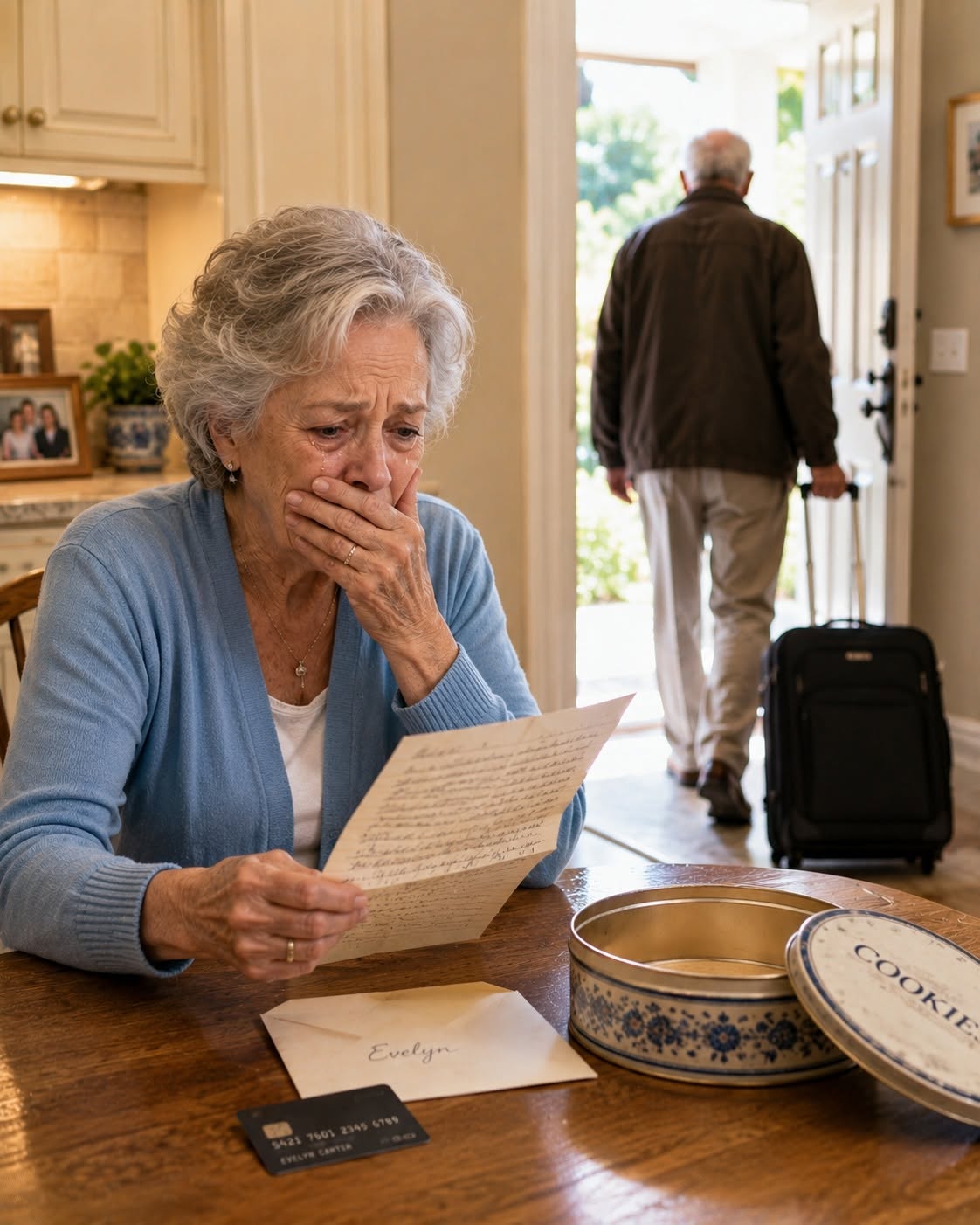
Her husband handed her a bank card after fifty years of marriage. It took her five years to discover what he had really left behind.
Evelyn Carter didn’t touch the card for five years.
The day her husband, Richard Carter, walked out after their golden wedding anniversary, he placed it on the kitchen table as casually as if he were leaving behind a grocery receipt.
“There’s about two thousand dollars on it,” he told her without meeting her eyes. “Keep it for emergencies.”
Then he carried his suitcase through the front door, climbed into a silver sedan driven by another woman, and disappeared from the life they had built together for half a century.
Evelyn stood at the kitchen window until the car vanished around the corner.
She didn’t cry.
Not then.
She simply picked up the card, opened the cabinet above the stove, and slipped it into an old blue cookie tin that had once belonged to her mother.
Then she closed the cabinet.
As far as she was concerned, Richard could keep his money, his apologies, and whatever remained of his conscience.
At seventy-four, Evelyn had more immediate problems.
She had to learn how to live alone.
For fifty years, she had organized her life around other people. She raised three children, managed household expenses, remembered appointments, cooked holiday dinners, cared for Richard’s elderly parents, and somehow stretched every paycheck whenever money was tight.
Now there was only silence.
At first, it frightened her.
Then she decided she would conquer it.
When the bathroom faucet leaked, she watched repair videos until she figured out how to replace the washer herself. When the lawn mower stopped working, she spent an afternoon cleaning the carburetor instead of calling anyone.
She clipped coupons.
She turned the thermostat down.
She stopped buying fresh flowers.
And whenever her children called, she gave them exactly the same answer.
“I’m fine. Don’t you worry about me.”
Her oldest daughter, Hannah Carter, never completely believed her.
“Mom, you know we can help.”
“I know.”
“Then let us.”
“I said I’m fine.”
Evelyn always changed the subject.
The truth was that independence had become more than pride.
It had become armor.
If she needed no one, no one could abandon her again.
But there was one thing Evelyn couldn’t repair herself.
Her heart.
For several years, doctors had been monitoring a damaged heart valve. At first, it had been manageable. Then came the exhaustion. Walking upstairs left her breathless. Carrying groceries from the car became difficult. Some mornings she woke with a strange pressure in her chest and sat quietly on the edge of her bed until it passed.
She told no one.
Then, during a routine cardiology appointment, Dr. Samuel Brooks studied her latest test results longer than usual.
Finally, he removed his glasses.
“Evelyn, we can’t keep waiting.”
She tried to smile.
“That sounds serious.”
“It is.”
The valve disease had progressed significantly. Without surgery, the risk would continue increasing.
“How long?”
“I’d like this done within the next few weeks.”
Evelyn stared at him.
“Surgery?”
“Yes.”
“What kind?”
When he explained, she barely heard the rest.
All she understood was that someone would open her chest and repair her failing heart.
At seventy-nine years old.
She drove home afterward gripping the steering wheel so tightly her fingers hurt.
Halfway there, she pulled into an empty parking lot.
For several minutes, she simply sat.
Then she cried.
Not dramatically.
Not loudly.
Just frightened tears slipping down the face of a woman who had spent most of her life making sure everyone else was okay.
Eventually, her thoughts turned to money.
Hospital bills.
Deductibles.
Medication.
Recovery care.
Transportation.
Her eyes closed.
And she remembered the cookie tin.
Richard’s card.
Two thousand dollars.
For emergencies.
If open-heart surgery didn’t qualify, she wasn’t sure what did.
Still, when she arrived home, she opened the cabinet, took down the tin, and stared at the card.
She couldn’t do it.
Using Richard’s money felt like admitting that after everything he had done, she still needed him.
So she put the card back.
Days passed.
Her surgery date approached.
She became more tired, and maintaining the performance of being “fine” required almost as much energy as simply surviving.
Then one Sunday after church, Evelyn heard something that nearly made her laugh.
Richard was being honored at the annual Franklin Community Leadership Gala.
For his “extraordinary contributions to family and community.”
Evelyn stood frozen in the church hallway.
“Richard?” she asked.
The woman beside her smiled.
“Oh yes. Apparently they’re giving him a lifetime achievement award. Such a devoted family man.”
Evelyn nearly choked.
A devoted family man.
She thought of fifty years of invisible labor.
She had packed lunches while Richard built his career.
She had stayed awake with sick children because he had meetings in the morning.
She had managed bills when his business struggled.
She had cared for his mother through two years of declining health.
She remembered birthdays Richard forgot, gifts she bought and signed with both their names, Christmas mornings she created while he accepted compliments for providing such a beautiful life.
And after fifty years, he had left her for Marlene Hayes.
Now Richard was going to stand beneath chandeliers and receive an award for family values.
Two days later, Evelyn’s hands trembled so badly she didn’t trust herself to drive.
That frightened her more than anything.
She took the cookie tin down.
This time, she removed the card.
“I suppose this counts as an emergency,” she whispered.
She took a bus to First Heritage Bank.
At the counter, she handed the card to a young teller named Olivia.
“I’d like to withdraw whatever is left on this.”
Olivia typed something.
Then stopped.
She looked at the screen again.
“Mrs. Carter?”
“Yes?”
“Could you wait here for a moment?”
Evelyn’s stomach tightened.
Of course.
Richard had canceled it.
Maybe Marlene had spent it.
Maybe there had never been two thousand dollars at all.
A few minutes later, the branch manager, Daniel Foster, approached.
“Mrs. Carter, would you mind coming into my office?”
Evelyn followed him.
Once seated, Daniel placed the card on his desk.
“Your husband left specific instructions concerning the first time you accessed this account.”
“My former husband.”
Daniel nodded politely.
Then he opened a drawer and removed a sealed envelope.
Her name was written across the front.
“Evelyn.”
Richard’s handwriting.
Her hands went cold.
“Before you read it,” Daniel said, “I think you should see the current balance.”
He turned his monitor toward her.
$48,216.73.
Evelyn stared.
“No.”
Daniel looked confused.
“That can’t be mine.”
“It is.”
“There were two thousand dollars.”
“Originally.”
He showed her the transaction history.
Every month, for five years, Richard had deposited part of his pension into the account.
Some months the amount was modest.
Other months it was considerably larger.
But every transfer carried essentially the same note:
“For Evelyn. What I owe her.”
Evelyn covered her mouth.
“Why?”
“I believe the letter explains that.”
She opened the envelope.
Richard had written several pages.
He admitted that he had lied about the balance because he knew Evelyn would never willingly accept money from him after he left.
Then came the sentence that made her stop breathing.
This is not generosity, Evelyn. It is a debt.
Richard listed things.
Years she had stayed home when their children were small.
Money from her inheritance used to rescue his struggling business.
The nights she cared for his father.
The vacations she gave up.
The retirement savings she allowed them to use during difficult years.
The unpaid labor.
The compromises.
The opportunities she had quietly surrendered so his career could keep moving forward.
Then he wrote:
I spent years accepting your sacrifices as though they were simply what a wife was supposed to do. I understand now that nearly everything people congratulate me for building rested on work you did without recognition.
Evelyn’s vision blurred.
Near the end was one final sentence:
This money is not charity. It is what you are owed.
Evelyn lowered the letter.
For five years, she had imagined Richard leaving that card as an insult.
Two thousand dollars for fifty years.
But somewhere beneath his cowardice, he had understood.
He had seen the sacrifices.
He simply hadn’t possessed the courage to acknowledge them while standing in front of her.
That evening, Evelyn called her children.
Hannah arrived first, followed by Michael Carter and their younger sister, Rebecca Carter.
They assumed something terrible had happened.
In a way, it had.
Evelyn told them about the account.
Then she told them about the surgery.
Everything stopped.
Hannah stared at her.
“The surgery is next week?”
“Yes.”
“And when were you planning to tell us?”
Evelyn looked down.
“Afterward.”
Rebecca began crying.
Michael stood and walked toward the window, clearly trying to control his anger.
“Mom, you were going to have open-heart surgery without telling your children?”
“I didn’t want anyone worrying.”
Hannah picked up Richard’s letter.
Her voice shook as she read it aloud.
When she finished, she placed it on the table.
“Dad understood enough to write an apology and hide almost fifty thousand dollars in a bank account.”
Evelyn said nothing.
Hannah looked directly at her.
“But an apology shouldn’t have to hide anywhere.”
The Franklin Community Leadership Gala took place the following week.
Evelyn had originally planned to ignore it.
Then she changed her mind.
Richard had spent five years acknowledging the truth privately while continuing to enjoy his public reputation.
She wanted him to say it where people could hear him.