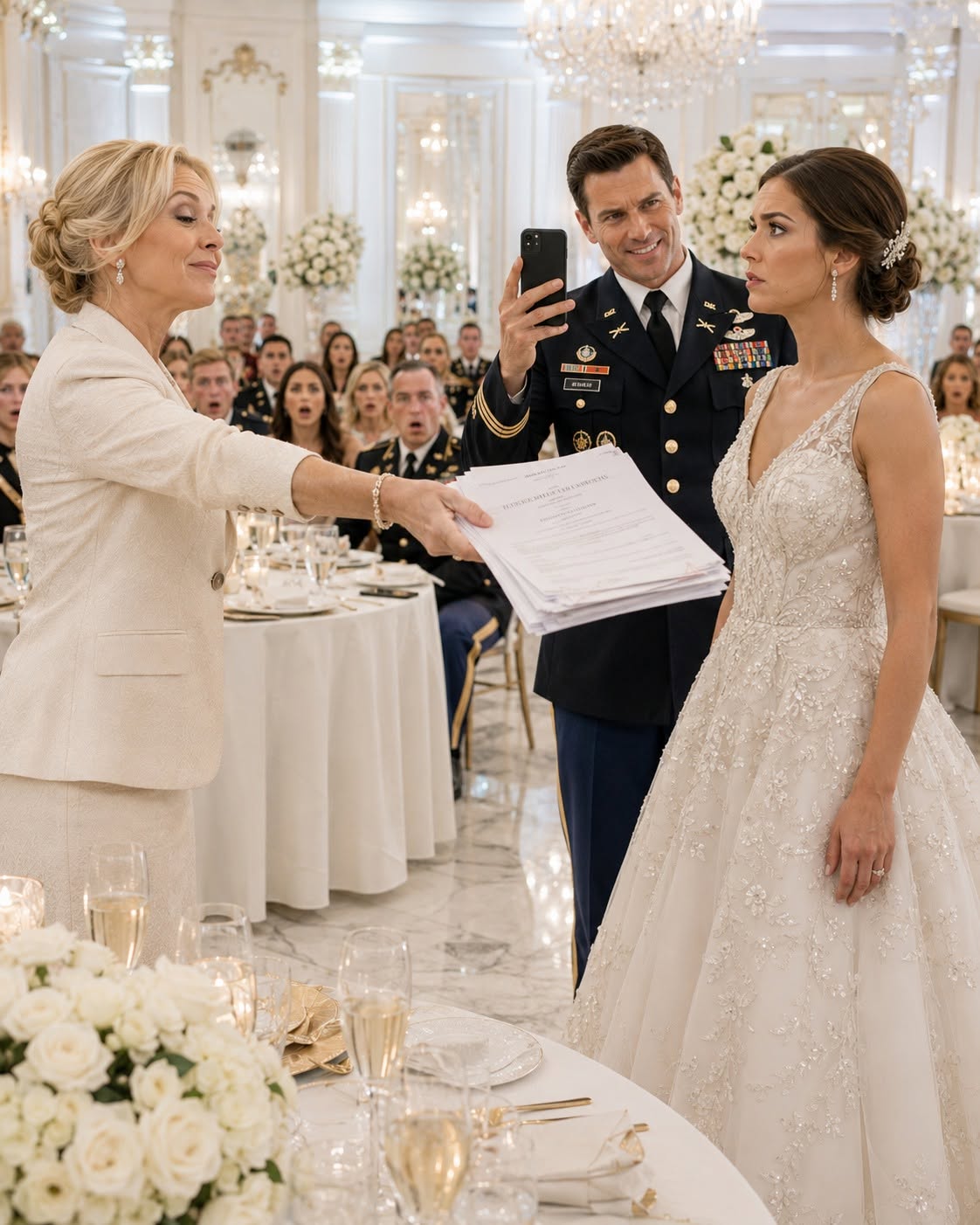
“Happy birthday, Natalie. Here are your divorce papers. You can stop acting like the perfect wife now.”
My mother-in-law said it in front of my entire unit during the Military Gala Ball, smiling so flawlessly that it looked rehearsed.
The orchestra had just finished a formal dance, and the hotel ballroom slipped into that brief silence where you can hear glasses touching, shoes crossing the floor, and people breathing. Patricia Lane moved between the tables in a deep emerald sequined gown as though she were the guest of honor at an event that had nothing to do with her. In one hand, she carried an expensive handbag. In the other, a cream-colored envelope.
She placed it beside my plate, directly over my folded napkin.
My husband, Derek, stood several feet away with his phone raised.
Recording.
He made no effort to hide it. In fact, he looked pleased, wearing the cheap confidence of a man who believed the outcome had already been decided.
I was in my dress uniform.
It was my 31st birthday.
Members of my battalion sat around me. Colonel Harrison, my commanding officer, slowly lifted his eyes. Beside me, Captain Blake quietly placed her fork on her plate.
No one said a word.
Patricia tilted her head and raised her voice.
“Go ahead, sweetheart. Open it. Let everyone see that my son is finally getting rid of the burden he’s been carrying.”
Derek laughed.
“Come on, Natalie. Don’t make this dramatic. You’re a soldier, right? You can take it.”
I could feel every pair of eyes turning toward me.
Some angry.
Some sympathetic.
That was exactly what they wanted.
They wanted me shaking.
Crying.
Demanding answers in front of everyone.
I picked up the envelope.
Inside was a no-fault divorce petition, a proposed financial settlement, a request allowing Derek to remain in the house “until the property dispute was resolved,” and a list of renovations and expenses he claimed I owed him.
$44,000 for renovations.
$18,000 for furniture.
$11,000 for “family contributions.”
I almost laughed when I reached the last page.
The house was never ours.
It was mine.
My grandmother Evelyn had left it to me before I married Derek. It was an old house in Georgetown, with climbing roses, patterned tile floors, and a kitchen that somehow still smelled faintly of coffee even when no one had brewed any.
Derek always said that house should “become part of the Lane family.”
His mother repeated the same idea constantly:
“A good wife shares what she has with her husband.”
Three weeks before the gala, my bank called about a suspicious transaction.
A mortgage-backed loan for $220,000 had been placed against my house.
I had never applied for it.
Then I discovered something worse.
There was a deed claiming that I had transferred 50% ownership of the property to Derek.
There was also a power of attorney granting him authority over my financial affairs, dated before my deployment to Fort Liberty, being used as though it were still valid.
But I had revoked that power of attorney two years earlier.
I said nothing to Derek.
Instead, I contacted my attorney, Rachel Monroe.
Then the bank.
Then the financial crimes division at the District Attorney’s Office.
That was when the lid came off something rotten.
Of the $220,000, more than $110,000 had already been transferred into an account belonging to Patricia Lane.
Another portion had gone into Derek’s failing remodeling company, a business surviving on unpaid bills, inflated invoices, and promises he could no longer keep.
And now my mother-in-law stood in front of me believing she was delivering the final blow.
I took the pen from the envelope.
Derek moved his phone closer.
“That’s it. Sign it. I want this on video.”
So I signed.
But I did not sign the settlement.
I did not sign the property agreement.
I did not agree to anything.
I signed only the acknowledgment confirming that I had received the documents.
Patricia smiled because she thought I didn’t understand the difference.
“See? That wasn’t so hard. Now that house can finally belong to a real family.”
Colonel Harrison’s expression tightened.
I placed the papers neatly beside my water glass.
Then I stood.
“Thank you,” I said.
Derek lowered the phone slightly.
“For what?”
I looked at him.
Then at Patricia.
“For handing me these documents in front of an entire room full of witnesses. And thank you for recording your mother explaining what the two of you intended to do with my house.”
Derek’s smile vanished.
Patricia blinked.
Then the ballroom doors opened.
A woman in a charcoal-gray suit entered with two investigators behind her.
She walked directly toward my husband.
“Mr. Derek Lane,” she said. “Do not turn off that phone.”
And right there in front of everyone, Patricia stopped breathing as though she had just watched a dead woman walk into the room.
Assistant District Attorney Allison Grant didn’t look at me when she entered.
That was what I respected most about her.
She wasn’t there to save me.
She was there to do her job.
She presented an order authorizing the seizure of Derek’s phone and another covering documents connected to my Georgetown property, the mortgage loan, and several transfers made during the previous two months.
Derek lifted both hands as if this were some minor misunderstanding.
“This is ridiculous. This is a private event.”
Allison didn’t change her expression.
“It’s also the location where you chose to record the delivery of documents relevant to an active fraud investigation.”
Patricia gave a dry laugh.
“Fraud? My son spent years putting money into that house. He painted it. Replaced doors. Paid for repairs.”
From behind the investigators appeared Rachel Monroe, my attorney, wearing a simple black dress and carrying a folder beneath one arm.
She had attended the gala as my guest.
Derek had assumed she was another officer.
Rachel looked directly at Patricia.
“Replacing kitchen tile does not turn inherited property into marital property.”
My mother-in-law’s face hardened.
Derek stepped toward me.
“You planned this?”
“No,” I replied. “I reported what you did using my identity.”
His voice rose.
“I was your husband. I had power of attorney.”
“You had one,” I said. “And I revoked it.”
The words struck the table like breaking glass.
Around us, my fellow officers quietly moved aside.
Nobody wanted to interfere.
But nobody wanted to leave either.
Colonel Harrison remained standing with his arms folded across his chest.
Allison explained that the bank had provided copies of the mortgage documents, the altered deed, the revoked power of attorney, and security footage from the branch showing Patricia accompanying Derek when the transaction was submitted.
“That’s a lie,” Patricia said.
Rachel opened her folder.
“No. This is the lie.”
She removed a copy of the property settlement included with the divorce papers.
According to that document, I had supposedly agreed to convert my inherited house into marital property and waive any claim against debts Derek had accumulated during our marriage.
I had never seen it before.
Yet my signature appeared at the bottom.
Beside it was the stamp of a notary’s office in Arlington.
The assistant notary listed on the paperwork was Jason Lane.
Patricia’s cousin.
Allison placed a photograph on the table.
It was security footage from the entrance of that notary’s office on the exact day I had supposedly signed the document.
I wasn’t there.
Derek was.
So was Patricia.
She was carrying a red folder beneath her arm.
That day, I had been at Fort Bragg for a military training exercise.
There were flight records.
Base-access logs.
Unit photographs.
And thirty-six people who could verify that I had never gone anywhere near Arlington.
The color disappeared from Patricia’s face.
Derek wet his lips.
“That proves nothing.”
Allison removed another document.
“There’s more.”
The digital file containing the agreement had been created the previous afternoon at 6:42 p.m.
Not eighteen months earlier, as the divorce filing claimed.
Not during any supposed visit I had made to the notary.
Yesterday.
Rachel added:
“And it was created after Mr. Lane’s attorney requested a copy of the property agreement for attachment to the divorce petition.”
A notification suddenly sounded from Derek’s phone.
Everyone heard it.
He tried to lock the screen.
One investigator stepped forward.
“Do not touch that phone again.”
Derek clenched his jaw.
Patricia looked at her son.
This time, there was no pride in her eyes.
Only panic.
Allison asked:
“Mrs. Lane, did you know this agreement did not exist before yesterday?”
Patricia opened her mouth.
Derek interrupted immediately.
“Mom, don’t answer.”
But the pressure had already cracked her.
The silence of the entire ballroom seemed to press down on her shoulders.
Her glittering gown suddenly looked less like elegance and more like cheap armor.
Then she whispered:
“You told me nobody could check when the file was created.”
Derek closed his eyes.
And I knew that one sentence had just buried them both.
Part 3
That sentence ended the performance.
There was no screaming.
No dramatic arrest in the middle of the ballroom.
Nobody was dragged past the orchestra in handcuffs like a villain in a television drama.
Real life is usually colder than that.
The investigators seized Derek’s phone.
They collected contact information from witnesses.
Several people were told not to delete videos, texts, or photographs from the evening.
Colonel Harrison spoke briefly with Allison.
Then he came to me.
He didn’t ask whether I was all right.
He simply said:
“Captain Walker, no one in this room mistakes composure for weakness.”
I nodded.
Inside, however, I was shaking from my knees all the way to my throat.
That night, I returned alone to my house in Georgetown.
My house.
I switched on the entryway light and saw my grandmother Evelyn’s photograph sitting on the console.
She was smiling in a red shawl beside the climbing roses.
For years, Derek had complained that the photograph looked “too old-fashioned” and said we should remove it to modernize the house.
I never did.
I sat in the kitchen still wearing my uniform.
I didn’t cry right away.
Sometimes your body becomes stone because it knows that once it turns to water, it may not be able to stop.
The investigation continued for almost five months.
Once investigators began pulling everything apart, more pieces appeared.
Derek had kept a copy of the power of attorney I had given him before a deployment, back when I still trusted him.
It had been limited.
It allowed him to handle routine banking matters while I was gone.
It did not allow him to transfer half my house to himself.
Two years later, after I realized Derek was using my absences to make financial decisions without consulting me, I formally revoked that authority.
I notified the bank as well.
But Derek had kept a scanned copy.
Someone altered it to remove the language showing that it had been revoked.
Then they submitted the altered version as though it were valid.
Patricia went with Derek to the bank and told an employee that I was “unreachable because of military duties.”
She said it with enough confidence that a newer employee processed the paperwork.
The forged property-transfer document had been built using information copied from legitimate records.
Patricia’s cousin Jason helped give the false agreement a legal appearance.
He wasn’t the head notary.
But he had access to office seals, document templates, and professional contacts.
They believed that would be enough.
Luckily, the full $220,000 loan had not been released immediately.
That delay saved me.
A bank employee reviewed the application because something about my signature looked wrong.
It didn’t match the signature the bank already had on file.
It didn’t match signatures on other documents.
She was also suspicious because the transaction had been rushed, and Derek had asked twice how long it would take before the mortgage became “irreversible.”
Months later, I learned that woman’s name.
She had saved the house my grandmother spent forty years building.
Of the money that had already moved, more than $110,000 went to Patricia.