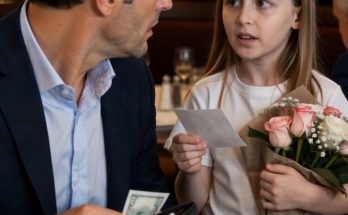
My name is Sydney. I was eleven when my childhood ended with a crumpled twenty-dollar bill in my hand and one word my mother used like it excused everything: independent.
“See? You’re independent now,” she said with a bright, brittle smile, dragging her huge Samsonite suitcase toward the front door. “You’re not a baby anymore, Sydney. Just order food if you need to. I’m going to Europe for a month. I’ll be back before you know it.”
I looked down at the bill. Twenty dollars. For thirty days.
There were no emergency numbers on the fridge. No neighbor had been told to check on me. The pantry hadn’t been stocked. She didn’t even stop long enough for a real goodbye. I heard her heels crossing the floor, the suitcase wheels rattling down the driveway, and then the front door clicked shut.
“I’ll be fine,” I whispered into the empty hallway. Even at eleven, I knew that wasn’t true.
I hurried into the kitchen and pulled open the fridge. A carton of sour milk sat beside a jar of pickles. In the pantry, one can of creamed corn and a dented tin of tuna. That was when the fear became real. She had actually left me there — alone, in a big house, with twenty dollars and almost nothing to eat.
At first I treated every dollar like it had to survive with me. I counted my money before buying anything. I thought through every meal, because one careless purchase could mean going hungry later. The number kept shrinking. And every night, the house felt a little bigger.
Nobody came through the door asking if I’d eaten. Nobody called to ask if I was scared. Nobody remembered that “independent” and “abandoned” were not the same thing.
Eventually the twenty dollars was gone. Then the food was gone. But something else disappeared too — the part of me that kept waiting for my mother to realize what she’d done. For days I’d imagined the phone ringing, pictured her apologizing, promising she was coming home early. That call never came.
She had called me independent. So I started thinking carefully about what independence actually meant, coming from an adult who was using the word as permission to walk away from an eleven-year-old.
By the final stretch of that month, I wasn’t the same kid who’d stood in the foyer clutching a twenty. I made a decision. I wasn’t going to scream when she came home. I wasn’t going to break anything. I wasn’t going to beg her to understand why I’d been scared. I wanted her to see something instead. So I prepared it and left it exactly where I knew she’d find it.
Here’s what she didn’t know had happened while she was gone. By day nine, once the food and the money were both gone, I did the only thing I could think to do — I walked two blocks to my Aunt Carol’s apartment, the only family member whose number I actually remembered by heart, and knocked on her door with my school backpack on. I told her everything: the twenty dollars, the empty pantry, no emergency contacts, nothing. Aunt Carol wasn’t my mother’s biggest fan to begin with, and what I told her confirmed every worry she’d apparently had for years but never acted on.
She took me in for the rest of the month without telling my mother — partly because she genuinely didn’t know how to reach her overseas, and partly, she admitted to me years later, because she wanted to see exactly how long it would take my mother to even notice her daughter wasn’t answering calls at the house. The answer was: my mother never called the house at all that entire month. Not once.
While I stayed with Aunt Carol, she also did something else. She contacted a family law attorney she knew socially and asked, hypothetically at first, what evidence would matter if a relative needed to document child neglect for a custody or guardianship case. The attorney gave her a clear answer: dated records, direct statements from the child, financial evidence showing what was and wasn’t provided, and ideally something from the child herself, in her own words and handwriting, made contemporaneously rather than after the fact.
So Aunt Carol helped me write it. Not a diary entry, not a letter meant to guilt anyone — a plain, dated, factual account: what I was given, what ran out and when, what I did to survive, and who I turned to when I had nowhere else to go. I wrote three pages by hand over the final week of that month, and Aunt Carol had it notarized the day before my mother was due back, just to be safe.
That was what sat on the kitchen counter when my mother walked in with her tan and her souvenir bags. Not a note asking for an apology. A notarized statement, dated and witnessed, documenting thirty days of unsupervised abandonment of a minor — with a pen beside it, because Aunt Carol had already filled out the first page of a guardianship petition and left space for my mother’s signature agreeing to it, rather than contesting it in court.
“No,” my mother whispered, staring at the pages. “No. No. This can’t be happening.”
I stood across from her and said nothing, because I’d already said everything I needed to say, in my own handwriting, over the course of that month.
My mother did not sign that day. She fought the petition for almost four months, insisting it had been an exaggerated situation and that she’d “trusted me to handle things.” But Aunt Carol’s documentation, my own written record, the empty pantry photos she’d taken before restocking it that first week, and a family court that took child abandonment seriously made the outcome fairly clear. I moved in with Aunt Carol permanently the following spring, with my mother retaining supervised visitation that, over the years, she used less and less.
I’m thirty-one now. Aunt Carol is the person I call Mom in every way that matters. My biological mother and I speak maybe twice a year, brief and polite, the way you talk to someone you’ve made peace with but never quite forgiven.
I still remember exactly what that twenty-dollar bill looked like, crumpled in my palm in the foyer. I remember it not because it destroyed me, but because it was the moment I learned that sometimes the people who are supposed to protect you the most are the ones you have to learn to stop waiting on — and the people who actually show up are the family you get to choose to keep.