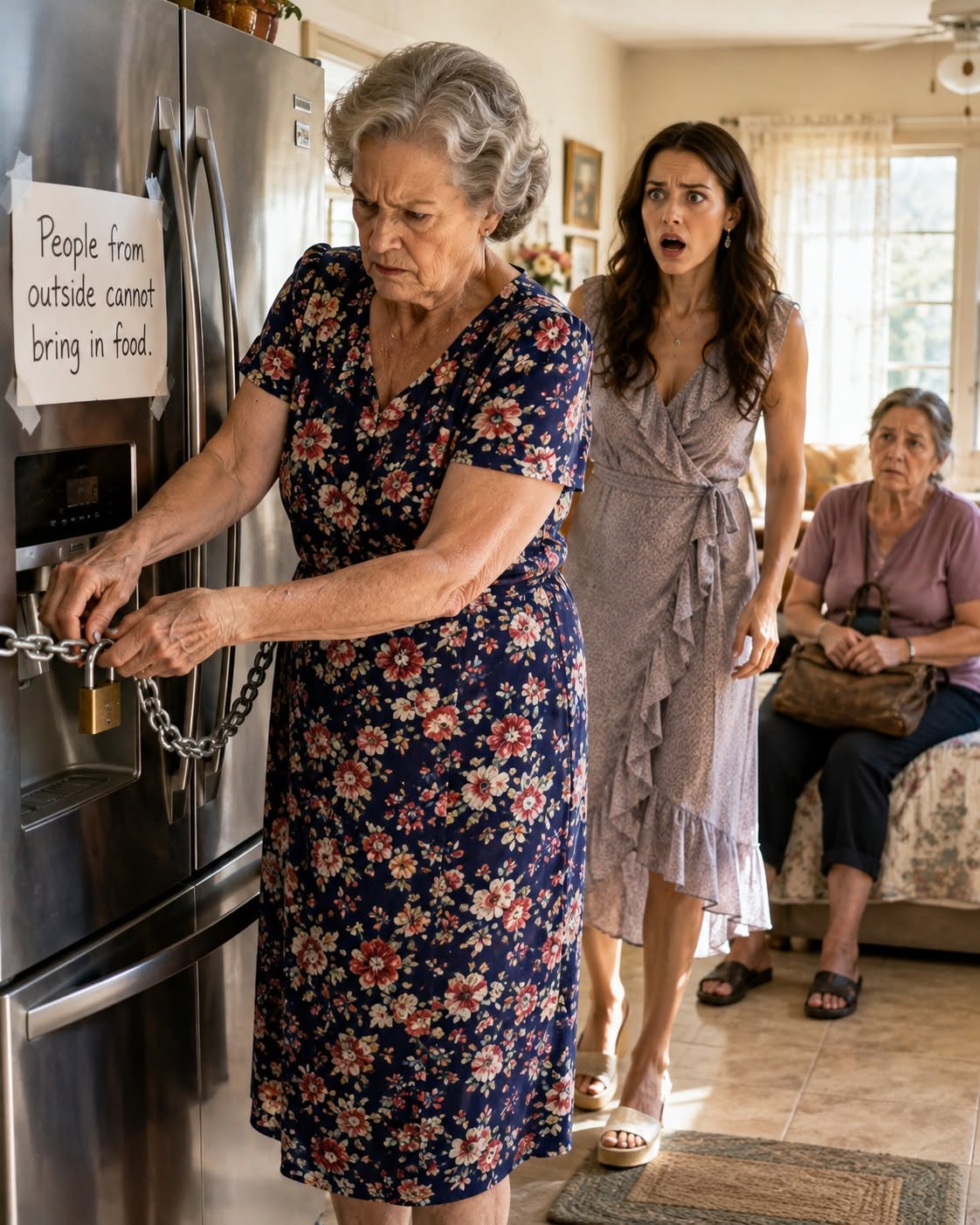
“I run things here. Your mother may be your mother, but under this roof she’s still a guest. If she wants food, she can pay for her own.”
That was what my mother-in-law, Diane, told my mother on the second day of her visit, right before chaining the refrigerator shut, switching off the electricity to the bedroom where she was staying, and casually leaving to spend the night at her younger son’s house.
My name is Allison. I’m 36 years old, and I live with my husband, Mark, and our son, Ethan, in Scottsdale, Arizona. My mother, Helen, is 64 and lives in a small town outside Prescott. After my father died, she grew used to living by herself, tending a few chickens and growing vegetables on the small piece of land she still owns.
For years, I asked her to come stay with us.
She always answered the same way:
“No, honey. You have your own life. I don’t want to get in the way.”
That time, Mark insisted himself.
“Mrs. Helen, come stay with us for a week. Ethan wants to see you, and Allison does too. This is your home too.”
My mother finally agreed.
She arrived by bus carrying an old suitcase and several bags filled with homemade flatbread, fresh cheese, dried peppers, eggs, and a jar of homemade caramel sauce for Ethan.
Diane had been living with us for nearly a year. She had sold her own house without talking to us first, then showed up one afternoon with two suitcases, saying that at her age, her place was beside her oldest son.
We took her in.
We even gave her the larger bedroom.
The problem was that little by little, she stopped acting like a guest and began behaving like she owned the place. She criticized my cooking, my schedule, the way I raised Ethan, and especially anything I did for my mother.
“A married woman should know who her real family is,” she repeated constantly.
What she never mentioned was that years earlier, when Mark and I could barely cover rent, my mother had sold a small parcel of land she inherited from my father so she could lend us money for the down payment on our first home.
She never asked us to repay a single dollar.
That was why the contempt in Diane’s eyes when Helen arrived hurt so much.
The first evening, she barely bothered to hide it.
Mark served my mother dinner, and Ethan sat beside her listening to stories about the town where she lived.
Diane dropped her fork against her plate.
“It’s amazing how quickly the pecking order changes when visitors show up,” she muttered.
The next morning, Mark and I left for work.
Before I left, I prepared rice, chicken, fruit, and cold water.
“Mom, eat whatever you want,” I told her. “And if you need anything, call me.”
I got home before four that afternoon.
My mother was sitting beside a window, fanning herself with a magazine. Her hair was stuck to her forehead, and her blouse was damp with sweat.
“What happened?”
“Nothing, honey. It’s just warm in here.”
I went to get her some cold water.
That was when I saw the refrigerator.
A chain had been wrapped around both doors and secured with a padlock.
A handwritten note was taped above it:
“Everything in here is for my son and grandson. Outsiders keep their hands off.”
My hands began to shake.
The electricity in my mother’s room was off too.
Diane had shut down only that one circuit.
“Did you eat?”
My mother lowered her eyes.
“I had a couple of dry biscuits in my bag. That was enough.”
On the kitchen table, I found another note.
“I went to Brian’s. The visitor needs to learn how to behave.”
But underneath that was something even worse:
“This house will belong to my sons eventually. Everyone should learn their place.”
I didn’t scream.
I photographed both notes and put them away.
Because there was something Diane didn’t know.
Mark and I had spent the previous two months preparing to sell the house.
We already had a buyer.
We had already accepted a deposit.
And three days earlier, we had signed the final purchase documents on another home.
Diane had just declared war over a house that was legally about to stop belonging to us.
And what happened when she finally discovered the truth was something none of us could have predicted.
Mark came home that evening, saw the padlock, and stood in silence for several seconds.
Then he walked over to my mother.
“I’m sorry, Mrs. Helen. This happened under my roof, and I’m responsible for not setting boundaries sooner.”
Helen tried to minimize it.
“Don’t fight with your mother because of me.”
Mark slowly shook his head.
“Keeping quiet just to preserve the peace can become another way of allowing someone to mistreat people.”
He called Diane.
Half an hour later, she arrived with Brian, Mark’s younger brother, and Brian’s wife, Megan.
Megan walked in, looked at the refrigerator, and laughed.
“All this drama over a padlock?”
Brian added:
“Besides, this is Mark’s family home. Mrs. Helen should understand she’s only visiting.”
Mark slapped his palm against the table.
“This house belongs to Allison and me. Both of our names are on the deed. Neither you, Mom, nor Megan gets to decide who can eat in this house.”
Diane immediately began to cry.
“After everything I’ve done for you! Your wife has finally turned you against your own mother.”
Then Megan said something that exposed exactly what they were thinking.
“If Mrs. Helen causes this many problems, she should just go back home tomorrow.”
My mother stood up.
“I’ll leave, honey. I don’t want to tear a family apart.”
I wrapped my arms around her.
“You didn’t tear anything apart.”
After nearly an hour of arguing, Diane left again with Brian and Megan.
When the front door finally closed, Mark took me into the kitchen.
“That’s it,” he said. “We’re going ahead with the plan.”
The sale was already essentially finalized, and the paperwork was almost complete. We had purchased another house that was smaller but laid out better and closer to Ethan’s school.
We had never planned to abandon Diane.
Mark had already found her a one-bedroom apartment near a medical clinic, a grocery store, and several bus routes.
We planned to cover the first six months of rent and continue paying for her medication.
But instead of telling her immediately, we decided to stay quiet until the handover.
Over the next several nights, we moved documents, clothes, computers, and personal belongings into the new house.
My mother helped without asking many questions.
“Set boundaries,” she told us, “but don’t do anything just to get revenge.”
The next day, I called Diane.
“Come back, Mom. I don’t want to keep fighting.”
Her response confirmed that she had mistaken my calm tone for surrender.
“That’s better. A smart daughter-in-law knows when to stop challenging her husband’s mother.”
She returned that same afternoon.
Megan came with her.
Over the following days, I heard increasingly absurd plans.
They wanted to replace the dining room furniture.
Redo the living room.
Turn the room where my mother had slept into a bedroom for Brian’s children.
One evening, I overheard Megan talking to Diane on the phone.
“Mom, you need to hold on to that house. Jason… I mean, Mark already has another place now. This one could go to Brian. That would be fair between the brothers.”
That was when everything became clear.
Megan wasn’t defending my mother-in-law.
She was defending an inheritance she had already distributed in her imagination.
On the morning of the handover, Mark left early to finish paperwork with the bank. Ethan, my mother, and I were already at the new house.
At 8:12, my phone started ringing.
Diane.
I didn’t answer.
She called again.
Then again.
By 8:20, I had 17 missed calls.
Then 29.
Then 41.
Finally, a message appeared:
“WHAT DOES THAT SIGN MEAN?”
The real estate agent had just placed a huge sign in front of our old house:
HOUSE SOLD — HANDOVER TODAY.
Diane called me more than 50 times.
But by then, the buyers were already standing at the property with the signed documents.
And the worst part still hadn’t happened.
When Mark and I arrived at the old house, Diane was standing in front of the entrance like she was defending her property from intruders.
Brian and Megan stood beside her.
Across from them were the real estate agent, one of the agency employees, and the couple who had bought the house, all waiting awkwardly.
“Tell them to leave!” Diane shouted when she saw Mark. “They’re trying to throw me out of my own house!”
Mark didn’t raise his voice.
He pulled a folder from under his arm.
“Mom, this was never your house.”
Diane froze.
“I’m your mother.”
“Yes. But being my mother doesn’t make you the owner.”
The real estate agent showed copies of the sales agreement, the deed, and the handover documents.
Everything was legal.
Everything was complete.
Diane pressed both hands to her chest.
“I sold my house in Prescott to be near you. And now you’re putting me out on the street?”
Mark watched her for several seconds.
“You sold your house without asking me first, and you gave a large part of the money to Brian when he wanted to start a business. It was your property, and I respected your right to make that decision. This property belongs to Allison and me. Why should our decision be treated differently?”
Brian interrupted.
“Because Mom lives here.”
“Living somewhere doesn’t make you the owner.”
Megan crossed her arms.
“You already bought another house. What would it really cost you to leave this one for Mom and Brian?”
I stared at her.
She had finally said it out loud.
This wasn’t about Diane being homeless.
They wanted the house.
“It would cost us the money we worked for years to put into this place,” I said. “It would cost us the loan we still have on the new house. It would cost our son part of his future. And it would cost us accepting the idea that you can divide property that never belonged to you.”
Megan rolled her eyes.
“Always so calculating.”
I took out my phone.
“Calculating like my mother, who sold land to help us with the down payment when we didn’t have enough?”
Diane lowered her eyes.
Mark continued:
“Mom, I brought you a solution.”
He handed her a sheet of paper.
It was the lease agreement for the apartment we had reserved for her.
“It has an elevator, one bedroom, a kitchen, and it’s ten minutes from the clinic. We’ll pay the first six months. After that, we’ll continue helping you every month and covering your medication.”
Diane studied the document.
Her expression softened.
For the first time, she seemed to realize that we weren’t trying to abandon her.
“You already rented it for me?”
“Yes.”
“Will I still be able to see Ethan?”
“Of course. You’re still his grandmother. We just need boundaries.”
I stepped closer.
“I never wanted to take your son away from you. But the day you locked up food and shut off the electricity to my mother’s room, you crossed a line I will never allow you to cross again.”
Diane pressed her lips together.
She looked like she was about to accept it.
Then Megan leaned close to her ear.
“Don’t sign anything. If you accept that apartment, you’ll lose your rights. Ask them for part of the money from the sale.”
Mark heard her.
“What rights, Megan?”
She hesitated.
Brian jumped in.
“Mom deserves money. You’re the oldest son. You’re responsible for her, and you should help your brother too.”
“Helping you doesn’t mean giving you a house.”
“Then give her at least a hundred thousand dollars!” Megan snapped. “So she can have a decent retirement.”
Even Diane turned to look at her.
One hundred thousand.
Megan said it as casually as if she were asking someone to pass the salt.
Mark took a slow breath.
“Do you know how much we actually made from the sale? Do you know how much we still owe on the new house? Do you know what Ethan’s school costs? No. Because you don’t care. You heard the word ‘sale’ and immediately started counting somebody else’s money.”
Brian stepped toward him.
“Don’t be selfish.”
That was when I opened the folder I had prepared.
Inside were bank transfers, medical receipts, and payment records from the previous four years.
“Diane’s cataract surgery. Arthritis medication. Dental work. Medical tests. Insurance. Monthly support. And here are two debts of Brian’s that Mark paid because Diane came to our house crying and saying his property might be seized.”
Brian’s face lost all color.
I didn’t read the totals aloud to embarrass anyone.
I simply placed the records on the table.
“We have never abandoned Diane. But caring for someone does not mean giving them the deed to your home.”
The real estate agent stepped forward cautiously.
“We need to begin the final inspection. The buyers are legally entitled to take possession today.”
Diane moved back in front of the door.
“I’m not leaving.”
Mark closed his eyes briefly.
“Mom, please.”
“No!”
She tore the apartment lease in half.
“As long as I’m standing here, nobody is handing this house over.”
Megan smiled faintly.
That tiny smile told me exactly what she wanted.
She wanted the fight to continue.
The buyers tried to remain calm.
The young woman, Ashley, spoke gently.
“Ma’am, we understand this is difficult. We can wait while you gather your personal belongings.”
“I don’t want your pity!”
While everyone was arguing outside, Megan disappeared for several minutes.
Nobody noticed.
Not until Ashley checked the smart security camera on her phone, which we had left connected for the handover.
“Excuse me,” she said. “Is that woman taking things out of the house?”
We gathered around the phone.
The footage showed Megan entering the foyer, removing an auxiliary keypad from the security system, and putting it into her purse.
Then she picked up two decorative vases that were included in the inventory for the sale.
Megan returned outside.
Mark stared directly at her.
“Open your purse.”
“What?”
“Open your purse.”
“You have no right.”
Ashley raised the phone.
“We have you on camera.”
Megan went pale.
“I was only putting some things away.”
“For who?” I asked.
“For Mom.”
“Those items belong to the buyers now.”
Brian exploded.
“Stop treating my wife like she’s a thief!”
He reached for Ashley’s phone.
The real estate employee stepped between them.
There was a brief struggle.
Brian shoved him.
The man stumbled, and the phone he was holding hit the pavement.
The screen shattered.
Everyone fell silent.
Mark stared at his brother.
“You just turned a family argument into something else.”
The real estate agent pulled out her phone.
“I’m calling the police.”
Megan started crying.
“No! Brian, just give everything back.”
But he was still furious.
“Let them come! This is a family matter.”
Mark slowly shook his head.
“Not when you shove an employee and damage his property.”
Fifteen minutes later, two police officers arrived.
There were no handcuffs.
No exaggerated scene.
They asked to see the documents and listened to everyone involved.
The agent showed them the sales contract and handover paperwork.