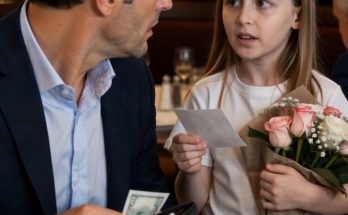
My daughter got a broken toy horse on New Year’s Day.
Then my father looked at the cheap plastic toy in her hands and smirked.
“She doesn’t count.”
I will never forget the way Josephine looked up at me after he said it.
She was eight years old.
She had been standing beside my parents’ Christmas tree since breakfast, still wearing the red sweater she had picked out herself.
Her cousins, Clara’s twins, were sitting across the room surrounded by gifts.
Tablets.
Bicycles.
New sneakers.
Art kits.
A giant dollhouse.
Josephine had received one wrinkled gift bag.
Inside was a plastic horse with one leg snapped off and black marker streaked across its side.
She tried to smile anyway.
Then my father laughed.
“The good presents are for the grandchildren who actually matter.”
Nobody corrected him.
That hurt more than the broken toy.
My daughter slowly lowered her eyes.
Then she pressed her face into my shirt and whispered, “Daddy… maybe my real present is hidden somewhere else?”
I held her tighter.
“Maybe,” I said.
But I already knew what I was going to do.
Twenty minutes later, I walked back into that living room carrying the expensive watch and leather handbag I had brought for my parents.
I placed both gifts back into their bags.
My father narrowed his eyes.
“What are you doing?”
I looked at him.
Then at my mother.
Then at Clara, who was sitting comfortably on the couch while her twins tore through wrapping paper.
“I’m taking my gifts home.”
My father gave a short laugh.
“Because of a toy?”
“No.”
I glanced down at Josephine.
“Because of what you said.”
My mother immediately stepped in.
“Oh, don’t make this dramatic.”
“I’m not.”
“You know your father was joking.”
I looked at my daughter again.
She was still holding the broken horse.
She had stopped crying.
That somehow made me feel worse.
Kids learn very quickly when adults have decided their feelings are inconvenient.
They learn when to stop asking.
They learn when to smile.
They learn which rooms they are welcome in.
And sometimes, if nobody stops it, they learn to believe they deserve less.
I had spent years telling myself my father was simply old-fashioned.
He had always been harder on me than on Clara.
When we were children, Clara got praised for being charming.
I got praised for being responsible.
Clara could make mistakes and everyone laughed.
If I made one, my father called it carelessness.
When we grew older, the pattern never changed.
Clara received help with college.
I worked two jobs.
Clara moved into a condo my parents helped finance.
I bought my first house with a loan I repaid myself.
When Clara had children, my parents became enthusiastic grandparents.
They bought expensive clothes.
Paid for vacations.
Hosted elaborate birthday parties.
They kept photographs of the twins everywhere.
Josephine’s photographs were mostly the ones I sent them.
Still, I kept telling myself it didn’t matter.
I told myself adults could survive unequal treatment.
I didn’t understand how deeply it could affect a child until I saw my daughter holding a broken toy and wondering whether another present existed somewhere because she couldn’t believe that was all she was worth.
I knelt beside her.
“Let’s go home.”
She looked toward my father.
“Can I take the horse?”
My chest tightened.
“Of course.”
She held it carefully.
As we walked toward the door, Clara called after me.
“You’re seriously leaving because your daughter didn’t get enough gifts?”
I stopped.
I turned around.
“She didn’t get enough respect.”
Clara rolled her eyes.
“Oh, come on.”
My father leaned back in his chair.
“This is exactly why you’ve become so sensitive.”
I almost laughed.
Sensitive.
That word had followed me for years.
It was what my father said whenever I questioned him.
It was what my mother said whenever I asked why Clara received different treatment.
It was what everyone said whenever I noticed something they preferred I ignore.
But that day, I finally understood something.
I didn’t need them to agree with me.
I needed to protect my daughter.
So I left.
The drive home was quiet.
Josephine sat in the back seat holding the broken horse in both hands.
About halfway home, she asked, “Daddy?”
“Yeah?”
“Did Grandpa really mean I don’t count?”
I gripped the steering wheel.
For a few seconds, I couldn’t answer.
Then I said, “What your grandfather said was wrong.”
“But he said it.”
“I know.”
“Does that mean I don’t count?”
“No.”
I looked at her in the rearview mirror.
“You count more than you know.”
She stared down at the toy.
“Then why doesn’t he act like it?”
That question stayed with me.
Because I didn’t have a good answer.
Not one a child should have to hear.
So I told her the truth.
“Sometimes adults treat people unfairly because they are wrong. That doesn’t make the unfair treatment true.”
She nodded slowly.
Then she asked whether we could fix the horse.
I said yes.
That evening, I sat at the kitchen table with a small repair kit while Josephine watched.
The leg was badly cracked.
The plastic was cheap.
The black marker wouldn’t come off completely.
But we managed to make it stand again.
Josephine smiled.
“It looks better.”
“It does.”
She picked it up.
“I’m going to name her Lucky.”
I smiled.
“Why Lucky?”
“Because she almost got thrown away.”
I stopped moving.
She didn’t realize what she’d just said.
Or maybe she did.
Children notice more than adults think.
The next morning, I opened my laptop.
I wasn’t planning revenge.
I wasn’t planning to punish my parents.
I simply wanted to understand something I had been avoiding for years.
How much had I actually given them?
I started looking through my records.
Mortgage payments.
Utility transfers.
Medical expenses.
Insurance.
Home repairs.
The family vacation I had quietly paid for two summers earlier.
The college tuition contribution I had made for Clara when she said she was struggling.
The renovation loan for my parents’ kitchen.
The new roof.
The replacement HVAC system.
The property taxes I had covered during a period when my father said money was tight.
I stared at the numbers.
Then I stared again.
My father had spent years telling relatives that I was selfish.
That I never helped the family.
That Clara was the generous daughter because she hosted holidays and bought birthday gifts.
But the financial records told a different story.
I had simply never talked about what I paid.
I had assumed helping family didn’t need applause.
That morning, I realized something else.
Silence can protect a relationship.
But sometimes silence protects the person taking advantage of you.
I called my accountant.
“Can you pull every transfer I’ve made to my parents and Clara over the last five years?”
There was a pause.
“All of them?”
“All.”
He sent the records later that afternoon.
The total was much larger than I expected.
Then I noticed something I had never seen before.
Several payments to my parents had been categorized as loans.
I had never agreed to loans.
I had simply transferred money whenever my father asked.
My accountant explained that the descriptions had been entered on their side.
That changed the situation.
I called my father.
He answered immediately.
“You left your mother’s house without saying goodbye.”
“I said goodbye.”
“You embarrassed us.”
“I brought Josephine home.”
“Over a joke.”
“No.”
I took a breath.
“Over what you said to her.”
He sighed.
“You’re still carrying this?”
“I have a question.”
“What?”
“Why have you told everyone I’ve never helped this family?”
Silence.
I waited.
“You know that’s not true.”
“Everyone contributes differently.”
“I agree.”
“Then stop keeping score.”
“I wasn’t.”
I opened the spreadsheet in front of me.
“I am now.”
His tone changed.
“What does that mean?”
“It means I’m done pretending that money I gave you never existed.”
My father laughed.
“You’re threatening your own parents over Christmas gifts?”
“No.”
I looked toward the hallway.
Josephine was sitting on the floor, repairing a paper stable for Lucky.
“I’m setting a boundary because my daughter deserves one.”
My father became angry.
He accused me of being ungrateful.
My mother joined the call.
Then Clara.
Within minutes, the conversation became exactly what it had always become.
They told me I was overreacting.
They told me family should forgive.
They told me Josephine was too young to understand.
That last sentence almost made me laugh.
She understood enough to ask whether she counted.
I ended the call.
Three days later, my parents invited me to dinner.
I almost refused.
Then I realized I wanted to hear what they planned to say.
So I went.
Josephine stayed home with a babysitter.
I didn’t want her anywhere near another argument.
When I arrived, my father was sitting at the dining table.
My mother placed a folder in front of me.
“What is this?”
“Your father thinks we should settle this like adults,” my mother said.
I opened it.
Inside was a list of every gift they had given me over the years.
Furniture.
Clothing.
Small appliances.
A used car.
The total was highlighted at the bottom.
My father tapped the page.
“You see? We have given plenty too.”
I looked at him.
“I never said you hadn’t.”
“Then what exactly do you want?”
“I want you to stop teaching my daughter that she has to earn a place in her own family.”
My mother looked away.
My father shook his head.
“She misunderstood.”
“She heard you.”
“I didn’t mean it literally.”
“Then apologize.”
He stared at me.
“You’re asking me to apologize to an eight-year-old?”
“Yes.”
He refused.
That was the moment I stopped negotiating.
I stood.
“Then we’re done.”
My mother looked startled.
“Done with what?”
“Christmases. Birthdays. Financial help. Holidays where Josephine is treated like an unwanted guest.”
My father’s face hardened.
“You wouldn’t.”
“I already did.”
I placed the folder back on the table.
Then I pulled out my phone.
“I’ve also canceled the automatic transfers.”
My father stood.
“You can’t do that.”
“I can.”
“You owe this family.”
“No.”
I looked at him.
“I’ve spent years believing I did.”
His voice became quieter.
“What about us?”
I thought about that question.
For years, I had believed being a good son meant tolerating anything.
But being a good father required something different.
It required knowing when to stand between your child and harm.
So I answered honestly.
“I don’t know.”
I walked out.
Nothing dramatic happened that night.
No shouting in the street.
No police.
No spectacular revenge.
Just a door closing behind me.
And somehow, that was enough.
A week later, my mother called.
She said my father had been thinking.
I didn’t get excited.
She asked whether Josephine could come over.
I said I needed to know why.
“Your father wants to see her.”
“Why?”
“He wants to apologize.”
I was silent.
Then I asked, “Does Josephine know?”
“No.”
“Then don’t tell her yet.”
I didn’t want her expecting something that might never happen.
The following Saturday, my father came to our house.
He stood on the porch holding a small box.
When Josephine opened the door, she looked at him cautiously.
He knelt.
It took him a long time to speak.
“I owe you an apology.”
Josephine looked at me.
I didn’t answer for her.
She turned back toward him.
“For what?”
“For something I said.”
He swallowed.
“I said you didn’t count.”
Josephine looked down.
My father continued.
“That was wrong.”
She was quiet.
Then she asked, “Do I count now?”
His eyes filled with tears.
“Yes.”
She studied him for several seconds.
“Okay.”
My father opened the box.
Inside was a small wooden horse.
Hand-carved.
Not expensive.
Not flashy.
Just carefully made.
“I made this for you,” he said.
Josephine touched it.
Then she looked at the plastic horse sitting on our entry table.
Lucky.
She picked up the wooden horse.
“Can they both be friends?”
My father smiled.
“Yes.”
That was the first time I saw something change in him.
Not because he bought a better gift.
Because he finally understood that the gift had never been the point.
Months later, Josephine kept both horses on the shelf above her desk.
The plastic one with the repaired leg stood beside the wooden one my father had carved.
Whenever I passed her room, I saw them together.
Two very different toys.
Two very different memories.
One reminded her of the day someone told her she didn’t count.
The other reminded her that an apology could be real when it came with changed behavior.
My parents didn’t become perfect.
Clara didn’t suddenly become generous.
Our family didn’t magically become close.
But the rules changed.
And Josephine never again had to wonder whether she belonged.
On the next New Year’s Day, she woke before everyone else and ran into the kitchen holding Lucky.
“Daddy!”
I turned around.
She was smiling.
“Grandpa sent a picture.”
I looked at her phone.
It was a photo of the wooden horse sitting on my father’s workbench beside a piece of sandpaper.
Under it was a message.
“Working on another one.”
Josephine grinned.
“Can we visit him?”
I smiled.
“Yeah.”
She ran back upstairs.
I stood alone in the kitchen for a moment.
The previous year, my daughter had asked whether her real present was hidden somewhere else.
This year, she didn’t ask.
She already knew the answer.
Her place wasn’t hidden in a gift bag.
It was in the way people treated her when there was nothing to gain.
And when I passed her bedroom later that morning, I saw Lucky standing upright beside the new wooden horse.
The broken leg was still visible.
So was the repair.
We never replaced it.
Josephine had decided she liked it that way.
It reminded her that something could be damaged without being worthless.
And I realized that was probably the best New Year’s gift either of us had received.