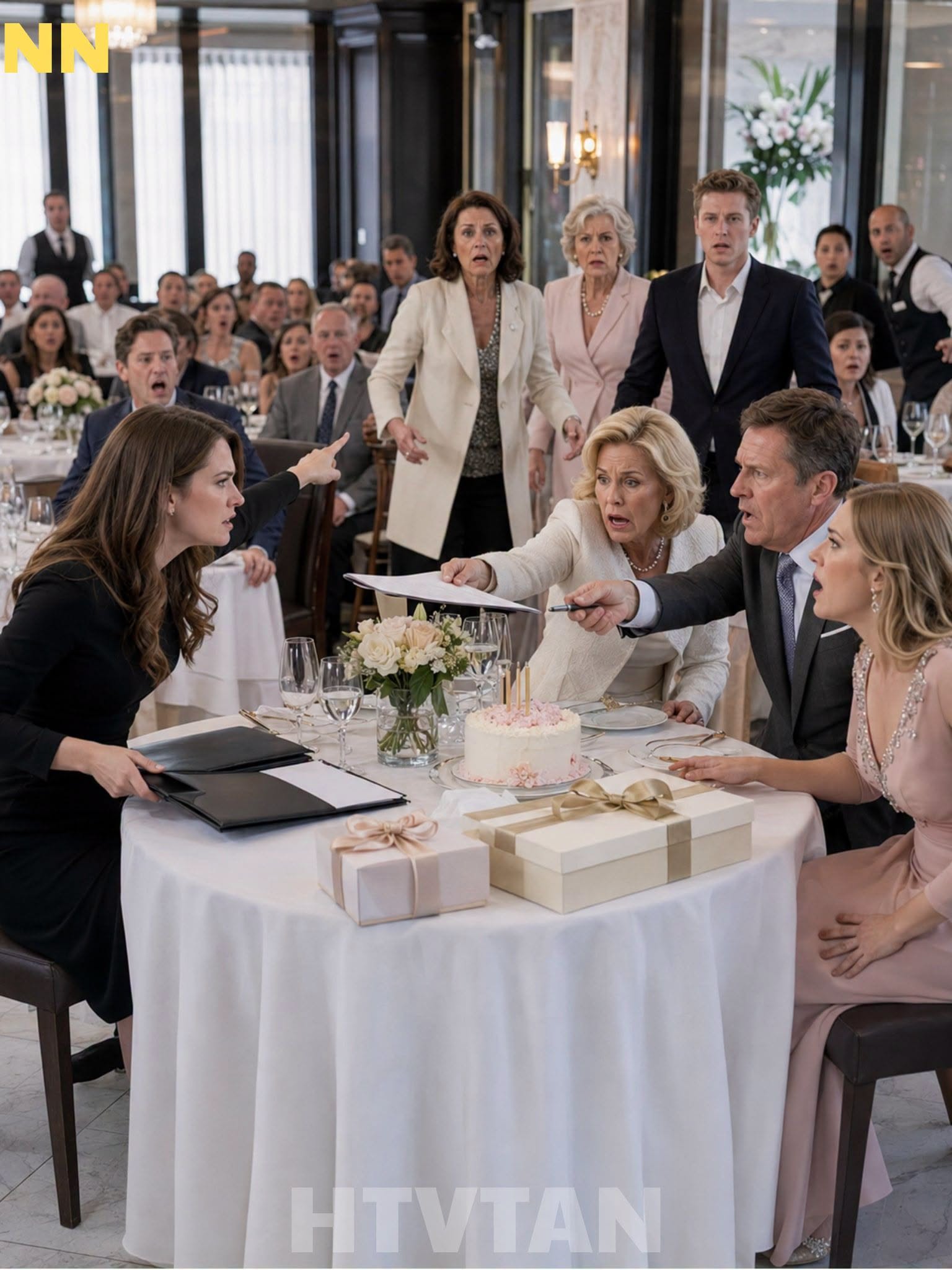
“We only kept you because it made sense at the time, Claire. You’re not useful to this family anymore,” my mother said, sliding a legal waiver across my twenty-eighth birthday dinner while my father pushed a pen toward my shaking hand. She expected me to surrender every inheritance claim while my sister watched with smug pity, as if twenty-eight years of humiliation could be erased by one signature. Instead, I opened the black folder beneath my hands and pointed three tables behind her. My biological mother, grandmother, and brother slowly stood. Mom’s face went white. She thought she was cutting me out of the family. She had just exposed exactly why the family fortune was never hers to control.
### Part 1
My mother pushed a legal waiver across the white tablecloth at The Alder Room, smiled over the rim of her wine glass, and said, “We only kept you because it made sense at the time, Claire, but you are not useful to this family anymore.”
She did not raise her voice, which somehow made it worse, because cruelty delivered calmly has a way of settling into a room like expensive perfume, quiet and impossible to ignore.
My father sat beside her with his tie perfectly centered and his hands folded over a leather briefcase, nodding as if ending a daughter’s place in the family was nothing more than closing an underperforming account.
Across from me, my sister Elise smoothed the skirt of her pale floral dress and looked at me with the soft, bored pity of someone watching a waitress bring the wrong soup.
Elise always got the floral dresses.
When I was seven, I found a pink dress in a donation box at school, a little wrinkled and missing one button, but soft enough that I carried it home inside my backpack like a secret I was afraid to breathe on.
I tried it on in my bedroom when the house was quiet, standing in front of the closet mirror with my bare feet pressed against the cold floor, and for maybe ten seconds I looked like a girl somebody might choose.
Then my mother came in, crossed the room without a word, grabbed the fabric, and tore it away from me like it was something dirty.
“You don’t deserve to wear a dress,” she said, leaving me shaking in that room while Elise stood in the hallway wearing yellow flowers and holding a doll with glass eyes.
After that, I wore khaki pants, navy shirts, practical shoes, and whatever made me invisible enough to survive breakfast.
Now, at my twenty-eighth birthday dinner, my family had gathered to remove me from the last paper trail that said I belonged to them.
What they did not know was that three tables behind my mother, my real family had been sitting in silence since before I walked in.
And the folder under my hands was not a surrender.
It was the one document they had never imagined I would find.
The Alder Room smelled like candle wax, lemon polish, and the kind of wine people order when they want the server to know they belong there.
My mother had chosen a round table near the back windows, not because it was private, but because it reflected beautifully in the glass, and Vanessa Greer liked being visible when she was winning.
She sat at the head of the table in a cream blazer with gold buttons, her chin lifted just enough to remind everyone that she had decided where we would eat, what we would order, and how the evening would end.
My father, Martin Greer, kept one hand near the brass clasp of his briefcase, tapping it twice, pausing, then tapping it once more.
I noticed because I had spent years learning how nervous people betray themselves before they speak.
Elise arrived nineteen minutes late in a floral dress that looked like springtime had been expensive on purpose, kissed my mother on both cheeks, and gave me a smile that never reached her eyes.
“Claire,” she said, as if my name tasted plain.
I nodded once.
The waiter came. Vanessa ordered for everyone without asking what I wanted.
“Claire will have the simple chicken,” she said, handing the menu back. “She has always preferred practical things.”
That was not true, but my mother had never needed truth when control was available.
I rested both hands on the slim black folder in front of me and looked at the linen fibers under my fingertips, each tiny thread crossing another in a pattern that held because tension made it strong.
That thought steadied me.
A few yards away, at the bar, a gray-haired man in a brown jacket sat with an untouched glass in front of him.
His name was Daniel Mercer, a retired legal officer who had spent thirty years making powerful people regret careless sentences.
He did not look at me directly.
He only turned his glass a quarter inch clockwise, and I knew what it meant.
He was listening.
So were the people three tables behind Vanessa.
I had asked them not to move, not to speak, not to rescue me, not yet.
“Let me finish this myself,” I had told them in Susan Bell’s tiny blue kitchen three weeks earlier, while rain tapped the window and a fourth chair sat pulled out beside the table like it had been waiting for twenty-eight years.
Susan had cried without making a sound.
Her son, Caleb, who had my jaw and my stubborn eyebrows, had stared at the floor so hard I thought the linoleum might crack.
Her mother, Rose, had taken both my hands and said, “Then we will sit where you can see us when it is over.”
I did not look back at them now.
If I did, I was afraid I would break before the war even began.
Vanessa waited until the appetizers arrived, tiny plates arranged too beautifully for anyone to be hungry, before she lifted her glass and smiled.
“Well,” she said, “there is no reason to drag this out.”
Martin opened the briefcase.
The sound of the clasp snapping loose cut through the table like a bone cracking.
He removed a packet of papers, thick with signatures, seals, and the cold confidence of people who believed paper could make cruelty respectable.
“We have revised our estate documents,” he said. “It is time to be realistic.”
Elise tilted her head and placed one manicured hand against her chest, performing sympathy the way a child performs a school play.
“You have always understood limits better than anyone, Claire,” she said. “This family has carried you long enough, and blood should protect blood.”
There it was.
Blood.
She pressed the word into the air between us and left it there like a fence.
Vanessa’s smile deepened, and Martin slid the waiver closer to my plate.
“Sign this tonight,” he said. “It simply confirms that you release any expectation of inheritance, property interest, or future claim against us.”
He said it like he was offering me a clean napkin.
My mother leaned back and crossed her arms.
“We only kept you because it made sense at the time,” she said. “The benefits, the family image, your grandmother’s little obsession with charity. But now you are twenty-eight, and Sutton—”
She stopped.
Her mouth tightened.
Elise’s original name had almost slipped out, the one from some older draft of their perfect family story, the one I had heard whispered once when I was small and ignored it because children ignore what they cannot survive knowing.
“Elise,” Vanessa corrected smoothly, “has a future to think about.”
I looked at the waiver.
Then I looked at my mother.
For a moment, I was seven again, feeling pink fabric tear under her fist.
But this time, there was no mirror behind me.
This time, I had witnesses.
And this time, I knew exactly where the seams were.
### Part 2
Martin pushed a pen toward me, silver and heavy, the kind of object he bought because it made even a signature feel obedient.
“Just sign, Claire,” he said. “Do not make this harder than it needs to be.”
I had heard some version of that sentence my entire life.
Do not make dinner awkward.
Do not upset your mother.
Do not embarrass Elise.
Do not ask about the checks.
Do not wear that.
Do not cry.
Do not make this harder than it needs to be.
The waiter passed behind me with a tray of glasses, and the tiny clink of crystal brought the room back into focus.
My mother’s wine sat untouched now, her fingers tight around the stem.
Elise had stopped pretending to be bored.
Martin’s pen hovered near my hand, waiting for the frightened girl he remembered to take it.
I did not.
Instead, I looked at him and said, “Which benefits were worth keeping me for, Martin?”
His face shifted.
Not much, not enough for someone else to notice, but enough for me.
A twitch near his left eye.
A shallow breath.
A glance at Vanessa before he could stop himself.
My mother’s smile froze.
“Do not be dramatic,” she said.
“I am asking a simple question.”
“No,” she said, setting her glass down. “You are trying to humiliate us in public because you have always been ungrateful.”
There it was again, the old machinery grinding into motion.
If I objected, I was dramatic.
If I remembered, I was bitter.
If I asked for the truth, I was ungrateful.
I placed my palm flat on the folder and let the silence stretch until Elise shifted in her chair.
Martin cleared his throat.
“The adoption came with certain financial arrangements,” he said carefully. “That is normal. Responsible families plan around resources.”
“Resources,” I repeated.
Vanessa’s eyes narrowed.
“The point is not the past,” she said. “The point is that you are no longer a dependent child, and you will not continue draining from a family that gave you every opportunity.”
I almost laughed, but not because anything was funny.
Every opportunity.
A bedroom with no lock because privacy was a privilege.
Birthdays where Elise got a cake and I got envelopes with grocery-store gift cards because “you like practical things.”
High school dances I did not attend because Vanessa said dresses made me look ridiculous and Martin said arguing about clothes was immature.
A college savings account my grandmother Marian had supposedly created for me, which somehow became “family flexibility” when Elise wanted a summer art program.
And still I had found a way out.
I had studied on buses, filled out forms at midnight, joined the service at eighteen, learned discipline from strangers because my own house had only taught me silence.
By twenty-eight, I had built a life Vanessa could neither decorate nor destroy.
That was why she needed this waiver.
Not because I was weak.
Because I was no longer reachable.
Martin slid the papers closer again, and this time the edge touched my plate.
“The adoption was generous,” he said. “Your mother and I gave you our name.”
Vanessa nodded, pleased with that.
“That name opened doors for you,” she said. “Do not forget that.”
I thought about the door of my childhood bedroom.
I thought about how often it closed.
Then I looked past Vanessa, not fully turning, just letting my eyes move enough to catch the reflection in the window.
Three tables behind her, Susan Bell sat very still with both hands folded in her lap.
Rose sat beside her, silver hair pinned neatly, her mouth pressed into a line that looked gentle from far away but was made of iron.
Caleb stared at Martin like he was memorizing a face he might need to describe later.
My throat tightened.
For twenty-eight years, they had believed I was gone because someone had told them the adoption had been closed, final, unreachable, sealed behind rules no ordinary family could fight.
Susan had been nineteen when she lost me, young enough to be frightened by lawyers, old enough to spend the rest of her life blaming herself.
She had written letters that never reached me.
She had left porch lights on.
She had kept a box of birthday cards in a closet, one for every year, each envelope addressed only to My Claire because she did not know what last name I had been given.
The first night I met her, she did not touch me until I touched her first.
That was how I knew she loved me.
Vanessa would have grabbed.
Susan waited.
Martin tapped the waiver with one finger.
“Your grandmother Marian may have had sentimental ideas,” he said, “but those ended with her. This is the legal reality now.”
That was the sentence I had been waiting for.
Not because it was smart.
Because it was wrong.
Daniel Mercer turned his glass again at the bar.
I opened the black folder.
The clasp made a small metallic sound, barely louder than a breath, but my mother heard it.
Her eyes dropped to my hands.
For the first time all night, she looked uncertain.
I removed one page and placed it beside the waiver.
Then a second.
Then a third, which I kept under my palm.
Elise leaned forward.
“What is that?”
I did not answer her.
I looked at Martin.
“You revised your will,” I said.
His chin lifted. “Correct.”
“You removed my name from your personal estate.”
“Correct.”
“You believe that means I have no claim to anything connected to this family.”
His confidence returned just enough to make him foolish.
“That is exactly what it means.”
I nodded slowly.
Then I slid the first page into the center of the table.
“That is interesting,” I said, “because your will was never the document that mattered.”
The silence changed.
Before, it had been tense.
Now it became sharp.
Vanessa looked down at the page but did not touch it.
Martin’s eyes moved over the heading.
His face emptied.
Elise whispered, “Dad?”
I turned the second page so Vanessa could read the highlighted clause.
“Marian Greer did not leave the main assets to you,” I said. “She placed them in an irrevocable trust.”
My mother’s mouth opened, then closed.
“That is old paperwork,” she said.
“No,” I said. “It is active paperwork.”
Martin reached for the page, but I placed two fingers on it first.
“Careful,” I said. “That is a certified copy.”
He pulled his hand back like the paper was hot.
I let the words come slowly, because people like Vanessa deserved to hear the door closing one hinge at a time.
“The trust paid care distributions to you and Martin while I was a minor, then continued transitional family distributions until my twenty-eighth birthday.”
Vanessa went pale under her makeup.
Elise looked between our faces, still trying to find the winning side.
“At midnight tonight,” I continued, “the remaining trust assets transfer to me.”
Martin’s lips moved, but no sound came out.
I tapped the waiver gently.
“This paper cannot release a trust you do not control.”
The room had narrowed to our table, to my mother’s fingers digging into white linen, to my father’s breathing turning shallow, to Elise’s floral dress suddenly looking childish and loud.
Vanessa finally found her voice.
“You do not understand what you are talking about.”
I looked toward the bar.
Daniel Mercer stood, adjusted his jacket, and walked toward us with the calm pace of a man who had never needed to hurry to be dangerous.
“No,” he said, stopping beside my chair. “She understands perfectly.”
### Part 3
Vanessa looked at Daniel Mercer as if a chair had started speaking.
“Who are you?” she demanded.
“Counsel,” he said.
One word.
It landed harder than a shouted accusation.
Martin closed his eyes for half a second, and in that half second I saw something in him cave in.
Not remorse.
Not love.
Recognition.
He knew the game had moved beyond the table, beyond the waiver, beyond Vanessa’s ability to shame everyone back into position.
Daniel did not sit down.
He stood at my right shoulder, hands relaxed, expression unreadable, and somehow the whole table rearranged itself around his presence.
“We have already notified the trustee,” he said. “The transfer process began this morning. Any attempt to coerce Ms. Bell into signing a release tonight will be documented.”
“Ms. Bell?” Elise said sharply.
Vanessa turned back to me.
Her face had gone still in the old dangerous way, the calm that used to come before punishment.
“Your name is Greer,” she said.
I opened the folder again and removed the third page.
This one I had not wanted to use quickly.
It felt different from the trust papers.
The trust documents were weapons.
This was a wound.
I laid the certified birth record on the table and turned it toward my mother.
“My name was Claire Bell before you changed it,” I said.
Vanessa stared at the page.
For one second, she looked less like a woman losing money and more like a woman seeing a ghost she had buried badly.
Elise reached for the document, but Daniel’s voice stopped her.
“Do not touch that.”
She froze.
Martin rubbed both hands over his face.
“Oh, God,” he whispered.
It was the first honest sound he had made all night.
I looked at him, waiting.
There are moments in life when a person can still become something better than what they have been.
Small moments.
Brief ones.
A cracked door.
A hand reaching back from the edge.
Martin had one right there.
All he had to do was say, “I knew.”
All he had to do was say, “I am sorry.”
All he had to do was look at me without looking at Vanessa first.
His eyes lifted to mine, wet and frightened.
“Marian loved you,” he said.
My chest tightened despite everything.
Then he looked at Vanessa.
She gave him one cold glance.
And my father folded.
He looked down at the table.
That was all.
That was his choice.
Twenty-one years after he had watched my mother tear a dress off my body, he was still looking away.
The last thread snapped so quietly that only I heard it.
Vanessa shoved her chair back.
“You are making a disgusting scene,” she hissed.
“No,” Daniel said. “You did that when you described your adopted daughter as a financial benefit in a restaurant full of witnesses.”
My mother’s eyes flashed.
She turned on him first because she thought men with gray hair and calm voices might still respond to status.
“You have no idea what this family has done for her.”
Daniel glanced at the waiver, then at the trust papers.
“I have a fairly detailed idea.”
Elise stood halfway, then sat again when no one followed her.
“This is insane,” she said. “Claire, just because you found some technicality does not mean you get to destroy everyone.”
I looked at my sister.
For years, I had hated her floral dresses more than I hated her.
That sounds ridiculous unless you have lived as the unwanted child in a house where fabric, cake, affection, and forgiveness are all handed out unevenly.
But sitting there, watching Elise panic because the money river had changed direction, I realized she had not won either.
She had been raised to believe love was proof of superiority.
That was its own kind of cage.
I still did not feel sorry enough to open the door for her.
“You said blood should protect blood,” I told her. “You were right.”
Her face crumpled with confusion.
Then Vanessa understood.
Her head turned slowly, following my gaze past her shoulder.
Three tables behind her, Susan Bell stood up.
She was not glamorous.
She wore a simple blue dress and a gray cardigan, and her hands were clasped in front of her like she was trying to keep herself from reaching for me too soon.
Beside her, Rose rose carefully from her chair, small and straight-backed, with eyes that had seen enough life to know that rage did not need noise to be real.
Caleb stood last, knocking his knee against the table so hard the glasses trembled, then muttering, “Sorry,” under his breath because he was nervous and human and exactly the kind of brother I had not known how badly I wanted.
The restaurant went completely silent.
Vanessa stared at them.
“No,” she said.
It came out small.
I stood.
“My biological family is sitting right there,” I said. “They heard everything.”
Susan’s eyes filled, but she did not cry.
I had asked her not to rescue me, and even now, every line of her body showed the cost of keeping that promise.
Vanessa’s face twisted.
“Those people abandoned you.”
Susan flinched.
That was the first thing that made me angry.
Not the waiver.
Not the money.
Not even the dress.
That flinch.
The way my mother by birth absorbed a lie she had been punished by for almost three decades.
I stepped away from the table.
“No,” I said. “They lost me.”
Vanessa laughed once, ugly and sharp.
“And now they want you because there is money.”
Rose’s voice came from behind her, quiet but clear.
“We wanted her when we had nothing.”
The sentence moved through the room like a candle being lit.
Vanessa had no answer to it.
Martin stayed seated, shoulders curved inward, staring at the trust documents as if grief might change the numbers.
Elise whispered, “Mom, do something.”
For the first time in my life, my mother had nothing to do.
Daniel picked up the waiver and placed it back in front of Martin.
“I suggest you take this home,” he said. “You may want to preserve it for your own attorney.”
Martin looked at me then.
Really looked.
“Claire,” he said, and my name sounded unfamiliar in his mouth. “We can talk.”
I thought about every year I had waited for him to talk.
When I was seven and the torn pink dress lay on the floor.
When I was thirteen and Vanessa made me return a school choir dress because Elise said I looked strange in it.
When I was seventeen and I left for basic training with one duffel bag and no one hugged me at the airport.
When I was twenty-three and Marian died, and Martin told me there was no need to attend the reading because “these things are complicated.”
We could have talked in any of those years.
He was only ready now because silence had become expensive.
“No,” I said.
Just that.
No.
Then I walked toward the table where Susan, Rose, and Caleb were waiting.
Fifteen steps can be longer than twenty-eight years when every step takes you away from the only family you were told you had and toward the one that never stopped leaving a light on.
I did not look back.
### Part 4
Rose reached me first.
She lifted both hands to my face, her palms warm and dry, her thumbs resting gently beneath my eyes like she was checking whether I was real.
“There you are,” she whispered.
Not where have you been.
Not why didn’t you find us sooner.
Not look what they did.
Just there you are.
Something inside me gave way so suddenly I almost stepped back from it.
Susan moved closer but still did not touch me until I turned to her.
That patience broke me more than any embrace could have.
I reached for her first.
She made one sound, almost a breath and almost a sob, then wrapped her arms around me with such careful strength that I understood she had practiced this hug in her head for years and still did not trust herself not to hold too tightly.
“You kept a chair,” I said against her shoulder.
“Every birthday,” she whispered. “Every single one.”
Caleb cleared his throat beside us.
“I know this is probably weird,” he said, voice rough, “but I am really glad you are here.”
I laughed then.
It was small and shaky and completely unexpected.
Across the restaurant, Elise started crying.
Not the quiet kind.
The kind meant to be noticed.
Vanessa snapped something at her, and Martin muttered back, and suddenly the Greer table sounded exactly like it had always sounded when the doors were closed, all blame looking for somewhere soft to land.
Only this time, I was not available.
Daniel came over and placed my black folder on the empty chair beside me.
“You handled yourself well,” he said.
“I almost didn’t.”
“Almost does not count in law or aviation,” he replied.
Rose smiled faintly. “I like him.”
For ten minutes, maybe fifteen, we sat at that table like people recovering from a storm that had passed over the roof but not destroyed the house.
The waiter approached nervously and asked if we needed anything.
Susan looked at me.
I looked at the untouched plates, the folded napkin, the empty chair that had been waiting.
“Coffee,” I said. “And whatever dessert is easiest.”
Caleb grinned.
“That is the most military answer I have ever heard.”
“I am trying to be emotionally vulnerable,” I said. “Do not rush me.”
He laughed, and the sound loosened something in the room.
When the desserts came, Rose insisted on dividing one slice of chocolate cake into four uneven pieces, giving me the largest without asking.
It was such a grandmother thing to do that I had to look down at my plate until my eyes stopped burning.
Susan told me about the small house on Maple Hollow Lane, about the porch light, about the box of birthday cards.
Caleb told me he had almost driven to my apartment the night Susan found my contact information but turned around because Rose said, “Do not show up like a raccoon at a garbage can. Let the girl breathe.”
Rose denied saying it exactly that way.
Caleb insisted she had.
For the first time that night, my body believed I was safe enough to be tired.
Then Vanessa appeared beside our table.
Of course she did.
People like Vanessa did not understand endings that were not delivered by them.
Her makeup had settled into the lines around her mouth, and her blazer was slightly crooked where anger had pulled her out of shape.
She did not look at Susan.
She looked only at me.
“Claire, we are leaving.”
The old command landed automatically.
For one terrible second, my muscles remembered obedience.
Then Caleb shifted beside me, not standing, not threatening, just present.
Susan’s hand rested lightly on the table near mine.
Rose kept eating cake.
I looked up at Vanessa.
“No,” I said.
Her nostrils flared.
“You are making a mistake.”
“No,” I said again. “I made the mistake every time I thought staying quiet would make you love me.”
That one reached her.
I saw it enter, saw it strike something she did not want touched.
Her face hardened.
“Love?” she said. “You have no idea what love costs.”
Susan’s fingers curled against the table.
I did not let her answer.
“I know exactly what your version cost,” I said. “It cost me birthdays, dresses, mirrors, sleep, and twenty-eight years of believing I had to be useful to be kept.”
Vanessa leaned closer.
“Those people cannot undo what we gave you.”
“No,” I said. “But they also did not ask me to sign a waiver before dessert.”
Rose made a small choking sound.
Caleb covered his mouth.
Even Daniel, still standing near the edge of the room, looked down as if hiding a smile.
Vanessa’s eyes flashed.
“This is not over.”
“It is for me.”
“You will regret humiliating your own mother.”
I stood then, slowly, because I wanted her to feel the difference between the child she had cornered and the woman she could no longer reach.
“You were never humiliated by me,” I said. “You were overheard being honest.”
Her hand twitched at her side.
For a moment, I thought she might reach for me.
She did not.
Too many people were watching.
That had always been the limit of Vanessa Greer’s courage.
She could destroy a child in a bedroom, but she could not bear looking ugly in public.
Martin appeared near the hallway, holding the briefcase against his chest like a shield.
Elise stood behind him, mascara streaked, floral dress wrinkled from sitting too long in panic.
My father looked at Susan, then at me.
“I hope someday you understand we did our best,” he said.
I waited for the old ache.
It did not come.
“No,” I said. “You did what was easiest.”
Martin’s face collapsed inward.
Vanessa grabbed his arm.
They left without another word.
Through the front windows, I watched them step into the cold night, three figures moving under the streetlights, smaller than they had ever looked from inside their own story.
When the door closed behind them, I sat back down.
Rose pushed my cake toward me.
“Eat,” she said. “Freedom is easier with sugar.”
And because no one at that table laughed at me for crying, I let myself cry.
### Part 5
The transfer did not happen like it does in movies.
There was no single dramatic phone call, no gold key handed over in a velvet box, no instant moment where the universe rearranged itself to make justice convenient.
There were emails, signatures, certified letters, tax forms, account verifications, old property records, and several conversations with Daniel Mercer that began with him saying, “This part will be tedious but important.”
I liked tedious but important.
It felt honest.
By the end of the first month, the trust had officially shifted into my control.
By the end of the second, Martin and Vanessa had learned that the Caldwell Drive house, the investment account they called “family reserves,” and the quarterly distributions that had funded Elise’s comfortable emergencies were not theirs to command anymore.
By the end of the third, Vanessa had sent twelve emails, four handwritten letters, and one birthday card with no apology inside.
The card had a watercolor cake on the front.
Inside, she wrote, We should not let money divide family.
I stared at that sentence for a long time at my kitchen counter, still wearing running clothes, sweat cooling on my back.
Then I dropped it into the shredder.
Not angrily.
Efficiently.
That was the surprising part of freedom.
I had expected it to feel like fire.
Most days, it felt like opening windows.
Susan and I did not become mother and daughter overnight in the easy way people imagine.
We were strangers with matching grief.
She knew my first word, but not how I took my coffee.
I knew her handwriting from twenty-eight birthday cards, but not the sound she made when she was annoyed at traffic.
We learned slowly.
Sunday dinners.
Awkward phone calls.
A trip to the grocery store where she cried in the cereal aisle because I casually said I hated peaches, and she had spent years imagining I loved them because she loved them.
Caleb started texting me pictures of ordinary things with captions like, Your brother has successfully assembled a chair and only has two screws left, which I found concerning but charming.
Rose called every Thursday at seven.
She never asked if I was busy.
She simply said, “It is Thursday,” and began talking.
I came to depend on it.
The trust gave me options, but the Bells gave me something harder to name.
Not rescue.
Not repair.
Witness.
They saw what had happened and did not ask me to make it smaller for their comfort.
One afternoon, Susan brought out the box of birthday cards.
We sat on her living room floor with rain darkening the windows, and she handed them to me in order.
Age one had a cartoon bear.
Age five had glitter.
Age sixteen had a long letter about how she hoped I had someone teaching me to drive carefully.
Age twenty-one simply said, I hope somebody is proud of you today. I am.
I read that one three times.
Then I folded it carefully and held it against my chest.
“I looked for you,” she said.
“I know.”
“I should have fought harder.”
I looked at her then.
The old Claire, the one Vanessa had raised, might have agreed because blame was familiar and somebody always had to hold it.
But I was learning that truth did not need to become another weapon.
“You were nineteen,” I said. “They had lawyers. You had grief.”
Susan cried then, and I did not tell her not to.
We were done making pain behave politely.
Elise showed up at my apartment six months after the dinner.
She stood outside my door in jeans and a plain sweater, no floral dress, no perfect hair, no mother beside her.
I almost did not open it.
Then I did, because curiosity is not forgiveness.
“What do you want?” I asked.
She swallowed.
“Mom and Dad are selling the house.”
“I know.”
“She says it is your fault.”
“I know that too.”
Elise looked smaller without an audience.
For the first time, I noticed how young she seemed, though she was only two years younger than me.
“Did you really hate me?” she asked.
I leaned against the doorframe.
“Sometimes.”
She flinched.
I did not soften it.
“But mostly I hated that you never questioned why hurting me made you feel safe.”
Tears filled her eyes.
“I was a kid.”
“So was I.”
That stopped her.
She looked down at her hands.
“I do not know how to be around you now.”
“Then don’t be around me yet.”
Her head lifted.
I watched the old entitlement rise, then fight with something newer and less certain.
“Are you cutting me off completely?”
“I am not funding your life,” I said. “I am not becoming your replacement parent. I am not giving you access to the trust because you cried in my hallway.”
She nodded, cheeks red.
“But,” I added, “if someday you want to talk without asking me for something, you can send one message.”
She cried harder then, quietly this time.
“I am sorry about the dresses,” she whispered.
It was such a strange apology, so specific and small, that I believed it more than I expected to.
“Me too,” I said.
Then I closed the door.
Not slammed.
Closed.
There is a difference.
### Part 6
A year after The Alder Room, I bought a dress.
Not because anyone told me I deserved one.
Not because I wanted Vanessa to see it.
Not because a courtroom, a trust, a legal victory, or a new family had magically erased the old mirror from my mind.
I bought it because I was walking past a small shop on a bright Saturday morning, smelled rain on hot pavement, saw a deep blue dress in the window, and realized I wanted to try it on.
That was all.
Wanting something had become reason enough.
The woman at the shop unlocked a fitting room for me and hung the dress on a brass hook.
For a long moment, I just stared at it.
Soft fabric.
Simple waist.
No flowers.
No apology.
My hands shook when I slipped it over my head.
Memory is rude that way.
It does not ask whether the present has earned the past.
It just arrives.
For a second, the fitting room lights became late afternoon sun.
The mirror became a closet door.
My mother’s footsteps came back across the floor.
I gripped the edge of the curtain and breathed the way I had been trained to breathe through panic, through altitude alarms, through rooms where everyone expected me to fail.
Then I looked up.
The woman in the mirror was not seven.
She was twenty-nine.
She had short dark hair, strong shoulders, tired eyes, and a blue dress that fit like it had no opinion about whether she was worthy.
I laughed once, then cried so suddenly I had to sit down on the little bench.
The shopkeeper knocked softly.
“Everything okay in there?”
I wiped my face.
“Yes,” I said. “I am taking it.”
I wore it to Susan’s house that evening.
Rose opened the door and froze.
Caleb looked up from the couch and said, “Whoa, somebody warn the neighbors, Claire discovered fashion.”
Susan elbowed him so hard he yelped.
Then she looked at me, really looked, and tears filled her eyes.
“You look like yourself,” she said.
That was better than beautiful.
Better than worthy.
Better than any word Vanessa had ever withheld.
We ate dinner on the back porch under white string lights that Caleb had hung crookedly and refused to fix because he said perfection was bad for morale.
Rose made pot roast.
Susan made a cake with uneven frosting.
I brought store-bought rolls because I still believed bread should not require emotional labor.
After dinner, Daniel Mercer stopped by with final papers for a charitable education fund I had created from part of the trust.
Not a foundation with my name carved on a wall.
Not a performance.
Just money quietly directed toward children aging out of systems where adults used paperwork to decide their value.
Daniel reviewed the documents at Susan’s kitchen table while Rose complained that lawyers charged too much for sentences nobody could understand.
“That is our entire business model,” Daniel said.
Caleb laughed so hard he spilled iced tea.
Later, when the dishes were done and the porch had gone cool, Susan handed me one more card.
No envelope this time.
Just a folded piece of cream paper.
“What is this?”
“Your next birthday card,” she said. “I am early for once.”
I opened it under the porch light.
Claire, you do not have to catch up on being loved. You are not late. You are here.
I read it twice.
Then I folded it and pressed it flat against my knee.
Vanessa called that night.
I knew because my phone lit up with her name while I was still sitting on Susan’s porch in the blue dress.
I watched it ring.
Once.
Twice.
Three times.
Then it stopped.
A voicemail appeared.
I did not listen.
Instead, I blocked the number.
The decision felt almost disappointingly simple.
No thunder.
No shaking.
No final speech.
Just my thumb touching a screen and a door closing where it should have closed years before.
Martin sent one letter after that.
He wrote that Vanessa was struggling, that Elise was distant, that the house sale had been painful, that he hoped time would soften me.
He wrote many things.
He did not write, I failed you.
So I did not write back.
Elise did message once.
Not asking for money.
Not defending Vanessa.
Just one sentence.
I am trying to remember differently.
I waited three days before answering.
Good.
That was all I could give her.
That was all I wanted to give.
Some people think not forgiving means carrying anger forever, but that is not what happened to me.
Not forgiving Vanessa meant I stopped leaving a chair open for someone who only entered rooms to take inventory.
It meant I stopped explaining my pain to people committed to mispricing it.
It meant I could love Susan without making her compete with a woman who never mothered me.
It meant I could look at Martin’s silence and call it a choice.
It meant I could see Elise as damaged without volunteering to be the place where her damage landed.
A few weeks before my thirtieth birthday, I returned to The Alder Room.
Not for revenge.
For dinner.
Susan, Rose, Caleb, Daniel, and I sat near the windows, not at Vanessa’s old table but close enough that I could see the reflection of the room in the glass.
The restaurant still smelled like candle wax and lemon polish.
The chairs still scraped softly over the carpet.
The wine glasses still caught the light.
But nothing in that room owned me anymore.
When the waiter asked what I wanted, Susan opened her mouth, probably to recommend something, then stopped herself and smiled.
I looked at the menu.
Really looked.
Then I ordered the most impractical dish on it, a ridiculous tower of seafood and pastry with a sauce I could not pronounce.
Caleb saluted me with his water glass.
“Growth,” he said.
Rose nodded solemnly. “Financially irresponsible growth.”
I laughed until my ribs hurt.
Near the end of dinner, Daniel raised his glass.
“To clean exits,” he said.
Susan lifted hers.
“To kept chairs.”
Rose lifted hers.
“To dresses.”
Caleb lifted his.
“To not letting Grandma make toast after one glass of wine.”
Rose smacked his arm.
I lifted my glass last.
For a moment, the reflection in the window showed me all of us together, a family made not by paperwork, not by blood alone, not by obligation, but by the daily decision to stay kind when staying cruel would be easier.
I thought of Vanessa somewhere else, perhaps still telling anyone who listened that I had betrayed her.
I thought of Martin sitting in a smaller house with smaller rooms and the same silence he had chosen over me.
I thought of Elise trying, maybe honestly, maybe not, to remember differently.
Then I let them go.
The girl in the pink dress had deserved softness.
The woman in the blue dress had finally given it to her.
THE END!