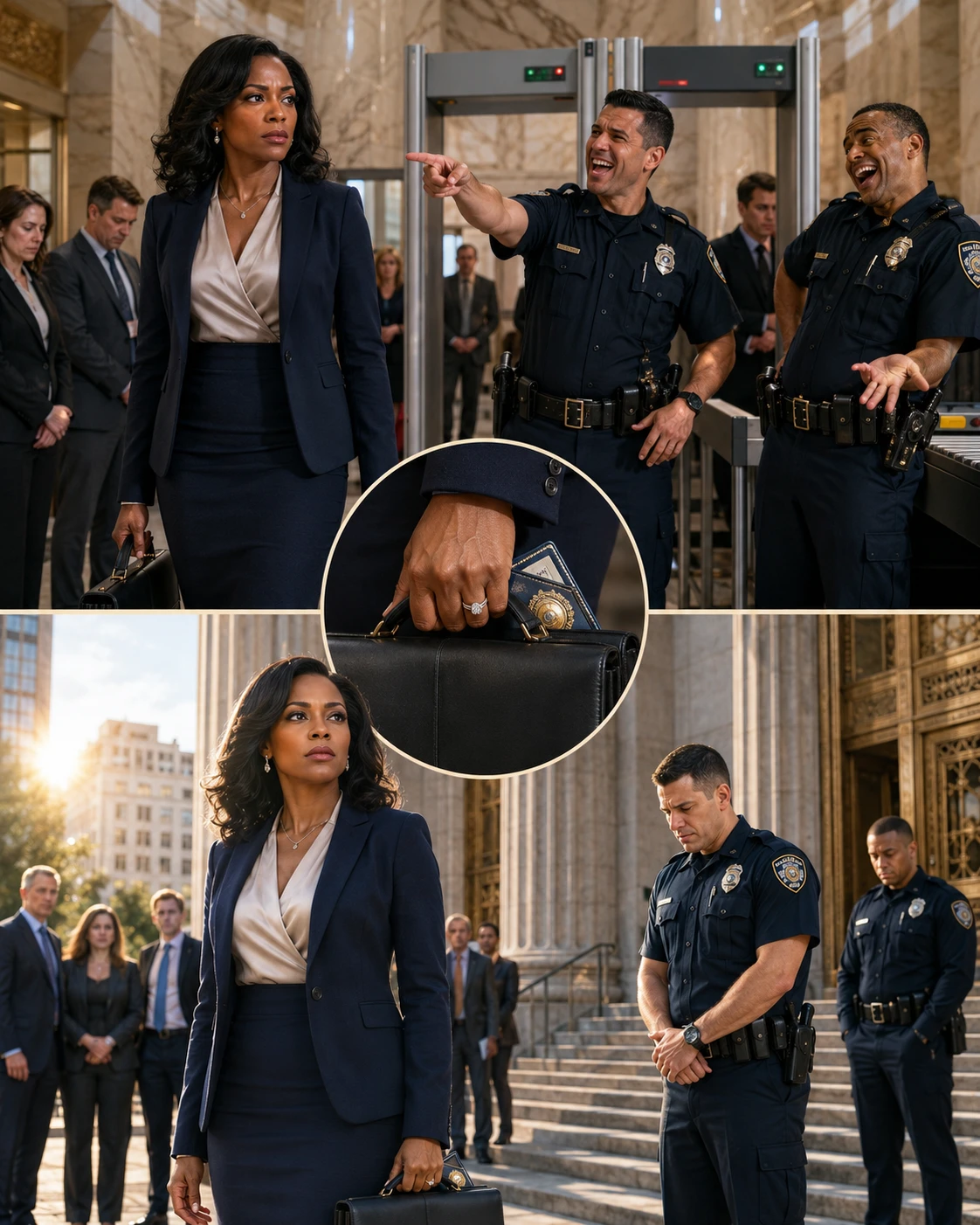
PART 1: THEY STARTED LAUGHING BEFORE I REACHED THE DOOR
The laughter started before I even made it through the courthouse doors.
At first, I thought it belonged to someone else.
Courthouses are full of strange sounds.
Nervous laughter.
Angry whispers.
Shoes striking marble.
Attorneys talking too loudly into phones because they want everyone nearby to know they are attorneys.
Families arguing in corners.
Defendants pretending not to be afraid.
I had spent enough time inside government buildings to know how fear disguised itself.
Sometimes as silence.
Sometimes as arrogance.
Sometimes as laughter.
But when I looked up, I realized the laughter was aimed at me.
Officer Daniel Martinez stood near the security checkpoint with his partner, Officer Carter.
I recognized both of them immediately.
Martinez recognized me too.
His eyes locked onto mine.
Then his mouth curled into the same small, satisfied smile I remembered from the side of the road.
He pointed at me.
Not casually.
Not subtly.
His finger shot forward as if he were identifying a suspect.
“There she is.”
Carter followed his gaze.
Then Martinez said it.
“The welfare queen thinks she’s somebody important.”
The words carried across the marble hallway.
Loud enough for me to hear.
Loud enough for Carter to hear.
Loud enough for the security officers near the metal detector to hear.
Loud enough for the woman holding a toddler ten feet away to glance over.
For a moment, nobody reacted.
Then Carter exploded into laughter.
He threw his head back dramatically.
Martinez grinned.
I stopped walking.
There are moments when your body reacts before your mind does.
My shoulders tightened.
My jaw locked.
Heat rose from my chest to my throat.
For one second, the hallway disappeared.
I saw red and blue lights.
A dark road.
Martinez leaning toward my driver’s-side window.
Carter standing behind him with one hand near his belt.
I heard Martinez asking me where I had stolen the car.
I heard myself answering calmly.
I remembered the way he had looked at my identification.
Not read it.
Looked at it.
As if the name printed there could not possibly belong to the woman sitting behind the wheel.
Then the courthouse hallway snapped back into focus.
Carter bent slightly at the waist and performed a ridiculous curtsy.
“Your Majesty.”
Martinez cupped both hands around his mouth.
“Need help finding the food stamp office?”
More laughter.
Their laughter bounced off the polished walls.
Sharp.
Deliberate.
Humiliating.
The thing about public humiliation is that the cruelty rarely belongs only to the person speaking.
It spreads.
It asks everyone nearby to make a choice.
Laugh.
Object.
Look away.
Most people chose the third option.
A man in a gray suit suddenly became fascinated by his phone.
A clerk carrying folders lowered her eyes.
The woman with the toddler pulled her child closer.
One security officer stared at Martinez, clearly uncomfortable, but said nothing.
I understood why.
Martinez was wearing a badge.
People often confuse a badge with permission.
They confuse authority with truth.
And men like Martinez depend on that confusion.
Carter wiped imaginary tears from his eyes.
“Oh, man,” he said. “She looks mad.”
I wasn’t.
Not exactly.
Anger would have been easier.
Anger was hot.
Useful.
Fast.
What I felt was colder.
I had spent twenty years walking into rooms where a single badly chosen sentence could alter federal policy, trigger diplomatic consequences, or put lives at risk.
I had briefed presidents.
Governors.
Military commanders.
Cabinet officials.
I had sat across from people who threatened the United States without ever raising their voices.
I had learned a long time ago that the loudest person in the room was rarely the most dangerous.
So I didn’t shout.
I didn’t threaten.
I didn’t tell them who I was.
Instead, I adjusted the strap of my government-issued briefcase.
The motion seemed to amuse Martinez.
“Look at that,” he said. “She brought a little briefcase.”
Carter snorted.
“What you got in there? Coupons?”
I looked at him.
Really looked at him.
His laughter weakened.
Only slightly.
But I noticed.
People who enjoy humiliating others usually expect one of two reactions.
Submission.
Or rage.
Both make them feel powerful.
Calm makes them nervous.
I smoothed the front of my blazer.
Then I looked at Martinez.
Steady.
Cold.
Precise.
Not because I was trying to intimidate him.
Because I was measuring him.
His stance.
His breathing.
His confidence.
The casual cruelty.
The complete certainty that nothing could happen to him.
He still didn’t know who I was.
And for the first time that morning, I realized that might be useful.
“Nothing to say?” Martinez asked.
I held his gaze.
“No.”
His smile widened.
He interpreted restraint as weakness.
That mistake had ruined better men than him.
I continued toward the courtroom.
Behind me, Carter whispered something.
They laughed again.
I kept walking.
Every step became deliberate.
Left foot.
Right foot.
Breathe.
Do not turn around.
Do not give them the moment they want.
Because sometimes the most dangerous thing you can do to an arrogant person is let them keep talking.
Three weeks earlier, I had not expected any of this.
March 15 had begun as one of the longest days of my year.
I had spent nine hours in meetings.
Two secure briefings.
Three calls that could not be summarized in ordinary email.
By the time I left the office, my head felt packed with static.
I wanted silence.
No staff.
No security conversation.
No policy.
No crisis.
Just the road home.
I drove myself whenever I could.
People found that strange.
At my level, almost everything became logistical.
Schedules.
Drivers.
Advance teams.
Protocol.
But driving gave me something government service rarely did.
Anonymity.
A red light did not care what position I held.
Traffic did not stand when I entered.
For thirty minutes, I could simply be Amara.
A woman going home.
That night, I took a route I had driven many times.
I remember glancing at my speedometer.
I remember the speed-limit sign.
I remember slowing after coming down a slight incline.
Then lights flashed behind me.
Red.
Blue.
Red.
Blue.
I pulled over immediately.
Hands visible.
Window down.
Engine off.
Not because I didn’t know my rights.
Because I knew exactly how quickly ordinary encounters could become dangerous.
Martinez approached first.
Carter stayed several steps behind.
“License and registration.”
No greeting.
No explanation.
I reached slowly.
“My license is in my wallet.”
“I didn’t ask where it was.”
His tone surprised me.
I looked up.
His expression was already hard.
I handed him my driver’s license.
His eyes moved from the card to my face.
Back to the card.
Back to me.
Then he gave a short laugh.
“This your car?”
“Yes.”
“Really?”
“Yes.”
He looked toward Carter.
Carter smirked.
Martinez tapped the roof with two fingers.
“Nice vehicle.”
I waited.
“Whose is it?”
“Mine.”
That was when the atmosphere changed.
Not dramatically.
Not in a way a camera would necessarily capture from twenty feet away.
But I felt it.
The same shift I had learned to detect in hostile meetings.
Martinez had decided something about me.
And now every fact would be forced to fit whatever he had already decided.
“Step out of the vehicle.”
“Officer, may I ask why?”
His face sharpened.
“I said step out.”
I did.
Carter moved closer.
Martinez asked where I was going.
I told him home.
He asked where I worked.
I told him federal service.
He laughed.
“What kind?”
“I’d prefer to keep the conversation related to the traffic stop.”
That was the moment he stopped pretending.
“People like you always think you know how this works.”
People like you.
Three words.
Simple.
Ancient.
Familiar.
I had heard variations of them my entire life.
At universities.
In government offices.
At formal dinners.
In hallways where people assumed I was administrative staff.
At checkpoints where my credentials were examined three times longer than everyone else’s.
But there was something different about hearing it on a dark roadside from a man with a badge, a weapon, and complete control of the encounter.
I stayed calm.
He issued the citation.
Fifteen miles per hour over the limit.
I looked at it.
Then at him.
“I wasn’t traveling fifteen over.”
His smile returned.
“You can tell it to the judge.”
So I did.
That was why I was in the courthouse.
Not to destroy him.
Not to make a political statement.
Not to prove how important I was.
I was there because a police officer had made an accusation, and I knew it was wrong.
I had no idea, walking into that building, that Martinez would make my case for me before the hearing even started.
When I entered the courtroom, I chose a seat near the front.
My briefcase rested beside me.
Martinez entered several minutes later.
The transformation was immediate.
The man who had been shouting about food stamps in the hallway disappeared.
His shoulders straightened.
His expression became serious.
Professional.
Controlled.
He greeted his attorney quietly.
Then he glanced toward me.
For half a second, the smirk returned.
And I understood.
This was his stage now.
The hallway had been entertainment.
The courtroom was performance.
He believed he knew both roles perfectly.
What he didn’t understand was that I had spent my entire career watching people perform under pressure.
And sooner or later, every performance cracks.
The clerk called the matter.
Martinez walked to the witness stand.
He raised his hand.
Swore to tell the truth.
Then sat down.
The attorney representing him adjusted his tailored jacket and approached.
“State your name for the record.”
Martinez leaned toward the microphone.
“Officer Daniel Martinez. Badge number 4187.”
His voice filled the room.
Strong.
Comfortable.
“Years of service?”
“Fifteen.”
A pause.
Then, with perfect solemnity:
“Fifteen years of dedicated service to this community.”
I watched him.
His eyes shifted toward me.
“Fifteen years dealing with people who think the rules don’t apply to them.”
There it was.
Not enough to object to.
Not enough to shock anyone.
Just enough to remind me that he still believed I was beneath him.
His attorney nodded.
“Officer Martinez, tell the court what happened on the evening of March fifteenth.”
Martinez leaned closer to the microphone.
“My partner, Officer Carter, and I were conducting routine patrol duties when we observed a vehicle traveling approximately fifteen miles per hour over the posted speed limit.”
Smooth.
Practiced.
Believable.
“Standard traffic violation.”
The judge listened.
The clerk typed.
Carter sat behind the counsel table, expression smug.
And I sat perfectly still.
Because as Martinez continued speaking, something became clear.
He wasn’t afraid of contradicting me.
He wasn’t afraid of exaggerating.
He wasn’t afraid of the court.
He thought the truth belonged to whoever wore the uniform.
Then his attorney asked the question that changed everything.
“Did the driver cooperate?”
Martinez looked directly at me.
And smiled.
“No.”
I felt the room tighten.
“She was argumentative from the beginning.”
That was when I knew I could not remain seated much longer.
PART 2: HIS VERSION OF ME
I have spent much of my life being described by people who met me before they knew me.
Aggressive.
Intimidating.
Cold.
Difficult.
Demanding.
Those words change meaning depending on who is being described.
A man who speaks firmly is decisive.
A Black woman who speaks firmly is angry.
A man who refuses to answer an irrelevant question is disciplined.
A Black woman who does it is uncooperative.
I had learned that lesson young.
I had learned it again in college.
Again in federal service.
Again in conference rooms where men repeated my ideas five minutes after dismissing them.
But hearing Martinez use the same mechanism under oath made something in me settle.
Not break.
Settle.
His attorney continued.
“In what way was she argumentative?”
Martinez folded his hands.
“She questioned basic instructions.”
“Such as?”
“I asked for identification. She challenged me.”
That was false.
Not dramatically false.
Not movie-villain false.
The dangerous kind.
The kind that takes a real event and bends it just enough.
I had asked why I needed to exit the vehicle.
Now that became challenging him.
I had asked that our conversation remain relevant to the traffic stop.
Now that became refusing instructions.
He was building a version of me one small distortion at a time.
“And what was her attitude?”
Martinez sighed as if the memory exhausted him.
“Entitled.”
His eyes moved toward me again.
“She acted like normal procedures didn’t apply to her.”
The attorney nodded gravely.
“Did she identify herself as someone important?”
That question made me look up.
Martinez hesitated.
For the first time, his rhythm changed.
“No.”
“Did she threaten you with her employment?”
“No.”
“Did she demand special treatment?”
“No.”
Three answers.
All true.
The attorney probably thought they helped him.
They helped me more.
Because the entire story Martinez was telling depended on one idea.
That I thought I was above the law.
Yet I had never told him who I was.
Never asked for special treatment.
Never used my title.
Never threatened his career.
Never asked him whether he knew who I was.
I had done exactly what citizens are constantly told to do.
Stay calm.
Comply.
Challenge the citation later.
And now I was challenging it later.
In court.
Exactly where he had told me to.
His attorney seemed pleased.
“So despite her attitude, you remained professional?”
“Yes.”
Carter shifted behind him.
I looked at Carter.
He avoided my eyes.
Interesting.
Martinez continued.
“I explained the reason for the stop and issued the appropriate citation.”
“Did you treat her differently because of her race?”
“No.”
The answer came instantly.
Too instantly.
“Did you use any racial language?”
“No.”
I felt something cold move through me.
The courthouse hallway had happened less than thirty minutes earlier.
The welfare queen.
The food stamp office.
People like you.
He had reduced the question to technical language.
Had he used an explicit racial slur?
No.
Therefore, in his mind, nothing racial had occurred.
That was how prejudice survived in respectable places.
Not always through confession.
Through definitions designed to exclude the obvious.
The attorney stepped away.
“No further questions at this time.”
The judge looked toward my side.
I had representation available to me.
Of course I did.
People in my position always did.
But this hearing had begun as something ordinary.
I had insisted on treating it that way.
No spectacle.
No government lawyers.
No entourage.
No calls from senior officials.
I had brought a private attorney who knew only what he needed to know.
He leaned toward me.
“You ready?”
I nodded.
Then something happened.
Martinez spoke before the judge could transition.
“Your Honor, if I may clarify something?”
The judge frowned slightly.
His attorney turned.
But Martinez continued.
“I’ve done this work fifteen years. You learn to recognize certain attitudes.”
Certain attitudes.
There it was again.
The judge’s expression hardened.
Martinez didn’t notice.
He was looking at me.
“Some people see the badge and immediately decide we’re the enemy.”
I stared at him.
He had no idea what I saw when I looked at a badge.
He had no idea how many police departments I had worked beside.
How many officers I had watched run toward scenes everyone else was fleeing.
How many funerals.
How many briefings.
How many threats prevented because a local officer noticed something small and acted correctly.
I didn’t hate police.
That made Martinez’s behavior worse, not better.
He was using the sacrifice of good officers to shield the arrogance of one bad moment.
The judge interrupted.
“Officer, answer questions put to you. Do not editorialize.”
Martinez nodded.
“Yes, Your Honor.”
His confidence dipped.
Only slightly.
My attorney stood.
He began carefully.
“Officer Martinez, you testified that Dr. Johnson was argumentative.”
Martinez’s eyes flickered when he heard the title.
Dr.
He had never asked what kind of doctor.
He probably assumed academic.
Or perhaps he simply hadn’t thought about it.
“Yes.”
“What exactly did she say that you considered argumentative?”
Martinez shifted.
“She questioned why I asked her to exit the vehicle.”
“So she asked a question?”
“It was the way she asked.”
“The way?”
“Her tone.”
“What about her tone?”
Martinez exhaled.
“Disrespectful.”
My attorney paused.
“Did she raise her voice?”
“No.”
“Did she curse?”
“No.”
“Did she threaten you?”
“No.”
“Did she refuse to exit the vehicle?”
“No.”
“Did she refuse to provide identification?”
“No.”
“Did she physically resist?”
“No.”
“Did she attempt to leave?”
“No.”
The room was quiet.
My attorney let the silence sit.
“So when you describe Dr. Johnson as uncooperative, you mean she asked why you wanted her to step out of the vehicle?”
Martinez’s jaw tightened.
“That and her overall demeanor.”
“Demeanor.”
“Yes.”
“What does that mean?”
Martinez looked toward his attorney.
No help came.
He looked back.
“She was acting superior.”
The words landed harder than he intended.
My attorney glanced at me.
I knew what he was thinking.
Do you want me to push?
I gave the smallest nod.
“Superior in what way?”
“She acted like she knew more than we did.”
“About what?”
“Procedure.”
“Did she?”
Martinez frowned.
“Did she what?”
“Know procedure?”
His attorney stood.
“Objection.”
The judge raised a hand.
“I’ll allow limited inquiry. Answer.”
Martinez looked irritated now.
“She knew certain phrases.”
“What phrases?”
“She said she wanted the conversation to remain related to the traffic stop.”
Several people in the courtroom shifted.
My attorney blinked once.
“That is the phrase you found suspicious?”
“I didn’t say suspicious.”
“You said it contributed to your belief that she considered herself superior.”
Martinez’s confidence was leaking away one drop at a time.
He tried to recover.
“Look, you had to be there.”
I almost smiled.
I had been there.
The judge had not.
The lawyers had not.
The clerk had not.
That was the advantage Martinez thought he possessed.
Two officers.
One woman.
Two uniforms.
One citation.
Who would a court believe?
He sat straighter.
“When you’ve been on the job as long as I have, you know what you’re dealing with.”
My attorney’s voice became quieter.
“And what were you dealing with?”
Martinez looked directly at me.
I watched him decide whether to answer.
Then arrogance won.
“Someone who thought she was important.”
The courtroom changed.
The judge looked at him sharply.
My attorney turned slightly toward me.
Carter’s face lost its amusement.
Because for the first time, Martinez had said the hidden part aloud.
My attorney approached the witness stand.
“Officer Martinez, did Dr. Johnson ever tell you she was important?”
“No.”
“Did she tell you where she worked?”
“She said federal service.”
“Did you ask what kind?”
“Yes.”
“Did she answer?”
“No.”
“Why did you ask?”
“Routine conversation.”
“Was her employment relevant to the alleged speeding violation?”
Martinez hesitated.
“No.”
“So she declined to answer an irrelevant question.”
“She was evasive.”
“Or private?”
Martinez stared at him.
My attorney continued.
“You testified she believed she was important. But she never told you she was important. Never demanded special treatment. Never threatened you. Never invoked a position. Never asked for a favor.”
Martinez said nothing.
“Correct?”
Finally:
“Correct.”
My attorney walked back toward our table.
I expected him to sit.
Instead, he stopped beside me.
“And this morning, Officer Martinez, did you see Dr. Johnson outside this courtroom?”
Carter went still.
Martinez’s eyes widened.
His attorney stood immediately.
“Objection. Relevance.”
My attorney didn’t move.
“It goes directly to Officer Martinez’s stated perception of Dr. Johnson’s demeanor and whether his characterization is neutral.”
The judge looked at Martinez.
Then at me.
Then back at the attorney.
“Proceed carefully.”
My heartbeat changed.
Not faster.
Heavier.
Martinez wet his lips.
“Yes. I saw her.”
“Did you speak to her?”
“Not really.”
I looked at him.
Not really.
The phrase angered me more than the insults.
Because cruelty was one thing.
Cowardice after cruelty was another.
My attorney’s voice sharpened.
“Did you call her a welfare queen?”
Silence.
Carter looked down.
Martinez’s attorney whispered, “Objection.”
But it had already landed.
The judge stared at Martinez.
Martinez’s face hardened.
“No.”
That surprised me.
He was going to deny it.
In a hallway filled with people.
He was going to deny something he had said minutes earlier.
My attorney looked toward me.
This was the point where most people expected outrage.
I felt none.
Only clarity.
The case was no longer about a traffic citation.
It was about credibility.
And Martinez had just placed his entire credibility on the edge of a blade.
My attorney asked again.
“You’re telling this court you did not refer to Dr. Johnson as a welfare queen?”
“No.”
“Did you ask whether she needed help finding the food stamp office?”
“No.”
“Did Officer Carter perform a mock curtsy?”
Martinez glanced at Carter.
“No.”
A murmur moved through the room.
The judge struck the bench lightly.
“Quiet.”
My attorney returned to our table.
He leaned down.
“We can call witnesses from the hallway.”
I knew that.
But something about the entire morning suddenly seemed absurd.
Witnesses.
Arguments.
Questions.
All because Martinez had looked at me and invented a person.
A welfare queen.
An entitled woman.
Someone pretending to be important.
Someone who did not belong in a nice car.
Someone whose confidence must be fraud.
Someone whose privacy must be arrogance.
I looked at the judge.
Then at Martinez.
And I realized the only reason this had continued so long was that I had allowed Martinez’s invented version of me to remain in the room.
So I stood.
The movement was small.
But every head turned.
Even the judge leaned forward.
Martinez stopped breathing for half a second.
My attorney whispered, “Amara?”
I looked at him.
“It’s time.”
PART 3: “I RUN HOMELAND SECURITY.”
I had spoken before rooms larger than that courtroom.
Much larger.
Rooms full of cameras.
Rooms full of officials whose decisions affected millions of people.
Rooms where a single poorly chosen phrase could become an international headline.
Yet when I stood that morning, I felt something I had not felt in years.
Nervousness.
Not because I doubted who I was.
Because I knew what would happen the moment I said it.
My identity would become the story.
And I had spent the entire encounter trying to avoid exactly that.
I didn’t want Martinez to treat me properly because of my title.
I wanted him to treat me properly because I was a human being.
That difference mattered.
It still matters.
But there comes a point when silence stops protecting principle and starts protecting a lie.
The judge looked at me.
“Dr. Johnson, please confer with counsel before addressing the court.”
“I understand, Your Honor.”
My voice came out calm.
Clear.
I looked at Martinez.
His expression had shifted.
The smirk was gone.
Not fear yet.
Confusion.
He knew something was happening.
He just didn’t know what.
My attorney stood beside me.
“Your Honor, my client would like to clarify a matter relevant to Officer Martinez’s testimony.”
The judge studied me.
“Briefly.”
I nodded.
Then I faced Martinez.
“You said I behaved as though I believed I was important.”
His attorney rose again.
“Your Honor—”
The judge held up one hand.
“Let her finish.”
I continued.
“You said I acted as though ordinary rules did not apply to me.”
Martinez’s jaw tightened.
“I said your attitude—”
“I heard what you said.”
My voice never rose.
That was important.
I wanted every word to belong only to itself.
No anger to hide behind.
No shouting he could call aggression.
No emotion he could use as an excuse.
I touched the handle of my briefcase.
“You mocked this bag in the hallway.”
Martinez froze.
Carter looked at him.
“You suggested I needed directions to the food stamp office.”
Martinez’s attorney whispered something under his breath.
I continued.
“You called me a welfare queen.”
Now the judge’s eyes moved directly to Martinez.
I paused.
Then said:
“You did all of that because you believed you knew what kind of woman was standing in front of you.”
No one moved.
I could hear the ventilation system.
The faint tap of someone’s shoe.
A page turning in the back.
Martinez opened his mouth.
I didn’t let him interrupt.
“You asked where I worked during the traffic stop. I told you federal service.”
His face changed.
Only a fraction.
Memory.
He remembered.
“You laughed.”
His eyes widened.
“You asked what kind of federal service. I refused because my employment had nothing to do with whether I was speeding.”
Carter was staring at me now.
Really staring.
The way people do when an image they built in their minds begins collapsing.
I looked toward the judge.
“My name is Dr. Amara Johnson.”
I paused.
Then I said the sentence that turned the room silent.
“I run Homeland Security.”
Nothing happened for perhaps two seconds.
Then everything happened at once without anyone actually moving.
Martinez’s face emptied.
Carter’s mouth opened.
His attorney slowly lowered himself into his chair.
The court clerk stopped typing.
A man behind me whispered, “Oh my God.”
The judge stared at me.
Not dramatically.
Not theatrically.
Just long enough to confirm that she had heard correctly.
Martinez blinked.
Once.
Twice.
Then a third time.
His complexion changed.
The blood seemed to drain from his face.
I had seen that expression before.
Not on him.
On officials during crisis briefings when a piece of information suddenly changed the meaning of everything that had come before.
His mind was working backward.
The roadside.
My calm.
My refusal to discuss irrelevant employment.
The briefcase.
My title.
My presence in court.
The hallway.
Every joke.
Every word.
For the first time, Daniel Martinez was hearing himself the way everyone else had heard him.
He swallowed.
“I—”
His voice failed.
The judge spoke.
“Dr. Johnson, when you say you run Homeland Security, you mean—”
“I mean exactly that, Your Honor.”
I gave my official title.
There was no applause.
No dramatic gasp.
No triumphant music.
Real silence is more powerful than any of those things.
Real silence is what happens when people suddenly understand that the social order they assumed five seconds earlier was imaginary.
Martinez had believed the badge made him the most important person in our encounter.
Then he believed the courtroom would make his version of events the official one.
Now he was sitting under oath while the woman he had publicly mocked stood ten feet away and calmly explained that she had spent twenty years serving at levels of government he had never bothered to imagine.
But that was not why the moment mattered.
And I needed the court to understand that.
So I continued.
“I want to be very clear.”
The judge nodded.
“I am not saying my position makes Officer Martinez’s behavior unacceptable.”
Martinez stared at me.
“I am saying his behavior was unacceptable before he knew my position.”
The room stayed silent.
“If I were unemployed, it would be unacceptable.”
My voice tightened.
“If I received food assistance, it would be unacceptable.”
The woman with the toddler from the hallway was sitting near the back now.
Our eyes met.
“If I cleaned offices for a living, it would be unacceptable.”
Carter looked down.
“If I had no degree, no title, no federal credentials, and no briefcase, it would still be unacceptable.”
Martinez shifted in the witness chair.
His attorney looked miserable.
I faced him directly.
“You don’t get to insult people until you discover they’re important.”
That sentence landed differently.
I could see it.
Even the judge leaned back slightly.
I continued.
“You are supposed to treat them as though they are important because they are citizens standing in front of you.”
Martinez’s mouth moved.
Nothing came out.
His lawyer stood.
“Your Honor, I think we’re moving far beyond the scope of the traffic citation.”
The judge looked at him.
Then at Martinez.
“Counsel, your client’s credibility is now very much within the scope.”
He sat.
Martinez finally found his voice.
“I didn’t know.”
I looked at him.
There it was.
The sentence I had expected.
I didn’t know.
He probably meant he didn’t know who I was.
But that was precisely the problem.
“You didn’t know what?”
I asked.
He swallowed.
“Your position.”
“And if you had?”
He didn’t answer.
I stepped closer to my table.
“If you’d known, would you have spoken differently?”
His attorney rose.
“Dr. Johnson—”
The judge’s voice cut through.
“Officer Martinez may answer.”
Martinez looked trapped.
For the first time since I had met him, he did not control the situation.
“If I’d known…”
He stopped.
The answer was too dangerous.
Yes meant he admitted respect depended on status.
No meant he was claiming he would have called the person running Homeland Security a welfare queen anyway.
Neither option saved him.
My attorney spoke softly.
“Officer?”
Martinez finally said, “I would’ve handled the interaction more carefully.”
There it was.
More carefully.
The words echoed inside me.
Not more lawfully.
Not more respectfully.
More carefully.
Because consequences mattered only when the person in front of him possessed the power to create them.
I sat down.
For several seconds, nobody spoke.
Then the judge turned toward Martinez.
“Officer, did you make the statements Dr. Johnson attributes to you in the hallway?”
Martinez looked toward Carter.
The judge saw it.
“Do not look at your partner. Look at me.”
Martinez faced forward.
His confidence was gone.
“I may have made a joke.”
“A joke?”
“Yes, Your Honor.”
“So your earlier testimony that you did not say those things was inaccurate?”
Martinez hesitated.
His attorney closed his eyes.
The judge waited.
Finally Martinez said, “I didn’t remember the exact wording.”
I almost laughed.
Not because anything was funny.
Because thirty seconds earlier he had remembered enough to deny each statement individually.
Now his memory had become fog.
The judge’s expression hardened.
“You were asked whether you called Dr. Johnson a welfare queen. You said no.”
Martinez nodded once.
“You were asked whether you referenced the food stamp office. You said no.”
Another nod.
“You are now saying you may have made those statements as jokes.”
“Yes.”
The judge leaned forward.
“That is not a memory problem, Officer.”
Carter looked as though he wanted to disappear.
The attorney representing the officers asked for a brief recess.
The judge granted ten minutes.
The gavel struck.
Everyone stood.
Then the courtroom erupted into whispers.
Martinez stepped down from the witness stand.
For the first time since the traffic stop, he did not look at me.
Carter followed him toward the side door.
Before disappearing, he glanced back.
The expression on his face was no longer amusement.
It was fear.
My attorney turned to me.
“Well.”
I exhaled.
It was the first full breath I had taken in several minutes.
“Well,” I repeated.
He shook his head.
“You could have told me exactly how senior your role was.”
“You knew enough.”
“I knew you worked at a high federal level.”
“That should have been irrelevant.”
He studied me.
“You really wanted to handle this like an ordinary citizen.”
“I am an ordinary citizen.”
He smiled faintly.
“You know what I mean.”
I did.
And that was precisely why my hands had started shaking.
Not dramatically.
Just enough that I pressed them against my knees beneath the table.
Because underneath the satisfaction of watching Martinez’s lie collapse was something heavier.
If I had been who he thought I was, what would have happened?
If I had not had a title that froze a courtroom?
Would anyone have believed me?
Would the phrase welfare queen have remained a joke between two officers?
Would my questions have remained “attitude”?
Would my calm have been written down as arrogance?
Would his uniform have outweighed my voice?
The thought stayed with me as the courtroom emptied for recess.
Then I saw Martinez standing near the side wall.
He was looking directly at me.
And this time, there was no smile.
PART 4: WHAT HAPPENS AFTER THE ROOM GOES SILENT
I thought Martinez might avoid me.
Instead, he walked over.
His attorney tried to stop him.
“Daniel.”
Martinez ignored him.
My attorney stepped closer to me.
I raised a hand slightly.
It was fine.
Martinez stopped several feet away.
Up close, he looked different.
Smaller.
Not physically.
Certainty had made him seem larger before.
Now that certainty was gone.
“Dr. Johnson.”
The title sounded unnatural in his mouth.
I said nothing.
He glanced around.
Several people were watching.
That bothered him.
Of course it did.
Public shame feels very different when you are the one wearing it.
“I think this got out of hand.”
I stared at him.
That was the first thing he chose to say.
Not I’m sorry.
Not I was wrong.
It got out of hand.
As though the morning were weather.
Something that happened around him.
“You think?”
He lowered his voice.
“The comments in the hallway… we were joking.”
“Who was laughing?”
His mouth tightened.
“What?”
“You said it was a joke. Who was it for?”
He looked toward Carter.
Carter stood twenty feet away pretending not to listen.
“I don’t know.”
“You and Officer Carter were laughing.”
He said nothing.
“I wasn’t.”
He shifted his weight.
“It wasn’t meant to become this.”
“What was it meant to become?”
Again, silence.
That was the problem with cruelty once you removed the audience.
It had no respectable explanation.
Martinez looked exhausted.
“I didn’t know who you were.”
There it was again.
I had expected him to say it.
Still, hearing it made my stomach turn.
I stepped closer.
“Officer Martinez, you keep saying that as though it helps you.”
His eyes lifted.
“It makes it worse.”
He frowned.
“You’re telling me the only reason you regret what happened is because you discovered I had a title.”
“That isn’t what I said.”
“Then tell me what you mean.”
He opened his mouth.
Stopped.
Looked away.
For the first time, I saw something beneath the arrogance.
Not goodness.
Not redemption.
Pressure.
Fear.
He was thinking about his job.
His reputation.
His record.
The fifteen years he had announced so proudly.
He was calculating consequences.
And for a moment, part of me wanted to let him calculate.
To let him imagine phone calls.
Investigations.
Supervisors.
News reports.
Everything powerful people are capable of bringing down when they choose to use the full weight of their position.
But revenge was not why I had come.
And I refused to become the person he had accused me of being.
I would not use my office to settle a personal traffic dispute.
I would not threaten him with federal power.
I would not make a call.
The truth was enough.
“You told the court you’ve spent fifteen years dealing with people who think the rules don’t apply to them,” I said.
He looked at me.
“Maybe you should ask yourself who you were describing.”
His face hardened again.
Only briefly.
A last defense.
“You think because of one bad joke I’m some kind of racist?”
I studied him.
“I think you saw me and felt comfortable saying something you would never have said to a white woman carrying the same briefcase.”
His eyes narrowed.
“You don’t know that.”
“No.”
I nodded.
“I know what you said.”
He had no answer.
I continued.
“I know what you assumed about my car.”
His expression changed.
“And I know you described my calm questions as attitude while describing your own behavior as professionalism.”
Martinez looked toward the courtroom doors.
I lowered my voice.
“I don’t need to know what’s in your heart, Officer.”
He looked back.
“I only need to know what you did.”
That landed.
His shoulders dropped slightly.
For the first time, he looked less like a man defending himself and more like a man forced to stand beside his own actions.
Carter approached.
His usual smirk was gone.
“Dr. Johnson.”
I looked at him.
He swallowed.
“I… the curtsy thing was stupid.”
“Yes.”
“And the jokes.”
“Yes.”
He nodded quickly.
“I didn’t mean anything by them.”
I almost smiled.
People say that when they mean they don’t want consequences from them.
“Then why say them?”
Carter looked at Martinez.
Martinez looked away.
That answered more than words could.
The bailiff called everyone back inside.
Martinez started toward the door.
Then stopped.
“What’s going to happen?”
For the first time, his voice sounded human.
Not authoritative.
Not mocking.
Afraid.
I knew what he was really asking.
What are you going to do to me?
I picked up my briefcase.
“What happens next shouldn’t depend on who I am.”
His face tightened.
“It should depend on what you did.”
Then I walked past him.
Back inside, the courtroom felt different.
The same benches.
Same seal.
Same judge.
Same fluorescent light mixing with daylight from high windows.
But everyone now knew what had been hidden before.
Not merely my title.
Martinez’s assumptions.
Once exposed, they colored every earlier sentence.
Entitled.
Argumentative.
Superior.
People who think the rules don’t apply to them.
Words that had sounded professional ten minutes earlier now sounded different.
That was the power of context.
The judge resumed the hearing.
My attorney addressed the original citation first.
He returned to the central issue.
Speed.
Not insults.
Not status.
The allegation that I had driven fifteen miles per hour over the posted limit.
Martinez answered more carefully now.
Too carefully.
My attorney asked where he had first observed my vehicle.
Martinez gave the location.
He asked how long he had followed before initiating the stop.
Martinez answered.
He asked whether the speed estimate had been continuous.
Martinez paused.
“No.”
“Was traffic present?”
“Yes.”
“Were there other vehicles?”
“Yes.”
“Could your view have been interrupted?”
“Briefly.”
The questioning continued.
Nothing dramatic.
No secret recording.
No surprise witness holding a mysterious document.
Just questions.
Specific ones.
The kind that separate certainty from assumption.
Martinez’s original statement—fifteen miles over—had sounded absolute.
Under questioning, it became less absolute.
An observation.
A judgment.
A moment.
A conclusion made quickly.
I listened carefully.
This was why courts existed.
Not to reward the person with the most authority.
To examine claims.
When my attorney finished, the judge asked me whether I wished to testify.
I did.
I took the oath.
Then sat in the same chair Martinez had occupied.
It felt strange.
My attorney approached.
“Dr. Johnson, did you know the posted speed limit on the road that evening?”
“Yes.”
“Were you traveling fifteen miles per hour above it?”
“No.”
“Were you speeding at any point?”
I thought carefully.
“I cannot swear that my speed never moved a few miles above the limit while descending the incline.”
Martinez looked up.
I could have denied everything.
I didn’t.
“But I checked my speed when I saw the patrol vehicle. I was not fifteen miles over.”
“Did you pull over immediately?”
“Yes.”
“Provide identification?”
“Yes.”
“Exit the vehicle when ordered?”
“Yes.”
“Threaten either officer?”
“No.”
“Invoke your government position?”
“No.”
“Why not?”
I looked toward the judge.
“Because my position had nothing to do with the stop.”
The courtroom was quiet again.
My attorney nodded.
“No further questions.”
Martinez’s lawyer rose for cross-examination.
He seemed less confident than before.
“Dr. Johnson, you would agree that your professional responsibilities require composure under pressure.”
“Yes.”
“So you are unusually trained in how to present yourself calmly.”
I wondered where he was going.
“Yes.”
“Meaning an officer could potentially perceive resistance even if you did not raise your voice.”
I looked at him.
“An officer can perceive anything.”
He paused.
“The question is whether the perception is reasonable.”
A murmur moved through the room.
The judge gestured for silence.
The attorney changed direction.
“You refused to tell Officer Martinez exactly where you worked.”
“Yes.”
“Why?”
“Because it was irrelevant.”
“Could that have seemed evasive?”
“To him?”
“Yes.”
“Apparently.”
He frowned.
“Could you understand why?”
“No.”
The attorney stepped closer.
“Why not?”
“Because citizens are not required to prove social value before receiving professional treatment.”
He stopped.
For a second, I regretted the sentence.
It sounded polished.
Too polished.
Like something from a speech.
But it was true.
And I was tired of pretending truth needed to sound accidental.
The attorney looked down at his notes.
“No further questions.”
The judge called a brief pause to review the matter.
I returned to my seat.
Martinez sat across the aisle.
Our eyes met.
He looked away first.
Several minutes later, the judge returned.
We stood.
Then sat.
She addressed the traffic citation first.
After reviewing the testimony and the uncertainty surrounding the speed determination, she found the evidence insufficient to sustain the allegation as presented.
The citation was dismissed.
A small wave of relief moved through me.
Not triumph.
Relief.
That was why I had come.
To challenge something I believed was wrong.
But the judge wasn’t finished.
She folded her hands.
“Officer Martinez.”
He straightened.
“Yes, Your Honor.”
“What occurred in the hallway this morning concerns me independently of the traffic matter.”
His face tightened.
“More concerning is the conflict between your initial testimony and your later acknowledgment that you may have made the statements.”
Martinez looked down.
The judge continued.
“This court will not determine departmental discipline. That is not the purpose of today’s proceeding.”
I appreciated that.
No theatrical punishment.
No judge suddenly acting outside her role.
No fantasy of power.
Just consequence following process.
“However,” she said, “the record will reflect what occurred here.”
Martinez swallowed.
“And I expect the appropriate supervisory channels to address conduct that undermines public confidence in law enforcement.”
Carter stared at the floor.
The judge looked toward me.
“Dr. Johnson.”
“Yes, Your Honor.”
“I appreciate your restraint.”
I nodded once.
“Thank you.”
Then she said something I did not expect.
“And your point is well taken.”
The room waited.
“Professional dignity should not depend on discovering that the person in front of you holds an important title.”
My throat tightened.
That mattered more than the dismissal.
Because that was the truth beneath everything.
The judge adjourned the hearing.
People began standing.
Folders closed.
Chairs scraped.
Voices returned.
The strange spell of silence broke.
But I knew no one in that room would hear Martinez’s jokes the same way again.
As I gathered my things, Carter passed me.
He stopped.
For a second, I expected another weak apology.
Instead he said quietly:
“I should’ve stopped it.”
I looked at him.
“Yes.”
He nodded.
“I know.”
Then he walked away.
Martinez remained near his table.
Alone.
His attorney had stepped aside to make a call.
For fifteen years, Martinez had probably believed silence from other people meant agreement.
That morning, he learned silence can mean something else.
It can mean people are watching.
Remembering.
Waiting for the truth to catch up.
PART 5: I DIDN’T NEED THEM TO FEAR ME
Outside the courthouse, the air felt different.
Cooler than I remembered.
I stood on the steps for several seconds and let the city move around me.
Cars.
Sirens in the distance.
A bus releasing passengers.
Two attorneys arguing about lunch.
Ordinary life continuing as though nothing important had happened.
Maybe nothing important had.
One traffic citation had been dismissed.
One officer had embarrassed himself.
A judge had made a few strong remarks.
Tomorrow, the courthouse would fill again.
People would hurry through those doors carrying problems much larger than mine.
Still, I couldn’t leave immediately.
My hands were steady now.
My chest wasn’t.
People imagine power feels like certainty.
It doesn’t.
Real power often feels like responsibility.
What you could do.
What you should do.
What you must refuse to do.
I could have made calls after the traffic stop.
One call would have changed the atmosphere instantly.
The moment Martinez entered my name into the right system and understood who he had stopped, his tone might have transformed.
Another call could have brought supervisors.
Another could have surrounded an ordinary traffic dispute with officials and lawyers.
I chose not to.
Not because I wanted to trap him.
Because I didn’t want my title to become a shield that protected only me.
If the system treated me fairly only after recognizing my name, then nothing meaningful had been proven.
I needed to know how Daniel Martinez treated Amara Johnson when he thought Amara Johnson had no power.
Now I knew.
That was the part I wished I could forget.
The courthouse doors opened behind me.
I heard footsteps.
Martinez.
I knew before I turned.
He had removed none of his uniform.
Badge still visible.
Duty belt.
Dark shirt.
Polished shoes.
But he carried himself differently.
He stopped beside me, leaving several feet of distance.
For a while, neither of us spoke.
Then he said:
“I’ve been trying to figure out what to say.”
I looked toward the street.
“That’s probably a good place to start.”
He gave a small, humorless breath.
“I was wrong.”
I turned toward him.
The words were simple.
No excuse attached yet.
I waited.
He looked uncomfortable with silence now.
Good.
“I shouldn’t have said what I said.”
I said nothing.
“And I shouldn’t have denied it.”
Still nothing.
His jaw tightened.
“I was embarrassed.”
“That happened before you denied it.”
He nodded.
“Yeah.”
“And before you learned who I was?”
His eyes dropped.
“Yeah.”
That was the first honest thing he had given me.
Not the apology.
The acknowledgment of sequence.
The humiliation had not created his behavior.
The reveal had merely exposed it.
Martinez rubbed his palms together.
“I don’t know what you want from me.”
“I didn’t ask you for anything.”
“I know.”
He looked at me.
“But you’re… you.”
Almost despite myself, I smiled.
“I’m me.”
“You know what I mean.”
“Yes.”
He hesitated.
“Are you going to make calls?”
There it was.
The question underneath every sentence.
I considered making him wait.
Then decided against it.
“No.”
His surprise was immediate.
“No?”
“No.”
“Why?”
“Because I don’t use federal authority to punish someone for embarrassing me.”
He looked almost relieved.
I wasn’t finished.
“That doesn’t mean there won’t be consequences.”
Relief vanished.
“What does that mean?”
“It means the judge heard you.”
I counted lightly on my fingers.
“Your attorney heard you. Court staff heard you. People in the hallway heard you. Your partner heard you.”
Martinez looked toward the courthouse.
“And you testified under oath.”
His face tightened.
“Whatever follows should follow the proper process.”
He stared at me for several seconds.
“So you’re not going after my job?”
“No.”
He exhaled.
Then I added:
“But I am not protecting it either.”
That stopped him.
“If you’re asked what happened,” I said, “tell the truth.”
His eyes lowered.
“That may be the only useful thing you can do now.”
We stood in silence.
Then he asked:
“Do you really think I’m racist?”
It was the same question he’d asked inside.
This time it sounded different.
Less defensive.
More afraid of the answer.
I looked at him.
“I think you want me to give you a label because labels are easier than examining behavior.”
He frowned.
“If I say yes, you can decide I’m unfair.”
I paused.
“If I say no, you can decide what happened doesn’t matter.”
He looked away.
“I won’t give you either escape.”
That answer seemed to hurt more than accusation would have.
I continued.
“You knew nothing about me.”
He nodded slowly.
“Yet within minutes, you decided I was suspicious for owning my car, difficult for asking a question, entitled for knowing procedure, and funny because you connected me with welfare.”
His mouth tightened.
“Those choices came from somewhere.”
He stared at the steps beneath us.
“You figure out where.”
For the first time all day, I felt no anger toward him.
Not forgiveness.
Not sympathy.
Distance.
His choices belonged to him now.
I didn’t need to carry them.
Martinez nodded once.
Then another voice came from behind us.
“Daniel.”
Carter stood near the doors.
Martinez looked back.
Carter gestured that they had to leave.
Martinez turned toward me.
“Dr. Johnson.”
“Yes?”
He struggled for a moment.
Then:
“I am sorry.”
No explanation.
No joke.
No if.
No but.
I nodded.
“I heard you.”
He seemed to understand that I wasn’t required to absolve him.
He walked away.
Carter gave me a small nod before following.
I watched them cross the sidewalk.
Two men in uniform.
The same men who had laughed when I entered the building.
The same men who had believed they controlled the story.
Now they walked quietly.
I thought that would feel satisfying.
It didn’t.
Not exactly.
Justice and satisfaction are not always the same thing.
Satisfaction wants a villain destroyed.
Justice wants the truth acknowledged and the harm addressed.
I had no interest in watching Martinez lose everything.
I wanted him to understand something much harder.
The woman he mocked had not suddenly become worthy of respect when he learned my title.
I had been worthy before he knew it.
So had every woman he had underestimated.
Every person he had dismissed.
Every driver whose nervousness he had called attitude.
Every citizen who lacked the vocabulary to defend themselves.
Every person who entered a courthouse without a government briefcase.
That afternoon, I returned to my office.
My staff knew something had happened.
Not the details.
Just enough.
My deputy met me outside the secure conference room.
“How’d court go?”
“Citation dismissed.”
“Good.”
He studied my face.
“But?”
I looked through the glass toward the conference room.
People were waiting inside.
Folders open.
Screens glowing.
National security did not care that I had spent the morning being mocked.
Threats did not pause because my feelings needed time.
“Long morning.”
He nodded.
“Need five minutes?”
I almost said no.
Then changed my mind.
“Yes.”
I went into my office and closed the door.
For the first time that day, I was alone.
I set the briefcase on my desk.
The same briefcase Carter had mocked.
The same briefcase Martinez had reduced to a punch line.
It contained nothing magical.
No secret file that would destroy them.
No hidden evidence.
No revenge.
Just work.
Documents.
Notes.
A secure device.
Responsibilities.
That was all.
I sat down.
For several minutes, I stared at the city through the window.
Then I thought about the moment the courtroom went silent.
People would remember the line.
I knew that.
“I run Homeland Security.”
It was dramatic.
Clean.
The kind of sentence people repeat.
But it wasn’t the sentence I wanted remembered.
The important sentence came afterward.
You don’t get to insult people until you discover they’re important.
I hoped Martinez remembered that one.
I hoped Carter did too.
I hoped everyone in that courtroom did.
Because power does strange things to people.
A badge.
A title.
A uniform.
An office.
A courtroom.
A government credential.
They can make us believe dignity belongs in a hierarchy.
That respect should rise upward.
That politeness is something we reserve for people who can hurt us.
But character is revealed in the opposite direction.
How do you treat the person you believe cannot punish you?
How do you speak to the woman whose job you don’t know?
The driver whose clothes you judge?
The stranger with no impressive title?
The citizen standing alone?
That morning, Martinez thought he was speaking to someone powerless.
That was why he laughed.
Later, when I stood in court and told him who I was, the laughter stopped.
But I didn’t want his silence because he feared my position.
I wanted something harder.
I wanted him to understand why he should never have laughed in the first place.
A knock sounded on my office door.
My deputy leaned in.
“They’re ready for you.”
I stood.
Straightened my blazer.
Picked up the same briefcase.
For a brief moment, I saw the courthouse hallway again.
Martinez pointing.
Carter curtsying.
The laughter.
The looks from strangers.
The heat in my chest.
Then I remembered what came after.
The witness stand.
The contradictions.
The denial.
The question.
Who was it for?
And finally, the silence.
I walked toward the secure conference room.
People stood when I entered.
I hated that sometimes.
That afternoon, I noticed it more than usual.
“Please sit,” I said.
They did.
I placed my briefcase on the table and opened my notes.
For the next hour, we discussed matters larger than one arrogant officer and one dismissed traffic citation.
But the morning stayed with me.
Not because I had won.
Not because Martinez had been embarrassed.
And not because an entire courtroom had fallen silent when I revealed who I was.
It stayed with me because of what happened before they knew.
That was the truth.
The part nobody could explain away.
When Daniel Martinez thought I was nobody, he showed me exactly who he was.
And when the truth finally entered that courtroom, I didn’t need to shout.
I didn’t need revenge.
I didn’t need to threaten him.
I only had to stand.
Look him in the eye.
And let him understand that the woman he had spent the morning trying to make small had never been small at all.
The room fell silent because they learned my title.
I walked away hoping they had learned something more important.
Respect should never require one.