### Part 1
By four in the morning on Wednesday, my kitchen smelled like sage, orange peel, and the kind of determination that only makes sense when you’re trying too hard for people who have never asked you to.
I stood barefoot inside thick wool socks, wearing the faded blue apron I’d owned since nursing school, and leaned over a fourteen-pound turkey that had been soaking in brine since Monday night.
Outside the kitchen window, Columbus was still black and quiet. The only light came from the stove hood and the small lamp over the sink. Every time the refrigerator clicked on, I could hear the old pipes in our house answer with a faint metallic knock.
My husband, Ethan, wandered downstairs around five.
He stopped in the doorway, hair sticking up on one side.
“Nora, are you seriously cooking already?”
“I’ve been cooking.”
He looked at the clock.
“That’s worse.”
I laughed and threw a dish towel at him.
At thirty-four, I worked twelve-hour shifts as a registered nurse at a hospital twenty minutes from our house. I was used to functioning before sunrise. But spending two straight days preparing Thanksgiving wasn’t about efficiency.
I wanted this dinner to be memorable.
Our daughter, Maisie, had just turned four. She had Ethan’s gray eyes and my habit of insisting she could do absolutely everything herself.
She wanted to help with Thanksgiving, which meant she’d spent Tuesday crushing cranberries with a wooden spoon and announcing that she was “the sauce manager.”
By Wednesday night, I had homemade cranberry sauce cooling in glass jars, two pies on the counter, green bean casserole assembled, potatoes peeled, stock simmering, rolls proofing under a clean towel, and a turkey drying uncovered in the refrigerator so the skin would crisp properly.
I’d spent part of my hospital bonus on ingredients.
Not because Ethan’s parents needed an expensive meal.
Because I wanted to make something beautiful.
That distinction would matter later.
Ethan sat at the kitchen table that night while I shaped the last batch of honey-wheat rolls.
“You know you don’t have to prove anything to Mom.”
My hands stopped for half a second.
“I know.”
“Then why do all this?”
I pressed another piece of dough beneath my palm.
“Because I like cooking.”
That was true.
It just wasn’t the whole truth.
His mother, Diane, had never openly told me I wasn’t good enough for her son.
She didn’t need to.
Diane was sixty-two and had perfected the art of cutting without leaving visible marks.
There was never a scene.
Never shouting.
Never anything dramatic enough for me to point to afterward and say, “There. That’s what she does.”
Instead, there were comments.
“You wear scrubs so often, I suppose dressing up feels strange.”
Or:
“Ethan always used to date women who were really into fitness.”
Or my personal favorite, delivered while examining my dining room six months after we’d bought our house:
“You’ve made it very cozy. Rachel preferred that cleaner, minimalist look.”
Rachel.
Ethan’s ex-girlfriend.
They had dated for three years before we met.
I had never seen Rachel in person.
But after six years of marriage, I knew she made excellent stuffed mushrooms, ran half-marathons, folded fitted sheets correctly, wore tasteful neutral sweaters, never overcooked salmon, and apparently had the supernatural ability to select Christmas gifts that made Diane gasp with joy.
Most of this information came from Diane or Ethan’s younger sister, Brooke.
Brooke was twenty-nine and much harder to dislike because, outside this particular issue, she could be funny and thoughtful.
She sent me ridiculous videos during night shifts.
She bought Maisie a miniature nurse kit for her birthday.
Then, without warning, she’d say something like:
“Rachel used to make this amazing lemon thing. Ethan, remember?”
And Ethan would do what he’d always done.
Smile awkwardly.
Shrug.
Change the subject.
I had told myself for years that ignoring it was maturity.
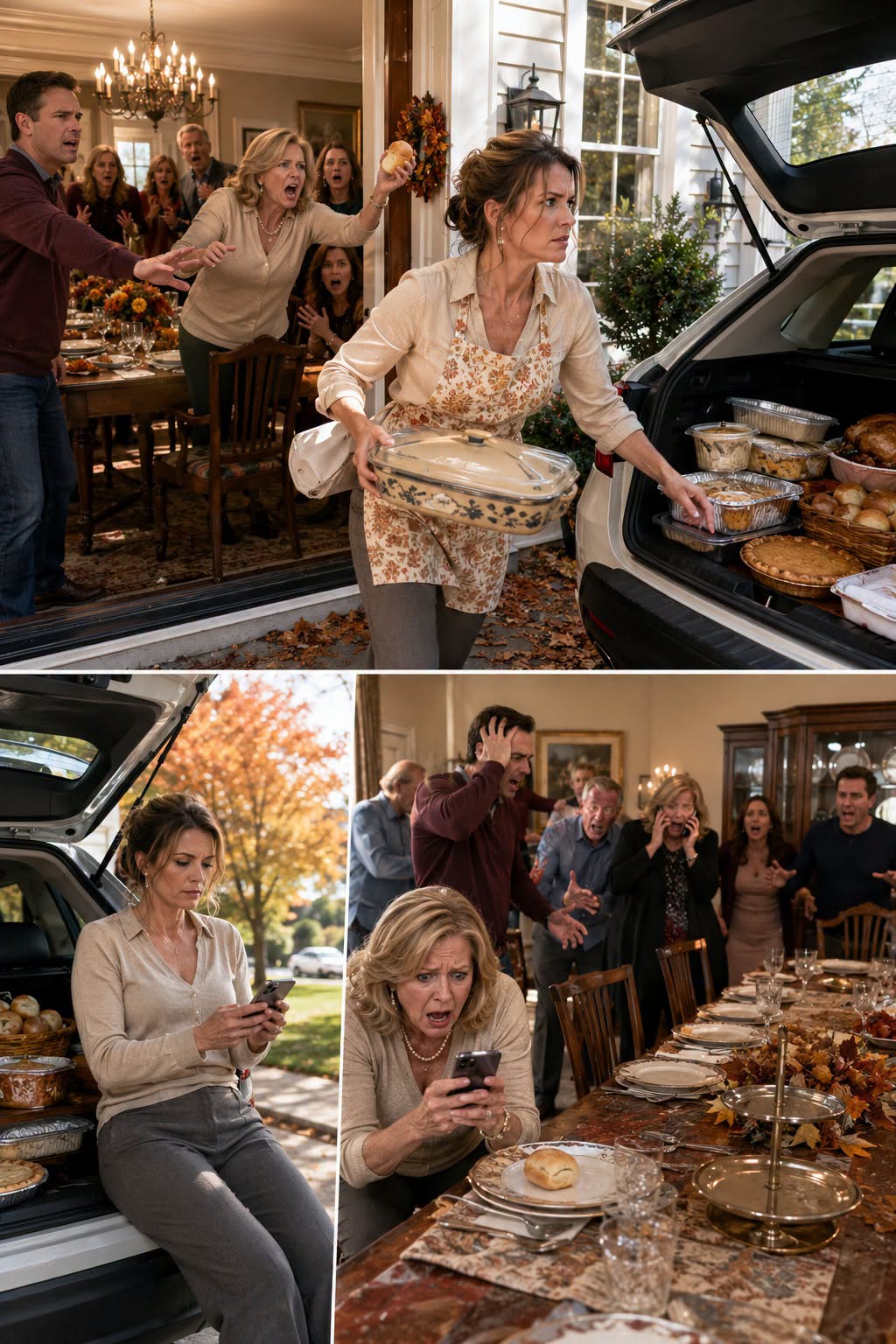
By Thursday afternoon, every dish was packed carefully into the back of our SUV.
Maisie carried the basket of rolls to the car with both arms wrapped around it.
“This is important food,” she informed Ethan.
“The most important,” he agreed.
We drove forty-five minutes to his parents’ house in Westerville.
I remember feeling happy.
Actually happy.
The sky was pale and cold. Bare trees lined the road, their branches sharp against the November clouds. Maisie sang half of a Thanksgiving song she’d learned at preschool and invented the rest.
When we pulled into Diane and Paul’s driveway, there were already two cars outside.
Ethan lifted the turkey.
I balanced two pie tins against my forearms while carrying a bag of casseroles.
Maisie raced up the walkway and rang the bell three times.
Diane opened the door.
Her eyes went straight past my face to the pies.
“You brought two?”
“Pumpkin and apple.”
A tiny pause.
“Oh.”
Just that.
Oh.
Then she stepped aside.
Brooke was sitting in the living room beside her boyfriend, Mason.
She saw the bags piling onto the kitchen counter.
“Wow, Nora. You really went all out.”
“It was fun.”
And it had been.
Until Brooke looked toward the counter and casually added:
“Did you make stuffed mushrooms?”
“No.”
“Oh. Rachel used to make these unbelievable stuffed mushrooms every Thanksgiving.”
There it was.
Not ten minutes after I’d walked through the door.
I glanced at Ethan.
He was removing foil from the turkey.
Brooke continued.
“Goat cheese, herbs, breadcrumbs. Ethan, remember? Everybody used to ask for the recipe.”
Ethan didn’t look up.
“I don’t really remember.”
Brooke laughed.
“How do you not remember? You ate like twelve.”
I reached for the oven mitts.
“I made cranberry sauce.”
“Nice.”
Brooke was already looking at her phone.
Then she added almost absently:
“Rachel would’ve done mushrooms, though.”
Something inside me tightened.
Not enough to snap.
Not yet.
I slid the turkey into Diane’s oven and reminded myself of what I’d been telling myself for six years.
Don’t make it a thing.
Don’t be sensitive.
Don’t ruin the holiday.
Then Diane lifted my basket of homemade rolls.
She turned one over in her hand.
“You made these?”
“Yes.”
“Honey wheat.”
She squeezed one gently between her fingers.
Then she smiled as if remembering something lovely.
“Rachel’s mother always brought those flaky brown-and-serve rolls from the bakery on Fifth Avenue.”
She looked at the basket again.
“Everyone loved those.”
I stared at her hand around my roll.
And for the first time all day, I stopped feeling proud of the dinner I’d made.
I started wondering why I had brought it at all.
### Part 2
Twenty minutes later, more family arrived.
Paul’s older brother, Raymond, came through the door carrying two bottles of sparkling cider. His wife, Elaine, followed with their sixteen-year-old son, Caleb, who immediately disappeared toward the television when someone mentioned football.
The house got louder.
Coats piled onto the guest bed.
The smell of coffee mixed with Diane’s cinnamon candles and the turkey roasting in the kitchen.
For a little while, everything felt almost normal.
I held Maisie against one hip while she made her stuffed giraffe march up my arm. Elaine asked about work. Raymond complained about highway construction. Paul moved quietly through the room with his coffee, occasionally smiling at something without joining the conversation.
Paul had always been different from the rest of them.
Reserved.
Patient.
Almost painfully nonconfrontational.
Six months after Ethan and I married, I’d made a blueberry cake for Sunday dinner and accidentally doubled part of the sugar.
I knew it was too sweet the second I tasted it.
Diane had taken one bite and set down her fork.
Paul ate two pieces.
Then he said, “Tastes like something my mom used to make.”
I never knew whether that was true.
But kindness doesn’t have to be perfectly factual to matter.
On Thanksgiving, Elaine noticed my rolls.
“Those homemade?”
Before I could answer, Diane said, “Nora made everything herself. She’s very ambitious.”
Everyone chuckled politely.
I smiled because apparently my face had spent six years learning to do that automatically.
“Occupational hazard,” I said.
Raymond looked confused.
“How’s cooking an occupational hazard for a nurse?”
“She’s always taking care of everybody,” Ethan said.
He meant it affectionately.
Still, something about the way Diane had said ambitious bothered me.
Not generous.
Not thoughtful.
Ambitious.
Like Thanksgiving dinner was a job interview I’d created for myself.
I carried Maisie to the couch and sat beside Ethan.
Brooke was scrolling through old pictures on her phone.
Suddenly she held the screen toward him.
“Oh my God. Look what came up in my memories.”
I knew before I saw it.
Rachel.
The photo was years old. Ethan looked younger, Brooke had shorter hair, and a woman with long dark curls stood beside them holding a casserole dish.
I turned my attention to Maisie’s giraffe.
Brooke laughed.
“That’s the mushroom dish!”
Mason, her boyfriend, glanced at her.
“Maybe don’t?”
It was quiet enough that I heard him.
Brooke lowered her phone.
“What?”
He shrugged.
“Nothing.”
Ethan had heard it too.
His jaw tightened.
For one hopeful second, I thought he was finally going to say something.
Instead he stood.
“Anybody need a drink?”
I looked down at my daughter.
Scratch number three.
Breathe through it.
That’s what I’d always done.
Diane came from the kitchen wiping her hands.
“The rolls might be a little dense.”
The room didn’t completely stop, but my world did.
“What?”
She wasn’t even looking at me.
She picked up the cheese knife.
“I’m just wondering if they proofed long enough.”
Brooke made a tiny sound into her glass.
Not quite laughter.
But close enough.
I looked toward the kitchen.
Inside the oven was a turkey I’d brined for three days.
In Diane’s refrigerator were potatoes I’d peeled by hand at midnight, cranberry sauce Maisie had helped make, a casserole I’d tested twice, and butter I’d browned carefully so it smelled nutty instead of burned.
On the counter sat two pies.
I had worked harder on that dinner than anyone had asked me to.
That had been my choice.
What happened next was also my choice.
I handed Maisie to Ethan.
“Stay with Daddy for a minute.”
Then I walked into the kitchen.
I opened the refrigerator.
I put the lid on the mashed potatoes.
Then the green beans.
Then the cranberry sauce.
I found the insulated carriers I’d brought and began packing them again.
My hands weren’t shaking.
That surprised me.
I wasn’t angry.
I felt strangely clear.
Diane entered while I was wrapping the pumpkin pie.
“What are you doing?”
“Packing.”
“For what?”
“I’m taking the food.”
Her mouth opened.
“What do you mean, taking it?”
“Exactly what it sounds like.”
“Nora, the turkey isn’t finished.”
“I know.”
I took the roasting pan from the oven and covered it carefully with foil.
She stared at me like I’d suddenly begun speaking another language.
“You’re being serious.”
“Completely.”
Her face changed.
That careful social polish slipped.
“Why?”
I looked at her.
“Because you’ve spent the last hour comparing everything I made to Rachel.”
“I did not.”
“You mentioned her mother’s rolls.”
“That was just a memory.”
“Brooke mentioned her mushrooms twice.”
“Brooke isn’t me.”
“You inspected my rolls and announced to the room that they’re dense.”
“I was trying to help.”
That almost made me laugh.
Instead, I tied the roll basket closed.
“Diane, I worked two days on this meal. I didn’t bring it here for a competition with someone Ethan stopped dating almost a decade ago.”
Her cheeks went red.
“No one said it was a competition.”
“No. That’s what makes it worse.”
Ethan appeared in the doorway.
He looked at the covered turkey.
Then at his mother.
Then at me.
This was the moment.
The familiar one.
The place where he usually said, “Mom didn’t mean anything.”
Or, “Can we just get through dinner?”
Or the sentence I had come to hate most:
“You know how she is.”
I waited.
He said nothing.
I lifted the first carrier.
“I’m taking Maisie to my mother’s.”
Ethan swallowed.
“Nora—”
“You’re welcome to stay.”
Diane looked at him immediately.
That told me more than anything she could have said.
She expected him to stop me.
Maybe part of me expected it too.
He didn’t.
I made three trips to the SUV.
On the final one, Maisie carried the basket of rolls against her chest.
“Are we going somewhere?”
“Grandma Helen’s.”
Her eyes widened.
“Does Grandma Helen have whipped cream?”
“Almost certainly.”
“Okay.”
Children understand priorities better than adults.
I buckled her into the back seat.
Ethan followed me outside.
Cold air lifted his hair.
“Are you sure about this?”
That question hurt more than Diane’s comments.
I looked at him.
“I’m sure I’m done pretending this doesn’t hurt.”
His face changed.
But before he could answer, I closed the car door.
Forty-five minutes later, I pulled into my mother’s driveway with Thanksgiving dinner still packed behind me.
And for the first time in six years, I had no intention of carrying it back.
### Part 3
My mother, Helen, was watching the Thanksgiving parade when Maisie burst through her front door.
“Grandma!”
My mother barely had time to turn before Maisie collided with her knees.
Then Mom looked past her and saw me standing there with a pie balanced on each forearm.
She didn’t ask the obvious question.
She simply said, “Good Lord.”
“Happy Thanksgiving.”
Her eyes moved toward the driveway.
“Where’s Ethan?”
“Westerville.”
Another pause.
Then she nodded toward the kitchen.
“Put those down before you drop them.”
That was my mother.
No dramatic interrogation.
No immediate outrage.
First, protect the pie.
Questions afterward.
Her house smelled like coffee and the lemon furniture polish she’d used for as long as I could remember. Afternoon light came through the dining room curtains and made bright rectangles across the floor.
I set everything down.
She filled the kettle.
Then she sat across from me.
“All right.”
I told her.
Not just about that afternoon.
About six years.
The comments.
The comparisons.
Rachel’s cooking.
Rachel’s clothes.
Rachel’s athletic habits.
The time Diane suggested I ask Rachel’s old stylist where she’d had her hair cut.
The way Ethan always tried to smooth things over instead of stopping them.
The way I’d participated in that smoothing because I hated conflict.
My mother listened without interrupting.
When I finished, she looked toward the mountain of food covering her counter.
“So what happened today wasn’t really about rolls.”
“No.”
“I didn’t think so.”
My eyes burned suddenly.
That annoyed me.
I hadn’t cried at Diane’s.
I didn’t want to cry now.
Mom reached across the table and squeezed my wrist.
Then she stood.
“We need chairs.”
I blinked.
“What?”
“If all this food is here, we’re eating it.”
She called my Aunt Marcy.
Aunt Marcy called my cousin Jonah, who’d planned to eat frozen lasagna in his apartment because his roommate was out of town.
Jonah asked if his girlfriend, Tessa, could come.
Mom said, “If she eats turkey, she can come.”
Within two hours, the house transformed.
Aunt Marcy arrived carrying a salad and enough gossip for three counties.
Jonah brought ice.
Tessa brought flowers.
Maisie made place cards from printer paper and purple marker, spelling Aunt Marcy’s name “Marsy” and deciding that was close enough.
My turkey finished cooking in Mom’s oven.
When I cut into it, steam rose through the kitchen and carried the smell of thyme, garlic, and roasted skin through the whole house.
Nobody inspected it.
Nobody asked whether somebody else made it differently.
Jonah bit into a roll.
He closed his eyes.
“Nora.”
I laughed.
“What?”
“If you ever open a bakery, I’ll invest.”
“You have forty dollars in savings.”
“Then I’ll invest emotionally.”
Later, he took two slices of apple pie.
Tessa asked for my cranberry sauce recipe.
Aunt Marcy wrapped mashed potatoes in foil to take home.
And somewhere between the second helping and Maisie declaring that cranberry sauce counted as fruit, I felt something loosen inside my chest.
Not triumph.
Relief.
That frightened me a little.
Because relief meant I’d been under pressure long enough to stop noticing it.
At seven, I stood at the sink washing dishes.
Headlights swept across the backyard fence.
Mom looked out the window.
“Someone’s here.”
I knew the car.
Ethan stepped out.
His coat was buttoned wrong.
One collar stuck upward.
He walked toward the door with the distracted urgency of someone whose mind had been somewhere else for the entire drive.
Mom let him in.
“Want dinner?”
“No, thank you.”
“Coffee?”
He hesitated.
“Sure.”
He accepted a mug and didn’t touch it.
He sat in the kitchen while everyone continued talking.
No one attacked him.
That almost seemed to make him more uncomfortable.
Eventually he came beside me.
“Can we talk?”
I dried my hands.
We went onto the back porch.
The November cold found the opening at my collar immediately. Mom’s solar fence lights were glowing even though three of them had been broken since summer.
Ethan leaned against the railing.
For a few seconds, neither of us spoke.
Then he said, “You should have told me.”
I stared at him.
“I did.”
“Not like this.”
“No. You’re right. I never packed Thanksgiving dinner into the car before.”
“Nora.”
“I’ve been telling you for six years.”
He looked away.
“Little comments.”
“They weren’t little to me.”
“I know.”
“Do you?”
He rubbed both hands across his face.
Then he surprised me.
“I didn’t. Not really.”
The anger I’d been missing earlier finally appeared.
Not explosive.
Sharp.
“That’s convenient.”
“I thought if nobody meant harm, then there wasn’t harm.”
I stared through the porch railing at the dead grass.
“And now?”
“After you left, Mom kept saying you misunderstood. Brooke said you were overreacting.”
“Of course.”
“I agreed with them for about five minutes.”
That got my attention.
He looked at me.
“Then Dad asked why they kept talking about Rachel.”
I said nothing.
Ethan continued.
“He said, ‘If Rachel was so perfect, why don’t you invite her to Thanksgiving instead?’”
Despite everything, a laugh almost escaped me.
“Your father said that?”
“Apparently Dad has been saving six years of opinions.”
That sounded like Paul.
Ethan shoved his hands into his pockets.
“Then Uncle Raymond asked Brooke why she still talked about my ex when I’m married and have a kid. Mason said he’d wondered the same thing.”
The porch went quiet.
“For the first time,” Ethan said, “I heard it from outside.”
I thought of Mom’s kitchen.
The noise.
The mismatched chairs.
Nobody measuring me against a ghost.
“This,” I said, gesturing toward the warm house behind us, “is what Thanksgiving is supposed to feel like.”
He looked through the glass.
Maisie was on Jonah’s shoulders.
Aunt Marcy was laughing so hard she had one hand against the table.
Ethan nodded slowly.
“I know.”
His phone rang.
He pulled it out.
His expression changed almost immediately.
“What happened?”
A pause.
“Is Dad okay?”
My anger vanished beneath instinct.
Ethan listened, face tightening.
“How bad?”
Then he looked at me.
“Dad burned his hand.”
“What?”
“He tried cooking after everyone left.”
“Paul doesn’t cook.”
“I know.”
Another pause.
Then Ethan said into the phone, “We’re coming.”
He ended the call.
“My uncle took him to urgent care.”
I grabbed my coat.
Not because Diane deserved rescuing.
Not because the afternoon had been forgiven.
But because Paul had quietly eaten my terrible blueberry cake six years earlier and told me it tasted like home.
Some debts aren’t obligations.
They’re choices.
And I already knew which kind this was.
### Part 4
Diane’s house smelled like burned butter when we walked back in.
The dining table was still set for Thanksgiving.
Empty plates.
Untouched glasses.
A centerpiece surrounded by food that had never arrived.
The sight should have made me feel guilty.
It didn’t.
Paul sat on the living room couch with his right hand wrapped in white gauze.
He looked deeply embarrassed.
“Let me see.”
“I’m fine.”
“You went to urgent care.”
“They overreacted.”
“Paul.”
He sighed and held out his hand.
I crouched beside him.
The clinic had cleaned and dressed the burn correctly. Most of it looked superficial, but one area along his palm would need careful monitoring.
“What exactly were you doing?”
His ears turned red.
“Trying to fry eggs.”
Brooke, standing near the fireplace, muttered, “He poured butter into a pan that was way too hot.”
Paul frowned.
“Nobody asked for commentary.”
“Why were you cooking?” I asked.
He glanced toward the kitchen.
Diane was standing inside it, arms folded.
“Your mother-in-law hadn’t eaten.”
Something uncomfortable moved through me.
Paul noticed.
“This wasn’t your fault.”
I looked at him.
He continued.
“Don’t even think that.”
Diane looked away.
I straightened.
“I’ll make something simple.”
“Nora,” Ethan said quietly.
“It’s for Paul too.”
That was important.
I wanted everyone to hear it.
I wasn’t returning to finish the Thanksgiving I’d removed.
I wasn’t surrendering my boundary because somebody got hurt.
I was choosing to make an injured man dinner.
Those were different things.
The refrigerator held eggs, cheddar, leftover roasted vegetables from Wednesday, and bread.
I made a frittata.
Nothing impressive.
Nothing I’d spent two days preparing.
I could feel Diane watching from the doorway.
She didn’t criticize my knife skills.
She didn’t mention Rachel.
The silence was almost surreal.
Halfway through chopping vegetables, Brooke came into the kitchen.
“Nora?”
“Yeah?”
She leaned against the counter.
“I’m sorry.”
I kept chopping.
She waited.
“For today,” she added.
I set the knife down.
“Which part?”
Her face tightened.
“Fair.”
That answer mattered.
She rubbed one thumb against the edge of her sleeve.
“The Rachel stuff.”
I waited.
“I don’t know why I keep doing it.”
“Yes, you do.”
Her eyes rose to mine.
I wasn’t trying to be cruel.
But I was tired of making things easy.
Brooke looked toward the living room.
Finally she said, “Mom liked her.”
“I know.”
“And when they broke up, Mom acted like something had been taken away from the family.”
“Also something I know.”
“I guess I copied it.”
“For six years?”
She winced.
“Yeah.”
The refrigerator hummed between us.
Then she said, “I think part of me liked having something that made you feel like the new person.”
That was the first truly honest thing anyone in that house had said about Rachel.
I looked at her.
“Why?”
Her eyes filled with embarrassment.
“Because before you came along, Ethan was still my brother.”
“He still is.”
“I know that now.”
She swallowed.
“But then he met you, got married, bought a house, had Maisie. Everything changed really fast. And every time Mom brought up Rachel, it was like talking about the version of our family before all that happened.”
It didn’t excuse anything.
But suddenly the pattern had a shape.
Rachel wasn’t just a woman.
She was nostalgia.
A weaponized version of the past.
“You made me compete with a period of your life that doesn’t exist anymore.”
Brooke nodded.
“Yeah.”
“That was unfair.”
“I know.”
I turned back to the vegetables.
After a moment she said, “Do you hate me?”
The question was so unexpectedly young that I almost smiled.
“No.”
She exhaled.
“But I’m not pretending today didn’t happen.”
“I wouldn’t ask you to.”
“The Rachel comments stop.”
“They will.”
“Not just around me. Stop making her a family mascot.”
Brooke gave a small, embarrassed laugh.
“Okay.”
I slid the vegetables into the pan.
She started to leave.
Then she turned.
“For what it’s worth, I ate one of your rolls before you left.”
I raised an eyebrow.
“And?”
“They weren’t dense.”
That time I did laugh.
After dinner, Paul went upstairs to take pain medication prescribed by the clinic.
Brooke and Mason left soon after.
Ethan was helping Maisie search beneath the couch for her giraffe when Diane asked me to sit down.
The living room television was playing a holiday movie with the volume low.
Diane sat opposite me.
For once, there was no audience.
“I don’t know how to start,” she said.
“You don’t have to.”
“I do.”
She folded her hands.
“I grew up poor.”
I’d heard the story before.
Small town.
Three children in one bedroom.
School clothes from church donation boxes.
A mother who saved bacon grease in jars because nothing could be wasted.
But Diane wasn’t telling the story for sympathy this time.
“When I married Paul,” she said, “I decided nobody would ever walk into my house and know where I came from.”
I waited.
“So everything had to be right. Food. Furniture. Clothes. Manners. Everything.”
Her eyes dropped.
“Rachel understood that kind of thing.”
There it was again.
My chest hardened.
Diane noticed immediately.
“No. I’m saying this badly.”
“Very.”
She nodded.
“Rachel cared about appearances the way I did. You never seemed to.”
“I care about people being comfortable.”
“Exactly.”
I frowned.
She looked around the immaculate living room.
“I think that bothered me.”
That surprised me.
“Why?”
“Because you could walk into a room and not spend the whole time wondering whether everyone approved of you.”
I almost laughed at the absurdity.
“Diane, I spent six years wondering whether you approved of me.”
Her face fell.
And for the first time, I think she understood the full size of what she’d done.
But understanding wasn’t the same thing as fixing it.
And I wasn’t going to confuse the two anymore.
### Part 5
“I was jealous of you.”
Diane said it so quietly that at first I thought I’d misunderstood her.
“What?”
She stared at her folded hands.
“Not of your marriage. Not exactly.”
The television behind us filled the room with soft music.
She took a breath.
“You work in a hospital. You come home in messy hair and scrubs and somehow still seem sure of who you are. You serve food in mismatched dishes. Your mother puts folding chairs at the table. You don’t apologize for any of it.”
I thought about Mom’s kitchen.
Purple marker place cards.
Aunt Marcy stealing pie crust from Maisie’s plate.
Jonah investing forty imaginary dollars in my nonexistent bakery.
“No,” I said. “I don’t.”
“I’ve spent my whole life apologizing before anybody had a chance to criticize.”
For the first time, Diane didn’t sound polished.
She sounded tired.
I understood tired.
That didn’t mean I was ready to absolve her.
“So you criticized me first.”
Her eyes closed briefly.
“Maybe.”
“Not maybe.”
“No.”
She looked at me.
“You’re right.”
Those two words were so rare from her that they seemed almost foreign.
I leaned back.
“Diane, you didn’t just make comments. You taught Brooke to do it. You let Rachel become this measuring stick that followed me through my own marriage.”
“I know.”
“Do you?”
Her mouth tightened.
“I know now.”
“That’s different.”
She nodded.
“Yes.”
Ethan entered the living room but stopped when he realized we were talking.
I looked at him.
“You can stay.”
He sat on the arm of a chair.
Diane rubbed her palms over her skirt.
“I’m sorry.”
I had imagined that apology more times than I wanted to admit.
In some versions, I accepted immediately.
In others, I delivered a perfect speech that made everyone finally understand.
Reality was quieter.
“I hear you.”
Diane looked surprised.
“I don’t know if I can forgive six years because you had one bad afternoon afterward.”
Her face changed.
Not anger.
Pain.
But I had spent too long treating other people’s discomfort as an emergency.
So I kept going.
“I believe you’re sorry tonight. I also need to see whether you’re sorry when there’s another holiday, another dinner, another chance to compare me to somebody.”
“I understand.”
“And Rachel’s name stops being used like a warning label.”
Diane looked at Ethan.
Then back at me.
“Yes.”
“If you slip, I’m leaving.”
Her eyebrows rose slightly.
“I’m not threatening you. I’m telling you what I will do.”
Ethan was quiet beside us.
Then he said, “And I’ll leave with her.”
I turned.
That mattered.
Diane’s eyes moved to her son.
Something passed across her face.
Loss, maybe.
Or realization.
The family dynamic she’d relied on had changed.
She nodded.
“Okay.”
We left around nine.
Maisie fell asleep before we reached the highway, giraffe tucked beneath her chin.
For several miles Ethan drove with both hands on the wheel.
Then he said, “I owe you an apology too.”
“Yes.”
He almost smiled.
“I deserved that.”
I watched streetlights slide across the windshield.
“You kept making me responsible for absorbing your mother’s behavior.”
“I know.”
“You called it keeping the peace.”
“I know.”
“But there wasn’t peace. There was just silence.”
His fingers tightened around the wheel.
“Yeah.”
I looked at him.
“Do you know what hurt most today?”
“Mom?”
“No.”
That startled him.
“You asking me if I was sure when I was packing the car.”
His face fell.
“I wasn’t asking because I thought you were wrong.”
“It sounded exactly like every other time.”
He nodded.
“I was scared.”
“Of what?”
“That if you walked out, something would break that I couldn’t put back together.”
I looked through the windshield.
“And did it?”
He considered that.
“Maybe something needed to.”
That answer stayed with me.
The next few weeks were awkward.
Diane didn’t call me for nine days.
Brooke did.
She sent me a picture of a restaurant menu with stuffed mushrooms circled.
Her message said:
Traumatized. Never eating these again.
I laughed harder than I should have.
But boundaries reveal things apologies don’t.
At Christmas, Ethan suggested we host.
I hesitated.
“Do you actually want that?”
“I want home-field advantage.”
That made me smile.
We invited everyone.
Before Christmas morning, Diane called.
“What can I bring?”
“Whatever you want.”
A long pause.
Then she said, “Would rolls be all right?”
I knew exactly what she was doing.
“Yes.”
“Bakery ones.”
I almost laughed.
“Also yes.”
Christmas arrived with freezing rain tapping the windows.
Diane came in carrying two bags.
She handed me the rolls without comment.
Then she noticed the roast in the oven.
For one second, I saw the old reflex form on her face.
Her lips parted.
I waited.
She closed them.
Then said, “It smells wonderful.”
It was a tiny moment.
Nobody else noticed.
I did.
Later, she picked up a dish towel and began drying dishes beside me.
We didn’t discuss Thanksgiving.
We talked about Maisie’s preschool teacher.
Sometimes change isn’t a grand apology.
Sometimes it’s the sentence somebody chooses not to say.
But I still wasn’t ready to trust it.
And in January, something happened that forced me to decide whether Diane’s Thanksgiving apology had been real—or whether she’d simply learned to hide the comparison better.
### Part 6
My mother’s furnace died during the coldest week of January.
Not slowed down.
Not made an alarming noise.
Died.
She woke to a house cold enough that she could see her breath near the upstairs windows.
Ethan and I drove over after my shift, wrapped pipes, called a repair company, and convinced Mom to stay with us until the replacement part arrived.
She resisted for twelve minutes.
Then Maisie said, “Grandma, you can sleep in my room and I will protect you.”
Mom packed a bag.
On her second night with us, Diane stopped by to return a serving dish she’d taken home after Christmas.
I was upstairs giving Maisie a bath when I heard voices below.
By the time I came down, Mom and Diane were sitting at the kitchen table.
A pot of coffee sat between them.
I froze halfway down the staircase.
They weren’t arguing.
They were laughing.
Not polite laughing.
My mother was wiping beneath one eye.
Diane was leaning forward with one hand covering her mouth.
Ethan came beside me.
“What happened?”
“I don’t know.”
“Should we intervene?”
“Absolutely not.”
We disappeared into the living room.
They talked for nearly two hours.
Later, after Diane left, I asked Mom what they’d discussed.
“Things.”
“Helpful.”
“Her mother. My mother. You kids.”
I waited.
Mom smiled.
“Apparently motherhood is just discovering new and inventive ways to accidentally pass down the things you swore you wouldn’t.”
That sentence stayed with me.
A few days later, Diane called.
Not Ethan.
Me.
“Would you have coffee with me?”
Every defensive instinct in my body woke up.
“Why?”
“Because I’d like to talk to you.”
“About?”
She hesitated.
“Rachel.”
I almost hung up.
Then she added quickly, “Not like before.”
I agreed to meet her at a café halfway between our houses.
Saturday morning smelled like snow.
Diane was already sitting near the window when I arrived.
She had an envelope beside her coffee.
I looked at it.
“What is that?”
“Nothing dramatic.”
“People only say that when something is dramatic.”
For once she smiled.
Then she pushed the envelope toward me.
Inside were old photographs.
Ethan in college.
Brooke as a teenager.
Family vacations.
Rachel appeared in several.
I didn’t understand.
“Diane…”
“I found these while cleaning a closet.”
“Okay.”
“I realized something.”
She picked up one picture.
It showed Rachel standing beside Diane at a Christmas party.
“I don’t miss her.”
I stared at her.
Diane continued.
“I miss this.”
She touched Ethan’s younger face.
“Both my children living close. Nobody married yet. Nobody aging. Paul hadn’t had his first blood-pressure scare. My mother was still alive.”
Her eyes shone.
“I’ve been using Rachel’s name for years when what I meant was that I miss being younger.”
That was painfully human.
And unbelievably unfair.
“So I paid for it.”
Diane nodded.
“Yes.”
“Brooke did too.”
“Yes.”
“Ethan too.”
She looked down.
“Yes.”
I slid the photograph back.
“Then why tell me?”
“Because explanations aren’t apologies.”
I raised my eyebrows.
She gave a humorless smile.
“Your mother is very direct.”
“That sounds like her.”
“She told me I was making you compete with a dead version of my life.”
“Rachel isn’t dead.”
“No. My life from then is.”
That distinction landed.
Diane gathered the photographs.
“I don’t expect you to forgive me.”
That was the first time anybody had said that.
Not, I hope someday.
Not, surely we can move on.
Just that.
“I don’t,” I said.
She flinched slightly.
I continued.
“I don’t forgive what happened just because I understand it better.”
Her eyes stayed on mine.
“But I don’t want to spend the rest of my life angry either.”
“Neither do I.”
“So let’s stop trying to erase it.”
“What does that mean?”
“It means you behave differently now. I respond to who you are now. That’s it.”
She nodded slowly.
“I can do that.”
“And if you bring up Rachel to compare me again, I’m leaving.”
“I know.”
I smiled faintly.
“Good.”
Spring arrived.
Then summer.
Nothing magical happened.
Diane didn’t become a different person overnight.
Sometimes she still made a comment about my house and stopped herself halfway through.
Once she told me Maisie’s birthday cake looked “rustic,” saw my face, and immediately said, “That sounded insulting. I meant charming.”
I laughed so hard I had to sit down.
Brooke changed too.
Not perfectly.
But enough that I trusted the effort.
The biggest change was Ethan.
He stopped translating his mother’s behavior for me.
If Diane said something inappropriate, he addressed it before I needed to.
At Easter, she criticized Brooke’s boyfriend’s job.
Ethan simply said, “Mom.”
One word.
She stopped.
It was such a small thing.
I wondered how different six years might have felt if he’d learned that word sooner.
Then October arrived.
One year since my hospital bonus.
One year since I’d begun planning the Thanksgiving dinner that eventually ended up back in my car.
And when Ethan asked where I wanted to celebrate Thanksgiving this time, I already knew the answer.
“My mother’s.”
He smiled.
“Good.”
“What?”
“I was hoping you’d say that.”
This time, nobody was asking me to return to the old table.
If Diane wanted Thanksgiving with us, she would have to come to mine.
### Part 7
The Wednesday before Thanksgiving, I woke before sunrise again.
Same wool socks.
Same faded apron.
Same fourteen-pound turkey.
The difference was that I wasn’t anxious.
There was no invisible judge waiting in Westerville.
No imaginary scorecard.
Maisie, now five, wandered into the kitchen at seven wearing pajamas covered in tiny stars.
“Is the sauce manager needed?”
“Desperately.”
She climbed onto her stool.
Our kitchen windows had fogged from the heat. Butter browned in a saucepan. Orange zest brightened the cranberry mixture. The house smelled exactly the way I’d wanted Diane’s house to smell the year before.
Warm.
Busy.
Safe.
Ethan came downstairs carrying coffee.
He kissed my forehead.
“Need help?”
“Peel potatoes.”
He made a face.
“You said help.”
“That is help.”
At nine that evening, my phone rang.
Diane.
I wiped flour off my hand.
“Hello?”
“I’m making stuffed mushrooms.”
I stopped.
There was a long silence.
Then she rushed on.
“I found an old recipe card. Rachel’s mother gave it to me years ago.”
I almost laughed at the absurdity.
“Diane…”
“I know how that sounds.”
“Do you?”
“Very much.”
I leaned against the counter.
She continued.
“I almost threw it away.”
“Why didn’t you?”
“Because I realized the mushrooms never did anything wrong.”
That startled a laugh out of me.
She laughed too.
“I thought I’d make them.”
“Okay.”
“And bring them to Helen’s.”
Another pause.
“If she’s comfortable with that.”
Something inside my chest softened.
Not erased.
Not healed into some perfect smooth surface.
Just softened.
“I’ll ask her.”
Mom’s answer was immediate.
“Tell her to bring enough for Marcy.”
Thanksgiving afternoon, my mother’s driveway filled faster than we’d expected.
Aunt Marcy arrived first.
Jonah and Tessa came carrying wine and a board game nobody played.
Brooke and Mason brought sweet potatoes.
Paul carried flowers with his healed hand.
Diane walked in last with a casserole dish.
She looked nervous.
My mother took it.
“These the famous mushrooms?”
Diane froze.
I nearly choked.
Mom grinned.
“I’m joking.”
Diane stared at her.
Then laughed.
Actually laughed.
“You’re terrible.”
“I’ve been told.”
The dining room wasn’t big enough, so we pushed two tables together.
Mom brought folding chairs from the garage.
The dishes didn’t match.
One tablecloth was cream.
The other was blue.
Diane noticed.
I watched her notice.
Then I watched her decide she didn’t care.
That meant more to me than any apology.
Dinner was loud.
Maisie sat beside Paul and kept breaking pieces off her roll for him.
He ate every one.
Brooke tried the mushrooms and said, “Okay, I understand why these caused six years of family trauma.”
“Brooke,” Ethan warned.
“What? Too soon?”
“Yes.”
I laughed anyway.
The mushrooms were excellent.
I told Diane.
Her whole face brightened.
“Really?”
“Really.”
She started to say something.
For a split second, I knew what almost came next.
Rachel’s mother always—
But Diane caught herself.
Instead she said, “I’m glad.”
And passed me the dish.
Later, Jonah requested a third piece of apple pie.
Tessa asked again for the cranberry recipe.
Aunt Marcy somehow convinced Paul to tell a story about Ethan getting stuck inside a laundry hamper when he was eight.
Ethan denied every word.
Maisie believed all of it.
I sat at the end of the table and watched.
For years, I’d thought acceptance meant eventually becoming good enough that Diane would stop comparing me.
I’d been wrong.
Acceptance had begun the afternoon I stopped auditioning.
I had taken my turkey.
My pies.
My daughter.
My effort.
I had carried everything out the door.
And the world hadn’t ended.
That was what changed me.
After dinner, I walked into Mom’s kitchen to get more coffee.
Diane followed.
For a moment, it was just us.
She rinsed a plate.
Then she said, “Thank you for letting us come.”
“It’s Mom’s house.”
“You know what I mean.”
I did.
She dried her hands.
“I thought about last year all day.”
“So did I.”
“I was awful.”
I leaned against the counter.
“You were.”
A year earlier, I would have softened that.
Not anymore.
Diane nodded.
“I don’t think you ever forgave me.”
I thought carefully.
“No.”
She absorbed the answer.
Then she gave a small nod.
“That’s fair.”
“But I don’t hate you.”
Her eyes met mine.
“And I like who you’re trying to be now.”
Something in her expression broke open.
Not dramatically.
Just enough.
“That means more than you think.”
I looked toward the dining room.
“Then keep earning it.”
She smiled through suddenly wet eyes.
“I will.”
From the other room, my mother yelled, “Who took the cranberry sauce?”
Diane looked at me.
“Your family is loud.”
“Our family.”
She paused.
Then nodded.
“Our family.”
I let her have that word.
Not as forgiveness.
As possibility.
Because possibility, I’d learned, was something people could earn.
But trust was built much more slowly.
### Part 8
That night, after everyone left, Ethan and I stayed to help Mom clean.
Maisie fell asleep on the couch beneath a crocheted blanket, one hand still wrapped around her stuffed giraffe.
The house grew quiet in stages.
First the voices disappeared.
Then the dishwasher began humming.
Then Mom went upstairs.
Finally it was just Ethan and me standing in the kitchen where everything had changed a year earlier.
He handed me a clean plate.
“Are you okay?”
I slid it into the cabinet.
“Yeah.”
“Really?”
I looked at him.
A year ago, that question would have irritated me.
Tonight, it didn’t.
“Really.”
He nodded toward the dining room.
“That was a good Thanksgiving.”
“It was.”
He dried another plate.
After a moment he said, “I’m still sorry.”
“For what?”
“Not seeing it earlier.”
I leaned against the counter.
He looked older than he had the year before.
Not physically.
More aware.
Sometimes awareness ages people.
“I spent a lot of our marriage thinking being a good husband meant keeping everyone from fighting,” he said.
“And now?”
“Now I think sometimes somebody needs to be uncomfortable.”
I smiled.
“That’s progress.”
“I’m serious.”
“I know.”
He set the dish towel down.
“When you packed that turkey, I thought you were blowing up Thanksgiving.”
“I know.”
“But you weren’t.”
“No.”
“You were refusing to let everyone else ruin it.”
That was exactly right.
I hadn’t found those words myself.
I reached for his hand.
He took mine.
Our marriage didn’t become perfect after that Thanksgiving.
I don’t believe in stories where one confrontation fixes years of habits.
Ethan still occasionally avoided difficult conversations too long.
I still sometimes said “It’s fine” when it wasn’t.
Diane still cared too much about appearances.
Brooke still had an impressive ability to speak before thinking.
People don’t become new people because a turkey leaves the house.
But they can become more honest versions of themselves.
And sometimes that’s enough.
The next year, Diane hosted Easter.
Beforehand she called me.
“I’m thinking ham, roasted vegetables, potatoes, and lemon cake.”
“Sounds good.”
A pause.
“Any objections?”
“Why would I object?”
“I wanted to ask instead of assuming.”
That sentence told me she’d understood more than I thought.
We went.
The lemon cake collapsed slightly in the middle.
Diane stared at it like it had betrayed her.
I ate two slices.
“It’s good.”
“It looks terrible.”
“It tastes good.”
She looked at me.
Then started laughing.
“I hate that you’re right.”
“Get used to it.”
By then, Rachel’s name had almost disappeared from family conversation.
Not because we’d banned history.
Because history had returned to its proper size.
One afternoon Brooke showed me old college photographs and Rachel appeared in one.
Brooke didn’t hide it.
She didn’t make a comparison.
She simply said, “That was Rachel.”
“I know.”
Then she swiped to the next picture.
That was it.
That’s how I knew things had actually changed.
Not because nobody ever said her name again.
Because her name no longer meant anything about me.
Paul remained my quiet favorite.
Every Thanksgiving afterward, he asked me if I’d made the rolls.
Every Thanksgiving, he took two.
The third year after the original disaster, I finally asked him whether that blueberry cake from six years earlier had truly reminded him of his mother.
He looked confused.
“What blueberry cake?”
I stared at him.
“The ridiculously sweet one.”
His face slowly changed.
“Oh.”
“You lied.”
Paul considered this accusation.
“Your feelings were hurt.”
“So you lied.”
“I exercised diplomacy.”
I laughed until my stomach hurt.
That was Paul.
Diane overheard the conversation.
She crossed her arms.
“That cake was terrible.”
Paul nodded.
“It really was.”
“Both of you are unbelievable.”
But I was laughing when I said it.
There was no sting left.
Not because I had forgiven everything.
I hadn’t.
For a long time, I thought forgiveness was the only respectable ending to hurt.
It isn’t.
Sometimes the healthier ending is remembering exactly what happened and refusing to let it happen again.
I never forgot how Diane made me feel during those first six years.
I never rewrote that Thanksgiving into a funny misunderstanding.
I never told myself I had been too sensitive.
She had compared me.
Brooke had joined her.
Ethan had failed to stop it.
Those things were true.
It was also true that Brooke apologized without asking me to make her feel better.
Diane changed her behavior without demanding immediate forgiveness.
Ethan learned that protecting his marriage sometimes meant disappointing his mother.
Paul discovered he should never be allowed near an overheated frying pan.
And I learned something more important than all of it.
I learned I could leave.
Not my marriage.
Not necessarily my family.
A situation.
A table.
A room where my dignity was becoming the admission price for belonging.
That knowledge changed the way I moved through everything afterward.
At work.
With relatives.
With friends.
Even with myself.
I stopped overexplaining boundaries.
I stopped treating every person’s disappointment as evidence I’d done something wrong.
And every Thanksgiving, when I pulled the first tray of rolls from the oven, I remembered Maisie carrying that basket against her chest while we left Westerville.
She had been four.
She hadn’t understood the argument.
She had only understood that Mommy said it was time to go.
Years later, when she was old enough to ask what happened that Thanksgiving, I told her a simpler version.
“Some people weren’t being kind about something I worked hard on, so we went somewhere that felt better.”
She thought about that.
Then asked, “Grandma Diane?”
“Yes.”
“But she’s nice now.”
“She tries very hard.”
Maisie nodded as if this made perfect sense.
Then she asked the question children ask when adults spend years trying to make things complicated.
“So you didn’t have to stay just because she was family?”
I looked at her.
“No.”
“Good.”
She went back to coloring.
One word.
Good.
I thought about how many years I’d needed to learn what my daughter understood immediately.
Family doesn’t earn unlimited access to you by being family.
Marriage doesn’t require swallowing disrespect to keep holidays peaceful.
An apology doesn’t erase history.
And forgiveness isn’t something anybody gets to demand because enough time has passed.
People can change.
Relationships can survive.
Families can even become better.
But only after somebody becomes willing to pick up the turkey, pack the pies, buckle the child into the car, and leave the table where they’ve been treated like they’re lucky to have a seat.
That first Thanksgiving, I thought I was taking dinner away.
I know better now.
I was taking myself back.
THE END!