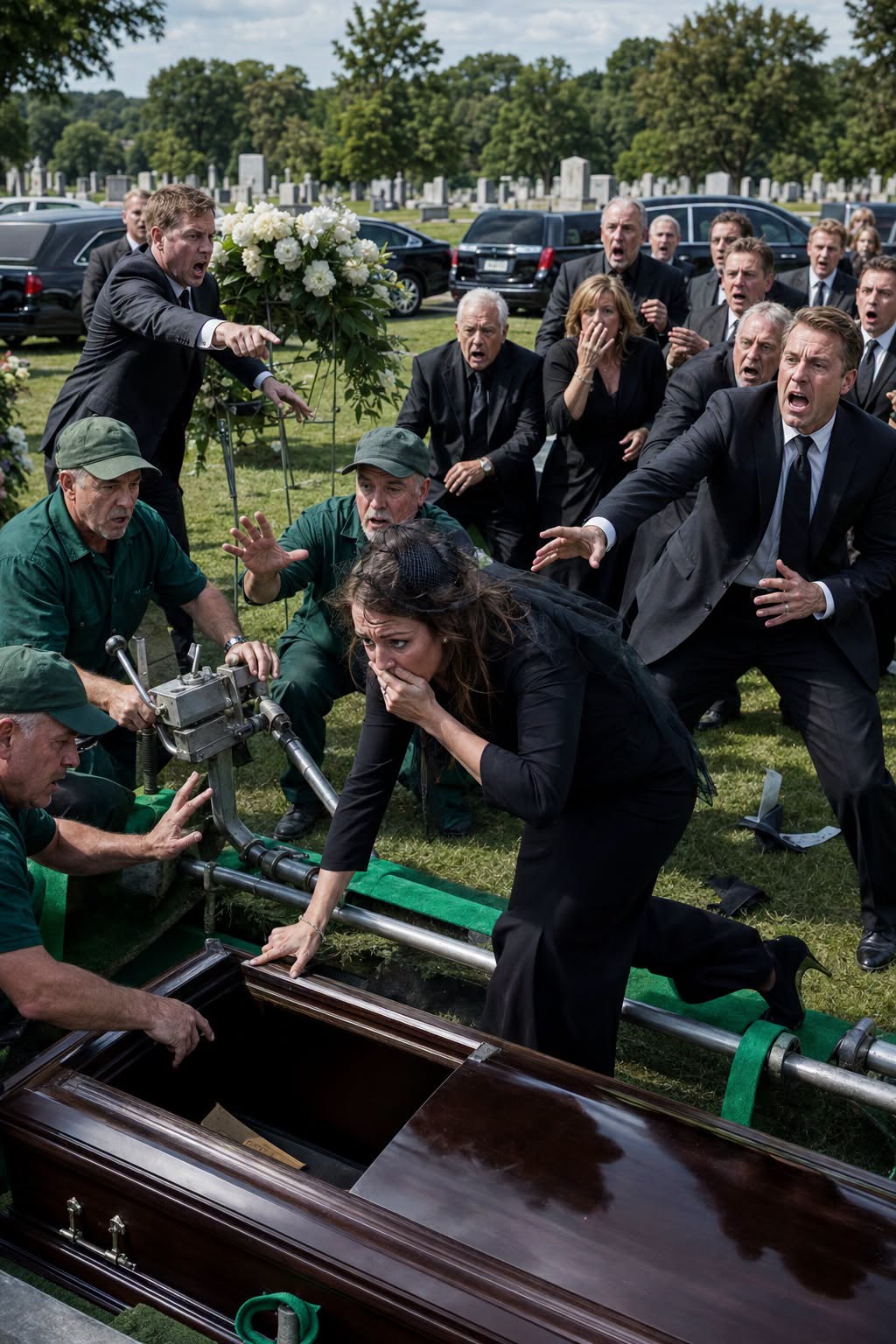
“Cover The Grave, You Slow Turtles!” My Brother Shouted At The Cemetery Workers. As My Husband’s Coffin Was Lowered, The Device Malfunctioned, And The Lid Shifted Open. I Felt Something Was Wrong. I Pushed My Brother Aside And Looked Inside. And That’s When I Saw…
### Part 1
“Bury it already, you slow turtles!”
My brother Derek’s voice cracked across the cemetery so violently that even the groundskeepers stopped moving.
For a second, nobody seemed to know how to react.
My husband’s funeral wasn’t over.
The pastor still had one hand resting on his Bible. A cold Iowa wind pushed dead leaves across the damp grass, scraping them against the legs of the folding chairs. Behind me, somebody sniffled quietly. The smell of wet soil hung so heavily in the air that I could taste it.
But Derek kept waving toward the open grave.
“Come on! Lower it! We’ve been standing out here forever.”
I stared at him.
My name is Mara Bennett. I was thirty years old that afternoon, and until that moment, I thought grief had already emptied me of every emotion I had left.
I was wrong.
“Derek,” I whispered. “Stop.”
My mother, Lorraine, squeezed my elbow.
“He’s upset too, sweetheart.”
No.
Derek didn’t look upset.
He looked impatient.
There was a difference.
Three days earlier, my husband Ethan had collapsed in our living room. Our longtime family physician, Dr. Calvin Mercer, had declared it sudden cardiac failure. Mom and Derek had practically taken over everything afterward—the funeral home, the burial plot, the paperwork, even the choice of casket.
I had barely slept.
I had barely eaten.
And now my brother was screaming at cemetery workers as if they were unloading furniture instead of lowering my husband into the earth.
One worker pulled a lever on the lowering device.
Metal groaned.
The polished oak coffin began descending.
Then something snapped.
A violent metallic crack split the air.
One side of the lowering mechanism dropped several inches, tipping the coffin hard against the dirt wall.
People screamed.
The pastor jumped backward.
One of the workers cursed and reached for the controls.
The coffin struck the side of the grave with a dull, horrible thud.
The impact knocked part of the lid out of alignment.
“Don’t touch it!” the funeral director shouted.
Derek immediately rushed toward the grave.
“Just straighten it and keep going.”
The funeral director stared at him.
“Sir, we have to inspect the casket.”
“There’s nothing to inspect!”
Something in Derek’s voice made me look at him instead of the coffin.
He was pale.
Not grief-pale.
Fear-pale.
I stepped forward.
“Mara,” he said quickly.
I ignored him.
The coffin had shifted enough to create a narrow opening near Ethan’s face.
I crouched beside the grave.
All I could see at first was darkness, satin lining, and a sliver of his cheek.
Then his eyelid moved.
Not much.
A twitch.
So small I almost convinced myself it had been the wind, or light, or my exhausted brain trying to resurrect the man I loved.
Then it happened again.
My heart stopped.
“Ethan?”
Derek grabbed my shoulder.
I spun around.
“Get away from me.”
“Mara, you’re in shock.”
“I saw him move.”
Nobody spoke.
Derek’s fingers tightened.
“You didn’t.”
I stared into his face.
He wasn’t confused.
He wasn’t heartbroken.
He was terrified.
“Raise the coffin,” I shouted.
A groundskeeper hesitated.
“Ma’am—”
“Raise it!”
Derek pulled me backward.
“Stop this!”
I shoved him with both hands.
He slipped in the mud and fell hard on one knee.
“Touch me again,” I screamed, “and I’m calling the police.”
Mom rushed toward me.
“Mara, please. You’re making a scene.”
“My husband moved!”
“He’s dead!”
“How do you know?”
The question came out before I could stop it.
My mother froze.
Only for a fraction of a second.
But I saw it.
And suddenly, memories I had been too devastated to examine began pushing through the fog.
Derek demanding the earliest funeral date.
Mom insisting there was no reason for an autopsy.
Dr. Mercer signing the death certificate almost immediately.
Sienna, Derek’s girlfriend, appearing at my house the morning after Ethan died with documents claiming Ethan had secretly stolen money from our company.
Every one of them trying to move me forward.
Sign this.
Approve that.
Don’t ask questions.
Bury him.
Quickly.
The cemetery crew brought the coffin back up.
The funeral director forced the damaged lid open.
I ran to Ethan.
His skin was gray and frighteningly cold.
But one of the workers placed two fingers against his neck.
His expression changed.
“Oh my God.”
“What?” I grabbed his sleeve.
“I think there’s a pulse.”
Derek stumbled backward.
Mom made a sound that didn’t resemble a word.
Someone called emergency services.
Minutes later, sirens screamed through the cemetery gates.
The paramedics moved with a speed nobody else had shown Ethan since his collapse.
Oxygen.
Monitor.
Stretcher.
Commands I barely understood.
Then one of them looked directly at me.
“He has cardiac activity.”
My knees nearly gave out.
“He’s alive?”
“Very weak, but yes.”
I turned toward Derek.
He was staring at the stretcher as though a corpse had just climbed out of the ground.
That was when I knew.
Whatever had happened to Ethan had not started at the cemetery.
It had started months earlier, inside the company Ethan and I had built together.
And my brother knew exactly why my husband had been buried alive.
Three years before that nightmare, our company had been nothing more than a rented warehouse outside Des Moines, two battered laptops, one forklift that stalled every winter morning, and a stack of invoices we were terrified we wouldn’t be able to pay.
Ethan and I sold wind-energy equipment to contractors throughout the Midwest.
We worked constantly.
He handled procurement and engineering relationships. I managed finance, contracts, and expansion.
Eventually, our tiny operation became Bennett Renewable Supply, with more than eighty employees and a commercial distribution facility large enough to make my mother call us “the successful side of the family.”
That phrase always bothered me.
Especially because she usually said it while looking at Derek.
My younger brother had bounced between jobs for years.
Nothing was ever his fault.
One manager “didn’t respect him.”
Another company was “full of idiots.”
A third position was supposedly beneath him.
Mom always had an explanation.
Then she began asking me to hire him.
At first, I refused.
Then she started showing up at family dinners with tears in her eyes.
“You have more than enough,” she told me one Sunday. “Your own brother is struggling.”
“Mom, he has no supply-chain experience.”
“He can learn.”
“He needs to apply like everyone else.”
Her face hardened.
“So strangers deserve opportunities more than family?”
That question followed me for weeks.
Eventually, I gave in.
Derek became our supply-chain manager.
It was one of the worst decisions of my life.
At first he behaved.
Then he started pushing preferred vendors through without proper secondary approvals.
Three months later, he hired his girlfriend, Sienna Cole, into accounting.
He told me she was “brilliant with numbers.”
I should have checked.
I didn’t.
By the time I realized how much control I had handed them, Derek could approve vendors while Sienna processed the payments.
They controlled opposite ends of the same pipeline.
And eventually, money started disappearing.
The first warning came from our senior accountant.
She placed a folder on my desk containing transfers to unfamiliar logistics companies registered in Nevada.
The amounts were large.
The approvals all traced back to Derek.
I confronted him.
The next morning, he arrived in a new European sports car.
“How did you pay for that?” I asked.
His face tightened.
“Investments.”
“What investments?”
Before he could answer, Mom barged into my office carrying a folder of her own.
She dropped brokerage statements onto my desk.
“Your brother made money trading technology stocks,” she snapped. “Maybe congratulate him instead of accusing him.”
The paperwork looked convincing.
I wanted it to be convincing.
So I made another terrible decision.
I stopped investigating.
Ethan didn’t.
Three weeks before his funeral, he began staying late at the office.
Then one night, he came home carrying a small black hard drive.
He locked the front door.
Closed the curtains.
And told me my brother had been stealing from us.
Not thousands.
Hundreds of thousands.
Ethan had asked my closest friend, Rachel Myers, a corporate attorney, to quietly audit the suspicious transactions.
She found shell companies.
Fake vendors.
Money routed through Nevada.
Accounts connected to Sienna.
And payments that appeared to cover enormous personal debts Derek had hidden from all of us.
Ethan put the evidence in our wall safe.
Then he confronted my brother.
He gave Derek one final deadline to return what he could before the case went to police.
That Friday night, Derek showed up at our house asking to “explain everything.”
By sunrise Saturday, Ethan had been declared dead.
Standing outside the emergency room after the cemetery rescue, I finally understood the question I should have asked days earlier.
What exactly happened inside my house that night?
And why had everyone been so desperate to make sure Ethan never woke up?
### Part 2
The emergency room smelled like disinfectant, burned coffee, and rain-soaked clothing.
I sat beneath fluorescent lights with dried cemetery mud on my shoes while a detective named Aaron Walsh stood across from me holding a notebook.
“Mrs. Bennett, I need you to walk me through Friday night.”
Beyond the double doors, doctors were fighting for Ethan’s life.
My husband had been inside a coffin less than an hour earlier.
Now police were asking whether somebody had tried to kill him.
I wrapped my hands around a paper cup I never drank from.
“Derek came over after dinner.”
“Your brother?”
“Yes.”
“What did he want?”
“To talk about money.”
Detective Walsh looked up.
“What money?”
There it was.
The question that could destroy my family.
I answered anyway.
I told him about our company.
The missing payments.
The Nevada vendors.
The private audit.
The hard drive Ethan had locked away.
Walsh stopped writing.
“How much money are we discussing?”
“Potentially more than eight hundred thousand dollars.”
His expression changed.
“Your brother knew your husband had evidence?”
“Yes.”
“And your husband planned to contact law enforcement?”
“Monday morning.”
Friday night returned to me in pieces.
Derek standing in our living room holding printed invoices.
His coat still wet from rain.
The smell of Ethan’s coffee.
Their voices getting louder.
“You think I stole from you?” Derek had demanded.
“I know you did,” Ethan answered.
“You don’t know anything.”
“I know those Nevada companies don’t move freight. I know Sienna is connected to them. And I know company money ended up covering your personal debts.”
Derek’s face had drained of color.
I remembered sitting on the edge of the sofa, stunned by the numbers Ethan was describing.
He had not told me everything before that night because he wanted to verify it first.
Derek kept insisting it was a software problem.
Ethan laughed once.
Not because anything was funny.
Because the lie was insulting.
“You have until Monday,” Ethan said. “After that, Rachel takes everything to the authorities.”
Then Ethan walked toward the kitchen.
I remembered Derek standing beside the coffee table.
I remembered looking away because my phone buzzed.
I remembered Ethan coming back.
I remembered him drinking.
Twenty minutes later, he collapsed.
At least, twenty minutes was how it felt in my memory. Everything after that had been chaos.
I reached for my phone.
Derek grabbed it.
“Don’t call an ambulance,” he said.
That should have told me everything.
Instead, I had been screaming too hard to think.
“What do you mean, don’t call?”
“I called Mercer. He’s close.”
“He needs a hospital!”
“Mara, listen to me.”
“No!”
I tried to get around him.
Derek blocked the front door.
He said public emergency services would bring police.
He said Ethan’s accusations against him would become public.
He said the company would collapse if rumors spread.
Even then, he was talking about the company while my husband lay motionless on the carpet.
Dr. Mercer arrived carrying a leather bag.
I had known him since I was a teenager.
He attended my parents’ anniversary dinners.
He sent Christmas cards.
That familiarity made me trust him when I should have questioned everything.
He checked Ethan briefly.
Too briefly.
I begged him to do more.
He told me Ethan’s heart had stopped.
He told me there was nothing anyone could have done.
I collapsed beside the sofa.
After that, Mom arrived.
I never even remembered calling her.
That realization hit me in the hospital hallway.
“Detective?”
Walsh looked up.
“I didn’t call my mother that night.”
“Who did?”
“I don’t know.”
He wrote something down.
A physician emerged through the ICU doors.
I stood so quickly that coffee spilled across my hand.
“Mrs. Bennett?”
“Yes.”
“Your husband is alive, but his condition is extremely serious.”
My throat closed.
The doctor continued carefully.
“His neurological response is abnormal for ordinary cardiac arrest. We’re running toxicology tests because we believe some type of powerful sedating or paralyzing substance may have been involved.”
I stared at him.
“Someone poisoned him?”
“I’m saying we need more information.”
Detective Walsh was already moving.
“Doctor, notify me the moment those results are confirmed.”
He turned back to me.
“Mrs. Bennett, nobody associated with Friday night should be allowed near your husband.”
Nobody.
That word included my mother.
I hated myself for thinking it.
Then my phone rang.
Mom.
I almost answered.
Walsh shook his head.
“Let it go.”
The call stopped.
Immediately, Derek called.
Then Sienna.
Then Mom again.
The detective looked at the screen.
“They’re nervous.”
The toxicology results came later that evening.
The doctor did not give me technical names.
I didn’t need them.
He said Ethan had been exposed to a strong substance capable of suppressing breathing and creating a state that could be mistaken for death if examined negligently.
Negligently.
Or deliberately.
Police moved fast after that.
Dr. Mercer was brought in for questioning.
Derek’s phone was seized at the cemetery after officers caught him trying to delete messages.
Sienna apparently panicked the moment she saw him placed in a patrol car.
She started yelling that she had “nothing to do with whatever Derek did to Ethan.”
Nobody had accused her yet.
She accused herself.
By midnight, Detective Walsh returned carrying a transparent evidence bag.
Inside was a flash drive recovered from Derek’s sports car.
“We also found two encrypted storage devices,” he told me. “Financial investigators will look at them.”
I thought of Ethan’s evidence.
“The company safe.”
“What about it?”
“There’s a hard drive inside our office safe. Ethan put the audit there.”
Walsh nodded.
“We’ll get a warrant.”
I looked through the ICU window.
Ethan lay surrounded by machines.
His face was almost colorless.
All because I had let family loyalty overrule common sense.
I thought the worst part was knowing Derek had stolen from us.
Then I remembered what happened the morning after Ethan collapsed.
Sienna had come to my house carrying bank statements.
She sat across from me at our dining table while funeral flowers filled the room with the sickly-sweet smell of lilies.
“I hate showing you this,” she whispered.
She slid the papers toward me.
Transfers.
Large ones.
Apparently authorized by Ethan.
Payments to a woman whose name I did not recognize.
Sienna suggested Ethan had been funding a secret relationship.
I had been devastated enough to believe almost anything.
Then I saw one specific transfer.
Fifty thousand dollars.
Authorized the previous November.
I remembered that date because Ethan had been in the hospital after emergency surgery.
He could barely keep his eyes open that afternoon.
Yet according to Sienna’s paperwork, he had personally approved a corporate wire transfer.
Impossible.
That was when I knew the records were fabricated.
I never told her.
I folded them and hid them inside my coat.
Now I handed those same documents to Detective Walsh.
He examined them for several minutes.
“This is useful.”
“There’s more.”
“What?”
“We installed security cameras after houses in our neighborhood were burglarized.”
Walsh’s eyes sharpened.
“Inside the house?”
“Front entrance, kitchen, living room hallway, garage.”
“Do they record continuously?”
“Yes.”
My heart began pounding.
The footage might show Friday night.
Derek blocking me.
Dr. Mercer arriving.
Maybe even what happened while Ethan’s back was turned.
Walsh immediately called another officer.
I sat there listening as he requested a search team and digital preservation order.
For the first time since the cemetery, I felt something stronger than grief.
Rage.
Not blind rage.
Useful rage.
The kind that keeps your hands steady.
The next afternoon, officers retrieved the recordings.
Detective Walsh asked me to identify the people in the footage.
We watched together in a small hospital conference room.
There was Derek.
There was Ethan.
There was me.
Ethan walked toward the kitchen.
Derek glanced over his shoulder.
Then he reached toward Ethan’s mug.
I stopped breathing.
His hand moved quickly.
Too quickly to see every detail.
But there was no question he had put something into the drink.
Walsh paused the video.
“That’s enough to get warrants moving.”
He started the recording again.
Ethan returned.
He drank.
My stomach twisted.
Then something else moved on screen.
A shadow.
Near the hallway.
I leaned forward.
“Wait.”
Walsh paused it.
“What?”
“Go back.”
He did.
Someone had been standing just beyond the kitchen entrance.
The figure stepped forward briefly.
A woman.
Gray cardigan.
Pearl bracelet.
I knew that bracelet.
I had given it to her for Mother’s Day.
“No,” I whispered.
Detective Walsh looked at me.
“Who is that?”
I stared at the frozen image of my mother watching Derek tamper with Ethan’s drink.
“She knew.”
And suddenly Derek was no longer the only family member I had lost.
### Part 3
My mother had watched.
That was the part I could not fit inside my head.
Stealing money was one thing.
Lying was another.
But standing ten feet away while your son tampered with another man’s drink—and then helping rush that man into the ground—belonged to a category of betrayal I had never imagined.
Detective Walsh replayed the video.
Mom appeared in the hallway several minutes before Ethan collapsed.
She was not supposed to be at my house.
I remembered seeing her later, after Dr. Mercer supposedly declared Ethan dead.
But the camera proved she had arrived earlier.
Much earlier.
She had entered through the side door.
Derek must have let her in.
“She never tried to stop him,” I said.
“No.”
“She never warned Ethan.”
“No.”
“And after he collapsed, she stayed hidden?”
Walsh nodded toward the screen.
The footage showed Mom backing away as Ethan started losing control of his body.
She disappeared down the hall.
Derek shouted my name.
I ran into the room.
Mom didn’t reappear until Dr. Mercer had already arrived.
My mother had watched everything and deliberately waited.
I covered my mouth.
Memories reorganized themselves with brutal clarity.
Her insistence on a fast funeral.
Her resistance to an autopsy.
Her constant repetition that Ethan had “always hated unnecessary attention.”
I had believed those were the words of a grieving mother-in-law.
They were the words of an accomplice trying to bury evidence.
Police arrested her that evening.
She called me from the station.
I declined the call.
She called again.
And again.
Finally, she left a voicemail.
“Mara, sweetheart, please. You don’t understand. Your brother made a terrible mistake. I was frightened. I didn’t know what to do.”
I deleted it.
Ten minutes later, another voicemail arrived.
“Please don’t abandon me over this.”
Over this.
As though she had forgotten my birthday.
Rachel arrived at the hospital shortly afterward.
She looked exhausted, still wearing her navy business suit from court.
She hugged me without saying anything.
Then she placed a hand on the conference table.
“They recovered Ethan’s hard drive.”
“Everything?”
“Everything.”
Rachel had helped Ethan build the case in secret.
Now she explained what they had actually discovered.
The theft was bigger than Ethan initially suspected.
Derek and Sienna had created fake logistics firms that billed Bennett Renewable Supply for services never performed.
Payments were divided into amounts designed to avoid automatic review thresholds.
Some money went toward Derek’s debts.
Some went toward cars, travel, jewelry, and an expensive condo none of us knew existed.
Sienna had forged digital authorization records.
And my mother?
Her fingerprints were financial too.
“Lorraine received money,” Rachel said quietly.
I stared at her.
“How much?”
“More than a hundred thousand dollars over two years.”
I laughed once.
It sounded ugly.
“What for?”
“We don’t know yet.”
I did.
For loyalty.
Mom had always complained that Ethan and I were “comfortable” while she lived on a fixed retirement income.
I paid her property taxes.
Covered home repairs.
Sent her money monthly.
Apparently that had not been enough.
Derek had been giving her more.
Suddenly her aggressive defense of his sports car made sense.
She hadn’t merely believed his fake investment story.
She had helped create it.
The brokerage statements she carried into my office had been fabricated.
Mom wasn’t protecting an innocent son.
She was protecting her income stream.
I leaned back in the chair.
“I hired him because of her.”
Rachel didn’t answer.
“I put him in that position because she made me feel guilty.”
“You made a bad business decision,” she said. “Derek made criminal decisions. Those aren’t the same thing.”
That distinction mattered.
But it did not erase what my choices had cost Ethan.
The investigation expanded quickly.
Police seized Derek’s electronics.
Federal investigators joined because the transfers crossed state lines.
Sienna’s confidence collapsed almost immediately.
Within days, she began cooperating.
She admitted the fake companies were created specifically to disguise missing money.
She admitted manipulating accounting entries.
And she gave investigators messages from Derek discussing Ethan.
Not explicit instructions.
Derek was too careful for that.
But close enough.
“He’s going to ruin everything.”
“He has the whole file.”
“If he talks Monday, it’s finished.”
And then, sent Friday afternoon:
“Tonight has to solve this.”
Dr. Mercer broke next.
Once investigators confronted him with the toxicology evidence, phone records, and video of his arrival, his story disintegrated.
He admitted Derek had paid him.
Not to kill Ethan, he insisted.
Only to “handle the situation quietly.”
Nobody believed the distinction.
He had examined a living man and signed a death certificate.
He had watched me beg him for help.
Then he sent my husband to a funeral home.
The funeral director was devastated when investigators explained what had happened. He had relied on legal medical documents.
The cemetery workers had unknowingly been minutes from completing a murder.
Every ordinary system had functioned exactly as designed.
Because criminals had fed those systems false information.
That realization terrified me more than anything.
Three days after the rescue, Ethan moved his hand.
I was sitting beside his bed reading emails from company employees when his finger brushed mine.
I froze.
“Ethan?”
Nothing.
Then his fingers moved again.
I stood so fast the chair struck the wall.
A nurse rushed in.
His eyelids fluttered.
Slowly.
Painfully.
Then he opened his eyes.
I started crying before I realized I was making any sound.
“Hey,” I whispered.
His gaze wandered until it found me.
He looked confused.
The breathing equipment prevented him from speaking.
I held his hand.
“You’re safe.”
His eyebrows moved.
“You’re in the hospital.”
He tried to shift.
“Don’t. Please.”
His eyes searched mine again.
Then something changed.
Fear.
He remembered.
I knew immediately.
“Derek can’t get to you.”
His fingers tightened around mine.
“He’s in custody.”
Ethan closed his eyes.
One tear slid toward his temple.
I bent over his hand.
“I almost buried you.”
The words came out broken.
“I am so sorry.”
His thumb moved weakly against my skin.
It took several more days before he could speak comfortably.
His first full sentence to me was not about Derek.
It was not about the company.
It was not even about the cemetery.
“Did you believe the affair story?”
I stared at him.
Even half-dead, my husband knew exactly where my mind would go.
“No.”
His eyes narrowed.
“Sienna showed me fake transfers.”
“And?”
“One of them was dated while you were unconscious after your appendix surgery.”
A faint smile appeared.
“That was sloppy.”
I laughed through tears.
“Yes.”
Then his expression became serious.
“Mara, where’s your mother?”
I had been dreading that question.
I told him.
Everything.
The camera.
The hallway.
The money.
The arrest.
Ethan listened without interrupting.
When I finished, he turned toward the window.
“Did she call you?”
“Yes.”
“What did she say?”
“That I didn’t understand.”
He was quiet.
Then he looked at me.
“You do understand.”
I nodded.
For the first time, I did.
Some betrayals are complicated.
Some are misunderstandings.
Some relationships deserve repair.
But a woman who watches your husband being deliberately incapacitated, helps declare him dead, pushes you toward a quick burial, and protects the person responsible is not confused.
She has chosen a side.
My mother had chosen hers.
Now I chose mine.
I instructed Rachel to remove Lorraine from every financial arrangement connected to me.
No monthly support.
No paid property taxes.
No company benefits.
No emergency credit card.
Nothing.
Rachel hesitated.
“Are you sure?”
I looked through the glass at Ethan learning to breathe normally again.
“Yes.”
Then my phone rang.
Mom’s name appeared.
I watched it until the screen went dark.
That was the last time I ever considered answering.
But while Ethan survived, our company was still bleeding.
And Derek had hidden one final surprise inside the business that threatened to destroy everything Ethan and I had spent years building.
### Part 4
The call came from our bank on Thursday morning.
Rachel was with me in Ethan’s hospital room when my phone buzzed.
The moment I heard our relationship manager’s voice, I knew something was wrong.
“Mara, we’ve identified irregularities involving two company credit facilities.”
“What kind of irregularities?”
A pause.
“Guarantees.”
My stomach tightened.
“What guarantees?”
Apparently, Derek had used forged board documents to pledge company assets against loans connected to one of the shell vendors.
If those loans defaulted, the lender could pursue equipment, inventory, and possibly our primary warehouse.
“How much?”
The answer made me sit down.
Nearly two million dollars.
Ethan watched my face.
“What?” he whispered.
I put the call on speaker.
The banker explained that investigators had already flagged the documentation, which bought us time.
But forged or not, unraveling the obligations would require attorneys, auditors, regulators, and weeks of financial uncertainty.
After I ended the call, Ethan stared at the ceiling.
“I should’ve fired him the first time.”
“So should I.”
“No.”
He turned his head toward me.
“You wanted to trust your brother.”
“I ignored evidence.”
“So did I.”
“You didn’t hire him.”
“I let you keep him.”
Even after everything, he refused to let me carry the entire guilt.
That was Ethan.
It was also why Derek had hated him.
Ethan could be stubborn, but he was difficult to manipulate.
Once he saw something clearly, emotional pressure rarely changed his mind.
Derek used to call him arrogant.
Mom called him controlling.
Now I understood why.
Boundaries feel like cruelty to people who benefit from you having none.
For the next several weeks, I divided my life between Ethan’s rehabilitation and the company.
I entered the office on my first morning back and found the building unnaturally quiet.
Employees watched me from behind computer monitors.
Everyone knew something terrible had happened.
Rumors had filled whatever gaps the news reports left open.
I called the entire staff into the warehouse.
Forklifts sat silent behind us.
Late morning light streamed through the high industrial windows.
I stood beside pallets of turbine components and told them the truth I was legally allowed to tell.
“Bennett Renewable Supply was financially exploited by people in positions of trust. Law enforcement is investigating. Ethan is alive and recovering. The company is not closing.”
A hand rose.
It belonged to one of our warehouse supervisors.
“Are our jobs safe?”
That question hurt more than the numbers.
Derek hadn’t only stolen from Ethan and me.
He had endangered eighty families.
“Yes,” I said. “If I have to sell my house before I miss payroll, your jobs are safe.”
Nobody applauded.
I was glad.
This wasn’t a movie.
People needed certainty, not speeches.
Rachel helped recruit an outside forensic accounting firm.
Every vendor was reverified.
Every bank authorization reset.
Sienna’s entire department lost system access until investigators cleared individual employees.
We established dual approvals for significant transfers.
No family member would ever again receive a job without independent vetting.
Especially not because somebody cried at dinner.
The investigation kept revealing more.
Derek’s sports car was seized.
So was his condo.
Jewelry.
Investment accounts.
Several luxury watches.
Cash hidden in a safe.
Sienna’s attorney began blaming Derek publicly.
Derek’s attorney blamed Sienna.
Dr. Mercer blamed both of them.
Mom blamed fear.
Everybody blamed somebody.
Nobody blamed greed.
That was the one word they avoided because it explained too much.
My mother wrote me letters from custody.
The first began:
“I know you hate me right now.”
I stopped there.
The second said:
“A mother never stops loving her children.”
I threw it away.
The third arrived through her attorney.
This one was different.
She claimed Derek had manipulated her.
She said she had accepted money without understanding where it came from.
She said that when she saw him tampering with Ethan’s drink, she froze.
She insisted she believed Dr. Mercer would save Ethan.
Then came the sentence that ended whatever microscopic piece of sympathy I might have had left.
“I couldn’t let your brother’s whole life be ruined over one mistake.”
One mistake.
He had stolen for years.
He had planned the Friday meeting.
He had interfered when I tried to call emergency services.
He had bribed a physician.
He had tried to bury Ethan before anyone discovered the truth.
My mother considered all of that one mistake.
Ethan surviving was apparently the inconvenience.
Derek going to prison was the tragedy.
I handed the letter to Rachel.
“Keep it for the prosecutors.”
Mom sent no more.
Ethan came home seven weeks after the cemetery.
I had imagined that day constantly.
The reality was quieter.
He moved carefully.
He had lost weight.
The living room disturbed him, so before he returned, I replaced the rug where he had collapsed.
I threw away his coffee mug.
I moved the chair.
I changed almost nothing else because I refused to let Derek erase our home.
That first night, Ethan stood in the kitchen staring at the coffee machine.
“You okay?” I asked.
He nodded.
Then shook his head.
“No.”
I stepped beside him.
“We can get rid of it.”
“No.”
He touched the counter.
“I want coffee.”
“You sure?”
“Absolutely.”
I made two cups.
We sat at the island.
He took the first sip slowly.
Then another.
Nothing happened.
He smiled.
It seemed like such a ridiculous victory.
But that was how recovery worked.
One ordinary thing reclaimed at a time.
The trial began months later.
By then Ethan could walk without assistance.
The federal courthouse was crowded with reporters on the first morning.
Derek entered wearing a suit.
No expensive watch.
No arrogant grin.
He looked smaller.
Sienna sat beside her attorney several feet away.
They no longer looked at each other.
Mom faced separate charges connected to obstruction, financial fraud, and her role in the cover-up.
Dr. Mercer had already agreed to cooperate in exchange for consideration at sentencing.
His medical license was gone permanently.
The prosecution opened with a photograph of Ethan’s damaged coffin.
I looked away.
Then came the financial records.
The fake vendors.
The transfers.
The forged signatures.
The surveillance footage.
The moment Derek reached toward Ethan’s drink was played more than once.
The courtroom stayed completely silent.
Then the prosecutor played footage from later that night.
Me kneeling beside Ethan.
Derek blocking me.
Mom stepping from the hallway after the damage was already done.
Dr. Mercer pretending to examine him.
I gripped Ethan’s hand beneath the table.
Derek stared straight ahead.
For the first time in my life, I saw my brother without excuses.
Not as the boy Mom always defended.
Not as my difficult younger sibling.
Not as somebody who “just needed one more chance.”
I saw the man his choices had made him.
And I felt nothing resembling love.
### Part 5
The verdict came after eleven days of testimony.
Guilty.
Derek closed his eyes as the first count was read.
Then another.
And another.
Fraud.
Conspiracy.
Obstruction.
Attempted homicide.
Sienna was convicted on the financial charges and several counts related to the cover-up. Her cooperation reduced some of her exposure, but it did not erase the years she spent forging records and helping steal from the company.
Dr. Mercer received his own sentence later.
The judge called his actions “a profound betrayal of both medical ethics and basic humanity.”
I agreed.
A doctor’s signature had almost buried my living husband.
I would never forget that.
My mother’s case hurt differently.
Her attorney tried to portray her as a frightened parent caught between two children.
The prosecutor destroyed that argument with financial records showing she had benefited from Derek’s scheme long before Friday night.
Then they played the hallway footage.
Mom watched herself standing there in her gray cardigan.
Watching Derek.
Watching Ethan.
Doing nothing.
She cried.
I did not.
By sentencing day, federal authorities had already frozen and seized most of Derek’s assets.
The sports car disappeared first.
Then the condo.
Investment accounts.
Luxury purchases.
Money recovered from the Nevada entities was returned through restitution proceedings.
It didn’t replace what we had lost.
But the company survived.
That mattered.
Derek received decades in prison.
When the judge announced the sentence, he turned toward me.
For one second, I saw the brother I grew up with.
The boy who used to follow me around our backyard carrying a plastic baseball bat.
The teenager who asked me for advice before his first job interview.
Then the memory vanished.
He had made hundreds of decisions between that boy and this courtroom.
Nobody had forced him to become this man.
Sienna received a lengthy sentence as well.
She sobbed.
Derek never looked at her.
That seemed fitting.
They had risked everything together and ended by trying to sacrifice each other.
Mom’s sentence was shorter than Derek’s, but prison wasn’t the punishment she feared most.
Losing me was.
I knew because she asked permission to speak before being taken away.
Her attorney glanced toward mine.
Rachel whispered, “You don’t have to listen.”
“I know.”
Mom stood.
She looked older than she had six months earlier.
“Mara.”
Hearing my name in her voice almost pulled me backward through thirty years.
Birthday cakes.
School pickups.
Christmas mornings.
Hospital visits.
Every memory that once convinced me a mother could never intentionally harm her daughter.
But she had.
Not by hurting my body.
By deciding my husband’s life was less valuable than Derek’s freedom.
“I’m sorry,” she said.
I waited.
“I was scared.”
I said nothing.
“I thought I could protect Derek and still protect you.”
That nearly made me laugh.
“You tried to bury my husband.”
Her face crumpled.
“I didn’t know he was alive.”
“You watched Derek put something in his drink.”
“I froze.”
“You stayed quiet when he collapsed.”
“I was terrified.”
“You pushed me to bury him three days later.”
She started crying harder.
“I thought it was already too late.”
That answer told me everything.
If Ethan had truly died, she would have accepted it.
His death would have been the price of protecting Derek.
I stood.
“I need you to understand something.”
The courtroom went quiet.
“I don’t hate you.”
She stared at me.
For one foolish second, hope appeared on her face.
I took it away.
“Hating you would require me to keep carrying you around inside my life.”
Her mouth opened.
“I’m done doing that.”
“Mara—”
“You chose Derek when you helped cover up what he did. You chose his money when you accepted it. You chose his future when you decided Ethan’s life could be sacrificed to protect him.”
“I’m your mother.”
“You were.”
The words came easier than I expected.
“I’ve already removed you from every financial account connected to me. The bills I used to pay for you are no longer my responsibility. Your house, your legal costs, your living expenses—none of them are mine.”
Her face went white.
“Please.”
“No.”
“I have nobody.”
“You had me.”
That was the truth.
“You had me for thirty years.”
The court officer stepped closer.
Mom began crying again.
I turned away.
She called my name once.
I kept walking.
There are people who believe forgiveness is always necessary for healing.
Maybe it is for them.
It wasn’t for me.
I did not need revenge against my mother.
I did not need to scream at her.
I did not need her to suffer.
I simply needed her gone.
A year after the cemetery, Bennett Renewable Supply moved into a larger regional facility.
We never planned the expansion.
It happened because something unexpected followed the scandal.
Customers stayed.
Employees stayed.
Several contractors who had heard what happened contacted us simply to say they trusted the way we handled it.
We rebuilt slowly.
Properly.
Rachel joined our board as outside counsel.
An independent financial firm performed quarterly audits.
No executive could approve both a vendor and its payment.
Nobody bypassed background checks.
Nobody received a senior job because of family connections.
Whenever somebody jokingly called the new controls “Fort Knox,” Ethan would smile.
“Good.”
He recovered almost completely.
There were lingering problems at first—fatigue, nightmares, occasional panic when he woke in a dark room.
The cemetery was worse.
We drove past it once by accident.
His hand tightened around the steering wheel so hard his knuckles turned white.
I reached over.
“We can turn around.”
He stared through the windshield.
Then he shook his head.
“No.”
We kept driving.
That became our philosophy.
Not pretending it didn’t happen.
Not forgiving people who didn’t deserve access to us.
Just continuing forward.
On the anniversary of his rescue, Ethan and I returned to the cemetery.
Not for Derek.
Not for Mom.
For ourselves.
The same burial plot had been filled in long ago.
There was no headstone because, thankfully, there was no body beneath it.
Grass had grown over the place where I once thought I would leave my husband forever.
The afternoon was clear.
No rain.
No machinery.
No shouting.
Ethan stood beside me with his hands in his jacket pockets.
“So this is where you shoved your brother into the mud?”
I looked at him.
“That’s what you remember?”
“I’ve heard the story.”
“You were busy.”
“Apparently.”
I laughed.
He did too.
Then the laughter faded.
Ethan stared at the patch of grass.
“If that cable hadn’t broken…”
“I know.”
We had said that sentence many times.
If the lowering mechanism hadn’t failed.
If the coffin hadn’t tilted.
If the latch hadn’t shifted.
If I hadn’t stepped closer.
There were too many versions of our life where Ethan never came home.
I stopped thinking about them.
This was the version we had.
I took his hand.
“I used to think the worst thing that happened to us was Derek trying to kill you.”
Ethan looked at me.
“It wasn’t?”
“No.”
“What was?”
“Finding out how many chances I gave people because I was afraid saying no would make me a bad daughter or sister.”
He squeezed my hand.
“And now?”
“Now I’m very comfortable disappointing people.”
He smiled.
“I’ve noticed.”
We walked back toward the car.
My phone buzzed.
An unknown number.
For years, that would have made my stomach tighten because Mom periodically tried contacting me through relatives, attorneys, or unfamiliar phones.
Eventually, everyone learned the answer was the same.
No.
No prison visits.
No holiday calls.
No money.
No reconciliation.
Derek wrote Ethan once.
The letter was returned unopened.
Sienna never contacted us.
Dr. Mercer disappeared from our lives except when his name appeared in legal paperwork.
And I never again confused blood with loyalty.
Family is not the person who demands your trust because you share a last name.
Family is the person whose behavior makes that trust safe.
I learned that while standing over an open grave.
The people who betrayed us lost their freedom, their money, their careers, and their place in our lives.
But the greatest consequence was something no judge imposed.
They lost access to us permanently.
Ethan opened the passenger door for me.
Before getting inside, I glanced once more toward the cemetery.
A year earlier, Derek had stood there shouting for workers to bury my husband faster.
He believed another few shovels of dirt would erase everything—the missing money, the forged records, the lies, the evidence, Ethan himself.
Instead, that grave exposed all of them.
And the man they were so desperate to bury walked away from it beside me.
THE END!