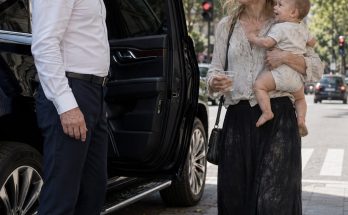
I gave birth at 41, and my husband left me for an 18-year-old. “That old woman’s child will probably be a nobody,” he sneered.

Fifteen years later, at the college admission ceremony, one shocking revelation destroyed him and his young lover in just three seconds.

Chapter 1: The Beginning of the End

I was forty-one when my son was born.

Apparently, that alone made me guilty of something.

The second offense—according to my husband—was expecting him to stay.

His name was Luca Vance, and for nearly two decades, I built my life around the belief that stability mattered more than passion. He wasn’t romantic. He didn’t write notes or remember dates. But he was steady—or at least, I thought he was.

We tried for years to have a child.

Doctor visits. Treatments. Silent car rides home filled with disappointment we didn’t know how to voice. By the time I finally became pregnant, I was almost afraid to feel happy.

But when my son, Leo, was born, I thought everything had finally been worth it.

Luca looked at him once and said, “He’s smaller than I expected.”

I should have understood then.

Everything unraveled quickly after that.

Late nights turned into overnight absences. “Work dinners” became weekends away. Meanwhile, I was at home with a newborn, exhausted and healing, trying to survive on instinct and love.

Then one night, I saw a message on his phone:

Miss you already. Last night was wild.

No name. Just a heart.

When I confronted him, he didn’t even try to lie.

“She’s eighteen,” he said.

Like that explained everything.

“You left your wife and baby for a teenager?” I asked.

He sighed, irritated.

Then he said the sentence that stayed with me for years:

“That old woman’s kid is probably slow anyway.”

Two days later, he left.

Chapter 2: Raising a “Mistake”

He disappeared into a new life with his girlfriend, Wendy—young, carefree, and proudly visible online.

I stayed behind.

With a newborn.

With bills.

With silence.

But motherhood doesn’t give you the luxury of falling apart.

So I worked.

I sacrificed.

I rebuilt.

And my son—my “slow” child?

He grew.

Quietly. Brilliantly.

Leo didn’t just learn—he absorbed everything. By thirteen, he was reading university-level material. By fourteen, he was building tools to solve real-world problems. By fifteen, he was winning national competitions.

His father barely noticed.

When Luca did call, it was always the same question:

“Does he show any real potential?”

I always gave the same answer:

“You’ll see when the world does.”

Chapter 3: The Ceremony

Fifteen years later, that moment arrived.

The ceremony took place at St. Sterling’s Academy, a historic institution known for excellence. Only twelve students in the country had been selected for an elite research fellowship.

Leo was one of them.

He stood at the front of the hall, composed, confident—everything his father never believed he could be.

That’s when Luca showed up.

Of course he did.

Dressed well. Polished. With Wendy at his side, still clinging to the image they had built together.

“Impressive,” he said, glancing at Leo. “Let’s see if it’s really worth all the effort.”

Wendy smiled faintly. “Some people peak late, I suppose.”

I simply replied, “You might want to pay attention.”

Chapter 4: Three Seconds

The ceremony began.

Names were called. Achievements listed.

Then came Leo.

He walked onto the stage calmly.

The dean spoke:

“Leo Sterling, recognized for his groundbreaking work in predictive infrastructure systems and for initiating a formal investigation into regulatory failures affecting public safety…”

A ripple moved through the audience.

Then the screen lit up with a live address from Dr. Phoebe Reed, a renowned figure in research and ethics.

She congratulated the students.

Then she said:

“We are especially proud of Mr. Sterling, whose findings exposed serious misconduct within one of our affiliated development divisions. As of this morning, all individuals involved have been terminated and referred for legal action.”

Silence.

Absolute silence.

Three seconds.

That’s all it took.

Luca froze.

His phone began vibrating nonstop.

Because the investigation Leo contributed to had uncovered corruption—documents, approvals, falsified reports.

All leading back to one name.

Luca Vance.

Chapter 5: The Fall

He checked his phone.

His face changed instantly.

Wendy whispered, “What’s happening?”

He didn’t answer.

Because he already knew.

The career he built…

The reputation…

The illusion…

Gone.

He looked toward the stage, then at me.

“This is your fault,” he muttered.

I stood.

“No,” I said clearly. “This is yours.”

People turned.

“You walked away from your own child because he didn’t fit your expectations,” I continued. “And now the same child exposed the truth about you.”

Luca had nothing to say.

For once in his life—

Nothing.

Chapter 6: The Final Word

Then Leo stepped down from the stage.

He walked straight toward his father.

Calm. Steady.

Unshaken.

“You were wrong about one thing,” Leo said.

Luca swallowed. “What? That you’re smart?”

Leo shook his head.

“No. About my mother.”

The room held its breath.

“You called her old,” he said. “What she was… was strong enough to raise me alone after you left.”

Luca looked away.

And that was it.

He lost everything—

Not because of revenge.

But because truth finally caught up.

Chapter 7: What Remains

After the ceremony, people gathered around Leo.

Praise. Recognition. Opportunity.

But when he came back to me, he asked quietly:

“Are you okay?”

I smiled through tears.

“I am now.”

Later, he asked, “Do you ever wish you had me earlier?”

I didn’t hesitate.

“Never.”

Some people think ruin happens in a single moment.

But sometimes, it begins much earlier—

With abandonment.

With cruelty.

With underestimating the wrong person.

And sometimes, fifteen years later, the truth arrives exactly on time.

Not loud.

Not vengeful.

Just undeniable.

And that’s more powerful than anything they ever took.

Epilogue: The Architecture of Light

The sun over St. Sterling’s Academy possessed a crisp, autumn clarity that made the century-old brick buildings look newly carved.

High above the central quadrangle, a flock of migratory birds swept through the blue sky in a silent, perfect $V$, shifting effortlessly against the wind. Below them, catering crews quietly dismantled the white marquee tents from the afternoon’s fellowship ceremony, folded the navy-blue velvet tablecloths, and stacked the empty wooden chairs into neat rows.

The grand, intimidating hall that had just witnessed the complete, public dismantling of Luca Vance’s thirty-year career was now returning to its natural state: quiet, dignified, and entirely indifferent to the men who thought they owned the world.

I sat on a stone bench beneath the wide canopy of an ancient oak tree, holding a lukewarm paper cup of dark coffee in both hands.

My silver-grey coat was buttoned against the fresh October breeze, and for the first time in fifteen years, my shoulders didn’t ache. The perpetual, invisible tension that had settled into my neck on the cold autumn morning Luca walked out of our nursery had simply… evaporated. It hadn’t dissolved in a dramatic burst of anger or a tearful breakdown. It had vanished in the three seconds it took for a dean’s voice to carry across a microphone and for a phone to vibrate in a coward’s pocket.

Beside me on the bench sat Leo’s leather satchel. It was heavy, scuffed at the corners, and stuffed with research journals, architectural blueprints, and a small, worn wooden dinosaur his grandfather had carved for him when he was five.

A few yards away on the gravel path, Leo stood surrounded by three senior professors from the department of civil engineering and Dr. Phoebe Reed herself. The world-renowned ethics investigator and research director was gesturing toward a blueprint Leo had pulled from his folder, her sharp, analytical face lit with genuine excitement. Leo was listening intently, nodding, his tall, lean frame inclined respectfully toward her.

He was fifteen years old. He possessed his father’s dark, striking hair and sharp jawline, but everything else—the quiet intensity of his eyes, the steady, unhurried cadence of his speech, the deep humility in how he carried his extraordinary mind—belonged entirely to the life we had built together in our small, sunlit house across town.

Dr. Reed smiled, patted Leo warmly on the shoulder, and handed him an official cream envelope sealed with the red wax crest of the university board. They exchanged a firm handshake before she turned and walked toward the faculty administration building.

Leo watched her go, took a long, steadying breath, and then turned toward me. The formidable, brilliant young researcher who had just brought a corrupt corporate division to its knees vanished instantly, replaced by the gentle, attentive boy who still checked to make sure I had remembered my scarf before we left the house.

He walked over, his shoes crunching softly on the gravel, and sat down beside me on the stone bench.

“Dr. Reed signed the formal research directive,” he said quietly, setting the envelope on his lap. “The oversight board is freezing every municipal contract associated with Vance Global Holdings pending the federal audit. The legal team is stepping in tomorrow morning.”

I looked at the red wax seal on the envelope. “And your father?”

Leo’s expression didn’t harden. There was no bitter satisfaction in his eyes, no theatrical triumph. Just a calm, clear stillness.

“His chief legal counsel called him while he was standing in the parking lot,” Leo replied, watching a dry oak leaf tumble across the grass. “The board held an emergency meeting twenty minutes after the dean finished speaking. They stripped him of his executive voting rights, revoked his pension structure, and froze his corporate accounts. By four o’clock today, the state regulatory commission will file formal charges for falsifying public safety certifications on the bridge expansion project.”

I took a quiet sip of my coffee. “And Wendy?”

A faint, sad smile touched the corner of Leo’s lips. “She took the keys to his car and left him at the front gates. I saw her calling an Uber from the curb while he was still arguing with his lawyer on the phone.”

The poetic symmetry of it was almost terrifying, yet entirely predictable.

Fifteen years ago, Luca had discarded a thirty-nine-year-old wife and a newborn baby because he believed youth, vanity, and shallow perfection were the only things worth possessing. He had traded a life of quiet substance for a girl who looked good on his arm at dinner parties. And now, the very shallow, transactional cruelty he had cultivated in his new life had turned inward on him the exact moment his money and title vanished.

He hadn’t been destroyed by a vengeful ex-wife. He hadn’t been ruined by a bitter son.

He had built a house out of straw, greed, and lies, and then acted surprised when the first real wind blew it down.

“Do you feel sad for him, Mom?” Leo asked softly, turning his dark eyes toward me.

I looked down at my hands, at the faint silver ring mark still visible on my left ring finger if the light hit it just right—a permanent scar from a nineteen-year marriage that had ended in a single, cold sentence in a hospital room.

“No, Leo,” I said honestly. “Sadness requires a sense of loss. You can’t lose something that was never real in the first place. I spent nearly two decades believing your father was a foundation. It took me a long time to realize he was just a shadow that happened to take up space in my living room.”

I reached out and smoothed the lapel of his jacket. “What I feel… is peace. Pure, quiet peace.”

Leo smiled, placing his hand over mine. “Good.”

Later that evening, long after the crowds had cleared from the academy grounds and the autumn sun had dipped below the horizon, Leo and I sat in the small, warm kitchen of our bungalow on the north side of the city.

The house was modest, built in the 1920s with creaky hardwood floors, a stone fireplace, and a deep bay window that looked out over a yard filled with wild hydrangeas and old pine trees. It wasn’t a gated estate in the suburbs like the one Luca had bought for Wendy. It didn’t have marble countertops, smart-home automation, or a four-car garage.

But every square inch of it was saturated with life.

The refrigerator was covered in magnets holding Leo’s science fair ribbons, his early sketches of bridge trusses, his acceptance letters, and an old, faded Polaroid photograph of the two of us sitting on a blanket in the park when he was three years old. The air smelled of roasted garlic, fresh rosemary, and the sweet, dark tea we always brewed on Sunday nights.

While Leo sat at the wooden kitchen table scribbling notes into his leather journal, I stood at the stove, gently stirring a pot of tomato soup.

My mind drifted back to the dark, terrifying winter of forty-one.

I remembered standing in the center of a drafty, empty nursery while the snow rattled against the windowpanes. I remembered the heavy, suffocating weight of the hospital bills stacked on the counter, the cold silence of a phone that never rang, and the terrifying, intrusive thought that maybe—just maybe—Luca had been right.

“That old woman’s kid is probably slow anyway.”

For months after he left, those words had haunted me like a physical threat. Every time Leo cried a little too long, every time he missed a milestone by a single week, every time he stared silently at a wall while other toddlers played, a cold terror would seize my heart. What if Luca was right? What if I had failed him before his life had even begun? What if I wasn’t enough to protect him from the world?

I remembered the nights I sat on the floor beside his crib, holding his tiny, warm fingers through the wooden slats, weeping silently so I wouldn’t wake him, praying to a God I wasn’t sure was listening to simply give me the strength to make it to Friday.

I didn’t have a corporate legal team. I didn’t have an offshore trust fund. I didn’t have a network of influential friends.

All I had was a forty-one-year-old body that ached with exhaustion, an old Honda civic with a rusted muffler, a night-shift job auditing medical records at the county clinic, and an unshakeable, ferocious love for a tiny boy who looked up at me with big, dark, curious eyes and saw his entire universe in my face.

I worked forty-eight hours a week. I clipped coupons. I bought his clothes from thrift racks and traded home-cooked meals with our neighbor, Mrs. Gable, in exchange for babysitting while I took online certification courses to earn an extra three dollars an hour.

And slowly, quietly, the miracle happened.

Not with a loud flourish, but in the quiet, steady rhythm of ordinary days.

I remembered the afternoon Leo turned four. We couldn’t afford a party at a venue or a fancy bakery cake, so I baked a chocolate cake from a box, decorated it with green frosting, and took him to the public library.

While I was looking for picture books in the children’s section, I turned around to find four-year-old Leo sitting cross-legged on the floor, holding an advanced manual on mechanical physics that an engineering student had left on a reading desk. He wasn’t looking at the pictures. He was tracing the mathematical equations with his small index finger, his lips moving silently, his eyes bright with a profound, terrifying comprehension.

When I gently pulled the book away, he looked up at me and whispered, “Mommy, the numbers balance. Look. The bridge stays up because the triangle holds the weight.”

That was the day I realized my son wasn’t broken. He wasn’t “slow.” He wasn’t a mistake.

He was a masterpiece.

And the man who had abandoned him because he didn’t fit into a shallow, superficial mold of what a child should be had thrown away the greatest gift a human being could ever receive.

A sharp, sudden knock at the front door broke the quiet of the kitchen.

Leo looked up from his journal, his eyebrows drawing together in a slight frown. It was nearly eight o’clock at night. We rarely had unannounced visitors.

“Stay here, Leo,” I said gently, setting the wooden spoon on a ceramic tray.

I walked through the warm living room, pulled back the small lace curtain on the front door, and looked outside.

Standing on the porch beneath the yellow porch light was a man who looked like a ghost of the life I had left behind.

Luca Vance.

He wasn’t wearing his immaculate charcoal suit or his silk tie. His designer coat was unbuttoned, wrinkled, and damp from the light mist falling outside. His dark hair was disheveled, his jaw was covered in a rough, uneven stubble, and his eyes were bloodshot, rimmed with a deep, dark exhaustion.

He looked fifty-six going on seventy.

I unlocked the deadbolt and opened the door three inches, keeping the heavy brass security chain engaged.

“Luca,” I said flatly. My voice didn’t contain an ounce of anger. It held the exact same tone I used when answering a telemarketer.

Luca stepped closer to the screen door, his hands trembling as he shoved them into his coat pockets. “Jessi… please. Just give me five minutes. Please.”

“You shouldn’t be here, Luca. The court order from the fellowship committee explicitly forbids you from contacting Leo or approaching his residence.”

“I’m not here as a corporate representative, Jessi!” he choked out, his voice cracking, completely devoid of the smooth, polished arrogance he had displayed at the academy hours earlier. “The board… they took everything. They locked me out of the office. The state attorney served me with a subpoena twenty minutes ago. My accounts are frozen. Wendy took her things and cleared out my personal safe before I could even get back to the house…”

He pressed his hand against the doorframe, his shoulders shaking.

“I have nothing left, Jessi,” he wept, the tears tracking through the dirt on his cheeks. “Thirty years of work… gone in an afternoon. I came here because… because you’re the only person who remembers who I was before all of this. Before the firm, before the money…”

I stared at the man standing on my porch through the glass.

For years, I had wondered what I would feel if this exact moment ever arrived. I had imagined speeches. I had imagined throwing his cruelty back in his face, reminding him of the cold night he packed his bags while our son was screaming in a bassinet, reminding him of the sickening sentence he had spat at me before walking out the door.

“That old woman’s kid is probably slow anyway.”

I had thought about that line a thousand times over fifteen years. I had imagined making him swallow every single word.

But looking at him now—broken, pathetic, clutching the railing of a house he had never contributed a single cent to build—I realized something profound.

The ultimate victory over a person who tried to destroy you isn’t hurting them back.

It’s reaching a place where their pain doesn’t give you joy, their regret doesn’t move your heart, and their presence doesn’t affect your pulse by a single beat.

He was a complete, absolute stranger.

“I do remember who you were, Luca,” I said softly, my voice carrying across the quiet porch. “You were a man who believed that people were things to be used, used up, and thrown away the second they became inconvenient. You believed that young meant valuable, that quiet meant weak, and that wealth meant you were superior to the truth.”

Luca swallowed hard, his eyes pleading through the screen. “I made a mistake, Jessi. I was foolish. I was arrogant. But Leo… he’s my son. He has my blood. If I could just talk to him, if he could tell the board that the investigation was an academic misunderstanding—”

A soft step sounded behind me in the hallway.

Leo walked up, carrying a mug of warm tea. He stood beside me, his tall, quiet frame filling the doorway. He looked at his father through the glass—not with hatred, not with fury, but with the cool, analytical detachment of a scientist observing a specimen under a microscope.

“There was no misunderstanding, Mr. Vance,” Leo said, his voice deep, calm, and entirely unshakeable. “The data in the public safety report was absolute. You chose to use sub-standard steel girders on the river bridge to save four hundred thousand dollars on the municipal contract. You put thousands of commuters at risk every single day so your quarterly profit margin would look impressive to investors.”

Luca froze, staring at his son through the screen. “Leo… I did it for our future—”

“You didn’t do it for our future,” Leo interrupted gently. “You did it for yourself. And you didn’t raise me. This woman raised me.”

Leo laid his arm gently around my shoulders, pulling me close against his side.

“She bought my books by working extra shifts,” Leo continued, looking his father dead in the eye. “She taught me how to read by staying up until midnight after twelve-hour medical audits. She built my mind, she protected my character, and she taught me that a man’s worth is measured by his integrity, not his bank account. You gave me half my DNA, Mr. Vance. She gave me my life.”

Luca’s mouth opened, but no sound came out. The absolute, unassailable truth of Leo’s words hung in the cold night air like a iron wall.

“Please leave our property now,” Leo added softly. “If you stay, we will call the local precinct, and the officers will enforce the protective order.”

Luca stared at us for ten long seconds. He looked at my calm, unbothered face. He looked at his brilliant, unshakeable son standing proudly beside me. He looked at the warm, light-filled house glowing behind us.

He realized, in that final, brutal second, that he was looking at a fortress he could never break, a family he could never join, and a life he had voluntarily surrendered fifteen years ago for a shadow that had dissolved in the rain.

Without another word, Luca Vance turned around, pulled his collar up against the cold mist, and walked down the porch steps into the dark, empty street.

I reached out, clicked the heavy deadbolt shut, and turned off the porch light.

We walked back into the kitchen together.

The soup was steaming on the stove. The wooden table was warm, the tea was hot, and the soft strains of a classical piano piece played softly from the small radio on the counter.

I ladled two bowls of soup and set them flat on the table. Leo pulled out my chair for me, then sat down across from me, picking up his spoon.

“Is he gone?” I asked softly.

“He’s gone, Mom,” Leo replied, smiling gently. “He’s completely gone.”

I looked across the table at my son—the boy the world had once considered a handicap, the boy an arrogant father had called a mistake, the boy who had grown up to change the world simply by standing firmly in the light.

Some people think that justice arrives with thunder, with screaming, or with dramatic acts of revenge.

But sitting in that warm, quiet kitchen, listening to the rain tap softly against the bay window, I knew the truth.

Real justice is quiet.

It is a mother who refuses to quit. It is a child who grows up loved, whole, and free. It is the steady, unyielding accumulation of ordinary days built on love, truth, and dignity.

And when the storm finally clears, the people who tried to break you are left standing alone in the dark, watching from a distance as you sit down at a table you built with your own two hands, eating a meal you earned, surrounded by the only thing that ever truly mattered.

I reached across the table, took my son’s hand, and smiled.

The truth had arrived. It was exactly on time. And it was more than enough.

Leave a Reply

Your email address will not be published. Required fields are marked *