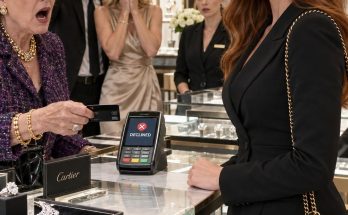
“Throw it out, Dad. Mom never had any real money.”
My daughter, Madison, said those words less than four hours after we buried her mother.
I was seventy years old and had just returned from the funeral of Evelyn, my wife of forty-three years. Downstairs, relatives, longtime business partners, neighbors, and friends were still arriving at our house in River Oaks, Houston, but I had retreated to our bedroom because I could no longer listen to people telling me how sorry they were.
Evelyn had always lived simply.
While I spent decades developing office buildings and retail centers across Houston, she preferred working quietly in a small book-restoration studio in Montrose. She repaired cracked leather bindings, cleaned fragile pages, and could spend an entire afternoon rescuing a book most people would have thrown away.
She never cared about my cars.
She never cared about my watches.
She hated expensive business dinners and usually laughed whenever someone called us wealthy.
While searching for the lavender hand cream she used every night, I opened an old wooden sewing box on her dresser.
Beneath a false bottom, I found a faded blue bank passbook, the kind financial institutions hadn’t issued in decades.
I was just about to open it when Madison walked in without knocking.
“What are you doing up here? Brandon is downstairs talking to your business associates. You should be there.”
I held up the passbook.
“I found this hidden among your mother’s things.”
Madison snatched it from my hand, flipped through two yellowed pages, and laughed.
“Seriously, Dad? Mom’s little book shop barely paid its own rent. You paid for everything.”
Then she tossed the passbook into the wastebasket.
I didn’t argue.
I watched her walk away in the black designer dress she had purchased using my credit card two days earlier.
And something inside me hurt almost as much as burying Evelyn.
My daughter didn’t respect her mother.
She respected money.
I waited until Madison left the room, retrieved the passbook from the trash, and slipped it inside my jacket.
As I headed toward the garage, Brandon, my son-in-law, caught up with me.
“Henry, Madison and I have been thinking about what happens now. You’re grieving. You shouldn’t have to worry about your businesses, trusts, investments, or taxes. My firm can handle everything for you.”
He lowered his voice reassuringly.
“I’ve already prepared some powers of attorney.”
The dirt covering my wife’s grave was still wet, and the man married to my daughter was already trying to take control of everything I owned.
I gave him the tired smile of an elderly widower.
“We’ll talk about it later.”
Then I drove directly to the downtown headquarters of Commonwealth Private Bank.
I asked for Thomas Reed, the director of private banking and an old professional acquaintance.
I placed the passbook on his desk.
“I want to know what this is.”
Thomas picked it up.
At first, he looked confused.
Then he read the account number.
The blood seemed to drain from his face.
He stood immediately, locked his office door, lowered the blinds, and stared at the passbook again.
“Henry… where did you get this?”
“It belonged to Evelyn.”
His hands began to shake.
“Don’t leave this office.”
“Why?”
Thomas swallowed.
“Because this isn’t a normal savings account. And if you only discovered this book today, then we have a very serious problem.”
He reached for his phone.
Before dialing, he looked at me with genuine alarm.
“I need to contact the authorities. Right now.”
That was the moment I realized Evelyn had carried an enormous secret with her to the grave.
What I didn’t yet understand was that the secret was about to tear my family apart.
Thomas logged into a restricted internal system I had never seen.
“Evelyn established this trust in the late 1990s,” he explained. “She invested gradually in technology, telecommunications, fiber infrastructure, data centers, and companies that most people weren’t paying attention to at the time.”
I stared at him.
Evelyn.
The woman who restored antique books and claimed she wasn’t interested in investing.
The woman who wore the same winter coat for fifteen years because she insisted there was nothing wrong with it.
She had quietly built an independent fortune.
“How much?”
Thomas turned the monitor toward me.
More than thirty-four million dollars.
For several seconds, I couldn’t speak.
I felt pride.
Shock.
And an almost unbearable sadness.
I had spent forty-three years beside an extraordinary woman and had never known this part of her.
But Thomas wasn’t smiling.
“There’s another problem.”
He clicked the screen.
“The money is being moved.”
There was an international transfer request for nearly the entire trust balance.
The destination was an offshore company registered in the Cayman Islands.
The transfer had been initiated at 10:15 that morning.
At 10:15, I had been standing beside Evelyn’s coffin at church, delivering the final words I would ever speak over my wife.
“Who authorized this?”
Thomas opened the supporting documents.
There were notarized powers of attorney containing my signature and Evelyn’s.
Neither signature was genuine.
The system also showed an emergency verification message had been sent to the email address registered as the family’s secondary contact.
Madison’s email.
I didn’t feel an explosion of anger.
I felt something colder.
Suddenly, I understood why my daughter had thrown away the passbook.
She hadn’t believed the account was worthless.
She believed the money had already disappeared.
Fortunately, the transfer had been flagged for manual review because of its size and timing.
Thomas contacted the financial crimes division of the FBI and the bank’s fraud unit.
Several investigators arrived discreetly.
They confirmed that the transfer could be frozen without immediately notifying whoever had initiated it.
I asked them for forty-eight hours.
One investigator frowned.
“Why?”
“Because if you arrest whoever did this now, all you have is one fraudulent transfer.”
I looked at him.
“I want to know how far this goes.”
That afternoon, I returned home.
Before entering the kitchen, I heard laughter.
Madison and Brandon were drinking champagne from a bottle Evelyn and I had bought years earlier for our fortieth anniversary.
The moment they noticed me, both expressions changed.
“Dad!”
Madison rushed toward me.
“We were worried. You disappeared. You look exhausted.”
Brandon immediately adopted the concerned-son-in-law expression I’d seen him use in front of clients.
He mentioned the powers of attorney again.
I pretended to be overwhelmed.
For two days, I played the role they already believed I was becoming.
An elderly widower.
Distracted.
Confused.
Emotionally fragile.
Whenever they placed papers in front of me, I rubbed my chest.
Sometimes I claimed I was dizzy.
Other times, I said my attorney should review everything.
Meanwhile, a private investigator I had trusted for years, Marcus Cole, began examining Brandon’s financial history.
The first file was devastating enough.
Shell corporations.
Failed investments.
Massive debts.
Private loans from people no respectable businessman should ever owe money to.
Companies months away from collapse.
Brandon desperately needed Evelyn’s trust money to escape a financial disaster he had concealed from everyone.
Then Marcus put down a second folder.
“This part is going to hurt.”
Inside were photographs.
Brandon in Florida.
Brandon beside another woman.
Brandon carrying a three-year-old boy.
A second family.
For one brief moment, I thought Madison might also have been deceived.
Marcus shook his head.
“Don’t feel sorry for her yet.”
He played an audio recording recovered from data connected to Madison’s phone.
Three days before Evelyn died, Brandon had told her the trust required authentic biometric verification.
Madison’s response was clear.
“Mom is sedated. The night nurse goes to dinner at seven. I’ll get her fingerprint.”
Marcus placed a tablet in front of me.
The security camera from the room where Evelyn had spent her final days showed Madison entering with a small ink pad.
My daughter walked to her unconscious mother’s bedside.
She lifted Evelyn’s hand.
Then she pressed her mother’s thumb into ink and onto several documents.
I watched it twice.
I shouldn’t have.
Something inside me broke the second time.
Marcus closed the video.
Then he placed a third folder on the table.
“I’m not finished.”
I looked at him.
“What could possibly be worse?”
“Madison has been communicating with a private physician for several weeks.”
He hesitated.
“This time, Evelyn wasn’t the target.”
I already knew before he said it.
“You were.”
And what they planned to do to me that night was worse than theft.
PART 3
The physician’s name was Dr. Gregory Mercer.
He ran a private clinic in Uptown Houston and had a history of complaints involving suspicious competency evaluations for wealthy elderly patients.
Marcus had obtained emails, text messages, invoices, and payment confirmations.
The plan was remarkably simple.
That was what made it frightening.
Madison intended to put a sedative and a psychoactive medication into my dinner.
The dosage was designed to produce confusion, shaking, disorientation, and paranoia.
Then Brandon would call Dr. Mercer and claim I was suffering a grief-induced mental crisis.
The doctor would arrive at the house pretending to conduct an emergency evaluation.
His report had already been drafted.
Severe cognitive impairment aggravated by bereavement.
Inability to manage personal or financial affairs.
Possible danger to self.
With that assessment, Madison and Brandon intended to seek temporary control over my finances and companies while arranging for me to be placed in a private care facility.
First, they tried to steal from a dying woman.
Then they planned to erase her husband legally.
I called the federal investigator assigned to the case.
“We don’t have forty-eight hours.”
“What happened?”
“They’re doing it tonight.”
The investigators agreed to wait nearby until I gave the signal.
At eight that evening, Madison knocked on the door of my study.
“Dad, we made you dinner. Mom wouldn’t want us falling apart like this.”
I followed her downstairs.
The dining table looked beautiful.
Fine china.
Candles.
A bottle of expensive wine.
In front of my chair sat a plate of steak covered in dark mushroom sauce.
Brandon stood just behind me.
Madison smiled too brightly.
“Please eat something, Dad. You need your strength.”
I moved the steak around with my fork.
I didn’t take a bite.
“I’m not hungry.”
Brandon’s smile vanished.
“You need to eat.”
It wasn’t concern.
It was an instruction.
Madison placed a folder beside my plate.
“Then maybe we can handle some paperwork while we’re sitting here.”
I opened it.
Powers of attorney.
Financial-management documents.
And beneath them, a form from Dr. Mercer’s clinic.
I looked at her.
“What’s this?”
“Just permission for a medical evaluation.”
She reached across the table.
“We’re worried about you.”
She handed me a pen.
I took it.
Both of them went quiet.
The tip hovered above the signature line.
Then I clicked the pen closed.
“I’m not signing anything.”
Madison leaned closer.
“Dad, you’re not thinking clearly.”
I slowly straightened in my chair.
For two days, I had shuffled through the house.
I had pretended to forget things.
I had allowed them to speak slowly to me as though I were already incompetent.
That performance was over.
I reached into my jacket.
Then I dropped Evelyn’s faded blue passbook directly onto the paperwork.
Madison’s face turned white.
“Remember this?” I asked.
“You threw it in the trash because you said it wasn’t worth anything.”
Brandon immediately stepped forward.
“Henry, you’re obviously confused.”
“Sit down.”
My voice stopped him.
I opened Marcus’s first folder.
“I know about your shell companies.”
Brandon’s eyes changed.
“I know about the millions you owe. I know about the people demanding repayment. I know your businesses are collapsing.”
He backed away.
“And I know you attempted to move more than thirty-four million dollars from Evelyn’s trust into an offshore account.”
“I don’t know what you’re talking about.”
“The transfer has been frozen since the morning of her funeral.”
Madison turned toward him.
“Frozen?”
Real fear appeared on her face.
I removed the photographs from Florida.
“I also know about your house outside Orlando.”
Brandon stopped breathing for half a second.
Madison picked up one of the photographs.
It showed her husband holding a little boy while a blonde woman stood behind him with her arms around his waist.
Madison stared at it.
“Who is she?”
Brandon said nothing.
“Brandon, who is this woman?”
Nothing.
“And who is that child?”
Her hands began shaking.
“Tell me this isn’t real.”
For one brief moment, I saw my daughter as a betrayed wife.
Then I remembered Evelyn’s unconscious hand.
“Don’t turn yourself into the victim now.”
Madison looked at me.
“You knew exactly what you were doing to your mother.”
I pulled out still images from the security recording.
One showed Madison beside Evelyn’s bed.
Another showed her lifting her mother’s hand.
The final image showed her pressing Evelyn’s thumb onto the ink pad.
Madison dropped the picture.
“Dad…”
“I watched it.”
For the first time that evening, my voice broke.
“I watched you use your mother’s hand when she couldn’t even open her eyes.”
She began crying.
“I watched you take her fingerprint so you could steal from her.”
“Dad…”
“And then you stood at her funeral in a black dress, hugged people, and accepted condolences like a grieving daughter.”
“Brandon said the money was supposed to be ours!”
“It belonged to your mother.”
“He said she had hidden it because you wanted everything!”
“Evelyn didn’t owe you thirty-four million dollars.”
“I didn’t know what else—”
“No.”
I stared at her.
“You made a choice.”
Brandon slammed his hand onto the table.
“Enough! We can fix this. We’re family.”
I turned toward him.
“You were planning to take the money and disappear with another woman.”
Madison spun around.
“What?”
“You weren’t saving this family,” I told him. “You were funding your escape.”
Madison held up the Florida photograph.
“You were going to leave me?”
Brandon’s restraint disappeared.
“Shut up!”
“I did all of this for us!”
“No,” he snapped. “You did it because you’ve spent your entire life wanting your father’s lifestyle without ever earning it.”
Madison went completely still.
But we weren’t finished.
I picked up the medical form.
“And what about Dr. Mercer?”
Her tears stopped.
The room became silent.
“Would you like to explain why you’ve been paying him?”
No answer.
“Or should we talk about what you planned to put in my dinner?”
Brandon’s eyes flicked toward my plate.
It was small.
Instinctive.
But enough.