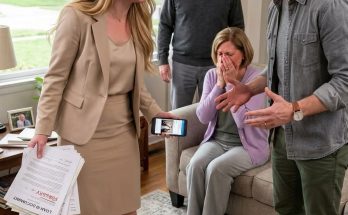
For six months, I cared for my husband’s dying father while my husband and his mother quietly spent his money.

Every time my husband saw me reading beside his father’s bed, he laughed. “Stop wasting your time. He can’t hear you anymore.” Then one night, the old man suddenly opened his eyes and whispered eight words to me. The next morning, I placed a red folder on the table. My husband opened it—and his face instantly went white.

Part 1

“Are you still reading to him? Marisol, he’s not a person anymore, he’s just a breathing body,” Daniel sneered from the bedroom doorway. Behind him, his mother let out a sharp chuckle, clutching a handful of glossy shopping bags from a high-end department store.

For six straight months, I sat beside the bed of my father-in-law, Arthur, inside his home in suburban Chicago. Every single day, I bathed him, turned his body to prevent bedsores, moistened his cracked lips with a damp cloth, and read western novels aloud because they had always been his favorite.

He had suffered a catastrophic stroke, and the doctors warned us that he might remain unresponsive for a very long time. But they also reminded us of a fundamental rule I knew well from my years working as a home health aide: even when a patient cannot move or speak, you must never assume they cannot hear you.

To my husband, Daniel, and my mother-in-law, Teresa, Arthur was already a corpse.

And the worst part was that they acted as though his money had already passed down to them.

Arthur had worked for over forty years as a court stenographer. He was a quiet, meticulous, deeply observant man—the kind who saved every receipt, recorded every date, and could recall a conversation from a decade prior word-for-word. He was never a billionaire, but he was extraordinarily prudent: his home was paid off, he held substantial investments, and he enjoyed a comfortable pension.

When the stroke incapacitated him, Teresa seized control of his primary bank accounts using a durable power of attorney Arthur had signed years earlier for medical emergencies. That money was explicitly meant for his care.

Instead, it began vanishing into things that had nothing to do with him.

First, it was custom leather living room furniture. Then, a luxury watch for Daniel. Soon after, Daniel paid off his brand-new pickup truck using his father’s savings. Teresa booked high-end cosmetic treatments, and by the third month, the two of them flew down to Miami for a seven-day beach vacation.

“We just need to clear our heads,” Teresa had told me smoothly, as if I hadn’t spent the previous ninety nights sleeping upright on a hard chair beside Arthur’s bed.

I had temporarily stepped away from my own job to care for Arthur because they claimed a private nursing facility was “far too expensive.”

“Why pay strangers thousands a month when we already have a nurse in the family?” Teresa had declared.

I was a trained aide, not a registered nurse, but the distinction never mattered to her. To that family, my worth extended only as far as the free labor I provided.

That evening, Daniel and Teresa went out for an expensive steak dinner. I finished reading a chapter, closed the paperback, and murmured my usual sign-off: “That’s all for tonight, Arthur. We’ll pick up here tomorrow.”

Suddenly, his eyelids fluttered open.

His eyes locked directly onto mine.

“Mari…” he rasped out, his voice a dry whisper.

I leaned in so close I held my breath. “I’m right here, Arthur.”

He swallowed with immense effort, forcing out words one painstaking syllable at a time: “Cedar… chest… under the blankets… red folder.”

He took a long, shallow breath.

“Tomorrow… put it… on the table.”

“Why, Arthur?” I whispered.

His eyes filled with a terrifying, piercing clarity I hadn’t seen in months.

“It’s time… they know… I heard everything.”

His eyes drifted shut once more.

I went straight to the closet and pulled out the small cedar chest. Hidden beneath two heavy wool blankets was a thick, red leather accordion folder tied shut with a black ribbon. Written across the front in Arthur’s precise, razor-sharp handwriting was a single word: URGENT.

I didn’t open it.

The next morning at dawn, I placed the red folder right in the center of the kitchen island.

Daniel walked downstairs in his bathrobe, spotted it, untied the ribbon, and pulled out the cover document.

Every drop of color drained from his face.

Teresa stepped into the kitchen behind him, holding her morning coffee. Daniel spun around, holding the paper in a trembling fist, and screamed at his own mother:

“You swore to God he was never going to find out about this!”

I still had no idea what was inside that folder. But looking at their horrified faces, I realized Arthur had never been as helpless as they thought.

And I had no idea what was about to unfold.

Part 2

Teresa lunged forward to snatch the paper from Daniel’s hand, but he stumbled backward as if the document were burning his skin.

“Where did you get this?!” he demanded, whipping his head toward me.

“Your father told me where it was last night,” I replied flatly.

The silence that fell over the kitchen was deafening. For six months, they had openly mocked me for reading to Arthur, for talking to him, for updating him on the household. Now, both of them stared down the hallway toward his bedroom with pure terror in their eyes.

“That’s impossible!” Teresa gasped, her voice cracking. “He’s braindead! He can’t speak!”

“He spoke last night.”

Daniel dropped the folder onto the marble island.

Teresa grabbed it with shaking hands and began frantically flipping through the pages. I caught glimpses of certified deeds, bank ledgers, notarized affidavits, and legal correspondence. I didn’t understand the full scope yet, but she clearly did.

“This isn’t valid,” she stammered, backing away. “Your father was confused. He didn’t know what he was doing.”

“It’s notarized and dated fourteen months before his stroke,” Daniel answered, his voice hollow.

That single sentence broke her composure completely.

I stepped forward to reach for the folder, but Teresa clutched it tight against her chest like a shield. “This is a private family matter, Marisol! You have no right!”

I stared at her, my voice turning to ice. “I am the person who has spent the last six months changing his linens, feeding him through a tube, turning his body every two hours, and keeping him alive while you were in Miami. Don’t you ever tell me I have no right.”

Daniel snapped, completely losing control. “You don’t understand what this does to us!”

“Then explain it to me, Daniel.”

And that was when he made the fatal mistake.

“Mom said that as long as my dad never woke up, no one would ever audit the accounts!” he shouted, pacing the floor like a caged animal.

Teresa whipped around, her eyes wild. “Shut your mouth, Daniel!”

It was too late.

“You told me the power of attorney gave us total control!” Daniel yelled back at his mother, completely unravelling. “You said the house was coming to us anyway! You said we could use his cash reserves now and just clean up the accounting during probate after he died!”

A wave of intense nausea hit my stomach.

They weren’t just mismanaging his medical care. They were actively counting down the days until his death so they could cover up their theft.

Teresa tried to spin it. “Don’t be absurd! We were simply advancing funds that were going to be our inheritance anyway!”

“Using the life savings of a man who is still breathing in the next room?” I asked.

She had no answer.

I pulled out my cell phone and dialed the number printed on a legal business card tucked into the side pocket of the red folder: Ignacio Salgado, Attorney at Law.

When the attorney answered and I gave my name, he went quiet for a beat.

“You’re Marisol?” he asked.

“Yes.”

“Arthur spoke to me about you extensively before his medical emergency,” the lawyer said solemnly.

My heart hammered against my ribs. “He did?”

“I need you to bring that folder to my office immediately. And Mrs. Vance—do not let anyone alter, hide, or destroy a single piece of paper in that stack.”

Teresa lunged toward me to grab the folder from the counter. I snatched it first and stepped out of her reach.

The attorney’s voice continued over the speakerphone: “Arthur established an irrevocable living trust, a revised last will, and an explicit fiduciary directive requiring a full forensic audit of his assets in the event of his incapacity. If he has regained any level of consciousness, we are also bringing in an independent medical examiner today.”

Daniel collapsed into a kitchen chair, burying his face in his hands. “A living trust…?”

Teresa closed her eyes in defeat.

She had known parts of Arthur’s estate plan, but not the trap he had laid for them.

By 2:00 PM that afternoon, Attorney Salgado and an auditor from the bank arrived at the house. They sat at the dining table, spreading out Arthur’s red folder alongside his official bank statements from the previous six months.

The auditor ran a red pen down the ledger lines, circling transaction after transaction.

The Miami resort.

The pickup truck loan payoff.

The luxury watch.

The cosmetic surgery clinic.

Designer boutique charges.

Five-star steakhouses.

The auditor looked up from the papers, locking eyes with Teresa. “Mrs. Vance, you are going to need to provide legal proof showing how every single one of these expenditures directly benefited Arthur’s medical care.”

For the first time since I met her, my mother-in-law had absolutely nothing to say.

Then, Attorney Salgado pulled a wax-sealed envelope from the bottom of the red folder. Written across the front were words that chilled the room:

TO BE UNSEALED ONLY IF MY FAMILY USES MY INCAPACITY TO STEAL MY ESTATE.

Daniel began to weep silently before the seal was even broken.

And as the lawyer slid the letter out, Teresa whispered in a terrified voice, “No… please don’t read that out loud…”

Part 3

Attorney Salgado didn’t open the letter immediately. First, he instructed the independent physician he brought along to evaluate Arthur in his bedroom.

Teresa attempted to block the hallway, claiming her husband was too frail for visitors, but the attorney calmly reminded her that obstructing a court-ordered medical evaluation during a fiduciary audit was a criminal offense.

Inside the bedroom, Arthur’s eyes were open. When he heard my voice, his fingers reached out and gripped my hand tightly. He responded to the doctor’s simple neurological tests with clear, deliberate eye blinks and weak vocal nods. When asked if he wanted Attorney Salgado to execute his legal documents, Arthur blinked twice—his explicit signal for “yes.”

Teresa stood in the doorway, clutching her chest, her face pale with dread.

We returned to the dining room. Attorney Salgado broke the black wax seal and began reading Arthur’s letter aloud.

Arthur had written it fourteen months before his stroke.

“If you are reading this document, it means the exact betrayal I anticipated has come to pass.”

Over three detailed pages, Arthur had recorded dozens of casual, callous remarks his family had made over the years—comments they assumed he was too quiet to notice.

He documented Teresa casually discussing “what she would do with the estate once the house was finally hers.” He documented Daniel asking how much money was sitting in his father’s investment accounts and grumbling that holding onto that much wealth “at his age” was a waste. He documented mother and son making financial plans using assets that Arthur was still actively managing.

Arthur had heard every single word.

For over forty years, Arthur had sat in courtrooms as a stenographer, recording human deceit word-for-word for a living. His family had mistaken his quiet demeanor for ignorance.

He had been protecting himself long before he ever got sick.

Working with his attorney and the bank, Arthur had transferred his home, his pensions, and his liquid portfolios into an irrevocable living trust. As long as he was healthy, he retained full control. If he became incapacitated, the trust automatically transferred administrative control to a neutral corporate trustee—the bank—with strict instructions that every penny be used exclusively for his round-the-clock medical care, private nursing, and physical therapy.

Teresa couldn’t sell the house. Daniel couldn’t inherit the investments. The power of attorney Teresa held applied only to a secondary checking account—and every dollar she had drained from it was now classified as unauthorized conversion of assets.

Furthermore, Arthur had completely rewritten his last will and testament.

Daniel lifted his head, his tears suddenly vanishing. “How much did he leave me?”

He didn’t ask how his father was doing. He didn’t ask what the letter said about his recovery. He only asked for his number.

In that single second, I saw my husband for the hollow, greedy stranger he truly was.

Attorney Salgado looked at Daniel with cold professional disdain. “Significantly less than you were expecting, Mr. Vance.”

Daniel stood up, his chair scraping violently against the floor. “I am his only son!”

“That does not grant you the legal right to plunder his estate while he is alive in the next room,” the attorney replied smoothly.

Teresa slammed her hands on the table. “I am his wife! I’ve been married to him for forty years! This girl showed up six years ago!”

“This girl.”

She spoke about me as if I were a piece of discarded furniture.

Attorney Salgado pulled another document from the red folder. “Which brings us to the final clause of Arthur’s trust directive.”

He read my full legal name aloud: Marisol Hernandez Vance.

My breath hitched in my throat.

Arthur had designated a substantial portion of his personal trust estate, along with an independent caretaking stipend, directly to me.

This was not a reaction to my caretaking after his stroke—the document had been executed over a year prior.

Arthur had written his reason in his own handwriting:

“Marisol is the only person who entered this family without ever asking me what I was worth. If a day comes when I cannot speak for myself, I trust her to do what is right, even if it costs her.”

Tears spilled down my face.

Teresa lost all control, screaming across the table, “You manipulated him! You coaxed him into writing this!”

“The document was executed and notarized fourteen months before his medical event,” Attorney Salgado reiterated firmly. “Mrs. Vance was not present at any legal consultations, and we have certified psychiatric evaluations proving Arthur was of sound mind.”

Teresa’s entire defense rested on painting me as an opportunistic outsider. Arthur had systematically dismantled her narrative before it was ever spoken.

The financial auditor set down his ledger. Because of the clear evidence of financial exploitation of a vulnerable adult, the bank was freezing all access to Arthur’s remaining accounts immediately, launching a formal recovery claim for the misallocated $110,000.

Puerto Vallarta.

The pickup truck loan.

The luxury watch.

The cosmetic treatments.

Every single dollar spent by Daniel and Teresa was now a personal debt they owed back to Arthur’s estate trust.

Suddenly, a soft, rhythmic thumping echoed down the hallway from Arthur’s room.

I hurried down the hall, pushing the door open. Arthur was awake, his head turned toward the doorway.

“Do you need something, Arthur?” I asked softly.

His lips moved slowly. “Bring… them… in.”

Daniel walked in first, hanging his head. Teresa followed, her face blotched red with tears.

Arthur stared at his son and wife for several long seconds.

Daniel stepped closer to the bed. “Dad… look, we can fix this. Mom just thought—”

“Fix… what?” Arthur rasped out.

“The money… the accounts. We were just—”

Arthur turned his head slowly toward Teresa. “You thought… I was… dead.”

Teresa burst into loud, dramatic sobs. “Don’t say that, Arthur! I’ve taken care of you my whole life!”

Arthur took a long, labored breath. “Six months… how many nights… did you sit… in this chair?”

Teresa’s sobbing stopped instantly. She had no answer. She had never spent a single night in that chair.

Arthur reached out his frail, trembling hand, searching the bedsheet until his fingers brushed mine.

“Mari… did.”

That simple, three-word statement delivered more destruction than any courtroom verdict ever could.

Daniel stepped forward, stammering desperately, “Dad, I was just scared to see you like this! Mom said you weren’t conscious, that there was no point in talking to you!”

Arthur looked at his son with a profound, crushing disappointment.

“You called me… a body.”

Daniel went completely rigid.

A cold shiver ran down my spine. Arthur had heard the conversation from the doorway weeks ago. He had heard his own son refer to him as nothing more than a breathing corpse.

“Forgive me, Dad,” Daniel choked out.

Arthur closed his eyes slowly. “Forgiveness… doesn’t erase… what you do… when you think… no one is watching.”

Over the next few weeks, the corporate trust took full legal control of Arthur’s estate.

Certified home health nurses were hired to assist me, physical therapy equipment was brought into the home, and Arthur received the highest level of care money could buy. For the first time since his stroke, his estate was actually being used for him.

The financial audit proceeded relentlessly.

Teresa was forced to surrender the legal title to her luxury vehicle, and Daniel’s truck was repossessed when the bank demanded immediate repayment of the fraudulently transferred funds. Facing potential felony charges for elder financial abuse, Teresa and Daniel surrendered all administrative claims to the estate, agreeing to a court-monitored repayment structure.

The final collapse, however, happened within my marriage.

One evening, Daniel found me in the kitchen packing my personal belongings into boxes.

“Marisol, please,” he pleaded, his voice breaking. “We can still save our marriage. We can get through this.”

I looked at him, remembering six years of quiet cruelty: his mother belittling me while he looked the other way; the Christmas where Teresa handed me a half-used candle as a gift while Arthur secretly slipped me a fine fountain pen with a note reading: “Never let anyone convince you that working with your hands and heart is a small thing.”

“Save what, Daniel?” I asked.

“Us! Our life!”

“Your father was lying helpless in the next room, and you were using his sickness to pay off your truck,” I said flatly. “You called him a body right in front of him.”

He lowered his gaze. “I was frustrated—”

“And when you saw that red folder on the counter this morning, your very first thought wasn’t ‘What did we do to my dad?’ Your very first thought was shouting at your mother, ‘You promised he would never find out.’

He had no response.

Then he uttered the sentence that permanently severed the last thread between us:

“If you’re going to inherit money from my father’s trust anyway, we could use part of it to settle the bank claims. We’re still husband and wife, Marisol.”

Even now, looking at the wreckage of his family, he saw me as nothing more than an access point to someone else’s wealth.

“Your father protected his estate specifically because he knew you would try to do this,” I said coldly.

I filed for divorce that same week.

There was no grand reconciliation. There was only paperwork, quiet exhaustion, and an incredible sense of freedom the moment I signed my name to the dissolution papers.

Teresa cut off all contact with me. Daniel moved into a small, rented studio apartment, stripped of his luxury truck, his father’s money, and his pride.

Arthur, on the other hand, began to make steady progress.

It wasn’t a miraculous movie recovery—the stroke had left permanent neurological damage—but he gained more speech, stayed alert for hours at a time, and actively participated in his daily routine.

Months later, I was sitting beside his bed, finishing another western novel. As I closed the back cover, I looked up.

Arthur was smiling at me.

“What is it, Arthur?” I asked.

“The… red folder,” he rasped out, a glint of humor in his eyes.

I laughed out loud. “You want to hear that story again?”

He nodded. He loved hearing about the morning Daniel walked downstairs and found the red folder sitting on the kitchen island.

“He turned as white as a bedsheet,” I exaggerated, making a face. “I thought he was going to pass out right onto the tile.”

Arthur chuckled, a warm, rough sound. “And… what did he scream?”

“’You promised he would never find out!’” I quoted.

Arthur’s eyes lit up with satisfaction. “Good.”

Once his health stabilized, his estate trust officially hired me as his primary care coordinator, paying me an above-market professional wage with guaranteed time off.

That gesture made me cry far more than the living trust provisions ever had. For years, Daniel and Teresa had weaponized the word “family” to demand my free labor. Arthur used the exact same word to remind me that my time and humanity had value.

I rented a bright, cozy one-bedroom apartment ten minutes away.

One afternoon, as I was finishing a chapter, I looked at him and asked, “Arthur… how long could you hear us while you were lying here?”

He thought for a long moment. “From… almost… the beginning.”

“Everything?”

He nodded slowly. “Miami… the shopping bags… Daniel… you crying.”

I froze. “You heard me crying?”

“In… the bathroom.”

For six months, I believed my exhaustion and loneliness had been completely invisible.

Arthur reached out, his hand gripping mine. “I heard… you choose… to stay.”

I remembered the night I almost packed my bags and walked out forever. I had stood in the hallway, whispering to the walls that Daniel and Teresa didn’t deserve another second of my life, but that Arthur was a human being and I wouldn’t abandon him just because his family had discarded him.

I thought I was talking to myself.

He had heard every word.

“Is that why you told me where the red folder was?” I asked quietly.

He shook his head slowly. “The folder… was already written… to protect you.”

He paused, gathering his strength.

“I told you… because I knew… you would do… the right thing.”

And in that moment, I finally understood.

Arthur hadn’t rewarded me for six months of bedside caretaking. He had been observing my character long before he ever suffered a stroke. He had seen me when I thought no one was watching, just as he had seen his son and wife.

Today, I still think about that red folder, but not because of the money it held.

I think about how frighteningly easy it was for two people to strip a man of his dignity the moment he could no longer defend himself.

Incapacity does not erase a person’s humanity. Silence is not absence. And a human being does not stop deserving respect simply because they can no longer demand it.

The last time we finished a book together, I closed the cover and set it on the nightstand. “Well, that’s the end of that one, Arthur.”

Arthur looked at me. “Good… ending.”

“Yes,” I smiled. “The main character lost a lot, but he kept the things that actually mattered.”

He lifted an eyebrow slightly. “Like… you.”

I laughed softly. “I lost a husband, Arthur.”

“No,” he said, forcing the words out with a mischievous smirk. “You lost… a problem.”

I burst out laughing so hard the floor nurse peeked her head into the room to see what was going on. Arthur was laughing too—a quiet, shoulder-shaking chuckle.

For a few golden seconds, he was the sharp, witty man who had walked into his kitchen six years ago, handed me a fine fountain pen while I was washing dishes, and reminded me that my work had dignity.

The red folder changed our lives, but it wasn’t the greatest gift Arthur gave me.

The greatest gift was the unshakeable certainty that I had been seen, valued, and understood by someone who cared.

And perhaps that is why I never stopped seeing him.

Leave a Reply

Your email address will not be published. Required fields are marked *