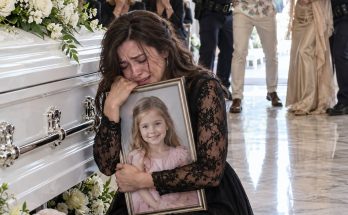
My 15-year-old daughter kept complaining about severe stomach pain and constant nausea, but my husband dismissed her. “She’s pretending. Don’t waste your time or money,” he said.

I didn’t listen. I secretly took her to the hospital. When the doctor examined her CT scan, his expression suddenly changed. He lowered his voice to a whisper and said, “There’s something inside her…” And the moment he told me what he had found, I could only scream.

PART 1

The night I found my fifteen-year-old daughter curled up on the bathroom floor, vomiting and clutching her stomach, my husband didn’t even get up from the couch.

“Leave her alone, Mariana,” Richard said, not taking his eyes off his phone. “She’s overreacting again. We’re not wasting money on an ER run for a temper tantrum.”

Something inside me snapped.

Chloe had been complaining for nearly a month. At first, it was nausea after breakfast. Then she stopped finishing her meals, started coming home pale from high school, and spent her evenings curled on her side with a heating pad against her abdomen. I had insisted three separate times on taking her to see a doctor.

Richard always found a reason to shut it down.

“It’s just nerves.” “She’s trying to skip school.” “At that age, everything hurts when they want attention.”

But that night, Chloe didn’t look like a dramatic teenager. Her lips were dry, her t-shirt was soaked with sweat, and her breathing was ragged.

I knelt beside her. “Look at me, sweetheart.”

Chloe lifted her eyes. “Mom… it feels like something is pulling me from the inside.”

Richard appeared in the doorway, letting out a loud sigh. “And here go the two of you again.”

I didn’t argue. I waited until Chloe could stand, guided her to her bedroom, and sat beside her until she drifted off.

The next morning, I told Richard I was taking her to buy new sneakers because hers were worn out.

“Don’t get expensive ones,” he grunted.

The moment we pulled out of our driveway, I drove straight to City General Hospital.

Chloe noticed when I took the wrong turn. “Mom… Dad is going to be furious.”

“Let him be mad at me.”

“He said it wasn’t necessary.”

“A doctor is going to decide that today.”

In the emergency room, the triage nurse stopped asking questions the second she gently pressed Chloe’s abdomen. My daughter gasped in sheer agony.

They drew blood, hooked up an IV, and ordered an ultrasound. Based on what they saw, they immediately escalated it to a STAT CT scan.

Forty minutes later, a pediatric gynecologist named Dr. Elisa Navarro walked into the exam room accompanied by a chief specialist. Neither of them was smiling.

Dr. Navarro pulled up a chair. “Mrs. Sterling, we found a large mass in Chloe’s abdomen.”

I went completely rigid. “A tumor?”

“It’s a possibility, but we don’t know the exact nature of the mass yet. It appears to originate near her right ovary. We need to run further tests and evaluate her for emergency surgery.”

Chloe gripped my hand tightly. “Is it cancer?”

“We can’t say that yet,” Dr. Navarro said gently. “Benign masses can grow quite large. What’s urgent right now is finding out why it’s causing so much acute pain.”

I felt the room closing in on me. “How long has it been there?”

Dr. Navarro looked at me carefully. “Given its size, this didn’t appear overnight or even this week.”

Chloe dropped her gaze to the hospital blanket. “Dad knew it hurt way before this, Mom.”

I spun toward her. “Before you told me?”

She nodded faintly. “When you went out of town to care for Grandma, he took me to a clinic.”

My heart hammered against my ribs. “What clinic?”

“I don’t know… an urgent care clinic down the highway. They examined me and said I needed a pelvic ultrasound right away. Dad got really mad at the doctor.”

Dr. Navarro listened silently. “What happened after that, Chloe?”

Chloe began to cry, soft tears falling onto her gown. “He told me not to tell you because you’d make a big scene and spend money we didn’t have.”

Before I could even process the words, my phone vibrated in my coat pocket.

Richard. Three missed calls. Then a text: Where are you two?

I typed back: At the hospital. Chloe has a large abdominal mass.

His reply came almost instantly: Do NOT authorize anything until I get there.

I stared at the screen.

He didn’t ask if she was stable. He didn’t ask if she was in pain. He didn’t ask what the mass was.

He just wanted to halt everything.

Dr. Navarro read my face. “Is something wrong?”

I showed her the text message.

Chloe let go of my hand, her voice barely a whisper. “Mom… there’s something else.”

“What is it, sweetie?”

She looked toward the door, as if expecting her father to burst through it. “Dad was giving me pills to make the pain go away.”

“What kind of pills?”

“I don’t know. He said they were for my stomach. But every time I took them, I got really, really sleepy.”

Dr. Navarro leaned in closer. “Do you still have the bottle?”

Chloe shook her head. “He gave them to me directly out of an unlabeled bottle.”

A cold, terrifying chill ran down my spine.

And then my fifteen-year-old daughter said something that made my blood run cold: “The last time I begged him to go back to the doctor, Dad told me that if you found out what was happening… ‘it was going to ruin us all.’”

At that exact moment, the door pushed open.

Richard stood there. And by the way his eyes darted from the heart monitor straight to Chloe, I realized he hadn’t come to check on his daughter.

He had come to see how much we had found out.

PART 2
“What did you do to her?” Richard demanded, stepping into the room without greeting anyone.

He didn’t hug Chloe. He didn’t ask how she felt. He looked at the IV bag, the clinical chart, and the monitors like a man assessing property damage.

Dr. Navarro stood up straight. “Your daughter is stable, sir. We are completing her pre-op evaluations.”

“I want all procedures suspended until I get a second opinion,” Richard stated flatly.

“The patient is in acute pain from a mass that requires surgical evaluation,” Dr. Navarro replied, her tone turning stern.

Richard set his jaw. “I already took her to a clinic weeks ago. It wasn’t urgent.”

A suffocating silence fell over the room.

I glared at him. “So you did take her?”

He hesitated for half a second. “To an urgent care. As a precaution.”

“And why did you hide it from me, Richard?”

“Because you turn every minor ache into a tragedy!”

Chloe shrank beneath the sheets. Dr. Navarro caught the gesture instantly.

“Sir, I need you to wait out in the hallway,” Dr. Navarro said.

“I am her father.”

“And she is experiencing distress. Step out.”

Richard glared at Chloe. “Tell them you’re fine.”

Chloe’s breathing hitched. “I… I don’t want you in here right now.”

It was the first time in my life I saw Richard completely speechless. He turned on his heel and stormed out.

The hospital social worker arrived shortly after. She spoke softly, allowing Chloe to guide the conversation, and confirmed a chilling truth: for weeks, my daughter had been minimizing her pain based on her father’s volatile mood.

Chloe explained that the clinic visit had been six weeks ago. She remembered the green sign, the receipt Richard shoved into his glove compartment, and the doctor insisting on a pelvic ultrasound “as soon as humanly possible.”

She also described the pills. Dr. Navarro noted the physical descriptions, suspecting a prescription sedative.

I wasn’t going to wait for Richard to confess. I called my sister, asked her to go to our house, and check Richard’s bathroom drawer. She found the bottle tucked behind his shaving kit, snapped photos, and sent them to me.

It was a heavy-duty prescription sedative—prescribed to Richard months ago for insomnia, not to a teenager for severe abdominal pain.

Dr. Navarro’s forehead creased in outrage. “He was medicating her without a prescription to mask her symptoms.”

I felt a wave of nausea. He hadn’t just ignored her pain. He had actively kept her sedated and silent.

By 9:00 AM the next morning, the medical records from the private clinic arrived via fax. The physician’s note was crystal clear: Persistent lower abdominal mass, palpable, priority pelvic ultrasound required. Go to ER if pain escalates.

Below it was the signature acknowledging receipt of instructions: Richard Sterling. Six weeks ago.

It was no longer my word against his.

Yet something still didn’t make sense. Richard made a great living as a senior procurement manager for a packaging firm. We had high-end medical insurance. We were comfortable.

Why would a simple medical procedure terrify him so much that he’d risk his daughter’s life?

The answer came through a simple bank notification.

I opened our joint bank account app on my phone to process an ER intake deposit.

Available balance: $2,800.

I blinked. We were supposed to have nearly $75,000 in our primary savings.

I pulled up the transaction history.

Massive wire transfers to an entity called Horizon Capital. Unfamiliar credit card payments. Cash withdrawals of $5,000, $10,000, and $15,000.

For four months, money had been drained from our family reserves into a high-risk real estate venture.

I called our accountant. When I named the development firm, he went dead quiet.

“Mariana… Richard didn’t tell you about that investment?”

“No.”

“He put over ninety thousand dollars of your joint capital into it. The project defaulted two months ago. It’s in litigation.”

The ground seemed to give way beneath me. “Did he take out loans?”

“A personal loan, two high-interest credit lines, and a auto-equity loan.”

I hung up, looking back at the bank logs.

Then I spotted a charge: Westside Urgent Care Clinic — $120. Six weeks ago.

Two days after that clinic visit, Richard had wired his last $15,000 into the failing investment fund to avoid losing his equity stake.

Richard hadn’t been afraid of a medical bill.

He had been terrified that if I took Chloe to the hospital, the insurance claims, copays, and financial verifications would force me to look at our joint accounts and discover that he had quietly bankrupted our family.

He chose to keep our daughter sedated with prescription pills rather than let his financial fraud be exposed.

I immediately forwarded the bank records to a top family law attorney recommended by my sister. Then, I placed an emergency freeze on all joint accounts requiring dual authorization.

At 4:00 PM, the pediatric surgeon explained that Chloe needed emergency surgery the following morning. The mass was compromising her right ovary, risking severe tissue necrosis.

I signed the consent form.

Without calling Richard. Without asking his permission. Without negotiating.

That night, he sent me a text: You’re destroying this family over a dramatic stomach ache.

I took a screenshot and sent it directly to my attorney.

PART 3

Chloe’s surgery began at 7:30 AM.

I walked beside her gurney until the double doors of the surgical wing. Before they rolled her in, she squeezed my fingers.

“Mom… if Dad comes, I don’t want to see him when I wake up.”

“You won’t see him, sweetheart. I promise.”

“Are you staying?”

“Every second.”

In the waiting room, my sister handed me a cup of coffee that remained untouched. Meanwhile, my attorney was compiling our emergency filing: bank ledgers, clinic records, the prescription bottle photos, and Richard’s text messages.

At 11:50 AM, the surgeon emerged in her scrubs. “She did wonderfully.”

My legs nearly gave out.

The mass was nearly seven inches across—a large, complex cyst that had caused intermittent ovarian torsion, which explained the unbearable waves of pain and nausea. The surgical team successfully removed it while preserving her ovarian tissue.

“Was it malignant?” I asked, my voice trembling.

“Visually, it appears entirely benign, though pathology will give us the final report in three days,” the surgeon smiled.

When I walked into recovery, Chloe was drowsy, her eyes half-open. “Mom…?”

“I’m right here, sweetie.”

“Is it gone?”

“It’s completely gone.”

“And you’re still here?”

I laughed through my tears. “I told you I wasn’t moving an inch.”

Richard arrived an hour later carrying a store-bought bouquet of flowers. The hospital social worker intercepted him in the hallway, informing him that Chloe had requested no visits from him.

He spotted me near the nurse’s station. “Mariana, we need to talk.”

“Right here is fine.”

He looked around. “I’m not discussing our marriage in front of strangers.”

“Then don’t discuss it.”

“You’re letting your sister manipulate you,” he hissed.

I pulled a manila folder from my bag. “We found the prescription bottle, Richard.”

His face changed. “That was just to help her rest!”

“It was a heavy sedative prescribed to you. You aren’t a doctor, and you were drugging our daughter.”

I pulled out the clinic note. “The doctor six weeks ago ordered a priority ultrasound. You signed the notice, took her home, and buried it.”

Richard looked away, his jaw tightening. “She wasn’t in that much pain back then!”

“She begged you to go back, and you told her not to tell me because it would ‘ruin us all.’”

I pulled out the bank statements. “And by ‘ruin us,’ you meant this.”

He went completely rigid. “You went into my accounts?”

“Our accounts. You drained ninety thousand dollars of our family savings for a illegal investment scheme.”

“I was going to recoup it!”

“Two days after Chloe’s clinic visit, you transferred fifteen thousand dollars to that fund,” I said, pointing at the dates. “You chose to hide your financial disaster over getting our daughter emergency medical care.”

He opened his mouth, but no lies came out.

The evidence was airtight. The clinic confirmed he was warned. The bank proved where the money went. The bottle proved he illegally medicated her. His texts proved he tried to block her treatment.

“My attorney will be contacting you today,” I said calmly. “I’m filing for divorce and full legal custody.”

He glared at me, desperate. “You’re throwing away seventeen years of marriage over a bad investment?!”

“No,” I replied, looking him dead in the eye. “I’m ending it because when your secret competed with our daughter’s life, you chose your secret.”

He left without seeing her.

Three days later, pathology confirmed the mass was a mature, benign teratoma. No chemotherapy, no further invasive treatments required.

When the doctor gave us the news, Chloe wept with relief. So did I.

“Mom, you’re squeezing my hand too hard again,” Chloe giggled softly from her bed.

I let go immediately. “Sorry!”

“I’m going to bill you for physical therapy,” she teased.

It was the first real joke she had made in months.

The recovery was long. For weeks after returning home, Chloe was hesitant before taking any medication, even over-the-counter vitamins. But with time, therapy, and absolute safety, the light returned to her eyes.

I opened an independent account, secured a court order freezing all joint real estate, and let my attorney handle the divorce proceedings. Richard was forced to liquidate his personal assets to cover the joint debt he had fraudulently accumulated.

A year after that fateful morning, we returned to the hospital for Chloe’s annual follow-up ultrasound.

Dr. Navarro walked into the room, and Chloe raised an eyebrow. “Before you say anything, Doctor… is there anything inside me?”

Dr. Navarro laughed. “Just normal organs, Chloe. Everything looks 100% clear.”

Chloe let out a huge breath. I wiped a tear from my eye.

As we walked out into the hospital parking lot, Chloe stopped in her tracks. “Mom… we forgot something.”

“What?”

“My new sneakers.”

It took me a second to realize what she meant. The day I rushed her to the ER, I had used buying sneakers as an excuse to get her out of the house. We had never bought them.

We drove straight to the mall. Chloe tried on four pairs before settling on a sleek white pair with dark green trim.

She looked at the price tag. “They’re a little expensive, Mom.”

For a split second, Richard’s voice echoed in my head: Don’t get expensive ones.

I looked at my daughter standing in front of the mirror—healthy, vibrant, with color back in her cheeks and a future ahead of her.

“If you love them, sweetie,” I smiled, handed my card to the cashier, “we’re taking them.”

Chloe smiled brightly, wrapping her arms around me. “Thanks, Mom. For everything.”

I held my daughter close under the bright mall lights, knowing that the dark days were finally behind us. I had taken a stand when it mattered most—and my daughter was safe, happy, and whole.

Leave a Reply

Your email address will not be published. Required fields are marked *