I sacrificed twenty-two years of my life raising my triplet nieces, but what they did at their college graduation left me collapsing to my knees.

Part 1: The Porch Light

There were plenty of nights when I questioned whether I was doing enough, whether I was making the right choices, or whether I was getting anything right at all. Looking back now, though, I can trace everything that happened to a single decision I made on an ordinary October evening.

The porch light flickered that night, casting a thin yellow ring across the wooden boards. I had just come home from a double shift, still smelling like sawdust and motor oil, my front door keys already in my hand.

Then I nearly tripped over them. Three car seats were lined up on the porch, alongside one diaper bag and a note written on the back of a gas receipt.

I picked up the receipt first because my mind refused to process what I was seeing inside those car seats. The handwriting was unmistakable, slanting hard to the right exactly the way my brother Lucas’s handwriting always had.

The note contained only a few words. “I’m sorry, Owen. I can’t do this.”

That was it. There was no forwarding address, no phone number, and nothing explaining where he had gone or when he might return.

Lucas’s wife, Rebecca, had been buried just eleven days earlier. My brother hadn’t even made it through two weeks without leaving his three daughters behind.

I was twenty-seven years old, unmarried, and living in a tiny apartment above the hardware store where I swept floors, cut keys, and worked whatever hours they needed me. I had exactly three hundred and twelve dollars in my checking account, and my bed was a futon that didn’t even fold all the way out.

And now there were three six-month-old babies sitting on my porch. One of the triplets made a soft, wet hiccup, as if she were trying to be polite about announcing her presence.

I knelt down on the porch and looked closer. Two little faces were fast asleep, but the smallest one was wide awake, staring at me with enormous gray eyes that matched my mother’s exact shade.

“Hey,” I whispered, reaching out a hand. “Hey, you.”

Right then, the door to the apartment next door opened. Mrs. Gable stepped outside wearing her bathrobe and slippers, which slapped against the concrete as she hurried toward me.

“Owen?” she asked, her voice filled with shock. “What in the world is going on?”

“It’s Lucas’s triplets,” I replied softly, unable to take my eyes off the car seats.

Her face changed immediately as she looked around the dark porch. “Where is he?”

“He’s gone,” I said, handing her the scrap of paper.

She looked at the note, then at me, and then back at the three babies. She pressed one hand against her chest with a deep sigh. “Honey, you can’t raise three babies alone!”

“I know!” I exclaimed quietly, feeling a sudden surge of panic.

“You don’t even know how to warm a bottle,” she added firmly.

I sighed deeply because she wasn’t wrong about that. Mrs. Gable knelt beside me on the cold wood, her expression shifting from surprise to profound worry.

I was already thinking she was right when the smallest baby suddenly reached upward. Her tiny hand moved blindly through the air until her fingers found mine, and then her fist closed around my index finger.

She was six months old, and her hand was tiny, but her grip was warm and surprisingly strong. I didn’t move, nor could I bring myself to break the contact.

Mrs. Gable looked down at her and softened her voice. “That’s Sadie,” she said quietly.

I looked up at her, completely puzzled. “How do you know that?”

“Rebecca brought them by twice this summer, and she made sure we’d know how to tell them apart,” Mrs. Gable explained gentle. “She said the smallest one would always be Sadie.”

“Sadie,” I repeated slowly, testing whether my mouth still worked properly.

Baby Sadie kept holding on, unaware that I had no money, no experience changing diapers, and no proper home for them. She didn’t know that her mother was gone or that her father had abandoned her; she only knew that someone was there holding her hand.

“I’ll call social services in the morning,” Mrs. Gable said gently, putting a hand on my shoulder. “There are good families out there, Owen, families who are actually ready for this.”

Sadie’s fingers remained wrapped securely around mine. I opened my mouth to agree with Mrs. Gable, fully intending to do the sensible thing.

“Okay,” I whispered, looking directly into Sadie’s big gray eyes. “Okay. Okay, I’ve got you.”

Mrs. Gable went quiet, recognizing the decision in my tone. The porch light flickered again above us.

I carried the babies inside one at a time, setting them down as gently as I could. Somewhere between the second trip and the third, something fundamental changed inside me.

I stopped being just Uncle Owen. I became something else, something I didn’t have a word for yet, though eventually I would understand that I had become their father by accident.

Part 2: The Years Between

Twenty-two years passed the way a long shift does, feeling slow in the middle but completely gone by the end. I packed their lunches every morning, sometimes using the wrong kind of bread, and I braided their hair so badly that Mrs. Gable would sometimes fix it for them on the porch before school.

“You’re going to give those girls complexes, Owen,” Mrs. Gable teased one morning while pulling a brush through Harper’s tangled hair.

“I’m doing my best,” I replied, holding up three lunchboxes.

“I know you are,” she laughed warmly. “That’s the problem!”

I laughed too, grabbed my keys, and headed out to work. I worked double shifts at the hardware store, and when that wasn’t enough, I took on triple shifts to cover everything they needed.

There were braces that needed paying for, science fair projects to fund, and new sneakers to buy because somehow all three girls’ feet had grown at the exact same time. There were fevers I sat through, school meetings I attended, late-night homework sessions, and broken hearts I had absolutely no idea how to fix.

So when one of them was hurting, I did the only thing I knew how to do. I made grilled cheese sandwiches, sat beside them on the couch, and let them cry it out.

There were years when all three of them seemed to hate me at once. Sadie was thirteen when she started slamming doors so hard that the pictures shook on the walls.

Claire was fifteen when she refused to look at me for an entire month after I grounded her for staying out late. Harper was seventeen when she looked me in the eye and said I didn’t understand anything about her life.

“You don’t understand anything!” Harper yelled before running to her room.

She was right, because I didn’t understand half of what they were going through. But I stayed, because staying was the one thing I knew how to do.

I missed things along the way, too. I missed a cousin’s wedding in Phoenix because Claire came down with a sudden case of the flu.

I missed a fishing trip to Idaho that I’d been promising myself for ten years. And somewhere along the way, I missed the chance to build a conventional life or start a family of my own.

Then there was Laura, the woman I truly loved. She was patient with my situation for a long time, longer than she probably should have been.

One night, she stood at my front door with tears welling up in her eyes. “I’m not asking you to choose, Owen,” she told me softly. “I’m just asking if there’s room for me in this life.”

I looked at her, knowing exactly what she was really asking. “There isn’t,” I said, my heart breaking into pieces.

She looked at me with deep understanding. “Not the kind I deserve?”

“Not the kind you deserve,” I confirmed quietly.

She nodded as though she’d already known my answer before asking. Then she walked away into the night, accidentally leaving a blue sweater behind on the chair, which I never returned.

I stayed with the triplets, not because they had asked me to sacrifice everything, but because someone had to be there for them.

Lucas showed up over the years the way bad weather does, appearing unexpectedly and briefly before disappearing again. A birthday card arrived once with no return address, and a Christmas card came another year with a postmark from a town I had never visited.

When the girls were twelve, Lucas finally called the apartment line. “I want to reconnect, Owen,” he said over the crackling line. “I’ve been thinking.”

I held the receiver so tightly that my knuckles turned white and my hand cramped. “Thinking about what, exactly?”

“About them,” he replied hesitantly. “About being a dad.”

I stared at the peeling yellow paint on the kitchen wall. “If you want to be a dad, you get on a plane and come here,” I told him sternly. “You don’t think about it on my phone bill.”

Lucas didn’t get on a plane, and he never called again. The cards eventually stopped coming altogether, and while I wondered if the girls noticed, they never brought his name up. But I noticed everything, and I carried the weight of it every single day.

Part 3: Graduation Day

At night, I would lie awake on my bed and run numbers through my head, the way you do when you’ve been broke for so long that counting becomes an involuntary habit. They weren’t money numbers, but rather the questions that kept me up in the dark.

Did I do enough for them? Did I say the right thing at the right time? Did they know how much I loved them, or did they only see a man who was always exhausted?

There was one fear underneath all of it that I never voiced to anyone. Deep down, I worried the triplets were still waiting for their real father, and that I was merely the man who had stepped in out of obligation.

Then came the morning of their college graduation. I sat in my old pickup truck in the parking lot for twenty minutes before I could gather the courage to get out.

I was forty-nine years old, my beard had gone gray in patches, and my left knee still throbbed from a ladder fall two summers ago that had never completely healed. In my hand was a cheap digital camera I barely knew how to operate, and my fingers were shaking.

Inside my wallet, resting behind an expired insurance card, was Lucas’s original note written on the back of the faded gas receipt. I unfolded it carefully with both hands, reading the slanted handwriting one more time.

I wondered whether the girls would mention Lucas today, or worse, whether they wished he were the one sitting in the audience instead of me. I folded the note back up, placed it safely in my pocket, and stepped out into the humid morning air.

The auditorium smelled strongly of floor polish and perfume. I found my seat seven rows back, resting the camera on my bad knee as I tried to calm my racing nerves.

Then the ceremony began, and one by one, the girls walked across the stage to receive their diplomas. They called Harper first, and she started crying before her name had even finished echoing across the room.

Halfway across the stage, Harper wiped her eyes with her gown sleeve and laughed at herself, making me smile from my seat. Next came Claire, my middle child and my wild card, who spotted me immediately and waved with both hands just like she used to do from the school bus window.

Finally, they called Sadie. She walked across the stage with a serious expression, looking as though she were carrying something far heavier than a diploma.

I raised the camera and pressed the shutter button, thinking that was the end of the ceremony. But then the dean stepped back to the microphone and tapped it twice to regain everyone’s attention.

“We have one special presentation before we conclude today,” the dean announced into the microphone.

My girls walked back onto the stage together, holding hands just as they used to do when they were little children crossing busy streets. Something tightened painfully in my chest, though I didn’t understand why.

Sadie took the microphone from the stand and looked out at the crowded room. “Our father couldn’t be here today,” she said clearly.

My stomach dropped, and for a terrifying second, I couldn’t catch my breath. They were going to talk about Lucas, publicly honoring the man who had abandoned them while I sat in the seventh row.

I felt a surge of hurt rise in my throat, but I forced myself to sit still and smile so they could have their moment. Then Harper reached into her gown sleeve and pulled out a worn notebook, while Claire covered her mouth to hide her tears.

Sadie looked directly toward the center aisle. “We found the notebook,” she stated into the mic. “The one kept in the kitchen drawer.”

My eyes closed as my grip tightened on the camera. I thought of the daily journal entries I had written at the kitchen table late at night after long shifts, letters meant to explain my choices to them if I ever died young.

Sadie began reading my own words back to the audience. “To my girls. You’re one year old today. I don’t know if you’ll ever read this, or if I’m doing any of this right, but I wanted to write it down anyway.”

A cold chill ran straight down my spine as I recognized the familiar text. “I’m twenty-seven,” Sadie read on, her voice trembling slightly. “I’m scared all the time, and I don’t know how to be a father, but I know I’m not going anywhere.”

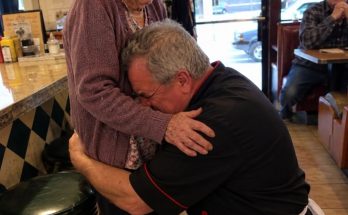
My knees buckled completely, and I slipped out of my chair onto the floor. A kind stranger beside me quickly grabbed my elbow to help me back into my seat, but I was too overwhelmed to even thank him.

Part 4: The Truth

I realized in that breathless moment that when Sadie said “our father,” she had been talking about me all along.

Up on the stage, Sadie stopped reading for a moment and looked straight down the aisle at me. She cleared her throat and continued reading from the old notebook.

“I’ll never be the dad you deserve, but I’ll be the one who shows up,” she read softly.

Harper took the notebook from her sister, her voice cracking as she took over the reading. “I promise you breakfast every morning, even if it’s burnt, and I promise you’ll never have to wonder where I am.”

Claire stepped up to finish the passage. “I love you more than I knew a person could love anything. Happy first birthday.”

The entire auditorium became a blur as tears filled my eyes and spilled down my cheeks. Sadie walked down the stage steps and came straight down the center aisle toward row seven.

She knelt beside my chair and placed a framed document directly into my trembling hands. “We filed the adoption petitions months ago,” she whispered, “and they finally went through last week.”

I stared at the official document, unable to read the legal text through my blurred vision. Up on stage, Harper spoke into the microphone once more.

“We found what our biological father left behind,” Harper declared proudly to the entire room. “You were never just our uncle, Owen.”

“You were always our dad,” Claire added, wiping tears from her face. “We just made the paperwork match the truth.”

Sadie stood up and wrapped her arms tightly around my neck, and I held her back with everything I had left in me. The entire audience stood up and began to applaud, filling the room with a thunderous roar.

I don’t remember walking out of the building, nor do I recall the drive back home.

Three weeks later, I stood by the window in my small apartment above the hardware store, holding two different frames in my hands. On the left wall, I hung Lucas’s old gas receipt note, and on the right wall, I hung the framed adult adoption certificate.

I stood there for a long time staring at both pieces of paper, realizing that what I had done was never a sacrifice, but rather the life I had chosen, a life that had ultimately chosen me back.

I sat down on the futon couch, pulled out my phone, and scrolled to a number I hadn’t dialed in twelve years. My finger hovered over Laura’s contact name for a hesitant moment before I finally pressed call.

She answered on the second ring, her voice as warm as I remembered. “Owen?” she asked softly.

I closed my eyes and smiled through the quiet room. “I was wondering if we could talk,” I said into the phone.

“I was wondering when you’d call,” she replied gently.

THE END.

Leave a Reply

Your email address will not be published. Required fields are marked *