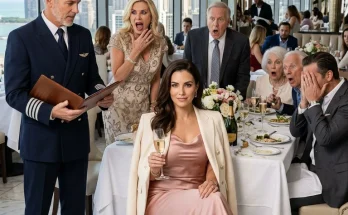
The first thing my mother did when she saw me at my sister’s wedding was tilt her head, let her eyes travel over my dress uniform, and say, loud enough for the nearest tables to hear, “What is a lowly soldier like you doing back here?” A few people laughed automatically, the way people do when someone cruel says something with enough polish.
My father stared into his bourbon.
My sister Ellie froze under her veil.
Daniel, her groom, went ghost-pale.
He wasn’t looking at my mother.
He was staring at the nameplate on my jacket, then at my face, then back at the row of ribbons over my heart.
His hand tightened around his champagne glass so hard I thought it might crack.
The string lights above us glowed soft and forgiving, but nothing about the room felt soft anymore.
To understand why that one sentence wrecked an entire wedding, you have to go back nine years, to my parents’ kitchen and a tuition bill I was still naïve enough to believe they might help me pay.
I was eighteen, accepted to a state university two hours away, and so relieved I could barely breathe.
I had scholarships, some savings from part-time jobs, and a plan that only worked if the people raising me were willing to meet me somewhere in the middle.
I laid the tuition bill on the kitchen table like it was something official enough to earn respect.
My mother didn’t even look at the numbers.
She sat at the counter peeling a clementine in one perfect spiral, the scent of citrus sharp in the room.
My father kept typing on his laptop.
When I finished explaining the gap, my mother said, “You’ll figure it out.
That’s what being an adult is.”
I waited for my father to disagree.
I waited for him to say we would review budgets, cut back, find a way, do anything that sounded remotely like parenting.
He glanced up once, shrugged, and said, “Your mom’s right.”
That was it.
No discussion.
No hard conversation about limits.
No apology.
Just a smooth little sentence that told me I was not a daughter worth rearranging anything for.
A week later Ellie came home in tears because the used car they had bought her before senior year was suddenly too embarrassing to park beside her friends’ newer ones.
By Friday there was a different car in the driveway, cleaner, brighter, with a ribbon on the hood.
My mother handed her the keys like she was crowning her.
My father looked proud.
Ellie squealed and hugged them both.
I stood in the doorway with my tuition bill in my hand.
Nobody noticed me.
Or maybe they did and chose not to.
That was the day I stopped mistaking favoritism for subtlety.
In our house, my parents never announced who mattered most.
They itemized it.
Cars, clothes, rent, sorority dues, spring break deposits, little emergency transfers that somehow never existed when I needed textbooks.
I enrolled anyway.
I worked mornings at a coffee shop and nights shelving inventory at a pharmacy.
I learned how to make one bag of groceries last a week.
I learned how to pretend exhaustion was discipline.
Then midway through my first semester, a paperwork error changed part of my aid package,
and suddenly I was short more money than I could make in time.
I brought the new forms home because desperation makes fools of even the proud.
My mother heard two sentences and said, “No.” When I pointed out that they were paying Ellie’s private school tuition in full, my father said, “We can’t pay for two colleges,” in the patient tone of a man who thought reason was on his side.
I looked straight at him.
“That’s funny, because you never paid for mine.”
My mother’s face hardened like I had broken some unspoken rule by saying the quiet part out loud.
Then she delivered the sentence that sat in my chest for years like a stone.
“Ellie’s different.
College matters for her.”
For her.
Not for me.
Not for my future.
Not for the life I was trying to claw toward with both hands.
Something in me went still that night.
Not shattered.
Not dramatic.
Just finished.
I withdrew from school the next morning, packed two plastic bins and a duffel bag, and loaded my old car without crying.
My mother stood on the porch with her arms crossed and asked, “So you’re giving up?”
“No,” I told her.
“I’m choosing something that doesn’t depend on you.”
I drove straight to a recruiter’s office in a tired strip mall wedged between a payday lender and a nail salon.
The fluorescent lights buzzed.
The chair was uncomfortable.
The sergeant behind the desk asked if I was sure, and for the first time in months I answered without hesitation.
“Yes.”
The military was harder than anything my parents could have imagined and fairer than anything I had ever known.
Basic training stripped away every story I had told myself about what I needed to survive.
Nobody cared who had been favored at home.
Nobody cared who had once been told she mattered less.
You either met the standard or you didn’t.
I met it.
Then I met the next one.
And the next.
There were cold mornings that burned my lungs, boots that never dried fast enough, blistered hands, aching shoulders, and the kind of exhaustion that clears your mind because it leaves room for almost nothing except the next task.
Somewhere inside all of that, I learned the difference between being unwanted and being underestimated.
I built a life one earned thing at a time.
First promotion.
First deployment.
First real friendship that didn’t ask me to shrink so someone else could feel bigger.
Years later, using tuition assistance and every benefit I could stack, I finished the degree my parents had decided didn’t matter for me.
No one handed it to me across a kitchen table.
I took it back inch by inch.
I did not talk to my family unless absolutely necessary.
On birthdays my mother sent stiff messages that read like obligations.
My father sent nothing.
Ellie occasionally texted links to registry lists, fundraisers, or vague updates about her life as if we were the kind of sisters who had simply grown busy instead of broken apart.
So when the wedding invitation arrived, thick cream paper with gold lettering and my parents’ names at the bottom, it sat unopened on my counter for two days.
By the time I slit the envelope, I had already decided
I wouldn’t go.
By the time I reached the RSVP card, I knew I would.
Not because I missed them.
Not because I believed in reconciliation.
I went because silence can start to feel too much like agreement, and I had spent nine years letting them tell themselves a story in which I was the one who walked away without reason.
The venue was the kind of country club my mother had always admired from the outside until Ellie’s engagement gave her a way in.
There were white roses everywhere, candles floating in glass cylinders, polished floors reflecting chandeliers, and guests dressed in expensive fabrics that whispered when they moved.
My mother was in her element, smiling with all the warmth of a woman managing inventory.
When I entered the reception hall in my dress uniform, conversations dipped.
A few people recognized me vaguely from old neighborhood holidays.
Most didn’t.
My mother spotted me near the bar, and I watched the calculation happen in her face.
She was going to get ahead of my presence by making me smaller first.
So she laughed lightly and said, “What is a lowly soldier like you doing back here?”
The ugliest part was how practiced it sounded.
She wanted the room to learn from her.
This daughter was the disappointing one.
This daughter could be dismissed.
Then Daniel pushed back his chair so hard the legs screamed against the floor.
“Shut up!” he shouted.
The entire ballroom went silent.
Ellie stared at him, bouquet trembling in her hand.
My mother blinked twice, like no one had ever interrupted her performance before.
Daniel kept his eyes on me.
Not casually.
Not politely.
He looked like he had been dropped into the middle of a memory he had prayed he would never revisit and never forget.
“This is Staff Sergeant Bennett,” he said, his voice rough.
“You do not speak to her like that.”
My mother gave a brittle smile.
“Daniel, I think you’re confused.
She’s my older daughter.”
“I know exactly who she is.” His eyes never left mine.
“Do you?”
A murmur moved across the tables.
My father set down his glass.
Ellie whispered, “Daniel, what are you doing?” He ignored her completely.
Two years before the wedding, Daniel had told Ellie he once served overseas as a young lieutenant.
I didn’t know that until later.
I also didn’t know he had been in a convoy that rolled after an explosion, trapped half-conscious in a smoking vehicle while everyone around him shouted that they didn’t have time.
He told Ellie there was one NCO who went back anyway.
That NCO was me.
I remembered the day the second he said my rank.
Heat pressing through smoke.
A harness jammed against metal.
A young officer trying to stay conscious while blood ran into his eye and he kept apologizing for being dead weight.
I remembered grabbing his vest, cutting him loose, and dragging until my shoulders felt like they were tearing.
I remembered him trying to ask my name and seeing only my last name tape before medics took him.
He had remembered it for years.
Daniel swallowed and pointed to the thin white scar beside his temple.
“She pulled me out of an armored vehicle when it would have been easier, and safer,
to leave me there.
The reason I am alive to stand here today is because she went back.”
No one moved.
Even the servers stood still.
My mother recovered first, or tried to.
“Well,” she said, with a little laugh that made my skin crawl, “that’s very brave, but family is complicated, and you don’t know the whole story.”
Daniel turned on her then, not loud but cutting.
“I know enough.
I know I’ve spent months hearing what a selfish failure her family thinks she is.
I know your daughter just walked into this room and the first thing you did was humiliate her in public.”
My father rose halfway from his chair.
“Let’s take this somewhere private.”
Daniel looked at him with open disgust.
“The insult wasn’t private.”
Ellie finally found her voice.
“Daniel, please.
You don’t understand.
She left.
She always wanted everyone to feel sorry for her, and—”
He snapped toward her so fast she stopped.
“That’s what you told me.
That she was dramatic.
That she quit college because she couldn’t handle responsibility.
That your parents bent over backward for her and she still blamed everyone else.”
He took a breath that sounded painful.
“Every time I talked about the bravest person I ever met, you sat there and listened.
Every time I said I owed my life to Sergeant Bennett, you nodded.
You never once told me she was your sister.”
Ellie went white.
That was the moment I understood why Daniel had looked at me like the floor had vanished.
This wasn’t just recognition.
It was betrayal rearranging itself in real time.
Ellie shook her head too quickly.
“I didn’t know for sure.”
Daniel laughed once, sharp and joyless.
“You heard her last name.
You knew she joined the Army.
You knew the timeline.
You knew enough to ask one honest question, and you didn’t, because it was easier to keep letting me believe your family’s version.”
My mother stepped in front of Ellie as if shielding her from consequences was still an option.
“This is her wedding day.
Whatever grievance you people have can wait.”
You people.
I had spent years thinking I no longer cared what she called me, but some wounds don’t disappear.
They just get quieter until someone presses on them with perfect aim.
For the first time that night, I spoke.
“You told me to be independent,” I said.
My voice came out steadier than I felt.
“So I was.
You refused to help with college.
You paid Ellie’s tuition, her cars, her apartment, and probably half of this wedding.
Then you looked at the life I built without you and still needed it to be smaller than hers.”
My father said my name softly, like he had earned the right.
I didn’t even turn.
“In our house,” I continued, “nobody ever had to guess who mattered.
You kept the receipts.”
A sound moved through the room, not quite a gasp, more like collective recognition.
Guests were no longer watching a family spat.
They were watching a pattern reveal itself.
Daniel looked at Ellie with something colder than anger.
“When did you know?”
She pressed her lips together, then tried the kind of half-truth that had probably worked for her most of her life.
“I realized it might be
her after you told me the story at the lake house.
But you were always so intense about it, Daniel.
You talked about her like she was this saint.
I didn’t want my sister turning into the center of everything again.”
Again.
I almost laughed.
Not because it was funny, but because the lie was so naked it barely deserved the name.
I had never been the center of anything in that family except blame.
Daniel heard it too.
“You were jealous of the woman who saved my life,” he said quietly.
Ellie’s eyes filled.
“That’s not fair.”
“No,” he said.
“Fair would have been telling the truth.”
He reached up, removed the boutonniere from his lapel, and set it on the sweetheart table with care so precise it felt final.
Then he took the ring box from his jacket pocket.
For one suspended second, Ellie looked relieved, like maybe he was about to rescue the scene with some grand gesture of forgiveness.
Instead he placed the box beside the flowers.
“I am not marrying into this,” he said.
The room seemed to tilt.
Ellie made a sound I had never heard from her before, something between a sob and an outrage.
My mother stepped toward Daniel so quickly a server had to move aside.
“You cannot do this over a misunderstanding.”
Daniel’s expression did not change.
“This is not a misunderstanding.
This is character.
Yours.
Ellie’s.
All of it.”
My father looked older in that moment than I had ever seen him.
“Daniel, please.
People are watching.”
He gave the smallest, bleakest nod.
“That’s the problem, isn’t it? She could degrade her own daughter in public, and the only thing you care about is whether the audience noticed.”
My mother’s face went hard enough to cut glass.
She turned on me at last, dropping all pretense.
“You always did ruin things.”
I met her eyes.
“No.
I just stopped helping you hide them.”
For a second nobody had anything left.
Not my mother with her social instincts, not Ellie with her tears, not my father with his silence.
The truth had entered the room and it was ruinously plain.
I could have stayed and watched the aftermath, but suddenly I didn’t need it.
I had not come for an apology, and I was no longer hungry for one.
So I turned and walked toward the exit, my medals light against my chest, my steps steadier than they had been when I arrived.
I had almost reached the front doors when I heard Daniel behind me.
“Sergeant Bennett.”
I turned.
Up close he looked shaken in a deeper way than anger alone could explain.
“I’m sorry,” he said.
“I should have recognized the possibility sooner.
I should have asked better questions.”
“You believed what you were told,” I said.
“That’s what people do with family.”
He shook his head.
“Not anymore.”
For a moment we stood under the porte-cochère while valets pretended not to stare.
Rain had started, light and cold, dimpling the dark pavement.
Daniel let out a breath.
“I told your story for years without knowing your name.
Tonight I found out the people closest to you were the ones trying hardest to erase it.”
“That’s their habit,” I said.
He looked back toward the ballroom doors.
“It
won’t be mine.”
There was nothing romantic in the moment, and that mattered.
He wasn’t offering rescue.
He was offering witness.
For someone who had spent most of her life being diminished in rooms full of people, that landed harder than any dramatic apology could have.
A few minutes later my father came outside alone.
He stopped several feet away, as if distance might protect him from the fact that he had earned every inch of it.
“We made mistakes,” he said.
I almost told him not to cheapen it with the plural.
My mother had been cruel, yes, but his cowardice had financed it.
Instead I said, “You watched them happen.”
He opened his mouth, closed it, then tried again.
“We thought you were stronger.”
I laughed then, because sometimes the ugliest truths deserve the sound.
“You didn’t think I was stronger.
You thought I would survive being given less.”
He had no answer for that.
Maybe because there wasn’t one.
Maybe because the only honest answer would have implicated him in far more than one tuition bill.
He looked back toward the music that had awkwardly started again inside and said, weakly, “Your sister is devastated.”
“So was I,” I said.
“She just had a nicer venue.”
I left before he could ask for absolution I had no intention of giving.
In the weeks that followed, the family group chat came alive for the first time in years.
My mother called Daniel unstable.
Ellie called him cruel and told anyone who would listen that I had manipulated him with a war story.
My father sent a three-sentence text that used the word regret twice and the word sorry not at all.
I deleted them all.
What I kept was different.
Daniel mailed a copy of the incident citation I had never seen, the one written after that day overseas.
He had highlighted a single line: Staff Sergeant Bennett re-entered the vehicle without hesitation.
Beneath it he wrote, Thank you for giving me a life big enough to walk away when I saw the truth.
I folded that note and put it in the same box as my degree, my promotion orders, and the first pay stub that proved I would never again need permission to build a future.
People who heard about the wedding took sides, which is what people do when a public collapse forces them to decide whether they fear embarrassment more than dishonesty.
Some said Daniel should have handled it privately.
Some said Ellie did not deserve to be humiliated on her wedding day.
Some said family wounds are complicated, as if complexity excuses a lack of courage.
Maybe it was cruel to end a wedding in front of two hundred guests.
Maybe it was late.
Maybe it should never have gotten that far.
But I know this: the thing that destroyed that marriage wasn’t one outburst in a ballroom.
It was years of choosing convenience over character, image over truth, one daughter over another, until eventually there was nothing sturdy left to stand on.
For the first time in my life, someone watched my family try to make me small and refused to go along with it.
He didn’t save me that night.
I had already done that for myself.
But he did something
almost as rare.
He believed what he saw.