CHAPTER 1 – THE QUESTION IN THE DINER
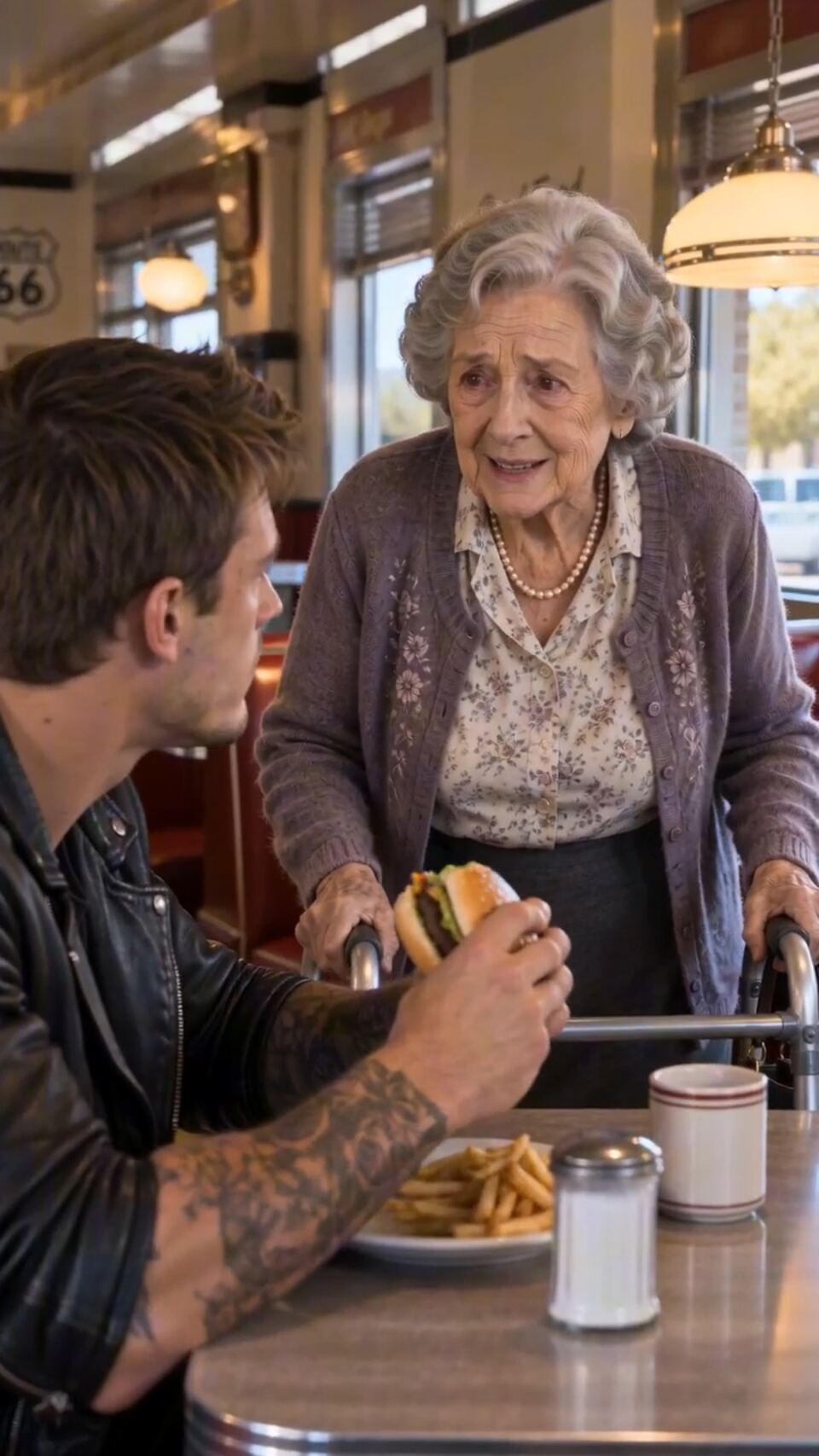
“Would you pretend to be my grandson?”
The old woman asked it so softly I almost thought I’d imagined it.
I looked up from my burger. She stood beside my booth with both hands gripping a silver walker.
“Excuse me? Ma’am.”
“My landlord is coming today,” she said. “He thinks I have no family.”
I should have said no.
I had tattoos up both arms and a week’s worth of bad sleep on my face. I was exactly the kind of stranger mothers warned their daughters about.
Instead, I stood up.
“Okay. I’ll help.”
Her relief came fast and painful, like she’d been holding her breath all morning.
She opened her purse with shaking fingers and pulled out a few folded bills. “This is all I can pay you.”
I pushed the money back. “You don’t have to-”
A photograph slipped from her purse and floated to the floor between us.
I bent to pick it up.
The picture was old and worn at the edges. A younger version of her stood in summer sunlight, holding a little girl with dark eyes and a stubborn chin.
My mother’s face.
Not older. Not tired. Not before she died.
Just little.
I stared too long.
“Who is this little girl?” I asked, though I already knew.
The old woman’s eyes filled at once. “My daughter, Anna.”
My throat closed.
I handed the money back to her and kept my eyes on the photo so I wouldn’t have to see her face yet.
“You don’t have to pay me,” I said.
Then I made myself look at her.
“Because Anna is my mother.”
The color drained from her face. The photograph slipped from her fingers and hit the tile.
And before either of us could speak again, the diner’s front bell rang.
A man in a tan coat stepped inside and called out, “Mrs. Alvarez, I hope you’re packed.”
CHAPTER 2 – THE LANDLORD
The old woman swayed so hard I thought she might fall.
I caught her elbow before she did.
The man in the tan coat spotted us and smiled in a way that wasn’t friendly. He was in his fifties, trim, clean-shaven, carrying a folder under one arm like paperwork made him powerful.
“There you are,” he said. “And who is this?”
I felt the old woman’s hand clutch my sleeve.
I answered before she could.
“I’m her grandson.”
His eyes moved over my jacket, my tattoos, my motorcycle helmet on the booth seat. He clearly didn’t like what he saw, but he adjusted fast.
“Funny,” he said. “In twelve years of collecting rent, I’ve never met any family.”
“Maybe you never asked,” I said.
His mouth tightened. “Mrs. Alvarez is three months behind. The county inspector has also deemed the back stairs unsafe. The property may be condemned. I offered her a room elsewhere.”
The old woman finally found her voice. “A room above the laundromat with no elevator.”
“It is affordable.”
“It is a cage,” she whispered.
I looked at her then. Really looked. The careful lipstick. The pressed blouse. The walker with one tennis ball worn thinner than the other. This wasn’t stubborn pride. This was fear of being removed from the last place in the world that still felt like hers.
The landlord opened the folder. “Unless a family member is prepared to take legal and financial responsibility-”
“I am,” I said.
Mrs. Alvarez turned to me, stunned.
He gave a short laugh. “You don’t even know what you’re agreeing to.”
Maybe he was right. I didn’t know her. An hour ago, I hadn’t known my mother had one living relative.
My mother never said the word mother unless she was drunk, angry, or both.
Before I could answer, Mrs. Alvarez reached into her purse again. This time she pulled out an envelope, old and yellowed.
“It came back unopened,” she said to me, not the landlord. “I sent it twenty-six years ago. To Anna.”
She handed it over with trembling fingers.
Across the front was my childhood address in Dayton.
I had lived there with my mother until I was six.
And on the back, in my mother’s handwriting, were three words:
Return to sender. Deceased.
CHAPTER 3 – WHAT MY MOTHER NEVER SAID
I took Mrs. Alvarez back to her apartment after the landlord left with a warning that he’d return in forty-eight hours.
The building sat behind the diner on a side road lined with weeds and tired mailboxes. Her place was small but clean. Crocheted pillows. A clock that ticked too loudly. A framed pressed flower by the window. On the kitchen table sat a jar full of buttons and a stack of past-due notices held together with a rubber band.
I put the unopened letter down between us.
“My mother wasn’t dead,” I said.
Mrs. Alvarez lowered herself into a chair. “I know that now.”
“Then why did she send this back?”
She stared at the envelope for a long time. “Because she wanted me to believe she was dead to her.”
The words should have made me angry. Instead they made me tired.
My mother, Anna, had raised me alone, worked nights, and loved me in broken pieces. Some days she held me too tight. Some days she disappeared into silence so deep I learned not to knock on her bedroom door. She died at fifty-two from liver failure and took most of her stories with her.
“She told me her mother threw her out,” I said.
Mrs. Alvarez’s eyes lifted sharply. “No.”
I waited.
“She left after a fight,” she said. “A bad one. I wanted her to stay in school. She wanted to go to Nashville with a boy who promised songs and forever. She was nineteen. I said cruel things. So did she. She left that night.” Her voice cracked. “I thought she’d cool off. Then I learned she was pregnant. By then she wouldn’t answer.”
I sat down across from her.
“You knew about me?”
“I knew there was a baby boy. A friend of hers wrote once. No name. No address. Just enough to break my heart and keep it beating.”
She rose suddenly and shuffled to a narrow hallway. When she came back, she held a tin box.
Inside were birthday cards.
Every year from age one to twenty-one.
Unmailed. Unsigned except for one line.
For my grandson, wherever life has carried you.
My chest ached in a place I didn’t know was still alive.
Then she handed me one more thing: a folded notice from the county office.
The building wasn’t being condemned.
It was being sold.
And the buyer’s name was Harold Pike, the landlord.
CHAPTER 4 – THE HOUSE ON MAPLE STREET
“He’s trying to scare you out before the sale closes.”
Mrs. Alvarez nodded. “I suspected. I couldn’t prove it.”
That was enough for me.
I spent the afternoon making calls from her kitchen table. First to the county office listed on the notice. Then to the number of the inspector. Then to a woman at the tenants’ rights center in Millfield who sounded like she’d dealt with Harold Pike before and was tired of his name.
By evening, we had facts.
The building had violations, yes, but no active condemnation order. Harold had offered low cash settlements to three tenants already. Two had left. Mrs. Alvarez was the last one in the front units, and her apartment connected to the small garden lot behind the property. Once she was gone, he could combine the structures and raise the value.
It was greed. Small-town, polished greed.
But there was more.
The inspector emailed me a copy of the original property file. Mrs. Alvarez had once owned half the building with her late husband. After his stroke, she signed papers she barely understood during a refinancing. Harold, who managed the property then, gained controlling interest. Legal, maybe. Clean, maybe not.
Mrs. Alvarez pressed her hand to her mouth. “I trusted him.”
I thought of my mother. Of all the years she spent telling herself she had no one. Of all the cards in the tin box.
We could fight the sale. Challenge the notices. Delay him. But the woman across from me was eighty-two, living on Social Security and pride.
I looked around the kitchen. The flower print. The walker. The envelope my mother had sent back. The life she had stayed in long enough to be cornered.
“Come with me,” I said.
She blinked. “Where?”
“To my place. For now.”
Her answer came fast. “No. I won’t be charity.”
“It’s not charity.”
“What is it then?”
I swallowed. The next words felt bigger than anything I’d said all day.
“It’s what family does when time has already been wasted.”
She cried then. Quietly. Like someone ashamed of needing comfort.
That night, while I packed a suitcase for her, I found a second envelope tucked inside the tin box. It was addressed to me in my mother’s handwriting.
Unopened.
And postmarked three days before she died.
CHAPTER 5 – THE LETTER SHE LEFT
I didn’t open my mother’s letter until dawn.
Mrs. Alvarez was asleep on my couch, her walker parked beside the lamp like a tired guard dog. My bike stood outside under the pale morning sky. For the first time in years, I was afraid of paper.
Inside was one page.
Eli, If I don’t get to say this right, at least I’ll say it true. I lied to you about my mother. She was hard, but she wasn’t heartless. I was ashamed. Of leaving. Of failing. Of the kind of life I gave you. I wrote to her three times and tore up every letter. If you ever find her, don’t punish her for my pride. And don’t punish yourself for becoming a man I didn’t know how to raise. Love, Mom
I read it twice. Then a third time.
When Mrs. Alvarez woke, I made eggs we both barely ate. After breakfast, we went together to the tenants’ rights office. The advocate helped file a complaint against Harold Pike for misrepresentation and coercive eviction practices. The county agreed to freeze the transfer until a review was complete. Other tenants came forward after hearing Mrs. Alvarez was fighting.
Harold didn’t go to jail. Life is usually less dramatic than people want.
But he lost the sale. He lost the management contract. And for the first time, he had to stand in a public room while people he had frightened said his name out loud.
A week later, I drove Mrs. Alvarez to the cemetery where my mother was buried.
She brought the old photograph.
I brought the unopened birthday cards.
At the grave, she touched the stone with two trembling fingers. “You were loved badly,” she whispered. “But you were loved.”
I stood beside her and finally understood that both things could be true.
Before we left, she slipped one card into my hand.
For my grandson, age twenty-nine, she had written that morning.
Not wherever life has carried you.
Just this:
I’m glad it carried you back.
As we walked toward the car, she took my arm instead of the walker.
And when she asked, very carefully, “Would you come for Sunday supper?” I smiled and said, “Only if you’re making too much food.”
She laughed.
It sounded a little like my mother.

