“Don’t watch the camera.””
Those were the first words Mia whispered after accusing me of attacking her.
Not I’m scared.
Not Call the police.
Not even He hurt me.
Just four words, spoken through trembling lips while my son stood between us with murder in his eyes.
And somehow, those four words frightened me more than the slap that had split my lip.
My name is Thomas Harrison. I was seventy years old that autumn evening, a widower of five years, and until that night, I believed the worst thing that could happen to an old man was being forgotten by the people he loved.
I was wrong.
Sometimes, the people you love remember you perfectly.
They remember where you keep your money, which buttons make you angry, what makes you feel guilty, and exactly how much pain you will tolerate before you finally fight back.
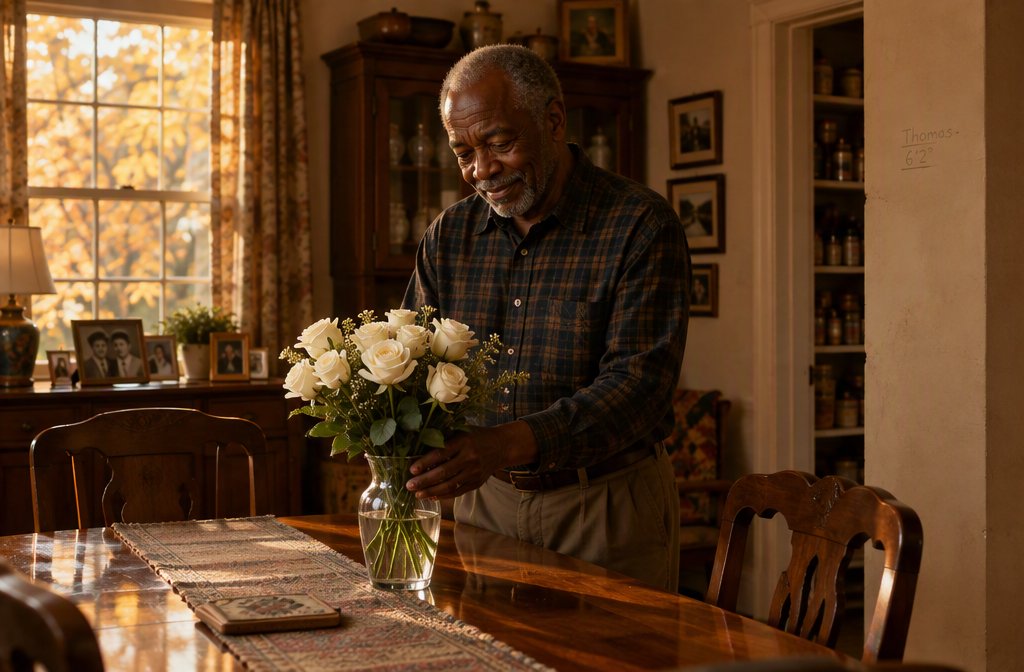
The evening had started with white roses.
Margaret’s favorite.
I placed them in a glass vase at the center of our dining table, adjusting each stem until the arrangement looked the way she used to make it. Five years after cancer took my wife, I still caught myself preparing the house for her approval.
I could almost hear her voice.
Thomas, those roses are crooked.
I smiled and straightened the vase.
“Better?”” I murmured.
The empty dining room offered no answer.
For thirty years, Margaret and I had filled that house with memories. There were scratches on the staircase from Daniel’s toy cars, a dent beside the kitchen doorway from Claire’s bicycle, and a faint pencil mark on the pantry wall showing how tall our children had been each summer.
Margaret had refused to let me repair any of them.
“Those aren’t imperfections,” she’d told me.
“They’re proof we were here.””
After her funeral, I stopped noticing the house’s silence.
Then I started noticing it everywhere.
In the kitchen, where nobody asked whether the coffee was too strong. In the garden, where her gloves still hung beside the shed. In the bedroom, where I slept on one side of the mattress because moving to the middle felt like betraying a promise I hadn’t made.
So I kept one tradition alive.
Every autumn, I invited the family for dinner.
That year, I spent three days preparing. I roasted the beef Margaret had always served when the leaves turned gold, polished her silverware, and brought out the ceramic serving dish her mother had given us on our first anniversary.
When Daniel arrived with Mia, followed by Claire and my grandchildren, the house finally seemed to breathe.
“Grandpa!””
Eight-year-old Ethan came racing through the front door, nearly colliding with my knees.
“Look what I made!””
He thrust a paper airplane into my hand. One wing was crooked, and a strip of blue tape held the nose together.
“Magnificent,” I said.
“What’s its top speed?””
“Really fast.””
“How fast?””
“Like a hundred miles an hour!””
His sister, Lily, rolled her eyes.
“It crashes into the couch every time.””
“That’s because the couch cheats,” Ethan protested.
I laughed so hard that I had to wipe my eyes.
For a moment, I forgot my age, my loneliness, and the uncomfortable feeling that my children had begun treating visits to my house like appointments they couldn’t wait to finish.
Dinner was pleasant enough.
Daniel complained about his manager. Claire described a customer who had mistaken her for a teenager. Lily argued that broccoli was a violation of children’s rights, and Ethan tried to launch his airplane from the dining table until I threatened to confiscate its imaginary pilot’s license.
Mia sat beside my son, immaculate in a cream blouse and gold earrings.
She was thirty-eight, attractive, and exceptionally skilled at making an insult sound like a compliment.
Eight years earlier, I had welcomed her without hesitation.
I’d paid for their wedding reception when Daniel admitted his savings weren’t enough. I’d helped them buy their first house. When Mia’s father needed surgery, I covered the portion their insurance wouldn’t pay.
I never asked for the money back.
I thought family meant giving without keeping score.
Apparently, someone had been keeping score for me.
“Thomas, could you pass the potatoes?”” Mia asked.
I handed her the bowl.
“Of course.””
“Thank you, Mr. Harrison.””
I smiled.
“You know, Mia, after eight years, you can call me Dad.””
Her fork stopped halfway to her mouth.
Daniel looked at her, then at me.
“She knows that, Dad.””
“I was only saying she doesn’t need to be formal.””
Mia placed a potato on her plate.
“Some habits are difficult to change.””
She smiled as she said it.
I didn’t.
Claire quickly changed the subject.
“Dad, did you find Mom’s old photo album? The one from Maine?””
“Upstairs, I think.””
“You should bring it down. Lily has never seen Mom’s sunhat.””
“I heard that!”” Lily protested.
“Mom says I inherited my fashion sense from Grandma.””
“You did,” Claire replied.
“Unfortunately, you also inherited her inability to recognize a terrible hat.””
Everyone laughed.
I laughed, too, but my eyes drifted to Margaret’s empty chair at the head of the table.
For one brief second, I imagined her sitting there, shaking her head at all of us.
Then I stood.
“Back in a minute. Daniel, don’t eat the last piece of beef.””
My son grinned.
“No promises.””
I climbed the staircase slowly, listening to their voices mingle below.
Glasses clinked. Ethan complained about broccoli. Claire laughed at something Daniel said.
Then I heard a door close upstairs.
I stopped on the landing.
Mia stood beside the bedroom window, her phone clenched in one hand.
She wasn’t looking outside.
She was watching the staircase.
“Mia?””
She spun around.
For half a second, her face revealed something I had never seen there before.
Pure panic.
Then her familiar smile returned.
“Mr. Harrison.””
“Are you looking for Daniel?””
“No.””
The answer came too quickly.
I studied her face. Her lips were pale, and her fingers trembled around her phone.
“Are you feeling all right?””
“I’m fine.””
“You don’t look fine.””
“Please don’t come any closer.””
I stopped.
“Mia, I haven’t moved toward you.””
She glanced at the ceiling, then at the small black camera mounted near the hallway smoke detector.
I’d installed it six months earlier after someone broke into a neighbor’s home. It covered the staircase and landing, recording video whenever it detected movement.
Mia followed my gaze.
Her throat moved as she swallowed.
“What is it?”” I asked.
“Nothing.””
“If something’s wrong, you can tell me.””
“Just stay there.””
I raised both hands.
“I’m staying right here.””
She stared at me for another moment, as if waiting for something.
Then everything happened so quickly that I struggled to understand it.
Mia grabbed the front of her blouse and pulled.
Buttons scattered across the floor.
She yanked at her hair, tearing loose several strands, then threw herself against the wall.
“HELP!””
I froze.
“Mia, what are you doing?””
“STAY AWAY FROM ME!””
Footsteps thundered downstairs.
I took one instinctive step toward her, then stopped when she screamed again.
“DON’T TOUCH ME!””
“I haven’t touched you!””
Daniel appeared at the top of the stairs, followed by Claire.
My son looked at his wife sitting on the floor, her blouse torn, her hair disheveled, her face streaked with tears.
Then he looked at me.
He didn’t ask what had happened.
He didn’t notice that I stood several feet away with both hands raised.
He simply stepped between us.
“Dad,” he said, his voice dangerously quiet.
“What did you do?””
“Nothing. I came upstairs for your mother’s photo album.””
Mia grabbed his wrist.
“He followed me.””
I stared at her.
“What?””
“He wouldn’t leave me alone.””
“Mia, you were standing beside the window. I asked if you were all right.””
“Stop lying!””
Claire stepped forward.
“Wait. Let’s calm down and figure out—”
Daniel cut her off.
“Figure out what? Look at her!””
“I am looking at her,” Claire snapped.
“I’m also looking at Dad.””
Mia buried her face against Daniel’s shoulder.
“He scared me,” she sobbed.
I felt something inside me shift.
Not anger.
Not yet.
Something colder.
“Mia,” I said slowly, “tell them exactly what happened.””
She lifted her head.
For a moment, our eyes met.
I saw fear there, but not the kind I’d expected.
It was the fear of someone waiting for a door to open.
Then she whispered, “He tried to hurt me.””
Daniel struck me before I could answer.
The slap cracked through the hallway.
My glasses slid crookedly down my nose, and my cheek burned.
I staggered against the banister.
For several seconds, nobody moved.
I had carried that boy through a snowstorm when he was six because our car had broken down and his fever was dangerously high. I had sat beside his bed all night, counting his breaths. I had worked double shifts to pay his college tuition and stood beside him when he married the woman now accusing me.
And he had just hit me in my own home without asking a single question.
“Daniel,” I whispered.
He pointed a finger at my face.
“Don’t you dare say my name like you’re the victim.””
“Your father hasn’t even explained himself,” Claire said.
“Stay out of this!””
“No!””
Mia clutched Daniel’s arm.
“Please, don’t fight because of me.””
It was a remarkable performance. She looked fragile enough to break, yet every word she spoke drove another nail into my coffin.
Daniel turned back to me.
“Get away from her.””
I touched my cheek.
“This is my house.””
His eyes narrowed.
“Then maybe you shouldn’t have brought us here.””
I looked at my son and realized he meant it.
He believed I had done something unforgivable, yet he was the one threatening me in the home I had shared with his mother.
I wanted to shout.
Instead, I looked up at the camera.
A tiny red indicator blinked above the landing.
The recording light.
I pointed toward it.
“Daniel, there’s a camera right above your head.””
He barely glanced upward.
“So?””
“It records the landing. Everything that happened is on it.””
Mia went completely still.
Her fingers tightened around Daniel’s wrist.
Then she leaned toward him and whispered something I couldn’t hear.
Daniel’s expression changed.
Not relief.
Not confusion.
Recognition.
He looked at the camera again, and for the first time that evening, his anger seemed to falter.
“Dad,” he said, lowering his voice, “don’t touch anything. Don’t delete anything. Just stay here.””
“I wasn’t planning to.””
He pulled out his phone.
Mia suddenly grabbed his arm.
“No,” she whispered.
Daniel turned toward her.
“What?””
Her lips trembled.
Then she looked directly at me.
“Don’t watch the camera.””
And that was when I understood something terrible.
Mia wasn’t afraid of what I might have done.
She was afraid of what the camera might reveal.
Chapter 2: The Son Who Chose Her
Daniel called the police from the landing.
He didn’t ask me to sit down. He didn’t offer me a hand after striking me. He simply turned his back and spoke into his phone while Mia pressed a tissue against her cheek, although I hadn’t seen a single tear fall there.
“My wife has been assaulted,” he said.
“We’re at my father’s house. Yes, the suspect is still here.””
I stared at him.
“The suspect?””
He covered the phone.
“Don’t make this worse.””
I almost laughed.
At seventy, I had spent my life believing there was a line between right and wrong that even anger couldn’t erase. My son had crossed that line in less than ten seconds, and now he was telling me to behave.
“Daniel,” I said, “you hit me.””
His jaw tightened.
“You deserved to be stopped.””
“Stopped from doing what?””
He turned away and continued speaking.
Claire stood beside me, her face pale.
“Dad, are you hurt?””
“My pride is in worse shape than my cheek.””
She tried to smile, but her eyes were wet.
“I’m serious.””
“So am I.””
She touched my arm.
“Tell me what happened.””
“I came upstairs for your mother’s photo album. Mia was standing here. I asked if she was all right.
She told me not to come closer. I stopped. Then she tore her blouse and started screaming.””
Claire looked toward Mia.
“Why would she do that?””
Mia lowered her tissue.
“Because he wouldn’t leave me alone.””
“Dad says he never touched you.””
“He’s lying.””
The words came out sharply enough to silence the hallway.
Claire blinked.
“You’re certain?””
Mia stared at her.
“Are you calling me a liar?””
“No. I’m asking what happened.””
“You should be asking your father why he followed me upstairs.””
“I wasn’t following you!”” I said.
Daniel ended his call.
“The police are coming. Nobody leaves.””
“Fine,” I replied.
“But I want the camera footage preserved.””
Mia’s face went white.
It was subtle. A tightening around the mouth, a quick glance toward the ceiling.
But I saw it.
So did Claire.
“Why are you so worried about the camera?”” she asked.
Mia looked at her with sudden contempt.
“Because I don’t want my humiliation recorded for everyone to see.””
“The recording doesn’t have to be shown to everyone,” I said.
“It can be given to the police.””
Daniel stepped toward me.
“Enough.””
“No, Daniel. Not enough. You accused me of attacking your wife, then hit me. You don’t get to decide that this conversation is over.””
For the first time, my son looked uncertain.
Then Mia made a small, wounded sound.
He immediately turned back to her.
“Are you okay?””
She nodded, wiping her face.
“I just want to go home.””
“We will.””
“Daniel,” I said, “this is your home, too. You grew up here.””
He looked around the hallway as if the walls themselves disgusted him.
“Not anymore.””
Those three words hurt more than the slap.
A few minutes later, the doorbell rang.
Two officers entered the house. The older one introduced himself as Sergeant Miller, while his younger partner, Officer Grant, asked everyone to remain separated.
Sergeant Miller had gray hair, a tired face, and the cautious manner of someone who had learned that the first version of a story was rarely the whole story.
He examined my cheek.
“Did your son strike you, sir?””
“Yes.””
Daniel interrupted.
“I was protecting my wife.””
Sergeant Miller raised a hand.
“I’ll hear from everyone separately.””
He spoke to Mia first.
She sat on the living room sofa with a blanket around her shoulders. Daniel stood beside her, refusing to leave until the sergeant reminded him that cooperation was not optional.
I watched through the doorway as Mia described an entirely different evening.
According to her, I’d followed her upstairs, cornered her near the bedroom, made inappropriate comments, and grabbed her when she tried to leave.
Every detail was delivered with convincing hesitation.
Every pause seemed carefully placed.
When Sergeant Miller asked whether she had any injuries, Mia touched her upper arm.
“He grabbed me here.””
Officer Grant made a note.
When asked whether she wanted medical attention, she shook her head.
“No. I just want him away from me.””
Then she looked at Daniel.
He reached for her hand.
I turned away.
I couldn’t bear to watch my son comfort the woman who was destroying me.
When my turn came, Sergeant Miller sat opposite me at the dining table.
The roast beef had gone cold. A child’s paper airplane lay beneath a chair. The white roses stood in the center of the table as if they had been invited to witness something they could never understand.
“Start from the beginning,” he said.
I did.
I told him about the dinner, the photo album, and Mia standing beside the window. I described how she had told me to stay away, how I’d raised my hands, and how she’d torn her blouse.
He listened without interruption.
When I finished, he asked, “You mentioned a security camera?””
“Yes. It covers the upstairs landing.””
“Does it record continuously?””
“Whenever it detects movement. It stores footage on a device in my office.””
“Can you show us?””
“Of course.””
Daniel appeared in the doorway.
“Dad, maybe we should wait.””
Sergeant Miller looked at him.
“Why?””
Daniel hesitated.
“I don’t want private footage circulating.””
“It would be handled as evidence,” the sergeant replied.
Mia appeared behind him.
Her face had changed again. The tears were gone, replaced by a strained composure that made her look older.
“Please,” she said softly.
“I don’t want everyone watching me fall apart.””
Sergeant Miller’s expression remained neutral.
“No one is asking the public to watch anything, ma’am.””
“But it’s embarrassing.””
“Then we can address privacy concerns through the proper process.””
Mia glanced at Daniel.
He looked at the floor.
I led the officers to my study.
The computer sat beneath the window, beside a framed photograph of Margaret and me on our fortieth wedding anniversary. I turned it on, opened the security application, and selected the upstairs camera.
A timeline appeared.
I clicked the recording from that evening.
The footage showed the landing from a fixed angle. The image was clear enough to identify faces, though the camera had no audio.
Sergeant Miller leaned forward.
“Can we see the moments before the incident?””
I moved the timeline backward.
Mia appeared on screen, standing beside the window.
She looked toward the staircase, checked her phone, then looked directly at the camera.
She remained there for nearly two minutes.
Then I appeared, walking up the stairs with my hands empty.
The footage showed me stop several feet away from her.
We exchanged words, though no sound reached us.
Mia stepped back.
I raised both hands.
Then she seized her blouse.
She tore it.
She pulled at her hair.
She threw herself against the wall.
Sergeant Miller watched the sequence twice.
Officer Grant took photographs of the screen.
Neither officer spoke for several seconds.
Finally, Sergeant Miller looked at me.
“Is there another camera in this hallway?””
“No.””
“Any possibility this footage has been edited?””
“Not by me.””
He examined the screen again.
“Can you export the original file?””
“Yes.””
“Please do that without altering it. We’ll document the transfer.””
I saved the recording to a new drive while Officer Grant noted the time and device information.
Then Sergeant Miller asked for the moments before I appeared.
I moved the timeline farther back.
Mia was alone again.
She stood beside the window, checked her phone, and looked at the camera.
Then she did something that made my stomach tighten.
She lifted her right hand and held up three fingers.
She lowered them one at a time.
After that, she walked out of the camera’s field of view toward the bedroom door.
Thirty seconds later, she returned.
She checked her phone again.
Then she waited for me.
Sergeant Miller rewound the clip.
“Interesting,” he murmured.
“What does it mean?”” I asked.
“I’m not ready to say.””
He copied the earlier segment, too.
When we returned downstairs, Daniel was pacing near the front door.
Mia sat on the sofa, her hands folded in her lap.
Sergeant Miller addressed everyone.
“We’ve reviewed footage that appears inconsistent with some portions of the initial account. We need to conduct further inquiries before reaching any conclusions.””
Daniel stared at him.
“What does that mean?””
“It means the investigation is ongoing.””
Mia stood abruptly.
“You can’t use that recording. It violates my privacy.””
Sergeant Miller turned toward her.
“That’s something we can review, but you don’t get to decide what evidence is relevant simply because you dislike what it shows.””
Her face flushed.
Daniel stepped forward.
“She has rights.””
“So does your father,” Sergeant Miller replied.
For once, my son had nothing to say.
The officers left after collecting the footage and taking statements. They advised us not to contact one another about the incident until further inquiries had been completed.
Daniel refused to look at me as he helped Mia toward the door.
At the threshold, she stopped.
For a moment, she seemed to consider saying something.
Then she leaned close enough that only I could hear her.
“You should have left the camera alone.””
I stared at her.
“What did you expect me to do? Pretend nothing happened?””
Her eyes hardened.
“I expected you to remember who your family is.””
She walked out.
Daniel followed without looking back.
The door shut.
I stood in the silence, listening to their car pull away.
Then I returned to the study.
Margaret’s photograph sat beside the computer. She was smiling in it, one hand resting on my shoulder, her wedding ring catching the sunlight.
I sat down and opened the security application’s event log.
I wanted to know why Mia had been looking at the camera before I’d arrived.
The timeline showed an event that didn’t appear in the footage I’d reviewed with the officers.
A motion alert from earlier that afternoon.
Someone had accessed the camera’s administrative settings.
The account name was unfamiliar, but the timestamp was clear.
*3:17 p.m. — Remote configuration changed.*
I clicked the event details.
A device identifier appeared.
My hands went cold as I recognized the name attached to the login.
It belonged to my son.
Daniel had accessed my security system hours before the dinner.
And according to the event log, he’d disabled the camera’s audio recording.
Chapter 3: The File They Tried to Erase
I didn’t sleep that night.
At two in the morning, I sat alone in my study, watching rain crawl down the window while Daniel’s name glowed on the computer screen.
The camera had recorded everything.
But not everything it could have recorded.
Someone had disabled the audio hours before Mia tore her blouse.
I stared at the timestamp until the numbers blurred.
Daniel had known about the camera. He had known where it pointed. He had known the footage might matter.
Yet he had struck me anyway.
I opened the event log again, hoping I’d misunderstood something. The record remained unchanged.
*3:17 p.m. — Remote configuration changed.*
*User: Daniel Harrison.*
I clicked the details.
The system showed that the audio setting had been disabled from a device registered to Daniel’s phone. It also showed a second action at 3:21 p.m.: a request to change the camera’s retention settings.
That request had failed.
I leaned back in my chair.
“Why, Daniel?””
The house gave me nothing.
I remembered him at eight years old, sitting on the kitchen counter while Margaret bandaged a cut on his knee. I remembered him at sixteen, furious because I’d refused to buy him a car. I remembered the night he called from college, crying because his girlfriend had left him.
I had answered every call.
I had forgiven every mistake.
I’d convinced myself that love meant giving someone another chance until they finally understood what they’d done.
But as the rain tapped against the window, I began to wonder whether all those chances had taught my son that there would never be a consequence.
At 6:40 a.m., my phone rang.
It was Claire.
“Dad? Are you awake?””
“I haven’t slept.””
“Neither have I.””
I heard a car engine in the background.
“Where are you?””
“Outside your house. Can I come in?””
I opened the front door before she could knock.
Claire stood on the porch in yesterday’s clothes, holding two coffees and looking as if she’d spent the night arguing with herself.
She stepped inside and handed me one cup.
“I brought the kind you like.””
“Thank you.””
She glanced toward the staircase.
“Did the police say anything else?””
“Not yet.””
“Do you believe Mia planned it?””
I looked at my daughter.
“Why are you asking me?””
“Because I keep replaying what happened. When she started screaming, Daniel didn’t look surprised. He looked angry. As if something had gone wrong.””
I set my coffee on the table.
“There’s something else.””
I showed her the event log.
She read it twice.
“Daniel disabled the audio?””
“Yes.””
“Before dinner?””
“Hours before.””
Claire sat down slowly.
“That’s not an accident.””
“No.””
She pressed her fingers against her forehead.
“Oh, Dad.””
For a while, neither of us spoke.
Then Claire lifted her head.
“There’s something I need to tell you.””
I waited.
“Three weeks ago, Mia called me. She said she was worried about you living alone. She asked whether you’d ever discussed giving Daniel power of attorney.””
I frowned.
“Why would she ask you that?””
“She said you were becoming forgetful.””
I stared at her.
“I’m seventy, Claire. I occasionally forget where I put my glasses. That doesn’t mean I can’t manage my life.””
“I know.””
“What exactly did she say?””
Claire pulled out her phone.
“I saved the messages because I thought they were strange.””
She scrolled, then handed it to me.
Mia’s messages were short and carefully worded.
Your dad seems more confused lately.
Have you noticed him repeating himself?
Daniel thinks someone should help him organize his finances before something happens.
Then, three weeks later:
If anything unusual happens at the family dinner, please don’t jump to conclusions.
I read the last message twice.
“What does she mean by that?””
“I don’t know,” Claire whispered.
“I thought she was talking about an argument. I never imagined—”
She stopped.
Her eyes filled with tears.
“I should have told you.””
I returned the phone.
“You didn’t know what she was planning.””
“But I knew she was asking questions about your money.””
I stood and walked to the kitchen.
On the counter sat Margaret’s ceramic serving dish, still waiting to be washed. I ran warm water over it, though there was nothing on it that required such careful attention.
I needed something ordinary to hold on to.
“Dad,” Claire said quietly, “what are you going to do?””
I dried the dish and placed it on the shelf.
“Find out why my son disabled the audio.””
At nine, I called a lawyer.
His name was Robert Ellis. He had handled Margaret’s estate and helped me update my will after her death. He listened without interrupting while I explained the accusation, the camera footage, and the strange administrative changes.
When I finished, he asked, “Have the police retained the original recording?””
“Yes.””
“Good. Don’t edit it, don’t post it online, and don’t send copies to relatives. Preserve your own records, and let the investigators handle the evidence.””
“What about the camera settings?””
“Keep the logs. Don’t attempt to access Daniel’s accounts or devices. We can document what your own system shows.””
I looked at the computer.
“Robert, I think this was planned.””
There was a pause.
“Then we need to determine what else was planned.””
He arranged an appointment for that afternoon.
Before we hung up, he asked whether I had any recent documents involving my property or finances.
I thought of the folder in my desk.
Three months earlier, Daniel had visited me with a stack of forms, claiming that a bank representative had recommended consolidating my accounts. He’d asked me to sign a document authorizing him to speak to financial institutions on my behalf.
I’d refused.
Daniel had become irritated.
“Dad, it’s just a precaution,” he’d said.
“What if you end up in the hospital and can’t manage your bills?””
“I have a lawyer for that.””
“Robert Ellis can’t sit beside you every day.””
“Neither can you.””
He’d left without finishing his coffee.
At the time, I’d assumed he was worried about me.
Now, I wondered whether he had been testing how easily I could be persuaded.
I found the folder and placed it in my briefcase.
At noon, my phone buzzed.
A message from Daniel.
We need to talk. Don’t involve Claire.
I stared at the screen.
Then another message arrived.
You don’t understand what’s at stake.
I called him.
He answered immediately.
“Dad.””
“What is at stake, Daniel?””
Silence.
Then he said, “Mia is falling apart.””
“She accused me of assaulting her.””
“She was frightened.””
“The camera shows her tearing her own blouse before I touched her.””
“You don’t know what happened outside the camera’s view.””
“Then why did you disable the audio?””
He stopped breathing for a moment.
I could hear traffic behind him.
“Who told you that?””
“The event log on my own system.””
“Dad, I was checking the settings.””
“Why?””
“To make sure everything worked.””
“By turning off the audio?””
He sighed.
“It’s complicated.””
“No. It’s a simple question.””
“Can we please talk in person?””
“Where?””
“Your house. Just you and me.””
I looked at Claire, who had been listening from the kitchen doorway.
“Fine,” I said.
“Come at two.””
He arrived at 2:07 p.m.
He wore the same navy sweater he’d worn the previous evening. His eyes were bloodshot, and his jaw looked tight enough to crack a tooth.
He didn’t bring Mia.
He walked into the living room and remained standing.
“Where’s Claire?””
“Not here.””
It was a lie, but I wanted to see what he would say.
Daniel nodded as though relieved.
“Good. This is between us.””
I pointed to the chair opposite mine.
“Sit.””
He sat.
For several seconds, we listened to the clock ticking above the fireplace.
Then Daniel leaned forward.
“Dad, I need you to understand something. Mia has been under enormous pressure.””
“From what?””
“Work. Her family. Money.””
“What does that have to do with me?””
He rubbed his hands together.
“She made a mistake.””
I stared at him.
“What mistake?””
“She panicked. Things got out of hand.””
“Did you know she was going to accuse me?””
His eyes flickered.
“No.””
“Did you know she planned to tear her blouse?””
“No.””
“Then why did you disable the audio?””
He stood abruptly.
“Because I didn’t want private conversations recorded!””
“Your wife was in my house. You were in my house. You had no reason to change my security settings without asking.””
“I was trying to protect my family!””
“From what?””
He looked at me with an expression I’d never seen before.
Not anger.
Not shame.
Desperation.
“Dad, you have money. You have this house. You have investments and insurance policies. You don’t have a wife anymore, and you don’t need everything you’ve got.””
The words landed between us like broken glass.
I stood slowly.
“Is that what this is about?””
“No.””
“You think I have too much?””
“That’s not what I said.””
“Then tell me what you said.””
He walked to the window, pulling at the cuff of his sweater.
“Do you know what it’s like watching your father live alone in a four-bedroom house while you’re struggling to pay your bills?””
I stared at him.
“You and Mia bought a house I helped you afford.””
“And everything costs more now.””
“I paid for your wedding.””
“That was eight years ago.””
“I helped with your mortgage.””
“And we appreciated it!””
“Then why are you talking as if I’ve stolen something from you?””
He turned.
“Because you never let us forget what you’ve done for us!””
I flinched.
“I never asked you to repay me.””
“You didn’t have to. You made sure we remembered.””
For a moment, I couldn’t speak.
Had my generosity become a debt in his mind? Had every birthday check, every emergency loan, every Christmas gift become another reason for resentment?
I sat down.
“Daniel, if you needed help, you could have asked.””
He laughed bitterly.
“And you’d have given me another lecture about responsibility.””
“Perhaps. But I wouldn’t have accused you of something you didn’t do.””
His face changed.
He looked away.
I knew that look. I’d seen it when he was a boy and had broken something expensive, when he was a teenager caught lying about where he’d been.
It was the look of someone who had run out of excuses.
“Did Mia plan this?”” I asked.
He said nothing.
“Daniel.””
His hands began to shake.
“Dad, I can’t tell you everything.””
“Why not?””
“Because if I do, I’ll lose my marriage.””
I stared at him.
“And if you don’t, you may lose your father.””
His eyes filled with tears, but he didn’t move toward me.
For one terrible second, I thought he might finally tell the truth.
Instead, he reached into his pocket and placed a folded document on the coffee table.
“Just read this.””
I opened it.
It was a draft of a petition seeking a court-appointed guardian for me, claiming I was no longer capable of managing my affairs.
My name was printed at the top.
The supporting statement described confusion, aggressive behavior, and an incident involving an inappropriate confrontation with a family member.
The date was the day before the dinner.
I looked up slowly.
“You prepared this before Mia accused me.””
Daniel’s mouth opened, but no words came out.
“You were planning to have me declared incompetent?””
“No. It was just a draft.””
“Why?””
“Because Mia thought it would help us arrange things properly.””
“Arrange what?””
He took a step backward.
“Dad, please.””
I lifted the document.
“Were you planning to take control of my money?””
“No!””
“Were you planning to take control of this house?””
He looked at the floor.
That was answer enough.
I placed the petition on the table.
“Get out.””
“Dad—”
“Get out of my house.””
He stood motionless for a moment, then grabbed his coat.
At the door, he turned back.
“You don’t understand what Mia knows.””
I felt the blood drain from my face.
“What does she know?””
Daniel’s expression crumpled.
“Ask her what happened to Mom’s insurance money.””
Then he walked out.
I remained by the door long after his car disappeared.
Margaret’s insurance money.
I’d received the payout five years earlier, used a portion to cover her final medical bills, and placed the rest in an account reserved for retirement and emergencies.
Daniel had never asked about it.
Or so I’d believed.
I went into the study and opened the filing cabinet where I kept the old policy documents.
The folder was exactly where I remembered leaving it.
Inside were the original insurance papers, bank statements, and a letter from the insurer confirming the final payout.
I read through every page.
The amount was correct.
The deposits were accounted for.
But tucked between two statements was a photocopy of a document I had never seen before.
It appeared to be an authorization allowing a representative to request information about the policy and its associated accounts.
The signature at the bottom looked like mine.
Almost.
I brought it closer to the light.
The handwriting was too careful. The capital T in Thomas was wrong. The final stroke of the surname was shorter than the one I used.
Someone had copied my signature.
And beside the authorization, someone had written a phone number.
I recognized it immediately.
It belonged to Mia.
I reached for my phone, intending to call Robert.
Before I could dial, a notification appeared on the computer.
The security system had detected another remote login attempt.
The username was Daniel’s.
This time, the attempt had failed.
A second notification followed.
*Remote user requested deletion of stored recordings.*
I stared at the screen.
Then my phone rang.
The caller was Sergeant Miller.
“Mr. Harrison,” he said, “we’ve completed an initial review of the footage and the digital records you provided. There’s something we need you to understand.””
I gripped the edge of the desk.
“What is it?””
“The camera settings weren’t the only thing altered yesterday.””
“What else?””
“We found evidence of an attempted deletion request after the incident. We’re examining the logs now.””
I looked at the screen, where Daniel’s failed login attempt remained visible.
Sergeant Miller continued.
“And there’s another matter. The footage from your upstairs camera appears to show your daughter-in-law waiting for you before the confrontation. We need to establish why.””
I swallowed.
“Can you tell me anything else?””
“Not yet. But I recommend you preserve every financial document connected to your late wife’s estate.””
My eyes moved to the forged authorization on the desk.
“Why?””
The sergeant paused.
“Because the name appearing in one of the financial records we’ve reviewed is not your son’s.””
I looked down at the photocopy.
The signature was almost mine.
The phone number belonged to Mia.
And when Sergeant Miller finally told me whose name appeared on the record, I understood why my daughter-in-law had been so terrified of the camera.
It wasn’t simply proof that she’d lied about me.
It was proof that someone had been preparing to take everything I owned.
And the person who had helped her wasn’t the person I had expected.
Chapter 4: The Name on the Insurance File
“Your daughter-in-law’s father,” Sergeant Miller said.
“His name appears on a financial inquiry connected to your late wife’s insurance policy.””
For several seconds, I couldn’t make sense of the words.
Mia’s father, Richard Cole, was a retired accountant who lived in Connecticut. I’d met him only a handful of times, mostly at family celebrations where he sat quietly at the end of the table, drank expensive whiskey, and spoke about the importance of protecting one’s assets.
He had always seemed harmless.
Once, when Margaret was undergoing chemotherapy, Richard had called to ask how I was managing the bills. He’d offered to recommend someone who could help organize my finances.
I’d thanked him and declined.
Now Sergeant Miller was telling me that his name appeared in a record connected to my wife’s insurance money.
“What exactly did he request?”” I asked.
“We’re still verifying the documents. I don’t want to give you an incomplete picture. Your attorney should be involved before you make any decisions about your accounts.””
“Was the request legitimate?””
“That is one of the questions we’re investigating.””
I looked at the photocopied authorization on my desk.
The signature that resembled mine suddenly seemed uglier than a crude forgery. Someone had taken a name I had written thousands of times and reproduced it to gain access to something I had spent a lifetime protecting.
Margaret had trusted me to look after our family.
I had never imagined that protecting our children from hardship might one day mean protecting myself from them.
“Sergeant,” I said, “I have another document. It appears to contain my forged signature.””
“Don’t alter it. Keep the original and the envelope or folder in which you found it. Your attorney can advise you on how to provide it properly.””
After we hung up, I called Robert Ellis.
He answered on the second ring.
“Thomas, I was about to call you. What happened?””
I told him about Sergeant Miller’s call and the authorization in my filing cabinet.
Robert asked me to photograph the document for our meeting, preserve the original, and avoid confronting Mia or Richard.
“Most importantly,” he said, “don’t assume that a suspicious document proves who created it. We need the records, the dates, and the chain of custody.””
“I understand.””
“And Thomas?””
“Yes?””
“If someone is trying to establish that you cannot manage your own affairs, we need to make sure every decision you make now is documented and reasonable. Don’t give them an opportunity to twist your response into evidence against you.””
I looked at the guardianship petition Daniel had left behind.
“I think they already have enough material to twist.””
“Then we’ll deal with facts, not fear.””
By noon, I had assembled five years of bank statements, Margaret’s insurance records, our property deed, and every document Daniel had asked me to sign since his wedding.
The stack was thicker than I expected.
At the bottom of the filing cabinet, I found a small envelope in Margaret’s handwriting.
Thomas — keep these safe.
Inside were two old photographs, a receipt from our honeymoon, and a folded letter she had written shortly before her final hospitalization.
I sat down before opening it.
My darling Thomas,
If you’re reading this, I probably haven’t had the chance to tell you one last time how much I love the life we built.
I know you worry about the children. You always have. You would give them the roof over your head and the shoes off your feet if they asked.
Please remember that helping someone is not the same as letting them decide your worth.
Our children are good people, but good people can make terrible choices when they confuse love with entitlement.
Keep your judgment, Thomas. And keep your kindness.
I read the letter twice.
Then I folded it carefully and placed it inside my jacket.
At three o’clock, I met Robert in his office downtown.
He was sixty-two, with silver hair and a habit of removing his glasses whenever he wanted someone to understand that he was taking them seriously.
He spread the documents across his desk.
“This guardianship petition is concerning,” he said.
“It isn’t a court order, and a draft doesn’t establish that anything has been filed. But the timing deserves scrutiny.””
“Daniel says it was Mia’s idea.””
“Did he say why?””
“He claimed they were worried about my finances.””
Robert looked up.
“Have you experienced any problems managing your accounts?””
“No.””
“Have you been diagnosed with anything that affects your decision-making?””
“No.””
“Have you authorized Daniel or Mia to act on your behalf?””
“Not beyond ordinary family arrangements.””
He nodded.
“Good. We’ll review your existing legal documents, make sure your current wishes are properly recorded, and determine whether any unauthorized requests were made.””
He examined the photocopied insurance authorization.
“This signature is suspicious, but I won’t call it a forgery without an appropriate examination. Do you recognize the wording?””
“No.””
“Did you ever sign a blank form for Daniel?””
“Never.””
Robert placed the document beside the guardianship petition.
“Then we need to establish where this came from.””
He opened his computer and reviewed the records I had provided.
After several minutes, he frowned.
“Thomas, did you ever have a joint account with Daniel?””
“No.””
“Did you ever authorize anyone to discuss Margaret’s insurance policy with a third party?””
“No.””
He leaned back.
“There’s a request for policy information in these records, but I can’t tell from this copy whether it was granted. We’ll need the insurer’s original file.””
“What about Richard Cole?””
“His name appears on the inquiry. That doesn’t necessarily mean he submitted it personally. Someone could have used his information.””
I thought of Mia standing on the landing, watching the camera.
“Why would anyone go to so much trouble?””
Robert didn’t answer immediately.
Instead, he asked, “What was the approximate value of the insurance payout?””
I told him.
His eyebrows rose slightly.
“That is a substantial amount.””
“It was meant to protect Margaret and me in our old age.””
“And has any of it gone missing?””
“Not that I know of.””
“Then don’t move money impulsively. We’ll contact your financial institutions through verified channels and confirm the account status.””
He made a list of steps we needed to take, including reviewing my existing power of attorney, updating account security, and formally preserving the records connected to the camera incident.
Before I left, he handed me a business card for a forensic document examiner.
“I’d like this person to look at the signature,” he said.
“And I want you to avoid any direct confrontation until we’ve established more of the facts.””
I promised I would.
I lasted less than twenty-four hours.
At 10:18 the next morning, Mia called.
I nearly let it go to voicemail.
Then I remembered her last words on the porch.
You should have left the camera alone.
I answered.
“Thomas,” she said, sounding exhausted, “we need to talk.””
“About what?””
“Daniel is falling apart.””
“That’s unfortunate.””
“Don’t do that.””
“Do what?””
“Act as if none of this matters to you.””
I stood beside the kitchen window.
“You accused me of assaulting you. Your husband struck me. Then I discovered that he had disabled my security camera’s audio recording before the incident.””
“I didn’t tell him to do that.””
“Did you tell him to prepare a guardianship petition?””
Silence.
“Mia?””
“Daniel was worried about you.””
“He was worried enough to prepare a document suggesting I couldn’t manage my own affairs before you accused me of attacking you?””
“That’s not what happened.””
“Then explain what happened.””
She exhaled sharply.
“I can’t do this over the phone.””
“Robert Ellis has advised me not to meet with you privately.””
“Of course he has. Lawyers always make things worse.””
“He makes things clear.””
Her voice dropped.
“Do you really want to destroy this family over one terrible evening?””
I looked at Margaret’s roses, now beginning to wilt at the edges.
“You destroyed something when you chose to lie.””
“I was frightened.””
“Of what?””
Another silence.
Then she said, “Of what would happen if you found out about the money.””
My fingers tightened around the phone.
“What money?””
She seemed to realize what she’d said.
“Forget it.””
“No. You called me. You brought it up. What money?””
“Thomas, please.””
“Was it Margaret’s insurance money?””
She hung up.
I stared at the screen.
Then I immediately called Robert and told him what had happened.
He listened carefully.
“Write down her exact words while you remember them,” he said.
“Include the time of the call. Don’t embellish them, and don’t try to provoke another admission.””
I made the note.
At noon, the insurer called Robert’s office and confirmed that it had received an inquiry about Margaret’s policy several months earlier. The company was reviewing the authorization and would provide additional records through the proper channels.
It was not proof of theft.
But it was proof that someone had attempted to obtain information about the policy without my knowledge.
That evening, I sat in Margaret’s old armchair and watched the sun sink behind the garden fence.
My phone buzzed.
A message from an unknown number.
You need to stop asking questions about the insurance money.
I read it twice.
A second message appeared.
You don’t know what Margaret agreed to before she died.
My heart hammered against my ribs.
I called Robert.
He told me to preserve the messages and not reply.
Then I opened the old envelope containing Margaret’s letter again.
I read every word, searching for something I might have missed.
There was no mention of money, no hidden confession, no warning about Richard Cole.
Only a final sentence I’d overlooked the first time.
If Daniel ever tells you that everything he does is for the family, ask him which family he means.
I lowered the letter.
Outside, headlights swept across the living room wall.
A car stopped in my driveway.
Someone got out.
I went to the window and looked through the curtain.
Richard Cole stood on my porch, holding a leather folder.
He looked directly at the window, as though he knew I was watching.
Then he lifted his phone and called me.
I answered without opening the door.
“Richard?””
“Thomas,” he said calmly.
“We need to settle this before the police make an innocent misunderstanding into something none of us can repair.””
I looked at the folder beneath his arm.
“What misunderstanding?””
He paused.
“The one involving your wife’s final signature.””
And before I could ask what he meant, he added six words that turned my blood cold.
“Margaret didn’t leave that money to you.””
Chapter 5: What Margaret Signed
I did not open the door.
Richard stood beneath the porch light, his leather folder tucked against his chest, looking less like a concerned relative than a man who had arrived to collect a debt.
“Thomas,” he called through the glass, “please. We can discuss this like adults.””
I kept my hand on the phone.
“You can discuss it with my attorney.””
“This has nothing to do with attorneys.””
“You just told me my dead wife didn’t leave me her insurance money. I think that makes it a matter for attorneys.””
Richard’s expression tightened.
“Margaret made an agreement.””
“What agreement?””
“Let me inside, and I’ll explain.””
“No.””
He glanced toward the street.
For a moment, I thought he might leave.
Instead, he slid the folder under the edge of the storm door.
“Read the documents. You’ll see I’m telling the truth.””
Then he walked back to his car.
I waited until his taillights disappeared before opening the door.
The folder smelled faintly of leather polish and cigarette smoke. Inside were photocopies of insurance correspondence, bank statements, and a typed agreement bearing Margaret’s name.
The first page stated that a portion of the insurance proceeds had been designated for a private family trust.
The second page referred to an obligation involving Richard Cole.
The third page carried what appeared to be Margaret’s signature.
I sat at the dining table, the same table where I’d served her favorite roast beef less than a week earlier, and read every line.
The document claimed that Margaret had agreed to transfer a substantial portion of her insurance proceeds into an account managed by Richard.
The stated purpose was to protect the family’s finances and provide future support for Daniel.
But there was no original signature, no witness information, and no clear explanation of why the money would have been transferred to Richard rather than placed in a trust under my control.
The document was dated six weeks before Margaret died.
I remembered those six weeks.
I remembered the hospital room, the antiseptic smell, and the way Margaret’s hand had grown smaller inside mine.
I remembered promising her that I would take care of the children.
I remembered her asking me to bring the blue blanket from home because the hospital sheets made her cold.
I remembered sitting beside her bed while she slept, terrified that every quiet breath might be her last.
I did not remember any agreement involving Richard.
I called Robert.
He arrived forty minutes later, carrying a briefcase and a paper bag containing two sandwiches neither of us ate.
He examined the documents without speaking.
Finally, he said, “These are copies. We need the originals.””
“Do you believe they’re real?””
“I believe we need to verify them before drawing conclusions.””
He turned to the final page.
“This signature resembles Margaret’s, but a visual resemblance proves very little. We’ll have the examiner compare it with known genuine signatures.””
“What if she signed it?””
“Then we’ll examine the terms, the circumstances, and whether any transfer actually occurred.””
I looked at the page again.
“Richard says Margaret didn’t leave the money to me.””
“That’s not what this document establishes. It claims she intended to allocate some proceeds elsewhere. We still need to determine whether it was valid, whether it was ever implemented, and who had access to the funds.””
Robert placed the papers in a protective sleeve.
“Thomas, I need to ask you something. Did Margaret ever tell you she wanted Daniel to receive a specific amount of money after her death?””
“She wanted us to help the children if they needed it. She never named an amount.””
“Did she ever discuss giving Richard control of her assets?””
“No.””
“Did she trust him?””
I thought carefully.
“She trusted him to look after his own family. That isn’t the same as trusting him with ours.””
Robert nodded.
“Then we proceed carefully.””
The next morning, he contacted the insurance company and requested the complete policy file. He also arranged for the document examiner to review the purported agreement.
Meanwhile, I made a list of every account Margaret and I had maintained.
There were the joint checking account, our retirement savings, the insurance account, and a small investment portfolio Margaret had inherited from her mother.
I had managed them all after her death.
Or believed I had.
On Friday morning, Robert called with an update.
“The insurer’s preliminary records show that the policy paid the designated beneficiary,” he said.
“That was you.””
I closed my eyes.
“So the money was mine?””
“The payout was made to you as the named beneficiary. Richard’s document appears to describe a separate arrangement, but we have no evidence yet that such an arrangement was executed.””
“What about the bank account mentioned in his papers?””
“I’m waiting for the bank to confirm whether it ever existed and whether any transfer was made.””
I sat down at the kitchen table.
For the first time since the confrontation, I felt a small measure of relief.
Then Robert continued.
“The document examiner also noticed something unusual about the purported signature.””
“What?””
“The ink and reproduction characteristics suggest the signature may have been copied from another document rather than signed directly onto this agreement. That’s preliminary, not a final conclusion.””
I stared at the wall.
“Someone copied Margaret’s signature?””
“Possibly. We need the final report.””
I thought of the forged signature on the authorization in my own filing cabinet.
Two suspicious documents.
Two signatures.
One dead woman who could no longer explain what she’d agreed to.
That afternoon, Claire came over with a box of photographs.
“I found these in Mom’s old desk,” she said.
She placed the box on the dining table.
“I thought maybe looking through them would help.””
We sat together, sorting photographs into small piles.
Margaret at the beach.
Margaret holding newborn Daniel.
Margaret wearing the enormous sunhat that had become family legend.
Then Claire pulled out a photograph taken at the hospital.
Margaret was sitting upright in bed, looking exhausted but smiling at the camera. Beside her stood Richard, holding a paper cup of coffee.
I stared at the picture.
“When was this taken?””
“About two months before she died,” Claire said.
“Dad, do you remember that visit?””
I did.
Richard had come alone that afternoon. He’d told me he wanted to give Margaret some privacy, so I’d stepped into the corridor to make a phone call.
When I returned, he was leaving.
He’d smiled and patted my shoulder.
“She’s a strong woman, Thomas. You should be proud.””
At the time, I’d thanked him.
Now I wondered what they’d discussed while I was outside.
Claire turned the photograph over.
A handwritten note appeared on the back.
Richard came by to discuss the arrangement. Need to speak with Thomas before signing anything.
The handwriting was Margaret’s.
Claire covered her mouth.
“She never spoke to me about an arrangement.””
“Neither did she to me.””
We examined the photograph under the kitchen light.
The note was dated three days before Richard’s visit.
I read it again.
Need to speak with Thomas before signing anything.
That sentence mattered.
If Margaret intended to sign the agreement Richard had brought me, she had written that she needed to speak with me first.
I had never seen that conversation take place.
“Maybe she changed her mind,” Claire whispered.
“Maybe.””
“Or maybe Dad—”
She stopped herself.
I looked at her.
“Or maybe what?””
“Maybe Richard asked her to sign something she didn’t understand.””
I returned the photograph to its sleeve.
“We need evidence, Claire. Not guesses.””
She nodded, though her expression remained troubled.
That evening, Daniel called.
I almost ignored him, but Robert had advised me to preserve communications rather than abruptly cut off every channel.
I answered.
“What do you want?””
“Dad, I heard Richard went to your house.””
“Who told you?””
“Mia.””
“Of course.””
He sighed.
“Look, I know things have gone too far. I want to fix this.””
“Then tell the police the truth about the camera.””
“I told them I was checking the settings.””
“You disabled the audio.””
“I didn’t think it mattered.””
“You prepared a guardianship petition before your wife accused me of assault.””
Silence.
“Dad, the petition was never filed.””
“That doesn’t explain why it existed.””
He lowered his voice.
“Richard said you were going to make things difficult.””
“Difficult for whom?””
“For everyone.””
I gripped the phone.
“Daniel, did you know about the insurance agreement?””
He didn’t answer.
“Did you know Richard had documents claiming your mother intended to transfer money to him?””
“Dad, please don’t do this.””
“Did you know?””
“Yes,” he whispered.
The room seemed to tilt.
“How long?””
“Since last year.””
I closed my eyes.
“Last year?””
“Mia showed me the paperwork. She said Mom had promised to help us.””
“Help you with what?””
“Our debts.””
“What debts?””
He exhaled shakily.
“Credit cards. The house. Some business expenses.””
I stared at the wall.
“How much?””
“I don’t know exactly.””
“Daniel.””
“More than we could pay back quickly.””
“And you thought your mother’s insurance money belonged to you?””
“I thought she’d wanted to help.””
“Then why didn’t you ask me?””
“Because you would have said no.””
The honesty of the answer hurt more than another lie.
I leaned against the table.
“You were willing to let your wife accuse me of assault so you could gain control of my finances?””
“No!”” he said quickly.
“I never wanted that to happen.””
“But you knew she had a plan.””
“I knew she wanted to talk to you about the estate.””
“By tearing her clothes and screaming that I’d attacked her?””
“I didn’t know she’d do that!””
“Then why did you disable the audio?””
His breathing grew uneven.
“Because Richard said the camera could create problems if there was a family argument.””
“What family argument?””
He said nothing.
I could hear a television playing in the background.
Finally, he whispered, “Dad, I made a terrible mistake.””
“Yes,” I said.
“You did.””
“Can you forgive me?””
I looked toward the photograph of Margaret on the mantelpiece.
“I don’t know.””
He began to cry.
I’d heard my son cry only a handful of times in his adult life. Once when his marriage nearly collapsed during its first year. Once when he thought he’d lost his job. And once when Margaret’s doctor told us the cancer had spread.
Every time, I’d wanted to protect him.
Even now, I wanted to believe that the boy I’d raised was still somewhere inside the man who had betrayed me.
But forgiveness was not the same as pretending.
“Daniel, you need to tell the police everything you know.””
“If I do, Mia will leave me.””
“That is a consequence you need to face.””
“She’s my wife!””
“And I’m your father.””
He went silent.
Then he said something that chilled me.
“Richard told Mia that if you saw the original document, you’d understand why Mom signed it.””
“Why?””
“Because he said she was afraid of what would happen if you found out.””
I sat very still.
“Afraid of what?””
Daniel’s voice dropped to a whisper.
“Dad, I think Mom knew someone was stealing from her before she died.””
The call ended a few seconds later.
I sat in the darkened kitchen, listening to the refrigerator hum.
Margaret had written that she needed to speak with me before signing anything.
Someone had copied her signature.
Someone had tried to obtain information about her insurance policy.
And now Daniel was telling me she might have suspected theft while she was still alive.
I opened the box of photographs again.
At the bottom lay a small envelope with my name on it.
The handwriting was unmistakably Margaret’s.
Inside was a single folded sheet of paper.
There were only two sentences.
Thomas, if Richard ever asks you to sign anything concerning the insurance money, don’t.
And if Daniel says he knows nothing about it, ask him what he saw in my hospital room on the last night.
I read the words until the page trembled in my hands.
Then I remembered something I had tried for five years not to think about.
On Margaret’s final night, Daniel had arrived at the hospital shortly before midnight.
He’d stayed with her for twenty minutes.
When he came out, his face was pale, and he refused to tell me what they’d discussed.
I’d assumed she’d been saying goodbye.
Now I wondered whether she’d been trying to warn him.
And whether my son had chosen to ignore her.
Chapter 6: The Last Night at the Hospital
Margaret died at 4:12 on a rainy Thursday morning.
I remembered the exact time because I had watched the clock above the hospital door while holding her hand, waiting for the next breath that never came.
The nurse had switched off the monitor. A doctor had entered quietly. Someone had drawn the curtains.
I had remained beside the bed, unable to understand how a room could contain so many people and still feel completely empty.
Daniel arrived shortly before midnight that night.
He had been living with Mia in their first apartment, about forty minutes from the hospital. When he entered the room, he looked as if he’d run all the way from the parking garage.
“Dad,” he whispered.
I stood.
“She’s awake. She asked for you.””
He looked toward the bed.
Margaret’s eyes were open, but her breathing was shallow. The medication made her voice faint and uneven.
“Danny,” she murmured.
Daniel took her hand.
“I’m here, Mom.””
She looked at me, then back at him.
“Did you bring it?””
He nodded.
I frowned.
“Bring what?””
Daniel looked at me.
“Nothing, Dad. Just something Mom asked me to get.””
Margaret squeezed his fingers.
“Not here,” she whispered.
I remember the words because they confused me.
Not here.
Not what?
I had stepped into the corridor to speak with the nurse about Margaret’s medication. When I returned, Daniel was standing beside the window with a folded sheet of paper in his hand.
Margaret had closed her eyes.
“Everything all right?”” I asked.
Daniel slipped the paper into his coat pocket.
“Yeah.””
“Did your mother need anything?””
He looked at her, then at me.
“She wants you to stay with her.””
“Of course.””
He left a few minutes later.
I never asked about the paper.
I never asked what Margaret had meant.
And after she died, I was too consumed by grief to remember the conversation until Claire showed me the note.
Now, five years later, I sat in Robert Ellis’s office and told him everything.
He listened, then folded his hands.
“Do you remember whether Daniel had a document with him when he arrived?””
“I remember a folded sheet of paper. I don’t know what it was.””
“Did you see him give anything to Margaret?””
“No.””
“Did Margaret appear distressed?””
“She was very ill. It’s difficult to separate her physical condition from how she felt.””
Robert nodded.
“That’s understandable. We shouldn’t assume the paper had anything to do with the financial documents. But the note gives us a reason to ask Daniel what happened.””
I looked down at Margaret’s letter.
“What if she was trying to tell him that someone was stealing from her?””
“Then we need to establish what she knew and when she knew it.””
Robert had already received preliminary information from the insurance company. The original policy had named me as the sole beneficiary, and the payout had been deposited into our joint account after Margaret’s death.
There was no record of an authorized transfer to Richard Cole.
The bank had also confirmed that the account number on Richard’s agreement did not belong to any trust established in Margaret’s name.
It belonged to a private business account registered to a company called Cole Financial Services.
Richard had been the company’s sole director.
Robert placed a copy of the record on the desk.
“This doesn’t establish criminal conduct by itself,” he said.
“But it makes the purported agreement much more concerning.””
I stared at the company name.
“Why would Margaret agree to transfer her money into his business account?””
“We don’t know that she did.””
“What if he took it without her permission?””
“Then the bank records and document examination may help establish that.””
Robert paused.
“Thomas, there’s another issue. The insurer’s file contains a record of a request made while Margaret was still alive. Someone asked for details about the policy’s beneficiary and payout terms.””
“Who?””
“The request was submitted using information associated with Richard’s company. The insurer flagged it because the requester couldn’t provide sufficient authorization.””
I thought of Richard sitting beside Margaret’s hospital bed.
I thought of the folded paper in Daniel’s hand.
I thought of Margaret’s note.
If Daniel says he knows nothing about it, ask him what he saw in my hospital room on the last night.
“Can the police question Daniel about that night?””
“They can ask him to provide a statement. Whether he cooperates is his decision.””
Robert closed the file.
“But before you speak with him again, I recommend you let the investigators know about Margaret’s letter.””
I agreed.
By that afternoon, Sergeant Miller had received copies of the relevant documents. He told me the department was examining the alleged assault, the attempted deletion of the camera recordings, and the suspicious financial paperwork.
He also confirmed that Daniel had agreed to return for another interview.
“He’s not under arrest,” Sergeant Miller emphasized.
“At this stage, we’re trying to establish what everyone knew and when they knew it.””
“Do you believe my son was involved?””
“I believe he has information he hasn’t fully explained.””
That was enough to keep me awake for another night.
The following morning, Daniel appeared at my house alone.
He looked thinner than he had a week earlier. His beard was untrimmed, and the skin beneath his eyes had darkened.
I opened the door but didn’t step aside.
“Why are you here?””
“I need to talk about Mom.””
I studied his face.
“Did you bring the paper she gave you at the hospital?””
His expression changed so quickly that I almost missed it.
“What paper?””
“The one you had in your coat pocket on her last night.””
He swallowed.
“Dad, that was five years ago.””
“And I have a letter from your mother asking me to find out what happened.””
He stared at me.
“You found one of her letters?””
“Yes.””
“Which one?””
“The one about Richard and the insurance money.””
Daniel closed his eyes.
For a moment, he looked like the frightened boy I’d once carried through the snow.
Then he stepped inside.
We sat in the living room, separated by the coffee table.
I placed Margaret’s letter between us.
He read it slowly.
When he reached the final sentence, his hands began to shake.
“What did she tell you?”” I asked.
He stared at the paper.
“She told me Richard wanted her to sign something.””
“What?””
“An authorization. He said it was for financial planning.””
“Did she sign it?””
“I don’t know.””
“Daniel.””
He looked up.
“She asked me to bring her the paperwork. I thought she wanted to sign it because she was worried about what would happen to us after she died.””
“Why didn’t you tell me?””
“Because she told me not to.””
I felt as if the room had grown colder.
“She told you not to tell me?””
“She said she needed to understand it first. She didn’t want you worrying while she was sick.””
I leaned forward.
“What did you do with the paper?””
Daniel rubbed his face.
“I took it home.””
“Why?””
“I didn’t know what else to do.””
“And then?””
He looked toward the window.
“Mia saw it.””
I said nothing.
“She asked what it was. I told her Mom had wanted me to bring it to the hospital. She said she could help me understand it because her father knew about finance.””
“And you gave it to her?””
“I let her take a photograph.””
My stomach tightened.
“When?””
“The next day.””
“Did you ever see the original again?””
“No.””
I stared at my son.
“You gave Mia a photograph of a document concerning your dying mother’s insurance money, and you never asked what happened to the original?””
He flinched.
“I was twenty-nine. Mom had just died. I wasn’t thinking clearly.””
“You were old enough to understand that something important had happened.””
“I know.””
“Do you?””
His eyes filled with tears.
“Dad, I made a mistake.””
“You keep saying that.””
“Because I don’t know what else to say.””
I stood and walked to the fireplace.
For years, I’d believed the last days of Margaret’s life were painful but uncomplicated. She had been sick. We had loved her. We had said goodbye as best we could.
Now I wondered how much of her final weeks had been spent worrying about a financial threat she hadn’t known how to explain.
“Did your mother tell you she suspected Richard of stealing from her?”” I asked.
Daniel shook his head.
“Not exactly.””
“What does that mean?””
He stared at his hands.
“She said the numbers didn’t make sense. She said she’d found something wrong with an account.””
“What account?””
“I don’t know.””
“You don’t know, or you don’t want to tell me?””
He looked up sharply.
“I don’t know! She didn’t explain everything. She was tired.
She was scared. She asked me to promise that I wouldn’t let Richard handle your finances after she died.””
I turned.
“And you agreed?””
“Yes.””
“Then you disabled my camera, prepared a guardianship petition, and allowed your wife to accuse me of assault.””
His face crumpled.
“I didn’t think it would go that far.””
“What did you think would happen?””
He didn’t answer.
I walked back to the table and sat down.
“Tell me the truth about the dinner.””
Daniel took a shaky breath.
“Mia said she needed to talk to you about Mom’s estate. She told me you’d be more likely to listen if you believed there was a legal problem with the money.””
“What legal problem?””
“She said Richard had documents proving Mom had promised him a portion of the insurance payout.””
“And the accusation?””
He stared at the floor.
“She said if you refused to cooperate, she’d have to protect herself.””
“By accusing me of assault?””
“She said she wouldn’t actually go through with it.””
I felt sick.
“Then why did you disable the audio?””
He pressed his palms against his eyes.
“Richard told me the camera could record private conversations. He said it would be better if the audio was off before anyone started arguing.””
“Anyone?””
“I thought you and Mia might have a disagreement about the estate.””
“And when she tore her blouse?””
“I didn’t know she was going to do that.””
“But you hit me.””
He began to cry.
“I saw her on the floor, and I lost control.””
“You didn’t ask what happened.””
“I know.””
“You didn’t look at the camera.””
“I know.””
“You chose her story before you heard mine.””
He covered his face.
“I know.””
For the first time, I felt no urge to comfort him.
I had spent decades teaching Daniel that actions had consequences. Somewhere along the way, I had allowed my love to become an excuse for him to avoid them.
I would not make that mistake again.
“Did Mia tell you what she intended to do with my money?””
He lowered his hands.
“She said the money was supposed to help us.””
“Who is us?””
“Me and her.””
“Did she mention Richard?””
Daniel hesitated.
“His company had debts. She said the family needed to settle them before they became a problem.””
I stared at him.
“Your mother’s insurance money was supposed to pay your father-in-law’s business debts?””
“That’s what she said.””
“And you believed her?””
“I wanted to believe her.””
The distinction was painful.
Daniel stood, walked to the window, and pressed his forehead against the glass.
“Dad, I need to tell you something else.””
I waited.
“Last month, Mia asked me to sign a document confirming that you had been showing signs of confusion. She said it was just to support a future guardianship application if you became unable to manage things.””
“Did you sign it?””
He nodded.
My chest tightened.
“What did it say?””
“I didn’t read every page.””
“You signed a statement about your father’s mental capacity without checking whether it was true?””
“I thought it was administrative.””
I looked at him for a long time.
Then I asked, “Do you still have a copy?””
“Yes.””
“Give it to Robert.””
He nodded.
As he reached for his coat, I noticed a white envelope protruding from his pocket.
“What is that?””
He froze.
“Nothing.””
“Daniel.””
He slowly removed the envelope and placed it on the table.
Inside was a handwritten note on hospital stationery.
The paper had yellowed along the edges.
I recognized Margaret’s handwriting immediately.
Daniel pushed it toward me.
“I found it in an old box after the police contacted me. I should have given it to you sooner.””
My hands trembled as I unfolded it.
Danny,
I need you to understand that love is not a reason to sign something you haven’t read.
Your grandfather taught me that money can disappear, but trust takes much longer to rebuild.
If Richard tells you that I’m giving him control of the insurance money, ask to see the original document.
If he cannot show you my original signature, do not believe him.
And if anything happens to me before I can explain this to your father, tell him what you saw in the blue folder.
I read the final sentence twice.
The blue folder.
I looked at Daniel.
“What was in the blue folder?””
He shook his head.
“I don’t know.””
“You were there. You said she gave you paperwork.””
“I never saw a blue folder.””
“Then why did she mention it?””
He looked genuinely confused.
For the first time, I believed him.
Whatever Margaret had been trying to protect us from, Daniel had not understood it.
But someone else had.
I picked up the note and placed it beside the photocopied agreement Richard had brought to my house.
The handwriting was genuine.
The warning was unmistakable.
And the reference to an original document suggested that Margaret had known someone might try to pass off a copy as her signature.
I called Robert and told him about the note.
He asked me to bring it to his office without folding it again.
Then he said something that changed the direction of the investigation.
“Thomas, the examiner has completed the first comparison of the two disputed signatures.””
I gripped the phone.
“And?””
“The signature on the authorization attributed to you is inconsistent with your known handwriting. The signature on Margaret’s alleged agreement is also inconsistent with the genuine samples we’ve provided.””
I closed my eyes.
“So both documents were forged?””
“The examiner believes both signatures were reproduced from existing documents rather than written naturally. The final report will explain the limitations, but the findings are significant.””
I looked at Daniel, who stood motionless beside the table.
“Who made them?””
“We don’t know yet.””
Then Robert paused.
“There’s one more thing. The insurer has located an internal note from Margaret, dated four days before she died. She requested that no changes be made to the beneficiary or any related financial arrangements without speaking to you directly.””
My throat tightened.
“She was trying to protect me.””
“It appears she was concerned about unauthorized changes.””
I looked down at her handwriting.
For five years, I had believed Margaret had left me alone with grief.
Now I understood that she had left me a warning I hadn’t known how to read.
And someone had spent those five years hoping I would never discover it.
Daniel reached for the hospital note.
“Dad, what are you going to do?””
I pulled the paper closer to me.
“I’m going to find the blue folder.””
He looked confused.
“Where would it be?””
I thought of Margaret’s old desk, the filing cabinet, the storage boxes in the attic.
Then I remembered the last thing she’d asked me to do before her final hospitalization.
She had handed me a small brass key and told me to keep it somewhere safe.
I had placed it in the locked drawer of her bedside table.
After she died, I’d never opened that drawer again.
I stood.
“Come with me.””
We climbed the stairs together.
I unlocked the bedroom drawer and pulled it open.
Inside lay Margaret’s reading glasses, a dried rose, and a small brass key tied to a blue ribbon.
Beneath them was a folded card in Margaret’s handwriting.
For Thomas. Only if the truth becomes necessary.
My hands began to shake.
I turned the card over.
On the back, she’d written a location.
Not a bank.
Not a lawyer’s office.
A storage unit on the edge of town that I hadn’t visited in six years.
Daniel stared at the address.
“Dad,” he whispered, “I know that place.””
I looked at him.
“How?””
He swallowed.
“Because Mia took me there last year.””
“Why?””
His face drained of color.
“She said Richard needed somewhere to store some old business files.””
I gripped the card.
“What was in the blue folder?””
Daniel shook his head, his voice barely audible.
“I don’t know. But I remember Mia carrying one when we left.””
And for the first time since Margaret died, I felt something stronger than grief.
I felt the certainty that the truth had been waiting for me all along.
All I had to do was unlock the door.
Chapter 7: The Storage Unit
The storage facility stood behind a row of abandoned warehouses on the edge of town, surrounded by a chain-link fence and weeds that had grown tall enough to hide the lower half of the security cameras.
I hadn’t visited the place in six years.
Margaret had rented the unit shortly before her first round of chemotherapy, claiming she needed somewhere to keep the furniture we’d inherited from her mother while we renovated the spare bedroom.
The renovation had never happened.
Neither had the conversation about what remained in storage.
Now, standing beside my car with the brass key in my pocket, I wondered whether my wife had known that the unit might someday become the only place where the truth could survive.
Daniel stood beside me, staring at the building.
“Mia said her father needed somewhere to keep some old files,” he murmured.
“When did she bring you here?””
“Last spring.””
“And you didn’t think to ask why she was using your mother’s storage unit?””
“She told me the rental was still in Mom’s name. She said you knew about it.””
“I didn’t.””
He rubbed his face.
“Dad, I know how this looks.””
“How does it look, Daniel?””
He opened his mouth, then closed it.
“Exactly,” I said.
The facility manager, a broad-shouldered man named Frank, met us in a small office that smelled of burnt coffee and floor cleaner.
He checked my identification and the rental agreement before handing me a clipboard.
“Unit 214,” he said.
“You haven’t been here in a while.””
“No.””
“Your account is paid through the end of the month. Someone called last week asking about access.””
My hand stopped over the clipboard.
“Who?””
“A woman. She said she was family and wanted to know whether the unit could be cleared without the account holder present.””
“Did she give her name?””
Frank checked his computer.
“Mia Cole.””
Daniel stared at the screen.
“She called here?””
“Last Tuesday.””
That was three days before the family dinner.
I looked at Daniel.
He seemed to be struggling to breathe.
Frank handed me a small metal trolley.
“Let me know if you need anything.””
We followed the corridor to Unit 214.
The metal door was painted a faded blue. My brass key turned with a stiff click, and the door rolled upward with a grinding sound that echoed through the building.
Inside, dust covered the furniture.
Margaret’s mother’s oak dresser stood against the back wall, wrapped in an old blanket. Several cardboard boxes sat beside it. A rolled rug leaned in one corner, and a broken floor lamp lay across a stack of books.
Everything looked exactly as I remembered.
Almost.
On the far side of the unit, a rectangular patch of floor was clean.
Something had recently been removed.
I stepped inside.
“Daniel, look at this.””
He crouched beside the clean patch.
“Something was here.””
“Something heavy enough to leave marks.””
I examined the boxes. Most contained old photographs, Christmas decorations, and household records. One held Margaret’s gardening journals. Another contained the children’s schoolwork.
Then I found a cardboard box labeled Insurance and Estate.
It was empty.
I stared at the label.
“Your mother kept everything organized,” I said.
“She wouldn’t have left an empty box like this.””
Daniel looked around.
“Maybe Richard took the contents.””
“Then we need to find out when.””
I called Robert and explained what we’d discovered. He told me not to disturb anything else until the police could advise us on how to document the unit.
While we waited, Daniel walked to the back wall.
“Dad, I think I remember something.””
“What?””
“When Mia brought me here, she asked me to help her move a blue folder into the car.””
My stomach tightened.
“Did you see what was inside?””
“No. It was thick. She said it contained old business records.””
“Did you ask why your wife’s father needed to keep business records in your mother’s storage unit?””
Daniel shook his head.
“I didn’t think it mattered.””
“You never think it matters until something goes wrong.””
He flinched.
I regretted the words almost immediately, but I didn’t apologize. There were too many things he needed to understand, and too many years in which I’d made difficult truths easier for him to avoid.
An hour later, Sergeant Miller arrived with Officer Grant.
They photographed the unit, documented the empty box, and asked us to identify everything we remembered being stored there.
Sergeant Miller examined the clean patch on the floor.
“Do you know whether anything valuable was kept here?””
“Not financially valuable,” I said.
“But my wife kept important papers in this unit.””
“Any chance she stored original insurance documents?””
“Yes.””
He looked toward the empty box.
“Then we need to establish what was removed and by whom.””
Frank confirmed that the facility’s entrance cameras retained recordings for thirty days. He agreed to preserve the relevant footage for the police.
Sergeant Miller turned to Daniel.
“You said your wife brought you here last spring?””
“Yes.””
“Did you see anyone else?””
Daniel hesitated.
“Her father was here once.””
“Richard Cole?””
“Yes.””
“When?””
“About six months ago.””
“Did you see him remove anything?””
Daniel rubbed his palms together.
“He carried a folder to his car.””
“What color?””
“Blue.””
Sergeant Miller and Officer Grant exchanged a glance.
I felt the air leave my lungs.
The blue folder.
Margaret had specifically mentioned it in her final note.
Sergeant Miller asked Daniel to describe the folder in detail. Daniel remembered a dark blue cover, a metal clasp, and a white label attached to the front.
He also remembered something else.
“Mia told me not to mention the visit to my father,” he said.
I turned toward him.
“Why?””
“She said you’d be upset because Richard was moving things without permission.””
“And you agreed not to tell me?””
Daniel nodded.
I looked away.
The betrayal no longer felt like a single terrible decision. It had become a series of small choices, each one easier to excuse than the last.
He had kept quiet when Margaret warned him.
He had kept quiet when Richard removed the folder.
He had kept quiet when Mia prepared the accusation.
And every silence had given them another opportunity to continue.
Sergeant Miller stepped aside to speak with Frank.
Officer Grant remained with us.
“Mr. Harrison,” she said to me, “do you have any idea what might be in that folder?””
I thought about the forged signature, the suspicious insurance inquiry, and the document claiming Margaret had agreed to transfer money into Richard’s business account.
“Evidence,” I said.
“Evidence of what?””
“Something my wife was trying to protect us from.””
Officer Grant nodded.
“We’ll need to locate it.””
As we left the storage facility, Daniel followed me to the car.
“Dad, please wait.””
I turned.
“I’m listening.””
He looked exhausted.
“I know you don’t trust me.””
“That would be an understatement.””
“I deserve that.””
“Yes, you do.””
He swallowed.
“But I want to help you find the folder.””
“Why now?””
“Because Mom left it for you.””
“Did she?””
He looked confused.
I took the brass key from my pocket and held it up.
“She left a note directing me here. She didn’t leave it for you to help Richard remove it.””
Daniel lowered his eyes.
“I know.””
I put the key away.
“If you want to help, tell the police everything you remember. Every visit. Every conversation.
Every document Mia showed you. Don’t protect her from the consequences of her choices.””
He nodded.
Then he said, “Dad, there’s something I haven’t told you about the insurance money.””
I waited.
“Last year, Mia showed me a bank statement. She said the money was already gone and that Richard had used it to cover a business emergency.””
My stomach clenched.
“What money?””
“The money Mom left.””
“How much?””
Daniel looked toward the storage building.
“Almost all of it.””
I felt the world narrow to a single point.
“Are you saying my wife’s insurance money was stolen?””
“I don’t know for sure. That’s what Mia told me.””
“Did you see the account?””
“Yes.””
“Was it your account?””
“No.””
“Whose?””
He swallowed.
“Richard’s company.””
For a moment, I couldn’t speak.
The insurance payout had been deposited into my account. I had checked the balance regularly, paid the household bills, and moved portions into investments.
The money had never simply disappeared.
Unless someone had accessed it without my knowledge.
Or unless Mia had been lying about the entire transaction.
I called Robert before Daniel could say another word.
He instructed me to request a current account review through my bank and to let the police examine the records.
Then he asked me to come to his office the next morning.
“There may be another explanation,” he said.
“We need to follow the evidence.””
That night, I barely touched my dinner.
I sat in Margaret’s kitchen with her letter beside my plate, staring at the empty chair across from me.
I remembered the final weeks of her life, the way she’d watched me whenever I spoke about money, and how she’d once reached for my hand and said, Promise me you’ll never sign anything because someone tells you it’s for your own good.
I’d promised.
Now I wondered whether she had been trying to warn me about Richard, about Mia, or about Daniel.
At 11:43 p.m., my phone rang.
It was Sergeant Miller.
“We’ve obtained the facility’s access records,” he said.
“There is something you should know.””
I sat upright.
“What is it?””
“Your daughter-in-law didn’t simply inquire about the unit. Her access code was used to enter the facility twice during the past month.””
“Did she enter my unit?””
“The records show access to the corridor, but we’re still reviewing the camera footage.””
“Can you tell me when?””
“The first visit was eleven days before the family dinner.””
“And the second?””
“Two days afterward.””
I gripped the phone.
“What happened on the second visit?””
Sergeant Miller paused.
“The footage shows Mia arriving with another person. That individual entered the building carrying a small metal case.””
My mouth went dry.
“Who was it?””
“We’re working to confirm the identity. But there’s something else.””
“What?””
“The person left without the case.””
I stared at Margaret’s letter.
The blue folder had disappeared.
Someone had returned to the storage unit after the accusation, carrying a case that was not visible when they left.
And whoever that person was, they had known exactly where to find what remained.
Chapter 8: The Man in the Footage
Sergeant Miller asked me to come to the station the following morning.
I arrived at 9:15 a.m., carrying a notebook containing every detail I could remember about Margaret’s final weeks.
Daniel had offered to drive me, but I refused.
Trust could not be restored by sitting in the same car.
At the station, Sergeant Miller led me into a small interview room with a table, four chairs, and a wall clock that ticked loudly enough to make silence uncomfortable.
Officer Grant sat beside him with a laptop.
“We’ve reviewed the storage facility footage,” Sergeant Miller began.
“We believe we can identify the second visitor.””
He turned the laptop toward me.
The video showed Mia entering the building two days after the confrontation. She wore a dark coat and carried a handbag.
A man followed her through the entrance.
He was tall, with thinning gray hair and a heavy black jacket.
Richard Cole.
I recognized him immediately.
He carried a metal case in his right hand.
Mia glanced toward the security camera, then pointed down the corridor.
The recording showed them disappearing from view.
Several minutes later, they returned.
Richard was no longer carrying the case.
Mia was holding a thick blue folder.
I stared at the screen.
“They found it.””
“Possibly,” Sergeant Miller said.
“We can’t determine the contents from the footage alone.””
“What happened next?””
Officer Grant clicked forward.
Mia left the building carrying the folder. Richard followed her empty-handed.
They separated in the parking lot.
Mia drove away.
Richard walked toward a different vehicle parked outside the camera’s field of view.
Sergeant Miller paused the recording.
“We’re checking whether either of them visited another location afterward.””
I leaned back.
“Why would they return after the police had already taken the camera footage?””
“That is one of the questions we’re asking.””
I looked at Richard’s frozen image.
“He knew the documents were missing.””
“Or he knew something important remained in the unit.””
“What’s the difference?””
Sergeant Miller didn’t answer.
Instead, he opened another file.
“This is a record from your bank.””
The page showed a list of transactions from the account into which Margaret’s insurance payout had been deposited.
At first glance, everything appeared normal.
Monthly bills. Property taxes. Medical expenses. Transfers into savings.
Then I saw a series of withdrawals I didn’t recognize.
Three transfers had been made over an eight-month period.
Each was relatively small compared with the insurance payout, but together they amounted to a substantial sum.
The destination account belonged to Cole Financial Services.
My mouth went dry.
“I didn’t authorize these.””
Sergeant Miller nodded.
“We’re aware. The bank is investigating the transactions and reviewing how they were initiated.””
“How could anyone transfer money from my account?””
“We don’t know yet. The records suggest the transactions were submitted using electronic authorization. The bank is examining the access history.””
I stared at the dates.
The first transfer had occurred fourteen months earlier.
The second, eleven months earlier.
The third, eight months earlier.
All three had taken place while I was still trying to adjust to retirement.
I had assumed my finances were stable because I had never seen a reason to question them.
I felt suddenly foolish.
Sergeant Miller seemed to read my expression.
“Mr. Harrison, the fact that you didn’t notice these transactions doesn’t establish that you were careless or incapable. Financial fraud can be difficult to detect, especially when transactions are spread over time.””
I nodded, but his words did little to ease the shame.
I had spent my working life managing a construction company. I had reviewed invoices, negotiated contracts, and caught mistakes worth thousands of dollars.
Yet someone had taken money from my own account while I trusted my family.
“What happens now?”” I asked.
“We’re working with the bank to establish who initiated the transfers and whether the supporting authorizations were legitimate.””
“Will you recover the money?””
“That depends on what the investigation establishes and what remedies are available. Your attorney can advise you about the financial side.””
I thanked him and left the station feeling older than I had when I entered.
At Robert’s office, I showed him the records.
He studied them carefully, then called the bank’s fraud department while I waited.
After a lengthy conversation, he hung up and looked at me.
“The bank has frozen further transfers to the destination account while it investigates. They’ve also disabled the existing third-party access associated with the account.””
“Can they tell us who arranged it?””
“They’re reviewing the access credentials and authorization documents.””
I rubbed my forehead.
“Could Daniel have done it?””
“Possibly. But we won’t accuse anyone without evidence.””
I looked at the transaction dates again.
“Daniel admitted that Mia showed him financial paperwork last year. He said Richard’s company had debts.””
Robert nodded.
“That gives us a reason to ask whether the transfers were connected to those debts. It doesn’t tell us who authorized them.””
He opened a new folder.
“There’s something else. Your bank records show a failed attempt to add another authorized user to the account six months ago.””
I looked up.
“Who?””
“The request was made under Daniel’s name, but it was not completed. The bank flagged a mismatch in the documentation.””
I closed my eyes.
Another attempt.
Another document.
Another moment when someone had tried to gain access to my finances.
Robert leaned forward.
“Thomas, I recommend we formally revoke any existing authorizations, change your account credentials, and review all your financial and estate documents. We’ll also ask the bank to preserve every relevant record.””
I agreed.
By lunchtime, we had begun the process.
When I returned home, I found a message from Daniel.
I spoke to the police. I told them about the transfers.
A second message followed.
I know I can’t undo what I did.
I stared at the screen for a long time.
Then I typed a reply.
Tell them everything. Do not leave anything out.
I did not add that I loved him.
Not because it was untrue.
Because I needed him to understand that love could survive without shielding him from responsibility.
That afternoon, Claire arrived with a padded envelope.
“I found this in Mom’s old sewing cabinet,” she said.
“It was tucked beneath a false bottom.””
She placed it on the dining table.
Inside was a small cassette tape and a folded note.
The note read:
For Thomas, if Richard refuses to tell the truth.
My heart began to race.
“Where did you find this?””
“Behind the drawer lining. I was looking for Mom’s old sewing patterns, and the bottom came loose.””
I turned the cassette over.
A label had been attached to it in Margaret’s handwriting.
*Richard — February 14.*
I stared at the date.
Valentine’s Day.
Five years earlier, Margaret had been alive and receiving treatment. I remembered that day clearly because I’d brought her a box of chocolates she’d been forbidden to eat.
She had laughed and told me to hide them from the nurses.
“What do you think is on it?”” Claire asked.
“I don’t know.””
“Do we have a cassette player?””
“Somewhere.””
I searched the attic and found an old portable recorder in a box of family belongings. The plastic casing was scratched, and the battery compartment was corroded, but the device still worked when I connected it to an adapter.
I placed the cassette inside.
My hands shook as I pressed play.
At first, there was only static.
Then Margaret’s voice emerged, faint but unmistakable.
“Richard, I told you I wasn’t signing anything until Thomas had reviewed it.””
A man’s voice answered.
“You’re making this more difficult than it needs to be.””
I looked at Claire.
She covered her mouth.
Margaret continued.
“The account doesn’t match the statements you gave me. You said the money was being held in trust, but the bank says no trust exists.””
Richard’s voice hardened.
“Your husband doesn’t understand these arrangements.””
“Thomas understands more than you think.””
“You’re sick, Margaret. You should be focusing on your health, not questioning every decision I make.””
There was a pause.
Then Margaret said something that made my knees weaken.
“I know about the transfers.””
Richard said nothing.
“I know money was moved without my permission. I know you used Daniel’s name on the paperwork. And I know you told Mia that I had agreed to everything.””
The recording crackled.
Richard’s voice returned, lower this time.
“You don’t have proof.””
“I have the statements.””
“Statements can be misunderstood.””
“And signatures can be forged.””
I stopped breathing.
Claire gripped my arm.
On the recording, Richard gave a short, humorless laugh.
“You’re accusing me of forging your signature?””
“I’m asking you to explain why the signature on this authorization doesn’t match the one on the original policy.””
Another silence.
Then Richard said, “You should be careful about what you tell Thomas.””
Margaret’s voice became colder than I’d ever heard it.
“Don’t threaten my husband.””
“I’m trying to protect your family.””
“From what? The truth?””
The recording ended with a sharp click.
Neither Claire nor I moved.
For five years, I’d remembered Margaret as gentle, patient, and unfailingly generous. I had forgotten that beneath her kindness was a woman who had spent decades running a household, raising two children, and making decisions that affected everyone around her.
She had not been helpless.
She had been fighting.
And she had been fighting alone.
I pressed play again, listening to the exchange a second time.
When it ended, Claire wiped her eyes.
“Dad, Mom knew.””
“Yes.””
“She knew Richard was taking money.””
“It sounds that way.””
“Why didn’t she tell you?””
I looked at the note.
For Thomas, if Richard refuses to tell the truth.
“Perhaps she tried.””
I called Robert and told him about the cassette.
He asked me not to make additional copies or send it to anyone until the police could arrange to document it properly. He also advised me to keep the original in a safe place and record when and where Claire had found it.
Within an hour, Sergeant Miller arrived at the house.
He listened to the recording with Officer Grant.
When it ended, he remained silent for several seconds.
“This is significant,” he said.
“We’ll need to verify the recording’s authenticity and establish the context, but it provides a clear lead.””
“Can you arrest Richard?””
“Not on the basis of this recording alone. We need corroborating evidence and a fuller understanding of the financial transactions.””
I nodded.
I was beginning to understand that truth and justice were not the same thing.
Truth could arrive in a voice on an old cassette.
Justice required people to examine it, verify it, and prove what it meant.
Before leaving, Sergeant Miller asked whether Margaret had kept other recordings.
“I don’t know.””
“Any old phones, computers, or documents she might have used?””
I thought about the storage unit, the missing blue folder, and the brass key.
“Possibly.””
He gave me a card with instructions for preserving any additional evidence.
That evening, I sat with Claire at the dining table and listened to Margaret’s voice one final time.
When the tape ended, I placed it back in its case.
“I wish I’d known,” I whispered.
Claire reached across the table and took my hand.
“Mom left you a way to find out.””
I looked toward the empty chair beside me.
For the first time in five years, the silence in the house felt different.
Not empty.
Waiting.
Then my phone rang.
It was Daniel.
“Dad,” he said, his voice breaking, “Mia just called me.””
“What did she say?””
“She knows about the cassette.””
My stomach tightened.
“How?””
“I don’t know. She said Richard is leaving town tonight.””
I stood.
“Where is he going?””
“She wouldn’t tell me.””
Then Daniel whispered, “Dad, she said if the police find the blue folder, they’ll discover what happened to Mom.””
I gripped the phone.
“What does she mean?””
“I asked her the same thing.””
“And?””
His answer came out as a whisper.
“She said Mom didn’t die believing she had been betrayed.””
I stared at the cassette on the table.
“What did she mean?””
Daniel began to cry.
“She said Mom died knowing exactly who had betrayed her.””
And before I could ask another question, he told me the name.
It was not Richard’s.
It was not Mia’s.
It was mine.
Chapter 9: The Secret Margaret Took to Her Grave
For several seconds after Daniel spoke, I couldn’t breathe.
“Say that again.””
He was crying too hard to answer.
“Daniel, tell me exactly what Mia said.””
“She said Mom knew who had betrayed her. She said the blue folder proves it.””
“Who did she say betrayed your mother?””
He hesitated.
Then he whispered, “You.””
I gripped the edge of the table.
“That’s impossible.””
“I told her that.””
“And what did she say?””
“She said Mom found something in your old business records. Something that made her believe you had hidden money from her.””
I stared at the cassette.
For five years, I had lived with the guilt of surviving Margaret. I had wondered whether I’d missed a symptom, whether I’d pushed her too hard to keep fighting, whether I’d failed to ask the right questions when she was still able to answer.
But I had never wondered whether she had died believing I had betrayed her.
“Daniel,” I said, forcing my voice to remain steady, “your mother and I shared every account we had. I never hid money from her.””
“I believe you.””
“Then why are you repeating Mia’s accusation?””
“Because she said the folder contains documents with your signature.””
I closed my eyes.
The forged authorization.
The disputed insurance agreement.
The suspicious transfers.
Another set of papers bearing my name.
“Did Mia tell you where the folder is?””
“No. She said Richard had taken care of it.””
“Taken care of it how?””
“I don’t know.””
“Daniel, listen to me. Your mother left a recording in which she directly confronted Richard about unauthorized transfers and a suspicious signature. We have evidence that someone attempted to access my bank account and delete the camera footage. Whatever Mia is telling you, we need to establish the facts.””
He was silent.
Then he said, “Dad, I need to tell you something about the night Mom died.””
I waited.
“I went back to the hospital the next morning.””
“You came to the funeral home with us.””
“Before that. I went back to her room after you went home to shower.””
I felt a chill move through me.
“Why?””
“Because I’d left something there.””
“What?””
“The blue folder.””
I stared at the wall.
“You had the folder in the hospital?””
“Yes.””
“Why?””
“Mia had asked me to bring it to Mom. She said Richard needed her to sign the final paperwork.””
I sat down.
“What did your mother do?””
“She refused. She said she wanted to speak to you first. I left the folder in the room because I thought she’d change her mind.””
“Did she?””
“I don’t know. When I went back the next morning, the folder was gone.””
I swallowed.
“Did you tell anyone?””
“No.””
“Why not?””
“Because Mia said Mom had asked her to take it. She told me everything had been settled.””
“And you believed her?””
Daniel made a broken sound.
“I wanted to.””
I pressed my fingers against my forehead.
Every answer seemed to lead to another question.
The blue folder had been in Margaret’s hospital room. Daniel had brought it at Mia’s request. Margaret had refused to sign the paperwork without speaking to me. Then the folder had disappeared.
Five years later, it had been stored in a unit rented in Margaret’s name, removed by someone connected to Richard, and apparently taken away again after the police began investigating.
I called Robert and explained what Daniel had told me.
He asked me to put Daniel on the phone.
For the next twenty minutes, Robert questioned him carefully about the folder, the hospital visit, and the documents Mia had shown him.
When the call ended, Robert spoke to me privately.
“We need to be careful about the accusation that Margaret believed you betrayed her. We have no direct evidence of that yet.””
“But if the folder contains my business records—”
“Then we need to see those records. Don’t assume that the documents are genuine or that their interpretation is correct.””
I looked at the clock.
“Richard is leaving town tonight.””
“Sergeant Miller should know that. I’ll contact him.””
Within half an hour, the police had been informed of Daniel’s statement and the new information about the blue folder.
Sergeant Miller called me back shortly afterward.
“We’ve located Richard’s vehicle,” he said.
“We’re attempting to speak with him. He hasn’t been charged, and he is not currently under arrest.””
“Can you stop him from leaving?””
“We have to operate within the law. If we establish grounds for a lawful intervention, we’ll act accordingly.””
I thanked him and hung up.
Then I looked at the old photographs spread across the table.
Margaret in her garden.
Margaret holding Claire’s newborn daughter.
Margaret laughing at a birthday dinner.
In every picture, she looked like the woman I’d known for thirty years: warm, observant, and stubborn when something mattered.
If she’d suspected Richard of stealing from her, she would have investigated.
If she’d discovered a forged signature, she would have confronted him.
And if she’d believed I was involved, she would have demanded an explanation.
She would not have silently accepted betrayal.
I needed to remember that.
At six that evening, Claire arrived with another box from the attic.
“Dad, I found this behind the old filing cabinet.””
She placed it on the floor.
Inside were business records from my construction company, Harrison Building Services, which I’d sold three years before Margaret died.
Most of the documents were routine: invoices, tax filings, payroll summaries, and contracts from projects I’d completed decades earlier.
Then Claire found a thin folder marked *1998 — Cole Development*.
She opened it.
The first page was a copy of a contract between my company and a development firm Richard had worked with before starting his own business.
The contract involved a renovation project on a commercial property. My company had been responsible for structural repairs, and Richard’s firm had managed the financing.
I remembered the project.
It had been complicated, but not unusual. Several invoices had been disputed, and we’d eventually settled the account through our lawyers.
I had assumed the matter was closed.
Claire turned the page.
“Dad, look at this.””
It was a bank transfer record showing a payment from my company to a holding account associated with Richard’s firm.
The amount was substantial.
I studied the date.
The transfer had occurred more than twenty-five years earlier.
“I remember this project,” I said.
“But I don’t remember this account.””
“Could it have been a business account?””
“Possibly. We used several accounts during the company’s expansion.””
She found another page.
This one showed a second transfer, followed by a handwritten note.
Difference to be reconciled. Awaiting approval from T. Harrison.
My signature appeared beneath it.
I stared at the page.
The signature looked like mine.
Unlike the insurance authorization, it was not obviously wrong.
But I couldn’t remember signing it.
“Dad,” Claire said softly, “could this be what Mom found?””
“I don’t know.””
I examined the document carefully.
The transaction had been recorded in an old ledger, but there was no matching entry in the final settlement records I’d kept when I sold the company.
It was possible the money had been moved and later reconciled through another account.
It was also possible someone had inserted the page into the file years afterward.
I needed Robert to examine it.
I placed the document in a protective sleeve and photographed the remaining pages so we could preserve the order in which we’d found them.
Then I called my former accountant, Peter Lawson.
He had retired several years earlier, but he still answered his phone with the same brisk voice he’d used when we worked together.
“Thomas! It’s been a while.””
“I need your help with an old business transaction.””
I described the project and read him the date and amount.
There was a long pause.
“I remember that job,” Peter said.
“It caused a lot of trouble.””
“What kind of trouble?””
“Richard’s company claimed we’d underpaid a subcontractor. You disputed the invoice because the work hadn’t been completed.””
“That sounds familiar.””
“We eventually settled the matter. But there was a separate issue involving a payment that was supposed to be held in escrow until the dispute was resolved.””
I stared at the document.
“Who controlled the escrow account?””
“Richard’s firm arranged it through a third party.””
“Was the money ever returned?””
“I believe so, but I’d need to check my archived records.””
“Could you?””
“I’ll see what I can find.””
Before we ended the call, Peter said something that made my stomach tighten.
“Thomas, I remember Margaret calling me about that project years later. She asked whether a particular transfer had been authorized.””
“When?””
“Not long before she became seriously ill.””
I gripped the phone.
“What did you tell her?””
“That I couldn’t confirm it without the original ledgers. I offered to look into it, but she said she’d found something that might explain the discrepancy.””
“What had she found?””
Peter hesitated.
“A copy of a transfer authorization bearing your signature.””
I looked at Claire.
“Did she say whether the signature was genuine?””
“No. She wanted me to compare it with the company’s records. But before I could arrange a meeting, she was hospitalized.””
I closed my eyes.
“Peter, do you still have the records?””
“Some of them. I kept the archived ledgers from that year. I’ll look tonight.””
I thanked him and hung up.
Claire sat beside me.
“Mom was investigating this before she died.””
“Yes.””
“Do you think Richard was involved back then, too?””
“I think we need to find out.””
At 9:12 p.m., Peter called back.
He sounded shaken.
“Thomas, I found the original ledger.””
“What does it show?””
“The payment was authorized, but the receiving account doesn’t match the one listed on the disputed document you described.””
I sat upright.
“What do you mean?””
“The account number on the copy is different. The original ledger shows the payment went to an escrow account managed by an independent firm. The copy you have shows the money going directly to a company associated with Richard.””
My hands went cold.
“Could the document have been altered?””
“It’s possible. I can’t say who altered it, but the copy doesn’t match the original transaction records.””
I looked at Claire.
She was already recording the details in her notebook.
Peter continued.
“There’s something else. I found a letter from Margaret. She wrote to me after she discovered the discrepancy.””
“What did it say?””
“She asked whether you had ever approved a transfer into Richard’s private account. I told her I had no record of such an approval.””
I swallowed.
“Did she reply?””
“Yes. She said she would speak to you once she’d confirmed what had happened.””
I looked at Margaret’s photograph on the mantelpiece.
She had been trying to find the truth while I was worrying about hospital bills and medication schedules.
She had been trying to protect me from a betrayal I hadn’t even known existed.
“Peter,” I said, “could you send the original records to Robert Ellis?””
“Of course. I’ll contact him in the morning.””
After the call ended, Claire hugged me.
For the first time in days, I let myself cry.
Not because I was frightened of losing my money.
Because I had finally begun to understand the burden Margaret had carried during the final months of her life.
She had discovered something wrong. She had tried to verify it. She had confronted Richard.
And someone had hidden the evidence.
At 10:36 p.m., Sergeant Miller called.
“We’ve spoken to Richard Cole,” he said.
“He denies any involvement in the alleged financial misconduct and says the documents were part of a legitimate family arrangement.””
“Does he have the blue folder?””
“He claims he doesn’t know what you’re referring to.””
I closed my eyes.
“Of course he does.””
Sergeant Miller continued.
“However, we’ve obtained additional records from the storage facility. The person who removed the folder after the incident has been identified.””
“Who?””
“It’s someone associated with Richard’s business. We’re working to locate him.””
I thanked the sergeant and hung up.
Then my phone buzzed with a message from Daniel.
Dad, I found something in Mia’s email account.
I stared at the words.
A second message appeared.
It’s a draft letter to Richard. It says the money wasn’t supposed to go to his company.
I called him immediately.
“Daniel, what does the letter say?””
He was breathing hard.
“It’s dated two months before Mom died. Mia wrote that Richard had promised to return the money once the business dispute was settled.””
“Did he?””
“No. The letter says he used the funds to cover another debt.””
I gripped the phone.
“What else?””
Daniel went quiet.
Then he whispered, “Dad, there’s a sentence at the end that I don’t understand.””
“What sentence?””
He read it aloud.
If Thomas discovers what happened in 1998, he’ll realize the insurance money was never the real problem.
I stared at the old business records on the table.
“What was the real problem?”” I asked.
Daniel’s answer came slowly.
“I think Mom discovered that Richard had been using your name for years.””
The room fell silent.
My name.
My signature.
My company.
My wife’s insurance money.
For decades, I’d believed that the hardest part of growing old would be accepting the things I could no longer do.
I had never imagined I’d spend my seventieth year discovering that someone had been using my identity to hide a secret that began before my children were grown.
Then Daniel sent me a photograph of the draft letter.
At the bottom was a final line.
The original agreement is still in the blue folder. If he finds it, we’re finished.
I looked at Claire.
“The folder isn’t just evidence of the insurance money.””
She shook her head slowly.
“No.””
I read the sentence again.
Whatever Margaret had discovered in 1998 had followed our family for nearly three decades.
And if the original agreement still existed, it could prove that the theft had begun long before Margaret became ill.
It could also explain why someone had gone to such extraordinary lengths to make me look incompetent, discredit my account of the confrontation, and erase the camera footage.
They hadn’t simply been trying to take my money.
They had been trying to keep me from discovering who had been taking it all along.
And the next morning, Robert called with the news that the missing blue folder had finally been found.
It was not in Richard’s office.
It was not in the storage unit.
It was in a safe-deposit box registered under my name.
A box I had never opened.
A box I had never known existed.
And according to the bank’s records, it had been accessed for the last time just three days before Margaret died.
Chapter 10: The Truth My Wife Left Behind
Robert Ellis called me at 8:07 on a Thursday morning.
I was standing in the kitchen, holding a cup of coffee I hadn’t touched, when his voice came through the phone.
“Thomas, the bank has confirmed the safe-deposit box exists. It’s registered under your name, and the records indicate it was accessed three days before Margaret died.””
I stared at the white roses on the dining table.
“Who opened it?””
“That is what we’re trying to establish. The bank has agreed to preserve the access records, but we’ll need to follow the appropriate legal process to obtain everything.””
“Can I open it?””
“Not until we understand the circumstances surrounding the account. Given the investigation, I want the police present when access is authorized.””
I looked toward the staircase.
For five years, I’d climbed those steps without knowing that my wife had left something behind that might explain the final months of her life.
“Robert,” I said, “what if Margaret put something in that box?””
“Then we’ll find it.””
“And what if someone else put something there using my name?””
“Then we’ll find that out, too.””
I hung up and sat at the table.
Margaret’s handwriting lay beside my coffee cup. Her letter had directed me to the storage unit. The cassette had revealed her confrontation with Richard. The old business records had exposed a transaction that didn’t match the company’s original ledger.
Everything pointed toward the same missing folder.
But the safe-deposit box raised a different question.
If it had been opened three days before Margaret died, who had known about it?
And why had nobody told me?
At nine o’clock, Daniel arrived.
He looked as though he hadn’t slept. His shirt was wrinkled, his eyes were red, and he held a manila envelope against his chest.
“Dad, I need to show you something.””
I opened the door but didn’t step aside immediately.
“Is this about Mia?””
“Yes.””
“Then start by telling me the truth.””
He nodded.
“I found the original email draft on the laptop she used before we got married. It was saved in an old archive folder. She must have forgotten it was there.””
He placed the envelope on the table.
Inside were printed emails between Mia and Richard, along with copies of financial statements.
I read the first message.
Richard had written that the disputed funds from the 1998 development project had been placed in a temporary holding account. He promised that the money would be returned after the project closed.
The next email, dated several years later, showed that the funds had been transferred to another company.
A third message referred to a payment from my construction business that I had never authorized.
I looked up.
“Daniel, where did you get these account statements?””
“They were attached to the emails.””
“Are they originals?””
“Digital copies.””
“Have you given them to the police?””
“Not yet. I wanted you to see them first.””
I closed the envelope.
“You should have taken them directly to Sergeant Miller.””
“I know.””
“Then why didn’t you?””
Daniel lowered his head.
“Because I was afraid you’d discover I was involved.””
The words settled between us.
I sat down slowly.
“What did you do?””
He pulled out the chair opposite me but didn’t sit.
“Two years ago, Mia asked me to sign a document for Richard’s company. She said it was a routine authorization for an old account that needed to be closed.””
“Did you read it?””
“Not properly.””
“Daniel.””
“I know. I know how stupid that sounds.””
“Did you sign it?””
He nodded.
“What did it authorize?””
“I thought it allowed Richard to access records relating to the old development project. I didn’t realize it could be used to make financial transfers.””
I studied my son.
“Did you ever receive money?””
“No.””
“Did you know money was being moved?””
“Not at first. Later, Mia told me that Richard had been using the account to cover business debts. She said everything would be reconciled.””
“And you believed her.””
“I wanted to believe her.””
I looked away.
That sentence had become the family motto.
Daniel wanted to believe Mia.
I had wanted to believe that my family would never hurt me.
Margaret had wanted to believe that a man she once trusted could be reasoned with.
Our willingness to believe had given Richard room to operate.
“What happened when your mother found out?”” I asked.
Daniel sat down.
“She called me one night. It was about two weeks before she died.””
I felt my chest tighten.
“What did she say?””
“She asked whether I’d signed anything for Richard. I told her about the authorization.””
“And?””
“She went quiet. Then she asked me to bring her a copy.””
“Did you?””
“No. Mia told me Mom was confused because of her medication. She said I shouldn’t encourage her suspicions.””
My fingers curled around the edge of the table.
“So you didn’t bring it.””
“No.””
“Did your mother ask again?””
Daniel’s eyes filled with tears.
“Yes.””
“When?””
“The next morning. I told her I was busy and promised I’d visit later.””
He stopped.
I waited.
“I never went.””
I stared at him.
My son had not merely failed to understand what was happening. He had been given a chance to help his mother investigate, and he had chosen the comfort of believing his wife.
Daniel covered his face.
“I thought there would be more time.””
For a moment, I saw the little boy who used to climb into my bed after thunderstorms.
I remembered sitting beside him when he had nightmares, telling him that being frightened wasn’t the same as being powerless.
Now he was a grown man who had discovered that fear could make a person powerless if he allowed it to make his decisions.
“I can’t change what happened,” I said.
“Neither can you.””
He lowered his hands.
“But you can decide what happens next. Give those emails to the police. Tell them about the document you signed. Tell them what your mother asked you to do.””
He nodded.
“And Daniel?””
“Yes?””
“Don’t ask me to protect you from the consequences.””
“I won’t.””
He left the envelope on the table.
Then, before he walked out, he turned back.
“Dad, there’s something else.””
I waited.
“Mia told me why she accused you that night.””
My stomach tightened.
“What did she say?””
“She knew the house had cameras. She’d noticed them months earlier when she came over to help you with the garden.””
I remembered the small security camera above the upstairs landing. I’d installed it after someone broke into a neighbor’s house.
Daniel continued.
“She thought the footage would show you following her. She planned to use it to support her accusation.””
“But she told you not to watch the camera.””
“Yes. Because she knew what it would show.””
“What?””
He swallowed.
“That she staged everything.””
I felt a cold calm settle over me.
The torn blouse. The scattered buttons. The screaming. The slap.
All of it had been designed to create a story before anyone could question it.
“What changed her mind?”” I asked.
“Mia realized the footage might also show her entering the upstairs hallway before you arrived. She was afraid it would reveal that she’d been waiting for you.””
I closed my eyes.
“Waiting for me to do what?””
“I don’t know. But she told me that if anyone asked, I should say you had been following her for weeks.””
I looked at him.
“And you agreed?””
Daniel’s face crumpled.
“I did.””
He left shortly afterward.
I sat alone for several minutes, then called Sergeant Miller and told him about the emails.
By noon, Robert had arranged a meeting with the bank and the police.
The safe-deposit box was located in a downtown branch I’d used for years. I remembered opening a box there shortly after Margaret and I married, but I had closed it when we bought our first house.
The bank’s records showed that the disputed box had been opened much later.
The account had been established using my identification and a signature that appeared to match mine.
But I had never signed the application.
At two o’clock, Sergeant Miller arrived with Officer Grant. Robert met us at the bank, carrying a folder of legal documents.
A bank manager led us into a secure room.
“Mr. Harrison,” she said, “before we proceed, I need to explain that the box was opened under a joint authorization. Your name appears as the primary holder, but another individual was listed as an authorized representative.””
“Who?””
She checked the paperwork.
“Richard Cole.””
I stared at her.
“Richard had access to a box registered under my name?””
“The authorization indicates that he did.””
“Did I approve it?””
“The signature is under review. The bank cannot confirm that it is genuine.””
Sergeant Miller exchanged a glance with Robert.
The manager led us to the vault.
After the required verification, she brought out a small metal box and placed it on a table.
I had spent years imagining what Margaret might have left behind.
I had imagined letters, photographs, perhaps a final message explaining why she’d become so withdrawn during the last months of her life.
I hadn’t imagined that the truth would be sitting in a metal box bearing my name.
The manager opened it.
Inside lay a thick blue folder, a sealed envelope, a small digital recorder, and a bundle of financial documents secured with a rubber band.
I recognized the handwriting on the envelope immediately.
*Thomas. Open this only when you are ready to know everything.*
My hands began to shake.
Robert touched my arm.
“Take your time.””
I broke the seal.
Inside was a letter dated four days before Margaret’s final hospitalization.
My dearest Thomas,
If you’re reading this, then someone has finally shown you what I’ve been trying to understand.
I have spent months examining the old business records. I discovered that Richard used a transaction from 1998 to create a false claim against your company. The original payment was legitimate, but the authorization he later presented was not.
He altered the account details and used the document to suggest that money had been transferred into an account you controlled.
When I challenged him, he told me I was mistaken.
When I showed him the original records, he said the matter was too old to investigate.
Then I discovered the insurance documents.
I stopped reading.
The room seemed to tilt.
Margaret’s letter continued.
The insurance payout was not the beginning of the scheme. It was the opportunity to hide what had happened before.
Richard had been moving money through accounts connected to his business for years. When the old development project came under scrutiny, he began using the insurance arrangements to cover discrepancies and create new paperwork.
I do not know how much money he has taken. I do know that he has used your name without your permission.
I confronted him because I wanted him to stop before our children became involved.
He told me that Daniel had already signed an authorization.
I looked up at Robert.
He nodded for me to continue.
I was angry with Daniel, but I was more frightened for him. Richard and Mia had convinced him that he was helping the family. I believe he did not understand what he had signed.
I asked him to bring me the paperwork. He promised he would.
He never came.
Tears blurred the page.
I remembered Margaret’s final days. Her frustration when Daniel missed a visit. The way she’d looked at me when I told her our son was busy.
I had assumed she was simply disappointed.
Now I understood that she had been trying to reach him before it was too late.
I continued reading.
Thomas, there is something else you must understand.
I never believed you betrayed me.
I stopped.
My breath caught in my throat.
For days, I’d been haunted by Mia’s claim that Margaret had died believing I was responsible.
But my wife had known the truth.
Richard told me you had approved the transactions. He showed me documents bearing your signature. I believed him for a short time because the records looked convincing.
Then I found the original ledgers.
I realized the signatures had been copied from genuine documents and attached to altered authorizations.
I am sorry I ever doubted you, even for a moment.
I pressed the letter against my chest.
Margaret had spent her final months investigating a betrayal that threatened our family, and she had done so while fighting cancer.
She had tried to protect me from a lie.
And I had spent five years wondering whether I’d somehow failed her.
I read the final paragraph.
The blue folder contains the original agreement, the altered documents, and a list of accounts that Richard used. I have also included the recording of our final conversation.
I made copies because I was afraid he would destroy the originals.
If Richard has continued using your name, do not confront him alone. Take everything to Robert Ellis and the police.
Most importantly, Thomas, do not let what happened turn you against the people who still have a chance to make things right.
I love you. I always have.
Margaret.
I lowered the letter.
For several seconds, nobody spoke.
Then I noticed a second envelope tucked beneath the financial documents.
It was addressed to Daniel.
Sergeant Miller photographed the contents before allowing Robert to examine them. Inside were copies of the authorization Daniel had signed, along with a handwritten note.
Robert read it first, then handed it to me.
Daniel,
You are not a bad man because you made a mistake. But you will become one if you keep choosing silence after you learn the truth.
Your father loves you. He always has.
Do not confuse his love with permission to avoid responsibility.
You have a chance to tell the truth. Take it.
Mom.
I closed my eyes.
Even when she’d been frightened and ill, Margaret had still been trying to save our son.
Not from punishment.
From becoming someone he could no longer respect.
Sergeant Miller carefully examined the documents in the blue folder.
“There is enough here to justify further investigative steps,” he said.
“We’ll need to verify the original records, trace the transactions, and establish who created and used the altered documents.””
“Can you prove Richard did it?”” I asked.
“We have evidence that points toward him, but we must establish the chain of responsibility. The digital records and financial trails will be important.””
Robert gathered the documents.
“We’ll coordinate with the investigators and the bank. Thomas, I also recommend that we begin proceedings to recover any money that can be traced to the unauthorized transfers.””
I nodded.
For the first time in weeks, the truth felt tangible.
Not because every question had been answered.
Because we finally had evidence that could be examined without relying on anyone’s word.
As we left the bank, my phone rang.
It was Daniel.
“Dad, the police are here,” he said.
“They want me to come in and give a statement.””
“Then go.””
“I will.””
He hesitated.
“Dad, did you find the folder?””
“Yes.””
“Did you read Mom’s letter?””
“Yes.””
A long silence followed.
Then he whispered, “Did she forgive me?””
I looked through the bank’s glass doors at the people walking along the sidewalk, each carrying their own worries, their own secrets, their own invisible burdens.
“I think your mother wanted you to have the chance to become someone better than the man you were becoming.””
Daniel began to cry.
“I don’t know how to fix this.””
“You start by telling the truth.””
“I will.””
“And then you accept what comes next.””
He breathed shakily.
“Do you think you’ll ever forgive me?””
I looked at Margaret’s letter in my hand.
“I don’t know, Daniel. Forgiveness isn’t something I can promise you today.””
He went quiet.
“But you’re my son,” I continued.
“That hasn’t changed. What changes now is what I allow you to do with that relationship.””
“I understand.””
“I hope you do.””
We ended the call.
That evening, I returned home and placed Margaret’s letter beside her photograph.
I sat at the dining table until the light outside faded and the house grew quiet.
Then I opened the digital recorder from the box.
Sergeant Miller had already arranged for the device to be examined, but the investigator had confirmed that its contents could be preserved without compromising the evidence.
I listened through headphones while Robert remained on the line.
Margaret’s voice filled my ears.
“Richard, this is your last opportunity to tell me the truth.””
His answer was immediate.
“There is nothing left to explain.””
“You used Thomas’s name.””
“I used a document he signed.””
“You changed the account details.””
“I corrected an error.””
“You moved money into your company.””
“I protected the project.””
“And you used Daniel.””
Richard exhaled sharply.
“Daniel signed the authorization willingly.””
“He didn’t understand what it meant.””
“Then perhaps you should have taught your son to read before he signed things.””
My stomach twisted.
Margaret’s voice became dangerously calm.
“You have one day to return the money and provide the original records.””
“And if I refuse?””
“Then I take everything to the police.””
Richard laughed.
“You’re dying, Margaret. What do you think they’ll do with your accusations?””
There was a long silence.
Then Margaret spoke.
“I’m dying, Richard. That means I have very little left to lose.””
The recording ended.
I sat motionless.
For years, I had thought the most painful part of losing Margaret was that I hadn’t been able to save her.
Now I understood that she’d spent her final strength trying to save the rest of us.
The following weeks were difficult.
The police interviewed Daniel several times. The bank completed its initial review and confirmed that certain transfers had been made without my authorization. Investigators traced additional transactions connected to Richard’s company and began examining the altered documents.
Richard was eventually charged with financial offenses related to the transactions and forged authorizations. Mia was also charged after investigators obtained records showing that she had helped conceal documents and knowingly made false statements about the night of the confrontation.
Their cases would take time to resolve.
I didn’t attend every hearing.
I had spent too many years believing that I could protect everyone by being present for everything. At seventy, I was learning that some responsibilities belonged to other people.
Daniel cooperated with the investigation and admitted signing the authorization without properly reviewing it. He also acknowledged that he’d supported Mia’s accusation against me despite knowing that he had not witnessed what happened upstairs.
His marriage ended.
He moved into a small apartment and began working with an attorney to address his involvement in the financial matters.
We spoke occasionally.
Sometimes he called to ask about a document. Sometimes he asked how I was feeling. Once, he invited me to dinner and spent the entire meal listening rather than defending himself.
It was a beginning, not a resolution.
I didn’t pretend otherwise.
The bank’s investigation also led to the recovery of a portion of the money transferred without authorization. Other funds remained disputed, and the legal process continued.
I sold nothing in a hurry. I signed nothing without review. I changed my financial arrangements, updated my estate documents, and made sure that every account required my direct approval.
For the first time in years, I understood the difference between being generous and leaving myself vulnerable.
Generosity was a choice.
Blind trust was not a requirement.
One autumn evening, nearly a year after the night Mia accused me, Claire came over with my grandchildren.
Ethan brought another paper airplane.
“Grandpa, I fixed the wings this time.””
I examined it carefully.
“Excellent engineering.””
“Do you think it’ll fly?””
“There’s only one way to find out.””
We went into the backyard.
Ethan launched the airplane. It rose above the grass, caught a breeze, and glided toward the old apple tree.
Lily cheered.
Claire laughed.
For a moment, the sound carried me back to the dining room, to the family dinner that had begun with white roses and ended with a slap across my face.
I remembered how quickly everything had collapsed.
I remembered Daniel standing between me and Mia, convinced that anger was the same thing as justice.
And I remembered Margaret’s words.
Do not let what happened turn you against the people who still have a chance to make things right.
I could not restore the family we had been.
I could not give Margaret another year.
I could not erase the choices my children had made.
But I could decide what kind of man I would be after learning the truth.
That evening, I set the dining table for four.
I placed white roses in the small glass vase at the center, just as I had on the night everything changed.
Claire noticed them when she came inside.
“Mom would have loved those,” she said.
“I know.””
She touched one of the petals.
“Do you still miss her every day?””
I looked toward Margaret’s empty chair.
“Yes,” I said.
“But I don’t miss her with questions anymore.””
Claire slipped her hand into mine.
We stood together in the quiet room while the evening light moved across the old photographs on the wall.
Later, after everyone had gone home, I found one final page tucked inside the back cover of Margaret’s gardening journal.
It had been folded so many times that the paper was soft along the creases.
The message was brief.
Thomas, if the truth ever comes out, remember this: the worst thing they can take from you is not your money, your reputation, or even your peace.
It’s your belief that love can still be trusted.
Don’t let them take that, too.
I read the words twice.
Then I placed the page beside her photograph.
I had lost money. I had lost years to uncertainty. I had learned that people could sit at your table, accept your kindness, and quietly prepare to destroy you.
But I had also learned that the truth could survive in an old cassette, in a forgotten letter, in a ledger someone had failed to destroy.
And sometimes, when the people you love have made terrible choices, the only way to give them a chance at redemption is to stop protecting them from the truth.
I turned off the dining room light.
The white roses glowed faintly in the darkness.
For the first time since Margaret died, I no longer felt as though I was waiting for her to tell me what I’d missed.
She had told me everything she could.
The rest was mine to live.
And as I walked upstairs, past the place where Mia had staged her accusation, I glanced once at the security camera above the landing.
For months, those four words had haunted me.
Don’t watch the camera.
Now I understood why she’d been so afraid of it.
The camera had recorded the truth.
But Margaret had left me something even more powerful.
The courage to face it.
THE END.

