Chapter 1 – The Invitation
It was an ordinary Thursday afternoon in Westerville, Ohio, when the pale pink envelope arrived. It sat on my granite kitchen counter, quietly tucked between an overdue electric bill and a bright yellow grocery flyer advertising discount chicken breasts.
My three-year-old twin sons, Luke and Owen, were currently engaged in a ferocious debate on the rug in the adjacent family room. Their wooden train tracks and plastic trucks were scattered across the floor like a miniature construction zone disaster.
“The fire truck has a ladder!” Luke insisted, holding a red engine aloft with intense three-year-old conviction.
Owen folded his small arms over his blue striped shirt. “Dinosaur can bite ladder. Dinosaur win.”
“Fire truck squirt water!” Luke countered, making violent splashing noises with his tongue.
“Dinosaur swallow water,” Owen replied matter-of-factly, not backing down an inch.
I couldn’t help the quiet laugh that escaped my lips. Four years ago, I had spent my days crying in silent rooms, weighed down by the heavy, suffocating silence of a broken marriage. Now, my home was filled with the chaotic, beautiful noise of two little boys who were my entire world.
I picked up the pink envelope, almost tossing it straight into the recycling bin under the sink. But the handwriting stopped me cold.
It was a stiff, precise print. Every letter was sharp, angled, and immaculately spaced—the unmistakable handwriting of a man who approached every aspect of life like an insurance auditor looking for a liability clause.
Mark. My ex-husband.
My fingers hesitated over the flap. We hadn’t spoken directly in almost four years, not since the cold, clinical day the divorce decree was finalized by our respective attorneys. I slid a finger beneath the thick paper and pulled out a heavy cardstock invitation.
It was an elaborate, expensive baby shower invitation for a Saturday afternoon event at a high-end private club in Dublin, Ohio. The gold-embossed lettering announced the upcoming arrival of a baby girl for Mark and his new wife, Emily.
I stared at it, wondering for a split second if it had been sent by mistake—some automated guest list error generated by a careless event planner. But then I flipped the card over and saw the handwritten sentence penned on the back in dark blue ink.
Come see what you could never give me.
Eight words. Eight precise, calculated words designed to cut through four years of healing like a serrated knife.
My breath hitched in my chest. I read the line once. Then twice. Not because the sentence was complex, but because I couldn’t fathom how a forty-five-year-old man could still harbour such active, unadulterated malice. He had gotten what he always wanted: a new, younger wife and a biological child on the way. Yet, he still felt the need to drag my face through the ashes of our failed past.
“Mommy!” Luke shouted from the living room, breaking my trance. “Owen broke the road!”
“The road is carpet,” Owen announced calmly, tearing apart another section of the wooden track.
I placed the pink card flat on the counter and walked into the living room, crouching down beside my sons. I gathered them both into my arms, smelling the sweet scent of baby shampoo and strawberry juice on their cheeks. They squirmed in my grip, giggling as I kissed their foreheads.
Looking down into their deep, familiar brown eyes, the ghost of Mark’s lingering cruel statement began to lose its sharp edge, replaced by a cold, burning clarity.
Our marriage had lasted seven long, painful years. Seven years of desperate hopes, endless doctor appointments, hormone injections that left my body bruised and exhausted, and the crushing grief of a hundred negative pregnancy tests. When the fertility specialists used the term unexplained infertility, Mark had quietly reframed it in his mind. He didn’t see shared odds; he saw a defective wife.
When he walked away from our marriage, he made sure to tell me that I had ruined his life’s ultimate dream.
He thought he knew the ending of my story. He thought I was still sitting in the dark, mourning the family I had been denied. He had invited me to his new wife’s baby shower to ensure he got a front-row seat to my humiliation.
He wanted an audience.
I looked back toward the kitchen counter where the pink card lay open under the bright ceiling light.
Come see what you could never give me.
I smiled a slow, quiet smile that had nothing to do with sadness.
“Okay, Mark,” I whispered to the empty room. “I’ll be there.” (792 words)
Chapter 2 – The Weight of Seven Years
The road to that Thursday afternoon had been paved with good intentions, quiet heartbreak, and a slow, agonizing erosion of love.
When Mark and I first married in our late twenties, we were convinced that life was a simple blueprint. You bought a starter home in a suburban neighborhood, spent a few years advancing your careers, and then filled the empty bedrooms with children’s laughter. We bought a four-bedroom house on a quiet cul-de-sac in Westerville. We walked through furniture showrooms on Saturday afternoons, running our hands over solid oak cribs and testing the glide of plush rocking chairs.
“Our kid is going to look so cute in this,” Mark had said back then, holding up a pair of tiny leather infant sneakers with a genuine, boyish smile.
I had believed him. I believed in him. I believed in the strength of our partnership.
Then the months started slipping away. A year of trying yielded nothing. Two years brought us to the polished, sterile corridors of a reproductive endocrinology clinic in Columbus.
The process consumed our lives. Our kitchen refrigerator, once decorated with vacation polaroids and wedding invitations, became a medical command center mapped out with color-coded calendars, medication schedules, and blood test reminders. Our bedroom lost every shred of romance, transformed into a timed, calculated battlefield where performance was monitored and failure was tallied every twenty-eight days.
Every negative pregnancy test became a tiny, private funeral. I would sit on the edge of the bathtub, watching the control line appear alone, feeling a profound, terrifying sense of failure settle into my bones.
“Unexplained infertility,” the doctors told us during a warm afternoon consultation. The specialist leaned forward, gesturing to our charts. “Claire’s ovarian reserve is slightly below average for her age, and Mark’s sperm motility shows minor variations, but biologically, there is no definitive reason why you shouldn’t conceive. It’s a combination of subtle factors.”
When the doctor spoke, Mark nodded politely, his hands folded in his lap. But the moment we stepped into the parking lot, his demeanor shifted. The nuances of medical analysis disappeared; his mind sought a singular, tangible culprit.
“My brother and his wife didn’t have to go through all this nonsense,” Mark muttered one evening as I washed dinner dishes, the steam rising into my face. “They got pregnant on their honeymoon.”
I paused, my hands buried in soapy water. “I’m not your brother’s wife, Mark.”
“I didn’t say you were,” he snapped from the kitchen island, pulling open his laptop.
“You didn’t have to.”
That exchange marked the beginning of the quiet war. Whenever a treatment failed, I became the default apologist. I apologized for my body, for the cost of the injections, for the mood swings caused by synthetic hormones, and for the darkening cloud over our household. Mark didn’t yell often; his resentment was cold, subtle, and persistent. He withdrew into work, into golf trips, into a shell of quiet contempt.
The final fracture occurred on Thanksgiving, two years before our divorce. We were at his mother Diane’s house. The air smelled of roasted turkey, sage stuffing, and pumpkin pie. Eleven family members were seated around the long dining table.
Halfway through the meal, Mark stood up and raised his glass of red wine. “I’d like to propose a toast,” he said, his voice smooth and commanding. “To family.”
The table echoed the sentiment, lifting their glasses with warm smiles.
Then Mark added, his eyes fixing squarely on me with a calm, deliberate chill: “And to the people around this table who actually know how to build one.”
The dining room went dead silent. Nobody laughed. His sister dropped her fork onto her porcelain plate with a sharp clatter. Mark took a slow, deliberate sip of his wine, holding my gaze over the rim of his glass.
I turned my head slightly to look at Diane, sitting at the head of the table. I expected anger on my mother-in-law’s face, or perhaps a sharp reprimand for her son’s blatant cruelty. Instead, I saw piteous sympathy. She looked at me as if I were a broken vase that her son was unfortunately forced to keep on his mantelpiece.
Three months later, Mark handed me divorce papers over breakfast.
“I can’t spend the rest of my life waiting for your body to cooperate, Claire,” he said coldly, buttoning his suit jacket. “I want a real family. I deserve a real family.”
The divorce was swift and devastatingly efficient. We sold the Westerville house, split our savings, and let attorneys carve up seven years of shared memories like assets on a ledger. I moved into a modest two-bedroom apartment, exhausted, hollowed out, and convinced that my dream of motherhood was officially dead.
Three weeks after the final papers were signed, Mark showed up at my apartment to collect two misplaced boxes of tax documents from our marriage. It was a rainy Tuesday night. We argued—about the past, about the unfairness of it all, about the years we had wasted agonizing over something that had ultimately broken us.
And then, in a moment of sheer emotional exhaustion, grief, lingering familiarity, and terrible judgment, the lingering toxicity burned out in one final, desperate night together.
The next morning, Mark stood by my front door, buttoning his collar. He didn’t look at me with tenderness. He looked at me with clinical detachment.
“Last night was a mistake, Claire,” he said, adjusting his watch. “It doesn’t change anything. We’re done.”
“I know,” I whispered, holding my robe tight against my chest.
He picked up his boxes and walked out of my life.
Five weeks later, I was kneeling on my bathroom floor, staring at a plastic stick in my shaking hands. Two distinct, dark pink lines stared back at me. I took a second test. Then a third. All positive.
At my six-week ultrasound, the technician moved the cold transducer over my stomach, studying the black-and-white screen with quiet concentration.
“Well, Claire,” she smiled warm-heartedly, turning the monitor toward me. “There’s a very good reason your hormone levels are so high. Look right here.”
Two tiny, pulsing flickers illuminated the screen.
“Twins,” she announced.
I sobbed into my hands, the tears washing away seven years of shame, inadequacy, and medical labels. My body wasn’t defective. It had just been waiting.
I made a conscious, protective choice that day. Mark had made it abundantly clear that he wanted nothing to do with me or our past. He had abandoned our marriage because he believed I was broken. I knew that introducing him into my pregnancy would only bring court battles, toxicity, and endless stress to the lives of my unborn children. I chose peace. I chose to raise my babies on my own strength, supported by my sister and close friends.
For three years, Luke and Owen were my entire universe. We built a quiet, joyful life in a cozy townhouse. I worked from home as a freelance medical copywriter, raising two bright, spirited boys who filled every corner of my life with purpose.
Until that pink invitation arrived in the mail.
I spent Friday evening preparing. I didn’t cry. I didn’t pace. I called my sister, Sarah, and asked if she could drive the boys to the venue in Dublin on Saturday afternoon, keeping them in the car or the lobby until I gave her a signal.
“Are you sure you want to do this, Claire?” Sarah asked over the phone, her voice laced with concern. “Mark is a narcissist. He’s setting a trap.”
“He thinks he’s setting a trap,” I corrected her gently, looking out the window at my sons playing in the backyard. “He thinks he gets to have the last word on who I am. It’s time he learns that he was wrong about everything.”
(1520 words)
Chapter 3 – The Gathering in Dublin
Saturday afternoon arrived draped in soft gray clouds and a cool Ohio autumn breeze. The venue Mark had selected was the Grandview Reserve in Dublin, an exclusive country club known for its floor-to-ceiling glass walls, manicured gardens, and opulent event spaces.
I parked my silver sedan in the sprawling paved lot, taking a moment to look at myself in the rearview mirror.
I wore a tailored, navy-blue knee-length dress that fit my figure perfectly. My dark hair was styled in soft, elegant waves falling over my shoulders, and my makeup was understated but polished. I didn’t look like the broken, tear-streaked woman who had signed divorce papers four years ago. I looked calm, composed, and entirely in control of my own skin.
My phone buzzed on the passenger seat. A text from Sarah: We’re ten minutes behind you. The boys are buckled in and eating apple slices. Luke is still insisting his fire truck can defeat a T-Rex.
I smiled, typing back a quick reply: Park near the east entrance. Wait for my call.
Taking a deep, steadying breath, I stepped out of the car, pulled my coat tightly around myself, and walked toward the grand glass doors of the club.
The private event room was tucked away at the end of a carpeted hallway lined with oil paintings. Long before I reached the doorway, I could hear the gentle murmur of classical music, the clinking of crystal glasses, and the polished chatter of thirty elevated guests.
I paused at the entrance, taking in the scene.
The room was decorated lavishly. Giant pastel-pink and white balloon arches framed the far wall, flanked by arrangements of white roses and hydrangeas. Oversized gold foil letters spelled out BABY GIRL above a massive table stacked high with designer-wrapped presents.
At the center of the room sat Emily, Mark’s new wife. She was in her early thirties, blonde, delicate, wearing a fitted lace maternity dress that accentuated her prominent bump. She looked radiant, surrounded by a court of smiling friends and family members.
And standing right beside her, holding a crystal flute of sparkling champagne, was Mark.
He looked older, though he had clearly taken pains to hide it. His hair was trimmed neatly, grey creeping into his temples, and he wore an expensive custom-tailored navy blazer. He was beaming, radiating the smug, triumphant energy of a man who believed he had finally won at the game of life.
Beside him, sitting in a plush armchair near the gift table, was his mother, Diane. She wore an elegant lavender suit, her silver hair styled in a rigid perm, watching her son with a look of absolute pride.
I stepped over the threshold into the room.
For the first few moments, no one noticed me. Guests were mingling, sipping mimosa cocktails, and admiring the extravagant floral displays. I walked slowly toward the beverage station, placing my coat over the back of an empty chair.
Then, Mark’s eyes swept across the room and locked onto me.
I saw the exact second he recognized me. His eyebrows shot up in momentary shock, quickly replaced by a wide, predatory grin. He hadn’t actually expected me to show up. He had sent that cruel note expecting me to wither in private, or perhaps show up looking desperate and broken. Seeing me standing there in my tailored dress threw him for a fraction of a second, but his arrogance quickly reclaimed the wheel.
“Claire!” Mark’s voice boomed across the room, deliberate and loud enough to draw the attention of half the guests. “You actually came!”
The chatter in the room faltered slightly. Several heads turned toward me.
Emily looked up from her armchair, her smile flickering into a look of deep confusion. She looked at Mark, then at me, clearly unaware that her husband had invited his ex-wife to her baby shower.
I maintained a serene, polite expression, walking a few steps closer to the center of the room. “Hello, Mark. Congratulations to you both.”
Mark didn’t offer a thank you. Instead, he adjusted his cuffs and tapped his champagne glass with a silver cocktail spoon. The sharp ding-ding-ding echoed clearly under the high ceilings.
“Everyone, if I could have your attention for just a moment,” Mark announced, stepping into the space between the gift table and the balloon arch.
The remaining guests fell silent, gathering in a loose semi-circle around him. Emily beamed up at him, placing a hand affectionately over her pregnant stomach.
Mark looked around the room, making eye contact with his college friends, his business partners, and finally, settling his gaze directly on me. His eyes held a wicked, triumphant spark.
“I just wanted to say a few words,” Mark began, his voice echoing with practiced theatricality. “Looking around this room, seeing all of you here to celebrate our baby girl, I’m filled with so much gratitude. Becoming a father has always been my greatest dream in life.”
A few sympathetic awws rose from the crowd. Emily squeezed his hand.
“For a long time,” Mark continued, his voice dropping an octave as he stared straight at my face, “I thought that dream was impossible. I spent seven long years trapped in a situation waiting for someone who simply couldn’t make that dream happen.”
An uncomfortable shift ripple through the room. A few guests looked at their shoes. Emily’s smile wavered slightly, sensing the sudden turn in tone.
Mark wasn’t finished. He raised his champagne glass higher. “I wasted years of my life on false hope and biological failures. But sometimes in life, you have to have the courage to leave the wrong woman behind so you can finally find the right one.”
The silence in the room became heavy, suffocating, and distinctly cold. Even his closest friends looked visibly uncomfortable with the blatant cruelty of the public spectacle.
Mark smiled, completely unfazed by the awkward atmosphere he had created. He was reveling in it. He turned to Emily, lifting his glass. “To Emily. The woman who proved I wasn’t the problem. The woman who finally made me a father.”
Glasses clinked weakly around the room.
Across the space, Diane sat up in her chair, looking at me with that same lingering, poisonous pity she had offered me at Thanksgiving four years ago. She gave me a small, dismissive nod, as if to say, You see? It was you all along.
My cheeks burned, not from shame, but from the sheer absurdity of his arrogance. He had built an entire narrative of his own superiority, convincing himself and his family that I was nothing more than a broken chapter he had successfully closed.
I didn’t utter a word of protest. I didn’t cry.
I calmly reached into my navy clutch purse, pulled out my smartphone, and tapped out a single three-letter text message to my sister Sarah:
Now.
I placed my phone back in my bag, crossed my arms, and waited.
(1410 words)
Chapter 4 – The Uninvited Guests
The tense silence in the Grandview Reserve’s event room hung like a heavy curtain. Mark was still standing beside his pregnant wife, sipping his champagne with the smug satisfaction of a man who believed he had just delivered a masterclass in personal vindication.
He looked at me, clearly expecting me to turn on my heel, burst into tears, and flee toward the exit in utter disgrace.
Instead, I stood completely still, looking directly into his eyes with a cool, unbothered expression that clearly unsettled him. His smile faltered slightly around the edges.
Before he could open his mouth to offer another passive-aggressive barb, the sound of rapid, light footsteps echoed down the hardwood hallway leading from the main lobby.
“MOMMY!”
Two small, energetic voices shouted in perfect, chaotic unison.
The heavy wooden double doors of the private event room burst open.
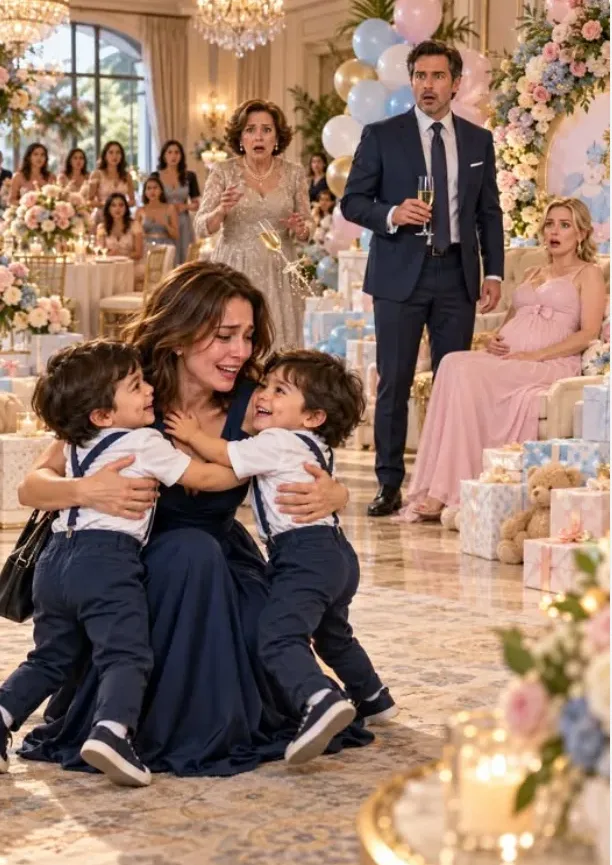
Luke and Owen came charging into the room like a pair of miniature tornadoes. They were dressed in matching dark green sweaters and khakis, their dark hair slightly messy from the car ride, their little light-up sneakers squeaking loudly against the polished floorboards.
“Mommy! Mommy!” Luke yelled, bypassing the balloon arch entirely and sprinting straight toward me.
“Auntie Sarah said we could find you!” Owen cheered, running right behind his brother.
Every single conversation in the room ground to a violent halt. Thirty pairs of eyes snapped from Mark to the doorway, and then to the two little boys racing across the room.
My heart swelled. I immediately dropped to my knees on the hardwood floor, opening my arms wide.
Luke hit me first, wrapping his small arms around my neck with enough force to knock me backward slightly. Owen piled in a second later, buried his face into my shoulder, his small hands gripping the fabric of my navy dress.
“I found a shiny rock in the parking lot, Mommy!” Luke announced loudly, his voice echoing under the high ceiling as he held up a greasy piece of gravel. “Look!”
“It’s not a rock, it’s a dinosaur egg,” Owen corrected sharply, tugging on my earring.
“I’ve got you, sweethearts,” I whispered, kissing the top of Luke’s head, then Owen’s, holding them tight against my chest.
A sharp, metallic crash shattered the quiet.
Across the room, near the gift table, Diane’s champagne glass had slipped directly from her fingers. It hit the floorboards, shattering into a dozen glittering shards, spilling sparkling wine across her polished leather shoes.
She didn’t react to the glass. She didn’t look at her ruined footwear.
Diane had stood up from her plush armchair, her knuckles turning bone-white as she gripped the edge of the wooden table for support. Her face had gone completely, shockingly pale—a ghostly, drained white that made her red lipstick look like a wound.
Her eyes were locked onto my sons.
She stared at Luke’s dark, almond-shaped eyes. She stared at the distinct, deep dimple on Owen’s left cheek as he giggled. She stared at the precise, cowlick wave in Luke’s dark hair—the exact same physical markers that had defined childhood photos of her own son forty years ago.
Mark slowly lowered his champagne glass, his eyes darting from his mother to the two boys clinging to my dress.
“Claire…” Diane whispered, her voice trembling so violently it was barely audible above the quiet background music. “Claire… who… who are those children?”
I slowly stood up, keeping a gentle, reassuring hand on Luke’s shoulder and Owen’s head. The boys sensed the strange energy in the room and quieted down, looking out at the crowd of adults with curious, innocent eyes.
“These are my sons, Diane,” I said, my voice carrying clearly, calmly across the silent room. “Luke and Owen.”
Diane took a staggering step forward, ignoring the broken glass beneath her heels. “How… how old are they?”
“They turned three in August,” I replied evenly.
The math hit the room like a physical blow.
Mark’s face underwent a terrifying transformation. The smug, triumphant arrogance vanished in a fraction of a second, replaced by a ghastly, hollow confusion. He looked at the boys. He looked at their faces, their eyes, their hands.
Then he looked at me.
“Three?” Mark stammered, his voice cracking painfully. “August? That… that’s impossible. We… we divorced four years ago…”
“We divorced four years ago in May, Mark,” I corrected him, stepping forward slightly so both boys were firmly behind my dress. “And three weeks after the papers were finalized, you came to my apartment to pick up two boxes of tax records.”
A collective gasp rippled through the room.
Emily’s head snapped toward her husband, her face turning as pale as Diane’s. “Mark? What is she talking about?”
Mark didn’t answer her. He couldn’t. He was staring at Luke and Owen as if he were looking at two ghosts that had stepped straight out of his nightmares.
“You…” Mark whispered, his fingers trembling so hard his champagne glass rattled against his ring. “You said… you were infertile.”
“No, Mark,” I said, looking him straight in the eyes, letting every person in that room hear the absolute truth. “The doctors said we had unexplained infertility. You decided I was the broken one. You walked away from seven years of marriage because you refused to accept that biological timing, stress, and luck play a role.”
I looked down at my sons, who were looking up at me with absolute trust.
“And nine months after that final night in my apartment,” I continued, turning back to face Mark and his frozen mother, “I gave birth to two perfectly healthy twin boys. Your sons, Mark.”
Chapter 5 – The Fractured Narrative
The room felt as though the air had been entirely sucked out of it. The gold foil balloons spelling out BABY GIRL suddenly seemed mockingly absurd hanging above the scene.
Emily stood up slowly from her armchair, her hands clutching her pregnant stomach, her eyes wide with a mixture of horror and fury as she stared at her husband.
“Mark?” Emily’s voice was shrill, cutting through the heavy silence. “Is this true? Did you sleep with her after your divorce?”
Mark stammered, his jaw working uselessly as he tried to construct a lie, a defense, anything to regain control of the room. “Emily… listen to me, she’s… she’s lying! She’s doing this to ruin our day! She brought someone else’s kids here to make a scene!”
“Lying?” I let out a soft, humorless laugh. “Mark, look at them.”
Luke chose that exact moment to scowl at Mark, crossing his small arms over his chest in a posture that was an absolute, carbon-copy replica of Mark’s own defensive stance. The resemblance was so glaring, so indisputable, that several of Mark’s close college friends in the crowd began whispering frantically among themselves.
Diane stepped past the broken champagne glass, her eyes fixed entirely on the boys. Tears were streaming down her face, ruining her carefully applied makeup.
“They have your eyes, Mark,” Diane choked out, her voice breaking. “They have your father’s chin. My God… they look just like you did when you were three.”
“Mom, stop it!” Mark yelled, losing his composure completely. His face flushed a deep, mottled red. “She’s setting a trap! If they were my kids, why wouldn’t she tell me three years ago? Why would she hide them?”
“Because you made it abundantly clear that you considered me a biological failure, Mark,” I answered coldly, my voice ringing with absolute conviction. “You told me you didn’t want to waste another second on my ‘defective body.’ Why would I drag two innocent babies into a custody battle with a man who resented their mother and had already abandoned our marriage?”
“They are my heirs!” Mark roared, taking an aggressive step toward me. “If those are my sons, you stole three years of my life from me!”
“You gave those three years away the day you signed the divorce papers and told me I was nothing to you,” I countered, standing my ground as Luke shifted behind my legs. “You wanted a fresh start, Mark. You wanted an audience today to humiliate me. You got your audience.”
“Get out,” Emily suddenly screamed, turning on her husband with tears of absolute humiliation spilling over her eyelashes. “Get out of here, Mark!”
Mark spun around, stunned. “Emily, sweetie, calm down, think about the baby—”
“Don’t you dare touch me!” Emily shouted, shoving his hands away. “You lied to me! You told me you hadn’t touched her in over a year before your divorce! You told me she was crazy and bitter! And you invited her here today just to be cruel to her?”
The guests were openly moving toward the exits now, whispering frantically, eager to escape the radioactive blast zone of the family scandal. Mark’s polished professional image, carefully curated for years, was disintegrating in real-time before the very people whose respect he craved most.
Diane sank back into a chair, burying her face in her trembling hands, sobbing quietly as she realized the grand-children she had unknowingly lost out on loving for three years were standing right in front of her, entirely out of her reach.
“Mommy,” Owen tugged on my hand, looking up with wide, worried eyes. “People are loud. I want to go.”
“Okay, baby,” I whispered softly, smoothing his hair back. “We’re leaving right now.”
I looked at Mark one last time. He looked smaller, stripped of his expensive suit and arrogant posture, standing alone in the middle of a ruined baby shower while his pregnant wife refused to look at him and his mother wept.
“Have a wonderful afternoon, Mark,” I said quietly.
I picked up Owen, took Luke firmly by the hand, and turned my back on the wreckage.
Chapter 6 – The Fallout in Westerville
By Monday morning, the fallout from Saturday’s events at the Grandview Reserve had spread like wildfire through our old social circles in Westerville and Dublin.
My phone had been buzzing almost non-stop since Sunday morning. Messages from old acquaintances, former neighbors, and even Mark’s sister, Denise, filled my inbox. Denise had sent a long, weeping text apologizing profusely for her brother’s behavior and begging for a chance to meet her nephews.
I sat at my kitchen counter, drinking dark coffee while Luke and Owen sat at the small children’s table eating oatmeal and watching cartoons.
There was a firm, hesitant knock at my front door.
I stood up, walked to the hallway, and looked through the peephole.
Standing on my porch was Diane.
She looked ten years older than she had on Saturday. Her silver hair was unstyled, tucked loosely behind her ears, and she wore a plain gray trench coat over slacks. She didn’t look like the formidable matriarch who had judged me over Thanksgiving dinners; she looked like a heartbroken grandmother.
I opened the door, standing firmly in the doorway. “Diane.”
“Claire,” she breathed, her voice raspy. She held a large paper shopping bag in her trembling hands. “Please… please don’t shut the door. I just… I need five minutes.”
I looked at her for a long moment. Four years ago, I would have let her walk all over me out of a desperate need for acceptance. But I was no longer that woman.
“Five minutes, Diane,” I said, stepping aside slightly. “Come in.”
She walked into the entryway, her eyes immediately darting toward the living room where the boys were watching television. She let out a small, trembling gasp, clutching the shopping bag tight against her chest.
“I brought some things,” Diane whispered, setting the bag on the entryway table. “Old photo albums of Mark when he was little… and some baby blankets I had saved from when my children were born. I… I didn’t know, Claire. I swear to you, if I had known you were carrying his babies, I would have stopped him. I would have made him fix things.”
“Fix things?” I asked, leaning against the wall with my arms crossed. “Diane, Mark didn’t want to fix things. He wanted a scapegoat. And you enabled him.”
Diane flinched, tears welling in her tired eyes. “I know,” she confessed quietly. “I was so focused on wanting Mark to be happy, to have the family his brother had, that I ignored how cruel he was becoming to you. I blamed you because it was easier than accepting that my own son was selfish.”
She looked toward the living room, watching Owen drop a spoonful of oatmeal on his shirt. A soft, painful smile touched her lips.
“They’re beautiful, Claire,” she whispered. “They’re absolute miracles.”
“They are,” I agreed softly.
“What’s going to happen now?” she asked, looking at me with desperation. “Mark… Mark is a mess. Emily moved out on Sunday. She went to stay with her parents in Cleveland. She’s talking about filing for legal separation before the baby is even born.”
I wasn’t surprised. A woman carrying a child doesn’t easily forgive learning that her husband used a public event to settle a petty, cruel score with his ex-wife—only to expose a massive secret in the process.
“Mark brought this on himself, Diane,” I said firmly. “He chose to write that note. He chose to make that speech.”
“He wants paternity tests,” Diane said hesitantly, watching my reaction closely. “His lawyer called him yesterday. Mark says if they are his sons, he wants shared custody.”
A cold, sharp anger flared in my chest, but I kept my voice steady. “He can request whatever tests he wants, Diane. But he will quickly realize that abandoning a marriage, establishing zero relationship for three years, and acting out of spite does not win you instant custody in an Ohio court.”
Chapter 7 – The Legal Battle Begins
Two weeks later, the formal legal papers arrived.
Mark hadn’t wasted time. Humiliated and facing the breakdown of his second marriage, he had hired a high-powered family law attorney in Columbus to file a petition for paternity establishment and emergency visitation rights for Luke and Owen.
I sat in the office of my own attorney, Susan Vance—a sharp, experienced woman in her fifties with short silver hair and an absolute no-nonsense attitude toward high-conflict divorces.
Susan reviewed the petition Mark’s team had submitted, tossing it onto her mahogany desk with a dismissive click of her pen.
“He’s asking for immediate overnight weekend visitations and court-mandated DNA testing,” Susan summarized, looking across at me. “Classic aggressive maneuvering. He wants to control the narrative again.”
“Are the DNA tests mandatory?” I asked, resting my hands in my lap.
“Technically, yes, since you were divorced when the children were conceived and born,” Susan explained calmly. “Establishing paternity legally is a standard procedure. But establishing custody and visitation for a father who has been completely absent for three years? That is an entirely different hill for him to climb.”
“He doesn’t actually want to be a father to Luke and Owen, Susan,” I said softly, looking out the window at the autumn leaves falling on the street below. “He wants to win. He wants to prove that he didn’t lose.”
“I know the type,” Susan nodded, her eyes sharp. “Men like Mark view children as trophies or leverage. When he thought you were infertile, you were a liability. Now that you have two healthy boys bearing his genetic code, he views them as assets he was denied.”
“What’s our move?”
Susan leaned back in her leather chair, a cold, confident smile touching her lips. “We consent to the DNA testing immediately. We don’t fight it for a single second. That establishes his legal obligation for back-pay child support for the last three years.”
I blinked. “Child support?”
“Oh, absolutely,” Susan chuckled cleanly. “If he wants to claim legal fatherhood, he gets the full package—financial responsibility backdated to the day those boys were born. Meanwhile, we request a court-ordered gradual re-entry plan supervised by a child psychologist, citing the fact that these boys have never met him and view him as a complete stranger.”
She picked up her pen, tapping it against the desk. “Let’s see how enthusiastic Mark remains about weekend custody when he realizes it comes with three years of back-dated child support payments and mandatory parenting classes.”
Three days later, we submitted to the court-ordered cheek swabs at a local medical clinic. Luke and Owen thought it was a fun game, giggling as the nurse gently rubbed the cotton swabs inside their cheeks.
Mark was present at the clinic, standing in the corner of the waiting room in his sharp suit, flanked by his attorney. He didn’t come over to talk to the boys. He just watched from a distance, looking stoic and important.
When the nurse finished, Luke looked over at Mark, then up at me.
“Mommy,” Luke whispered loudly, pointing his small finger directly across the waiting room. “Is that the angry man from the party with the balloons?”
A few patients in the waiting room turned to look. Mark’s face flushed a deep, embarrassed pink.
I gently pushed Luke’s finger down, holding his small hand. “Yes, honey. Let’s go get some ice cream.”
Chapter 8 – The Results and the Reality
The DNA results returned ten days later with 99.99% certainty. Mark Bennett was the biological father of Luke and Owen.
With paternity legally established, the court scheduled a preliminary custody conference in a private hearing room at the Franklin County Domestic Relations Court.
I sat at the long conference table beside Susan. Across from us sat Mark and his attorney, a sharp-suited man named Richard Sterling who looked entirely exhausted by his client.
Mark looked terrible. Dark circles hung under his eyes, and his suit sat slightly loose on his frame. The rumors had been true: Emily had officially filed for legal separation, taking her belongings back to her family’s estate in Cleveland, leaving Mark alone in his large suburban home.
“Your Honor,” Mr. Sterling began, addressing the magistrate at the head of the table. “My client is eager to fulfill his role as a loving father. He requests immediate weekend parenting time so he can bond with his sons.”
Susan didn’t even hesitate. She leaned forward, placing a thick stack of financial documents on the table.
“Your Honor,” Susan countered smoothly. “My client has no intention of keeping the boys from a safe, healthy relationship with their biological father. However, Mr. Bennett has been completely absent for thirty-six months. Jumping straight into overnight visits would cause severe psychological distress to three-year-old toddlers.”
She paused, handing a document to the magistrate. “Furthermore, now that paternity is formally established, we have submitted our motion for back-dated child support covering the past three years, calculated based on Mr. Bennett’s tax returns from his senior partnership at his firm.”
Mark’s attorney visibly flinched. He leaned over, whispering urgently into Mark’s ear.
Mark’s eyes widened as he looked at the financial figure listed on Susan’s motion. The back-pay child support, combined with ongoing monthly payments, amounted to a staggering sum—one that would severely impact his comfortable lifestyle.
“This is extortion!” Mark blurted out, breaking court decorum. “She hid my kids from me for three years, and now she wants me to pay for it?”
“Mr. Bennett, control yourself,” the magistrate warned sternly. “You were not present. The law requires biological parents to provide financial support from birth, regardless of marital status or personal disputes.”
The magistrate reviewed Susan’s proposed re-entry plan. “I am ordering a phased reunification process. Mr. Bennett will have two hours of supervised visitation once a week at a family counseling center, accompanied by a child therapist. If those sessions go well over six months, we can discuss expanding to unsupervised day visits.”
Mark stared at the magistrate in disbelief. “Two hours a week? In a community center? I’m their father!”
“And right now, sir, to those boys, you are a stranger who yelled at their mother at a baby shower,” the magistrate replied coldly, signing the order. “Court is adjourned.”
As we walked out into the carpeted hallway, Mark rushed out behind us, catching up to Susan and me near the elevators.
“Claire! Wait!” he called out, his voice desperate.
I stopped, turning around to face him. “What is it, Mark?”
“Can’t we talk about this like adults?” Mark pleaded, looking around nervously as if worried someone might recognize him. “Two hours a week in a sterile therapy room? It’s ridiculous! Just let me take them to the zoo on Saturdays. We can work out the money privately.”
I looked at the man who had once been my entire world—the man whose approval I had begged for, whose cruelty I had excused, and whose departure I had once mourned as the end of my life.
He hadn’t changed. He didn’t care about Luke’s love of fire trucks or Owen’s obsession with dinosaurs. He cared about avoiding convenience fees, public embarrassment, and financial hits.
“No, Mark,” I said quietly, my voice steady and unwavering. “We are following the court order. You wanted to be a father. Now you get to learn what being a real parent actually requires.”
Chapter 9 – The Slow Work of Healing
The six months that followed were a masterclass in quiet, slow-burning transformation.
True to the court’s order, Mark began attending his weekly two-hour supervised visitation sessions at a warm, child-friendly family center in Columbus.
The first month was an absolute disaster for him. Mark showed up in his expensive suits, trying to interact with two energetic three-year-olds as if he were conducting a corporate performance review. He brought expensive electronic gadgets and designer clothes—items that meant nothing to toddlers who preferred building cardboard fortresses and playing hide-and-seek.
“He tried to teach Luke how to use an iPad tablet today,” the child therapist, Dr. Elena Rostova, told me with a soft smile during our monthly check-in. “Luke ignored it and spent forty-five minutes making dinosaur noises under a table.”
“Did Mark play with him?” I asked.
“Eventually,” Dr. Rostova replied. “He had to take off his suit jacket, get down on his knees on the carpet, and pretend his shoe was a truck. It was the first time I saw him actually look at his son instead of looking at himself.”
Slowly, painfully, the sharp edges of Mark’s arrogance began to wear down under the relentless, unvarnished honesty of three-year-old boys. Children do not care about net worth, professional titles, or social standing. They only care about presence, patience, and love.
By the fourth month, a tentative, quiet shift began to occur. Mark stopped wearing his suits to the center, showing up in simple jeans and sweaters. He learned that Owen liked his toast cut into triangles, not squares. He learned that Luke needed a firm hug when he got frustrated with wooden blocks.
Meanwhile, Diane became a steady, gentle presence in our lives. I allowed her to visit the townhouse on Tuesday afternoons while I worked. She would sit on the rug for hours, reading storybooks to her grandsons, her eyes filling with quiet tears of gratitude every time Luke fell asleep in her lap.
One rainy November afternoon, as Diane was preparing to leave my house, she paused at the front door.
“Claire,” she said softly, holding her coat around her shoulders. “I want to thank you.”
“For what, Diane?”
“For not letting my son’s foolishness destroy your kindness,” she whispered, her eyes shiny with emotion. “You had every right to turn us all away. You had every right to shut the door on our family forever. But you gave my boys a chance to know who they are.”
“I didn’t do it for Mark, Diane,” I smiled gently, looking back at my sons playing in the living room. “And I didn’t do it for you. I did it because my boys deserve to grow up knowing they are loved by everyone connected to them.”
Chapter 10 – A Full Circle
A year after the chaotic afternoon at the Grandview Reserve, the air in Dublin was once again crisp and filled with the bright, golden leaves of mid-autumn.
I sat on a wooden bench at a community park near my new home—a spacious four-bedroom house with a sprawling, fenced-in backyard that I had bought entirely with my own hard-earned income and settled divorce assets.
A short distance away, Luke and Owen were racing across the grass toward a large wooden playground set, their joyous screams echoing through the cool air.
“Dinosaur fire truck attack!” Owen shouted, swinging a plastic bucket.
“Water power!” Luke roared back, scrambling up the wooden ladder.
Standing near the slide, wearing a simple blue hoodie and sneakers, was Mark.
He didn’t look like the man who had handed me divorce papers four years ago, nor did he look like the smug ex-husband who had raised a champagne glass to humiliate me at a baby shower. He looked like an ordinary, tired, but remarkably content father.
His second marriage to Emily had officially ended in divorce, though they had reached a peaceful co-parenting agreement for their baby daughter, Maya. Every other weekend, Mark had Maya at his home, learning the exhausting, humbling work of raising a toddler girl on his own.
The court had recently granted Mark standard weekend parenting time for Luke and Owen. He had paid his back-dated child support in full, set up college trust funds for both boys, and completed a year of co-parenting counseling without a single complaint.
Mark walked over to my bench, holding two paper cups of warm apple cider he had bought from a nearby park stand. He handed one to me.
“Thanks,” I said, taking the cup, the warm cardboard soothing my hands in the chilly air.
“They’re getting fast,” Mark remarked, watching the boys take turns going down the spiral slide. “Owen almost outran me from the parking lot.”
“He’s been practicing,” I smiled faintly.
Mark sat down on the far edge of the wooden bench, leaving a respectful distance between us. He took a sip of his cider, looking out over the autumn park.
“I received the final decree for Maya’s custody agreement yesterday,” Mark said quietly, his voice lacking any of the old sharp edge. “Everything is settled.”
“How are you holding up?” I asked gently.
Mark let out a slow, breathy laugh that turned to steam in the cold air. “If you had told me two years ago that I’d be spending my weekends changing diapers, making macaroni and cheese, and building train tracks on living room carpets, I would have told you that you were insane.”
He looked over at me, his brown eyes carrying a quiet, profound remorse that didn’t need grand speeches to be felt.
“I was so wrong, Claire,” Mark said softly, holding his cider cup with both hands. “About everything. About you, about infertility, about what matters in life. I thought having a family was something you earned like a promotion, or owned like a house. I thought I was entitled to it.”
I listened quietly, letting the autumn breeze blow past us.
“When I wrote that horrible note on that invitation,” Mark continued, his voice shaking slightly, “I was miserable. I had everything I thought I wanted, but I was still empty because I was living a lie. Seeing you walk into that room with Luke and Owen… it broke every terrible thing inside me that needed breaking.”
“It needed to break, Mark,” I said gently, looking at him with absolute sincerity. “For your sake, and for the boys’ sake.”
“I know,” Mark nodded slowly. “And I don’t expect you to ever forgive me for those seven years, or for how I treated you.”
“I already have, Mark,” I replied, turning my head to look him straight in the eye. “Not because what you did was okay, but because keeping anger inside is like drinking poison and expecting the other person to get sick. I have too much beauty in my life to waste time hating you.”
Mark stared at me for a long moment, a look of profound relief and respect washing over his features. He gave a quiet, humble nod. “Thank you, Claire.”
“Mommy! Daddy! Look!” Luke’s voice boomed across the playground.
Luke and Owen were standing at the top of the playground fortress, waving their arms wildly in the autumn sun, their light-up sneakers flashing bright red and blue.
“Look how high we are!” Owen yelled proudly.
Mark stood up from the bench, a genuine, warm smile filling his face—a smile that held no arrogance, no victory, only the pure, uncomplicated joy of a father looking at his children.
“I see you, boys!” Mark called out, walking toward the wooden structure. “Hold on, I’m coming up!”
I leaned back against the wooden bench, sipping my warm apple cider, watching my sons laugh as their father climbed up the ladder to join them.
The scars of seven dark years were still there, faint and quiet, but they no longer defined my life. I had survived the storm, spoken my truth, and built a life filled with unconditional love, resilience, and light.
I took a deep breath of the crisp autumn air, wrapped my coat tightly around my shoulders, and smiled at the beautiful, unpredictable world that was finally, completely mine.
THE END.