Chapter 1 – The Broken Stick
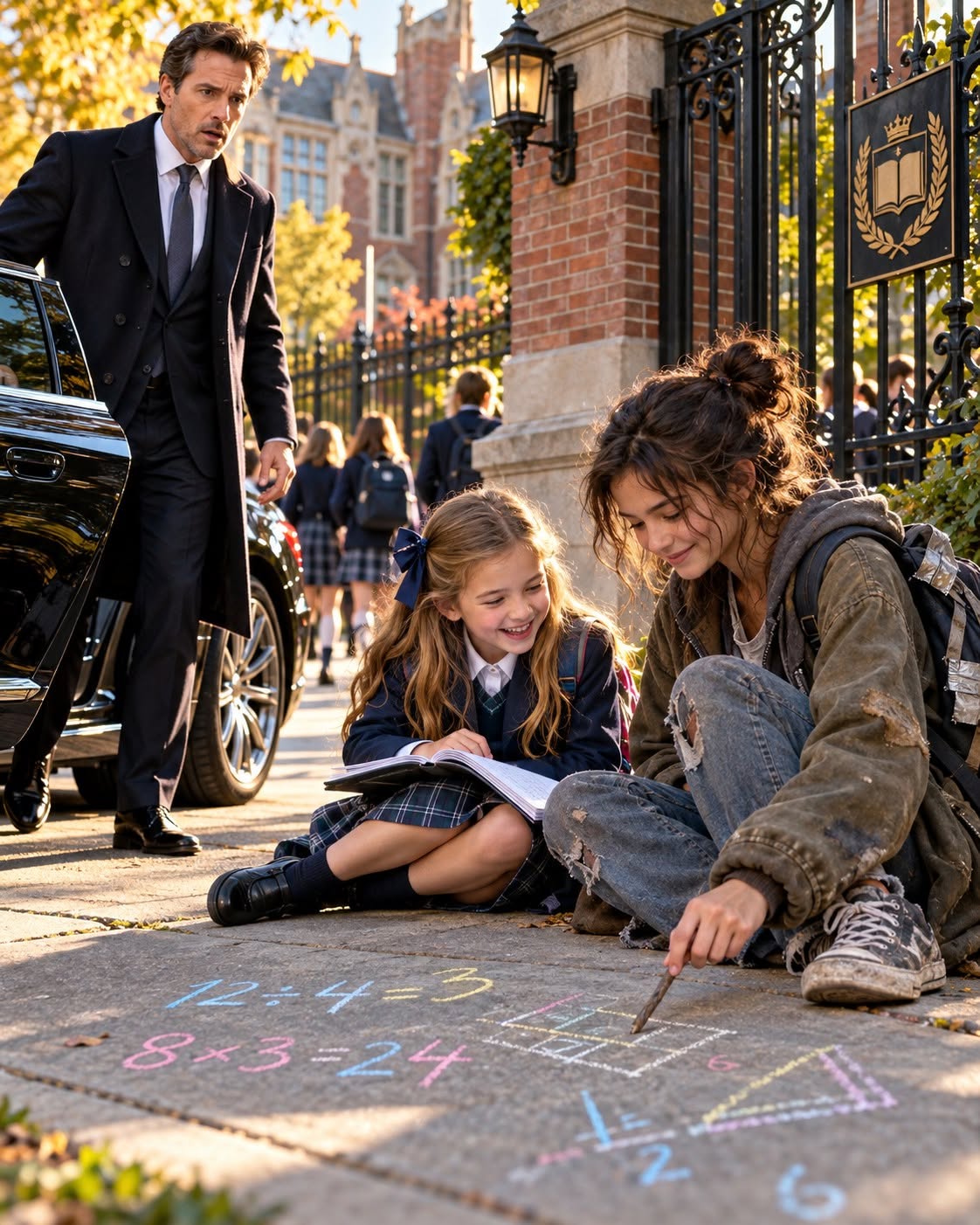
I arrived early to pick up my eight-year-old daughter from her private school.
Instead of waiting behind the gates, Sophie was sitting on the sidewalk beside a homeless teenage girl.
The girl was drawing math problems on the concrete with a broken stick.
I was about to rush over.
Then Sophie laughed.
Not a polite smile.
A real laugh.
The first one I had heard since her mother died two years earlier.
I immediately told my driver:
“Stop the car.”
My name is Daniel Harrison.
Most people in Chicago know me as an investor.
After my wife died, I became obsessed with controlling everything.
Sophie’s school schedule.
Tutors.
Therapy.
Meals.
Weekends.
Every hour of our lives had a plan.
I told myself structure would help her.
The truth was simpler.
I couldn’t control losing my wife, so I tried to control everything else.
That afternoon, I arrived at Sophie’s school twenty minutes early.
Then I saw her sitting on the curb.
Beside her was a teenage girl wearing an oversized coat and battered sneakers.
Her backpack was held together with strips of duct tape.
I immediately assumed she was homeless.
My first instinct was to get Sophie away from her.
Then I noticed the notebook across Sophie’s knees.
The teenager pointed to numbers she had drawn on the pavement.
“Don’t memorize it,” she told Sophie. “Look for the pattern.”
Sophie studied the problem.
Then her face suddenly lit up.
“Oh! That’s why I kept getting it wrong!”
She laughed.
I froze.
For two years, I had paid for expensive tutors, counselors, and specialists.
Nothing had brought that sound back.
Yet this girl had done it with a broken stick and five minutes of patience.
I stepped out of the car.
Neither of them noticed me.
Then the teenager erased the problem with her sleeve and started drawing something harder.
Sophie leaned closer.
And that was when I noticed something else.
The girl wasn’t guessing.
She understood the math far better than most adults I knew.
Chapter 2 – The Girl in the Oversized Coat
The sound of Sophie’s laughter hung in the brisk autumn air like a bell echoing in an empty cathedral. For seven hundred and thirty days, my home had been silent. Our penthouse overlooking Lake Michigan had become a vault of expensive grief, populated by whispering housekeepers, solemn child psychologists, and color-coded routines that I maintained with tyrannical precision.
Yet right here, on a cracked sidewalk outside St. Jude’s Preparatory Academy, my daughter was doubled over, her hands on her knees, giggling so hard a stray tear caught the afternoon light.
I walked toward them, my polished dress shoes clicking heavily against the concrete. As my shadow fell over the chalky white scratches on the pavement, the teenager froze.
Her head snapped up. In an instant, the warmth vanished from her face, replaced by a cold, feral vigilance that only comes from sleeping with one eye open. Her fingers tightened around the jagged piece of wood in her hand. Her knuckles were chapped, gray with city grime, and her oversized green army coat had frayed sleeves that swallowed her wrists.
“Sophie,” I said, keeping my voice level, though my heart was hammering against my ribs. “Time to go, sweetheart.”
Sophie scrambled up, clutching her backpack. “Dad! Look! She showed me why negative numbers flip when you multiply them. It’s not just a rule, it’s a mirror! Look at the line!”
I glanced at the sidewalk. Drawn with the charred end of a stick and chipped masonry stone was a beautifully intricate number line, flanked by geometric proofs that had no business being scribbled on public asphalt by an eighth-grade dropout. It looked like something from an advanced linear algebra textbook, translated into pure, intuitive visual art.
I turned back to the girl. She had already pushed herself to her feet, backing away instinctively. Up close, I could see how thin she was. Her cheekbones pressed sharply against pale skin, and her dark hair was chopped unevenly, tucked behind ears reddened by the chilly wind.
“I wasn’t bothering her, mister,” she said quietly, her voice hoarse, devoid of self-pity but loaded with armor. “She dropped her binder. I just helped her pick up the papers.”
“You did the math,” I observed, pointing at the concrete.
“It was sloppy,” she muttered, tugging the straps of her duct-taped backpack tighter. “Her teacher gave her a zero for not showing work. The formula they gave her is backwards anyway. Wastes three steps.”
I took a slow breath. “What’s your name?”
“Doesn’t matter. I’m leaving.” She took another two steps backward, glancing nervously toward the school’s security guard who was standing by the wrought-iron gate, eyeing her with blatant suspicion.
“Wait,” I said, reaching into my tailored wool coat. I pulled out my wallet, intending to hand her whatever cash I had—a hundred, maybe two. It was an instinctual reaction of a wealthy man accustomed to solving every human encounter with currency.
The moment the girl saw the leather wallet, her eyes narrowed. A sharp, stinging disgust flashed across her face.
“I don’t want your handouts,” she spat softly. “I helped the kid because she looked like she wanted to cry. Keep your money.”
Before I could say another word, she spun on the heel of her worn-out sneakers and vanished into the crowd of parents, nannies, and yellow school buses clogging the boulevard.
“Dad,” Sophie tugged my sleeve, her voice trembling. “Why did you scare her away?”
I looked down at my daughter. The spark that had animated her eyes just three minutes ago was fading, threatening to retreat back into the numb hollow shell she had occupied since the funeral.
I knelt down on the cold sidewalk, ignoring the dirt brushing against my trousers. On the ground near my shoe lay a folded, dog-eared piece of loose-leaf paper that must have slipped from the girl’s pocket when she stood up.
I picked it up. In the upper corner, scrawled in tight, elegant handwriting, was a name and a library branch barcode: *Maya Vance — Harold Washington Library.*
“I didn’t mean to scare her, Soph,” I whispered, staring down the crowded street where the green army jacket had disappeared. “I promise you, I didn’t.”
Chapter 3 – The Ghost in the System
That evening, the penthouse was unbearable.
Sophie sat at the dining table, staring at a bowl of roasted tomato bisque. For months, Dr. Kenneth, her $450-an-hour child psychiatrist, had told me to avoid pressuring her, to let her process her mother’s sudden loss in waves. But those waves were drowning her. Tonight, however, she wasn’t staring into space. She was staring at the blank napkin beside her plate.
Taking a silver pen from my pocket, Sophie began drawing lines on the linen.
“She said numbers are just people walking backward and forward on a bridge,” Sophie murmured without looking up. “Mom used to tell me that when people die, they go across a bridge. I asked Maya if you can use math to find someone who crossed.”
My chest tightened until I could barely draw breath. “What did she say?”
“She said math can’t bring anyone back,” Sophie whispered, a single tear cutting down her cheek. “But it can tell you exactly how much space they left behind. So you don’t feel crazy when the room feels too big.”
I closed my eyes. In two years of therapy, none of the specialists had pierced Sophie’s grief like that. They had tried clinical metaphors, sandbox therapy, and pharmaceutical suggestions. Maya Vance had done it with a stick and an honest observation.
After tucking Sophie into bed, I went straight to my study. I poured two fingers of scotch, sat behind my mahogany desk, and dialed Marcus Cole. Marcus was a former CPD detective who now handled high-stakes corporate vetting and asset protection for my private equity firm.
“Daniel?” Marcus answered on the third ring. “It’s past nine. Everything alright with Sophie?”
“I need you to run a name for me,” I said without preamble. “Maya Vance. Late teens, probably seventeen or eighteen. Frequent patron of the Harold Washington Library. Street homeless.”
There was a brief pause on the other end. “A runaway? Did something happen?”
“No,” I replied, staring at the slip of paper under my desk lamp. “I need to know who she is, where she came from, and why a girl who solves university-level calculus on the sidewalk is sleeping in the Chicago cold.”
It took Marcus less than four hours. At 1:30 AM, my tablet pinged with an encrypted PDF dossier.
I scrolled through the file, my scotch untouched.
Maya Vance was nineteen. Her mother had died when she was six; her father was unknown. She had spent thirteen years bouncing through eight different foster homes across Cook County. Her standardized test scores from middle school were in the 99.9th percentile. At age fourteen, she had taken an online high school equivalency exam and aced it without attending classes.
Then the paper trail turned dark.
At sixteen, she was placed in a privately contracted group home run by Vanguard Youth Services—a company whose board members included several prominent Chicago political donors. Two years later, the moment she turned eighteen, she vanished from the system. No college applications. No social security tax contributions. No registered address.
Under the section marked *Incidents*, there was a police report filed eighteen months ago. Maya had been accused of grand theft by the director of the Vanguard group home—a man named Raymond Vance (no relation), who claimed she stole thirty thousand dollars in administrative cash from the home’s safe. The charges had been dropped for lack of physical evidence, but her record was flagged, her foster discharge stipend revoked, and she was blacklisted from state transitional housing.
She hadn’t vanished because she wanted to be invisible. She had been pushed out into the cold and erased.
I printed out the photo attached to the file: a sixteen-year-old Maya staring into the state camera with fierce, unblinking defiance.
Chapter 4 – An Offer on the Pavement
I found her three days later on the third floor of the Harold Washington Library.
The room was quiet, smelling of aged cellulose, damp coats, and industrial radiator heat. Maya was seated at a corner wooden carrel tucked behind the periodicals, surrounded by three towering stacks of books: differential equations, real analysis, and theoretical physics.
She was wearing the same oversized coat, but her hood was down. In the warm library lighting, she looked impossibly young. A small plastic cup with a lid from a nearby fast-food chain sat next to her elbow, filled with tap water.
I didn’t sneak up on her. I pulled out the oak chair across from her desk and sat down.
Maya looked up instantly. Her dark eyes flashed with recognition, followed immediately by defensive hostility. She began sliding her notebook shut.
“If you brought the cops,” she said in a cold whisper, “you’re wasting your time. Sitting in a public library reading books isn’t loitering.”
“I didn’t bring the police, Maya,” I said calmly.
She flinched slightly at the sound of her name, then her eyes darted to my hands on the desk. “You had me tracked. Of course you did. Rich guys have people for that.”
“I did,” I admitted without apology. “Because you gave my daughter something no doctor in this city has been able to give her in two years. Hope. And an hour of peace.”
Maya scoffed quietly, though her fingers loosened their grip on the notebook. “I showed her a trick with negative signs. It wasn’t magic.”
“To her, it was.” I leaned forward, resting my forearms on the table. “Sophie’s mother died in a hit-and-run two years ago. Sophie was in the back seat. She walked away without a scratch, but she left her childhood behind in that wreck. I’ve watched her slowly fade into a shadow. Until Tuesday.”
Maya looked away, staring out the arched library window at the gray clouds rolling over the Loop. For a fraction of a second, the hard shell around her softened. She knew what it was like to watch the world crumble while everyone around you told you to get over it.
“I’m sorry about her mom,” Maya murmured. “Really. But I can’t help you, Mr. Harrison.”
“You know who I am?”
“Harrison Capital,” she said flatly. “You bought out three logistics firms last quarter and restructured their automated freight algorithms. The Tribune ran an article on your predictive analytics model. It was poorly written, but the underlying distribution theory was interesting.”
I stared at her, genuinely stunned. “You read the financial press?”
“I read whatever is free and keeps my brain from turning to mush,” she replied, packing her pens into a plastic pencil case. “Now, if you don’t mind, I have somewhere to be.”
She didn’t have anywhere to be. The temperature outside was dropping toward twenty-six degrees.
“I want to hire you,” I said clearly.
Maya stopped zipping her bag. She looked at me like I had just spoken in ancient Greek. “Hire me? To do what? Sweep your office?”
“To tutor Sophie. Three days a week. Two hours a day. I will pay you two hundred dollars an hour.”
Her mouth tightened into an angry, skeptical line. “Right. And what’s the catch? What do I actually have to do for that kind of money?”
The cynicism in her voice cut deep, a bitter reminder of what the world often demanded of defenseless young girls on the street.
“The catch is that you show up sober, clean, and ready to teach,” I said firmly, meeting her gaze so she could see the absolute absence of predatory intent. “The catch is that you don’t teach her from a curriculum. You teach her the way you think. You show her how you see the world.”
“And where does this tutoring happen?” she asked coldly.
“At my home. In the Gold Coast. Our housekeeper will be there at all times, as will I. You will have a hot meal before every session, and a private room to study in if you choose to stay afterward.”
Maya stared at me for a long time. Her throat bobbed as she swallowed. Her stomach gave a faint, betraying rumble that she tried desperately to ignore.
“I have a record,” she whispered, her voice dropping lower. “Or at least, people say I do. You checked my file. You know what Raymond Vance said I did.”
“I read the report,” I said. “And I know that an accounting deficit of thirty thousand dollars doesn’t disappear without a digital paper trail, yet Vanguard couldn’t produce a single receipt or transfer log tying it to you. You didn’t steal that money, Maya. You found out who did, didn’t you?”
Maya’s eyes widened, a sudden flicker of shock breaking through her stoic mask.
“They set you up to cover their own shortfall,” I continued. “I know how corrupt institutions operate. I eat people like Raymond Vance for breakfast in boardroom takeovers.”
I stood up, took a silver business card from my pocket, and placed it on top of her differential equations book, along with an envelope containing five crisp hundred-dollar bills.
“An advance on your first week,” I said. “There is a quiet hotel on Clark Street. Room is booked under your name for seven days. Take a shower, sleep in a real bed, buy some warm clothes. Tomorrow at four o’clock, a car will wait outside for you. If you get in, we start. If you don’t, keep the money, and I will never bother you again.”
I turned and walked away down the aisle without looking back.
Chapter 5 – The Glass Tower
At precisely 3:58 PM the following afternoon, my intercom buzzed.
“Mr. Harrison,” my doorman’s voice came through the speaker. “There is a young lady here. Miss Vance. She… says she has an appointment.”
I felt a surge of relief that surprised me with its intensity. “Send her up, Arthur.”
When the private elevator doors slid open into the foyer of our penthouse, Maya stepped out cautiously, like an animal entering a brightly lit trap.
She had washed her hair; it was clean, dark, and fell neatly past her collarbones. She wore a simple, brand-new navy sweater and dark jeans—inexpensive, bought off the rack, but clean and fitting. Her old duct-taped backpack was gone, replaced by a cheap canvas tote.
Her eyes scanned the soaring eighteen-foot ceilings, the floor-to-ceiling glass walls showcasing the vast slate-blue expanse of Lake Michigan, and the minimalist modern furniture.
“It looks like a museum,” she observed, her voice barely louder than a whisper. “Does anyone actually live here?”
“We try,” I said, stepping forward. “Welcome, Maya.”
Before she could respond, a sudden patter of small feet echoed across the hardwood floor. Sophie skidded around the corner of the hallway, wearing her school uniform. When she saw Maya, her eyes lit up with an electric joy I hadn’t witnessed in years.
“You came!” Sophie yelled, running forward and stopping just two inches short of hugging Maya, as if remembering her manners at the last second. “Dad said you might, but I didn’t believe him! Did you bring the stick?”
The corner of Maya’s mouth twitched into a genuine, crooked smile. “Sticks are strictly for outdoor use, kiddo. Indoors, we use real paper. And maybe colored markers if your dad doesn’t have a corporate ban on them.”
“We have markers!” Sophie cheered, grabbing Maya’s hand and dragging her toward the dining room table without waiting for permission.
For the next two hours, I sat in my adjoining study with the double doors cracked open.
I was supposed to be reviewing a seventy-million-dollar acquisition term sheet, but my eyes never left the crack between the doors.
There was no lecturing. No monotone drills. Maya took Sophie’s fifth-grade fraction homework and turned it into an architectural puzzle. She had Sophie building imaginary cities where bridge lengths had to balance against river widths, where each fraction represented a cable supporting a suspension tower.
When Sophie made a mistake, Maya didn’t correct her with a red pen. She asked: “If you build that pillar at that height, what happens to the bridge when the wind blows?”
Sophie would look at the numbers, frown, and say: “It falls down!”
“So how do we shore up the foundation?”
“We find the common denominator!”
“Bingo.”
And then came the laugh. Not just one, but several. Light, musical, unburdened.
Mrs. Gable, our longtime housekeeper who had served my late wife for years, walked into my study with a silver tray carrying tea. Her eyes were red-rimmed.
“Mr. Harrison,” she whispered, setting the cup down with trembling hands. “That girl… she’s an angel.”
“She’s not an angel, Mrs. Gable,” I said softly, watching Maya patiently guide Sophie’s small fingers across a ruler. “She’s a survivor. And that’s far more useful.”
Chapter 6 – Unlocking the Code
Three weeks passed. The arrangement became an anchor for all of us.
Maya came every Monday, Wednesday, and Friday. She refused to move into the hotel permanently after the first week, insisting on finding a small studio apartment near Pilsen using the money she earned. I respected her pride too much to force luxury upon her, though I quietly arranged with the landlord to ensure her heating was reliable and the building secure.
Sophie’s teachers called me in for an impromptu conference. Her math scores had jumped from the bottom quartile to the highest percentile in the grade, but more importantly, her social isolation had begun to crack. She was participating in class again.
On a rainy Thursday evening, I was delayed in a high-stakes video conference with our Tokyo partners. Maya had finished her session with Sophie, and Mrs. Gable had taken Sophie to her room for bedtime reading.
Maya was waiting in my study to collect her weekly check, sitting quietly in one of the leather armchairs.
When I finally ended the call and rubbed my burning eyes, I noticed Maya staring intently at the three fifty-inch Bloomberg monitors mounted on my wall.
Displayed on the center screen was a proprietary quantitative risk model developed by our lead financial engineers. We were preparing to deploy four hundred million dollars into renewable energy futures, but the risk curve was behaving erratically, showing unexplained variance spikes that had stalled the entire investment committee for ten days.
“You should recalculate your stochastic volatility parameter,” Maya said casually, her eyes tracking the flickering green and red data streams.
I paused, pen in hand. “Excuse me?”
“Your model,” she pointed a finger at the screen. “You’re using standard Black-Scholes assumptions for tail-risk distribution. But renewable commodities don’t follow Gaussian curves during seasonal climate transitions. Look at the seventh regression column. You’re over-weighting historical summer drought trends and ignoring the non-linear impact of early arctic air masses.”
I stared at her, dumbfounded. “Maya, that model was built by a team of MIT Ph.D.s.”
“Then your MIT Ph.D.s forgot that weather doesn’t obey textbook symmetry,” she said bluntly, standing up and walking over to the screen. “See this drop here? If you execute that trade tomorrow morning with that algorithm, your stop-loss triggers will misfire the moment the midwestern cold front hits natural gas reserves. You won’t hedge the downside; you’ll accelerate it. You’ll lose at least eight percent by market close.”
Eight percent of four hundred million was thirty-two million dollars.
My heart began to race. I stood up, walked behind my desk, and opened the source code for the valuation formula. “Show me.”
Without hesitation, Maya leaned over the keyboard. Her fingers flew across the mechanical keys with breathtaking speed. She didn’t look at reference notes; she didn’t search formulas online. She ripped out thirty lines of complex code and replaced them with an elegant, streamlined recursive equation that accounted for dynamic weather volatility.
When she hit *Execute Simulation*, the historical back-test reran.
The red variance spikes flattened out into a clean, predictable bell curve. The simulated loss vanished, replaced by an optimized yield of twelve percent.
I sat back in my chair, staring at the nineteen-year-old girl standing in front of me in an off-the-rack sweater.
“Where did you learn this?” I whispered.
“I told you,” she said, looking down, suddenly self-conscious. “I read books at the library. Math is just language, Mr. Harrison. If you know how the words fit together, you can read what the world is going to do before it does it.”
I looked from the screen to her face. “You’re not just a tutor, Maya. You’re a once-in-a-century intellect.”
“I’m a kid with no high school diploma and a police file,” she said bitterly. “Out there, that’s all I am.”
Chapter 7 – Shadows from the Past
The following Monday, my corporate office at Harrison Capital was quiet until Marcus Cole walked through my door unannounced. His expression was grim.
“We have a problem, Daniel,” Marcus said, closing the frosted glass door behind him.
“Is it Maya?”
“Yes and no. It’s Raymond Vance and Vanguard Youth Services.” Marcus dropped a thick manila folder onto my desk. “I dug deeper into that thirty-thousand-dollar embezzlement charge from eighteen months ago. It wasn’t thirty thousand. It was over four million dollars skimmed from federal foster care grants over a five-year period.”
I leaned forward. “And Maya?”
“Maya was working as an unpaid student clerk in Vanguard’s administrative office,” Marcus explained. “She was sixteen. She was organizing their digital archives and noticed discrepancies in the ledger numbers. She built a private spreadsheet documenting the ghost accounts where the money was being funneled. She was going to take it to the Department of Children and Family Services.”
“Raymond Vance found out,” I deduced, my fists clenching.
“He found out the day before she turned eighteen. He wiped the hard drive, staged a theft of petty cash from the safe, and blamed her. He used his connections with local law enforcement to scare her into silence. He told her if she ever spoke a word about the accounts, he’d ensure she was sent to a state penitentiary for grand larceny.”
“Who was Vance funneling the money to?” I demanded.
Marcus met my eyes. “Sterling Holdings.”
The air in my office turned to ice.
Richard Sterling. He was my chief rival in Chicago’s private equity sector—a ruthless, politically insulated billionaire who had spent the last five years trying to push Harrison Capital out of municipal development contracts. Sterling had funded Vanguard’s expansion through his charitable foundation, using it as a tax-sheltered vehicle to harvest federal kickbacks.
“Sterling knows she’s with you,” Marcus added quietly.
“How?”
“Vanguard still has an active alert in the municipal registry for Maya’s social security number. When you set up her private apartment lease and linked your corporate guarantor account, the alert pinged. Yesterday, two private investigators hired by Sterling’s legal firm were spotted taking photographs outside her apartment building in Pilsen.”
A cold, venomous fury ignited in my gut. They had stolen this girl’s childhood, cast her out onto the freezing streets, and now that she had found a sliver of safety, they were circling like vultures to ensure their secrets remained buried.
“Bring her here,” I ordered Marcus, my voice dropping to a dangerous register. “Now. Pack everything in her apartment. She doesn’t go back there.”
“Daniel, if Sterling finds out Maya has copies of those old ledgers, he won’t just try to frame her. He’ll eliminate her.”
“Let him try,” I said, standing up and adjusting my cuffs. “He’s about to find out what happens when you threaten my family.”
I paused. The word had slipped out naturally. *Family.*
For two years, my family had been a shattered fragment: me and my broken daughter. But in three short weeks, Maya Vance had become the spine that held our crumbling world upright. And I would tear Chicago apart stone by stone before I let Richard Sterling touch a hair on her head.
Chapter 8 – The Gala
Instead of hiding Maya in a safehouse, I chose the battlefield.
That Friday evening was the annual Chicago Civic Benefactors Gala at the Drake Hotel—the premier social gathering of the city’s financial, political, and cultural elite. Richard Sterling was the keynote sponsor.
At 7:30 PM, my town car pulled up to the Drake’s grand entrance.
I stepped out first, wearing a tailored black tuxedo. Then I reached back into the car and offered my hand to Sophie, who was radiant in a navy velvet dress, her hair pinned up with silver ribbons.
And behind Sophie stepped Maya.
She wore an emerald silk evening gown, simple and timeless, with no jewelry except for a pair of delicate diamond studs I had purchased for her that morning. Her posture was erect, her shoulders back, her chin held high. The homeless teenager in the oversized coat had vanished; in her place was a striking, regal young woman whose sharp, luminous eyes possessed an intelligence that outshone every diamond in that ballroom.
As we walked through the double doors into the Grand Ballroom, the murmur of the orchestra and the clinking of champagne flutes dimmed. Whispers rippled through the crowd.
*Is that Daniel Harrison?*
*He hasn’t attended a gala since his wife died.*
*Who is the girl with them?*
Across the ballroom, standing near the governor and two federal judges, was Richard Sterling.
Sterling was a silver-haired man in his late fifties with cold, predatory eyes and the smooth, practiced smile of a seasoned political predator. Standing right beside him was Raymond Vance, looking bloated and nervous in an ill-fitting tuxedo.
The moment Vance’s eyes landed on Maya, he choked on his champagne. His face turned the color of curdled milk.
Sterling noticed Vance’s reaction, followed his gaze, and saw us walking toward them. His thin smile faded into a tight, venomous scowl.
“Daniel,” Sterling said smoothly as we approached, his voice laced with patronizing condescension. “What a surprise. The recluse finally leaves his tower. And you brought little Sophie.”
“Sterling,” I greeted him coldly. “You know my daughter. And I believe you’re familiar with my associate, Miss Maya Vance.”
Sterling looked Maya up and down, his eyes narrowing with icy contempt. “Miss Vance. Raymond was just telling me about you. It’s remarkable how quickly one can move from city sidewalks to black-tie galas when one finds a sufficiently gullible patron.”
Several socialites nearby gasped softly. Raymond Vance smirked nervously behind his glass.
Maya didn’t flinch. She stepped forward, her gaze locking onto Sterling with the calm, devastating precision of a grandmaster surveying a doomed chessboard.
“It is remarkable, Mr. Sterling,” Maya said, her voice clear and carrying effortlessly across the listening circle. “Especially considering that eighteen months ago, Mr. Vance told me I’d be dead or incarcerated within a year. Yet here I am. And more interestingly… so is the missing four-point-two million dollars from the Vanguard federal foster ledger.”
The color drained instantly from Sterling’s face. Raymond Vance began to visibly sweat.
“I have no idea what slander you’re attempting to manufacture, young lady,” Sterling hissed, stepping closer, his veneer of aristocratic polish cracking. “You are an uneducated street vagrant with an arrest warrant waiting for execution.”
“She’s not manufacturing anything, Richard,” I stepped between Sterling and Maya, towering over him. “Yesterday morning, Maya reconstructed your entire offshore shell structure through the Cayman subsidiaries you used to wash Vanguard’s state allocations. At noon today, Marcus Cole delivered the complete forensic audit—along with Maya’s original digital backups—to the United States Attorney for the Northern District of Illinois.”
Sterling’s breath caught in his throat. His eyes darted wildly around the room, suddenly realizing that several plainclothes federal agents were already stationed near the exit doors.
“You’re bluffing,” Sterling whispered, his fists trembling against his thighs.
“I don’t bluff with my money, Sterling,” I said, leaning in so only he and Vance could hear. “And I certainly don’t bluff with my daughter’s family. Enjoy your keynote speech tonight. It’s the last public address you’ll ever make.”
Chapter 9 – The Space Left Behind
At midnight, the penthouse was quiet once again.
The federal agents had arrested Raymond Vance in the lobby of the Drake Hotel an hour after our confrontation. Sterling’s attorneys were already scrambling, but Marcus assured me that the evidence Maya had organized was airtight. The Department of Justice was unsealing an eighteen-count indictment for racketeering, federal grant fraud, and witness intimidation by morning.
Maya had shed her high heels and was sitting on the rug in the living room, staring out the vast glass wall at the city lights glittering below.
Sophie was curled up beside her, fast asleep, her small head resting comfortably against Maya’s lap. Maya’s hand gently stroked Sophie’s hair with a tenderness that brought an ache to my chest.
I walked over, carrying two mugs of hot chocolate, and sat on the floor near them. I handed one mug to Maya.
“Thank you,” she whispered, taking the cup with both hands to warm her fingers.
“You were extraordinary tonight,” I said.
Maya looked down at Sophie’s sleeping face. “I was terrified. When I saw Vance, my hands started shaking. For two years, I believed him. I believed I was trash. I believed that because nobody came looking for me when my mom died, it meant I wasn’t worth looking for.”
A single tear slipped down her cheek, falling onto the dark silk of her gown.
“My mother used to say that math was the only thing that didn’t lie,” Maya whispered, her voice breaking. “People lie. Promises break. Parents leave. But two plus two never betrays you. It’s always four. No matter how cold the street is, the equation stays true. That’s why I held onto it. It was the only part of the world that didn’t hurt.”
I reached out and gently placed my hand over her trembling shoulder.
“You spent two years measuring the space your mother left behind, Maya,” I said softly, my own voice thick with emotion. “And Sophie and I spent two years trapped inside our own emptiness. But you didn’t just survive that space. You filled it with light.”
Maya looked up at me, her eyes red, the fierce wall of independence finally dissolving into raw, human vulnerability.
“I don’t want to leave,” she choked out, a quiet sob escaping her lips. “I don’t want to be alone anymore, Daniel.”
“You’re not leaving,” I said with fierce certainty. “You have a home here. For as long as you want it. Tomorrow, we begin filing the paperwork for legal adult adoption, if you’ll have me. And the Dean of Mathematics at the University of Chicago has already received your portfolio. Your life starts now, Maya.”
Maya buried her face in her hands, her shoulders shaking as two decades of grief, terror, and loneliness poured out of her in silent, cleansing tears.
Sophie stirred in her sleep, wrapped her small arms around Maya’s waist, and murmured without opening her eyes: “I love you, Maya.”
Maya pulled Sophie closer, resting her cheek against the little girl’s hair. “I love you too, Soph.”
For the first time in two years, the penthouse didn’t feel like a vault. It felt like home.
Chapter 10 – The Unbroken Equation
Six months later, spring had finally broken over Chicago.
The ice on Lake Michigan had melted into brilliant turquoise waters, and the cherry blossoms were blooming in Grant Park.
The federal trial of Richard Sterling and his co-conspirators had concluded with a sweeping conviction. Vanguard Youth Services had been dissolved, its assets seized and converted into a fully funded educational trust for aging-out foster youth—a trust named the *Maya Vance Foundation*, managed under the joint oversight of Harrison Capital.
Sophie was thriving. She had won first place in the city-wide middle school robotics competition, presenting an autonomous drone navigation algorithm that she proudly announced was “co-designed by her sister.”
Maya’s life had transformed into a whirlwind of academic triumph. The University of Chicago had not only granted her full admission with an honorary scholarship; the Department of Mathematics had assigned her a graduate research assistantship, despite her having no formal undergraduate transcripts. Her first published paper on non-linear predictive dynamics in resource allocation had already been cited by sixty academic journals.
On a warm Saturday morning, the three of us walked down the sidewalk outside St. Jude’s Preparatory Academy.
The spot where I had first seen Maya was still there. The concrete was dry, the cracks worn by winter snow and summer rain.
Sophie bent down, picked up a dry oak twig from the grass, and handed it to Maya with a wide, mischievous grin.
“Show me the bridge again,” Sophie said.
Maya laughed—a bright, uninhibited laugh that echoed down the quiet street. She took the stick, knelt down on the sidewalk in her University of Chicago hoodie, and began drawing.
I stood beside them, hands in my pockets, the warm morning sun on my face. Two years ago, I thought control was the only way to survive grief. I thought if I built walls thick enough and schedules rigid enough, nothing could ever hurt us again.
I had been wrong. Healing hadn’t come from control. It had come from letting go. It had come from a broken stick, an extraordinary mind, and the courage of three wounded people daring to become whole together.
Maya stood up, wiping dust from her palms, and looped her arm through mine. Sophie grabbed my other hand, swinging between us as we walked toward the car.
“Dinner at the diner on Clark Street?” Maya asked, looking up at me with a smile. “My treat. I got my research stipend today.”
“Only if I get the cherry pie,” Sophie shouted.
“Deal,” I smiled, looking at my two daughters. The equation was finally balanced.
Chapter 11 – The Knock at the Door
That evening, our celebration stretched late into the night.
We returned to the penthouse around ten. The living room was filled with the scent of fresh lilacs that Sophie had picked from the conservatory. Sophie fell asleep on the couch clutching her robotics trophy, exhausted from an entire afternoon of laughing and running along the Navy Pier boardwalk.
Maya was seated at the kitchen island, a glass of iced tea beside her, reviewing the latest proofs for her upcoming presentation at the International Mathematical Congress in Zurich.
I was standing by the glass window, looking out over the velvet blackness of Lake Michigan, feeling a profound, settled peace that I thought I would never experience again on this earth.
Then, at 11:42 PM, the private elevator chime echoed through the penthouse foyer.
I frowned, glancing at my watch. The building had strict security protocols; no one was permitted up to the penthouse without my explicit phone authorization from the front desk.
“Are you expecting Marcus?” Maya asked, looking up from her papers.
“No,” I replied, my instincts instantly flaring. “Stay here with Sophie.”
I walked toward the foyer, my heart beginning to thud against my ribs.
Before I could reach the intercom panel, the elevator doors slid open with a soft, mechanical hiss.
Two armed United States Federal Marshals stepped out into the foyer, their badges gleaming under the recessed ceiling lights. Between them stood a woman wearing a dark cashmere overcoat.
She was in her late forties, tall, with striking, aristocratic features and piercing, dark eyes that were terrifyingly, unmistakably identical to Maya’s.
I froze. “What is the meaning of this? Who authorized you to enter my residence?”
One of the marshals stepped forward, holding up a sealed federal warrant bearing the gold stamp of the United States District Court.
“Mr. Daniel Harrison,” the marshal said in a flat, authoritative voice. “I am Deputy Marshal Miller. We are executing an emergency federal protective custody order issued by the Department of Justice.”
Maya appeared in the hallway behind me, her brow furrowed in confusion. “Daniel? What’s going on—”
The moment Maya spoke, the woman in the cashmere coat gasped. She took a trembling step forward, her face turning paper-white, tears instantly spilling over her eyes.
“Maya…” the woman breathed, her voice shaking with an agonizing blend of grief and shock. “My God… you’re alive.”
Maya stopped dead in her tracks. She stared at the woman, her eyes widening in horror, her breath hitching in her throat as if she had just seen a ghost rising from an open grave.
“No,” Maya whispered, backing away until her spine hit the wall. “No… that’s impossible. You died. You died in the hospital when I was six years old!”
“She didn’t die, Miss Vance,” Deputy Marshal Miller stated, looking directly at Maya. “Your mother, Dr. Evelyn Vance, didn’t die thirteen years ago. She was placed into Tier-One Federal Witness Protection after testifying against the international syndicate backing Richard Sterling’s financial network.”
The woman—Maya’s mother—stepped past the marshals, her hands outstretched, trembling uncontrollably.
“They told me you were killed in the car accident that took our home, Maya,” Evelyn wept, clutching an envelope bearing the presidential seal. “They told me you were dead to keep me cooperating. But Sterling’s files were unsealed this morning after his conviction. I found you. I came to bring you home.”
The room plunged into a suffocating, paralyzed silence.
I looked at Maya, whose face had completely drained of color, torn between twelve years of buried trauma and the impossible ghost standing before her.
And then, before anyone could speak, the elevator chime behind the marshals sounded once more, and the master security panel on the wall flashed crimson, blaring an emergency alarm that cut through the silence like a knife.
THE END.

