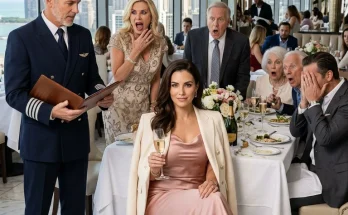
My IV line tugged sharply when I lifted my newborn son closer to my chest.
He was less than an hour old.
His skin was warm against mine, his tiny mouth opening and closing as if he was still deciding whether the world was safe enough to breathe in.
I could still feel the ache of labor in every bone, the tremble in my legs, the stitches, the exhaustion, the raw animal fear that comes when your body has just been pushed past its limits.
And then my mother-in-law walked into the hospital room with divorce papers.
Margaret Kingsley did not knock.
She never knocked, not on doors, not on lives, not on boundaries.
She entered with her chin lifted, pearls at her throat, her silver-blond hair pinned into the same perfect twist she wore to charity luncheons where she smiled for cameras and spoke about compassion.
Behind her came William, her husband, silent and stiff in an expensive navy suit.
Beside him stood a man I recognized only from the cold leather briefcase in his hand.
A lawyer.
And behind them all was Jessica.
Jessica, in a cream coat that looked too elegant for a maternity ward.
Jessica, with glossy hair falling over one shoulder.
Jessica, wearing my wedding ring on her finger.
For a second, I thought my mind had broken from pain and blood loss.
I stared at her hand, waiting for the image to correct itself.
But the diamond was there, catching the pale hospital light, the same diamond Christopher had placed on my finger two years earlier when he promised that I was his forever.
My husband stood near the doorway.
Christopher did not look at me.
He looked at the floor.
Margaret stepped forward and dropped a stack of papers onto my blanket.
They slid against my thigh and stopped beside my son’s swaddled body.
“Sign it,” she said.
Her voice was low enough not to alarm the nurses outside, but sharp enough to cut through the room.
I looked from the papers to Christopher.
“What is this?”
He swallowed.
His face was pale, his mouth tight, his eyes red like he had been crying or drinking or both.
“Valentina,” he said, barely above a whisper.
“Please don’t make this harder.”
Something inside my chest went still.
My name is Valentina.
For two years, the Kingsleys believed I was a struggling freelance graphic designer who had married their son for his money.
They called me a social climber, a trap, a pretty mistake.
Margaret never said those words in public, of course.
In public she said things like “humble background” and “not quite our world.”
In private, she was less careful.
What none of them knew was that I had been wealthy long before I met Christopher.
Not comfortable.
Not lucky.
Wealthy in the way people whispered about behind boardroom doors.
I was the founder and majority owner of Tech Vista Corporation, a cybersecurity and infrastructure company that handled contracts for hospitals, banks, logistics firms, and private investment groups all over the country.
My net worth had been estimated at $3.7 billion by journalists who had never managed to get a clear photo of me.
That was intentional.
I had spent years hiding from the kind of people who loved money more than human
beings.
I did not grow up rich.
My parents were schoolteachers who stretched every dollar and made birthdays beautiful with homemade cakes and handwritten cards.
When they died in a highway accident when I was nineteen, they left me with grief, medical debt from my mother’s last year of treatment, and a life insurance policy so small it disappeared almost immediately.
I taught myself to code because I could not afford college full-time.
I worked nights in a print shop, mornings in a coffee shop, and built software in the hours between.
I slept on a mattress on the floor of a studio apartment where the heat failed every winter and the ceiling leaked every spring.
By twenty-five, I had my first million.
By twenty-eight, I had more money than I knew how to feel comfortable owning.
But money did something ugly to love.
The first man I dated after my company took off seemed gentle and patient.
He listened when I talked about my parents.
He brought flowers to my office.
He said he admired how hard I worked.
Then I found messages on his laptop.
He had told his friends he was going to propose before my company’s next acquisition closed.
He joked about becoming “set for life” and said he could tolerate my workaholic personality for the right number of zeros.
One message said, “Once she signs, I’ll never have to fake interest in tech again.”
I did not cry until after I ended it.
After that, I disappeared behind legal structures, private trusts, and carefully managed anonymity.
My assistant Carlos became the public face of many business dealings.
My best friend Sophia became the only person allowed to tell me when I was lying to myself.
Then I met Christopher at a charity gala.
I was there as an anonymous donor.
I had just pledged five million dollars to expand a children’s hospital program when a tall man in a black tuxedo backed into me and spilled champagne down the front of my navy dress.
“Oh my God,” he said, horrified.
“I am so sorry.”
He grabbed napkins, then panicked when the napkins made it worse.
I laughed because his face was so genuinely stricken that I could not help it.
“I promise I don’t usually attack strangers with champagne,” he said.
“That’s good,” I replied.
“Terrible habit.”
He looked at my simple dress, my plain heels, the tray of empty glasses on the table behind me, and made the assumption everyone made when I did not arrive surrounded by assistants.
“Are you working this event?” he asked.
I could have corrected him.
Instead, I said, “Something like that.”
He insisted on buying me dinner to make up for the dress.
At first, I refused.
Then he looked so embarrassed, so earnest, so unlike the polished men who usually circled me, that I agreed.
At dinner, he talked about old movies and bad coffee and how much he hated pretending to understand his father’s investment friends.
He asked about me, and for once, I gave someone the version of myself that did not come with headlines.
“I’m a freelance graphic designer,” I told him.
It was not completely false.
I had designed the first logo for Tech Vista myself on a cracked laptop years ago.
Christopher
smiled.
“That’s amazing.
I’ve always admired creative people.”
He did not ask how much I made.
He did not ask who my clients were.
He did not try to impress me with his family’s money.
He walked me to my old sedan and said, “I’d really like to see you again, Valentina.”
For the first time in years, I wanted to believe someone was looking at me and not at what surrounded me.
Sophia warned me the moment I told her.
We were sitting in my kitchen, in the modest apartment I used as camouflage.
It looked like the home of a woman making decent but ordinary money.
The furniture was simple.
The art was inexpensive.
The building, however, belonged to me through a holding company and was worth forty-five million dollars.
Sophia sat across from me with her arms folded.
“You told him you’re a graphic designer?”
“Yes.”
“Valentina.”
“I wanted a normal conversation.”
“You don’t get to build a fake life and then act surprised if the real one explodes through it.”
Carlos was gentler but no less concerned.
“Run a background check on the family,” he said.
“At least that.”
“I know who the Kingsleys are,” I told him.
Everyone in certain circles did.
The Kingsleys were old money, or at least old enough money to pretend they had invented class.
William ran Kingsley Group, a private investment firm with a shrinking but still respectable reputation.
Margaret chaired committees, hosted fundraisers, and judged people by their shoes.
Christopher, their only son, worked at the firm under his father.
He was charming, handsome, and soft in a way I mistook for kindness.
For a while, he made me happy.
He brought soup when I was sick.
He remembered that I hated lilies because they smelled like funeral homes.
He kissed my forehead when I was tired and told me I worked too hard.
When he proposed one rainy evening in my apartment, with takeout containers on the coffee table and nervous tears in his eyes, I believed he loved me.
I said yes.
The first time I met Margaret and William, I understood immediately that love would not protect me from them.
Their house sat behind iron gates on a road lined with sycamore trees.
Inside, everything looked expensive and untouched.
The kind of house where no one ever seemed to spill coffee or laugh too loudly.
Margaret looked me over from head to toe before offering her cheek.
“So,” she said.
“Christopher tells us you’re a graphic designer.
How quaint.”
I smiled because I had learned long ago that people reveal themselves faster when they think you are powerless.
“It keeps me busy,” I said.
William grunted from behind a newspaper.
He did not stand.
Christopher squeezed my hand under the table.
I thought it meant he was sorry.
Later, I understood it meant he wanted me to endure quietly.
Then Jessica arrived.
She walked in without being introduced by the staff, which told me she belonged there more than I did.
Tall, poised, and beautiful in a studied way, she wore a silk blouse and diamond studs, her smile bright until it reached me.
“Valentina,” Margaret said, glowing for the first time that evening.
“This is Jessica.
She’s practically family.”
Jessica kissed Christopher’s cheek and sat
beside him.
Not across from him.
Beside him.
The dinner was a performance arranged for my humiliation.
Margaret asked where I summered as a child.
William asked whether freelance work came with “stability.” Jessica laughed at Christopher’s jokes and touched his sleeve when she spoke.
Once, when Margaret turned away, Jessica looked directly at me and smiled as if to say, You are borrowing what belongs to me.
In the car afterward, I waited for Christopher to say something.
He drove in silence.
Finally, I asked, “Is Jessica in love with you?”
He flinched.
“No.
It’s not like that.”
“Your mother wants it to be like that.”
He sighed.
“My mother wants a lot of things.
It doesn’t mean she gets them.”
“Then why didn’t you stop her?”
He reached for my hand.
“Because fighting her only makes it worse.
Trust me.
Just give them time.”
I wanted to believe him.
That was my weakness.
Not ignorance.
Hope.
After the wedding, Margaret’s cruelty became a weather system I was expected to live under.
She criticized my clothes, my posture, my cooking, my lack of family pedigree.
She sent me etiquette books as gifts.
She invited Jessica to every family occasion, including our first anniversary brunch.
Jessica came wearing white.
Christopher noticed.
I saw him notice.
But when I looked at him, he only shook his head slightly, begging me not to react.
That became our marriage.
His family cut me.
He handed me bandages and asked me not to bleed on the carpet.
Still, I stayed.
I told myself every marriage had battles.
I told myself Christopher was trapped between loyalty and love.
I told myself that if he loved me in private, maybe that was enough.
Then I got pregnant.
I told Christopher first.
He stared at the test in my hand, then at me, and for one shining second, joy broke through him.
He lifted me off the bathroom floor and laughed into my hair.
“We’re having a baby,” he whispered.
I held onto that moment for months because it was the last pure one.
Margaret’s reaction was ice.
“A paternity test will be necessary,” she said.
Christopher’s face flushed.
“Mother.”
“It’s a practical matter,” William said from his chair.
“Christopher has responsibilities.”
I waited for my husband to rise, to shout, to leave with me.
He only said, “That’s enough,” in a voice so weak the words dissolved before they reached anyone.
Jessica sent a gift basket two weeks later.
The card read, Congratulations, Christopher.
No mention of me.
During my pregnancy, I became useful to the Kingsleys only as a vessel.
Margaret tried to control my doctor, my diet, the nursery, even the name.
She told people at luncheons she was “preparing for her grandson,” as though I were not part of the equation.
Once, I overheard her speaking to Jessica in the hallway.
“Once the baby is here, things will be handled,” Margaret said.
Jessica replied, “And Christopher?”
“He will do what he always does.”
I stood frozen behind the partially open door, one hand on my stomach.
Christopher found me there and looked terrified.
“What did she mean?” I asked.
He rubbed his face.
“She’s just being dramatic.”
“No.
What did she mean?”
He kissed my forehead.
“I’ll talk to her.”
He never did.
At least, not in any way that mattered.
In my eighth month, Sophia came over and found me folding tiny onesies in the nursery.
I had chosen soft green instead of blue.
I wanted the room to feel peaceful.
Sophia watched me for a long moment.
“Tell him.”
I knew what she meant.
“No.”
“Valentina, you are about to have a child with a man whose family thinks you’re disposable.
He needs to know exactly who he married.”
“And then what?” I asked.
“I spend the rest of my life wondering whether he changed because he loves me or because I’m richer than his father?”
Sophia’s face softened.
“Maybe you already have your answer.”
I looked down at the tiny folded clothes and refused to hear her.
Labor began during a storm.
Christopher drove me to the hospital with one hand on the wheel and one hand gripping mine.
Rain slapped the windshield.
I remember staring at the blurred city lights and whispering to my son that we were almost there.
The labor lasted twenty-three hours.
There are pains you remember in flashes rather than sentences.
The nurse wiping my forehead.
Christopher’s hand slipping from mine when his phone buzzed.
The doctor telling me to breathe.
My body splitting open with effort.
The smell of antiseptic and sweat.
The sound of my own voice becoming someone else’s.
When my son finally cried, the world narrowed to that sound.
They placed him on my chest, and I forgot everything for a moment.
Margaret, Jessica, the whispers, the fear.
He was here.
He was real.
He had Christopher’s mouth and my dark hair and tiny fists curled like he was ready to fight.
Christopher kissed his forehead.
“He’s perfect,” he said.
I turned my face toward him, exhausted and crying.
“We’re parents.”
He smiled, but it trembled.
Then his phone rang.
He looked at the screen and stepped into the hallway.
That was the moment my old life ended.
Ten minutes later, Margaret entered with divorce papers.
At first, I could not process the words on the page.
Petition.
Custody.
Irreconcilable differences.
Voluntary relinquishment.
My vision blurred, then sharpened with terrifying clarity.
“The child stays with the Kingsley family,” Margaret said.
“You will be given a reasonable settlement and asked to leave quietly.”
“A settlement?” I repeated.
William finally spoke.
“More than fair for a woman in your position.”
Jessica lifted her hand slightly, making sure I saw the ring.
I looked at Christopher.
“Did you give that to her?”
He closed his eyes.
That was enough.
“She deserves a wife’s place,” Margaret said.
“She understands this family.
She has history with Christopher.
She can raise the boy properly.”
The lawyer cleared his throat.
Even he looked uncomfortable.
My son stirred, letting out a small, breathy cry.
I adjusted the blanket around him with hands that were suddenly steady.
“You planned this while I was pregnant,” I said.
No one answered.
“You waited until I was exhausted.
Until I had just given birth.
Until I was alone in a hospital bed.”
Margaret’s eyes hardened.
“Do not dramatize this.
You knew you were never suitable.”
Christopher whispered, “Valentina, please.
We can make arrangements.
You can still see him.”
I stared at him.
That was the first moment I truly saw my husband.
Not
as the man I loved.
Not as the man I hoped he could become.
As he was.
Weakness can be as cruel as malice when it stands beside it and does nothing.
“You’re taking my son?” I asked.
His mouth moved.
“It’s not that simple.”
“It is exactly that simple.”
Margaret leaned over the bed.
“Sign the papers.”
I reached for my phone.
Jessica laughed under her breath.
“Calling your little friend?”
I looked at her ring again, then at the papers touching my hospital blanket.
“No,” I said.
“I’m calling the man who manages the company that owns your father’s largest credit line, this hospital wing, and a controlling interest in the fund keeping Kingsley Group alive.”
The room changed.
It was not dramatic at first.
No one gasped.
No music swelled.
But Margaret’s expression flickered.
William’s newspaper mask cracked.
Christopher lifted his head.
Carlos answered on the first ring.
“Valentina?”
I put him on speaker.
His voice filled the hospital room, calm and professional.
“Are you all right?”
“No,” I said.
“I need you to initiate Protocol Seven.”
There was a pause.
“Are you sure?”
“Yes.
Freeze every discretionary account connected to Kingsley Group pending legal review.
Notify the board that I am exercising my rights through Maravilla Holdings.
Send my security team to the maternity wing.
And have Elaine file an emergency custody protection order immediately.”
William stepped forward.
“Who the hell is this?”
Carlos did not raise his voice.
“Carlos Mendes, chief legal and financial officer for Ms.
Valentina Maravilla, majority owner of Tech Vista Corporation and principal beneficiary of Maravilla Holdings.”
Jessica’s smile vanished.
Margaret looked at me as if my face had rearranged itself.
“Maravilla?” William said.
He knew the name.
Of course he did.
Men like William always knew the names of people who could ruin them.
Christopher stared at me.
“Valentina?”
I did not look at him.
Carlos continued, “Security is three minutes away.
Elaine is already being contacted.
Valentina, there is something else.”
His tone shifted, and my skin went cold.
“What?”
“We found documents filed yesterday through a Kingsley Group attorney.
Not just divorce preparation.
There was an attempt to establish emergency guardianship transfer language in the event you were deemed medically unstable after delivery.”
The room went silent.
My hand tightened around my son.
Carlos said, “They were preparing to argue that you were unfit before you even gave birth.”
I looked at Christopher then.
He had the decency to look broken.
“You signed that?” I asked.
His lips parted.
“My mother said it was just in case.
She said after the birth you might become irrational, that we needed protection, that it was only paperwork—”
“Paperwork to take my baby.”
“No,” he said quickly.
“No, I didn’t think—”
“That is the only true thing you’ve said today.”
Margaret snapped, “Christopher, stop talking.”
That command told me everything.
Not because he obeyed, but because he almost did.
The door opened, and two hospital security officers stepped in, followed by my private security lead, Daniel, who had clearly ignored every speed limit in the city.
He was broad-shouldered, calm, and furious in the quiet way competent people get when they find chaos.
“Ms.
Maravilla,” he said.
“Do you want them removed?”
Margaret recoiled at the name again.
Before I could
answer, Jessica shifted near the side table.
It was small, almost nothing, but I saw her hand move toward her purse.
“Daniel,” I said.
He followed my eyes.
“Ma’am, step away from the bag.”
Jessica froze.
“Excuse me?”
“Step away from the bag.”
The hospital security guard moved closer.
Jessica’s face flushed.
“This is harassment.”
Daniel did not blink.
“Then you won’t mind opening it.”
Margaret exploded.
“You cannot search her belongings.”
“No,” I said quietly.
“But hospital security can ask why she brought legal documents and medication labels into a maternity room that isn’t hers.”
Jessica’s eyes snapped to mine.
It was fear.
Not anger.
Fear.
The guard called for a nurse supervisor.
Within minutes, the room felt smaller, packed with authority that did not belong to Margaret.
Jessica finally opened her purse with shaking hands.
Inside were copies of the divorce petition, a small envelope containing my ring box, and a printed set of emails between Margaret, Jessica, and Christopher.
There was also a hospital visitor form.
On it, Jessica had listed herself as the baby’s “approved guardian contact.”
My stomach turned.
The nurse supervisor’s face hardened.
“Who authorized this?”
No one answered.
Carlos was still on speaker.
“Valentina, Elaine is on her way to court.
Do not sign anything.
Do not let the child leave your arms or the room.”
“I won’t,” I said.
William suddenly found his voice.
“This is a misunderstanding.
We can discuss this privately.”
“You wanted private when you thought I was powerless,” I said.
“Now you want privacy because you know you’re exposed.”
Margaret pointed at me, her hand trembling.
“You lied to this family.”
I almost laughed.
“I lied about money,” I said.
“You lied about trying to steal my child.”
Christopher took a step toward me.
Daniel blocked him.
“Please,” Christopher said.
“I didn’t know it would go this far.”
I looked at the man I had loved.
I remembered him kneeling in my apartment with a ring.
I remembered him holding my hand through storms.
I remembered every time I had begged him to stand up for me and watched him choose comfort over courage.
“You knew enough,” I said.
His face crumpled.
For the first time, I felt no urge to comfort him.
The next hours moved like a legal machine waking from sleep.
My attorney Elaine arrived with her hair still damp from the rain and fire in her eyes.
She took one look at the papers on my bed and said, “Absolutely not.”
By morning, an emergency order prevented Christopher or any member of his family from removing my son from the hospital.
The attempted guardianship filing triggered a review.
The hospital opened an internal investigation into how Jessica’s name appeared on any visitor paperwork connected to my child.
By noon, Kingsley Group’s board had received notice that Maravilla Holdings was suspending a crucial financing agreement due to ethical and legal concerns involving executive leadership.
William called it blackmail.
Elaine called it consequences.
Margaret tried to come back to the hospital with a different lawyer.
She was stopped downstairs.
Jessica posted a vague social media story about “truth coming out soon.” Carlos sent one letter from our legal department, and she deleted it within eleven minutes.
Christopher left me seventeen voicemails.
I listened to one.
He
cried through most of it.
He said he loved me.
He said he had been scared of losing his family.
He said Jessica meant nothing.
He said the ring was a mistake, that his mother had taken it from our bedroom after I went into labor and given it to Jessica as some symbolic gesture he had been too stunned to stop.
Too stunned.
That was Christopher’s whole life in two words.
Too stunned to defend his wife.
Too stunned to protect his child.
Too stunned to become a man until power had already chosen a side.
I deleted the rest.
Three weeks later, I sat across from him in a private mediation room with my son asleep beside me in a carrier.
Christopher looked thinner.
Older.
The boyish charm was gone, replaced by the gray exhaustion of a man finally living inside the consequences of his choices.
“I didn’t know who you were,” he said.
“No,” I replied.
“You knew exactly who I was.
You just thought I was poor.”
He flinched.
“You knew I was your wife,” I continued.
“You knew I was pregnant.
You knew your mother humiliated me.
You knew Jessica wanted my place.
You knew all of that before you knew about my money.”
His eyes filled.
“I loved you.”
“Maybe,” I said.
“But not enough to be brave.”
The divorce was finalized faster than anyone expected because Elaine made sure the evidence left very little room for theatrics.
I kept full custody.
Christopher received supervised visitation that could expand only after therapy, parenting classes, and a long list of court conditions he did not dare challenge.
Kingsley Group did not collapse overnight.
Families like that rarely fall in one dramatic crash.
They unravel in canceled meetings, withdrawn partners, resigned board members, and phone calls that stop being returned.
William stepped down within six months.
Margaret sold the mansion within a year.
Jessica moved to Europe and reinvented herself online with captions about healing from toxic people.
I heard about it from Sophia, who laughed so hard she nearly dropped her coffee.
As for Christopher, he did something I did not expect.
He stopped begging.
At first, I thought it was another tactic.
Then, slowly, he began showing up for his supervised visits on time.
He listened to the parenting coordinator.
He apologized without asking me to soothe him afterward.
He admitted in court, on record, that he had failed to protect me and had allowed his family to pressure him into decisions that endangered our son’s stability.
It did not erase what he did.
But truth matters, even when it arrives too late.
On our son’s first birthday, Christopher brought a small wooden train as a gift.
No designer label.
No grand gesture.
Just a toy our son immediately tried to chew.
When the visit ended, Christopher stood by the door and said, “I know I don’t deserve forgiveness.”
I adjusted my son on my hip.
“Then don’t ask for it.”
He nodded.
“I’m trying to become someone he won’t be ashamed of,” he said.
For the first time in a long time, I believed he might have meant it.
But forgiveness is not the same as access.
Regret is not the same as repair.
And love, I learned, is not proven by what
someone feels when life is easy.
It is proven by what they defend when everything costs them something.
I raised my son in a home where no one had to earn tenderness by having the right last name.
I told him stories about my parents.
I taught him that kindness without courage is just politeness.
I built a life that did not require hiding, shrinking, or waiting for someone else to choose me.
Sometimes people ask whether I regret lying about my wealth.
The answer is complicated.
My secret revealed their character, but it also delayed my own freedom.
It showed me who they were, but only after I had already given them chances they never deserved.
Margaret thought money was what made a person powerful.
She never understood that my real power was not the bank accounts, the companies, or the lawyers who answered my calls.
It was the moment I stopped begging weak people to love me well.
Still, whenever I think about that hospital room, about my newborn son against my chest and those divorce papers on the blanket, I wonder what kind of person sees a woman at her most vulnerable and chooses that exact moment to strike.
And I wonder something else, too.
Was Christopher a victim of his family’s cruelty, or was his silence the cruelest betrayal of all?