Part 1 – The Room
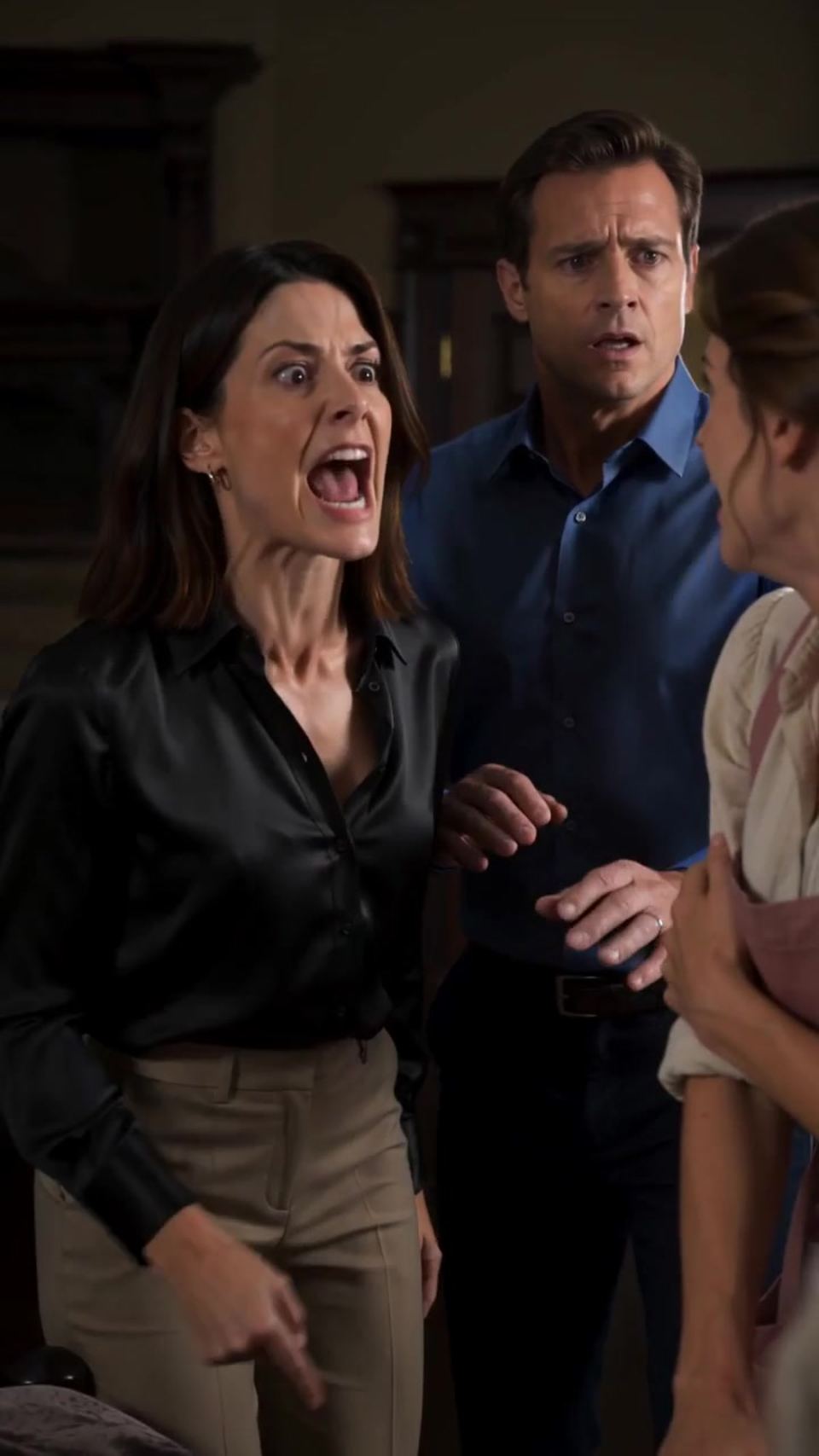
“Look at what she did! She tried to hurt Mother!”
Vivian aimed those words at Daniel the instant he shoved open the bedroom door. A few seconds earlier, the room had been quiet except for the wet rattle in Miriam Hale’s chest and the soft clink of the spoon in my hand. I was Nora, her caregiver. I had worked in that house for eleven months. Miriam’s speech had been gone since her stroke, and I had learned to read her needs in the twitch of her fingers, the angle of her chin, the way her eyes followed me when I crossed the room.
Vivian had come in already angry. She was arguing about the care schedule, about the new aide I had suggested, about the fact that her mother’s door was closed. Her black silk blouse caught the lamplight. Her voice climbed. Then her hand closed around the glass pitcher on the bedside tray. Beet juice, dark and red, sloshed against the rim. I saw her wrist turn. I saw the pitcher leave her hand.
I did not think. I crossed the two steps between the chair and the bed and threw my arms wide. The glass struck me below the right shoulder with a sound like a branch cracking under ice. Pain went through me in one bright sheet. The pitcher shattered. Cold juice soaked my back, and then a hotter wetness began to spread beneath it. Shards hit the floor and skittered under the bed. I heard Miriam gasp. I heard my own breath break.
Daniel stopped in the doorway. He was in a blue shirt, his tie loose from work. His face went from confusion to alarm as he took in my bleeding back, my raised hands, and his sister standing over the broken glass.
That was when Vivian pointed at me. “Look at what she did! She tried to hurt Mother!”
The words came out of her so easily that for one sick second I thought I had dreamed the throw. Then my back throbbed, and I felt a shard moving against my skin.
“No!” I gripped the bed rail. Tears ran down my face, but I could not let her take the truth from me. “That’s a lie! She threw the pitcher at the lady—I only took the hit to protect her!”
Vivian’s face twisted. “Shut up, you damn liar!”
Daniel lifted both hands, trying to quiet us. I waited for his gaze to settle on the torn cloth across my back. The evidence was on my body, yet I felt suddenly invisible. Vivian stood between him and the bed as if she belonged there and I did not.
I wanted to move away from her. I wanted to sit down. But Miriam lay behind me, unable to enter an argument about her own safety. I tightened my fingers around the bed rail. I had already said what happened. I could only hope Daniel would look carefully enough to see it.
Vivian’s mouth opened. Her fingers were stained red at the tips. She saw me notice, and her hand dropped to her side.
Daniel looked at his mother. Miriam had been propped against her pillows, silent, small under the blanket. Now she was moving. She pushed one elbow beneath her and raised herself with a slow, terrible dignity. Her face was pale, but her eyes were not confused. They were fixed on Vivian with a coldness that made the room shrink.
“Silence!”
The word cracked through us. Daniel’s raised hands went still. I stopped breathing. Vivian’s whole body stiffened.
Miriam’s chest rose. She did not look at him. She looked at her daughter.
Vivian took half a step back. Her face drained. She raised one trembling hand toward Miriam. “You… you can speak?!”
Part 2 – The Statement
For a long moment, no one seemed to know what to do with the fact that Miriam had spoken. Daniel lowered his phone. Vivian’s mouth worked. I pressed my hand to my back and felt wetness through my fingers—juice, blood, something torn.
“Mother,” Daniel said again, “did you just—”
But Miriam’s strength was already sliding away. Her hand shook. She spoke again, slower. “No. Not Nora.” Her words were rough and small. “Vivian… threw.”
Vivian made a sound. “She’s confused. She hasn’t spoken in months. You can’t—”
“Ambulance,” Miriam said. Her eyes found Daniel. “Now.”
Daniel called. He gave the address. He looked at me, then at his sister, then at the broken glass on the floor. “Viv, go downstairs.”
“I’m not leaving—”
“Go downstairs. Now.”
She went, but not before she shot me a look. I had seen anger before from families. Usually it was fear wearing a hard face. This was different. It was calculation.
The paramedics came quickly. A woman with short gray hair crouched beside me. “Can you sit?”
“I don’t know.” I sat on the edge of the bed because my legs were shaking. She cut my blouse open. The room smelled of beet juice and iron. A shard had gone in below my shoulder blade, and a long cut ran down toward my ribs. “You’re going to the hospital,” she said. I didn’t argue.
Daniel followed the stretcher to the door. “I’m sorry. I’ll meet you there.”
“Someone needs to stay with your mother,” I said.
“My aunt lives twenty minutes away. I’ll call her. But Nora—”
“You need to call the police too.” My voice shook. “I’m not going to pretend this was an accident.”
His jaw tightened. “Can we talk after you’re treated?”
“We can talk after you call the police.”
At the hospital, the doctor removed glass and closed the wound. It took time. I lay on my side while a nurse cleaned the juice and blood from my skin. My phone screen lit with messages. My agency: “Patient family reports an incident. Do not return to assignment until reviewed.” Daniel: “How are you?” Vivian did not call. I did not expect her to.
A police officer came at ten. She was younger than me, with a calm voice and a notebook. She asked my name and my version. I told her everything, including the beet juice, the right hand, the way Vivian had pointed at me before she had time to breathe. She took pictures of my back. She asked if I wanted to make a statement. I said yes.
But after she left, I sat in the discharge lobby with a pain pill and a plastic bag of my ruined uniform. My job was suspended. The rent was due. I had spent eleven months learning Miriam’s silences, and now I might lose her because I had been in the room when her daughter decided to throw a pitcher.
Daniel arrived. He looked older than he had that morning. “They told me you’re discharged.”
“I need a taxi.”
“I can drive you.” He held up a hand. “I know you don’t owe me anything. But I need to tell you something. The police came to the house. Vivian told them you had been drinking. That you threatened Mother.”
I laughed once. It hurt. “I don’t drink on duty. There wasn’t a bottle in the room.”
“I know. I told them.” He looked at the floor. “I also found beet juice on Vivian’s right cuff. She said it was from the tray. But the tray was on the other side of the bed.” He paused. “I don’t know what that proves.”
“It proves she touched the pitcher.” I closed my eyes. “It doesn’t fix my back.”
“No.” His voice was quiet. “What can I do?”
I looked at him. “Your mother asked for an ambulance. She used her voice for that. Do not let anyone tell her she imagined it. And I need to know whether you believe her or your sister.”
He met my eyes. “I believe her.”
Part 3 – The Conditions
Three days passed in pain and rest. I slept on my stomach. My neighbor Claude brought soup. My agency called twice: first a manager warning me not to post about the incident, then a claims adjuster asking if I had “encouraged conflict.” I answered carefully. I could feel my livelihood shrinking.
Daniel texted daily. On the fourth morning, he asked me to meet him and his mother. Not to work. Vivian would not be there. The doctor had told me to keep the wound dry, so I almost said no. But I wanted to hear Miriam’s voice again.
I took a cab. Daniel met me at the door. The hallway smelled of lemon polish, not beet juice. Miriam sat in the sitting room with a communication tablet and a new aide by the window. Her eyes were clear.
“Thank you for coming,” Daniel said.
I sat across from Miriam. “How is your speech?”
She tilted her hand. Not good, not terrible. She touched the tablet. A flat voice said, “A little. Not all.”
Daniel explained. The word “Silence” had come out in a moment of fear, and she was tired afterward. She could say a few words now, but not hold a conversation. She did not want anyone to call it a miracle. She wanted people to stop acting as if she had been hiding herself.
I nodded. “I never thought that.”
Her mouth curved. She typed, “You saw.”
“I saw.”
She typed more slowly. “Vivian is my daughter. I love her. I do not trust her near me.”
Daniel rubbed his face. “She’s at a hotel. She says she’s sorry the pitcher broke. She doesn’t say she threw it.”
“Because she wants the police to think I did,” I said.
Miriam typed, “I told them.”
The aide said quietly, “Mrs. Hale gave a statement with the board. It took a long time. The officer asked if she understood the difference between truth and lies. She typed her answer.”
I looked at Miriam. “You did that for me.”
“For me too,” the tablet said.
I felt something loosen, but it was not relief. My agency had offered me a night case in another town, live-in. I could disappear and let the police work. Or I could stay and face what this family had become.
“Vivian called my agency,” I said. “She told them I stole from your mother and threatened her. They have to investigate.”
Daniel’s face went hard. “That’s not true.”
“I know. But I can’t come back as if nothing happened. If I work here, I need a written plan. No Vivian in the house when I’m here. Another aide on nights. If she comes near me, I leave.”
Miriam typed, “Agreed.”
Daniel said, “She’s my sister. I can’t lock her out of her mother’s house.”
Miriam’s finger hit the screen. “Mine.”
The room went quiet. Daniel looked at his mother for a long moment, then nodded. “I’ll change the locks. But you have to tell her, Mother. I won’t do it for you.”
Miriam typed, “Call her.”
Daniel put the phone on speaker. Vivian’s voice came through, bright and brittle. “Did the caregiver convince you to turn against me?”
“Mother wants to talk to you.”
A pause. “She can’t talk.”
Miriam pressed the tablet. “I can. Enough. Stay away until police say.”
Vivian exhaled. “You can’t do this. That woman is not family. I am your daughter. I made a mistake, but she is turning you against me.”
Miriam typed, “You threw glass.”
“I didn’t mean—” Vivian stopped. “You can’t prove what I meant.”
“I saw,” the tablet said.
“You saw nothing. You were lying there. You can’t suddenly remember everything because a stranger told you a story.”
Miriam’s hand moved again. “I remember the pitcher. Your right hand. You were angry about the aide.”
The line stayed open. Daniel stared at the floor. I kept my eyes on my hands. This was not a contest between a daughter and a caregiver. It was a woman with a divided body and a clear mind, and a grown daughter who had used her hand as a weapon.
“Fine,” Vivian said at last. “I’ll stay at the hotel until the police finish. But this isn’t over.”
The call ended. Daniel sat down heavily. Miriam closed her eyes. I stood carefully. My back pulled, but I could stand.
“Thank you,” I said. “I’ll send the agency my conditions. If they agree, I’ll come back next week. Day shift only.”
Daniel looked up. “You’re still willing?”
“Not because I forgive your sister,” I said. “Because your mother asked. And because I decide where I work and how.”
Part 4 – The Locked Door
After my doctor cleared me for light duties and the agency approved a supervised return while its review continued, I arrived with Bea, a broad-shouldered aide who had worked with stroke patients for years. Daniel had changed the locks. Miriam sat in the kitchen with a cup of tea, her tablet beside her. She wore a blue cardigan, and her hair was brushed. When she saw me, she lifted two fingers. A small greeting. I read it as clearly as I had once read the twitch of her hand.
“Day shift only,” I said. “Three days a week. I’ll review the care plan, but I won’t lift her alone.”
Daniel nodded. “The agency agreed. Bea will be here mornings. Another aide comes at night.”
For two hours, the house felt almost ordinary. Miriam typed short instructions. Bea and I moved around each other. I kept my back straight and my bag close. Then someone rattled the front door.
Vivian’s voice came through the wood. “Daniel? Open this door.”
Daniel stepped into the hall. “You can’t come in, Viv.”
“I’m her daughter. You changed the locks on me?”
“Mother asked for it.”
“That woman asked for it.” I heard her kick the door lightly, a childish, furious sound. “She’s manipulating you. She’s after the house.”
Miriam’s hand came down hard on the table. She typed quickly, and the tablet said, “I am here. I am not a house.”
Bea reached for her phone. “I’m calling the police.”
Vivian kept shouting. “Nora, come out! Tell them what you did! You threw that pitcher and then played the victim.”
I stayed in the kitchen. My hands were cold, but my voice was steady. “I’m not coming out, Vivian. I’m not alone with you again.”
The police arrived in minutes. Through the window, I saw Vivian gesture and cry. She spoke fast. One officer came to the door and asked if we wanted to give a statement. Miriam typed, “Yes.” I gave mine. Bea gave hers. Daniel gave his. When the officers left, Vivian was still in the driveway, her face smeared with tears and fury.
The next afternoon, the officer called me. “Ms. Reyes, we’ve reviewed the statements. Ms. Hale’s account has changed twice. First she said you attacked her mother. Then she said you threw water. Then she said you tried to take something from the room. Your injury and the position of the broken glass matter. So does Mrs. Hale’s statement. We’re going to file charges.”
I sat on my couch with the phone against my ear. “What happens now?”
“She’ll be cited. There may be a plea. You should think about whether you want a no-contact order.”
My agency called an hour later. The investigation was closed. “No finding of misconduct,” the manager said. “You can return to the assignment under the agreed conditions.”
That should have felt like victory. Instead, I felt tired. That evening, Daniel came to my apartment with a folder. He stood in the doorway, holding it like a schoolboy with a late note.
“The police asked Mother to sign a statement about what she wants,” he said. “She wants you to stay. Not because she can’t find anyone else. Because she trusts you.”
“And you?”
“I believe her. I should have believed you sooner. I’m sorry.”
I looked at the folder. “I don’t want to be the reason your family breaks.”
“You aren’t. Vivian broke something when she threw that pitcher. We are only deciding what to do with the pieces.”
The next morning, at the station, the officer slid a form across the table. It was a request for a no-contact order. I could sign it, or I could leave it blank and let the court decide.
“If I sign this, she can’t come to the house,” I said.
“If the judge grants it,” the officer said. “It’s your choice.”
I thought of Vivian’s red-stained fingers. I thought of Miriam’s clear eyes. I picked up the pen.
Part 5 – The Tea
I signed. The order was granted for six months. It did not send Vivian to prison, and I did not need it to. It kept her from the house while the assault charge moved through the courts, and it kept me from having to decide each morning whether I was safe.
My back healed slowly. The scar below my shoulder was pink and tight. I could not lift Miriam alone for weeks, and I did not try. Bea took the mornings with me. Daniel hired a night aide and kept a schedule on the refrigerator. Miriam’s speech did not return all at once. She could say “tea,” “no,” “thank you,” and sometimes “Nora.” The rest came through the tablet. The doctor told them not to expect a straight line. Miriam told everyone not to expect a miracle. I learned to read her again, just as I had before, but now she could correct me.
On my first full week back, she waited in the kitchen while I made tea. The house smelled of lemon polish and toast. The old pitcher was gone. In its place was a ceramic teapot with a chipped spout. Miriam watched me pour. Her right hand lay on the table, fingers moving slightly.
“You are thinking,” she said. The words came out rough.
“I’m thinking about work,” I said.
“You leave?”
I set the cup in front of her. “Maybe. I’m not willing to take a live-in assignment. I want my own mornings. I want to know I can leave at the end of the day.”
She nodded, slow. Then she typed on her tablet. “I understand.”
Daniel came in with the mail. He looked tired but less divided than he had in those first days. “The agency called. They want to know if you’ll take the permanent day position. Three days a week. No nights. Bea stays. They also said the investigation is in your file as unfounded. If anyone asks, you can tell them to call me.”
I looked at Miriam. “What do you want?”
She typed: “A caregiver who leaves when she is tired. A friend who comes back for tea.”
I laughed. It was the first full laugh I had given in that house since the pitcher broke. “That’s a fair deal.”
Vivian did not come to the house. She sent one letter through her lawyer, addressed to Miriam. Daniel opened it in front of us because Miriam asked him to. It was an apology, but not the kind that healed anything. It said she was sorry for what happened, and sorry for the trouble, but it did not say she had thrown the pitcher. It did not say she had lied. Miriam listened to Daniel read it, then typed, “Not enough.”
She was right. Some apologies were just another way of asking the injured to carry the shame. I did not want to carry Vivian’s. I wanted to carry my own bag to work and my own bag home.
A month later, I moved out of my old apartment and into a smaller place near the bus line. Claude helped me carry boxes. I bought a plant for the kitchen window. I took the day position with Miriam and kept looking at other cases, because I had learned that loyalty could be a trap if it came without limits. But I liked the three days. I liked the way Miriam typed “morning” when I came in. I liked the way she corrected my pronunciation of her favorite tea.
The scar was still there. It would always be there. Some mornings it ached when the weather turned. On those mornings I called Bea and told her to start without me. No one argued. That was the point. I also started saving for a car, a small used one, so I would never again wait for someone else’s son to drive me home from a hospital.
One afternoon, Miriam pointed at the teapot and then at me. “Tea,” she said.
I poured two cups. We sat by the window and watched the street turn gold. I did not forgive Vivian. I did not pretend the Hale family was whole. I drank my tea until the clock reached four. Then I put my cup down and picked up my bag. Bea was already in the hallway. Miriam lifted her hand to say goodbye, and this time I did not have to guess whether she meant it was all right for me to leave.

