Chapter 2 – The Ghost in the Cockpit
The cockpit was bathed in an eerie sea of amber and crimson warning indicators. Alarm chimes echoed in rapid, syncopated rhythms, bouncing off the glass displays of the instrument panel. Outside the thick windshield, there was only pitch-black void—thirty-five thousand feet above the freezing swell of the North Atlantic.
Captain Robert Miller was slumped slightly forward in the left seat, his white uniform shirt soaked in sweat, his hands locked onto the control yoke so tightly his knuckles were bloodless. But it wasn’t Captain Miller who had spoken my name.
The voice had come from the center pedestal’s communication console, crackling through the high-frequency satellite transceiver.
“Brooke? Answer me. Is that David Hartley’s daughter?”
I froze in the doorway, my breath hitching in my chest. The voice was deep, raspy, and unmistakable. It belonged to Colonel Marcus Vance—my father’s longtime commanding officer and wingman from the 77th Fighter Squadron. The last time I had heard his voice was at Arlington National Cemetery eighteen months ago, when he knelt before me in his dress blues and pressed a folded American flag into my trembling hands.
“Uncle Marcus?” I stammered, stepping over the threshold into the cramped cockpit.
Captain Miller whipped his head around, his eyes wide and bloodshot with terror. Beside him, in the right seat, First Officer Sarah Chen looked utterly exhausted, her oxygen mask dangling around her neck as she fought to keep the aircraft level.
“You know the man on SATCOM?” Miller demanded, his voice shaking. “He broke into our emergency frequency ten minutes ago claiming he tracked our distress beacon from Ramstein Air Base.”
“David Hartley was my best friend,” Vance’s voice cut through the static, urgent and razor-sharp. “When Flight 414 transmitted a triple-redundant flight control failure squawk code, the Pentagon flagged it instantly. Brooke… sweetheart, listen to me carefully. Why are you on that plane?”
“I was flying to Spain to stay with Aunt Clara,” I whispered, tears stinging my eyes. “Mom couldn’t… she couldn’t take care of me anymore after Dad died.”
A heavy silence lingered over the radio for half a second before Vance inhaled sharply. “Captain Miller, you have an unrecoverable fly-by-wire corruption in your primary flight computers, don’t you?”
“Yes!” Miller shouted, fighting against a violent shudder that rippled through the airframe. “The digital flight envelope has locked our elevators and trim at a seven-degree pitch attitude! We’ve disconnected the autopilot, but the computers are overriding our manual inputs! Every five minutes, the nose pitches down toward the water, and we have to pull eighty pounds of force just to stay level! We don’t have the strength to fight this stick for another hour. We’re going to dive into the ocean!”
“Captain,” Colonel Vance replied, his tone dropping into a deadly, focused calm. “Commercial technical manuals don’t have a solution for this glitch because the computer software logic is proprietary military architecture adapted from the experimental Viper project. The only pilot who ever figured out how to manually trick the flight control computer into an uninhibited hard-reset while airborne was David Hartley.”
Miller stared back at me, his jaw slackening. “A twelve-year-old girl?”
“She isn’t just a twelve-year-old girl,” Vance said fiercely. “David built a full-scale cockpit simulator in his garage. Brooke logged over three hundred hours sitting in his lap, running mechanical failure diagnostics before she could even ride a bicycle. If anyone knows David’s override bypass, it’s her.”
Chen looked at me, hope battling despair in her eyes. “Brooke… do you know what he did?”
My heart slammed against my ribs like a caged bird. I closed my eyes, and suddenly I wasn’t thirty-five thousand feet over the freezing ocean. I was eight years old, sitting beside my father under the warm fluorescent lights of our garage in South Carolina, the smell of motor oil and solder in the air.
*“Remember, Brooke-bear,”* his voice echoed in my memory. *“When the machine thinks it’s smarter than you, you don’t fight the controls. You cut its brain off at the root.”*
“He called it the Ghost Protocol,” I whispered, opening my eyes. “He wrote down the exact circuit breaker sequence in his flight logbook.”
Captain Miller’s face fell. “Where is that logbook?”
“In my backpack,” I said. “Under seat 8A.”
Chapter 3 – The Circuit Breaker Gambit
Before Captain Miller could say another word, the aircraft shuddered violently. A mechanical voice barked through the flight deck speakers: *“CAUTION. FLIGHT CONTROL CORRUPTION. PITCH DOWN. PITCH DOWN.”*
The yoke jerked violently forward in Miller’s grip, fighting against him with brutal mechanical torque.
“I’m losing it!” Miller yelled, his veins bulging in his neck. “Sarah, help me pull!”
First Officer Chen threw both hands onto her yoke, planting her heels against the cockpit floor as both pilots grunted with agony, desperately fighting to haul the aircraft’s nose back up toward the horizon. Through the windshield, the horizon tilted sickeningly into an abyss of darkness. Out in the passenger cabin, a chorus of muffled screams erupted as the sensation of zero gravity lifted everyone slightly out of their seats.
“Get the backpack!” Chen choked out between clenched teeth. “Brooke, run!”
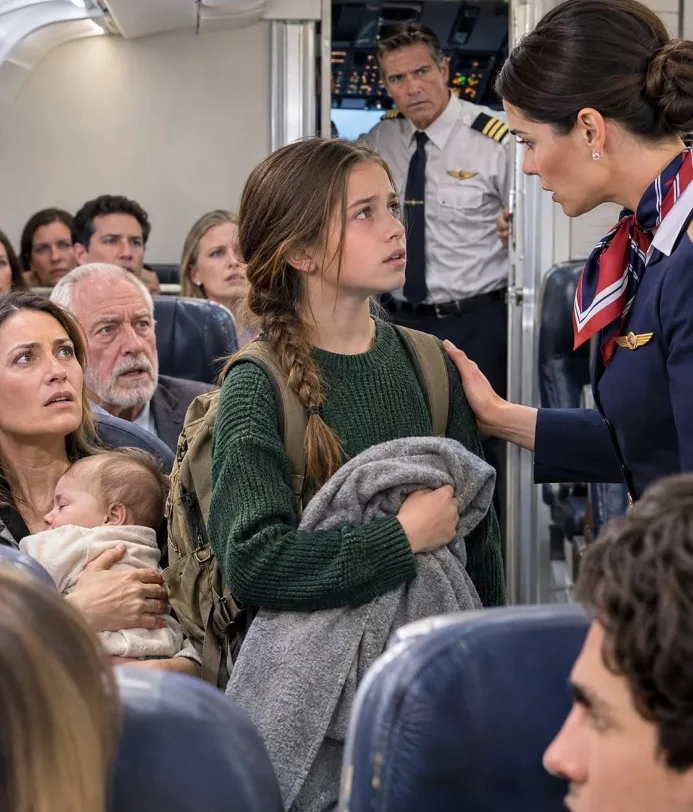
I turned on my heel and bolted through the cockpit door. The main cabin was in absolute pandemonium. Oxygen masks had deployed from the ceiling panels, dangling like yellow ghosts in the flickering fluorescent light. Flight attendants were desperately shouting for passengers to keep their seatbelts fastened, while across the aisle, passengers were sobbing, praying, and clutching one another.
A burly man in seat 7C reached out and grabbed my arm as I darted past. “What’s going on in there?! Are we going to crash?!”
“Let go of her!” shouted Maria, the flight attendant who had brought me forward. She knocked his hand away, shielding me with her body. “Sit down and brace!”
I dropped to my knees in row 8. The cabin floor was vibrating violently, rattling my teeth in my skull. I reached under seat 8A and dragged out my battered canvas backpack—the one with Dad’s old Air Force patches sewn onto the front. With shaking fingers, I ripped the zipper open and pulled out his thick, worn leather binder.
Inside were hundreds of pages filled with his precise, military handwriting, filled with aeronautical equations, schematic sketches, and personal notes. Tucked between pages 42 and 43 was a neon orange index card labeled: *X-16 DIGITAL TRIM LOCKOUT / HARDWARE OVERRIDE.*
“I found it!” I screamed.
Maria helped me to my feet and propelled me forward just as the plane leveled out with a sickening groan of metal. I stumbled back into the cockpit, sliding on the floor and catching myself against the jump seat.
Miller was gasping for air, his chest heaving, his hands trembling violently on the yoke. “Read it, Brooke! What breakers do we pull?!”
“He wrote that the primary flight control unit draws backup telemetry from three independent avionics busses,” I read aloud, my voice steadying through sheer adrenaline. “If you pull the main flight control computer breakers, the jet defaults to an emergency aerodynamic lockout mode—it freezes the horizontal stabilizer entirely!”
“That would kill us!” Chen shouted. “We’d never be able to flare for a landing!”
“No, wait!” I turned the card over. “Dad wrote: ‘Do not pull the flight control breakers. You have to starve the feedback loop. Go to the P6 circuit breaker panel behind the first officer’s seat. Pull Breaker B-14, Auxiliary Air Data Computer; Breaker D-08, Digital Pitch Sensor; and Breaker F-22, Hydraulic Actuator Feedback.’”
Chen stared at the wall of hundreds of tiny circular push-pull buttons behind her right shoulder. “That doesn’t make sense. If I pull those, we lose all artificial stall protection and our secondary attitude indicators!”
“It tricks the main computer into believing the hydraulic actuators have suffered a catastrophic mechanical jam,” I explained, the memory of my father’s calm explanations flooding back into my mind. “When the computer thinks the physical actuators are jammed, it disengages the digital fly-by-wire override and returns direct raw cable authority to the pilots’ yokes. It gives you back manual control!”
Miller looked at Chen. “He was the top test pilot in the Air Force, Sarah. Pull them.”
Chen unbuckled her harness, twisted around, and scanned the massive grid of switches. “B-14… found it!” *Click.* “D-08… found it!” *Click.*
She hesitated at the final row, her finger hovering over a switch labeled *F-22 HYD ACT FEED.*
“If this doesn’t work,” Chen whispered, “we’re dead in thirty seconds.”
“Pull it, Sarah!” Miller roared.
*Click.*
For three agonizing seconds, every light on the main instrument panel went dead. The cockpit plunged into total blackness, save for the faint moonlit clouds outside. Then, with a loud hum of auxiliary power, the flight instruments flickered back to life.
The violent resistance in the control column vanished. The yoke went smooth and neutral in Miller’s hands.
Miller tested the controls, pulling gently back, then easing forward. The aircraft responded instantly, rising gently through thirty-four thousand feet with a clean, stable climb rate.
“It worked…” Miller breathed, his voice cracking with emotion. He rested his forehead against the yoke, sobbing in sheer relief. “Sweet Lord above, it worked.”
Over the SATCOM speaker, Colonel Vance’s voice sounded clearer than ever. “Brooke? Captain? Report.”
“We’re stable, Colonel,” Miller spoke into his boom microphone, looking at me with pure reverence. “Your girl just saved three hundred people.”
“Don’t celebrate yet, Captain,” Vance replied grimly. “Look at your fuel telemetry.”
Miller’s head snapped toward the upper center display. His jaw dropped. The digital fuel readout was plummeting before our eyes.
Chapter 4 – The Bleeding Tanks
“Hydraulic leak in the starboard wing root,” Chen announced, her voice hollow as she tapped through the system status pages on her lower multifunction screen. “When the computer was fighting the actuators during that pitch oscillation, the high-pressure line fractured. It ruptured the crossfeed fuel conduit right alongside it.”
“How bad?” Miller asked, his hands instantly back on the throttles.
“We’re venting three hundred pounds of Jet-A every sixty seconds,” Chen said. “At this burn rate, our right engine will flame out in twenty-five minutes. The left engine will follow ten minutes later.”
I stared out the small right cockpit window. Even in the moonlight, I could see a massive white plume of vaporized fuel streaming behind the wing, shining like a ghostly tail across the black canvas of the ocean.
“We’re in the middle of the Atlantic,” Miller said, frantically rotating the navigational map dial. “Point of No Return has already passed. We don’t have enough fuel to reach Shannon, Ireland, and we can’t make it back to Gander, Newfoundland.”
“What about the Azores?” I asked softly.
Miller glanced back at me, his brow furrowed. “Lajes Field in the Azores is four hundred and eighty miles southeast of our current position. With full tanks, we’d make it easily. With this fuel leak? We’ll ditch into the ocean fifty miles short of the runway.”
“Then we glide,” I said without hesitation.
Miller almost laughed, a bitter, stressed sound. “Brooke, this is a commercial wide-body twin-engine airliner weighing nearly two hundred tons, not a glider. If both engines flame out at thirty thousand feet, our glide ratio is less than fifteen to one. We drop like a brick.”
“Not if you fly the Hartley Glide Ratio,” Colonel Vance’s voice cut in over the radio. “Miller, you listen to me and you listen to Brooke. David Hartley didn’t just study that aircraft’s flight computer; he spent three years running high-altitude dead-stick glide tests for emergency troop transports.”
“A dead-stick landing in a passenger jet?” Chen asked, turning pale. “In the dark, over open ocean?”
“If you stay on your current course, you hit the water anyway,” Vance stated cold-bloodedly. “Ditching at night in forty-foot North Atlantic swells has a zero-percent survival rate. Your only prayer is the concrete at Lajes Field. Turn southeast immediately. Brooke, grab David’s binder. Turn to section four: Tactical Energy Management.”
I flipped through the worn pages, the paper rustling in my shaking hands. My eyes scanned Dad’s neat sketches of aircraft descent angles, energy preservation formulas, and thermal atmospheric drafts.
“Here it is,” I said, leaning between the captain and first officer’s seats. “Dad wrote: ‘In a dual-engine flameout configuration, do not maintain standard minimum-drag airspeed. Lower the nose immediately to establish a clean two-hundred-and-twenty-knot descent until passing through the maritime inversion layer at ten thousand feet. Then, trade excess kinetic speed for distance by trimming one degree nose-up into the sea breeze.’”
Miller’s hands moved over the autopilot heading bug, rotating it to one-three-five degrees. The giant airliner banked smoothly to the right, swinging away from its European trajectory and pointing directly toward the isolated cluster of volcanic Portuguese islands in the middle of the Atlantic.
“Turn completed,” Chen said, her eyes fixed on the digital fuel counter. “Right tank down to eight hundred pounds. Fuel pressure warning light is flashing.”
*DING. DING. DING.*
A loud, low rumble vibrated through the right side of the airframe, followed by an unsettling silence. The constant, comforting hum of the right engine died away, replaced by the faint whistling of the wind rushing against the fuselage.
“Right engine flameout,” Miller reported, his voice dead flat. “Securing right throttle. Setting left engine to maximum continuous thrust.”
The aircraft yawed slightly to the right as the asymmetric thrust pulled at the rudder. Miller kicked the left rudder pedal to keep the nose straight, but we could all feel the sudden loss of power. The plane felt heavier, sluggish, hanging precarious in the thin air.
“Cabin crew, this is the captain,” Miller spoke into the PA system. His voice was composed, but anyone could hear the strain beneath it. “We have shut down our number two engine due to a mechanical issue and are diverting to the Azores. Please ensure your seatbelts are fastened and follow all instructions from your flight attendants.”
Through the cockpit door, we could hear the muffled cries of children and frantic murmurs of terrified adults.
“Sarah,” Miller said quietly, not looking away from his instruments. “Turn the transponder to 7700. Declare Mayday to Santa Maria Oceanic Control. Tell them we’re coming in on a wing and a prayer.”
Chapter 5 – The Shadow in the Cabin
With the starboard engine dead, the passenger cabin had grown noticeably colder. The air-conditioning packs were struggling, and the dimmed cabin lights cast long, nervous shadows across the rows of passengers.
“Brooke,” Chen whispered, glancing back over her shoulder. “Go back out to the galley and get some water. Drink something. You’re pale as a ghost.”
I didn’t want to leave the cockpit, but my throat was parched, burning like sandpaper. I clutched Dad’s logbook tightly against my chest and slipped through the armored door into the forward galley.
Maria was there, leaning against the food carts, her hands trembling as she poured water from a plastic pitcher into a paper cup. When she saw me, she dropped the pitcher, rushed forward, and pulled me into a fierce embrace.
“You’re an angel,” she sobbed softly into my hair. “Captain Miller told the senior purser what you did with the circuit breakers. You gave us a chance.”
“We’re still losing fuel,” I murmured, accepting the cup of water and drinking it down in three desperate gulps. “The second engine is going to stop soon.”
Suddenly, the curtain separating the galley from First Class was ripped aside. A tall, broad-shouldered man with slicked-back gray hair and an expensive tailored suit barged into the small space. His face was contorted in furious panic.
“What the hell is going on up here?!” he snarled, glaring at Maria. “I’m Senator Thomas Sterling! I demand to know why we just made a ninety-degree turn, why an engine went quiet, and why a little girl is running in and out of the cockpit!”
“Sir, please return to your seat immediately!” Maria insisted, raising her hands to block him. “Federal regulations strictly prohibit—”
“To hell with your regulations!” Sterling bellowed. Several passengers in the front rows unbuckled their seatbelts, craning their necks to watch. “The captain announced an engine shutdown! We have a right to know if we’re ditching! Is this child touching the controls? Are you out of your minds?!”
“Senator,” I said, stepping between him and Maria.
My voice was quiet, but something in my tone made him stop mid-rant. I looked directly into his eyes, using the exact posture my father used when dealing with hostile brass on the flightline.
“We suffered an asymmetric hydraulic rupture that cut the crossfeed fuel line,” I told him coldly. “Our right engine suffered fuel starvation three minutes ago. Our remaining engine has twelve minutes of fuel left. We are diverting to Lajes Field in the Azores, which is currently ninety miles outside our powered flight envelope. If you scream and cause a panic in this cabin, you will distract the crew, consume emergency oxygen, and shift the cabin center of gravity when we need absolute trim stability to glide. Sit down, buckle your seatbelt, and let us do our jobs.”
The senator stared at me, his mouth opening and closing like a landed fish. The sheer authority in my voice, backed by precise technical truth, completely disarmed him.
Behind him, an elderly woman in seat 2B leaned forward. “You heard the young lady, Thomas. Sit your behind down and shut up.”
A few nervous chuckles rippled through the front rows. Sterling’s face turned bright red. Without another word, he slunk back into his seat and clicked his seatbelt shut.
Maria looked at me with open-mouthed astonishment. “Where on earth did you learn to talk like that?”
“My dad,” I answered simply. “He said panic is a virus, and precision is the only cure.”
Suddenly, the floor beneath us seemed to drop out. The cockpit door swung wide as a deafening warning siren began to wail:
*“WARNING. ENGINE ONE FLAME OUT. GENERATOR FAILURE. EMERGENCY POWER ENGAGED.”*
The low hum of the left engine sputtered, coughed, and died completely.
The silence that followed was suffocating. Every light in the cabin vanished, plunging three hundred passengers into absolute, pitch-black darkness.
Chapter 6 – Dead Stick into the Storm
The only light left aboard the entire aircraft came from the tiny, battery-powered emergency exit signs and the faint, glowing standby instruments in the cockpit.
Outside, a low, ominous roar of wind screamed against the metal skin of the jet. Without the roar of jet engines, the sound of the air itself was terrifying—a razor-sharp hiss that reminded us how fragile we were, hurtling through the sky at four hundred miles per hour with nothing holding us up but physics and faith.
I scrambled back into the cockpit and wedged myself between the center console and the jump seat, anchoring my arms.
“Ram Air Turbine deployed!” Chen announced, pointing to the tiny external propeller that had automatically dropped from the belly of the plane, spinning in the slipstream to generate barely enough hydraulic and electrical pressure to keep our primary controls alive.
“Speed two-hundred and thirty knots,” Miller grunted, staring intently at the dimly lit artificial horizon. “We’re sinking at two thousand feet per minute. Sarah, where are we?”
“Seventy miles from Lajes,” Chen replied, squinting at the backup navigation display. “Altitude twenty-four thousand feet. If we maintain this descent rate, we’ll hit sea level fifteen miles short of the island!”
“Brooke!” Miller shouted over the screaming wind. “What does your dad’s book say? We’re losing altitude too fast!”
I fumbled with my pocket flashlight, shining the beam directly onto the handwritten pages of Dad’s binder.
“Look for thermal lift!” I read rapidly. “Dad says ocean storms create massive convective updrafts along their leading pressure fronts! Is there a storm cell near the Azores?”
Chen tapped the weather radar button, but the display was dead. “Main radar is offline with the engine generators! We’re flying blind!”
“No, you’re not,” Colonel Vance’s voice crackled through the battery-powered emergency radio. “Flight 414, this is Vance. I’ve got you on NATO satellite synthetic-aperture radar. There is a severe low-pressure storm system sitting directly over the channel between Terceira and São Jorge islands. If you steer heading one-two-zero, you will intercept the storm’s front-edge updraft in four minutes.”
“Marcus!” Miller yelled into his mic. “You want me to fly an unpowered passenger jet into a severe thunderstorm?!”
“That thunderstorm has vertical updrafts exceeding three thousand feet per minute!” Vance shouted back. “It’s an elevator, Bob! It’s the only elevator between you and the Atlantic! Ride the wave, or prepare for water impact!”
Miller cursed under his breath, sweat dripping from the tip of his nose onto his shirt collar. He looked over at Chen. “You ready for this, Sarah?”
“No,” Chen said honestly. “Do it anyway.”
Miller banked the heavy, silent jet toward one-two-zero degrees.
For two minutes, the plane glided through smooth, terrifying silence, steadily dropping: twenty thousand feet… eighteen thousand… sixteen thousand. The darkness outside the cockpit windshield began to thicken, shifting from deep navy to an impenetrable wall of bruised black clouds.
Then, the world exploded.
A massive wall of rain hammered the windshield like machine-gun fire. Violent turbulence struck the aircraft with the force of an earthquake, tossing us sideways. The wings groaned, the metal flexing upward as an immense cushion of rising air caught the aircraft’s belly.
The vertical speed indicator needle violently swung upward.
“We stopped descending!” Chen screamed with joy over the roaring tempest. “Rate of climb… plus five hundred feet per minute! We’re going up!”
The aircraft was being lifted like a giant leaf caught in a gale. But the violence of the storm was terrifying. Hailstones battered the cockpit glass with ear-splitting cracks, and lightning flashed in blinding sheets of violet and blue, illuminating the churning clouds around us.
“Hold her steady!” Miller roared, his muscles straining against the yoke. “Don’t let the nose pitch up too high or we’ll stall!”
“Brooke, hold on!” Chen yelled, grabbing the collar of my jacket as the aircraft dropped twenty feet in a sudden pocket of shear before being tossed upward again.
I pressed Dad’s book against my chest, squeezing my eyes shut. *Be brave, Brooke. A pilot never leaves people behind.*
“We’re passing through twelve thousand feet!” Chen called out. “Clear of the convective core in ten seconds!”
With one final, violent jolt that threw me against the jump seat frame, the aircraft burst through the eastern wall of the storm cloud into calm, open night air.
Below us, piercing through the scattered low clouds, a constellation of bright amber lights sparkled on the dark ocean surface.
“Lajes Field,” Miller whispered, his voice trembling with awe. “Runway one-five in sight.”
Chapter 7 – The Interceptor Escorts
The sight of the island of Terceira and the runway lights of Lajes Field brought an instant wave of tears to my eyes. But our relief lasted only a fraction of a second.
“We’re too high,” Chen said, her voice dropping into cold dread. “Altitude eight thousand feet, distance twelve miles. We have zero engine thrust to perform a go-around. If we come in too steep, our airspeed will exceed three hundred knots, and we’ll disintegrate on impact. If we lower the nose to dive for the runway, we crash. If we pull up to bleed speed, we stall and spin into the sea.”
“Flaps and gear are hydraulic,” Miller said grimly. “The Ram Air Turbine can only deploy the emergency gear extensions once. Once the wheels are down, we get massive parasitic drag. If I drop them too early, we fall out of the sky before reaching the threshold.”
Suddenly, two bright flashes of light appeared outside our left and right wingtips.
Twin streaks of twin-tailed aircraft painted in low-visibility grey pulled up alongside us, their afterburners glowing like miniature suns in the dark sky. United States Air Force F-15 Strike Eagles from the 48th Fighter Wing.
“Flight 414, this is Viper Lead on your left wing,” a crisp military pilot’s voice blared over the guard channel. “Colonel Vance called us in from our oceanic patrol orbit. We are your visual eyes. We’re going to guide you down the slot.”
Miller keyed his mic. “Viper Lead, we have zero engines, manual flight controls, and our landing envelope is completely blown. We’re four thousand feet too high for this approach angle.”
“We copy, 414,” the fighter pilot replied. “We’ve got someone on our tactical comms who wants to give the instructions.”
There was a click of static, and Colonel Vance’s voice returned, firmer than ever.
“Brooke,” Vance called out. “Are you listening?”
“I’m here, Uncle Marcus!” I shouted into the cockpit microphone.
“Do you remember the tactical descent David taught you for short-field combat landings? The Forward Slip maneuver?”
I gasped. “A forward slip in a Boeing 767?!”
Miller turned his head so fast I thought he’d pull a neck muscle. “Are you insane, Vance?! You want me to cross-control a wide-body airliner? Opposite rudder and aileron?! We’ll rip the vertical stabilizer right off the fuselage!”
“The airframe can take it,” Vance said flatly. “David proved it in the simulator during the Gulf War evaluations. A full-rudder forward slip will expose the entire broadside of the fuselage to the relative wind, creating massive aerodynamic braking without increasing your forward airspeed. It drops you out of the sky like a stone without building speed, then you kick it straight fifty feet over the numbers.”
Miller looked at his hands. They were shaking uncontrollably from sheer physical exhaustion. He had been wrestling a two-hundred-ton beast through turbulence and control failures for over an hour.
“I don’t have the fine motor control left,” Miller confessed, his voice breaking. “My arms… my forearms are cramping. I can’t hold a precision cross-control slip down to the runway threshold. If I over-kick the rudder, we cartwheel onto the tarmac.”
Chen looked at her captain in horror. “Bob, I haven’t flown a manual slip since flight school ten years ago in a Cessna!”
Silence descended over the cockpit, save for the whistling wind.
“I can do it,” I said.
Both pilots turned to look at me.
“I don’t have the foot strength for the rudder pedals,” I continued, stepping between their seats. “Captain Miller, you work the rudder pedals with your feet. First Officer Chen, you hold the throttles back and call out airspeeds and altitude. I will take the control yoke. I know the exact bank angle Dad used. I flew this landing fifty times in his simulator.”
Miller stared into my eyes. For five long seconds, the only sound was our collective breathing. He saw no hesitation in my face—only the fierce, unwavering ghost of his old friend, David Hartley.
“God help us,” Miller whispered. He slid his hands off the yoke and placed his heavy boots firmly onto the rudder pedals. “The flight controls are yours, Brooke.”
I reached out, wrapped my small fingers around the cold, textured grips of the control yoke, and took a deep breath.
“My aircraft,” I said.
Chapter 8 – The Hand on the Yoke
“Viper Lead to 414,” the F-15 pilot called out, banking tightly just three hundred yards off our port wing. “You are six miles out, lined up on runway one-five. Altitude five thousand feet. Ground emergency vehicles are rolling. Crash tenders in position. You are cleared to land, all runways, all vectors.”
“Brooke,” Chen said gently, her eyes darting between the runway lights growing larger in the windshield and the digital airspeed readout. “Speed is two hundred and ten knots. When you’re ready.”
My heart was beating in my throat, but my hands were completely steady. All the grief, all the emptiness I had felt since the military sedan had pulled up to our driveway eighteen months ago, suddenly crystallized into absolute, crystal-clear focus.
My dad wasn’t gone. He was right here, standing behind my shoulder, his hands resting invisibly over mine on the yoke.
“Captain Miller,” I commanded, my voice ringing clear and authoritative through the cockpit. “Right rudder pedal. Full deflection. Now.”
Miller slammed his right boot forward into the pedal.
At the exact same instant, I turned the control yoke thirty degrees to the left.
The aircraft reacted violently. The nose swung hard to the right, pointing away from the runway toward the dark volcanic hills of the island, while the plane itself continued hurtling straight along its original flight path. The entire left side of the fuselage caught the full force of the two-hundred-knot wind like a giant sail.
A terrifying groan of structural metal echoed through the cabin. Back behind us, the passengers screamed in collective terror as the plane tilted sideways, flying at a sickening crabbed angle through the sky.
“Vibration levels climbing!” Chen called out, her voice tight. “Airspeed holding rock-steady at one hundred and ninety knots! Descent rate… four thousand feet per minute! We’re dropping out of the sky!”
“Hold it!” I grunted, fighting the heavy aerodynamic pressure pushing back against the yoke. My twelve-year-old arms burned with agony, every tendon in my shoulders screaming under the strain. “Hold the rudder, Captain! Don’t let it slip back!”
“I’m holding it!” Miller yelled, his teeth bared in a feral grimace of exertion. “Two thousand feet!”
Through the side of the cockpit windshield, I could see the runway. The four PAPI approach lights next to the tarmac—which had been showing four white lights indicating we were far too high—began to change.
Three white, one red.
Two white, two red.
“On glidepath!” Chen screamed. “We have the glidepath!”
“Gear down!” I yelled.
Chen grabbed the landing gear lever and yanked it down into the emergency release detent. Beneath our feet, a massive clunk vibrated through the floorboards as the heavy landing gear doors snapped open and the massive multi-wheel bogies dropped into the airstream under sheer gravity.
*THUMP-THUMP. THUMP.*
Three green lights illuminated on the instrument panel.
“Three green! Gear down and locked!” Chen reported. “Eight hundred feet! Speed one hundred and sixty knots! Brooke, you have to kick it straight soon or we’ll touch down sideways and shear the landing gear off!”
“Not yet…” I whispered, watching the black water of the Atlantic give way to the rocky coastal cliffs at the edge of the island. “Not yet…”
“Five hundred feet!” Chen warned. “Four hundred!”
The ocean disappeared beneath us. The rocky seawall flashed past in a blur of spray. The concrete runway threshold, painted with giant white stripes and glowing green centerline lights, rushed up toward our windshield with terrifying speed.
“Two hundred feet!” Miller yelled. “Brooke, now!”
Chapter 9 – The Touchdown
“Release rudder!” I screamed. “Level wings!”
Miller pulled his right foot back, slamming his left foot forward to center the tail, while I threw my entire body weight into rotating the yoke to the right.
The two-hundred-ton aircraft whipped back around, snapping its nose straight down the center line of runway one-five with a violent snap that rattled every bolt in the airframe.
Fifty feet.
The runway surface was a textured gray blur rushing beneath us.
*“FIFTY. FORTY. THIRTY.”* the ground proximity automated voice called out through the speaker.
“Flare!” Chen shouted.
I pulled back on the yoke with everything I had left. Miller reached over, grabbing the yoke alongside my hands, adding his remaining physical strength to mine. Together, we hauled the column back three inches.
The nose tilted upward, cushioning our descent just inches above the asphalt.
*SCREEEEEECH!*
A deafening roar filled the cabin as the eight massive tires of the main landing gear slammed onto the concrete at one hundred and forty knots. Plumes of blue tire smoke erupted behind the wings, and the shockwave tossed us forward against our harnesses.
The plane bounced slightly, then settled down hard onto its wheels.
“Nose wheel down!” Miller shouted, pushing the column forward to pin the nose to the runway.
“No thrust reversers!” Chen warned, pumping the toe brakes. “Emergency accumulator braking only! We’re rolling too fast!”
Without reverse engine thrust, the aircraft was a five-hundred-thousand-pound projectile hurtling down a nine-thousand-foot strip of concrete surrounded by ocean on three sides.
“Brake! Maximum braking!” Miller roared, standing on the foot pedals with all his weight.
The carbon-ceramic brake assemblies in the wheels clamped down with immense hydraulic force. Sparks and blinding white-hot flames erupted from the wheel hubs as the metal melted under friction exceeding two thousand degrees.
The runway lights were flashing past like tracer rounds. Five thousand feet remaining… four thousand feet… three thousand feet…
Ahead, the runway was ending. Past the end of the asphalt was a hundred-foot drop-off into the black, churning waves of the Atlantic Ocean.
“It’s not stopping!” Chen sobbed, grabbing the instrument glare shield. “We’re running out of tarmac!”
“Brooke’s dad wrote one last thing!” I shouted, my eyes locking onto the center console. “Ground spoilers manual dump! Pull the yellow lever between the seats!”
Chen didn’t hesitate. She plunged her hand between the seats, found the recessed emergency cable loop, and yanked it straight up until the safety pin sheared.
On top of the wings, twelve giant metal aerodynamic spoiler panels instantly slammed upward to a ninety-degree angle, completely destroying all remaining lift and smashing the full weight of the aircraft down onto the tires.
The deceleration hit us like a brick wall.
Luggage exploded from overhead bins in the back cabin. The tires shredded, rims grinding directly against the concrete in a blinding shower of sparks, carving deep gouges into the runway.
Two thousand feet… one thousand feet… five hundred feet…
The aircraft lurched, shuddered, and skidded to a dead halt.
The nose of Flight 414 hung suspended in the air, dangling forty feet directly over the rocky cliff edge, staring down into the violent white foam of the ocean below.
Silence fell over the world.
Inside the cockpit, no one moved. No one spoke. The only sound was the clicking of cooling metal, the faint hiss of the fire extinguisher foam from the emergency trucks racing toward us, and the ragged, sobbing breaths of the three people inside the flight deck.
Then, from behind the armored cockpit door, a sound began.
It started as a single, weeping gasp. Then another voice joined. And within three seconds, an earth-shattering roar of three hundred passengers cheering, sobbing, and screaming in triumphant disbelief swept through the cabin.
First Officer Chen buried her face in her hands, her shoulders shaking violently as she wept.
Captain Miller slowly unbuckled his seatbelt. He turned toward me, sank to his knees on the floor of the cockpit, and wrapped his massive, trembling arms around me.
“You did it, kid,” Miller whispered, his tears soaking through my sweater. “You brought us home. Your dad… your dad would be so damn proud.”
Chapter 10 – The Atlantic Hero
By dawn, the runway at Lajes Field was bathed in the soft, golden light of an Atlantic sunrise.
More than a dozen emergency vehicles surrounded Flight 414, their flashing red and blue lights reflecting off the drenched tarmac. Mobile staircases had been rolled up to the aircraft doors, and Portuguese medical personnel, firefighters, and military officers were assisting the passengers down onto the ramp.
Every single passenger—all two hundred and ninety-eight of them—survived without a single critical injury.
When the cabin door opened and Captain Miller led me out onto the platform at the top of the stairs, the entire airfield went dead silent.
The passengers standing on the tarmac looked up. Senator Sterling was among them, his jacket draped over his arm, his eyes red from crying. Beside him stood families, elderly couples, young students, and crying parents clutching their children tight against their chests.
Suddenly, someone clapped.
Then another.
Within seconds, hundreds of people erupted into a thunderous ovation. Ground crews banged on the sides of fire trucks, Portuguese military guards stood at attention and saluted, and passengers held up their phones, shouting my name into the morning air.
“Brooke! Brooke! God bless you!”
Maria, the flight attendant, rushed up the stairs and handed me a warm wool blanket, wrapping it around my shoulders. “The whole world is talking about you,” she whispered, kissing my forehead. “CNN, BBC, the White House… everyone knows what you did.”
At the base of the stairs, standing in front of a line of military transport vehicles, was a tall man in an Air Force flight jacket, his silver hair catching the morning sun.
Colonel Marcus Vance.
He had flown in on a transport from Ramstein the moment our safe landing was confirmed. As I walked down the metal steps, clutching my father’s leather binder tight against my ribs, Vance stepped forward.
He didn’t treat me like a child. He snapped to attention and rendered a crisp, sharp military salute.
I stopped at the bottom of the stairs, lowered my head slightly, and then threw my arms around his waist. Vance pulled me close, resting his chin on the top of my head, his chest heaving with silent emotion.
“He was flying with you up there, Brooke,” Vance whispered, his voice cracking. “I felt him on the radio. Every single second.”
“I missed him so much, Uncle Marcus,” I sobbed into his jacket, finally letting the terror and exhaustion of the night wash away in a flood of hot tears. “I thought if I forgot about airplanes, it would hurt less.”
“You are your father’s daughter,” Vance said, stepping back and wiping my cheeks with his thumb. “Aviation is in your blood. You didn’t just save three hundred lives today; you honored David in a way no medal ever could.”
Captain Miller and First Officer Chen walked down the stairs behind me. Miller shook Vance’s hand fiercely, then turned back to me.
“Brooke,” Miller said, reaching up to unpin the golden four-stripe pilot wings from his chest pocket. He knelt down and carefully pinned them to the front of my jacket, right above my father’s squadron patch. “You earned these more than any pilot I’ve ever flown with. You’re family now. Always.”
Reporters were already gathering at the perimeter fence, cameras flashing from every direction. World leaders were issuing statements, praising the incredible miracle over the Atlantic.
For a brief, shining moment, standing on that tarmac in the middle of the ocean, the darkness of my past eighteen months seemed to melt away under the warm morning sun.
I was safe. The passengers were safe.
We had won.
Chapter 11 – The Black Box Revelation
Six hours later, the crowded chaos of the main terminal had quieted down. The passengers had been transported to local hotels to rest before relief flights arrived to take them to their final destinations.
Uncle Marcus had arranged a quiet private briefing room inside the Portuguese Air Force headquarters on the base for me to rest. A plate of untouched breakfast sat on the table beside my father’s leather binder.
The door clicked open, and Colonel Vance walked in. But the warm, proud expression he had worn on the airfield was completely gone.
His face was drawn, pale, and intensely grim.
Behind him stepped two men in dark civilian suits with Department of Defense security badges pinned to their lapels, followed by Captain Miller, who looked just as shaken as Vance.
“Uncle Marcus?” I asked, sitting up straight on the leather sofa. “What’s wrong? Did something happen to the plane?”
Vance closed the door firmly, locking the deadbolt, and looked at the two federal agents before turning to me.
“Brooke,” Vance said quietly, pulling a metal chair across the floor and sitting down directly in front of me. “The Portuguese aviation authorities, alongside the NTSB and Air Force Intelligence, just completed the preliminary data extraction from Flight 414’s Cockpit Voice Recorder and Flight Data Recorder.”
“The black boxes?” I asked.
“Yes,” Vance nodded, his voice dropping into a tense whisper. “Brooke… what happened last night wasn’t an accidental mechanical glitch. It wasn’t a standard software bug.”
My stomach dropped, a cold chill creeping down my spine. “What do you mean?”
Miller stepped forward, his fists clenched tight at his sides. “The pitch trim override, Brooke. The computer didn’t just fail. It was commanded to lock the controls and pitch the aircraft into the Atlantic. Someone uploaded a military-grade worm into the commercial avionics bus before we departed New York.”
I stared at them, the room spinning around me. “Why would someone do that to a commercial plane?”
“The plane was carrying three high-ranking European defense contractors,” one of the federal agents explained smoothly. “Along with sensitive military avionics telemetry. But that isn’t the most alarming part.”
Vance reached into his inside jacket pocket and pulled out a digital audio player, placing it on the table between us.
“When the computer corrupted,” Vance said, looking deep into my eyes, “the digital log recorded the origin of the override code that triggered the failure. It used a specific, classified encryption handshake. An encryption key that only existed on one single computer drive in the entire world.”
“Whose drive?” I whispered, my heart suddenly pounding like thunder.
“Your father’s,” Vance said.
The air vanished from the room.
“That’s impossible!” I gasped, jumping to my feet. “Dad died eighteen months ago! His jet crashed in the Nevada desert during a night-testing mission! You told me they recovered the wreckage!”
Vance stared at the table, his jaw working as if fighting back an unbearable truth.
“We recovered wreckage, Brooke,” Vance said slowly, his voice shaking with an emotion I had never heard in him before. “We recovered the black box and fragments of the airframe. But David’s body was never found. We assumed… the Air Force assumed the impact at Mach 2 had vaporized the cockpit.”
He reached over and pressed the *PLAY* button on the audio recorder.
The speaker crackled with the frantic, terrifying sounds of our cockpit from last night. We heard Captain Miller screaming, the wailing of the stall warnings, and the roaring wind.
Then, the audio cut to an isolated track—a hidden sub-channel that had been broadcast on the secure UHF military guard frequency at the exact millisecond our flight controls had been corrupted over the ocean.
A voice came through the static.
It wasn’t Uncle Marcus. It wasn’t the air traffic controllers.
It was a voice that made my entire soul stop breathing. It was calm, deep, and impossibly clear.
*“Protocol initiated. She is aboard the aircraft. If she remembers the checklist, she will survive the drop. Marcus, bring her to the coordinates. The Viper is alive.”*
The recording clicked off.
I stood frozen in the center of the room, my hands shaking so violently that my father’s logbook slipped from my fingers, hitting the floor with a hollow thud.
The voice on the recording was my father.
And it had been transmitted live, from an uncharted frequency, less than eight hours ago.

