Chapter 1 – SEVEN SECONDS THAT CHANGED EVERYTHING
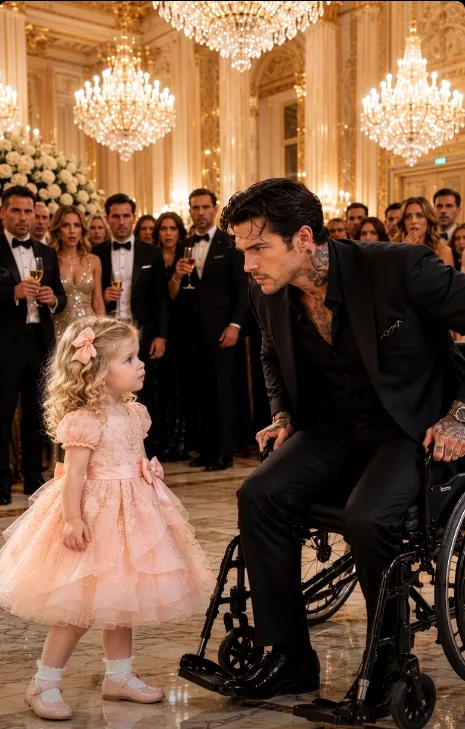
For seven seconds, Daniel Mercer stood without his wheelchair.
Later, the news channels would replay those seconds so many times that strangers began arguing about the angle of his knees, the movement of his hands, and whether the little girl’s words had somehow changed the rules of the world. But Daniel remembered none of those details. He remembered the ache in his calves. He remembered being terrified that the floor would rush up to meet his face. Most of all, he remembered the little girl’s expression.
Sofie looked as if she had asked him to open a door and was waiting for him to turn the handle.
On the eighth second, his left knee folded.
An enormous gasp filled the ballroom. Daniel pitched forward, one arm flailing toward empty air. A waiter dropped a tray. Before Daniel could hit the marble floor, a woman in a dark blue catering uniform caught him beneath one shoulder and a security guard caught the other. Together they lowered him into the wheelchair.
“Everybody move back,” the woman ordered.
Her voice cut through the crowd with more authority than the expensive microphones on the stage. She knelt in front of Daniel, checking his face while a dozen camera phones rose above the guests.
“Are you dizzy? Can you breathe?”
“I’m fine,” Daniel lied.
“Then stop trying to stand up again.”
He stared at her. She had a small burn on one wrist, tired eyes, and a name tag that said TASHA. She sounded nothing like the people who usually surrounded him. Nobody on his executive team had contradicted him in public for years.
“Where is the child?” he asked.
Tasha turned sharply.
Sofie had disappeared behind a wall of dark suits and glittering evening dresses. A silver-haired guest was telling a security officer to remove the girl. Someone else called for an ambulance. An influencer near the champagne tower was speaking into her phone about witnessing a miracle, apparently without noticing Daniel could hear every word.
“Sofie!” Tasha called.
A tiny hand pushed between two coats.
“Mama?”
“Come here. Right now.”
Sofie hurried over. She was not smiling anymore. Her bottom lip trembled, and she stared at Daniel’s legs.
“Did I hurt him?”
The question struck Daniel harder than his fall.
“No,” he said immediately. “You didn’t hurt me.”
“You fell.”
“I used to fall even before I needed this chair.” He swallowed. “I was never very graceful.”
Sofie considered that. “You look too tall to fall.”
For the first time that evening, Daniel laughed without bitterness.
A man in a perfectly fitted tuxedo forced his way through the crowd. Malcolm Price, president of Mercer Holdings, had been Daniel’s closest business partner for seventeen years. His smile was polished, but his eyes were fixed on the recording phones.
“Ladies and gentlemen,” Malcolm announced, “we’ve witnessed an emotional moment. Mr. Mercer will be assessed by his medical team. Please respect his privacy.”
He leaned toward Daniel. “We need to get you out of here.”
“Who invited them?” Daniel asked quietly.
“Who?”
“The woman and her daughter.”
Malcolm glanced at Tasha, and his pleasant expression tightened. “Catering hired temporary staff. Children aren’t permitted at events like this. I’ll handle it.”
“They stay,” Daniel said.
“Daniel, we have donors here from three countries. The board is waiting for you to sign the foundation agreement.”
“They stay.”
Malcolm looked at him for a long moment, then gave the kind of nod a man gives when he intends to obey only until he reaches the next room.
Daniel had learned to recognize that nod too late in life.
A doctor arrived carrying a medical bag. Dr. Mira Patel was not Daniel’s usual physician. His usual physician was in Switzerland, attending a conference organized by the Mercer Foundation. Mira was the local emergency specialist hired to oversee the event, an arrangement Daniel had barely noticed when his assistant approved it.
“Any chest pain?” she asked.
“No.”
“Loss of consciousness?”
“No.”
“New numbness?”
Daniel hesitated. “Actually, the opposite.”
She raised her eyes.
“I felt the floor,” he whispered. “Both feet. I felt it.”
Mira made no announcement to the room. She checked his pulse, tested his responses, and asked questions that required real answers rather than hopeful ones. When he described a brief sensation moving through his legs, she said something nobody had bothered to say to him for a very long time.
“That’s information worth investigating. It isn’t proof of permanent recovery, and you should not try to walk without medical supervision. But it matters.”
Daniel looked down at his hands.
For four years, people had treated his body as a finished story. He had almost started believing them.
At the edge of the crowd, Tasha was arguing with Malcolm’s chief of security. The guard held an open palm toward the exit. Sofie clutched her mother’s apron.
Daniel rolled his chair forward.
“What’s going on?”
The guard straightened. “Sir, we were asked to escort the contractor off the property.”
“By whom?”
“Mr. Price’s office.”
“Then Mr. Price’s office can explain its mistake.”
Tasha crossed her arms. “I don’t need anyone getting in trouble for us. We were leaving anyway.”
“You caught me,” Daniel said. “I’d like to thank you.”
“You’re welcome.”
“And your daughter gave me something I’ve been missing.”
Tasha’s expression hardened. “Please don’t put that on her. She’s three.”
He blinked.
“People are already calling her an angel. She’s a little girl who still needs help tying her shoes. Whatever happened out there, don’t make her responsible for it.”
Daniel looked at Sofie. She was trying to peel a gold sticker from the base of a table centerpiece.
“You’re right,” he said.
Tasha seemed surprised.
“I don’t hear that often,” he admitted.
“Maybe you’re around the wrong people.”
Before he could answer, the ballroom’s enormous video screen changed. The gold anniversary logo vanished, replaced by a live television feed. Daniel saw his own face, enormous and pale, while a breaking-news banner announced: PARALYZED BILLIONAIRE WALKS AFTER CHILD’S PRAYER.
The footage looped. Again he rose. Again the room gasped. Again he fell.
His public relations director hurried over. “We didn’t authorize this. One of the guests streamed it. Every outlet has the clip.”
Malcolm returned with a tablet tucked under his arm. “This is becoming a crisis. We should release a statement attributing the event to an involuntary spasm. No religious angle. No claims of recovery.”
“You haven’t spoken to my doctor,” Daniel said.
“I’m protecting you.”
Daniel had heard that sentence from people selling him things he didn’t want, hiding losses he hadn’t authorized, and telling him to cancel visits with old friends because the world had become too difficult for them.
“I’m not making any medical claims,” he said. “And I’m not calling a little girl a liar to make your job easier.”
Malcolm lowered his voice. “The board vote is tomorrow. The Harbor House transaction must close before the quarter ends. You cannot afford a spectacle.”
Daniel frowned. “What does Harbor House have to do with tonight?”
For a fraction of a second, Malcolm looked startled.
Then the smile returned. “Nothing. I mean the foundation announcement. We discussed it.”
Daniel’s memory of that discussion was vague. There had been endless documents, meetings conducted while he was in pain, and the assumption that Malcolm would manage whatever Daniel couldn’t face.
The doctor interrupted. “Mr. Mercer needs a quiet room, not another business meeting.”
“There,” Daniel said, looking at Malcolm. “Someone else who knows the word no.”
Mira guided him toward an adjoining suite. Tasha began gathering Sofie’s little backpack from beneath the catering table. The child stood close to her mother, watching Daniel as if she had something unfinished to say.
“Mr. Tall Man?” she called.
He turned.
“When you get scared, you can hold somebody’s hand.”
The room quieted again, though not with the dramatic silence of the first miracle. This time, a little girl had simply said something kind.
Daniel wanted to tell her that people had been holding his hands for years, steering him through corridors and posing beside him for photographs, without ever making him feel less alone. Instead, he said, “I’ll remember that.”
Tasha took Sofie’s hand and moved toward the service exit.
Daniel watched them go.
Through the open doors, he caught a glimpse of Malcolm speaking urgently into his phone. His business partner had turned away, but the hallway’s mirrored wall reflected his face clearly. He was not concerned, or angry, or even embarrassed by the unexpected event.
He looked frightened.
Daniel had stood for seven seconds in front of four hundred guests, and Malcolm Price looked as though he had just seen the one thing in the world he could not allow.
Later, in the private suite, Daniel would wonder whether that fear had anything to do with his legs.
Or whether standing up had finally allowed him to see something that had been happening right under his nose.
His phone buzzed with a message from an unfamiliar number.
DON’T SIGN THE HARBOR HOUSE PAPERS.
Beneath the warning was a photograph of a red brick building with a painted sign: HARBOR HOUSE FAMILY CENTER.
Daniel enlarged the image. A children’s mural covered one wall. In the corner, painted in uneven yellow letters, was a name.
SOFIE.
He stared at it until the screen dimmed.
The little girl who had told him to stand was connected to the project Malcolm seemed so desperate to finish.
And Daniel knew, with sudden terrible certainty, that the biggest part of the evening had not happened in the ballroom.
Chapter 2 – THE LITTLE GIRL NOBODY INVITED
At six the next morning, Tasha Reed woke to the sound of someone pounding on her apartment door.
Her first thought was that Sofie had fallen out of bed. Her second was that the rent was due in three days and she had exactly ninety-four dollars in the checking account she had been trying not to look at.
She checked the bedroom. Sofie was asleep beneath a blanket printed with tiny planets, one braid tucked across her cheek. Then Tasha moved carefully toward the door.
“Who is it?”
“Channel Eight. We’d love a quick statement about your daughter.”
Tasha froze.
“I’m not giving a statement.”
“We have a producer downstairs. A lot of people want to hear how she healed Daniel Mercer.”
“She didn’t heal anybody. Please leave.”
The knocking stopped, but voices remained in the hallway. Tasha stood with her back against the door, listening to strangers debate whether she was hiding a miracle or negotiating a better offer.
She had spent the night trying to protect Sofie from precisely this.
At the gala, the head caterer had fired her before she even got home. He said she had violated policy by bringing a child into the service area. Tasha had explained that her sister, who was supposed to babysit, had been taken to the emergency room with a severe asthma attack. The caterer had listened without sympathy. Then he’d said the words she kept hearing in her sleep.
“The Mercer account is worth more than your excuses.”
Now television reporters were standing outside the modest apartment where her daughter learned her letters. Someone had found her social media profile, and the number of messages made her phone too hot to hold.
She shut the curtains.
At seven, Sofie woke and asked for cereal with the little marshmallows.
“We have oatmeal,” Tasha said.
“Oatmeal is sleeping food.”
“What’s sleeping food?”
“Food that makes my mouth go to sleep.”
Tasha laughed despite herself. She made oatmeal with cinnamon, cut a banana into coins, and sat across from her daughter at the kitchen table. Sofie dipped each banana coin into the oatmeal as if docking a boat.
“Mama, is the tall man okay?”
“I think so.”
“He looked sad before he stood.”
Tasha stirred her coffee. “A lot of people are sad, baby. Even rich ones.”
“Can we go see him?”
“No.”
“Why?”
“Because he’s a stranger, and he has doctors and family who can look after him.”
Sofie frowned. “But he said he would remember my words.”
“People can remember something without needing you to fix their whole lives.”
The child went back to her oatmeal. A moment later she asked whether the moon was lonely because it was awake at night. Tasha answered as best she could. Parenthood, she often thought, was being required to know things no ordinary adult had ever needed to know.
Her phone rang. Unknown number.
“Ms. Reed?” a woman asked. “My name is Elena Ward. I work in Mr. Mercer’s legal office. He would like to speak with you privately, if you’re willing.”
Tasha’s shoulders tightened. “About my daughter?”
“About yesterday. And possibly about Harbor House.”
Tasha looked out the window toward the reporter’s van.
“What about Harbor House?”
“Mr. Mercer received a warning concerning the property. Your name appeared in the center’s volunteer records.”
That made Tasha’s stomach drop. She had spent fourteen months organizing neighbors against the sale of the family center. She had signed petitions, spoken at city hearings, and helped collect school supplies there when the local elementary program lost funding. Harbor House was where she had met her daughter’s preschool teacher. It was where Sofie had first dared to sing in front of people.
The property sat on valuable land beside a newly renovated riverfront district. Developers wanted apartments. Families needed the center. The fight had never felt fair.
“I have things to say about Harbor House,” Tasha answered. “But I’m not letting anybody use my child for publicity.”
“Mr. Mercer specifically asked that your daughter be kept out of any press discussions.”
Tasha hesitated. “Then he can call me himself.”
Seven minutes later, her phone rang again.
“Tasha? This is Daniel Mercer.”
His voice sounded different without ballroom speakers and a crowd between them. Less polished. More tired.
“How are your legs?” she asked before she could stop herself.
“Still attached. The doctors insist I consider that a promising start.”
She almost laughed.
“I want to apologize for what happened after you helped me,” he continued. “Your employer should never have fired you because of a security decision made by my people.”
Tasha went still. “How did you know I was fired?”
“I asked what happened to you after you left.”
She had grown accustomed to wealthy people promising concern in public and forgetting names by morning. His answer unsettled her.
“I’m not asking for a job,” she said.
“I haven’t offered one.”
“Good.”
“But if you lost wages because of my event, I can make sure the caterer follows the contract and local labor rules. My attorney will explain your options. No agreement to stay silent attached.”
That last sentence mattered more than he knew.
“Why are you calling about Harbor House?”
“Because someone sent me a photograph of it last night. The message told me not to sign documents my own company prepared.”
For a moment Tasha couldn’t speak.
“Mr. Mercer, have you ever been inside that building?”
“No.”
“Then before you sign a single thing, you should come and look people in the eye.”
“I plan to.”
“Not with a camera crew. Not with your security people clearing the neighborhood like it’s a crime scene. Just come.”
“I can do that.”
Tasha looked at Sofie, who was using her spoon to make a mountain of oatmeal. “And please leave my daughter out of it.”
“I will.”
After the call, Tasha found herself gripping the edge of the kitchen counter. She did not trust Daniel Mercer. He was the name on the company seeking the property, and names had consequences whether their owners knew it or not. But she had heard something in his voice that resembled shame, and that was more than she’d heard from anyone at Mercer Holdings.
Across town, Daniel had problems of his own.
His house manager presented a breakfast tray, a schedule, and an announcement that Malcolm had arranged an eight o’clock press conference. Daniel told him to cancel the conference. Five minutes later, Malcolm called.
“We need to get ahead of this,” Malcolm said.
“You mean get ahead of a little girl?”
“A potentially fraudulent narrative. Daniel, the stock price is moving.”
“My company isn’t publicly traded.”
“Our lenders watch sentiment. So do the investment partners.”
“Then let them watch.”
Malcolm exhaled. “I understand you’re emotional.”
“That’s the third time this month you’ve used that word when I disagreed with you.”
Silence.
“Send me every Harbor House document,” Daniel said. “Original contracts, board minutes, appraisals, environmental reviews. Everything.”
“That is a massive file.”
“I own the company.”
“Of course.”
“And cancel the signing.”
This time the silence was longer.
“The signing is scheduled for tomorrow,” Malcolm said. “If we delay, there’s a penalty.”
“How much?”
“A material amount.”
“Numbers, Malcolm.”
“Seven million dollars.”
Daniel stared at the window. The sun was moving across the mountains, lighting the city he had helped change. Seven million dollars was more than Harbor House could raise in a decade of bake sales and benefit concerts.
“Why would we agree to a penalty that size?”
“Because you instructed us to accelerate the closing.”
“I did?”
“You signed the authorization.”
Daniel glanced toward the stack of medical bills and contracts on the desk beside him. For years, he had signed what his team put before him. During difficult days, his signature had become a substitute for attention. He had considered that efficiency. Now it looked like surrender.
“Send it,” he said.
After the call, Elena Ward arrived with two folders. She had been his attorney for nine years and had never confused discretion with obedience.
“We have a problem,” she said.
“Only one? That’s encouraging.”
She placed the first document before him. It was a contract granting a development partner an option to acquire Harbor House and the surrounding properties. His signature appeared above the date. Daniel recognized the shape of his name. What he did not recognize was the date.
“I was in the hospital that week,” he said.
“Yes.”
“I had surgery.”
“Yes.”
“I couldn’t hold a pen for three days.”
Elena opened the second folder. The signature page was not an original. It was a scanned image inserted into a digitally completed agreement. The authentication record pointed to an executive account operated from Malcolm’s office.
“That doesn’t prove a crime,” Elena said. “But it absolutely requires investigation.”
Daniel read the contract again, then turned to an attached schedule listing entities that would receive payments when the property changed hands.
One name was repeated three times: Northstar Civic Partners.
“Who owns Northstar?”
“That’s what I’m trying to establish.”
He thought about Sofie standing under chandeliers, holding out a hand toward someone she barely knew. He thought about the mural with her name on it. He had built his fortune by claiming that cities could grow without forgetting the people in them. Yet he had been close to signing away a neighborhood building without ever meeting the people who depended on it.
“I’m going to Harbor House,” he said.
Elena closed the folder. “Then I suggest we leave through the side gate. Reporters have surrounded the driveway.”
Daniel moved his chair toward the door, then stopped.
“Elena, who sent me that warning?”
“We don’t know. The number was masked.”
“Find out.”
As they left, his phone vibrated with a second message from the same unidentified sender.
IF YOU WANT TO KNOW WHY YOU WERE NEVER MEANT TO VISIT HARBOR HOUSE, ASK MALCOLM ABOUT THE NIGHT OF YOUR ACCIDENT.
Daniel read it twice.
He had believed the crash was the worst thing that ever happened to him.
Now he began to suspect it had been useful to somebody else.
Chapter 3 – THE CONTRACT BENEATH THE CELEBRATION
Harbor House stood between a tire shop and a vacant lot filled with stubborn yellow flowers. Its bricks needed cleaning, the front steps had been patched three times, and a plastic banner above the entrance announced FREE FAMILY DINNER, THURSDAYS AT SIX.
Daniel stared at the banner through the window of his van.
“No cameras,” he reminded his driver.
“None in our group,” Elena said from beside him. “I can’t control the neighborhood.”
“I’m not trying to control the neighborhood. That’s apparently been my problem.”
When the lift lowered his wheelchair to the sidewalk, a boy on a bicycle recognized him and nearly rode into a trash can. Within minutes, a small crowd had gathered. Most people watched quietly. A few glared. Someone called out that Mercer Holdings had already stolen enough from this district.
Daniel did not argue.
Tasha waited at the entrance, wearing jeans and a green sweater. Without a name tag or uniform, she seemed taller. She looked first at Elena, then at the two security men standing discreetly near the van.
“I said no entourage.”
“They’re staying outside,” Daniel said. “Elena is here because she’s the person most likely to tell me when I’m being an idiot.”
“Good. I could use backup.”
Inside, the building smelled of coffee, lemon cleaner, and the kind of soup that improved any bad day. A bulletin board listed tutoring hours, food assistance programs, grief counseling, and a community gardening class. In one room, older men played chess beneath a window painted with paper stars. In another, a volunteer helped a woman complete an online job application.
Daniel had seen thousands of glossy presentations about community impact. None had prepared him for the sound of actual people living inside one.
“Who pays for all this?” he asked.
“Donations. Volunteers. A small city grant. Everybody doing three jobs and getting paid for one,” Tasha said. “Sometimes nobody gets paid.”
“Your daughter comes here?”
“Preschool three mornings a week. Her aunt teaches music here. My mother ran the kitchen before she got sick.”
Daniel noticed a framed photograph on the hallway wall: a Black woman with silver braids stood surrounded by laughing children. The plaque beneath read RUTH REED COMMUNITY KITCHEN.
“Your mother?”
Tasha’s expression softened. “She used to say no child should have to learn what hunger sounds like.”
“Used to?”
“She died last winter.”
Daniel stopped moving. “I’m sorry.”
“Thank you.”
Tasha neither rejected nor invited further sympathy. She led him into a classroom where a mural stretched from one wall to another. Painted trees held paper handprints for leaves. Yellow letters spelled out the names of children who had contributed. There, beneath a lopsided sun, was SOFIE.
“She painted the sun,” Tasha said. “Mostly on herself. Took three baths to get the yellow out of her hair.”
Daniel smiled, then grew serious. “Why does this place need saving?”
“Because the land is worth more to your partners with a parking garage on it. They offered to relocate services to a warehouse by the interstate.”
“Did they offer transportation?”
“A brochure.”
“That’s not transportation.”
“You’re learning.”
A woman with reading glasses on a beaded chain entered carrying a thick binder. Marisol Vega was Harbor House’s director, and she had no intention of being charmed by a billionaire who had arrived after a year of unanswered letters.
“Mr. Mercer,” she said. “We sent your office twenty-three requests for a meeting.”
“I know that now.”
“We submitted testimony from parents, teachers, and clinic staff.”
“I haven’t seen it.”
“Your company told the city this building was largely unused.”
Daniel looked at the crowded hallway beyond her shoulder.
“That statement was false,” he said.
“It was also effective.”
Marisol opened the binder. Inside were photographs, petitions, maintenance records, and attendance sheets. Nearly a thousand households used services at the center during an average month. One page contained a letter from Ruth Reed, written shortly before her death, describing how the kitchen had fed children during a winter power outage.
Daniel read the letter slowly. Ruth’s writing tilted uphill, and her signature was steady despite the date being only a few weeks before she died.
“She wrote to me?”
“She did,” Tasha said. “You never replied.”
He wanted to say he had never received it. He realized that would sound exactly like an excuse from a man wealthy enough to have employees screen his mail.
“I’m sorry,” he said again. “I should have known.”
“Yes,” Marisol replied. “You should have.”
Elena watched the exchange without interfering. Daniel understood why. If he hired the best lawyers in the country merely to explain away every consequence of his decisions, he would never find out what those decisions cost anyone else.
They spent the next two hours reviewing the property history. The original community center had been founded by a coalition of churches, local businesses, and retired teachers. Its trust agreement required that the property serve public purposes. But a legal amendment filed three years earlier had created an exception permitting redevelopment if the trustees certified that the building had become economically unsustainable.
“Who certified that?” Elena asked.
Marisol slid over a sheet of paper.
The signature belonged to a former trustee named Leonard Pike. He had resigned one month later. A second signature belonged to a company consultant who had never attended a public meeting.
Daniel recognized the consultant’s name. It appeared on a list of payments to Northstar Civic Partners.
“That can’t be a coincidence,” he said.
“Not necessarily,” Elena warned. “But it gives us something specific to examine.”
Tasha folded her arms. “That’s better than the answer we’ve been getting. The answer we’ve been getting is that the paperwork is in order.”
The door opened, and Sofie hurried into the room carrying a construction-paper crown. Her aunt Denise followed with an apologetic smile.
“Sorry. Music finished early.”
Sofie stopped when she saw Daniel. Her face lit up.
“Mr. Tall Man!”
“Hello, Commander Sofie.”
“I’m not a commander. I’m a queen.” She held up the crown. “I made it.”
“That seems like official documentation.”
She placed it on his head before her mother could intervene. The crown was much too small. Daniel balanced it awkwardly above one ear.
Marisol laughed. Elena took one discreet photograph at Daniel’s request, then put her phone away. For several minutes the room was simply a room, with a three-year-old telling adults where to sit and a billionaire accepting instructions from cardboard royalty.
“Did you walk today?” Sofie asked him.
Tasha opened her mouth, but Daniel answered first.
“Not today. My doctor wants me to practice safely.”
“But you can try?”
“With help. Very slowly.”
Sofie nodded as if slow progress was perfectly reasonable. “When I learned my bicycle, I fell in the bushes.”
“You have a bicycle?”
“Pink. With little wheels. Mama says they are training wheels.”
“Your mama sounds smart.”
“She is.” Sofie glanced at Tasha. “Sometimes she eats cereal for dinner when she thinks I’m sleeping.”
Tasha shut her eyes.
Daniel felt a quick sting of recognition. He had donated millions to organizations fighting childhood poverty while rarely seeing the careful, quiet economies practiced by actual families.
Before he could respond, Elena’s phone chimed. She read the message and moved toward the hall. When she returned, her expression had changed.
“Daniel. We need to leave soon.”
“What happened?”
“A judge has scheduled an emergency hearing. Northstar is seeking to enforce the closing date. They’re claiming any delay will cause irreparable harm.”
“We can argue that the transaction should be reviewed.”
“We can. But there’s more. Malcolm filed a board notice this morning.”
“Without telling me?”
“He says you’re temporarily unable to perform your duties after last night’s medical incident.”
Daniel felt the back of his neck grow cold.
“The incident where I stood up?”
“Apparently, he’s calling it evidence of unstable judgment. He’s asking the board to activate the continuity provisions in your shareholder agreement.”
Tasha stared at him. “What does that mean?”
“It means,” Daniel said, “that the person trying to remove this building may also be trying to remove me.”
His phone vibrated. Malcolm had sent a brief message: FOR YOUR OWN GOOD, PLEASE REST. WE’LL HANDLE EVERYTHING.
Daniel looked at the crown Sofie had placed on his head. It was decorated with crooked blue stars and one enormous red heart.
He removed it gently and handed it back to her.
“Your Majesty, I have to go to work.”
“Will you come back?”
He glanced at her mother, then at Marisol and the binder full of letters his company had ignored.
“Yes,” he said. “But first I need to make sure there’s still a door I can come back through.”
As he reached the hallway, a middle-aged janitor approached from the stairwell. His hands shook, and he kept glancing at the security men outside.
“Mr. Mercer,” he whispered. “My name is Henry Bell. I worked at the old Northstar garage.”
Daniel turned.
“I didn’t know who else to tell,” Henry said. “The night you had your accident, your car wasn’t supposed to be on that road.”
“What?”
Henry swallowed hard.
“Somebody changed your route. And I know who paid for it.”
Chapter 4 – A MIRACLE UNDER INVESTIGATION
Daniel wanted to hear everything Henry Bell knew right there in the hallway. Elena insisted they leave first.
“If he’s telling the truth, he’ll be safer speaking to an investigator who can document what he says,” she explained. “And if he’s mistaken, we need to establish that before accusations start spreading.”
Henry reluctantly agreed to meet at her office. He gave Elena his number on the back of a hardware-store receipt, then disappeared down the steps before reporters gathered outside could recognize him.
Daniel spent the ride home staring at the city. Four years earlier, he had crashed after a late meeting at a development site. His car had struck a concrete divider on an unfamiliar access road. He remembered rain, a sudden flare of headlights, and the violent silence after the impact. Doctors had explained his spinal injury carefully. Police had closed the collision investigation after finding no evidence of another vehicle.
He had spent years grieving the life he had before the accident. He had never considered that the route itself might matter.
“I want the original police records,” he told Elena.
“Already requested.”
“And independent review of the contract, everything Malcolm approved, every payment to Northstar.”
“I’m arranging that.”
“What about my company?”
“At two this afternoon, the board will consider whether to give Malcolm interim operating authority. Your presence could make a difference, provided we prepare carefully.”
“I’ll be there.”
“Before that, Dr. Patel wants to see you.”
Daniel almost protested. He was tired of hospitals. Tired of machines, white hallways, and being asked to score pain on scales that never captured what loss really felt like. But he could still remember the sensation beneath his feet, and that memory had become too important to ignore.
Mira met him at a rehabilitation clinic on the other side of town. There were no cameras, no ballroom guests, and no miraculous promises. Just a bright room with parallel bars and a therapist named Owen who asked Daniel whether he had eaten breakfast.
“I had coffee,” Daniel said.
“Then we start with food,” Owen replied.
The session began with a detailed neurological examination. Mira reviewed old imaging, medication records, surgery notes, and the progression of Daniel’s movement over time. The crash had damaged his spinal cord but had not severed it. That distinction had been documented early. He had experienced modest improvement during the first year, then stopped attending regular therapy after a series of setbacks.
“You may have retained more function than you realized,” Mira told him. “That doesn’t mean seven seconds proves you’ll walk independently. We need updated scans, strength testing, balance assessment, and a rehabilitation plan based on what your body can actually do now.”
“You think what happened was a reflex?”
“I don’t know yet. Some of the movement was voluntary, based on what you describe and what I can see on video. But a video isn’t a complete examination.”
Daniel leaned back. “So you can’t explain it.”
“Not completely. Medicine doesn’t know everything, and faith means different things to different people. My responsibility is not to dismiss your experience or promise you an outcome. It’s to help you understand your health safely.”
Daniel considered that.
“The little girl told me to believe,” he said.
“What did you believe?”
He looked down at his legs. “For one second, I believed that trying wasn’t the same thing as losing.”
Mira nodded. “That’s a powerful change. Let’s give your body the support it needs while you explore what comes next.”
When he tried to bear weight between the bars, his muscles trembled. His arms did most of the work. Owen supported him while Mira observed. After four seconds, he sat down, exhausted and shaking.
It was not a dramatic achievement. No one applauded.
Yet Daniel wanted to cry.
“Four seconds,” Owen said, writing it down. “And you controlled the descent. Tomorrow, we work from there.”
At the board meeting, Malcolm appeared disappointed to see him.
The conference room occupied the fortieth floor of Mercer Tower. In earlier years Daniel had loved the view. The skyline looked like a collection of promises. That afternoon, it resembled a set of properties on a spreadsheet, each with people living inside who might never know why their rent went up.
“Daniel,” Malcolm said warmly, too warmly. “We thought you’d be recovering.”
“I am recovering. That’s why I came.”
Seven directors sat around the table. Daniel knew their biographies, charities, children’s names, and preferred vacations. He was less certain which of them actually read the reports Malcolm produced in his name.
Malcolm began with concern. He referred to the viral video, the company’s reputation, and the possibility that Daniel was becoming vulnerable to outside influence. He never used Sofie’s name, but everyone knew whom he meant.
“We cannot allow a child’s statement to dictate corporate policy,” Malcolm said.
“It isn’t,” Daniel replied. “Evidence is.”
Elena distributed a packet of documents. It contained the Harbor House contract, the disputed signature page, and an analysis of related-party payments. The room grew quiet as directors turned the pages.
“I have not accused anyone of fraud,” Daniel said. “I’m asking for an independent review before the company commits to an irreversible transaction.”
Malcolm gave a strained smile. “We’ve already obtained legal opinions.”
“From firms your office retained.”
“Our regular counsel.”
“Then one more opinion shouldn’t frighten you.”
A director named Claire Winston leaned forward. She had been a public-school superintendent before joining the board, and Malcolm had always treated her like a ceremonial appointment.
“Why did the community attendance figures disappear from the redevelopment report?” she asked.
Malcolm looked irritated. “They were deemed outside the project’s scope.”
“A thousand households use the facility each month,” Claire said. “How can that be outside the scope?”
Another director, Peter Lang, studied the signature page. “Who verified the executive authorization?”
“The corporate secretary’s office,” Malcolm replied.
“Who instructed them?”
“I did, pursuant to Daniel’s standing delegation.”
Daniel felt an old anger rising. Once, that answer would have ended the matter. He had trusted Malcolm because Malcolm delivered results. Now he wanted to know who paid for them.
“Suspend the transaction,” he said. “Appoint independent counsel. Preserve all electronic records.”
Malcolm’s chair scraped the floor. “You are putting the entire company at risk because you had an emotional experience at a party.”
Daniel held his gaze.
“No. I’m asking questions because I finally stopped letting you answer them for me.”
For a moment, nobody moved. The hum of the air-conditioning sounded unnaturally loud. Daniel looked from one director to another, remembering the lunches, holiday cards, and confident handshakes that had once made this room feel secure. He no longer wanted loyalty measured by how quickly people agreed with him. He wanted questions that survived a polished presentation. Claire opened a second page and asked that her objection to the missing attendance figures be entered into the formal minutes. Peter requested a complete list of related entities. Even the director who had remained silent throughout the debate asked whether anyone had confirmed that Harbor House’s trustees understood the financial terms. Daniel listened, realizing that the sound of people challenging a decision could be the beginning of a healthier company.
The vote was narrow. Four directors supported the independent investigation, two opposed, and one abstained. The proposed transfer of interim authority to Malcolm was postponed pending a medical assessment and governance review. It was not victory, but the doors had not closed.
Afterward, Claire approached Daniel by the elevators.
“I should have asked harder questions a year ago,” she said.
“So should I.”
“Malcolm has been telling us you preferred not to deal with details.”
“For a while, I did.”
“That doesn’t excuse what anybody did with your absence.”
Daniel thanked her. His phone rang before he reached the lobby.
It was Tasha.
“I’m sorry to bother you,” she said. “There’s a truck outside Harbor House. Men are carrying boxes out.”
“The deal is suspended.”
“They say they have an eviction order. Marisol is trying to stop them.”
Daniel looked at Elena.
“Send me a photograph of the order,” Elena told Tasha. “Do not physically block anyone. If the order is valid, we’ll challenge it through the court.”
Tasha sent a picture. Elena examined it and frowned.
“This isn’t an eviction order. It’s a notice of inventory transfer, signed by an entity claiming to manage the building. It doesn’t authorize forced removal.”
Daniel felt a rush of anger. “Then call the police.”
“I’m calling the appropriate city office and sending counsel,” Elena said. “We need to keep everybody safe.”
By the time Daniel reached Harbor House, the truck was gone. Its driver had left without the boxes after the building’s attorney challenged his paperwork. Volunteers stood in the doorway, shaken but defiant. Sofie sat on a folding chair hugging a stuffed rabbit, its ears dragging on the floor.
Tasha came down the steps.
“They tried to take the children’s books,” she said. “Who evicts books?”
Daniel looked at the center’s windows. Someone had taped a handmade sign to the glass: WE ARE STILL HERE.
His phone buzzed with a photograph sent from an unknown number.
The image showed a black sedan parked beside a rainy road four years earlier. A man stood next to it, his face turned partly away. The timestamp was from the night of Daniel’s crash.
The message beneath read: YOUR ACCIDENT WAS NEVER THE WHOLE STORY.
Daniel enlarged the picture until the man’s hand came into focus.
He wore a distinctive silver ring with a rectangular blue stone.
Malcolm Price wore the same ring every day.
Chapter 5 – THE WOMAN IN THE RED COAT
The photograph arrived with no explanation, no source, and no proof that the blue-stoned ring belonged to Malcolm Price. Daniel knew better than to accuse a man publicly on the basis of an anonymous message. That did not make the image easier to forget.
Elena hired an independent forensic analyst to evaluate it. He confirmed the photograph appeared to have been taken years earlier on an older phone and showed no obvious signs of manipulation. He could not identify the man conclusively. He also noted that the road sign visible in the background placed the image less than half a mile from Daniel’s crash.
“Coincidences happen,” Elena said.
“How many before they stop being coincidences?”
“That’s why we investigate instead of guessing.”
The following day, Daniel received a request for an interview from a reporter named Rebecca Shaw. She had covered city development for a decade and had a reputation for asking questions that made both politicians and wealthy donors uncomfortable. Her message did not mention the miracle. It mentioned Northstar Civic Partners.
Daniel almost deleted it. Then he noticed the attached photograph: Rebecca stood in front of Harbor House wearing a bright red coat, interviewing Ruth Reed several years earlier.
He called her.
“Why do you want to talk?” he asked.
“Because I interviewed the people being displaced by your projects before anyone thought your name would generate a headline,” Rebecca said. “And because someone just threatened to sue me if I publish records about Northstar.”
“Who?”
“A lawyer representing a company that doesn’t appear to have any employees.”
Daniel arranged to meet her in a quiet cafe away from Mercer Tower. He brought Elena. Rebecca arrived carrying two notebooks and a worn leather messenger bag. The red coat was slung over her shoulder.
“You look healthier than the television makes you look,” she said to Daniel.
“Television seems determined to kill me and resurrect me every thirty seconds.”
“That’s why I’m not here to talk about your legs.”
Rebecca laid out a timeline. Northstar Civic Partners had acquired interests in six properties connected to neighborhood redevelopment. Three deals involved nonprofit land. Two had produced unusually large consulting fees. In one case, the promised replacement facility had never opened. In another, a playground had been replaced by a parking structure that remained half empty.
“The public records suggest a pattern,” Rebecca said. “The investment partners claim the deals benefit communities. The communities keep losing their buildings.”
Elena examined the spreadsheet. “You have the supporting documents?”
“Most. Some are still under records requests.”
“And what do you want from Daniel?”
“An answer to why he signed a contract he says he doesn’t remember approving.”
Daniel did not look away.
“I don’t know whether the signature was authorized,” he said. “That’s being reviewed. But I know I allowed other people to make decisions while my name stayed on the letterhead. That was my responsibility.”
Rebecca’s pen stopped.
“That’s not the answer I expected.”
“I’m getting that a lot lately.”
She opened a second notebook. “Then let’s discuss your crash.”
Elena stiffened. “We’re not speculating about an ongoing investigation.”
“I’m not asking you to. I have a witness who says your route was changed by a call from a Mercer executive.”
Daniel leaned forward. “Who is the witness?”
Rebecca hesitated. “I promised confidentiality.”
“Henry Bell?”
Her eyes revealed the answer before she spoke.
“How do you know Henry?”
“He approached me yesterday.”
Rebecca shut her notebook. “Then you need to understand something. Henry came to me because he’d been warned not to talk. He’s frightened, and with reason. A company once involved in Northstar security work employed his son. The son lost his job after Henry started asking questions.”
Daniel felt sick. The consequences of his company’s business had reached people he had never met, including a family he could not simply repair with a check.
“Can you put us in touch?” Elena asked.
“Only if he agrees.”
“That’s fair,” Daniel said.
Rebecca studied him. “You really have changed since the gala.”
“I don’t know if I’ve changed. I may just have run out of comfortable explanations.”
Across town, Tasha was learning how uncomfortable attention could be.
A woman she had never met approached her outside the grocery store and offered five thousand dollars for an exclusive interview with Sofie. When Tasha declined, the woman asked whether she knew how much money other parents made from children’s social media accounts.
Tasha walked away. An hour later, a photograph of her carrying groceries appeared online under the caption: MIRACLE MOM REFUSES TO TALK—WHAT IS SHE HIDING?
Then someone dug up an old eviction case from the year Sofie was born. Tasha had been late with rent after her mother spent three weeks in the hospital. The case had been dismissed when she paid the arrears. Online strangers turned it into a story about a dishonest mother chasing billionaire money.
Tasha sat on her kitchen floor and cried after Sofie went to bed. She wasn’t crying because the strangers knew about the rent. She was crying because they knew nothing about the nights she’d worked after closing time, the borrowed car that kept breaking down, or the pride Ruth had taken in every small victory.
At ten, a message arrived from Daniel’s office, offering legal support against harassment without requesting publicity or control. Tasha stared at it for a long while before calling back.
“I don’t need a rescuer,” she told Elena.
“Understood,” Elena replied. “You need choices. The offer is one of them. You’re free to decline.”
Tasha accepted advice on protecting her daughter’s privacy. She declined a public statement drafted by the public relations department. She also asked that Daniel not mention Sofie’s name during his interviews. Elena agreed.
The following morning, Tasha took Sofie to Harbor House through the back entrance. The volunteers had covered the windows with cheerful paper drawings to block the view of photographers.
Sofie pointed to one picture. “That’s my sun.”
“It sure is.”
“Why are the people outside looking at us?”
Tasha knelt to her level. “Because something surprising happened, and grown-ups sometimes get too excited about surprising things.”
“Did I do bad?”
“No, honey. You were kind. You prayed. That’s all. Nothing else is your job.”
Sofie threw her arms around Tasha’s neck. For a moment, the world narrowed to the smell of strawberry shampoo and the weight of a small child trusting her mother.
That afternoon, Rebecca published the first installment of her investigation. The headline read: WHO PROFITS WHEN A COMMUNITY CENTER DISAPPEARS?
She did not accuse Malcolm of crimes. She showed contracts, payment records, and unanswered questions. She quoted residents and described the discrepancy between Mercer Holdings’ claims about Harbor House and its actual use. She included Daniel’s acknowledgment of responsibility and his commitment to an independent review.
The article spread much faster than Rebecca expected. People who had mocked the miraculous video began discussing property trusts and opaque consulting fees. Former employees wrote to her with leads. A retired city planner shared notes about an unusual zoning request.
By evening, Northstar’s attorneys threatened litigation. Malcolm released a statement calling Rebecca’s investigation reckless and accusing unnamed activists of exploiting a disabled man.
Daniel read the statement in his office. He had not approved it.
He called Malcolm directly.
“Retract it,” Daniel said.
“We cannot look weak.”
“You don’t speak for me about my disability.”
“The company’s position—”
“I am telling you that the company’s position will be determined after the independent review.”
Malcolm’s voice turned cold. “You’re forgetting who kept this place running when you couldn’t get out of bed.”
There was the old weapon: gratitude sharpened into obligation.
“I haven’t forgotten,” Daniel said. “That’s why it took me so long to ask what you were doing.”
He ended the call.
Minutes later, Elena entered holding a printed email forwarded by the forensic investigator. The sender had requested anonymity but included original photographs, payment receipts, and a copy of a work order from the night of Daniel’s crash.
“We verified one important fact,” she said. “A vehicle belonging to a Northstar subcontractor was dispatched to the access road that night.”
“Why?”
“The work order describes an emergency safety inspection. But the safety office has no record of requesting one.”
Daniel felt a hard knot forming in his chest.
“Who signed the work order?”
Elena placed the paper in front of him.
The authorization carried the initials M.P.
“It’s not enough to identify a person,” she said. “Initials are initials. We need the source records.”
Daniel nodded, but he was already thinking of a different question.
If someone had arranged for a vehicle to be on that road, what exactly had they expected to happen?
His office phone rang. The receptionist’s voice shook.
“Mr. Mercer, there’s a woman downstairs insisting she speak to you. She says she was in the car that stopped after your accident.”
Daniel stood in the parallel bars only in therapy. But at that moment, with one hand gripping the desk, he felt the old instinct to rush toward an answer.
“What’s her name?” he asked.
“She won’t give it. She says you’ll recognize the red scarf.”
Daniel stopped breathing for a second.
At the crash scene, before the ambulance arrived, someone had knelt beside his broken window. He remembered a red scarf, wet with rain, and a voice telling him to stay awake.
For four years he’d believed that voice belonged to a stranger.
Now the stranger had found him.
Chapter 6 – THE NIGHT THE LIGHTS WENT OUT
The woman with the red scarf was named Evelyn Brooks. She was fifty-eight, a retired paramedic, and she had spent four years telling herself that the night of Daniel Mercer’s crash was none of her business.
She sat across from him in a private conference room and folded her hands tightly in her lap. A faded red scarf lay on the table between them.
“I kept it,” she explained. “I’m not sure why. Maybe because I wanted to remember that I did at least one decent thing.”
“You kept me awake,” Daniel said.
“You were frightened. Anyone would’ve done it.”
“Apparently not anyone. You’re the only person I remember.”
Evelyn looked at the floor. “I was driving home from my daughter’s place. I saw your headlights go sideways. Then I saw a dark SUV pull away. I stopped, called emergency services, and waited.”
Elena leaned forward. “Did you see the SUV strike Mr. Mercer’s vehicle?”
“No. I didn’t see an impact. I saw it leaving the road after his car hit the divider.”
“Could you identify the driver?”
“Not then. The windows were dark. But there was damage to the SUV’s back bumper, and I remember the license plate ended in six-four.”
Evelyn opened her purse and took out a photograph. “I found this last month in an old phone backup. It isn’t clear. I’m sorry.”
The picture showed rain, blurred lights, and the rear of a dark vehicle. Two final plate digits were visible: 64.
“Why come forward now?” Daniel asked.
Evelyn swallowed. “Because I saw the story about Harbor House. And because my neighbor told me that Northstar hired security trucks with the same markings as the SUV. I can’t say it’s the same one. I can say I should have told the police everything I saw.”
“Why didn’t you?”
“I tried. At first. A man called and told me the investigation was closed and the family wanted privacy. Later someone left a note under my door saying I should stop chasing attention.”
Daniel looked at Elena. She wrote down every word without interrupting.
“I was scared,” Evelyn said. “That’s the truth. My husband was sick. My daughter had a baby. I couldn’t risk strangers knowing where they lived.”
Daniel thought about Sofie and Tasha. Fear wasn’t always cowardice. Sometimes it was the calculation people made when they had less protection than he did.
“Thank you for coming,” he said. “We’ll make sure your account reaches the investigator handling the case.”
Evelyn’s eyes filled. “I don’t know whether it changes anything.”
“Neither do I. But I know keeping quiet didn’t help.”
A few hours later, Daniel joined a public listening meeting at Harbor House. His rehabilitation therapist had warned him against overexertion. He stayed in his wheelchair and listened while residents described what the center meant to them. An elderly man spoke about free blood-pressure screenings. A single father thanked the volunteers who helped his daughter learn to read. A teenager described finding a safe place to study after the apartment above her family’s became dangerous.
Daniel had entered business believing every problem had a price. He had invested in machines, buildings, and technological systems because he could measure them. That evening, he began to understand how difficult it was to measure what happened when a lonely person walked into a room and someone remembered their name.
Tasha spoke last.
“We’re not here to ask for pity,” she said. “We’re asking for the right to remain part of the city we helped build. If you want to develop this neighborhood, talk to the people who live here. Don’t erase us on a map and call it progress.”
The applause was immediate and long.
Daniel waited until it ended before speaking.
“I cannot undo the years I failed to listen,” he said. “I won’t pretend that one good speech fixes that. I can promise the proposed sale remains suspended while the records are reviewed. And I can promise to return with answers, even if the answers reflect badly on me.”
A woman near the back asked whether he expected applause for doing the minimum.
“No,” Daniel replied. “I think you’ve already given me more of your time than I earned.”
That answer earned no applause either. He appreciated it.
As people began clearing chairs, Sofie emerged from the children’s room carrying a toy stethoscope. She approached Daniel with enormous professional seriousness.
“I need to listen to your heart,” she announced.
“Is there a charge?”
“One cookie.”
“Sounds competitive.”
She pressed the plastic instrument against his jacket, frowned, and declared, “Your heart is loud.”
“It’s had a busy week.”
“You need a nap.”
Tasha called from across the room, “For once, I’m agreeing with the doctor.”
Daniel promised to follow the recommendation. He was halfway toward the van when every light in Harbor House went out.
For a second the building fell completely silent. Then children began crying. People called for flashlights. A volunteer near the kitchen shouted that the emergency exit was stuck.
Daniel turned his chair immediately.
“The backup lights?” he asked.
“Not working,” Marisol said, hurrying toward the circuit room. “They were inspected last month.”
Tasha had already scooped Sofie into her arms. “Everybody stay calm. We’re going out through the front.”
Elena called emergency services and reported the outage. Daniel instructed his security team to help guide people outside but not to block the doors. Volunteers used their phones as lights. Within minutes, the main hall emptied into the cool evening air.
Then someone yelled from the back classroom.
“Mrs. Alvarez is still inside!”
A grandmother who attended the literacy group had gone to the bathroom shortly before the outage. Her walker was found beside the sink, but she was not there. Daniel felt an impulse to rush in, checked himself, and told the trained security officer where the accessible corridors were located. Two officers searched with flashlights while emergency crews approached.
They found Mrs. Alvarez sitting safely in an office, where she had gone after becoming disoriented in the dark. A firefighter helped her outside. Nobody was injured.
The relief was almost physical. Tasha hugged Marisol. Sofie asked whether the building was scared of the dark.
“Buildings aren’t scared,” Tasha said. “People can be. That’s why we help each other.”
A utility worker arrived and examined the exterior electrical connection. He reported that the main power disconnect had been switched off manually. Someone with access to the locked equipment enclosure had opened it.
Marisol stared at him. “You mean it didn’t just fail?”
“Not from what I can see. The utility will document it. The authorities should review any signs of tampering.”
Daniel looked toward the fenced alley. The gate’s padlock hung open. Somebody had wanted the building dark, or had at least been willing to leave it that way.
Elena asked police to preserve the scene and requested copies of any nearby camera footage. Daniel refused to speculate in front of the crowd. But the timing disturbed him. The meeting had been public. Anyone could have known the building would be full.
The next morning, the headlines called it an attempt to terrorize a community center. Malcolm issued a statement condemning vandalism and promising cooperation. Daniel could not tell whether the words represented concern or an effort to stay ahead of suspicion.
Meanwhile, a disturbing rumor spread online. Edited footage showed Daniel’s security team entering the building during the blackout, accompanied by claims that he had staged the emergency to play hero. Rebecca Shaw published the complete timeline, including the utility report, but the false clip traveled faster than the correction.
Tasha was furious.
“People could have been hurt,” she told Daniel over the phone. “And now they’re treating it like entertainment.”
“I know.”
“No. You know what it’s like to have an army of people defend you. Sofie and I don’t.”
He did not defend himself. “You’re right. What would actually help?”
Tasha hesitated. “Keep the lawyers focused on the building. Don’t turn it into a campaign about you.”
“I won’t.”
They stayed on the line a moment longer. Daniel heard Sofie singing to herself in the background, then the squeak of a refrigerator door.
“She thinks you need a nap,” Tasha said.
“I’m starting to think she’s the only person giving me reliable medical advice.”
“She also thinks bananas are phones. Consider the source.”
They laughed. It was brief, but real.
Later that afternoon, Elena arrived with an update from the police. An alley camera had captured a van near the electrical enclosure shortly before the blackout. The company logo on its side was partially obscured. Investigators had asked Northstar for its fleet records.
“Is the van connected to Malcolm?” Daniel asked.
“We don’t know yet. We have to let the evidence lead.”
She handed him another document. The independent auditors had traced a payment from Northstar to an account belonging to a consulting firm called Blue Meridian Strategies. Its registered address was a mailbox rental. Its listed manager was a woman named Celeste Price.
Daniel felt the room shift around him.
“Malcolm’s wife?”
“His sister,” Elena said. “She has no disclosed role in Mercer Holdings.”
Daniel looked down at the report. The payment was labeled COMMUNITY TRANSITION SERVICES, and it was more than two million dollars.
Two million dollars to transition a neighborhood out of the building that had fed its children.
Then Elena pointed to a second line of the ledger.
Four years earlier, Blue Meridian had received a smaller payment on the same day Daniel’s route changed before the crash.
“That,” she said, “is a detail the investigators need to see immediately.”
Chapter 7 – THE TRUTH ABOUT THE ACCIDENT
The first thing Daniel learned from the reopened crash investigation was that memory could be both precious and unreliable.
He remembered headlights. He remembered the sound of rain against the windshield. He remembered a voice in a red scarf telling him not to close his eyes. But he could not remember another vehicle striking him, and he refused to invent that detail simply because he now distrusted Malcolm Price.
The investigators were equally cautious. They recovered photographs of the crash scene, examined old vehicle records, and interviewed everyone they could identify. Evelyn Brooks’s statement gave them a new direction, but it did not solve the case. Blue Meridian’s payment was suspicious because of its timing, not proof of a planned attack.
For the first time in years, Daniel was learning to live with questions without forcing answers.
He was less patient with Malcolm.
The Mercer board had hired an outside law firm to examine the Harbor House transaction and related financial matters. Malcolm remained president but no longer had unilateral authority to approve property transfers. The company issued preservation notices for financial records and executive messages. Daniel expected resistance. He did not expect his longtime partner to arrive at the house one evening carrying a bottle of whiskey and a photograph of them from twenty years ago.
“Remember this?” Malcolm asked, holding up the picture.
They stood beside a folding table in their first office. Daniel was twenty-eight and thin, wearing a tie that did not match his shirt. Malcolm grinned with one arm around his shoulder. Behind them sat a secondhand printer and a sign that read MERCER SYSTEMS, OPEN FOR BUSINESS.
“I remember having no clients,” Daniel said.
“We had ideas.”
“We did.”
Malcolm placed the bottle on the table. “I don’t understand what happened between us.”
“You stopped telling me what the company was doing.”
“You stopped asking.”
Daniel accepted the blow because it was partly true.
“I did,” he said. “And now I’m asking.”
Malcolm sat opposite him. For a while he said nothing. Then he began describing the years after the accident: the lenders who had threatened to withdraw, the clients who questioned whether Daniel could still lead, and the exhausting daily decisions nobody else wanted to make.
“I kept your company alive,” Malcolm said.
“You did important work.”
“And this is how you repay me? With investigators?”
“If everything you did was legitimate, an investigation will establish that.”
Malcolm’s face changed. His eyes narrowed, and the voice Daniel remembered from difficult negotiations appeared.
“You let a three-year-old child turn your head. Now you’re listening to activists who think the world owes them a free building.”
Daniel felt a fierce, sudden calm.
“The child asked me to stand,” he replied. “The adults showed me documents. Don’t confuse the two.”
Malcolm leaned forward. “If you push this, there are things about you that will come out.”
“Then let them.”
“You won’t like them.”
“I already don’t like who I was.”
Malcolm left the bottle unopened. At the door, he turned.
“I was your friend, Daniel.”
Daniel looked at the photograph on the table.
“That’s what makes this difficult.”
The following week, Daniel’s rehabilitation routine began before sunrise. Owen helped him practice transfers, supported standing, and controlled stepping within the therapy bars. Some days Daniel could shift weight from one leg to the other. Other days fatigue made even the smallest movement impossible. He learned not to mistake a difficult morning for a permanent verdict.
Sofie had become a strange kind of encouragement, though they rarely saw each other. Tasha sent Elena a drawing after Sofie insisted it belonged to “the tall man with the funny crown.” It showed a stick figure beside a wheelchair, both colored purple, with a huge orange sun overhead.
Daniel taped it to the wall near his therapy schedule. On bad days he looked at the drawing and remembered Tasha’s warning: a child was not responsible for his recovery. That made the drawing a gift rather than a demand.
He also began attending a small prayer service at the chapel where his mother once volunteered. He did not tell the press. He didn’t even tell most of his staff. His mother had been a woman of faith who believed that love without practical help was mostly a performance. She brought soup to neighbors, worked phone shifts at the shelter, and wrote thank-you notes to employees she had never met. Daniel had admired her generosity while dismissing her beliefs as sentimental.
Now, sitting at the back of the chapel, he wondered whether he had misunderstood both.
He did not ask God for a guarantee that he would walk. He asked for courage to tell the truth, even when it cost him.
The answer came from an unexpected place.
Henry Bell agreed to speak to investigators after they arranged a formal interview and discussed protective measures. He provided copies of dispatch logs from the garage that had serviced Northstar’s vehicles. One log showed that a dark SUV had been assigned to an access road near Daniel’s route on the night of the crash. The listed driver was a contractor named Vernon Ross, now living out of state.
The investigators located Vernon and interviewed him. His account was startling but more complicated than Daniel expected.
Vernon said he had been hired to delay Daniel’s arrival at a private meeting. His instructions were to park near the access road and make a phone call once Daniel’s car passed. He denied being told to cause a collision. According to Vernon, the area was poorly lit, the weather was terrible, and he left after seeing Daniel’s car lose control.
“Why not stop?” the detective asked.
“I panicked,” Vernon answered. “I was driving on a suspended license. I thought I’d get blamed for whatever happened.”
Investigators found partial corroboration in toll records and communications metadata. They did not find evidence that Vernon deliberately struck Daniel’s car. But they uncovered a more important clue: a message instructing him to wait until Daniel was on the older service road, not the safer main route.
The sender used a temporary corporate account connected to Blue Meridian.
Daniel received the update in Elena’s office. He sat in silence for a long time.
“They may have intended only to intercept me,” he finally said.
“Possibly,” Elena replied. “Or the plan was more serious. We can’t say yet.”
“I could have died.”
“Yes.”
The words sounded strangely simple.
He imagined Malcolm on the night of the accident, hearing the news and deciding whether to call an ambulance or his financial advisers. Then he reminded himself he did not know what Malcolm had known or done. Anger would not protect the investigation from exaggeration.
“What was the meeting about?” he asked.
Elena opened a file from the old corporate calendar. “You were supposed to review a financing proposal for the first Northstar redevelopment package. It was canceled after the crash. Malcolm approved a revised version three months later using his delegated authority.”
“Show me both versions.”
The difference was enormous. The earlier proposal required independent neighborhood impact reviews and capped consultant payments. The revised proposal removed the review requirement and expanded payments to a group of outside advisers.
Daniel stared at the pages.
His injury had not necessarily been planned. But his absence had created an opportunity, and someone had used it expertly.
“What happened to the original reviewers?” he asked.
“One retired. One was transferred. One left the company.”
“Find them.”
That evening, Tasha called with news that Harbor House had received a notice threatening to cut off its city funding because of alleged irregularities in attendance reports. Marisol believed the complaint was retaliatory, but the city required documentation before releasing the next installment.
“We can prove the attendance,” Tasha said. “It’s just going to take time.”
“I’ll have Elena review the appeal process.”
“We need the city to follow its rules, Daniel. I don’t want anyone thinking we’re receiving favors because of your daughter-sized friend.”
“Understood.”
He heard a knock on Tasha’s side of the call, then her voice telling someone she would be right there. The phone muffled briefly. When she returned, she sounded shaken.
“A man left an envelope under my door.”
“Are you safe?”
“Yes. He’s gone.”
“What does it say?”
The envelope contained a copy of Ruth Reed’s final letter to Mercer Holdings. Across the bottom, someone had written in heavy black marker: YOU SHOULD HAVE LET THE BUILDING GO.
Daniel’s stomach tightened.
“Don’t touch anything else,” he said. “Take a picture if it’s safe and contact the police. We’ll make sure the message is documented.”
“I know how to handle a threat,” Tasha answered, though her voice wavered. “I’m angry, not helpless.”
“I know. I’m sorry.”
After they ended the call, Daniel remained at his desk. He had wanted to walk because he missed freedom. Now he understood that freedom meant very little if he used it only to move through doors that were already open to him.
His phone rang again. The caller was Claire Winston.
“Daniel, I’m at the office. The auditors found a memorandum addressed to you that was never delivered. It predates the crash.”
“What does it say?”
“It says your own internal compliance team warned that Northstar was routing money through undisclosed family connections. The memo was marked urgent.”
“Who received it?”
Claire breathed out slowly.
“Malcolm. And someone else.”
“Who?”
“Your younger brother, Nathan.”
Daniel closed his eyes. Nathan had left the company three years earlier after an argument Daniel no longer remembered clearly. They had hardly spoken since.
For four years, Daniel had blamed their separation on pride.
Now he wondered whether his brother had been trying to tell him something he hadn’t been ready to hear.
Chapter 8 – THE PRICE OF SILENCE
Nathan Mercer did not answer Daniel’s first three calls.
On the fourth, he sent a text: IF THIS IS ABOUT MALCOLM, DON’T CALL AGAIN. COME ALONE.
Daniel read the words while sitting at his kitchen table. Elena advised against visiting without first understanding whether Nathan had relevant documents or faced legal exposure. Daniel listened. Then he asked her to arrange a meeting through Nathan’s lawyer, in a place where neither brother would feel cornered.
They chose a quiet public library halfway between Denver and the small mountain town where Nathan now lived. Nathan arrived in work boots and a faded jacket. His beard was threaded with gray. He looked less like the younger brother Daniel remembered and more like a man who had learned to survive without being recognized.
For a long time, neither spoke.
“You look good,” Daniel finally said.
Nathan glanced at the wheelchair. “You look tired.”
“That’s more accurate.”
They sat at a table near the windows. When they were boys, Nathan had followed Daniel everywhere, asking questions about radios and engines. Daniel had helped him build a bicycle from discarded parts. In their twenties they had dreamed of opening a company together. Somehow that dream had ended with Nathan leaving Mercer Holdings after a closed-door argument, and Daniel signing off on a settlement he barely read.
“I thought you tried to steal company information,” Daniel said.
Nathan gave a humorless laugh. “That’s what Malcolm told you.”
“He said you’d been sending confidential documents to competitors.”
“I sent documents to a compliance lawyer. That’s different.”
Daniel absorbed the words.
“Why didn’t you tell me?”
“I did. I emailed. I called. I drove to your house twice. Malcolm’s office said you didn’t want to see me. Then your attorney sent a warning letter accusing me of harassment.”
Daniel looked down. He remembered that letter. He had signed it after Malcolm described Nathan’s behavior as dangerous and unstable. The memory arrived with a sharp, humiliating clarity.
“I believed him,” Daniel said.
“I know.”
“I’m sorry.”
Nathan stared out the window. “I waited a long time to hear that.”
He took a folder from his bag. It held copies of internal emails, a compliance memo, and a spreadsheet highlighting consulting fees paid to Northstar-related entities. Nathan had worked in operations. He had noticed that vendor invoices carried almost identical descriptions despite being billed by different firms. He followed the money, discovered a web of related companies, and asked Malcolm to explain.
“He told me I’d misunderstand because I wasn’t a finance guy,” Nathan said. “So I got help from someone who was.”
“Then?”
“Then the accounts were locked, the staff were reassigned, and someone told the board I’d violated confidentiality. I signed the settlement because my wife was pregnant and I was afraid we’d lose the house.”
Daniel felt the shame settle into his chest.
“Why did you leave the evidence with no follow-up?”
“I didn’t. I gave it to a regulator. They couldn’t establish enough from the copies to open a major case then. I also sent the urgent memo to you. Malcolm intercepted it.”
Elena, seated at a separate table within view, had arranged for the documents to be reviewed properly. Daniel did not need to touch the originals or promise Nathan protection he couldn’t guarantee.
“I can’t fix what I did,” Daniel said.
“No. But you can stop pretending your brother left because he was jealous of your success.”
Daniel nodded. “I can do that.”
Nathan’s eyes softened for the first time. “I saw the little girl on television.”
“Sofie.”
“She had more nerve than either of us.”
“She’s also three years old. Her mother keeps reminding me.”
“Good mother.”
“Very.”
Nathan paused. “Does standing still hurt?”
“Sometimes. Mostly it scares me.”
“You were never good at admitting that.”
Daniel smiled faintly. “I’m trying to learn.”
The brothers spoke for another hour. They did not reconcile completely. Four years of silence could not be repaired by one lunch, especially when those years contained weddings missed, children never met, and birthdays acknowledged only by automatic calendar reminders. But Nathan agreed to meet again. For Daniel, that was enough to carry home.
Meanwhile, Malcolm’s position was unraveling.
The independent audit uncovered undisclosed relationships between Blue Meridian and several vendors receiving Northstar payments. A portion of the money had flowed to accounts controlled by Malcolm’s sister. Other funds supported political consulting and expensive hospitality expenses whose connection to community services was unclear. The board instructed external counsel to report potential misconduct to the appropriate authorities.
Malcolm denied wrongdoing. He insisted the payments were legitimate and blamed faulty accounting classifications. His attorney argued that the company had made complex decisions during Daniel’s incapacitation and was now punishing him for keeping operations afloat.
The public debate became ugly. Some commentators called Daniel irresponsible for delegating authority. Others treated him as an innocent victim with no responsibility for what happened under his name. Daniel rejected both extremes.
At a staff meeting, he addressed the company directly.
“You deserve a leadership team that answers questions and keeps accurate records,” he said. “I did not provide enough oversight after my accident. That was a failure. The investigation will decide who did what and whether laws were broken. My job is to make sure our systems no longer depend on trusting one person’s word.”
An employee in the back asked whether there would be layoffs.
“I don’t know yet,” Daniel answered. “I’ll share what we can as soon as decisions are made. I won’t promise certainty I don’t have.”
The employees did not cheer. Some looked relieved. Others looked frightened. At least they had heard an answer that sounded like a human being speaking rather than a corporate memo.
That afternoon, a letter arrived at Tasha’s apartment, this one from a law firm rather than an anonymous messenger. It alleged that she had interfered with a business transaction and demanded she stop making defamatory statements about Northstar.
Tasha felt a familiar urge to fold the letter, place it in a drawer, and hope the problem disappeared. Instead, she photographed every page and called the community legal clinic. Its attorney explained the difference between truthful advocacy and actionable defamation, reviewed her public comments, and advised her on next steps. The letter was not a court judgment. It was a demand, and demands could be challenged.
Tasha went to work the next morning feeling frightened but steadier.
She had found a new job at a neighborhood food cooperative, managing deliveries and part-time staff. It paid less than she needed but offered predictable hours. She did not tell Daniel about the offer because she didn’t want him to feel entitled to solve her finances. She did tell Marisol, who immediately volunteered to pick Sofie up from preschool twice a week.
“Community,” Marisol said, “is supposed to work both ways.”
On Friday, Rebecca Shaw published a follow-up investigation focused on the financial connections rather than Daniel’s private life. The report included documented facts and clearly identified allegations that had not been established. It also described how Northstar’s lawyers had threatened local residents over public testimony. Tasha was quoted by name, with her permission.
“If you think our facts are wrong,” she told Rebecca, “show us the records. Don’t try to frighten our neighbors out of talking.”
The next morning, the Northstar partner responsible for the Harbor House closing announced it was suspending the deal pending review. The city agreed to keep the center’s grant active while it examined the disputed attendance allegations.
For the first time in months, the people at Harbor House allowed themselves to celebrate. Volunteers brought trays of cornbread. Children decorated the walls with paper stars. Sofie announced that the building had won a prize and demanded cake.
Daniel attended quietly after his therapy appointment. He brought no photographers and made no speech. Instead, he helped Marisol review the budget with a volunteer accountant, making sure no new promises hid conditions in small print.
Tasha noticed him studying a spreadsheet and smiled.
“I thought rich people could just wave a hand and fix things.”
“I tried that method. It has a terrible failure rate.”
“You learning anything?”
“Every day.”
Sofie appeared between them holding a cookie in each hand. She gave one to Daniel and one to her mother, then asked whether everybody could please stop talking about money because it was boring.
“Agreed,” Daniel said.
Tasha watched him take a bite. “Don’t make promises to her you can’t keep.”
He understood what she meant. Sofie had begun asking when he would return, and Daniel knew the dangers of becoming an exciting adult who disappeared whenever life grew inconvenient.
“I won’t,” he said. “If I can’t come, I’ll make sure she knows.”
Tasha nodded. It was the beginning of trust, not its completion.
That night, Malcolm’s attorney requested a meeting with the board’s investigators. He offered access to certain private records in exchange for a negotiated departure and confidentiality protections. The board declined to promise secrecy before reviewing the evidence.
A day later, a sealed envelope arrived at Elena’s office. Inside was a flash drive and a handwritten note from someone claiming to have worked for Blue Meridian.
The note read: THE MONEY WASN’T THE FIRST PLAN. LOOK AT THE ORIGINAL TRAFFIC REPORT.
Elena forwarded the materials to the investigators without opening the drive on any ordinary office computer. It would be analyzed securely and preserved as evidence.
When Daniel heard about it, he felt neither triumph nor relief.
He had begun to understand that every new truth might change what he believed about the past.
What frightened him most wasn’t the possibility that Malcolm had betrayed him.
It was the possibility that Daniel’s own unwillingness to listen had helped the betrayal succeed.
Chapter 9 – THE WALK NOBODY COULD BUY
The drive to the courthouse took twenty minutes. Daniel spent most of it looking at his shoes.
They were ordinary brown leather shoes, chosen because the therapist liked their support and their soles didn’t slip easily on polished floors. Before the accident Daniel had spent absurd amounts on shoes handmade in Italy. He had cared about how they looked. Now he cared about whether they helped his feet feel steady.
“You don’t have to do this today,” Elena said from the opposite seat.
“I know.”
“Your testimony can be given with accommodations. Nobody expects you to stand.”
“I know that too.”
A hearing had been scheduled to consider restrictions on the Harbor House property while the civil disputes continued. Separate investigators were examining the financial records and the reopened crash case. Several Northstar representatives had been subpoenaed. Daniel was expected to explain what he had authorized, what he had delegated, and when he began questioning the transaction.
For three nights he had barely slept. Not because he feared opposing counsel, but because the hearing required him to confront a series of documents bearing his signature. Some he remembered. Some he did not. All carried the name that had made him wealthy.
At the courthouse entrance, television crews crowded the steps. A reporter called out, “Mr. Mercer, can you walk now?”
Daniel paused in his wheelchair.
“Sometimes I can take supported steps in therapy,” he replied. “I still use my wheelchair and may always need it. My health isn’t the issue before the court today.”
“Do you still believe the child performed a miracle?”
He thought of Sofie making a crown from paper, of her mother asking him not to turn the child into a symbol, of Mira refusing to promise what medicine couldn’t guarantee.
“I believe something happened that changed my willingness to try,” he said. “I believe faith matters to me. And I believe medical care matters too. Beyond that, I’d rather protect a little girl’s privacy than argue with strangers about her.”
He rolled inside before anyone could ask more.
The hearing was less dramatic than the reporters hoped. Lawyers discussed property titles, disputed authorizations, trust obligations, and the danger of irreversible changes before a full review. The judge requested precise evidence and refused to treat public outrage as a substitute for legal proof. Daniel appreciated the discipline, though it meant nobody got the sweeping victory they wanted by lunchtime.
When called, he explained the company’s delegation structure. He acknowledged that he had stopped attending key meetings during the worst of his recovery. He described discovering the unusual signature process and ordering an independent review. He did not call Malcolm a criminal, despite his anger. He answered what he knew and said “I don’t know” when he didn’t.
Opposing counsel pressed him.
“Mr. Mercer, isn’t it true that you signed dozens of documents without reading them?”
“Yes,” Daniel said.
“And now, after a widely publicized religious experience, you’re claiming those decisions don’t count?”
“No. I’m saying the disputed records need to be examined under the law. My failure to read carefully is relevant. So is whether the documents were properly authorized and whether the transaction complied with the trust.”
“You regret the business decision?”
“I regret not finding out who it would hurt before I allowed it to move forward.”
The lawyer glanced toward the judge, then changed subjects.
At the end of the session, the judge continued temporary restrictions preventing transfer or demolition of Harbor House while the ownership and trust issues were resolved. She ordered additional records produced and scheduled further proceedings. Tasha, seated behind Marisol, exhaled for what felt like the first time all morning.
It was not a final win. But the building would remain standing while the truth was examined.
Outside, a crowd had gathered behind a police barrier. A few people cheered when Tasha emerged. Others demanded that Daniel guarantee the center would remain open forever. He could not make that guarantee, and he refused to pretend otherwise.
“The legal process isn’t over,” he told them. “The people who use Harbor House deserve to be heard throughout it.”
A man shouted, “You just want a good headline!”
Daniel looked at him. “I understand why you think that.”
Then he returned to his van.
Three days later, the investigators interviewing the Blue Meridian whistleblower found information that changed the crash investigation. The flash drive contained archived dispatch emails and a draft plan to delay Daniel’s arrival at the old Northstar meeting. The language was clear about the purpose: keep Daniel away while executives finalized a revised financing arrangement. It was not clear that anyone intended a collision. One message discussed the possibility of closing a side entrance with a maintenance vehicle. Another showed that the route had been changed without a safety review.
The recovered records implicated Malcolm’s office in arranging the delay. They also showed that a staff member had raised safety concerns before the route was altered. An executive had replied that the schedule was more important than the inconvenience.
Daniel read the verified summary with his hands folded tightly together.
“They didn’t need me hurt,” he said. “They only needed me out of the room.”
“The investigators will decide what charges, if any, the evidence supports,” Elena replied. “But the governance failures are already documented.”
The board placed Malcolm on administrative leave and appointed an independent interim executive. It removed his access to company systems, preserved records, and began revising the procedures that had allowed one office to control so many decisions. Malcolm’s attorney again denied intentional wrongdoing and warned against prejudging the case.
Daniel expected to feel vindicated. Instead, he felt hollow.
He had trusted Malcolm with his business and much of his life. The damage was not only financial. It lived in the four years Daniel had spent believing his brother was a traitor, the people ignored at Harbor House, and the thought that the road where he crashed might have been made more dangerous by someone trying to prevent him from asking questions.
That afternoon, Nathan came to visit.
The brothers sat outside beneath the trees, neither pretending they were suddenly close again. Nathan described his daughter, now four, who loved dinosaurs and refused to eat anything green. Daniel told him about Sofie’s paper crown. They talked about childhood bike rides and their mother’s insistence that every guest leave their house with a full stomach.
“You remember what Mom used to say about second chances?” Nathan asked.
“That you have to do something with them.”
“Exactly.”
Daniel looked toward the long wheelchair ramp leading back to the house.
“I don’t know how to make up for all of it.”
“You don’t make it up in one afternoon,” Nathan said. “You show up again tomorrow.”
It sounded like rehabilitation. Perhaps it sounded like every difficult form of love.
The following Monday, Daniel attended therapy with a strange feeling in his chest. He was afraid to be disappointed. He had pushed too hard the week before and spent the evening with muscle spasms. Owen had adjusted the schedule, reminding him that rest was part of recovery, not an admission of failure.
This time, Daniel stood between the bars, carefully supported and monitored. He transferred weight to one foot, then the other. He took a small step. Then another. His muscles trembled, and Owen steadied him.
“Good,” Owen said. “Now stop while you’re still in control.”
Daniel sat down. Two steps. A handful of seconds. Nothing a camera would find exciting.
He laughed, then unexpectedly began crying.
Owen waited without embarrassment.
“I thought I needed to walk across a room for this to matter,” Daniel said.
“It matters because it matters to you.”
“What if this is as far as I get?”
“Then we keep working on the life you can live. Walking isn’t the measure of your worth.”
Daniel wiped his face. He had heard versions of that truth before, but something about the quiet room finally allowed it to reach him.
After therapy, he drove to Harbor House. Tasha had invited him to a meeting with local parents about how any future redevelopment should be governed. The conversation was practical and sometimes tense. They discussed permanent community ownership, accessible transportation, maintenance funding, and independent oversight. Daniel listened more than he spoke.
Sofie wandered in halfway through with a box of crayons and asked whether he wanted to draw a house.
“I’d love to,” he said.
She gave him a blue crayon. “Make it big so everybody fits.”
He drew a crooked square with a roof. She added people standing in the windows, a garden, and a bright yellow sun.
“You forgot the door,” she announced.
Daniel looked at the page. She was right.
“That’s a pretty important part.”
“Very,” Sofie agreed.
He drew a wide front door. Then another beside it, with a ramp leading up from the sidewalk.
Sofie watched him carefully. “Now you can come in.”
Tasha stood in the doorway and heard the last sentence. She did not say anything. She simply smiled, a small private smile Daniel was beginning to understand.
That evening, the board finalized a temporary community protection agreement. It provided for independent oversight of Harbor House and prohibited sale or demolition while the legal dispute continued. Any long-term plan would require documented consultation with residents and trustees. Daniel’s company would fund overdue maintenance without taking control of the center’s programs or using children in publicity.
The announcement was deliberately modest. Rebecca Shaw reported the terms and noted that several legal disputes remained unresolved. Marisol called it “a real step, not a ribbon-cutting.” Tasha agreed.
Daniel went home feeling exhausted and strangely peaceful.
Late that night, he received a voice message from Sofie, sent with her mother’s permission.
“Mr. Tall Man, Mama says no more talking on the phone tonight because it’s bedtime. But I made a house with two doors. Good night.”
He played it once, smiling. Then he put the phone aside.
He had spent a fortune searching for the one thing he couldn’t purchase. Now he was discovering that the most important steps in his life were not necessarily the ones his legs took.
The next morning, Elena arrived with a letter signed by Malcolm’s attorney.
Malcolm wanted to speak to Daniel privately before the next board session.
For the first time, Daniel realized he did not need to hear an apology in order to go on living.
But he still wanted to know whether the man who had been his friend would finally tell the truth.
Chapter 10 – WHEN THE BALLROOM DOORS OPENED AGAIN
The ballroom looked exactly as Daniel remembered it, which surprised him.
The chandeliers still hung like frozen waterfalls. The polished floor still reflected the windows. The grand piano still stood beside the far wall, though no one had played it yet. Eight months earlier, Daniel had sat in his wheelchair at the center of this room while strangers celebrated a version of him that was rich, powerful, and terribly alone.
Then a three-year-old girl had told him to stand.
Now the room was being prepared for a very different evening. No exclusive guest list. No cameras focused on wealthy donors. No speeches about heroic benefactors. The Mercer Foundation and Harbor House volunteers had organized a public gathering to celebrate the center’s new independent stewardship agreement, finalized after months of negotiation and legal review.
The legal settlement did not erase the past. The land would remain dedicated to community services under an independently governed nonprofit trust. Mercer Holdings had committed funding for repairs, accessibility improvements, and a long-term maintenance reserve, with oversight outside Daniel’s control. Local residents held seats on the governing board. The city would continue its grant program under transparent reporting requirements.
It was a complicated arrangement, negotiated by people who had disagreed fiercely and refused easy answers. Daniel considered it the best business decision he’d made in years precisely because he couldn’t simply order it into existence.
“You’re staring,” Elena observed beside him.
“I was remembering the last time I was here.”
“Try not to fall in front of four hundred people this time.”
“That would certainly simplify the press coverage.”
She smiled, then grew serious. “The criminal investigation is still ongoing. You know that.”
“I know.”
Malcolm had resigned from Mercer Holdings after the board presented its internal findings. Authorities had brought charges relating to alleged financial misconduct against several individuals involved in the Northstar transactions, with the cases proceeding through the courts. The reopened crash investigation had established that an unauthorized route change and a contractor’s roadside assignment preceded the collision. Investigators were still examining responsibility and intent. Daniel had learned to distinguish what evidence showed from what he desperately wanted explained.
Malcolm had eventually met him, with counsel present.
The conversation had been shorter than Daniel expected. Malcolm admitted that Northstar had become a way to reward people who helped him make deals happen. He insisted he had not intended for Daniel to be injured and denied ordering anyone to cause a crash. He acknowledged that he had hidden documents and treated Daniel’s absence as an opportunity to consolidate control.
“I thought I was saving the company,” Malcolm had said.
“Maybe you started there,” Daniel answered. “But somewhere along the way you started saving yourself instead.”
Malcolm had looked down. He offered an apology that sounded partly sincere and partly like a man rehearsing what he hoped a judge would hear. Daniel did not forgive him that day. He also did not promise never to forgive him. Some decisions, he understood now, deserved time.
When Malcolm left, Daniel felt no dramatic release. Only the strange quiet of a room after a long argument finally ended.
His relationship with Nathan was healing more slowly and more honestly. They met twice a month. Sometimes they talked about the company. Sometimes they argued about baseball. Nathan’s daughter had recently met Daniel and announced that his house was too big and his cookies were too small. Daniel had immediately purchased a larger cookie tin, a decision that earned no criticism from Elena.
“Are you ready?” she asked now.
He looked at his wheelchair, then at the folded mobility aid resting beside it. “Ready for what?”
“For a building full of people who are going to insist on feeding you.”
“I’ve survived worse.”
They entered the hall together.
Marisol had arranged long tables covered with food prepared by neighborhood families. Volunteers greeted guests and helped them find seats. A corner displayed photographs documenting Harbor House’s history: the first community kitchen, the preschool’s opening day, storm-relief deliveries, graduation celebrations, and Ruth Reed standing proudly behind a large pot of soup.
Tasha stood beneath her mother’s picture, adjusting a flower arrangement. She wore a simple deep-green dress, and her hair was pulled back with a silver clip. Daniel had seen her angry, exhausted, protective, and determined. That evening she looked happy in a way that seemed hard-won rather than effortless.
“You came,” she said.
“I was invited. I checked three times.”
“Good. Your reading skills are improving.”
They laughed. Then Tasha’s expression softened.
“I wanted you to see this,” she said, pointing to the photographs. “This is what we were trying to keep. Not just the bricks. The stories.”
Daniel studied a picture of Ruth handing out winter coats. “I wish I’d met your mother.”
“She would’ve given you an earful.”
“I suspect I needed it.”
“She also would’ve given you seconds at dinner. That’s how she apologized for the earful.”
Daniel looked at Tasha. “Thank you for not letting me buy my way out of listening.”
She glanced at the crowded room. “I didn’t do it alone. None of us did.”
Sofie appeared with a paper badge pinned to her dress. It read HELPER in purple marker. She had turned four the previous month, which she now considered an achievement qualifying her for several adult responsibilities.
“Mr. Tall Man!” she cried.
“Your Majesty.”
“I’m not queen today. I’m the helper.”
“I see that. Very important job.”
“I give people napkins. And I tell them where the cake is.”
“That might be the most important job in the room.”
She took his hand. “Come see. There’s chocolate cake and white cake and cake with strawberries.”
Tasha shook her head. “She’s been waiting to tell you for an hour.”
Daniel allowed Sofie to lead him through the room, Tasha walking beside them. He noticed how little attention most guests paid to his wheelchair. They were too busy greeting friends, arguing over recipes, and telling children to stop running near the serving tables. He was not the center of the evening, and the relief of that surprised him.
The formal program lasted twenty minutes. Marisol thanked the volunteers, city staff, attorneys, donors, and residents whose persistence had protected the center. Claire described new oversight procedures at Mercer Holdings. Daniel spoke briefly, acknowledging the company’s failures and thanking the community for demanding accountability.
Then Tasha stepped onto the stage.
“My mother used to say a door can mean two things,” she began. “It can keep somebody out, or it can give somebody a place to come in. Harbor House has always been the second kind. Tonight, we are not celebrating a billionaire’s generosity. We’re celebrating neighbors who didn’t let that door close.”
The applause that followed made Daniel’s eyes sting.
After dinner, an older woman asked him whether he would ever walk normally again. She seemed embarrassed as soon as the question left her mouth.
“I don’t know,” Daniel answered gently. “I’m making progress, but recovery isn’t a straight line. Some days I can take steps with support. Some days I need more rest. My life is still worth living either way.”
The woman patted his hand. “That’s a good answer.”
He wished someone had given it to him four years earlier.
Near the piano, Owen and Mira were speaking to Elena. Daniel had invited them because they had helped him reclaim his health without turning progress into a contest. They had agreed to attend as guests, not to provide a public demonstration. Daniel appreciated the distinction.
But as the evening went on, he began thinking about the seven seconds that had started everything. He remembered the shame of his laughter, the fury of feeling powerless, and the little girl who had offered him something without asking for a return. It wasn’t proof that suffering could be erased by belief. It was a reminder that he had stopped believing anything might change.
He asked Mira whether he could attempt a short, supported walk before leaving, away from the crowd.
“How are you feeling?” she asked.
“Rested. A little nervous.”
“You have your mobility equipment, and Owen is here. We can assess whether it’s appropriate. There’s no need to prove anything tonight.”
“I know. I want to do it for myself.”
They moved to a quiet side corridor with a handrail. Owen checked his support and positioning, then helped Daniel rise under supervision. His legs trembled, as they often did. He took one careful step, then another. The corridor smelled faintly of fresh flowers and lemon polish. He could hear laughter through the ballroom doors.
He took a third step.
Then a fourth.
Daniel stopped before he lost control, and Owen helped him sit safely. His breathing was heavy. Tears ran down his face.
“Four steps,” Owen said.
“Four,” Daniel repeated.
The number would mean nothing to someone crossing a city without thinking. To Daniel, it contained months of effort, setbacks, and small victories nobody else had seen. He did not ask Owen for a photograph. He did not call the press. He simply sat with the feeling until the tears stopped.
When they returned, Sofie noticed his red eyes.
“Are you sad?” she asked.
“No,” Daniel said. “I’m grateful.”
She considered this, then offered him a napkin from her helper stack. “For your face.”
He took it solemnly. “Excellent service.”
“You should say thank you.”
“Thank you, Sofie.”
“You’re welcome.”
A little later, the music began. Tasha asked Daniel whether he wanted to stay for the final song. He said yes. They sat near the edge of the room while children danced between the tables and older couples swayed slowly beneath the chandeliers.
“I used to think everything important happened when people were watching,” Daniel said.
“That’s a lonely way to live.”
“It was.”
Tasha glanced toward Sofie, who was attempting to teach Nathan’s daughter a dance she had invented three seconds earlier. “Most important things happen when nobody’s filming.”
Daniel watched the children laugh.
“What happens next?” he asked.
“Tomorrow? I take Sofie to preschool. I go to work. Marisol calls me about something that needs fixing. You do your exercises. The world keeps turning.”
“Sounds ordinary.”
“Ordinary can be pretty wonderful.”
He nodded. The answer felt bigger than any promise he had ever made in a boardroom.
At the end of the evening, Sofie climbed onto a chair to make one last announcement. Her mother hurried over, ready to rescue the microphone, but Marisol smiled and let the child speak.
“Everybody!” Sofie shouted.
The ballroom quieted.
“Don’t forget your coats! And the cake is all gone!”
Laughter swept through the room. Tasha lifted her daughter down, and the music resumed.
Daniel looked around at the open doors. People carried food containers home, exchanged phone numbers, and made plans for the next community meal. Nobody demanded a miracle. Nobody asked him to become a different person before they would welcome him.
He thought of the night he’d been asked to stand and walk. For years, he had interpreted those words as a challenge to his body. Now he heard another invitation beneath them: stop hiding behind what you own, stop surrendering your judgment to the people who flatter you, and move toward the lives waiting outside your comfortable rooms.
He would still use his wheelchair tomorrow. He would still have hard days. The court cases would continue, and rebuilding trust would take longer than rebuilding any office tower. None of that canceled what had changed.
As Tasha and Sofie headed toward the exit, Daniel called after them.
“Sofie!”
She turned, braids swinging.
“Yes, Mr. Tall Man?”
“You were right about something.”
“What?”
He smiled. “When you’re scared, it helps to hold somebody’s hand.”
Sofie looked pleased. She reached for her mother’s hand, then held out her other one toward him. Daniel took it from his chair, and together they moved through the open ballroom doors into the cool Denver night.
Above them, the stars shone over a city that still had much to learn about making room for everybody.
And for once, Daniel Mercer wasn’t counting the things he had lost.
He was counting the people who were still beside him.

