The ballroom at the Franklin Country Club smelled faintly of melting beeswax candles, white stock flowers, and the kind of expensive scotch that men buy when they want to look like they own the room. Outside the tall glass doors, the humid June air hung over the Tennessee hills like a wet towel, but inside, the air conditioning hummed along at a crisp sixty-eight degrees. It was the sort of room where people spoke in low, well-bred vowels, careful not to let their consonants rattle the crystal water goblets.
Clara looked like a dream against that heavy velvet drapery. My daughter had chosen to wear my mother’s wedding dress from June of 1954, an ivory silk-satin gown with long lace sleeves and sixteen small covered buttons running down the spine. We had taken it to a little alterations shop down off Main Street three months before the wedding, and the seamstress, an old German woman named Greta with pins always tucked behind her ears, had practically wept when she unzipped the garment bag. Greta ran her fingers over the French seams and whispered that nobody built clothes like this anymore. When Clara stepped out of the dressing room with the hem grazing her satin shoes, it fit her like it had been sewn that very morning.
My mother, Eleanor, who everyone just called Mama, had cried right there in the shop. She sat in a folding chair with her purse clutched in her lap, her eighty-nine-year-old hands trembling just a bit as she watched her only granddaughter spin in the dress she herself had worn sixty-two years ago before my father passed away in the brick house on Maple Street.
Evelyn, the groom’s mother, had offered to buy Clara a designer dress from a boutique in Nashville. Any budget, she had said, waving her hand as if money were something that simply arrived in the mail like circulars. Clara had politely declined, telling Evelyn that she wanted something with history, something that meant love and staying power. Evelyn had smiled then, that tight, thin-lipped smile women like her use when they think someone is being quaintly foolish.
By the time the wedding breakfast was served at the head table, the champagne had been flowing for a solid hour, and Evelyn’s filter was beginning to wear thin.
She was sitting three seats down from Mama, flanked by her sister Diane, who wore a turquoise dress that cost more than my first car. I was seated right across from them, cutting my roasted chicken into tiny, meaningless squares because my stomach had knotted up around three o’clock and refused to let anything else down.
Evelyn didn’t bother lowering her voice. She leaned her head close to Diane’s shoulder, pitching her words just high enough to carry over the gentle murmur of the string quartet in the corner.
“Well, it’s a LOOK, isn’t it,” Evelyn said, her diamond tennis bracelet clicking against the rim of her plate. “A secondhand dress at a wedding we paid this much for. I suppose when you come from nothing, you wear the nothing proudly. I just hope it’s been CLEANED.”
Diane let out a sharp, wet snort of champagne right into her napkin. “Honestly, Margaret, I thought the same thing. You can’t just pull old cedar-chest rags out and call them vintage.”
My heart didn’t race; it just dropped down into my shoes like a heavy stone. I looked across the table at Mama. She was sitting very straight in her armchair, her linen napkin spread across her lap.
I watched her hands go completely still on the white fabric. She didn’t snap her head around. She didn’t drop her chin. She simply folded the napkin once, very slowly, patient as church on a rainy Sunday.
Mama didn’t answer them at all. She reached out, picked up her fork, and told the young cousin sitting to her right that she thought the sweet pea centerpieces were just lovely.
I wanted to say something. I wanted to lean across that table and tell Evelyn exactly what kind of mortgage-free, hard-working stock my family came from, but I caught Mama’s eye across the floral arrangements. She gave me one microscopic shake of her head. Just a tiny twitch of her chin that meant hold your horses, I have this handled.
We sat through the clinking of glasses. We sat through the best man making a rambling speech about Liam and Clara meeting in college over a burnt pepperoni pizza. Evelyn beamed through it all, nodding like she was the sole architect of her son’s happiness and everyone else was just renting space in her orbit.
Then the band leader announced a twenty-minute intermission, and the room shifted. People stood up to stretch their legs, wander out toward the terrace for a breath of damp evening air, or head toward the bar for a refill.
Mama pushed her chair back. It made a soft scraping sound against the parquet floor.
I stood up automatically, thinking she needed help with her cane, but she waved me off with her fingers. She walked with that slow, deliberate grace she had kept ever since she taught high school English back in the seventies. She didn’t head for the exit or the ladies’ room. She walked right up to the bandstand where the lead singer was leaning against his amplifier, wiping his forehead with a monogrammed towel.
I watched from the head table, my breath caught somewhere near my collarbone.
Mama spoke to the young man, her voice too low for the room to catch. I saw him blink, look down at her kindly, and then nod, stepping aside to unplug a cord from the floor monitors.
Mama reached into her black leather handbag, the one she had carried to every funeral, wedding, and Easter service since I was a little girl. She pulled out a small, flat box wrapped in faded navy velvet. It was a box I had never once seen in all my sixty years under her roof.
The room didn’t go silent all at once. It died down in ripples. A few people near the bar kept talking, then their friends hushed them, until the whole banquet hall was so quiet you could hear the ice cubes settling in the silver buckets by the sweetheart table.
Mama stood before the silver microphone on its tall stand. She had to reach up just a fraction to adjust the chrome neck down to her height.
She looked out across the sea of upturned faces. She looked past the cousins, past the business associates, past the caterers standing by the kitchen doors, and straight at Evelyn, who had frozen with her champagne glass halfway to her mouth.
Mama smiled. It wasn’t a polite, tight smile. It was the sweet, easy smile of a woman who had seen ninety years of weather and knew exactly which trees would stand when the storm blew over.
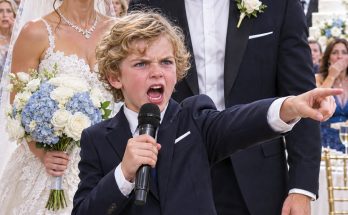
“Good evening, everyone,” Mama said into the microphone. Her voice had that old-school Tennessee bell tone to it, clear and carrying without an ounce of strain. “I’m Eleanor. Clara’s grandmother. And I understand there’s been some polite concern tonight regarding the provenance of my granddaughter’s dress.”
Evelyn’s face didn’t go white; it flushed a deep, mottled red that started at the collar of her silk blouse and crawled all the way up to her earrings.
Mama lifted the small navy velvet box in her left hand and popped the brass clasp with her thumb.
“My late husband, Arthur, worked seventy-hour weeks at the rail yards back in the winter of nineteen-fifty-four,” Mama said, her eyes fixed calmly on Evelyn’s corner of the head table. “We didn’t have much money for fancy store-bought receptions or country club dues. But Arthur wanted me to have something that lasted. He walked two miles into town every Tuesday for three months to pay cash to a tailor named Mr. Vance on Commerce Street. Every stitch in this dress was sewn by hand because Arthur told the tailor he wanted a gown that could survive a lifetime and still look decent when our grandchildren needed it.”
She reached inside the open velvet box. The room leaned in. You could have heard a pin drop on the thick carpet.
Mama took out three small items and laid them out on the flat of her palm under the stage lights. First, she held up an embossed card from the 1954 Franklin couturier, yellowed at the edges but clear as day in its ink. Next, she pulled out a tiny, pristine square of ivory silk-satin, exactly matching the skirt of Clara’s gown, untouched by time because it had rested in acid-free tissue inside a cedar trunk for decades. Finally, she lifted a miniature 14-karat gold sewing thimble, catching the chandelier light like a tiny star.
“So when I heard someone say tonight that this dress came from nothing,” Mama continued, her voice steady and warm, “I wanted to set the record straight. It didn’t come from nothing. It came from sixty-two years of a good marriage, hard-earned wages, and a grandfather who believed his bride deserved silk even if we had to eat beans for a month to pay for it.”
She looked right at Evelyn, who was now staring fixedly at her own butter knife as if it held the secrets of the universe.
“That’s not secondhand, friends,” Mama said softly, closing the velvet box with a quiet *click*. “That’s an inheritance. And I couldn’t be prouder to see my girl wearing it tonight. Thank you, and enjoy the music.”
For two seconds, there was absolute, ringing silence.
Then Liam, the groom, stood up so fast his chair clattered backward onto the floor. He started clapping. He didn’t just clap; he slammed his hands together with a loud, ringing sound and looked right at his mother before turning toward Mama with a grin that split his face wide open.
Within a heartbeat, the whole room erupted. People were standing up, cheering, and whistling. One of the uncles from our side let out a long, rolling holler that hit the ceiling rafters. Clara was standing near the sweetheart table with her hands over her mouth, tears streaming freely down her cheeks, looking like she wanted to run over and tackle her grandmother.
Evelyn sat there like a stone carving, staring straight ahead while Diane stared into her lap, pretending her phone had suddenly become the most fascinating object in Tennessee.
Mama adjusted the microphone back up to its high position, gave the bandleader a polite nod, and walked off the stage.
I intercepted Evelyn before she could slip out the side door toward the terrace. She was moving fast, her heels clicking a staccato rhythm against the hardwood, her face pinched into an ugly, tight mask.
“Evelyn,” I said. My voice wasn’t loud, but it had enough iron in it to make her stop in her tracks right beneath the brass wall sconces.
She turned around, her nostrils flaring. “I need some air, Carolyn. Your mother is entirely too dramatic for a public family event.”
“My mother told the truth,” I said, stepping close enough that she had to look me in the eye. “And you heard every word of it. If you ever speak about my family that way under my roof or my daughter’s wedding again, you won’t have to worry about looking at us at holidays, because you won’t be invited through the front door.”
“I offered to pay for a real dress,” Evelyn hissed, her voice dropping into a venomous whisper. “I offered to upgrade their honeymoon suite to the Four Seasons in Maui. We brought this family into society tonight.”
“We didn’t come to you for charity, Evelyn, and we don’t want your money,” I said, keeping my chin up. “Keep your suite. Keep your checkbook. My daughter is wearing an heirloom built on sixty-two years of love, and you couldn’t buy that if you emptied every bank account between here and Memphis.”
She opened her mouth to snap back, but she looked over my shoulder and saw Liam walking toward us with his jaw set like granite, his bowtie dangling loose around his collar. Evelyn pressed her lips together into a thin white line, turned on her heel, and pushed through the glass doors out into the humid dark.
By the time the band started playing again, the tension in the room had burned off like morning fog over the Cumberland River.
The dance floor filled up fast. The lights were dimmed down to a warm amber glow that made the ivory silk of Clara’s dress look like liquid pearl.
Mama was sitting at the edge of the dance floor in her folding chair, her black handbag resting neatly beside her feet. Clara and Liam were out in the middle of the room, slow-dancing to an old rhythm-and-blues tune the band had dug up from somewhere. As they drifted past, Clara spotted Mama, broke away from her husband for just a second, and pulled her grandmother up out of her chair.
Mama didn’t dance much, just swayed her shoulders in time with the horns while Clara laughed, her veil trailing behind her like sea foam.
Before the song ended, Mama reached into her handbag one last time. She pulled out the small, flat navy velvet box and pressed it directly into Clara’s hands, closing my daughter’s fingers around the brass clasp while the 1954 silk skirt brushed softly against the polished floorboards under the warm Franklin lights.