2 | THEY THREW AWAY HER CRUTCHES – Chapter 1
CHAPTER 1 — THE THINGS THEY THREW INTO THE WATER
The last thing Abigail Bennett’s stepmother did before abandoning her was kick both of her crutches into the sea.
“You’re slowing everybody down!”
Abigail grabbed the wooden railing as the first crutch disappeared beneath the dock.
The second struck the side of the family boat before floating away.
“Linda!”
She cried out.
“I need those!”
Her stepmother climbed into the boat without looking back.
“Then you should have moved faster.”
Abigail stared at her.
Beyond the private marina, emergency sirens echoed across the coastal town of Greyhaven, Oregon.
A powerful offshore earthquake had triggered a tsunami warning, and hundreds of residents were attempting to reach higher ground before the ocean returned.
The road behind the Bennett estate had become blocked by a landslide.
Abigail’s father decided that the family would escape aboard their motorboat.
He believed he could navigate through the sheltered inlet and reach an elevated evacuation area on the opposite shore.
Abigail had questioned that decision.
Her grandfather had always warned her that a familiar stretch of water could become completely unrecognizable during a major disaster.
But nobody was interested in discussing alternatives.
They were interested in leaving.
And apparently, they were interested in taking almost everything they owned.
Three suitcases occupied the boat’s rear seating area.
Two more had been placed near the cabin.
Linda had brought jewelry, expensive clothing, family valuables, and several boxes of personal belongings.
Abigail had brought a small waterproof bag containing medication, spare supplies for her prosthetic leg, and a photograph of her grandfather.
She had expected somebody to help her step aboard.
Instead, Linda watched her struggle with the changing height of the dock and complained that they were wasting valuable time.
Abigail’s left leg had been amputated below the knee four years earlier following a serious motorcycle accident.
She had gradually learned to walk with a prosthesis, return to work, and navigate most ordinary environments independently.
However, an inflamed area of skin around her residual limb had recently made prolonged use of the prosthesis painful.
For the past week, she had relied on forearm crutches whenever she needed additional support.
Her father knew that.
He had watched her struggle down the garden path that morning.
Now he stood beside the boat’s controls, looking toward the open water.
“Dad!”
Abigail shouted.
“Get my crutches!”
Michael Bennett looked at the floating supports.
Then toward the inlet.
“We don’t have time.”
“Then help me get aboard!”
Linda stepped between them.
“Michael, the water’s changing!”
Abigail’s sixteen-year-old half-brother, Owen, looked over the side.
“Mom, we can move the bags.”
Linda caught his shoulder.
“Sit down!”
He hesitated.
Abigail held out her hand.
“Owen, please.”
The teenager started toward her.
Their father suddenly leaned over the side of the boat and released the final mooring line.
The vessel moved away from the dock.
Abigail reached toward it.
“DAD!”
Michael looked at her.
“Get back to the house, Abby!”
“What?”
“Find somewhere high! We’ll send help!”
The distance between the boat and the dock increased.
Abigail tried stepping forward.
Without her crutches, her balance shifted dangerously.
Her prosthetic foot caught against a raised board.
She fell hard onto the wooden dock.
Pain shot through her hip.
She looked up just as the boat’s engine accelerated.
Linda was securing a suitcase beneath one of the seats.
Owen stood near the railing, shouting something Abigail could no longer hear.
Her father remained behind the controls.
Within seconds, they were moving toward the center of the inlet.
Abigail lay on the dock watching them disappear.
She had always known that Linda considered her an inconvenience.
She had never realized that her father agreed strongly enough to leave her behind during a disaster.
A strange silence settled over the marina.
The fishing vessels nearby shifted against their moorings.
Water moved rapidly away from the shoreline, exposing muddy ground beneath sections of the dock.
Abigail remembered her grandfather’s warnings.
Walter Bennett had spent most of his life building boats.
He designed fishing vessels, repaired rescue equipment, and occasionally accepted contracts from organizations developing experimental marine safety systems.
His workshop stood beside the family’s private boathouse.
As a child, Abigail spent entire summers there.
Walter taught her how to identify different woods by their smell and how to recognize when somebody had built something primarily to look impressive.
“Pretty doesn’t mean seaworthy.”
He used to tell her.
“Remember that when somebody tries selling you something expensive.”
After Abigail’s accident, he became interested in emergency evacuation equipment that people with limited mobility could operate without standing.
She helped test seat arrangements and control positions in his workshop.
Sometimes he became so absorbed in his designs that she had to remind him to eat lunch.
One afternoon, Walter showed her the unfinished shell of a compact rescue vessel resting inside a construction cradle.
It resembled an enclosed lifeboat, with a reinforced exterior, rounded windows, and a low entry platform.
He called it the Harbor Wren.
Abigail laughed at the name.
“That’s a very ugly bird.”
Walter looked offended.
“She’s unfinished.”
“She’s orange.”
“That’s so people can find her.”
He died ten months later.
After his funeral, Michael closed the workshop and announced that Walter’s unfinished projects would eventually be sold or dismantled.
Linda wanted the boathouse converted into a waterfront entertainment room.
Abigail was told that the Harbor Wren had never been completed.
She believed them.
Now, lying on the dock while the ocean withdrew around her, she remembered something Walter had written inside her birthday card during his final year.
If you ever need somewhere to go, the Wren will be waiting.
At the time, she thought it was simply his way of expressing affection for their strange little project.
Abigail looked toward the boathouse.
Its sliding entrance stood approximately thirty feet away.
She could not safely walk that distance without support.
But she could move.
She turned onto her side and began dragging herself toward it.
The rough wooden boards caught against her clothing.
Her hands hurt.
Every movement placed additional pressure on her recovering skin.
She kept going.
Behind her, several moored vessels began striking one another.
A distant roar traveled across the inlet.
Abigail looked toward the harbor entrance.
The horizon had changed.
A moving wall of dark water and white foam was advancing between the headlands.
The tsunami had reached Greyhaven.
She pulled herself across the boathouse threshold.
Inside, darkness surrounded stacks of old equipment and wooden construction frames.
The familiar smell of engine oil and cedar brought back memories so quickly that Abigail nearly stopped moving.
She crawled past Walter’s abandoned workbench.
An enormous gray tarpaulin covered something inside the central construction bay.
Abigail reached its lower edge.
She pulled.
The covering slid away.
Orange paint appeared beneath it.
Then a rounded observation window.
Then the small black lettering Walter had painted himself.
HARBOR WREN.
Abigail began crying.
The vessel looked considerably different from the unfinished shell she remembered.
Its windows had been installed.
Its equipment compartments were closed.
A short boarding platform rested beside the low entrance hatch.
Walter had finished it.
Someone had covered it and allowed her to believe otherwise.
Abigail dragged herself toward the boarding platform.
A laminated instruction card hung beside the hatch.
Her grandfather’s handwriting occupied the upper corner.
ABBY — EVERYTHING YOU NEED IS WITHIN REACH.
She touched the words.
Outside, the roar became louder.
She pulled herself onto the low platform, opened the hatch, and shifted into the padded transfer seat immediately inside.
Using the interior handholds, she moved toward the main operating position.
The controls were exactly where she remembered suggesting they should be during Walter’s early design tests.
Nothing important required her to stand.
Abigail closed the hatch.
A small display illuminated.
The vessel’s independent battery system remained charged.
Walter had arranged for a maintenance connection through the boathouse’s protected electrical supply.
Abigail activated the emergency operating system.
The interior lights came on.
A familiar mechanical hum traveled through the cabin.
Beyond the front window, water began entering beneath the boathouse doors.
Abigail secured herself in the operating seat.
“Come on, Grandpa.”
The water reached the vessel’s construction cradle.
The Harbor Wren shifted.
Then lifted.
Outside, the dock disappeared beneath a violent surge.
Water struck the boathouse with tremendous force.
The damaged waterfront doors broke outward, and the rescue vessel rose through the opening amid floating boards and broken equipment.
Abigail gripped the armrests.
The entire structure tilted before settling upright.
For several seconds, she could see nothing through the observation window except muddy water.
Then the vessel surfaced fully.
The boathouse was behind her.
Its lower walls were breaking apart.
Across the flooded marina, boats collided with buildings, overturned vehicles moved through the current, and enormous pieces of the waterfront floated toward the town.
Abigail searched the surrounding water.
The family motorboat appeared near the outer boundary of the estate.
It had not reached the opposite shore.
Instead, it was being carried sideways toward a submerged metal fence that once separated the private marina from an adjoining property.
Its underside caught against the structure.
The boat stopped abruptly.
The current continued pushing against it.
Abigail watched its cabin lean dangerously.
Suitcases slid across the deck.
Her father struggled behind the controls.
Owen caught the railing.
Linda reached toward a floating bag.
Then another surge struck the vessel.
The boat rolled farther onto its side.
Linda fell into the water.
Abigail gasped.
Her stepmother disappeared beneath the surface before emerging several yards downstream.
She screamed.
One of the floating crutches struck her shoulder.
Linda grabbed it.
The second had become caught against a piece of wooden fencing nearby.
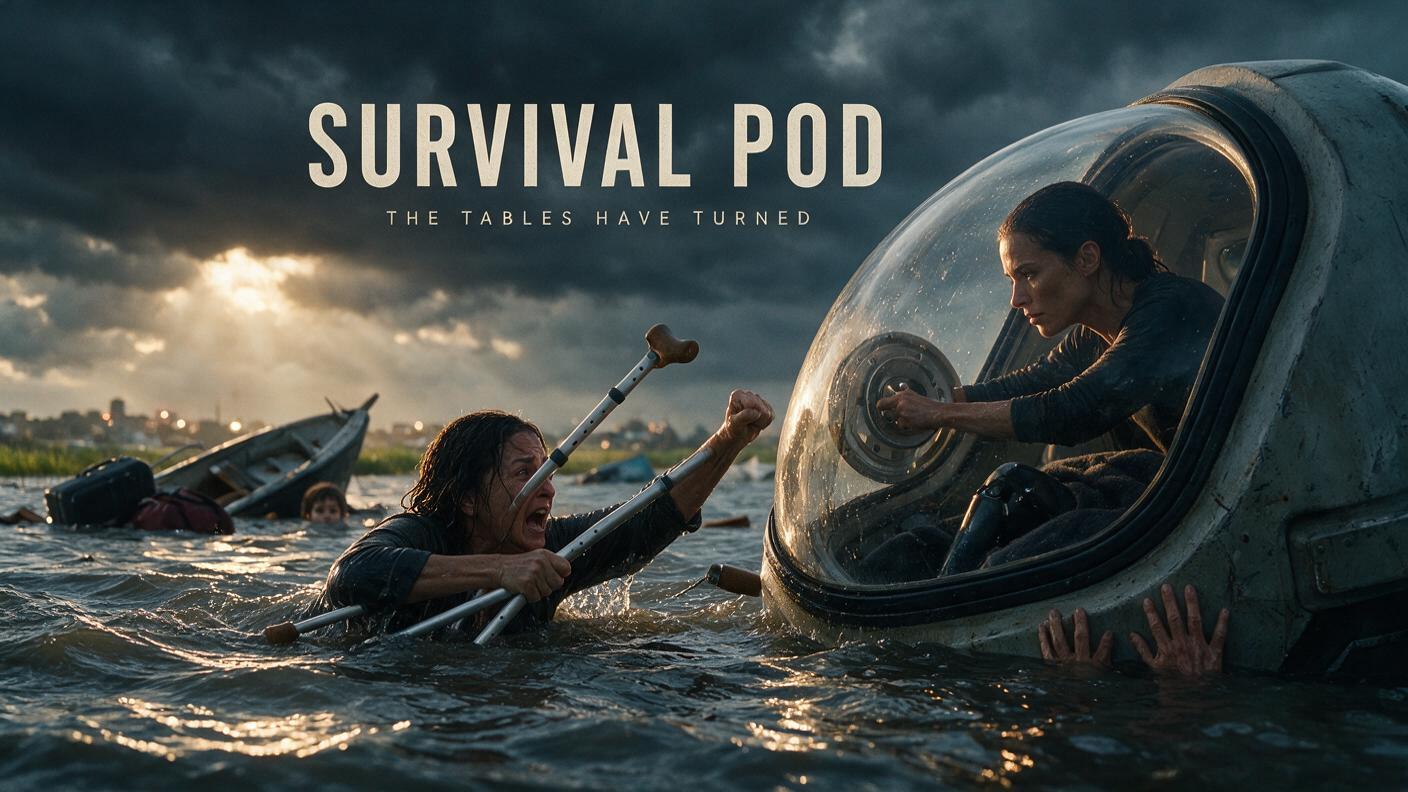
She seized that one too, desperately using the pair to keep her face above the turbulent water.
Abigail recognized their blue forearm supports immediately.
The crutches Linda had thrown away.
The same crutches she claimed Abigail did not deserve time to retrieve.
Now she was clinging to them as though they were the most valuable objects she owned.
The current carried the Harbor Wren toward the struggling woman.
Linda saw its orange exterior.
“HELP!”
She released one crutch long enough to catch an exterior handhold beside the rescue hatch.
The second crutch struck the observation window.
Linda began pounding against the glass.
“LET ME IN!”
Abigail moved closer to the control panel.
Linda suddenly recognized her.
“Abby?”
Her face changed.
“Oh, thank God!”
She struck the window again.
“OPEN IT!”
Abigail looked at the rescue hatch controls.
Then movement behind Linda caught her attention.
Owen was in the water.
He had apparently fallen from the tilting boat after his mother.
His head appeared briefly between two floating pieces of timber.
He reached toward the rescue vessel.
“ABBY!”
Then he disappeared.
Abigail screamed his name.
He surfaced again.
His movements were becoming weaker.
Linda was directly between him and the vessel’s only immediately accessible entrance.
“Linda, move!”
Abigail shouted through the external speaker.
“Owen’s behind you!”
Linda looked over her shoulder.
She saw her son struggling.
Then she turned back toward the hatch.
“Let me in first!”
“Owen’s going under!”
Linda tightened both hands around the exterior handhold.
“OPEN THE DOOR!”
Abigail placed her hand over the illuminated rescue control.
Behind Linda, Owen disappeared beneath the water again.
His mother refused to move.
And Abigail realized that the woman who had sacrificed her safety to escape the tsunami was now prepared to stand between her own son and the only shelter that could save him.
3 | THEY THREW AWAY HER CRUTCHES – Chapter 2
CHAPTER 2 — THE MOTHER WHO WOULDN’T MOVE
Abigail had never heard her own voice sound the way it did when she shouted at Linda through the Harbor Wren’s external speaker.
“LOOK BEHIND YOU!”
Linda turned again.
Owen’s head emerged from the muddy water approximately six feet away.
His orange life jacket remained visible, but something beneath the surface appeared to be holding him back.
He reached toward his mother.
“Mom!”
Linda stretched one hand toward him.
The distance was too great.
A floating section of timber struck the vessel.
Linda screamed and grabbed the exterior handhold with both hands again.
“Abby, please!”
Abigail looked through the window.
Her stepmother’s face was twisted with terror.
She was no longer the elegantly dressed woman who criticized how slowly Abigail crossed a room or complained when her medical equipment occupied space in the entrance hall.
She was cold, exhausted, and frightened of dying.
Abigail understood every one of those feelings.
She had experienced them on the dock less than ten minutes earlier.
Understanding them did not change what Linda was doing.
The Harbor Wren had been designed with a protected rescue entrance near its rear quarter.
A small exterior recovery platform sat above the vessel’s ordinary waterline, providing somewhere for survivors to climb or be assisted aboard.
Linda was clinging to the railing directly beside it.
Her body blocked the approach.
Abigail activated the exterior recovery equipment.
A compact floating support unfolded from a protected compartment.
Its retrieval line remained connected to the vessel.
Walter had originally demonstrated the arrangement using an empty training mannequin.
Abigail remembered laughing when the mannequin became stuck upside down.
Her grandfather had spent another month redesigning the equipment before asking her to test its controls again.
Now she guided the floating support toward Owen.
Linda saw it pass beside her.
She reached for it.
“That’s for Owen!”
Abigail shouted.
Linda stopped.
For several seconds, Abigail watched her struggle with the decision.
Then Owen called again.
“Mom, my leg!”
The boy was being held beneath the water by something he could not free himself from.
Abigail looked at the camera feed from the vessel’s rear.
A length of loose cord had become entangled around part of the debris beside him.
Whenever the debris shifted, Owen was pulled downward despite his life jacket.
The floating support reached his outstretched hands.
He caught it.
Abigail began crying with relief.
But his position barely changed.
He needed somebody close enough to help him become untangled.
She looked at Linda.
“He’s caught on something.”
Linda shook her head.
“I can’t swim over there!”
“Can you reach him if he comes closer?”
“I don’t know!”
Abigail studied the moving debris.
The water carried the timber toward the vessel in short, uneven movements.
Owen was getting closer.
She needed to keep the rescue entrance clear.
“Linda, move along the outside rail.”
Her stepmother looked toward the next handhold.
Then toward the open water beneath it.
“No.”
“You’re blocking him!”
“If I let go, I’ll die!”
“You don’t have to let go!”
Abigail could see the fear overwhelming her.
Linda appeared unable to think beyond the narrow section of railing already between her hands.
Then Owen’s voice changed.
It became quieter.
“Mom?”
Linda looked back.
He was close enough now for her to see his face clearly.
His lips had lost their color.
He was struggling to lift his head above the floating support.
For the first time, Linda stopped asking Abigail to open the hatch.
She looked at her son.
“Owen!”
She shifted toward him.
One hand remained against the railing while the other reached across the water.
Their fingers touched.
Then separated.
Linda cried out.
She moved farther along the exterior rail.
The rescue platform became clear.
Abigail watched Owen drift closer.
Linda caught the shoulder of his life jacket.
She held him above the surface while he struggled against whatever had trapped him.
Then the tangled piece of debris struck the side of the Harbor Wren and rotated.
Owen’s leg came free.
Abigail immediately activated the recovery mechanism.
The floating support drew him toward the platform.
Linda kept his head above the water until he reached it.
Owen collapsed against the boarding surface.
His mother tried following him.
Abigail spoke through the speaker.
“Let him come inside first.”
Linda looked at the hatch.
Then at her son.
This time, she moved aside.
The recovery compartment opened while the inner cabin remained protected.
Owen managed to crawl across the low threshold.
Abigail reached toward him from her operating seat.
“You’re here.”
He began coughing.
She helped him move into the cabin after the exterior hatch had closed and the transfer compartment was safe to enter.
He was soaked, shaking, and barely able to answer her questions.
Abigail retrieved an emergency blanket from the storage compartment beside her seat.
She wrapped it around his shoulders.
Then she looked outside again.
Linda remained against the vessel.
One of the blue crutches floated beside her.
The other had disappeared.
“Abby?”
Her voice came through the exterior microphone.
She sounded very small.
“Can I come in now?”
Abigail looked at Owen.
His eyes were closed, but he was breathing.
Then she authorized the next recovery sequence.
Linda climbed into the protected compartment with considerable difficulty.
When she finally entered the main cabin, she dropped onto the floor and began crying.
Abigail watched her crawl toward Owen.
“Baby!”
She touched his face.
“Owen, look at me!”
The teenager opened his eyes.
“Mom?”
Linda gathered him against her chest.
She kept repeating his name.
Abigail turned away and contacted the regional emergency service through the vessel’s marine radio.
Several voices were already transmitting distress reports.
A fishing boat had overturned near the harbor entrance.
Residents were trapped inside waterfront buildings.
A rescue team was attempting to establish an operations point beyond the inundated area.
Abigail reported their position, the number of people aboard, and Owen’s condition.
The operator advised that medical assessment was needed as soon as they could be safely reached.
For now, the Harbor Wren would have to remain clear of major obstructions and avoid unnecessary exposure to the strongest current.
Abigail acknowledged the message.
Then she looked through the rear window.
“Where’s Dad?”
Linda stopped crying.
“He was still on the boat.”
Abigail searched the water.
Their family motorboat had disappeared from its previous position beside the submerged fence.
Only several pieces of furniture and an overturned suitcase remained.
She looked toward the harbor road.
“Dad!”
Owen attempted to sit upright.
“I saw him.”
Abigail turned.
“Where?”
“He climbed onto the cabin roof.”
Linda stared at her son.
“You saw him?”
Owen nodded weakly.
“He told me to get away from the boat.”
Abigail activated the external cameras.
The flooded marina appeared across three small displays.
Buildings had collapsed.
Several vessels were drifting inland.
A section of the harbor’s maintenance pier had broken free and was rotating slowly in the current.
Finding one man among the wreckage seemed almost impossible.
Then Linda noticed something beneath Abigail’s operating seat.
A familiar wooden handle protruded from the side compartment.
She pulled it slightly.
A spare mobility aid.
Walter had included a compact folding crutch inside the vessel.
Linda looked toward Abigail’s injured leg.
For the first time since boarding, she seemed to remember how Abigail had reached the rescue vessel.
“What happened after we left?”
Abigail kept watching the cameras.
“I fell.”
Linda looked down.
“How did you get here?”
“I crawled.”
Silence filled the cabin.
Owen stared at his mother.
Linda opened her mouth.
Then closed it.
Abigail turned toward her.
“I begged you not to take my crutches.”
Linda began rubbing her hands together.
“I didn’t think—”
Abigail interrupted.
“I know.”
Her stepmother looked away.
Abigail had no desire to spend the next several minutes listening to excuses while her father remained missing.
She returned to the radio.
The operator reported that the current was carrying debris toward the industrial section of the harbor.
Abigail adjusted the vessel’s direction when conditions allowed.
As they moved past the damaged maintenance pier, Owen noticed a dark shape near a partially submerged floating dock.
“Abby!”
He pointed.
“That’s our boat!”
Abigail looked toward the structure.
The motorboat lay almost completely on its side.
Its stern had become trapped beneath the broken maintenance pier.
A portion of the cabin remained above the water.
Michael was standing against it.
His life jacket was torn along one side, and his right arm hung awkwardly beside his body.
He was holding a metal railing with his left hand.
Linda pressed against the window.
“MICHAEL!”
Her husband looked up.
He saw the orange vessel approaching.
Then he recognized Abigail behind its front window.
His expression changed.
“Abby!”
The voice reached them through the exterior microphone.
She stopped the Harbor Wren from advancing farther into the floating debris.
The damaged pier occupied most of the space between them.
An enormous section of broken roofing rested against the motorboat’s exposed hull.
Abigail could not safely bring the rescue vessel directly alongside him.
She contacted the emergency operator.
“There’s another survivor.”
She described the obstruction.
The operator warned that approaching unstable wreckage could endanger everyone already aboard.
Abigail looked at her father.
Michael pointed toward the far side of the overturned boat.
“Go around!”
He shouted.
“There’s space over there!”
The external camera showed a narrow opening.
Beyond it, a large metal framework projected from beneath the water.
Abigail could not determine how far the submerged structure extended.
She tried maintaining a position outside it.
Then the Harbor Wren shuddered.
A heavy grinding sound traveled beneath the cabin.
The control display changed from green to amber.
PROPULSION RESPONSE REDUCED.
Abigail looked down.
Something beneath the surface had interfered with the vessel’s propulsion system.
The current began turning them sideways.
Michael saw what was happening.
“ABBY, GET AWAY!”
She attempted to move the vessel clear.
Its response remained sluggish.
Owen sat upright.
“What’s wrong?”
Abigail looked toward the industrial buildings downstream.
The current was carrying them toward an old concrete bridge.
Its lower opening was almost completely blocked by floating wreckage.
The Harbor Wren was drifting directly toward it.
Between the rescue vessel and the bridge stood the overturned family boat.
Her father’s position was becoming increasingly unstable.
If the Wren struck the boat, Michael could be crushed between the two vessels.
If it moved past him, it would enter the debris collecting beneath the bridge.
Abigail contacted the emergency operator again.
Before she received a response, the exterior camera showed the damaged maintenance pier shifting.
The family motorboat rolled another few inches.
Michael lost his footing.
He caught the railing with his injured arm and screamed.
Linda began pounding against the observation window.
“Save him!”
Abigail looked at the unresponsive propulsion indicator.
Then at Owen, who had only just survived being pulled beneath the water.
Her grandfather had built the Harbor Wren to protect people.
He had never promised it could survive everything the ocean threw at it.
And as the distance between the two vessels disappeared, Abigail realized she might have only seconds to decide which members of her family she could still keep alive.
4 | THEY THREW AWAY HER CRUTCHES – Chapter 3
CHAPTER 3 — THE WOMAN THEY COULDN’T AFFORD TO LOSE
The Harbor Wren struck the overturned motorboat with a sound Abigail felt through her entire body.
Linda screamed.
Owen grabbed the edge of his seat.
Outside, Michael pulled himself against the exposed cabin roof just before the orange rescue vessel scraped along the lower section of the hull.
The collision turned the Harbor Wren sideways.
One of its reinforced observation windows developed a shallow crack.
The protective outer layer remained intact.
Abigail checked the compartment indicators.
There was no detected water intrusion into the main cabin.
But they were still drifting.
The concrete bridge was getting closer.
Beyond its damaged railings, an enormous accumulation of timber, vehicles, and fragments of buildings obstructed the opening beneath it.
Abigail knew the vessel could not safely pass through that wreckage.
She searched the exterior camera displays.
Then she noticed something moving beside the industrial shoreline.
A broad maintenance pontoon had broken loose from the pier and become lodged against an elevated concrete loading ramp.
The current divided around it.
Most of the debris continued toward the bridge, but a narrower section of water curved toward the loading area.
If the Harbor Wren retained enough directional control to reach that section, they might avoid the bridge.
Abigail described what she could see to the emergency radio operator.
The response came through broken static.
The operator could not verify the route from his position.
He advised her to prioritize keeping the vessel upright and avoid allowing additional people into exposed positions while it remained surrounded by unstable debris.
Abigail acknowledged him.
Then she looked toward her father.
Michael was several feet above the water, holding himself against the overturned boat.
His face was twisted with pain.
Linda reached toward the rescue hatch controls.
“Open it!”
Abigail caught her hand.
“Not while we’re against the wreckage.”
“But he’s right there!”
“And Owen is inside.”
Linda stopped.
Abigail pointed toward the boy.
“We cannot risk flooding this cabin.”
Her stepmother looked at her son.
Then slowly withdrew her hand.
Outside, Michael saw the concrete bridge approaching.
He looked toward the broken maintenance pontoon.
Then back at Abigail.
“Abby!”
She activated the speaker.
“I can hear you!”
Michael pointed toward the pontoon.
“Get Owen out of here!”
Linda began crying.
“What about you?”
Michael looked at the distance between the boat and the floating structure.
“I’ll try to reach that dock.”
Abigail felt a strange anger rise inside her.
Once again, her father was telling somebody to go ahead without him.
But this time, he was the person being left behind.
She wanted to ask whether he remembered making that decision for her.
Instead, she concentrated on the water.
The overturned boat shifted.
The damaged pier released one end of its hull, allowing the vessel to rotate toward the concrete loading area.
Michael held on.
Abigail used what remained of the Harbor Wren’s maneuvering capability to move toward the same section of water.
The rescue vessel responded slowly.
Walter had warned her during their design sessions that a boat rarely behaved as neatly in moving water as it did on a drawing.
She remembered his frustration whenever their training exercises failed.
She remembered him insisting that any useful rescue vessel needed to remain controllable even after suffering damage.
For the first time, Abigail understood how much of his work had been intended for moments exactly like this.
The Harbor Wren gradually turned away from the bridge.
Floating debris struck its exterior.
The damaged motorboat drifted ahead of them.
Then its exposed railing caught against the maintenance pontoon.
Michael looked toward the floating platform.
He managed to reach it with his uninjured arm as the motorboat pressed briefly against its edge.
With tremendous difficulty, he pulled himself onto the pontoon.
The boat rolled away beneath him.
Abigail watched it disappear toward the bridge.
Several seconds later, the sound of breaking fiberglass traveled across the flooded harbor.
Their expensive family boat vanished into the wreckage.
Michael lay flat against the pontoon.
He was alive.
The Harbor Wren moved into the relatively sheltered water beside the loading ramp.
Abigail reduced its movement as much as the damaged equipment allowed.
Then she contacted the operator again.
She reported their position beside the old industrial maintenance area and explained that her father was stranded on the partially secured floating platform.
A rescue crew was operating farther inland.
They were directed toward the location.
Abigail looked through the external camera.
Michael had crawled closer to the edge of the pontoon.
He was watching the rescue vessel.
Linda spoke quietly.
“Can we get him now?”
Abigail examined the conditions.
The strongest current remained farther from the loading ramp.
There was enough separation between the unstable wreckage and their recovery entrance to consider bringing another person aboard.
But Michael could not use his injured arm properly.
He would need assistance.
Abigail looked at Linda.
“I need your help.”
Her stepmother nodded immediately.
“Anything.”
For a moment, Abigail almost laughed.
She had spent years hearing the opposite whenever she needed somebody to help her carry groceries or retrieve something from a high shelf.
Now Linda was waiting for instructions.
Abigail explained that she would operate the recovery equipment while Linda helped support Michael once he reached the protected entrance.
They waited until the vessel was in a suitable position.
Michael followed their directions and moved toward the floating recovery support.
Linda remained beside the compartment, watching him approach.
When he reached the platform, she caught his good arm.
Together, with the assistance of the vessel’s recovery system, they helped him cross into the protected compartment.
The exterior hatch closed.
A few moments later, Michael entered the main cabin.
He collapsed beside Owen.
Linda wrapped a blanket around his shoulders.
For several seconds, Michael could only breathe.
Then he looked toward Abigail.
“How did you get here?”
She glanced toward the wooden handle of Walter’s spare crutch.
“Grandpa’s boat.”
Michael stared around the cabin.
“The Wren?”
Abigail nodded.
He touched the edge of the padded seat.
“I thought he never finished it.”
She looked at him.
“Did you ever check?”
Michael lowered his eyes.
Abigail remembered the months after Walter’s funeral.
Her father had been so eager to clear out the old workshop that he never considered whether anything inside it might have been worth preserving.
He regarded the Harbor Wren as another expensive experiment belonging to a man who refused to retire properly.
Now he was sitting inside it, wrapped in one of Walter’s emergency blankets.
Owen looked toward his father.
“Why did we leave Abby?”
The question came without warning.
Michael looked up.
“Owen, we’ll discuss that later.”
“No.”
The teenager’s voice shook.
“You took the rope off.”
Linda stared at him.
Owen continued.
“She was right there.”
Michael rubbed his forehead.
“I thought we were running out of time.”
“She asked us to move the bags!”
Nobody answered.
Owen began crying.
“I kept thinking somebody would come back for her.”
Abigail looked at her brother.
He had tried to reach her before Linda stopped him.
He had been frightened, confused, and dependent on the adults making decisions around him.
She reached toward his hand.
“You don’t have to explain what they did.”
Michael watched them.
Then he looked at Abigail’s leg.
Blood had seeped through a small section of fabric near the upper edge of her prosthetic fitting.
Her hands were scraped from crawling across the dock.
He seemed to notice those injuries for the first time.
“Abby…”
She looked away.
“Don’t.”
He became quiet.
The emergency radio announced that the immediate surge was beginning to weaken in parts of the harbor, although additional waves remained possible.
A rescue team had reached the higher section of the industrial loading area.
Abigail activated the Harbor Wren’s exterior identification lights.
Several minutes later, she saw figures in bright protective clothing approaching along the elevated concrete ramp.
One rescuer raised an arm.
Abigail answered through the radio.
For the first time since the evacuation warning arrived, somebody was coming who had no intention of deciding whether she was worth saving.
The responders established a safe transfer position near the sheltered edge of the loading area.
Owen received medical attention first.
Michael followed because of his injured arm.
Linda remained aboard while the crew prepared an accessible transfer for Abigail.
One of the responders leaned toward the cabin entrance.
“How do you usually get around?”
Abigail looked at the spare folding crutch.
“Normally I use two crutches when my leg’s giving me trouble.”
“All right.”
He asked how she preferred to be assisted and explained the available options.
There was no irritation in his voice.
No suggestion that she was delaying anybody.
Abigail felt tears gathering unexpectedly.
After everything she had survived, that simple conversation nearly broke her.
She reached the higher loading area with the crew’s assistance.
Beyond it, emergency vehicles waited on a road above the flooded industrial district.
The Harbor Wren remained below, secured as safely as conditions allowed until it could be recovered.
Abigail looked back at its orange exterior.
The cracked window caught the fading afternoon light.
Walter had once spent an entire Saturday persuading her that orange was a perfectly respectable color.
She smiled.
“You were right, Grandpa.”
At the temporary medical center, doctors examined her residual limb and treated the injuries caused by her fall.
She would need to temporarily reduce her use of the prosthesis while the irritated skin healed.
Owen was monitored after his prolonged exposure to cold water.
Michael required treatment for a shoulder injury.
Linda had several bruises and cuts.
All four survived.
That evening, a relief volunteer brought Abigail a replacement wheelchair so she could move around without placing additional pressure on her injured leg.
She was sitting beside Owen when Linda approached.
Her stepmother carried something wrapped in a towel.
She placed it across Abigail’s lap.
It was one of the blue crutches.
The rescue crew had found it caught against the Harbor Wren’s exterior recovery platform.
Its handle was scratched, and the forearm support was damaged.
Linda looked at it.
“I held on to that thing until I saw your boat.”
Abigail touched the familiar handle.
Linda began crying.
“I shouldn’t have taken them from you.”
Abigail looked at her.
“Why did you?”
Linda struggled to answer.
“I was frightened.”
Abigail nodded.
“So was I.”
Her stepmother wiped her face.
“I thought your father would help you.”
“You pushed my crutches into the water.”
Linda lowered her head.
There was no way to place that decision inside somebody else’s hands.
Abigail continued.
“And when Owen was drowning, you wouldn’t move.”
Linda began crying harder.
Owen looked toward his mother.
“I thought you couldn’t hear me.”
She covered her mouth.
“I heard you.”
The boy stared at her.
Linda reached toward him.
He moved his hand away.
For several seconds, the three remained silent.
Then Abigail placed the damaged crutch beside her wheelchair.
“You’re alive, Linda.”
Her stepmother nodded.
“I want you to understand that saving you doesn’t mean I’m going home with you.”
Linda looked up.
Abigail continued.
“I can’t live with people who think my safety is something they can trade for their own convenience.”
Michael appeared at the entrance to the room.
He had heard enough to understand.
“Abby, please.”
She turned toward him.
He looked exhausted.
“We made a terrible mistake.”
Abigail remembered the boat moving away from the dock.
She remembered how clearly her father heard her shouting.
“You didn’t forget me.”
She said.
“You saw me, and you left.”
Michael closed his eyes.
He did not answer.
Abigail arranged to stay with her aunt inland while recovering.
She gave Owen her new address and told him he could call whenever he needed to speak with her.
When Michael offered to accompany her, she declined.
He looked hurt.
She allowed him to feel it.
Three months later, the Harbor Wren was recovered from the damaged industrial waterfront.
Its propulsion equipment required extensive repairs, several exterior panels were damaged, and one observation window needed replacement.
But its protected cabin had survived.
Abigail visited the repair yard with Owen.
He carried a cardboard box containing several of Walter’s old tools that had been recovered from the boathouse.
Inside the box lay a small wooden plaque.
Walter had made it during the early construction of the rescue vessel.
There were four words carved into its surface.
ROOM FOR ONE MORE.
Owen showed it to Abigail.
“Should we put it inside?”
She smiled.
“Definitely.”
They entered the vessel after the repair supervisor confirmed it was safe.
Abigail moved into the operating seat.
Her new crutches rested beside her.
Owen attached the little plaque above the storage compartment.
Then he sat in the passenger seat.
“Do you think Grandpa knew something like this would happen?”
Abigail looked around the cabin.
“I think he knew emergencies don’t always wait until everybody’s ready.”
Owen considered that.
Then he asked:
“Would you still have opened the door if Mom hadn’t moved?”
Abigail thought about the muddy water, the screaming, and her brother’s frightened face disappearing behind Linda.
“I would have kept looking for a way to reach you.”
He nodded.
After a moment, he leaned against her shoulder.
Outside the repair yard, workers moved another damaged fishing vessel into position.
Abigail watched them through the newly installed window.
She had not yet decided what relationship she wanted with her father.
Linda had sent several letters.
Abigail had read them but had not agreed to resume contact.
There was no deadline for those decisions.
For now, she was concentrating on rebuilding her own life and preserving the vessel her grandfather had entrusted to her.
Before leaving the cabin, she retrieved the damaged blue crutch from the storage compartment.
Owen looked at it.
“You’re keeping that?”
Abigail nodded.
She placed it beside Walter’s wooden plaque.
It would never support her weight again.
It had been discarded by someone who thought it represented weakness and later depended on it to remain alive.
Abigail did not keep it to celebrate Linda’s humiliation.
She kept it because she remembered herself lying on the dock after the family boat disappeared.
She remembered believing, for several terrible seconds, that she had become too difficult to save.
Then she remembered crawling toward the boathouse.
She remembered opening the hatch.
She remembered pulling her brother out of the water.
Owen opened the cabin door and waited beside the boarding platform.
“Ready?”
Abigail collected her new crutches.
“Yeah.”
They left together.
Behind them, the Harbor Wren stood beneath the afternoon sunlight, its orange paint brighter than it had been in years.
The woman they had abandoned because she needed help walking had brought every member of their family back alive.
But surviving together did not give them the right to keep her.
And this time, when Abigail walked away, nobody touched her crutches.