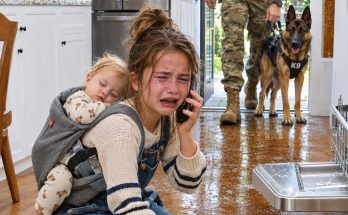
After my divorce, I was left with nothing and no one to help me. Pregnant and desperate, I swallowed my pride and took every job I could find just to survive. When my contractions started, I had no choice but to drive myself to the hospital, barely holding back the pain at every red light.

But just minutes after my baby was born, the doctor took one look at his face, turned pale, and burst into tears. He stared at me and whispered, “This is impossible… Do you know who these babies really are?”

PART 1

I gave birth alone because my ex-husband said I was “no longer his problem.” Ten minutes later, the doctor holding my newborn twin sons looked at their tiny faces, went pale, and began to cry.

“This… this can’t be possible,” he whispered.

I was too exhausted to understand. My hair was soaked, my hands were shaking, and my body felt like it had been split open by grief and pain. I had driven myself to the hospital at dawn, one hand on the wheel, the other pressed against my stomach, trembling through every red light and begging my babies to wait.

They didn’t.

Three months earlier, my husband, Preston Ashby, had thrown divorce papers onto our dining table while his mother, Genevieve, stood behind him like a queen watching an execution.

“You’re pregnant,” I said, staring at the papers.

Preston adjusted his silver watch. “That’s unfortunate timing.”

Genevieve smiled. “Don’t be dramatic, Callie. Men like my son don’t stay trapped by women who get pregnant to secure money.”

I laughed once, because the insult was too ugly to cry over.

“I never asked for your money.”

“No,” Genevieve said, leaning close. “You just quietly benefited from it.”

By the end of the week, Preston had frozen our joint account, canceled my health insurance, and told every friend we shared that I had cheated. The lie spread faster than fire. My phone stopped ringing. Doors closed. People who had toasted at our wedding suddenly looked through me in grocery stores.

So I worked.

I cleaned office buildings at night. I edited legal transcripts online before sunrise. I folded towels at a hotel laundry in Denver until my ankles swelled. Every dollar went into rent, prenatal appointments, and a small folder I kept hidden under my mattress.

At my twenty-week ultrasound, the technician went quiet, then smiled. “Two heartbeats,” she said. I sat up on that paper-covered table and cried so hard she thought something was wrong. Something was. I had no one to call.

Because Preston had forgotten one thing.

Before I became his quiet wife, I had been a forensic auditor for one of the toughest law firms in the city.

And Preston was careless.

When he locked me out of our accounts, he left behind transfer records, shell company invoices, and emails between him and Genevieve discussing how to “starve her until she signs away custody.”

I didn’t scream. I didn’t beg.

I saved everything.

Now, in the delivery room, the doctor stared at my sons like he had seen a ghost.

“What is it?” I rasped.

He looked at me, tears trembling on his lashes.

“Who is the father?”

My blood went cold.

“Preston Ashby,” I said.

The doctor’s hand tightened around the blanket.

Then the door opened.

And Preston walked in smiling.

PART 2

“Well,” Preston said, glancing at the bassinets, then at me, “look at that. She survived.”

Behind him came Genevieve in pearls, her heels clicking against the hospital floor. She carried no flowers, no gift, not even a lie of concern. Her eyes went straight to the babies.

“Are those them?” she asked.

“These are my sons,” I said.

Preston snorted. “For now.”

The doctor stepped between them and the bassinets. His name badge read Dr. Theodore Marsh. His face had changed from shock to something colder and sharper.

Genevieve noticed him and stiffened.

“Theodore?” she said.

The room fell silent.

Preston’s smile disappeared. “Mom, you know this guy?”

Dr. Marsh did not look at Preston. He looked only at Genevieve.

“Delivering the children of a man who abandoned their mother,” he said. “Yes. I know the family. I’m told it runs in it.”

Something passed between them, something old and poisonous.

Genevieve’s hand flew to her pearls. For the first time since I’d known her, she had no sharp sentence ready.

“You shouldn’t be on this floor,” she said at last, very softly.

“I’m the attending on this floor.” He turned to me, and his voice gentled. “Callie, may I show you something? You can say no.”

I nodded. He lifted my first son, Wesley, from his bassinet and turned him just enough so that the light caught the skin behind his left ear. There, small and pale as a thumbprint, was a crescent-shaped birthmark.

Then he did the same with my second son, Sawyer.

The same mark. The same ear.

“Identical twins don’t always share birthmarks,” Dr. Marsh said, his voice unsteady. “These two do, and so do I.”

He tilted his head and pushed back his hair.

Behind his left ear was a crescent.

I stared. I looked at his jaw, the line of his brow, the hazel of his eyes. I looked at Wesley’s tiny scowl in his arms. I looked at Preston, slack-jawed beside the door.

“It’s a hereditary mark,” Dr. Marsh said. “A cluster of pigment cells. It passes through a single bloodline. In my case, the only way I could have it is through my mother.”

Everyone turned to Genevieve.

“Theodore,” she whispered. “Please. Not here.”

“Where, then?” he asked, and the calm in his voice cracked. “Thirty-four years, and you’ve never once answered my letters.”

“Mom,” Preston said. “What is he talking about?”

Genevieve’s eyes closed.

“He’s your brother,” Dr. Marsh said to Preston, not unkindly. “Your half-brother. I was born when your mother was nineteen. She wasn’t married yet. She gave me up three days after I was born.”

The silence that followed felt physical, like a pressure change before a storm.

“That’s insane,” Preston said. “That’s a lie. Mom, tell him it’s a lie.”

Genevieve opened her eyes. They were wet, and she looked, suddenly, like an old woman.

“It’s not,” she said.

Preston sat down hard in the visitor’s chair. I had never seen him without his armor. For a moment, he was just a man who had been told his life was built on something he’d never been shown.

“Your father,” Genevieve said, to no one in particular, “was the son of the Ashby family. Old money. Old rules. I was a scholarship girl from Pueblo, waitressing through college. I got pregnant by a boy who disappeared. By the time I met Walter Ashby, the baby was already born.” She pressed her hand to her mouth. “Walter’s mother made it clear. A woman with a child out of wedlock would never be an Ashby. I could have a son from the agency, or I could have a future. Not both.”

“So you chose,” Dr. Marsh said.

“I was nineteen and terrified.”

“I was three days old.”

Her shoulders shook. “I thought you’d be better off.”

“I was raised by a plumber and a night nurse in Aurora who loved me,” he said. “I was fine. That isn’t why I’m upset.” He drew a breath. “Two years ago I found my records. I wrote to you four times. You never answered. I told myself you’d moved or died. Then I saw your name in a charity gala program, and I understood you’d simply chosen not to know me.”

Genevieve covered her face.

I should have felt triumphant. Instead I lay in that bed with my sons beside me and felt the strange, heavy sorrow of watching a family discover what it was made of.

Preston stood up, his voice rising. “This doesn’t change anything. Whoever his mother is, he’s still some random doctor making a scene. Callie, those boys are coming home with me. I have an emergency custody filing in the system. You can’t even afford a roof.”

“Preston,” Dr. Marsh said evenly. “Do you know what’s required before a court grants emergency custody?”

“I have the best lawyers in Colorado.”

“Then they should have told you it requires proof of unfitness. The proof can’t be that the mother was poor because you froze her accounts.”

I looked at him. He gave me the smallest nod.

“I may have been told things,” he said, “by someone who works with your wife’s attorney.”

Preston turned on me. “You told people.”

“I told the truth,” I said. “That’s all I’ve ever done.”

I reached under the pillow, where the nurse had tucked my phone in the bag I’d brought. I opened the folder I had spent three months building and turned the screen toward him.

“Do you remember Halcyon Bay Consulting?” I said.

Preston’s face went still.

“It’s one of eleven shell companies you used to move money out of Ashby Capital before the divorce. Money you reported as operational loss to avoid tax. Money you told the board had vanished into a bad investment.” I scrolled. “I didn’t hack anything, Preston. You left the documents in the home office printer queue. You forgot I used to do this for a living.”

“That’s stolen property.”

“It’s marital property,” I said. “From a shared home, accessed while I was still a legal co-owner and your wife. My attorney, Dolores Whitfield, has been filing it with the court since the second week of the divorce. Your lawyers have had copies for two months. Didn’t they mention it?”

His mouth opened. Nothing came out.

Genevieve whispered, “Preston. Is it true?”

He didn’t answer. That was answer enough.

PART 3

By midmorning, hospital security had escorted both Ashbys out of the maternity wing, not for scandal but because a nurse named Rosalind Park, who had stayed on shift two extra hours to hold my hand through the delivery, quietly told the charge nurse that Preston had threatened a patient. Dr. Marsh filed the report himself.

I slept for six hours. When I woke, Dolores was sitting in the corner with a legal pad on her knee and her reading glasses pushed up into her silver hair. She had a way of sitting that made you feel the room was safe.

“Your husband’s counsel withdrew an hour ago,” she said.

“Withdrew?”

“They found out about Halcyon Bay from the court’s forensic examiner. Apparently the examiner flagged the transfers last week, but Preston told them the documents were forged.” She smiled thinly. “They don’t like to be lied to. Neither does the district attorney.”

I closed my eyes. “What happens now?”

“Now you rest. Tomorrow, you meet your brother-in-law, if you want to. He asked.”

“My brother-in-law.”

“Half-brother-in-law. It’s a mess.” Her smile softened. “But he sat outside your door the whole time you were sleeping.”

Theo Marsh came in carrying two paper cups of terrible hospital coffee, one of which he set on my tray with an apologetic look.

“I’m told this is decaf,” he said. “I’m told lots of things in this building.”

I laughed, and then winced. “Thank you.”

He sat. For a while we watched the twins sleep, Wesley’s fist curled by his cheek, Sawyer’s mouth moving like he was tasting dreams.

“I owe you an apology,” he said. “I shouldn’t have started crying in your delivery room. It’s unprofessional.”

“You’re the first person who’s cried for me in a year.”

He looked down. “I didn’t cry for you. I mean, I did, I’m sorry for what he did to you. But when I saw their faces…” He pressed his thumb against his temple. “I’ve spent thirty-four years looking in the mirror at a face no one else in the world shared. Then two babies came out with it.”

“They’ll want to meet their uncle.”

He smiled, and it undid something in his whole expression. “I’d like that more than I can say.”

“There’s something else,” I said. “I need a favor. A big one. You can say no.”

“Ask.”

“I want to hand every document I have to the state attorney general. Not just the divorce court. Preston didn’t only steal from Ashby Capital. Some of those shell companies paid hospital supply contracts, including contracts for this one. Overbilled equipment, sold to the system at inflated prices.”

Theo went very still. “Which system?”

“This one. Mercy Valley.”

“Callie.” His voice was low. “I sit on the ethics committee.”

“I know. That’s why I’m asking you.”

He took a long moment. Then he said, “I’ll bring it to the board myself.”

The next four months were the hardest and the best of my life.

I moved into a small apartment near Washington Park that Dolores found through a client, at a rent I could manage. I nursed two babies at three in the morning and learned to change a diaper with one hand and answer an attorney’s email with the other. Theo came by twice a week with groceries, never staying more than an hour, never presuming. He brought a stuffed bear for each twin and a book on infant sleep that I never opened. On the third visit, he held Sawyer for forty-five minutes without speaking, and I watched my son settle against a chest that had the same heartbeat in it.

The case against Preston unfolded like a slow, orderly avalanche.

The attorney general’s office assigned a prosecutor named Imani Okoro, a brisk woman in her forties with a habit of tapping her pen against her teeth when she found something interesting. She spent three weeks inside my folder. On the last day she closed the file, looked at me, and said, “Mrs. Ashby, I’ve done this for sixteen years. I’ve never seen a financial trail this clean.”

“I’m not Mrs. Ashby anymore,” I said. “My name is Callie Brennan.”

“Ms. Brennan.” She nodded. “Congratulations on getting it back.”

Preston was indicted in October on charges of wire fraud, tax evasion, and falsifying hospital procurement records. The shell companies, eleven of them, collapsed under subpoena. Ashby Capital’s board voted to remove him as CEO the same week. His friends, the ones who had stopped calling me, stopped calling him.

His family divorce attorney, a man I had never met, offered through Dolores a settlement. It included my full share of the marital assets, an irrevocable trust for each twin, and sole legal and physical custody with supervised visitation only, if Preston ever completed a court-ordered program.

Dolores slid the paper across the table. “You could push for more.”

“I don’t want more,” I said. “I want my sons to grow up not afraid of their father. That’s all.”

I signed.

I had not expected to see Genevieve again.

She came to my apartment on a gray afternoon in December, without her pearls, wearing a plain wool coat. I recognized her only by her posture. She stood in the doorway holding a small gift bag, as if she weren’t sure the door would stay open.

“I won’t stay,” she said. “I wanted to say something to your face.”

I let her in. I didn’t offer tea. She stood by the window while the twins napped in the next room.

“I made you a villain because it was easier than seeing myself,” she said. “When you got pregnant, all I could think was that you were a mirror. A young woman, alone, about to be cast out by a family that had decided she wasn’t good enough. I’d done it to myself once, by choice, and I’d done it to my son, and I could not stand to see it happen to you. So I helped it happen. It makes no sense, and it’s the truth.”

I didn’t speak.

“I’ve written to Theodore,” she went on. “Real letters this time. He hasn’t replied.” She smiled bleakly. “He’s entitled.”

“He might,” I said. “Eventually. Not because you deserve it. Because he’s kinder than any of us.”

She nodded. “I would like to know my grandsons someday. But I understand if the answer is no.”

I thought about it for a long time. A year earlier, I’d have said no and meant it. But raising two sons had taught me something about the shape of a person’s regret, how it can be real and still not be enough.

“You can send them cards,” I said. “Birthdays. I’ll read them first. If you do it well, if you show up honestly and keep showing up, we’ll see.”

She pressed her fingers to her eyes and nodded. At the door she held out the gift bag. Inside was a pair of tiny knitted hats, one blue, one green.

“I learned to knit when I was nineteen,” she said. “In the three days I had him.”

She left before I could answer.

Preston pleaded guilty in January, three weeks before trial, after Imani Okoro’s team presented a draft verdict form with twenty-six counts. He received eight years. He wrote me a letter from county jail, three pages of excuse and one line of apology.

I never wrote back. Some doors you don’t have to slam. You just stop opening them.

Spring came early to Denver that year. On the first warm Saturday in April, I carried the twins out into Washington Park in a double stroller, Theo walking beside me with a diaper bag slung over his shoulder like a man who had been doing this for years.

“They’re going to be teething soon,” he said. “I read an article.”

“You read an article.”

“Fine, a journal.”

I laughed. We stopped at a bench beneath a flowering cherry tree. Petals drifted over the blankets in the stroller. Wesley grabbed one in a fist and examined it with the solemn suspicion he reserved for everything. Sawyer, beside him, giggled at nothing.

Theo bent down and brushed the hair behind Wesley’s ear. The small crescent mark was just visible, a pale half-moon.

“My mother used to say it was where the angels held you when you were born,” he said quietly. “Genevieve told me that in the first letter she ever sent. I think it’s the only true thing she said for thirty years.”

“It might be the truest thing in the whole story,” I said.

He looked at me. “Callie, I never thanked you.”

“For what?”

“For letting me in. You could have kept the door closed. I’d have understood. Instead I have two nephews who think I’m a piece of furniture they’re allowed to climb.”

I smiled. “They don’t think that.”

“They think it with their whole bodies.”

I leaned my head back against the bench and watched the light move through the branches. A year earlier, I had driven myself to a hospital with white knuckles and a pounding heart, certain I was alone. I had folded towels until my ankles ached and cleaned offices until sunrise. I had saved every receipt and every email and every printed invoice because a quiet voice inside me kept saying, Someday this will matter.

It had mattered. But not the way I expected.

The documents had put a man in prison. But the thing that actually changed my life was a doctor who couldn’t stop crying because he had seen, for the first time, a face like his own. It was a half-brother who sat outside my door. It was a nurse who stayed two hours late. It was an attorney who believed me on the first meeting, and a prosecutor who read every page.

I had thought I was building a case.

I was building a family.

“Theo,” I said.

“Yeah?”

“There’s a dinner at my place next Sunday. Just soup and bread. Dolores is coming. Rosalind from the nursing floor. Imani said she might stop by if she can get out of the office.” I hesitated. “I’d like you to come.”

He smiled. It was the same smile I’d seen on my son’s face in the delivery room, crooked and a little shy.

“I’ll bring the bread,” he said.

Wesley opened his mouth and made a sound like a very small trumpet. Sawyer joined in. The two of them babbled in the April sun, answering each other in a language only they understood, while the cherry blossoms fell.

I put one hand on each stroller handle and breathed in the spring.

I had been told I was no one’s problem.

It turned out I was someone’s mother, someone’s friend, someone’s sister-in-law. And for the first time in my life, I was entirely, unmistakably, myself.

THE END

Leave a Reply

Your email address will not be published. Required fields are marked *