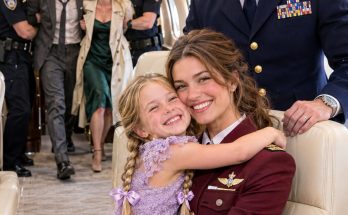
Just eight days after an emergency C-section, I stood in court holding my newborn baby as my husband smirked beside his mistress and publicly denied our child. He thought he had won everything, never realizing that FBI agents were already waiting outside with arrest warrants bearing his name…

PART 1

My name is Claire Whitaker, and eight days ago, surgeons cut open my abdomen to bring my daughter, Penny, into the world.

Today, shielding my fresh cesarean stitches beneath a loose jacket and holding my swaddled baby against my chest, I pushed open the heavy oak doors of Courtroom 302 in downtown Atlanta. Every step sent a burning jolt through my lower body, but the physical pain was nothing compared to the cold that spread through my chest when I saw him.

My husband, Grant.

He sat at the defense table in the navy suit I’d given him for our third anniversary, one arm resting along the back of another woman’s chair. That woman was Brooke, my old college roommate and Grant’s senior marketing associate.

Grant didn’t even flinch when our eyes met. Instead, he gave me a cold, dismissive smile and whispered something in Brooke’s ear that made her cover her mouth and giggle. They looked like a couple celebrating a victory, not a husband facing the wife who had nearly died giving birth to his daughter.

“Ah, Mrs. Whitaker,” Judge Prescott said from the bench, adjusting his glasses. “I’m glad you could join us. We were reviewing your husband’s petition for immediate summary judgment and a decree dissolving the marriage.”

I walked alone to the petitioner’s table and carefully set Penny’s carrier beside me.

“Your Honor, I was discharged from Northside Hospital barely seventy-two hours ago. My attorney withdrew from my case last night without explanation.”

Before I could finish, Grant’s lawyer, a polished, high-priced attorney named Richard Sterling, rose with a predatory smile.

“Your Honor, the reason her attorney withdrew is simple: there is no case. My client, Mr. Whitaker, has petitioned for annulment on grounds of extreme fraud. We have conclusive evidence that Mrs. Whitaker carried on multiple extramarital relationships during the period of conception. Furthermore, preliminary genetic testing shows that Grant Whitaker is not the biological father of the child in that carrier.”

A collective gasp rolled through the courtroom. Brooke leaned back and gave me a look of false sympathy.

“That’s a lie,” I whispered, my voice trembling as I fought not to let a single tear fall. “Grant knows Penny is his!”

Sterling strolled forward and set a thick manila folder on the judge’s bench.

“We have the certified DNA laboratory report, Your Honor. Zero percent probability of paternity. Under the infidelity clause of my client’s prenuptial agreement, Mrs. Whitaker forfeits all claim to marital assets, spousal support, and custody.”

Judge Prescott studied the document, his brow furrowing. He looked up and fixed me with a heavy, skeptical stare.

“Mrs. Whitaker. Do you have anything to say to this court before I sign this order?”

Alone in that courtroom with my eight-day-old baby, Grant believed he had destroyed me completely.

But he had no idea what I was carrying in my diaper bag.

PART 2

I breathed slowly and deliberately as I tucked Penny’s blanket to shield her face from the harsh fluorescent light. The incision throbbed in time with my heartbeat, but a cold, steady calm settled over me. I looked directly at the judge, then turned my head to meet Grant’s smug eyes.

“Yes, Your Honor,” I said, my voice cutting through the silence like a blade. “I do. But first, I’d like to address Mr. Sterling’s claim about my attorney’s withdrawal.”

Grant let out a mocking laugh and crossed his arms. “Your Honor, she’s stalling. She has no evidence.”

“Quiet, Mr. Whitaker,” the judge warned, gesturing for me to continue.

I reached into my canvas diaper bag and took out a silver flash drive and a sealed envelope bearing the seal of the Georgia Bureau of Investigation.

“My attorney didn’t abandon me because my case was hopeless. He withdrew because at 11:42 last night, forty thousand dollars was wired to his offshore account from a shell company registered as Apex Logistics, a company wholly owned by my husband.”

A murmur swept the courtroom. Grant’s smirk vanished. Beside him, Brooke shifted in her leather chair, clutching her designer bag.

“That is a baseless, defamatory accusation!” Sterling snapped, stepping forward. “Even if there were financial disputes between attorneys, it doesn’t change the undeniable biological reality. The DNA test performed by Meridian Laboratories shows my client is not the father! Mrs. Whitaker was unfaithful, and under Georgia law…”

“Meridian Laboratories?” I cut in, fixing my eyes on Sterling. “The private lab where Derek Bennett, Brooke’s biological brother, works as head lab technician?”

Judge Prescott’s eyes narrowed. “Is that true, Mr. Sterling?”

Sterling opened his mouth and faltered for half a second before regaining his composure.

“Your Honor, even if they know each other, the lab results are certified! DNA doesn’t lie!”

“It certainly doesn’t,” I said coldly. “Which is why, knowing my husband was tampering with local facilities, I had the court-certified medical team at Northside Hospital perform a full genomic profile and DNA sampling directly from Penny’s umbilical cord blood at the time of the emergency cesarean. The results were sealed by the hospital’s chief of surgery and delivered to this court’s secure registry this morning.”

I handed the official hospital file to the bailiff, who carried it to the bench. Grant leaned toward Sterling and whispered frantically, his knuckles white against the edge of the table.

Judge Prescott opened the sealed envelope and read the certified medical documentation. His expression turned to stone.

“The hospital’s DNA results confirm a 99.99 percent biological match. Grant Whitaker is, unequivocally, the father.”

Brooke gasped and pulled her hand from Grant’s arm as if he’d caught fire.

“However,” I continued, stepping closer to the bench, “the fake DNA test and the bribe to my attorney were only the warm-up. Three days before my emergency cesarean, when the doctors told us my pregnancy had developed life-threatening complications, Grant secretly forged my signature and took out a supplemental life insurance policy in my name worth five million dollars, with a double-indemnity clause if both mother and daughter died during delivery.”

The gallery gasped. Grant shot to his feet, his face a deep, mottled red.

“She’s lying! She’s trying to frame me!”

“Sit down, Mr. Whitaker!” Judge Prescott thundered, slamming his gavel so hard that the sound echoed off the high ceiling.

“I found the policy documents in our home safe last night while I was folding Penny’s clothes,” I said, my voice flat with cold. “Grant didn’t just want a divorce, Your Honor. He wanted me to die on that operating table so that he and Brooke could keep the millions.”


Before Sterling could object, the double doors at the back of the courtroom swung open. Two uniformed federal agents entered, accompanied by a woman in a dark suit carrying a case folder. Grant’s eyes went wide with naked terror as he realized the nightmare was far from over.

PART 3

The woman in the dark suit walked straight to the center of the courtroom. “Judge Prescott, I apologize for the interruption. I’m Special Agent Sarah Miller of the FBI’s Financial Crimes Division. We have federal arrest warrants for Grant Whitaker, Brooke Sutton, and Richard Sterling.”

Brooke flinched and shrank into the corner of the defense table. “What? No! I didn’t do anything! I’m just his girlfriend!”

“Ms. Sutton,” Agent Miller said calmly, unfolding a document, “we have wiretap records and digital evidence showing you were a co-holder of the offshore accounts used to launder money stolen from the Apex Logistics employee pension fund, as well as the transfers used to bribe Mrs. Whitaker’s original attorney. You are an active participant in wire fraud, insurance fraud, and conspiracy to commit murder.”

Grant went pale as a ghost. “Murder?” he stammered, his composure crumbling into panic. “That’s insane! I never hired anyone!”

“You didn’t need to hire a hit man, Grant,” I said, looking him dead in the eye while Penny murmured softly in her carrier. “You bribed an anesthesiologist at Northside Hospital to alter my dosage during the emergency cesarean. You wanted me to go into cardiac arrest on the table.”

A deathly silence fell over the room. Even Sterling looked horrified, edging away from Grant.

Agent Miller nodded. “Dr. Alan Thorne was taken into custody two hours ago. He confessed to everything, including text messages from Grant offering him two hundred thousand dollars to pass the surgery off as a tragic medical complication.”

Tears streaked Brooke’s face as agents moved in with handcuffs. She screamed at Grant, “You said she’d die! You promised we’d collect the insurance and leave the country!”

“Shut up, Brooke!” Grant barked, but another agent slammed him against the defense table and wrenched his hands behind his back. The sharp snap of steel cuffs rang through the room like thunder. Sterling was also served with a federal summons and escorted out by agents for his role in concealing evidence and tampering with witnesses.

With the defense table empty except for abandoned folders, Judge Prescott struck his gavel three times. His voice rang with righteous indignation.

“This court finds the actions of the respondent, Grant Whitaker, not merely fraudulent, but monstrous. The defense’s motion for summary judgment is denied in its entirety. I am immediately issuing an emergency protective order for Claire Whitaker and her daughter. Furthermore, under the authority of this court, all marital assets, properties, investment portfolios, and bank accounts are frozen and placed in trust for the benefit of Claire Whitaker and baby Penny. Mr. Whitaker’s parental rights are suspended pending the outcome of the criminal proceedings.”

He leaned forward, and his gaze softened.

“Mrs. Whitaker, you have shown extraordinary strength and courage. This court offers its sincere apology for what you were forced to endure today. You and your daughter are safe.”

“Thank you, Your Honor,” I whispered, my eyes burning, not with pain or sorrow, but with deep relief.

As agents led Grant and Brooke out in handcuffs, Grant turned to look at me one last time. His eyes pleaded desperately, but I gave him nothing, not a word. I simply held his gaze with unshakable dignity until the heavy doors closed behind him.

I lifted Penny’s carrier carefully, ignoring the dull ache in my abdomen, and turned around. The gallery rose to its feet, filling the room with warm applause and murmurs of support.

Outside, I pushed through the courthouse’s main doors into bright, golden sunlight. I sat on a marble bench in the plaza, holding Penny against my chest. She opened her tiny dark eyes and looked up at me, serene.

The months that followed were not easy. There were depositions, grand jury testimony, and nights when the incision ached and the fear came back in waves. But Agent Miller’s team had built their case well. Dr. Thorne’s confession, the wire transfers, the forged policy, and the texts left little room for argument. Grant was convicted of fraud, forgery, and conspiracy to commit murder, and received a sentence that would keep him in federal prison for decades. Brooke took a plea and testified against him. Sterling lost his law license and faced his own charges.

The court’s trust ensured Penny and I would never want for anything, but money was never what I’d fought for. I moved to a small house outside Decatur with a porch and a yard. My mother came to stay for the first three months, rocking Penny at night so I could sleep. I went back to my work as a pediatric nurse practitioner when Penny turned one, and I started volunteering with a legal-aid group for women facing abuse in court.

On Penny’s first birthday, we sat on the porch with a lopsided cake. She smeared frosting across her cheeks, laughing, and reached for my face with sticky hands.

Grant had believed he could destroy us. He had underestimated a mother’s instinct to protect her child.

I kissed the top of Penny’s head, breathing in the scent of sugar and baby shampoo, and knew that whatever challenges lay ahead, we had already won.

Epilogue: Five Years Later

On a warm Saturday in October, Penny turned six, and our porch in Decatur was crowded with paper streamers, juice boxes, and eleven kindergartners who had apparently never been told what an indoor voice was.

I stood at the kitchen window, cutting a sheet cake into squares, and watched my daughter run across the yard with a cape tied around her neck. She had my dark eyes and a gap where her front tooth used to be. She was shouting orders at a boy named Theo, who was supposed to be the dragon and kept forgetting.

“Mom!” she hollered through the screen. “Theo isn’t doing the dragon right!”

“Dragons are hard, sweetheart. Give him a minute.”

“He’s had five minutes!”

I laughed and carried the cake outside.

My mother sat in the porch swing, a plate of frosting-smeared napkins balanced on her knee. She had moved into the little apartment above our garage two years earlier, a plan that was supposed to be temporary and now appeared to be permanent. Neither of us had mentioned it. Some arrangements need no discussion.

“She’s bossy,” my mother said, nodding toward the yard.

“She gets it from you.”

“She gets it from you, and you know it.”

I couldn’t argue.

People sometimes ask me whether the years after the trial felt like a victory. I always hesitate. A victory implies something clean, a scoreboard with a final number. What I actually had was three years of paperwork, two rounds of testimony, and a body that took months to stop flinching at the sound of a hospital door.

Grant’s criminal trial lasted nine days. I testified for two of them. I wore a gray dress and kept my hands folded in my lap, and when his attorney, a replacement for Sterling who was both younger and far less sure of himself, tried to suggest I had misread my own husband’s intentions, I answered each question in the same level voice I use with frightened parents in the clinic.

“Mrs. Whitaker, isn’t it possible that Mr. Whitaker simply wanted financial security for his family?”

“He wired two hundred thousand dollars to my anesthesiologist,” I said. “I don’t know what kind of security that purchases.”

The jury took six hours.

Grant did not look at me when the verdict was read. He stared at the table, at his hands, at the knot of his tie. When the judge sentenced him, he finally lifted his head, and I braced for the plea in his eyes, the one he’d given me in the courthouse hallway that first day.

It wasn’t there. What I saw instead was something blank and tired, a man who had spent his whole life assuming the rules bent for him and was only now learning the exact weight of the ones that didn’t.

I felt nothing. That surprised me more than anything. I had expected rage, or triumph, or grief. What I felt was the quiet of a room after an alarm stops.

Brooke testified for the prosecution in exchange for a reduced sentence, and she served four years. I didn’t attend her hearing. She sent one letter, handwritten, through her attorney. I read it once and put it in a drawer. It said she was sorry. It also said she had been so sure she was in love, and I understood that this, in its way, was the saddest part. She had been used by him, too, and it had never occurred to her until the end.

I’m not ready to forgive her. I don’t know if I ever will. But I no longer carry her around.

The trust the court established turned out to matter more than I’d expected, though not for the reasons people assumed. We were not rich. Grant’s assets had been tangled in shell companies and frozen accounts, and by the time the federal government finished its restitution orders, much of what remained went to the employees whose pension fund he had looted. I was glad of that. The pension fund had belonged to people who clocked in every morning at a loading dock in Marietta, and none of them had deserved what he’d done.

What remained was enough. A house with a porch. A college account for Penny. A cushion so that I could say no to shifts that would take me away from her.

I did go back to work when she turned one. The clinic was understaffed, and truthfully, I missed it. I missed the weight of a stethoscope and the small, serious faces of toddlers deciding whether to trust me. After a year, I began volunteering with a legal-aid organization that connected women in crisis with attorneys and advocates. I sat in on intake meetings. I held hands. Sometimes I simply sat across a table from a woman who was sure no one would believe her, and I said, “I believe you.”

It turns out that’s often the first thing anyone needs to hear.

The party wound down around five. Parents collected children, and children collected goody bags, and the yard slowly emptied of capes and half-eaten cupcakes. By the time the last minivan pulled away, Penny was sitting on the porch steps in her crooked crown, picking at a piece of leftover frosting.

I sat beside her.

“Good party?”

“The best,” she said, with the solemn authority of a six-year-old. “Theo was a bad dragon, though.”

“He’ll improve.”

“He better.” She leaned against my arm. After a moment she said, “Mom?”

“Yeah?”

“Cassie at school said everybody has a dad. Do I have a dad?”

I had known this question was coming. I had rehearsed answers for it in the shower and in the car and in the long, quiet hours after she’d fallen asleep. None of them fit now.

“You do,” I said carefully. “His name is Grant. But he did some things that were very wrong, and he isn’t able to be part of our lives. That’s not because of anything you did. It’s never because of anything you did.”

She was quiet for a while, working her thumbnail along the edge of the step.

“Did he do bad things to you?”

“Yes. He tried to. But I’m okay, and you’re okay.”

“Because you were brave?”

I looked at her. At the dark, serious eyes. At the tiny crown listing sideways on her curls.

“I wasn’t always brave,” I said. “I was scared most of the time. But I had you, and that gave me something to be brave for.”

She considered this with great care. Then she nodded, satisfied, and put her head on my shoulder.

“I’m going to be brave for you someday,” she said.

“You already are.”

“No, a lot. Like a superhero.”

“Okay,” I said, laughing into her hair. “I’ll hold you to it.”

That night, after the dishes and the baths and three chapters of a book about a bear who couldn’t sleep, I stood in the doorway of her room and watched her breathe. The nightlight threw a soft amber glow across the blanket. Her cape hung from the bedpost, and her crown sat on the nightstand, where she’d insisted it be placed “for guarding.”

On the dresser, in a plain frame, sat a photograph from the day we left the hospital: me, thin and exhausted and grinning, holding a bundle of blankets. The date was written in marker along the bottom.

Day one.

I had kept it as a reminder of how close we’d come. But over the years, it had become something else. It had become proof of a beginning.

My mother appeared at the foot of the stairs with two mugs of tea. We sat on the porch swing, listening to the crickets, saying very little.

“You know,” she said eventually, “your father would have been proud of you.”

“Mom.”

“I mean it.” She sipped her tea. “He used to say you were the kind of person who didn’t make noise until it mattered. And then you made all of it.”

I smiled and leaned my head against her shoulder.

Inside the house, my daughter slept under a ceiling of glow-in-the-dark stars, safe and warm and entirely unafraid of the dark. The porch light hummed. Somewhere down the block, a screen door slammed, and a dog barked once and went quiet.

For eight days, long ago, I had walked on stitches and fear into a room full of people who wanted me to disappear.

I hadn’t disappeared.

I was here, on a porch swing in October, with my mother’s shoulder against mine and my daughter’s breathing drifting down the stairs, and I knew what I hadn’t known then.

Surviving wasn’t the victory.

This was.

Leave a Reply

Your email address will not be published. Required fields are marked *