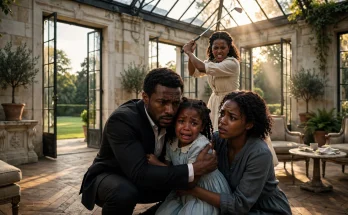
At 13, My Parents Kicked Me Out After My Twin Blamed Me For Crashing Dad’s Car. “Get Out. We Believe Your Brother,” Dad Shouted. Uncle Robert Drove 4 Hours To Get Me. 12 Years Later, At My MIT PhD Graduation, Uncle Stood During My Speech. Mom’s Hands Visibly Trembled When I Called Him My Real Father.
### Part 1
My name is Daniel Wright, and for a long time I thought the worst sound in the world was my father’s car hitting the oak tree in our front yard.
I was wrong.
The worst sound came later.
It was the soft click of the front door closing behind me while my mother stood in the kitchen, crying into a dish towel, and my father told me to wait outside for my uncle like I was a package nobody wanted anymore.
But I’m getting ahead of myself.
Before the porch, before MIT, before my mother’s hands trembled in a crowd of thousands, there was Oakmont Street. There was a white two-story house with blue shutters, a mailbox my father polished every spring, and a driveway where his black BMW sat like a family member with better protection than I ever had.
My twin brother, Ethan, and I were born eleven minutes apart.
He came first. I came second.
My mother used to say it as a joke when we were little. “Ethan arrived ready for the world. Daniel needed convincing.”
People laughed when she said it. I learned to smile, because children learn early which jokes are safe to challenge and which ones will make dinner quiet.
Ethan was everything my parents wanted in a son. He had a grin that made adults forgive him before he apologized. He could throw a baseball across the yard at seven and make my father clap like he’d witnessed a miracle. He told stories with his hands. He walked into birthday parties like everyone had been waiting for him.
I was quieter. I took apart flashlights to see how the switch worked. I read manuals. I kept screws in labeled plastic bags. When other kids played tag, I watched ants build tunnels along the edge of the driveway.
My parents didn’t call me curious.
They called me strange.
“Why can’t you be more like Ethan?” Mom would ask while folding laundry, like she was asking why I couldn’t put my socks in the hamper.
Dad was less gentle.
“Your brother doesn’t make everything complicated,” he’d say. “He just gets out there and does things.”
By the time we were thirteen, the house had learned its own rhythm.
Ethan did something good, the whole place lit up.
Ethan did something bad, the whole place made excuses.
I did something good, someone said, “That’s nice.”
I did something bad, or something Ethan said I did, the walls seemed to lean toward me.
That October Saturday smelled like wet leaves and gasoline before anything happened. I remember that because I had my bedroom window cracked open. The air had that sharp fall bite that made the inside of my nose sting.
I was sitting at my desk, doing a chemistry worksheet under the yellow light of my lamp. My pencil had teeth marks near the eraser. My laptop fan was humming because I had three research tabs open about combustion reactions. Downstairs, a football game mumbled from the TV.
Then came the crash.
Not a bump.
Not a scrape.
A deep, violent crunch, followed by glass breaking and my mother screaming my father’s name.
I jumped so fast my knee hit the underside of my desk. My pencil rolled off and disappeared under the bed. I ran to the window.
Dad’s BMW was wrapped around the oak tree.
Steam curled from the hood. The front bumper hung crooked like a broken jaw. The driver’s door opened, and Ethan climbed out.
For one second, just one, he looked up at me.
His eyes were wide. His mouth was open. He looked terrified.
Then something changed.
It was small, but I saw it.
His face shifted, like a kid remembering his lines in a school play.
Mom and Dad ran outside. Dad wasn’t wearing shoes. Mom had a kitchen towel in one hand.
“What happened?” Dad shouted. “What the hell happened?”
Ethan put one hand against the car, then looked at me again.
And pointed.
“Daniel,” he said, voice cracking. “He wanted to try driving. I told him not to.”
My hands went cold.
I was still upstairs, still behind the glass, still breathing in the smell of smoke and wet leaves.
But somehow, in that moment, I could already feel the driveway closing around me like a trap.
I ran for the stairs, but by the time I reached the front door, my brother had started crying.
And my parents were already looking at me like the verdict had been read.
### Part 2
I remember standing barefoot on the porch because I had run downstairs without shoes.
The concrete was cold under my feet. A little triangle of broken glass had skidded near the front steps, catching the afternoon light like ice. The BMW hissed beside the oak tree, and every few seconds something under the hood ticked.
“I didn’t do it,” I said before anyone asked me anything.
Dad turned toward me slowly.
His face was red in patches, especially around his neck. I had seen him angry before. Angry about bills. Angry about traffic. Angry when I forgot to bring the trash cans back from the curb.
This was different.
This was the look of a man who had already decided someone needed to pay.
“You stole my car,” he said.
“No. I was upstairs. I was doing homework.”
Ethan made a sound behind him. Not quite a sob. Not quite a gasp. It was perfectly placed, like punctuation.
“I tried to stop him,” Ethan said. “I swear I tried.”
I stared at him.
He was standing beside the crumpled car with one sleeve torn at the cuff. His hair had fallen over his forehead, and there was a red scrape on his cheek. He looked like a hero who had failed to prevent a tragedy.
He looked exactly like he wanted to look.
“Tell them the truth,” I said.
His eyes flicked to mine.
There it was again. Not fear this time.
Something brighter.
Satisfaction.
“Daniel,” Mom said, and her voice already had that tired disappointment in it. “Don’t make this worse.”
That sentence landed harder than my father’s shouting.
Don’t make this worse.
Not “What happened?”
Not “Are you hurt?”
Not “Let’s figure this out.”
Just don’t make this worse.
“I didn’t touch the car,” I said. “Check my laptop. My worksheet is on my desk. I’ve been upstairs for hours.”
Dad took one step closer. I could smell coffee on his breath and the cold metallic scent coming off the wreck.
“Your brother saw you.”
“Because he’s lying.”
Ethan flinched like I had slapped him.
Mom moved toward him immediately. She touched his shoulder. “Honey, go sit down.”
Honey.
I had just been accused of stealing and crashing a car, but Ethan was honey.
Dad grabbed my arm, not hard enough to bruise but hard enough to tell me I was smaller than him.
“You are grounded for six months,” he said. “No phone. No computer except schoolwork, and I’ll be watching. No friends. No robotics club. Nothing.”
“Dad—”
“And you’ll pay me back for the deductible.”
I blinked. “I’m thirteen.”
“You were old enough to take the car.”
“I didn’t.”
His fingers tightened. “You were old enough to lie.”
The word lie stuck to me like tar.
Inside, the house felt too warm. The game on TV was still playing, cheerful voices calling out plays like our family hadn’t just split down the middle. Mom sat Ethan on the couch and brought him a glass of water. I stood near the kitchen table while Dad paced with his phone, calling the insurance company.
“Yes,” he said into the phone. “My son took the vehicle without permission.”
My son.
For one wild second, I thought he meant Ethan.
Then he looked straight at me.
I tried everything.
I showed them my chemistry worksheet. Mom said I could have left it open.
I showed them the browser tabs. Dad said I could have opened them earlier.
I told them to ask Mrs. Alvarez next door, because her kitchen window faced the driveway. Dad said he wasn’t dragging neighbors into my lies.
Ethan sat quietly, sipping water with both hands.
Once, when Mom went upstairs and Dad stepped into the garage, I whispered, “Why are you doing this?”
He looked at me over the rim of the glass.
His cheeks were still wet, but his eyes were dry.
“You always think you’re smarter than everyone,” he whispered back. “Figure it out.”
Something in me cracked then.
Not loudly.
Just a small internal snap.
A realization that this wasn’t panic anymore. It wasn’t an accident. It was a choice.
When Dad came back, I asked for my phone.
“No.”
“I need to call Uncle Robert.”
His face hardened. “Absolutely not.”
But later, when he went outside to take pictures of the car and Mom started cleaning glass off the entry rug with shaking hands, I slipped upstairs and grabbed the old prepaid phone I kept hidden behind my bookshelf.
Uncle Robert answered on the second ring.
“Daniel? Everything okay?”
I opened my mouth.
For a few seconds, nothing came out except air.
Then I said, “Please believe me.”
And when I told him everything, the crash, the lie, my parents’ faces, he stayed quiet until I was finished.
Then he said three words no one in that house had said all day.
“I believe you.”
I sat on the edge of my bed, clutching the phone so hard my knuckles hurt.
Downstairs, my father’s voice suddenly exploded.
“Robert, stay out of it!”
And that was when I realized my uncle had called him.
I pressed the phone to my ear, listening to muffled shouting rise through the floorboards, and felt hope and terror twist together in my stomach.
Because someone had finally believed me.
And my father sounded angrier than ever.
### Part 3
The argument lasted twenty-three minutes.
I know because I watched the numbers change on the digital clock beside my bed. Red digits in a dark room. 6:41. 6:52. 7:04.
Dad’s voice carried through the vents.
“This is my house!”
A pause.
“My son, my decision!”
Another pause.
“No, you don’t get to tell me how to parent!”
I couldn’t hear Uncle Robert’s words, only the low vibration of his voice through the phone line before Dad shouted over him again. But I could imagine him. Sitting in his small kitchen four hours away, one hand pressed to his forehead, trying to stay calm because that was what Uncle Robert did.
He was Dad’s younger brother, but they didn’t seem built from the same material.
Dad was all volume and certainty. Uncle Robert was quiet pressure. Like a door that wouldn’t open no matter how hard you shoved.
Finally, Dad said, “If you’re so convinced he’s innocent, then you take him.”
Silence.
Then Dad hung up.
I sat there with the dead phone in my hand.
Downstairs, the house went quiet in that dangerous way houses do after shouting. No TV. No dishes. No footsteps.
Then my bedroom door opened.
Dad stood there with his arms crossed.
“Pack a bag.”
I thought I had misheard him. “What?”
“Your uncle is coming.”
I stood slowly. “Coming here?”
“He wants to play savior. Fine. You can live with him.”
The room tilted.
I looked past Dad into the hallway, expecting Mom to appear and say this had gone too far. Expecting her to push past him, wrap her arms around me, tell me no one was sending me anywhere.
She didn’t come.
“I’m thirteen,” I said.
Dad’s mouth twisted. “You were thirteen when you stole my car.”
“I didn’t steal it.”
“Thirty minutes, Daniel.”
He shut the door.
For a while, I just stared at the wood grain.
Then I moved.
Not because I understood. Not because I accepted it. Because some mechanical part of me knew that if I didn’t pack, Dad would come back and throw things into a trash bag himself.
I took jeans, shirts, socks, underwear. My toothbrush. The charger for my laptop. Three notebooks. A framed photo of me and Uncle Robert at a science museum when I was eleven. In the picture, I was holding a model rocket, and he was crouched beside me, grinning like I’d invented flight.
I left the soccer trophies Ethan had knocked off my shelf once and blamed me for breaking. I left the family photo from Lake Michigan where Ethan stood between Mom and Dad while I hovered at the edge, one shoulder cut off by the frame.
I took my science fair ribbons, then put them back.
I don’t know why.
Maybe some part of me still thought I was coming home.
Downstairs, Mom was in the kitchen. Her eyes were swollen. She was wiping the same spot on the counter over and over.
“Mom,” I said.
She didn’t look up.
“Please. I didn’t do it.”
Her hand paused.
For one second, I saw something in her face. Doubt, maybe. Or exhaustion. Or the faintest memory of all the times Ethan had smiled too easily after someone else got blamed.
Then Ethan walked into the kitchen.
He had changed shirts. The scrape on his cheek had been cleaned. He stood behind Mom like a shadow.
She looked away from me.
“Robert will be here around eleven,” she said. “Wait on the porch.”
“On the porch?”
Dad came in from the living room. “You heard her.”
The bag strap cut into my shoulder.
“You’re really doing this?” I asked.
Dad opened the front door.
Cold air rushed in, carrying the smell of damp leaves and engine oil.
“We believe your brother,” he said. “We don’t believe you.”
That was the moment.
Not the crash. Not the lie. Not the punishment.
That sentence.
It laid everything bare so cleanly there was nothing left to argue with.
I walked outside.
The porch light buzzed above me. Across the street, Mrs. Alvarez’s curtains moved. I sat on the top step with my backpack against my knees and listened to my family continue behind the glass.
Mom’s voice. Low.
Dad’s chair creaking.
Ethan laughing once at something on TV.
Normal sounds.
Complete sounds.
Like I had been removed from the house and the machine kept running just fine.
Four hours is a long time when you’re thirteen and unwanted.
The temperature dropped. My fingers went numb. At one point, I heard Mom near the door. The knob turned halfway, then stopped.
She never came out.
At 11:18, headlights swept over the lawn.
Uncle Robert’s old blue truck pulled into the driveway behind the wrecked BMW. He got out wearing a wrinkled jacket and the expression of a man holding back a storm.
When he saw me on the steps, his face broke.
“Oh, Daniel.”
He pulled me into a hug so fierce my bag slipped off my shoulder.
I pressed my face into his coat. It smelled like coffee, cold air, and the peppermint gum he always kept in his glove compartment.
“I didn’t do it,” I whispered.
“I know,” he said. “I know you didn’t.”
Behind us, the front door opened.
Dad stood there.
He didn’t apologize. He didn’t ask Uncle Robert to come in. He didn’t even look ashamed.
Uncle Robert picked up my bag.
“You ready?” he asked me.
I nodded.
As we backed out of the driveway, I looked once through the truck window.
Mom stood behind Dad now, half-hidden in the doorway.
Ethan was behind them both.
And just before the house disappeared, I saw my brother lift his hand.
Not to wave goodbye.
To touch two fingers to his forehead in a lazy little salute.
### Part 4
Uncle Robert didn’t talk much during the first hour of the drive.
The heater in his truck made a rattling sound every time he turned it higher. A paper cup of gas station coffee sat in the holder between us, untouched. Outside, the highway stretched black and empty, the lane markers flashing under the headlights like a countdown.
I kept my backpack on my lap.
I was afraid that if I put it down, I would fall apart.
“You hungry?” Uncle Robert asked eventually.
I shook my head.
He glanced at me. “You sure?”
“My stomach feels weird.”
“That makes sense.”
I stared at my hands. There was dirt under one thumbnail from where I had gripped the porch step.
After a while, I said, “What if they never let me come back?”
His jaw moved slightly.
“Daniel,” he said carefully, “do you want to go back tonight?”
The question startled me.
I had spent four hours on that porch wishing someone would open the door. Wishing Mom would come outside. Wishing Dad would say he had overreacted. Wishing Ethan would confess.
But go back?
I pictured walking through that door again. Dad’s silence. Mom’s red eyes. Ethan’s little salute.
“No,” I said.
The word came out so quietly I barely heard it.
Uncle Robert nodded once. “Then tonight, we don’t worry about forever. Tonight, we get you somewhere safe.”
His house was in a college town called Mercer Falls. I had visited before, usually for long weekends when Dad decided he didn’t want me “moping around” during Ethan’s tournaments.
I loved that house.
It was small, with a sagging porch and books in every room. The kitchen always smelled faintly of coffee and solder because Uncle Robert built little engineering projects at the table. There was a brass lamp by the couch that buzzed when it got too warm. Nothing matched. Everything worked.
We arrived close to three in the morning.
He carried my bag inside even though I told him I could do it. The guest room had a quilt folded at the end of the bed and a stack of old science magazines on the nightstand.
“You’ll sleep here,” he said. “Tomorrow we’ll figure things out.”
I stood in the doorway.
The room was warm. Quiet. Mine, at least for that night.
“Are they going to make me come back?” I asked.
Uncle Robert rubbed both hands over his face. He suddenly looked older than I remembered.
“I don’t know yet. But I’m going to do everything I can to make sure nobody forces you into a place where you aren’t safe emotionally.”
“Dad says I’m a liar.”
“I know what he says.”
“Mom believes him.”
His eyes softened. “I know.”
I swallowed. “Do you think maybe I am somehow? Like maybe I did something wrong before, and that’s why they think—”
“No.”
The sharpness of his voice startled me.
He knelt so we were eye level.
“You listen to me. You did not cause this by being quiet. You did not cause this by being different from Ethan. You did not cause this by being smart, or sensitive, or by wanting someone to hear you. Adults are responsible for how they treat children. Your parents failed that responsibility.”
The words were too big for me that night.
But they stayed.
For the next six months, life became paperwork.
Custody arrangements. School transfers. Calls with counselors. Meetings where adults used phrases like temporary placement and parental cooperation while I sat in plastic chairs pretending not to hear my own life being discussed like a damaged appliance.
My parents did not fight.
That surprised me most.
I had expected Dad to rage. I had expected Mom to cry and say she wanted me home. Instead, they agreed that I could stay with Robert “for a while.”
A while became the rest of eighth grade.
Then high school.
Then everything.
Mom called twice in those first six months.
The first time, she asked if I was eating enough vegetables.
The second time, she said Ethan missed me.
I almost laughed.
Dad never called.
Ethan sent one text from a number I didn’t recognize.
Sorry things got crazy. Hope ur good.
I deleted it.
Meanwhile, Uncle Robert built routines around me like scaffolding.
Breakfast at 7:00. School drop-off at 7:45. Homework at the kitchen table. Dinner together unless he had late office hours. Every Sunday, we went grocery shopping. He let me choose one ridiculous cereal and one science magazine from the checkout rack.
He didn’t compare me to anyone.
Not once.
When I got a 98 on a math test, he put it on the fridge.
When I got a 74 on an English essay, he read it with me and said, “Okay, let’s figure out what the teacher wanted.”
No yelling. No disgust. No lecture about wasted potential.
Just figuring it out.
One night in March, I woke up from a dream about the porch.
The room was dark except for the green glow of the alarm clock. I could hear rain tapping the window. For a few seconds, I didn’t know where I was, and panic rose in me so fast I couldn’t breathe.
I went to the kitchen.
Uncle Robert was there, grading papers in sweatpants, a mug beside him.
He looked up and understood immediately.
“Bad dream?”
I nodded.
He pulled out the chair beside him.
I sat down.
Neither of us said anything for a long time.
Then he slid a notebook toward me. On the first page, he had written: Daniel’s Ideas.
“What’s this?”
“For anything your brain refuses to let go of,” he said. “Inventions. Questions. Problems. Anger. Doesn’t matter. Put it somewhere.”
I opened the notebook.
The paper smelled clean and new.
For the first time since the driveway, I felt something other than fear.
A tiny, dangerous thing.
A beginning.
And as rain blurred the kitchen window, I wondered whether a life could be rebuilt from one blank page.
### Part 5
Mercer Falls Middle School had red lockers, narrow hallways, and a cafeteria that smelled like bleach, pizza, and wet sneakers.
On my first day, I wore a gray hoodie and kept my head down. I had decided the safest version of myself was small. Quiet. Invisible.
That lasted until second-period science.
Mr. Park, my new teacher, handed out a worksheet on basic circuits. It was supposed to take the whole class. I finished in eleven minutes and started correcting a mistake in the diagram because the bulb wouldn’t have lit the way it was drawn.
Mr. Park stopped beside my desk.
“You see the issue?”
I froze, expecting trouble.
“Yes,” I said.
He leaned closer. “Show me.”
So I did.
He listened.
Not the fake listening adults do while waiting to tell you why you’re wrong. Real listening. His eyebrows rose a little, and then he smiled.
“Interesting. Stay after class a minute.”
My stomach dropped.
But after the bell, he didn’t scold me. He pulled a small circuit kit from a cabinet and said, “Build it your way.”
By the end of the week, I was spending lunch in the science room helping him test equipment.
By the end of the month, he had introduced me to the robotics club.
That was where I met Maya Chen.
She wore mismatched socks, had a laugh like a hiccup, and could solder cleaner joints than most adults. She didn’t ask why I had transferred midyear. She just handed me a screwdriver and said, “Can you hold this while I swear at the motor controller?”
Friendship can start with less than people think.
At home, Uncle Robert noticed everything.
“You smiled today,” he said one evening while chopping onions.
I shrugged. “Robotics club is okay.”
“Okay as in tolerable, or okay as in you would save it from a burning building?”
I tried not to smile again. “Maybe the second one.”
He pointed the knife at me. “Good.”
Under him, I grew in ways I didn’t recognize at first.
I slept better. My shoulders stopped living near my ears. I stopped apologizing when I asked for seconds at dinner.
And my grades changed from good to frightening.
Not because I suddenly got smarter. I had always been smart.
I just finally had quiet.
No Ethan bursting into my room to borrow things he wouldn’t return.
No Dad calling my interests useless.
No Mom sighing because I didn’t have plans on Friday night like my brother.
Quiet can be a kind of medicine.
Still, the past followed me.
Sometimes it came in small ways. The smell of motor oil from a passing car. A boy in class saying, “Stop lying,” even jokingly. The sight of twins in a grocery store, dressed alike and laughing.
Sometimes it came through family.
Aunt Linda called Uncle Robert once while I was doing homework at the kitchen table. She must not have known she was on speaker.
“Tom says Daniel is being dramatic,” she said. “He thinks you’re encouraging it.”
Uncle Robert turned off the speaker.
But I had heard enough.
That night, I wrote in the notebook until my wrist hurt.
I wrote: I am not dramatic. I am not a liar. I am not the problem.
Then I wrote it again.
And again.
Freshman year of high school arrived with marching band practice on the football field, crowded stairwells, and the strange social hunger of teenagers trying to become someone before anyone else defined them.
I joined robotics, math team, and the school’s engineering program.
Ethan joined trouble, according to the little bits of news that leaked through relatives.
“He got suspended,” Aunt Linda told Uncle Robert during Thanksgiving.
“For what?” Robert asked.
“Something with another boy’s locker. Tom says boys mess around.”
I sat at the table, pushing peas around my plate.
Boys mess around.
When Ethan punched someone, boys messed around.
When Ethan stole, boys made mistakes.
When Ethan crashed a BMW, Daniel lied.
I waited for satisfaction to come.
It didn’t.
What I felt was colder.
Recognition.
Without me there, the house needed a new explanation for Ethan. Maybe at first they found one. Teachers misunderstood him. Friends were bad influences. Coaches were unfair.
Excuses are easy when you’ve practiced for years.
But even excuses have weight.
By sophomore year, I was taking calculus at the community college and spending weekends in Uncle Robert’s university lab. He gave me small tasks at first. Organize parts. Label wires. Run simulations.
Then one Saturday, while rain streaked the lab windows, he showed me a robotic arm with a faulty movement pattern.
“Tell me what you see,” he said.
I watched the arm twitch, overcorrect, pause, twitch again.
“The feedback loop is too aggressive,” I said. “It’s reacting like it’s always late.”
He looked at me.
“What?”
“Nothing,” he said. “Keep going.”
So I did. I talked through the problem. The sensor delay. The gain. The instability. The way the whole system panicked because it didn’t trust its own position.
Halfway through, I stopped.
My face burned.
“Sorry. I’m rambling.”
“No,” Uncle Robert said quietly. “You’re thinking.”
There was something in his voice that made me look away.
That night, at dinner, he said, “Have you thought about MIT?”
I laughed because it sounded impossible.
He didn’t laugh.
“I’m serious,” he said. “You have the mind for it.”
I stared at my plate. Steam rose from the pasta between us.
“People like me don’t go to MIT.”
“People exactly like you go to MIT.”
“You don’t know that.”
He leaned back in his chair.
“Daniel, I teach engineering students for a living. I know what talent looks like. More importantly, I know what discipline looks like. You have both.”
The kitchen seemed too bright.
“What if I don’t get in?”
“Then we aim high and land somewhere else excellent.”
“What if I do?”
His smile was small, steady.
“Then we figure it out.”
That night, after he went to bed, I opened my notebook.
On a fresh page, I wrote three letters.
MIT.
They looked ridiculous.
They looked impossible.
They looked like a door.
And for the first time, I wanted something big enough to scare me.
### Part 6
Applying to MIT is not one thing.
It is a hundred little humiliations dressed up as ambition.
Test scores. Essays. Recommendation letters. Project portfolios. Forms asking for family income, family background, family everything.
Family was the word that kept catching in my throat.
By senior year, I had built a small autonomous rover that could navigate uneven terrain using cheap sensors and a machine learning model I barely understood well enough to explain. I had won the state science fair. I had a 4.0 GPA, perfect math scores, and a robotics team that treated me like their quiet, sleep-deprived engine.
On paper, I looked impressive.
In mirrors, I still saw the boy on the porch.
Uncle Robert saw both and never confused them.
During application season, he made tea every night around ten and placed it beside my laptop without interrupting. Peppermint for stressful essays. Chamomile when I started vibrating from too much coffee.
One essay prompt asked me to describe a challenge I had overcome.
I stared at it for three days.
Then I wrote about building my first robot.
It was a cowardly answer.
Uncle Robert read it at the kitchen table, his glasses low on his nose.
“It’s well-written,” he said.
“But?”
“But it’s not the truth.”
I stared at the scarred wooden table. There was a solder burn near my elbow from a project we’d done two summers earlier.
“I don’t want admissions officers feeling sorry for me.”
“Then don’t ask for pity. Tell them what happened and what you built after.”
“What if they think I’m damaged?”
He set the paper down.
“Daniel, everyone is damaged somewhere. The question is whether the damage became an excuse or a foundation.”
I hated when he said things that were true.
So I rewrote the essay.
I didn’t name Ethan. I didn’t turn my parents into cartoon villains. I wrote about being disbelieved, being displaced, and discovering that stability can come from one adult who chooses to show up every day. I wrote about systems. How families are systems. How machines are systems. How small errors, ignored long enough, can produce catastrophic failure.
When I finished, I felt sick.
Uncle Robert read it in silence.
At the end, he took off his glasses and wiped his eyes.
“This one,” he said.
MIT decisions came out on a gray Saturday in March.
The whole morning smelled like rain. I tried to act normal and failed so badly that Uncle Robert told me to stop helping with breakfast after I cracked an egg directly onto the counter.
At 2:59 p.m., I sat on the couch with my laptop open.
At 3:00, the portal updated.
My hands went numb.
I clicked.
There was a video. Music. A message.
Congratulations.
For a second, I didn’t understand it.
Then Uncle Robert made a sound behind me.
Not a cheer. Not a word.
A broken, joyful breath.
I turned, and he was crying.
Actually crying.
“I got in,” I said, like maybe he needed confirmation.
He crossed the room and hugged me so hard the laptop slid sideways on the couch.
“I knew you could,” he said. “I knew it.”
The financial aid letter came next.
Full ride.
Tuition, housing, everything.
I read it three times. Uncle Robert read it four.
That night, we went to the diner near campus where the booths were cracked and the waitress called everyone sweetheart. He ordered pie even though neither of us had finished dinner.
“To MIT,” he said, raising his coffee mug.
I raised my water glass. “To not throwing up before clicking the portal.”
He laughed so loudly the couple in the next booth looked over.
Mom called two weeks later.
I don’t know how she heard. Probably Aunt Linda. News traveled through our family like smoke under doors.
“MIT,” she said, her voice thin and bright. “That’s wonderful, Daniel.”
“Thanks.”
“Your father is… impressed.”
The pause after impressed was doing too much work.
“Okay.”
“And Ethan said to tell you congratulations.”
I looked out Uncle Robert’s kitchen window. The backyard was muddy from spring rain. A squirrel hung upside down from the bird feeder, committing theft with confidence.
“Okay,” I said again.
Mom waited, maybe expecting more.
Maybe expecting me to ask about them. Maybe expecting me to make the conversation easier.
I didn’t.
Finally, she said, “We always knew you were smart.”
That sentence should have meant something.
Instead, I remembered Dad saying, “Did you see Ethan hit two home runs?”
I remembered Mom saying, “Why do you have to be so awkward?”
I remembered the door closing.
“No,” I said quietly. “You didn’t.”
Silence.
Then she said, “I don’t want to argue.”
“We’re not arguing.”
“I just called to say congratulations.”
“Thank you.”
After we hung up, I sat still for a long time.
Uncle Robert didn’t ask.
He just set a mug of tea beside me.
In August, he drove me to Cambridge.
The car was packed so full that my pillow was wedged against the rear window. The campus smelled like hot brick, cut grass, and nervous families. Students rolled suitcases over sidewalks. Parents carried lamps and laundry baskets. Everyone seemed to be entering the next version of themselves.
My dorm room was small, with cinderblock walls and a view of another building. Uncle Robert helped me make the bed, then checked the desk lamp twice because it flickered.
At the doorway, he put both hands in his pockets.
“Well,” he said.
My chest tightened.
“Yeah.”
He looked around the room like he wanted to memorize where he was leaving me.
“You call me if you need anything.”
“I know.”
“Not just emergencies. Bad cafeteria food. Weird professors. Existential dread.”
“I know.”
He nodded too many times.
Then he hugged me.
For years, he had been the person who stayed.
Now he was the one leaving, and somehow that hurt too.
“You belong here,” he whispered.
After he walked down the hall, I stood alone in my dorm room while voices echoed from other rooms.
Outside, the sky over Cambridge turned gold.
I had made it to MIT.
But as I looked at the empty bed, the bare walls, the life waiting to begin, one thought slid through my mind before I could stop it.
What if they finally realized what they had thrown away?
### Part 7
MIT did not care about my sad childhood.
That was one of the first things I loved about it.
Problem sets did not soften because your parents failed you. Code did not compile because you had trauma. Circuits did not pity you into working. At MIT, either the bridge held or it collapsed. Either the proof made sense or it didn’t. Either the robot moved or it sat there, stupid and expensive, while you questioned your worth at three in the morning.
I found comfort in that.
People were complicated.
Systems could be understood.
Freshman year hit like weather.
My first problem set in 6.01 took me fourteen hours and still came back with red marks. My roommate, Javier, played guitar badly when stressed, so our room often sounded like a raccoon trapped inside a folk song. The hall bathroom smelled permanently of wet towels and cheap shampoo. I lived on dining hall eggs, vending machine pretzels, and adrenaline.
For the first time, I was surrounded by people who had also been the smartest kid in their town.
Some adjusted by getting louder.
Some got quiet.
I got scared.
Not visibly. I still went to class, still turned things in, still answered questions when called on.
But at night, lying in my narrow bed under the blue-white glow of my laptop, I wondered if MIT had made a clerical error. Maybe they had meant another Daniel Wright. A Daniel with parents who came to family weekend wearing MIT sweatshirts. A Daniel who didn’t flinch when someone accused him of making excuses.
Every Sunday, Uncle Robert called.
Not texted.
Called.
“How’s my favorite engineer?” he’d say.
“I’m drowning.”
“Good. That means you’re in water deep enough to learn something.”
“That is not comforting.”
“It wasn’t meant to be. What are we drowning in?”
Then I would tell him. Linear algebra. Lab reports. A professor who spoke so fast he seemed personally offended by oxygen.
He never solved things for me unless I asked. Mostly, he listened until the panic organized itself into tasks.
Sleep four hours.
Email the TA.
Redo question three.
Eat something green.
During sophomore year, I joined a research lab working on autonomous systems. The lab smelled like dust, warm plastic, and machine oil. There were drones hanging from ceiling hooks and whiteboards covered in equations no one had erased because someone might still need them.
Professor Malik, my advisor, was a woman with silver hair, sharp eyes, and a habit of drinking espresso from a mug that said Please Let This Be Funding.
She asked me in my interview, “Why robotics?”
I gave the polished answer first.
Efficiency. Adaptability. Human-machine collaboration.
She waited.
So I gave the real answer.
“Because machines don’t lie about what state they’re in,” I said. “If they fail, there’s a reason. Maybe it’s hard to find, but it exists.”
Professor Malik studied me for a moment.
Then she said, “That’s not entirely true. Sensors lie all the time. But good engineers account for that.”
I smiled despite myself.
She hired me.
That lab became my second home. I wrote code until dawn. I argued with graduate students over model assumptions. I learned that elegance mattered, but working mattered more.
Junior year, my first paper was accepted at a major conference.
I read the email in the lab bathroom because that was where I happened to be when the notification came through. The fluorescent light buzzed overhead. Someone had left a paper towel in the sink.
Accepted.
I leaned against the stall door and laughed like an idiot.
Then I called Uncle Robert.
He answered breathless, probably walking between classes.
“Everything okay?”
“My paper got accepted.”
For a second, there was silence.
Then he shouted, “Yes!”
Somewhere near him, students laughed.
“You’re in public,” I said.
“I do not care.”
He flew to the conference.
He sat in the third row during my presentation wearing a tie with tiny circuit boards on it. When I stepped up to the podium, my hands shook so badly I had to grip the sides.
Then I saw him.
He gave me a thumbs-up.
I spoke.
Afterward, a professor from another university asked a brutal technical question. I answered it. Not perfectly, but well enough that Professor Malik nodded.
Uncle Robert took me to dinner that night.
“You looked like you belonged up there,” he said.
“I almost threw up.”
“Belonging and nausea often coexist.”
I laughed into my water glass.
My biological family became a distant weather report.
Mom called every few months. The conversations got stranger as I achieved more.
“I saw MIT posted something about your lab,” she said once.
“Yeah.”
“Your father showed it to someone at work.”
I didn’t know what to do with that.
Was I supposed to feel proud that the man who abandoned me had found bragging rights?
Ethan never called.
I heard through Aunt Linda that he had barely graduated high school. Then that he had enrolled in community college. Then that he had dropped several classes. Then that he was “finding himself.”
I wondered if my parents ever thought about the driveway.
Not the crash. They had probably thought about that.
The moment after.
The choosing.
Senior year, I was accepted into MIT’s PhD program with full funding.
When I told Uncle Robert, he didn’t cry this time.
He just sat down hard in the chair across from me during our video call.
“Doctor Daniel Wright,” he said.
“Not yet.”
“Eventually.”
“Maybe.”
“No,” he said firmly. “Eventually.”
My bachelor’s graduation came on a bright May morning with flags snapping in the wind and families everywhere taking too many photos.
I invited Uncle Robert.
Only Uncle Robert.
He cheered when my name was called, loud enough that Javier later said, “Dude, your dad is intense.”
I didn’t correct him.
Because by then, in every way that mattered, it was true.
That afternoon, while Uncle Robert took a photo of me in my cap and gown, my phone buzzed.
A message from Mom.
Congratulations. We’re proud of you.
I stared at the words until they blurred.
Then I put the phone back in my pocket.
Uncle Robert lowered the camera.
“You okay?”
I looked at him standing there in the sunlight, smiling at me like my joy was his own.
“Yeah,” I said. “I am.”
And I was.
But somewhere deep beneath the pride, a door I thought I’d sealed shifted slightly on its hinges.
I didn’t know then that it would open again five years later, at the worst possible moment for them.
### Part 8
A PhD is not a degree.
It is a long argument with yourself that occasionally produces research.
Mine took five years.
Five years of code that failed at midnight and worked at 2:13 a.m. for reasons that made no sense. Five years of conference deadlines, rejected papers, revised papers, reviewer comments that felt personally designed to ruin breakfast. Five years of teaching undergraduates who were brilliant, lost, arrogant, terrified, or all four before lunch.
I specialized in machine learning for autonomous robotic systems.
That sounds clean when written in a bio.
In real life, it meant I spent a lot of time watching robots make baffling choices.
One rover drove confidently into a cardboard box for six straight minutes. A drone once refused to land because a reflection on the floor confused its sensors. Another system performed beautifully in simulation and then became useless the moment a real wheel met real dust.
Professor Malik loved those failures.
“Reality is where weak assumptions go to die,” she said.
I wrote that on a sticky note and kept it above my desk.
Maybe because it applied to more than robots.
By my fourth year, my work had started getting attention. I published papers. Won awards. Got invited to give talks. People began using phrases like promising young researcher, which made me feel like a fraud wearing someone else’s jacket.
Uncle Robert never let me float too far from myself.
He still called every Sunday.
He still asked whether I had eaten.
He still drove to Cambridge when he could, even though the trip was long and his back hurt if he sat too many hours.
During one brutal winter, after a major experiment failed three weeks before a deadline, I called him at 1:00 a.m.
“I can’t do this,” I said.
There was a rustle on his end, then a lamp clicking on.
“Can’t do what?”
“Any of it.”
He didn’t panic.
That was one of his gifts.
“Okay,” he said. “Tell me the first broken thing.”
I laughed bitterly. “The model.”
“Good. Models can be fixed.”
“The dataset is garbage.”
“Datasets can be cleaned.”
“My advisor is going to realize I’m not good enough.”
“Advisors usually know that before students do. Malik has kept you this long.”
I rubbed my eyes until I saw sparks. My office smelled like stale coffee and overheated electronics.
“What if I’m only here because of what happened to me? What if people see a tragic backstory and mistake it for potential?”
His voice changed.
Not louder.
Heavier.
“Daniel, listen carefully. Trauma may explain your endurance. It does not write your code. It does not prove your theorems. It does not debug your systems. You earned your place.”
I closed my eyes.
He stayed on the phone until I breathed normally.
Then he said, “I’m coming tomorrow.”
“You don’t have to.”
“I know.”
He came anyway.
Four hours each way, just like that first night.
He took me to a diner near Kendall Square where the windows fogged from the cold and the waitress refilled his coffee without asking. He made me order pancakes. He listened while I drew system diagrams on napkins.
By dessert, I had a plan.
By Monday, I was working again.
That was Dad.
Not biology.
Behavior.
The PhD defense came in early April.
I wore the same tie Uncle Robert had worn to my first conference presentation, the one with tiny circuit boards. He claimed it was lucky. Professor Malik claimed luck was a word people used when they were too lazy to model uncertainty.
The room was too warm. My committee sat at the front with printed copies of my dissertation. My slides waited on the projector screen. Outside the windows, Cambridge was gray and wet.
For two hours, I defended five years of work.
I answered questions. Admitted limitations. Argued contributions. Explained failures. Showed why the system mattered.
At the end, they sent me into the hallway.
I stood there with my hands in my pockets, staring at a scuff mark on the floor.
Uncle Robert had not been allowed in the defense, but he was waiting near the elevators. When he saw me, he walked over.
“How’d it go?”
“I don’t know.”
“You do know.”
“I think okay.”
He nodded like that settled it.
Ten minutes later, Professor Malik opened the door.
Her face was unreadable.
“Dr. Wright,” she said, “please come back in.”
For a second, I didn’t move.
Then Uncle Robert’s hand landed on my shoulder.
I walked back into the room.
My committee was smiling.
Dr. Daniel Wright.
The words hit me slowly.
Not like lightning.
Like sunrise.
Afterward, Uncle Robert hugged me in the hallway and cried into my shoulder. A professor passing by politely pretended not to notice.
“I’m proud of you,” he said.
“I know.”
“No, you don’t.” He pulled back, eyes wet. “Not fully. But you will someday.”
Commencement was scheduled for May.
Because I had won two research awards, I was selected to give a student address at the doctoral hooding ceremony.
When Professor Malik told me, I thought she was joking.
“I hate public speaking,” I said.
“You present at conferences.”
“To people who enjoy suffering.”
“Same audience, nicer clothes.”
The ceremony would be huge. Thousands of people. Faculty. Families. Cameras. MIT officials. A stage large enough to make any childhood wound feel microscopic or enormous, depending on the lighting.
I sent Uncle Robert his invitation first.
Front row.
I made sure of that.
Then, three days later, an email appeared from an address I hadn’t seen in years.
[Jennifer.wright.5524@gmail.com](mailto:Jennifer.wright.5524@gmail.com).
My mother.
Subject: Your graduation.
I opened it in my office with the door closed.
Daniel,
We heard from Aunt Linda that you’re graduating from MIT with your PhD. Your father and I are so proud of you. We would love to attend if you’re willing to send us the details. We miss you. We hope this might be a chance to reconnect.
Love,
Mom
I read it once.
Then again.
Then a third time, slower.
Proud.
Miss you.
Reconnect.
Words are strange things. They can arrive polished and still smell rotten underneath.
For twelve years, they had lived without me.
Now Dr. Wright was worth attending.
I forwarded the email to Uncle Robert.
He called five minutes later.
“What do you want to do?” he asked.
Part of me wanted to delete it.
Part of me wanted to send one sentence: You had a son.
But another part, a colder part, imagined them sitting in that audience while Uncle Robert stood in the front row.
I imagined them seeing where their choice had led.
“Let them come,” I said.
Uncle Robert was quiet.
“Are you sure?”
“No,” I said. “But I want them to see.”
So I replied with the ceremony time, date, and ticket information.
Two tickets.
Section C. Row 7.
Good seats.
Not family seats.
Mom responded within minutes.
Thank you, Daniel. We’re so excited. We can’t wait to see you.
No apology.
No mention of the porch.
No mention of the lie.
Just excitement.
I closed my laptop and sat in the dark office while the lab hummed around me.
For the first time in years, I felt thirteen again.
But this time, I would not be standing outside their door.
They would be sitting inside my life, watching from a distance.
And they had no idea what I was going to say.
### Part 9
The morning of commencement smelled like fresh-cut grass, hotel soap, and rain that hadn’t decided whether to fall.
Uncle Robert had come two days early and insisted on staying in a hotel even though I offered my couch.
“You are not hosting anyone during graduation week,” he said. “You are being celebrated.”
His hotel room was a disaster by 8:00 a.m. My doctoral regalia hung from the closet door. His suit jacket was draped over a chair. The little coffee maker had produced something that tasted like burned cardboard, but he drank it anyway because he believed wasting coffee was a moral failure.
I stood in front of the mirror, trying to adjust the hood.
The orange trim looked too bright.
Engineering.
Years of work reduced to a strip of color and a ceremony program.
Uncle Robert came up behind me and fixed the fold with gentle hands.
“You look terrified,” he said.
“I’m giving a speech in front of three thousand people.”
“That explains it.”
“I could still fake food poisoning.”
“You could, but Professor Malik would know.”
“She would respect the strategy.”
“No, she’d ask for data.”
I laughed, which helped.
Then my phone buzzed.
A text from an unknown number.
We’re here. Your mother is nervous. Looking forward to seeing you.
Dad.
Not “I’m proud.”
Not “I’m sorry.”
Not “I know this is complicated.”
Just logistics dressed as courage.
I showed Uncle Robert.
His expression stayed neutral, but his thumb rubbed once along the edge of his coffee cup.
“You don’t have to engage,” he said.
“I won’t.”
“You also don’t have to perform pain for them.”
I looked at him in the mirror.
“I’m not.”
And I meant it.
The speech folded in my pocket was not revenge, at least not only revenge. It was truth arranged into paragraphs. It was twelve years of silence given a microphone. It was a thank-you note to the man who had done the work when the people with the titles had walked away.
Killian Court was already filling when I arrived.
Families moved in bright clusters, carrying flowers, cameras, tote bags, programs. Folding chairs stretched across the lawn. The stage stood at the front, formal and intimidating, with flags shifting in the breeze.
Doctoral candidates lined up by department.
Black robes everywhere. Colored hoods. Nervous laughter. Someone behind me was arguing quietly with their mother on the phone about parking.
Then I saw them.
My biological parents entered from the side aisle.
Dad looked smaller than memory.
That bothered me more than I expected.
In my mind, he was still huge, filling doorways, voice booming through vents. Now his hair had gone mostly gray, and his shoulders curved forward slightly under his suit jacket.
Mom wore a navy dress and low heels. Her hair was shorter. There were lines around her mouth I didn’t recognize. She scanned the crowd with quick, uncertain movements.
Looking for me.
I looked away before she found me.
A moment later, my phone buzzed again.
I think we see you.
I didn’t respond.
Then another message.
You look handsome.
I locked the screen.
The ceremony began with music swelling over the lawn. We processed past rows of faces. I kept my eyes forward, but I felt the crowd as a physical thing. The rustle of programs. The click of cameras. The low murmur of thousands of people trying to be quiet at once.
Uncle Robert was in the front row.
Of course he was.
He wore his best gray suit and the circuit-board tie. In his hands, he held a small sign.
That’s my son.
The words blurred immediately.
He saw me see it, and his face broke into the proudest smile I had ever known.
I almost lost it right there.
Not because of the sign.
Because he had made it without asking whether he was allowed to claim me.
He knew.
When my name was called for hooding, Professor Malik placed the doctoral hood over my shoulders.
“Congratulations, Dr. Wright,” she said quietly.
The applause rose.
Then Uncle Robert stood.
He didn’t just clap. He cheered like I had won the World Series, a Nobel Prize, and a middle school science fair all at once. The sign went high above his head.
People around him laughed and clapped harder.
Across the lawn, in Section C, Row 7, my parents were clapping too.
Politely.
Carefully.
Like guests at someone else’s life.
I wondered if they knew who the man in the front row was.
Maybe they recognized him. Maybe they didn’t. Twelve years can change a person, especially when you’ve chosen not to look.
After the hooding, there were speeches.
The MIT president spoke. A distinguished alumnus told us to be bold, humble, and generous with our gifts. A faculty speaker made a joke about PhD students and sleep that got tired laughter from everyone who understood too well.
Then I heard my name.
“And now, representing our doctoral graduates, Dr. Daniel Wright.”
Applause.
My legs moved before my mind caught up.
The podium was taller than I expected. The microphone smelled faintly metallic. My speech pages trembled once in my hands, then stilled.
Three thousand people looked at me.
My friends. My advisor. My colleagues.
My father in the front row.
My biological parents seven rows back in another section, waiting for a reunion they had imagined without asking what I had survived.
I looked at Uncle Robert.
He nodded.
I took one breath.
Then I began.
### Part 10
“President, faculty, families, friends, and my fellow graduates,” I said, “thank you for the honor of speaking today.”
My voice sounded steadier than I felt.
The first lines were ordinary. Gratitude. Recognition. The long road of doctoral work. The strange miracle of reaching the end of something that had once seemed endless.
People settled in.
Programs lowered.
Faces turned toward me.
Then I looked down at the page, though I knew the words.
“Twelve years ago, I stood on a porch with one bag of belongings and nowhere to go.”
The air changed.
It’s hard to describe, but large crowds have weather. They breathe. They shift. They warm or cool by degrees.
This one went still.
“I was thirteen years old. My twin brother had crashed our father’s car and told our parents I had done it. I was upstairs doing homework when it happened. There were ways to check. There were questions that could have been asked. But none of them were.”
I did not look at my parents yet.
If I looked too soon, I might turn the speech into a weapon instead of a witness.
“My parents believed him immediately. Not because the evidence was clear, but because the pattern was. He was the son they trusted. I was the one they doubted.”
Somewhere in the audience, a woman inhaled sharply.
I kept going.
“That night, after I begged to be believed and wasn’t, my father told me to pack a bag. My mother told me to wait on the porch. And the family that had raised me watched through a window while I sat outside in the cold.”
Now I looked.
Mom was frozen.
Her hands were clasped in her lap. Dad sat rigid beside her, jaw tight, eyes fixed on the stage. People near them had begun glancing sideways. Not rudely. Not yet.
Just noticing.
“But I was not on that porch forever,” I said.
I turned toward the front row.
“Because one person answered the phone.”
Uncle Robert’s smile was gone now.
His eyes shone.
“My uncle, Professor Robert Wright, drove four hours in the middle of the night to get me. He did not ask me to prove my worth before he helped me. He did not tell me to calm down. He did not say I was being dramatic. He said, ‘I believe you.’ Then he brought me home.”
The first tear slid down Uncle Robert’s cheek.
He wiped it quickly, like he could hide it from three thousand people.
He could not.
“For the next twelve years, he did what parents are supposed to do. He showed up. Every day. When I transferred schools, he sat with counselors. When I struggled, he stayed at the kitchen table until I understood. When I succeeded, he celebrated without comparing me to anyone else.”
My throat tightened.
I paused.
The silence held me instead of swallowing me.
“He took me to science museums. He let me fill the kitchen with wires and motors. He bought notebooks for ideas I didn’t yet know how to build. He told me that being different was not being lesser. He taught me that intelligence without kindness is just another kind of failure.”
Uncle Robert covered his mouth with one hand.
I could see his shoulders shaking.
I had promised myself I wouldn’t cry.
I had made no such promise about almost crying.
“When I said MIT seemed impossible, he said, ‘Then let’s aim there.’ When I got in, he cried harder than I did. When I doubted whether I belonged, he called every Sunday and reminded me that admissions may open a door, but work is what keeps you in the room. When my research collapsed, he drove four hours again, not because it was convenient, but because love rarely is.”
The audience was no longer still in a distant way.
They were with me now.
Some wiping eyes. Some leaning forward. Some staring at Uncle Robert like they were witnessing the shape of fatherhood.
“So today, before I speak about science or responsibility or the future, I need to honor the person who made my future possible.”
I turned fully toward him.
“Professor Robert Wright, would you please stand?”
He shook his head once, overwhelmed.
I smiled through the ache in my chest.
“Dad,” I said, “stand up.”
The word moved through the audience like a struck match.
Dad.
Uncle Robert stood.
For a heartbeat, nobody moved.
Then applause started from somewhere behind him. It spread fast, row by row, until the lawn filled with it.
He stood in the front row, crying openly now, one hand pressed to his chest. The sign that said That’s my son rested against his leg.
I waited for the applause to soften.
It didn’t.
It grew.
People rose to their feet near him. Then farther back. Then entire sections. Faculty stood. Graduates stood. Someone whistled. Someone shouted, “Yeah, Robert!”
I looked toward Section C.
Mom’s hands were trembling.
Not a little.
Visibly.
Her fingers fluttered against her program, then against her chest, then locked together as if she could hold herself in place. Her face had gone pale under her makeup.
Dad stared straight ahead, but the muscle in his jaw jumped. He would not look at Uncle Robert.
Maybe he couldn’t.
Maybe seeing his brother receive the ovation meant for a father forced him to measure the distance between title and truth.
When the applause finally faded, I continued.
“This degree is mine. I earned it through work, failure, stubbornness, and more coffee than any physician would recommend. But the foundation under it belongs to him. Every paper I published, every experiment I rebuilt, every student I taught, every award I received stands on the simple fact that one adult chose not to abandon a child.”
I turned back to the audience.
“Family is not a legal word. It is not a biological fact. It is a record of behavior. Who came when you called? Who believed you when belief cost them something? Who stayed after the dramatic moment ended and the daily work began?”
I let the questions hang.
Then, calmly, without raising my voice, I said the part I had rewritten seventeen times.
“To my biological parents, who are here today: thank you for teaching me what not to become. Thank you for showing me that favoritism has consequences, that disbelief can be a form of violence, and that some doors close not because of anger, but because too much truth stands in the way.”
Mom made a sound.
Small.
Broken.
People near her turned now. They knew. Of course they knew.
“I do not say this because I hate you,” I said. “I don’t. I say it because truth deserves daylight. You gave up on me. Robert did not. That is why he stands here today as my father in every way that matters.”
My final lines were for the graduates. About using knowledge with humility. About building systems that protect the vulnerable instead of rewarding the loudest voice. About asking better questions before accepting convenient answers.
But everyone knew where the heart of the speech had been.
When I finished, the applause came like thunder.
I stepped away from the podium with my hands cold and my chest strangely light.
As I returned to my seat, I looked once more at Section C.
Mom’s hands were still shaking.
Dad had one arm around her, but his face was not comforting.
It was gray with recognition.
They had come to watch their son become a doctor.
Instead, they had watched another man be named his father.
And there was nothing left for them to correct.
### Part 11
After the ceremony, the reception tent was loud enough to hide almost anything.
Almost.
Voices bounced off the white canopy. Champagne glasses clinked. Someone laughed too hard near the dessert table. The air smelled like grass, perfume, coffee, and those little sandwiches universities serve when they want donors to feel elegant.
People kept touching my shoulder.
“Powerful speech.”
“Congratulations, Dr. Wright.”
“Your father must be so proud.”
Each time someone said father, my eyes found Uncle Robert.
He was never far away.
At first, he couldn’t speak. He just pulled me into a hug in the middle of the tent while people moved around us like water around a stone.
“I meant all of it,” I said against his shoulder.
His breath caught.
“You called me Dad.”
“You are.”
He held me tighter.
When he finally pulled back, his eyes were red and his face was wrecked in the best possible way.
“My son,” he said quietly. “My brilliant son.”
Professor Malik found us then. She shook Uncle Robert’s hand with both of hers.
“So you’re the reason he’s impossible to discourage,” she said.
Uncle Robert wiped his eyes and laughed. “I tried to make him moderately discouragable. Failed completely.”
“Good,” she said. “We needed that.”
There were photos. Too many photos. Faculty photos. Lab photos. Award recipient photos. One journalist asked whether I would be willing to speak about the personal section of my address.
“Not today,” I said.
Uncle Robert gave me an approving glance.
Boundaries, he had taught me, are easier to build before people start moving your fence.
I saw my biological parents near the edge of the tent fifteen minutes later.
They looked like people who had arrived at the wrong funeral.
Mom stood with both hands wrapped around her clutch. Her fingers still trembled, the tiny movements visible even from across the room. Dad stood beside her, shoulders stiff, his eyes moving from me to Uncle Robert and back again.
For a moment, I thought they would approach.
My body reacted before my mind did.
My stomach tightened. My shoulders rose. The old instinct returned: prepare your defense, gather evidence, don’t cry, don’t sound angry, don’t give them a reason.
Then Uncle Robert’s hand touched my back.
Not pushing.
Just there.
“You okay?” he asked.
I breathed in.
The tent smelled like coffee and wet grass.
“Yeah,” I said.
Mom took one step forward.
Dad said something to her.
She stopped.
A woman standing near them looked from their faces to mine, then away with the uncomfortable politeness of someone who had just recognized a villain in public.
My parents left without speaking to me.
I watched them go.
No satisfaction rose in me.
Only a quiet click.
Another door closing.
That night, Uncle Robert and I ate dinner at a small Italian place where the tables were too close together and the waiter called him sir even though he kept dropping his napkin.
We ordered too much pasta. Neither of us cared.
Halfway through dinner, my phone lit up.
Email.
From Mom.
I didn’t open it immediately.
Uncle Robert saw my face change.
“They wrote?”
“Mom did.”
“You don’t have to read it tonight.”
“I know.”
But I did.
Daniel,
We didn’t realize. We didn’t know Robert had become so important to you. Sitting there today, hearing you call him your father, I felt like the floor disappeared under me. I know that sounds selfish. Maybe it is. Your hands used to shake when you were little and scared. Today mine wouldn’t stop shaking because I finally understood that we were the reason.
We thought you would come back someday. We thought there would be time. We told ourselves you were fine with Robert, that this arrangement had worked out, that maybe things were better this way. I see now how cruel that was.
We threw you away over a lie.
I don’t know how to fix what we did. I don’t know if it can be fixed. But I am sorry. I am so sorry.
Please talk to us.
Mom
I set the phone down.
The restaurant noise seemed to pull back.
Uncle Robert waited.
I stared at the candle between us. The flame bent whenever someone walked past.
“She said they threw me away over a lie,” I said.
His face tightened.
“That’s the first honest sentence I’ve heard from her in years.”
I laughed once, without humor.
“She wants to talk.”
“And what do you want?”
I picked up my fork, then put it down again.
“I don’t know.”
That was the truth.
People imagine closure as clean. A letter sent. A speech given. A door slammed.
But sometimes closure knocks back.
Two days later, Dad emailed.
Daniel,
I’m not good at this. That isn’t an excuse. Your mother is right. We failed you. I failed you.
I was angry about the car. I was proud. I had spent years seeing Ethan the way I wanted to see him and you the way I had decided you were. When the crash happened, I didn’t investigate because investigating might have proved I was wrong about both of you.
That is the ugliest truth I know about myself.
By the time I realized Ethan had lied, too much time had passed. I told myself you were better off with Robert. I told myself you didn’t want us. I told myself a lot of things because the truth was unbearable.
Watching you honor my brother as your father was the most painful moment of my life. I know I earned that pain.
I don’t expect forgiveness. I don’t deserve it. But I am sorry.
Thomas Wright
Thomas Wright.
Not Dad.
Not anymore.
I read the email in my office, surrounded by books, robotics parts, and the framed photo of me and Uncle Robert with the model rocket.
By the time I finished, my hands were steady.
That surprised me.
I had imagined this moment for years. An apology. Proof. Vindication. My parents finally saying the thing I had needed at thirteen.
But the apology did not travel backward in time.
It did not open the front door.
It did not warm the porch.
It did not make my mother choose me when choosing mattered.
I forwarded both emails to Uncle Robert and went for a walk along the Charles River.
The water was gray under the afternoon sky. Runners passed. A cyclist cursed at a pedestrian. Somewhere, a dog barked like it had discovered injustice.
My phone buzzed.
Uncle Robert.
He didn’t ask where I was. He just said, “You don’t owe them speed.”
“I know.”
“You don’t owe them forgiveness either.”
I stopped near the railing.
Hearing him say it loosened something in me.
“But you do owe yourself honesty,” he continued. “If there’s anything you want to say, say it. Not for them. For you.”
I looked at the water.
For years, I had thought the question was whether they would ever apologize.
Now they had.
And a harder question stood behind it.
What does an apology deserve when it arrives after the life it ruined has already been rebuilt without it?
### Part 12
I waited one week before responding.
Not because I wanted to punish them.
Because I wanted every sentence to belong to the thirty-year-old man I was becoming, not the thirteen-year-old boy still sitting in the cold.
During that week, Mom sent three more emails.
The first included old photos. Ethan and me as toddlers in matching red pajamas. Me holding a frog at age six. A blurry picture from a school concert where I stood in the back row, looking bored and small.
The second was shorter.
Please just let us hear your voice.
The third came at 1:12 a.m.
I keep seeing you on that stage. I keep hearing you say Dad.
I did not answer.
Dad sent nothing else.
That felt like him.
Either shame had made him quiet or pride had. I no longer cared enough to separate the two.
Uncle Robert did not tell me what to write.
He only made dinner, checked in, and once left a yellow legal pad on the kitchen table with a pen beside it. A quiet invitation.
The first draft was angry.
You don’t get to miss me now.
The second was cruel.
Congratulations on finally noticing the son you lost.
The third was too gentle.
I understand that mistakes happen.
I tore that one up.
Because what happened to me was not a mistake.
A mistake is forgetting milk.
A mistake is turning left too early.
What my parents did was a series of choices stacked carefully enough to become a life.
On Sunday morning, sunlight came through Uncle Robert’s kitchen window and lit the scratches in the old table. He was outside trimming a hedge badly. I could hear the clippers making uneven, determined sounds.
I opened my laptop.
And I wrote.
Mom and Thomas,
I read your emails. I believe that you are sorry. I believe the ceremony hurt you. I believe you are finally seeing some part of what happened clearly.
But I need you to understand something.
You did not lose me at MIT.
You lost me on the porch.
You lost me when Ethan pointed at me and you did not ask one real question. You lost me when I begged you to check my room, my homework, my computer, the neighbor’s window, anything, and you decided investigation was unnecessary because the answer you preferred was already available.
You lost me when you made my innocence less believable than Ethan’s performance.
I stopped typing.
My eyes burned, but I wasn’t crying.
Outside, Uncle Robert muttered, “Come on, you stupid branch,” and I almost laughed.
Then I continued.
You say you thought I would come back eventually. That means you knew there was something to come back from. You knew a child had been pushed out of his home. You knew years were passing. You knew birthdays, graduations, ordinary Tuesdays were happening without you. And still you waited for me to repair what you broke.
Robert did not wait for me to become impressive.
He came when I was inconvenient.
He did not choose me because I had an MIT acceptance letter, publications, awards, or a doctorate. He chose me when I had one bag, no proof anyone wanted to hear, and nowhere to sleep. That is why he is my father.
You are sorry now because the consequences became public and permanent. I accept that your regret is real. I do not accept that regret gives you access to my life.
I do not hate you. I am not trying to hurt you. But I am finished making room for people who only recognized my value after strangers applauded it.
I have a family. I have a father. I have peace.
Please do not contact me again unless there is a true emergency.
Daniel
I read it twice.
Then I called Uncle Robert inside.
He came in with leaves stuck to one sleeve.
I handed him the laptop.
He read slowly, standing beside the table. When he finished, he did not say it was harsh. He did not say it was merciful. He did not tell me what a good son would do.
He said, “That sounds like you.”
So I sent it.
My finger hovered over the button for only a second.
Then click.
The email disappeared into the machinery of the world.
I expected panic.
Instead, I felt air.
Not happiness, exactly.
Space.
Mom replied four hours later.
Please don’t close the door forever. We can go to therapy. We can explain. We can try.
I did not answer.
The next day, she wrote again.
You were my baby too.
I stared at that sentence for a long time.
Then I deleted the email.
Because being someone’s baby does not mean much if they can leave you outside in October.
Dad wrote once more, three weeks later.
I will respect your request. I am sorry. I will always be sorry.
Thomas
That was the last message I received from either of them for years.
Ethan tried once.
A social media message, sent at 2:37 a.m.
hey man. wild speech. guess we both got messed up huh? we should talk sometime.
I blocked him.
No reply.
No argument.
No courtroom.
He had stolen enough of my voice at thirteen.
He would not get more.
Life did not transform overnight. There was no movie scene where I walked into sunlight and never looked back.
Healing was quieter than that.
It was accepting a faculty position at a prestigious university and calling Uncle Robert first.
It was putting a framed photo of him on my office shelf.
It was correcting a student gently instead of humiliating them because I knew what humiliation did to bright kids.
It was learning that peace is not the same as forgetting.
At thirty, I became Assistant Professor Daniel Wright.
My lab studied adaptive learning systems for robotics. My students called me Dr. Wright. At first, the name made me look over my shoulder for someone older, more certain.
Then it became mine.
Uncle Robert visited during my first semester. He sat in the back of my lecture hall while I taught feedback control to undergraduates who looked half-asleep until the demo robot nearly drove off the table.
After class, one student came up and asked a question that began with, “This might be stupid, but…”
I interrupted gently.
“Questions are allowed to be unfinished here,” I said. “Not stupid.”
From the back of the room, Uncle Robert smiled.
Later, in my office, he looked at the photo of us from the MIT ceremony. Me in doctoral robes. Him beside me, eyes red, holding the sign.
“You know,” he said, “I never expected all this.”
“What, the professor thing?”
He shook his head.
“The privilege of being your dad.”
I looked down at my desk.
For all my speeches, all my published papers, all my careful words, some sentences still undid me.
“You earned it,” I said.
“So did you.”
That night, after he went back to his hotel, I received a call from Aunt Linda.
I almost didn’t answer.
When I did, her voice was older.
“Daniel,” she said, “I thought you should know. Ethan’s in trouble again.”
I closed my eyes.
For a second, the old house rose around me. Oakmont Street. Blue shutters. Broken glass.
“What kind of trouble?”
She hesitated.
And in that hesitation, I heard the echo of every excuse my family had ever made for him.
### Part 13
Ethan’s trouble was not small.
It involved stolen money, a failed business idea, a girlfriend who had left, and substances Aunt Linda described only as “things he shouldn’t be taking.”
I listened from my office while rain tapped against the window.
A robot chassis sat half-assembled on my workbench. Student reports waited in a stack. My life, the real one, surrounded me in quiet, ordinary proof.
“Your parents are overwhelmed,” Aunt Linda said.
“I’m sorry to hear that.”
She sighed. “They’re getting older, Daniel.”
I knew what she was doing, even if she didn’t say it directly.
Older meant softer.
Older meant maybe you should reconsider.
Older meant don’t let them suffer alone, even though they had once let a child sit alone on a porch because suffering was more convenient when it belonged to me.
“That sounds difficult,” I said.
“They miss you.”
“I’m sure they do.”
“Your mother cries when your name comes up.”
I looked at the framed photo on my shelf. Uncle Robert holding the model rocket. My eleven-year-old face open with trust because I hadn’t yet learned how expensive trust could be.
“Aunt Linda,” I said, “I’m not coming back into that family.”
Silence.
Then, softly, “Never?”
“Never in the way they want.”
“They made mistakes.”
“No,” I said. Not loudly. I didn’t need volume anymore. “They made choices.”
She didn’t argue after that.
People often stop arguing when you refuse to help them rename the thing.
I heard pieces over the next few years.
Ethan moved back in with my parents.
Ethan lost another job.
Ethan blamed a manager, then a friend, then anxiety, then bad luck.
My parents paid debts. Covered rent. Made calls. Explained. Apologized to people he had harmed.
The system they built had matured.
At thirteen, Ethan learned that blame could save him.
At thirty, he still believed it.
I took no pleasure in that.
Pleasure would have meant I was still standing close enough to the fire to enjoy the heat. I wasn’t. I was far away, living in a house with good morning light, teaching students, writing papers, calling Uncle Robert while making dinner.
The life I built was not revenge.
It was architecture.
Every beam mattered.
Trust. Work. Boundaries. Chosen family. Quiet rooms. Honest questions.
One spring, my university hosted a robotics symposium. Uncle Robert was invited as a guest speaker because I recommended him. He protested for three days.
“I’m just a state university professor,” he said.
“You are Professor Robert Wright,” I said. “Mentor to hundreds. Father to one particularly stubborn MIT graduate. You’re speaking.”
He grumbled, but he came.
He gave a lecture on engineering education that made half the room take notes like they had discovered scripture. He talked about curiosity. About letting students fail safely. About how confidence grows best when someone stops stepping on it.
During the Q&A, a student asked, “What made you so committed to mentoring?”
Uncle Robert glanced at me.
For a second, the auditorium disappeared, replaced by a porch light and cold concrete.
Then he said, “Because sometimes one person showing up at the right time changes the whole trajectory of a life.”
Afterward, we walked across campus together. Trees were blooming, dropping pale petals onto the sidewalk. He moved slower than he used to, and I pretended not to notice because dignity matters.
“You okay?” I asked.
“My knee hates stairs.”
“Your knee has always been dramatic.”
“My knee has tenure.”
I laughed.
He bumped my shoulder with his.
That evening, we had dinner at my house. I cooked badly. He ate kindly. The kitchen smelled like garlic, burned butter, and the lemon soap I used on the counters.
While I washed dishes, he said, “Do you ever regret it?”
I knew what he meant.
“The speech?”
“Any of it. Letting them come. Saying what you said.”
I watched water run over a plate.
“No.”
He nodded.
“I used to worry,” he admitted.
“About what?”
“That maybe I let my anger at Tom influence you. That maybe I should have pushed harder for reconciliation.”
I turned off the faucet.
“Dad.”
He looked at me.
I rarely used the word casually. Even after all these years, it still carried weight.
“You didn’t teach me to hate them. You taught me to stop begging people to love me correctly.”
His face shifted.
The sentence had landed.
I dried my hands and continued.
“There’s a difference.”
He looked toward the window. Outside, the backyard was dark except for the porch light.
“Yes,” he said quietly. “There is.”
Years after MIT, Mom sent one final letter.
Paper, not email.
It arrived in a cream envelope with careful handwriting. I knew her handwriting immediately, though I hadn’t seen it in years. The sight of it gave me a strange, distant ache, like pressing on an old bruise and finding only memory.
I opened it at my kitchen table.
Daniel,
I will respect your silence after this. I just wanted you to know that I understand more now than I did even at your graduation. Ethan has struggled for years, and your father and I have had to face the truth about what we encouraged in him and what we destroyed in you.
I used to think forgiveness was something children owed parents eventually. I was wrong.
You owe us nothing.
I wish I had opened the door that night.
I wish I had walked onto the porch.
I wish I had believed my quiet son.
I am sorry.
Mom
I read it twice.
Then I folded it and placed it in a box where I kept old documents. Not on display. Not destroyed. Just stored.
A record.
That weekend, Uncle Robert came over to help me fix a bookshelf that I absolutely could have fixed myself but preferred to let him supervise because it made him happy.
I showed him the letter.
He read it, then handed it back.
“How do you feel?”
I thought about lying and saying nothing.
But we had not built our family on lies.
“Sad,” I said. “But not pulled.”
He smiled faintly.
“That’s peace.”
Maybe it was.
Peace did not mean my mother’s regret healed me.
Peace meant her regret no longer directed me.
That night, after Uncle Robert left, I stood on my own porch.
The air smelled like cut grass and distant rain. A car passed slowly down the street, headlights sliding over the trees. Somewhere nearby, a child laughed.
I thought of thirteen-year-old me on another porch, cold hands gripping a backpack, waiting for someone to choose him.
I wished I could go back and sit beside him.
Tell him the truth.
Not that everything would stop hurting.
Not that his parents would come around.
Not that blood would become fair if he waited long enough.
I would tell him this:
Hold on. The right person is already driving toward you.
### Part 14
People sometimes ask what happened to my parents after the speech.
They expect drama.
They expect lawsuits, screaming phone calls, tearful confrontations in parking lots. They expect Ethan to confess in some cinematic way, rain pouring down while everyone finally sees the truth.
Real life is usually less theatrical and more permanent.
Ethan never gave me a confession.
He didn’t need to.
By the time my parents admitted the lie to themselves, the truth had become obvious through repetition. His stories kept changing. His charm stopped working on employers, girlfriends, landlords, police officers, and eventually even Mom and Thomas.
A lie believed too long does not become truth.
It becomes debt.
And debts collect interest.
I did not attend family holidays. I did not send birthday cards. I did not make surprise visits because someone’s health scare reminded everyone that life was short.
Life is short.
That is exactly why I refused to spend mine standing in rooms where my innocence had once been negotiable.
Instead, I built traditions with Dad.
Yes, Dad.
Uncle Robert to biology.
Dad to me.
Every Thanksgiving, we cooked too much food and invited students who couldn’t travel home. International students. Queer students whose families were complicated. First-generation students who looked at university dining halls the way I had once looked at MIT: grateful, intimidated, hungry in more ways than one.
Dad carved turkey badly. I made mashed potatoes too thick. Someone always brought a dessert from their home country, and the table became crowded with mismatched plates and stories.
One year, a freshman named Luis stayed late to help with dishes. He was brilliant and tense, the kind of kid who apologized before speaking.
At the sink, he said, “Dr. Wright, can I ask you something personal?”
“You can ask. I might not answer.”
He nodded seriously. “How do you stop caring what your family thinks?”
I handed him a towel.
“You don’t stop all at once,” I said. “You build a life loud enough that their opinion becomes background noise.”
He looked down.
“What if you still want them to be proud?”
The question moved through me like cold air.
“Then you let yourself want it,” I said. “Wanting love doesn’t make you weak. But you don’t hand people a knife just because you wish they’d bring you flowers.”
He dried a plate slowly.
“I think I needed to hear that.”
“So did I,” Dad said from the doorway.
I turned.
He had been standing there with a serving bowl in his hands, eyes soft.
After Luis left, Dad and I sat in the living room with coffee. The house smelled like cinnamon and dish soap. Rain tapped the windows. He looked tired but content, which had become one of my favorite expressions on him.
“You’re good with them,” he said.
“With students?”
“With wounded smart kids.”
I smiled faintly. “I had a good model.”
He looked away, pretending to study the bookshelf.
Dad was older now. His hair had thinned. His hands shook sometimes when he was tired, though he claimed it was too much coffee. I knew better than to fuss unless he let me.
Time changes the people who save us too.
That is the part no one warns you about.
When I was thirteen, Uncle Robert seemed unbreakable because I needed him to be. At thirty-five, I understood that he had been human the whole time. Tired. Angry. Afraid. Unsure. He had driven four hours that night without knowing whether he could truly fix anything.
He came anyway.
That is what love is.
Not certainty.
Arrival.
Years later, at an awards ceremony for my research, I stood on another stage.
Smaller than MIT. Warmer lighting. Less history pressing down from the walls.
I had won a major engineering prize for work on adaptive robotic systems used in disaster response. The kind of technology that helps machines navigate collapsed buildings, unstable ground, smoke, darkness, and uncertainty.
Reality is where weak assumptions go to die.
Professor Malik sent flowers with that written on the card.
Dad sat in the front row, wearing the circuit-board tie.
Of course.
When I accepted the award, I thanked my students, my colleagues, my advisor, and then I paused.
Dad already looked suspicious.
He knew me too well.
“I also want to thank my father, Professor Robert Wright,” I said. “He taught me that systems fail when they ignore bad data, and people fail when they ignore quiet children.”
The audience chuckled softly, not knowing the whole story.
Dad did.
His eyes filled.
Afterward, at dinner, he said, “You keep making me cry in public.”
“You keep showing up in public.”
“Fair.”
We walked back to the hotel under streetlights. The city smelled like rain on pavement, car exhaust, and late-night food from a cart near the corner. Dad moved carefully, one hand near the rail when we crossed steps.
At the hotel entrance, he stopped.
“Daniel.”
I turned.
His face was serious in a way that made me straighten.
“I need you to promise me something.”
“What?”
“When I’m gone someday, don’t let the old story become the only story.”
My throat tightened immediately.
“Dad—”
“No, listen.” He held up a hand. “What happened to you matters. What they did matters. I will never minimize it. But your life is bigger than that porch. Bigger than the lie. Bigger than the speech. Promise me you know that.”
The lobby doors opened behind him, spilling warm light onto the sidewalk.
For a second, I saw both versions of him.
The man from the porch, furious and protective.
The man before me now, older and gentle, asking not to be remembered only as a rescuer because he had also been a father through thousands of ordinary days.
“I promise,” I said.
He nodded.
“Good.”
Then, because emotion embarrassed him when it stayed too long, he added, “Also promise you’ll stop overcooking chicken.”
“No.”
“Cruel boy.”
We laughed and went inside.
My biological mother died when I was forty-two.
Aunt Linda called to tell me.
I stood in my lab office with a student’s draft open on my screen and the hum of 3D printers in the next room.
For a moment, I said nothing.
Then I asked, “Was she in pain?”
“No,” Aunt Linda said. “It was peaceful.”
“I’m glad.”
“Your father—Thomas—is asking if you’ll come to the funeral.”
I looked out the window.
Students crossed campus below, backpacks hunched against the wind. Somewhere in the building, someone dropped a metal tool and cursed.
“No,” I said.
Aunt Linda exhaled shakily.
“Are you sure?”
“Yes.”
I did not hate my mother.
That may disappoint some people.
Hatred takes maintenance. I had other things to build.
But grief is not an obligation owed to biology. Attendance is not proof of goodness. Forgiveness is not a ticket someone can print at the end of their life and expect you to validate at the door.
I sent flowers.
White lilies.
The card said: May you find peace.
That was all I had to give.
Thomas died six years later.
I did not attend that funeral either.
Ethan left me a voicemail afterward. His voice was rough, older, worn down.
“You always thought you were better than us,” he said. “Maybe you were. I don’t know. They loved you, you know. They were just bad at it.”
I deleted the message.
Love that abandons you and calls itself clumsy is not love I know what to do with.
Dad lived to seventy-nine.
In his final years, he moved closer to me. Not into my house, though I offered. He insisted on his own apartment because he said independence was good for the knees, which made no medical sense.
We had dinner every Tuesday.
He still criticized my chicken.
He still asked about my students.
He still kept the old sign from MIT, framed above his desk.
That’s my son.
When he got sick, the decline was slow enough to be cruel and fast enough to feel impossible. Hospital rooms have their own smell: antiseptic, plastic, fear pretending to be cleanliness. Machines beeped. Nurses came and went. Students sent cards. Professor Malik visited once and told him he had produced “one of the most stubbornly useful humans” she had ever met.
He liked that.
Near the end, I sat beside his bed holding his hand.
His skin felt thin and warm.
“Daniel,” he whispered.
“I’m here.”
He opened his eyes.
Still sharp.
Still him.
“You were never hard to love.”
I broke then.
Not loudly. Just folded over his hand and cried like the thirteen-year-old boy, the MIT graduate, the professor, the son, all of us at once.
He squeezed my fingers weakly.
“Don’t forget that.”
“I won’t.”
“Good.”
Those were not his last words, but they are the ones I kept.
After he died, I found the first notebook he had given me in a box in his closet.
Daniel’s Ideas.
Inside were my old inventions, angry sentences, half-finished sketches, and one page I did not remember writing.
I am not dramatic.
I am not a liar.
I am not the problem.
Underneath, in Dad’s handwriting, added years later, was one line.
You never were.
I keep that notebook in my office now.
Not hidden.
Not displayed like a trophy.
Just present.
A record of the blank page that became a life.
So no, this is not a story about forgiveness.
My parents did not get their lost son back. Ethan did not become my brother again. The family that abandoned me did not earn a soft-focus ending because regret finally found them.
Some doors stayed closed.
I am grateful they did.
Because behind another door was a man who answered the phone, drove four hours through the dark, and said the only words I needed to survive that night.
I believe you.
Everything after that grew from there.
My name is Daniel Wright.
I was not the son my parents chose.
I became the son my father raised.
And when my mother’s hands trembled in that MIT crowd, she was not watching revenge.
She was watching the truth stand up.
So was I.
THE END!