Inside the hidden drawer of my father’s old wardrobe, there was a photograph.
I didn’t know it then. None of us did. Not in that cold prison visiting room, not while the clock on the wall kept dragging my mother closer to death, not while my little brother stood trembling beside me with a plastic bag in his hand.
The wardrobe was forty minutes away, inside the house my Uncle Victor had kept locked for six years.
But the moment Noah spoke, something in the room cracked open.
Not a suspicion.
A door.
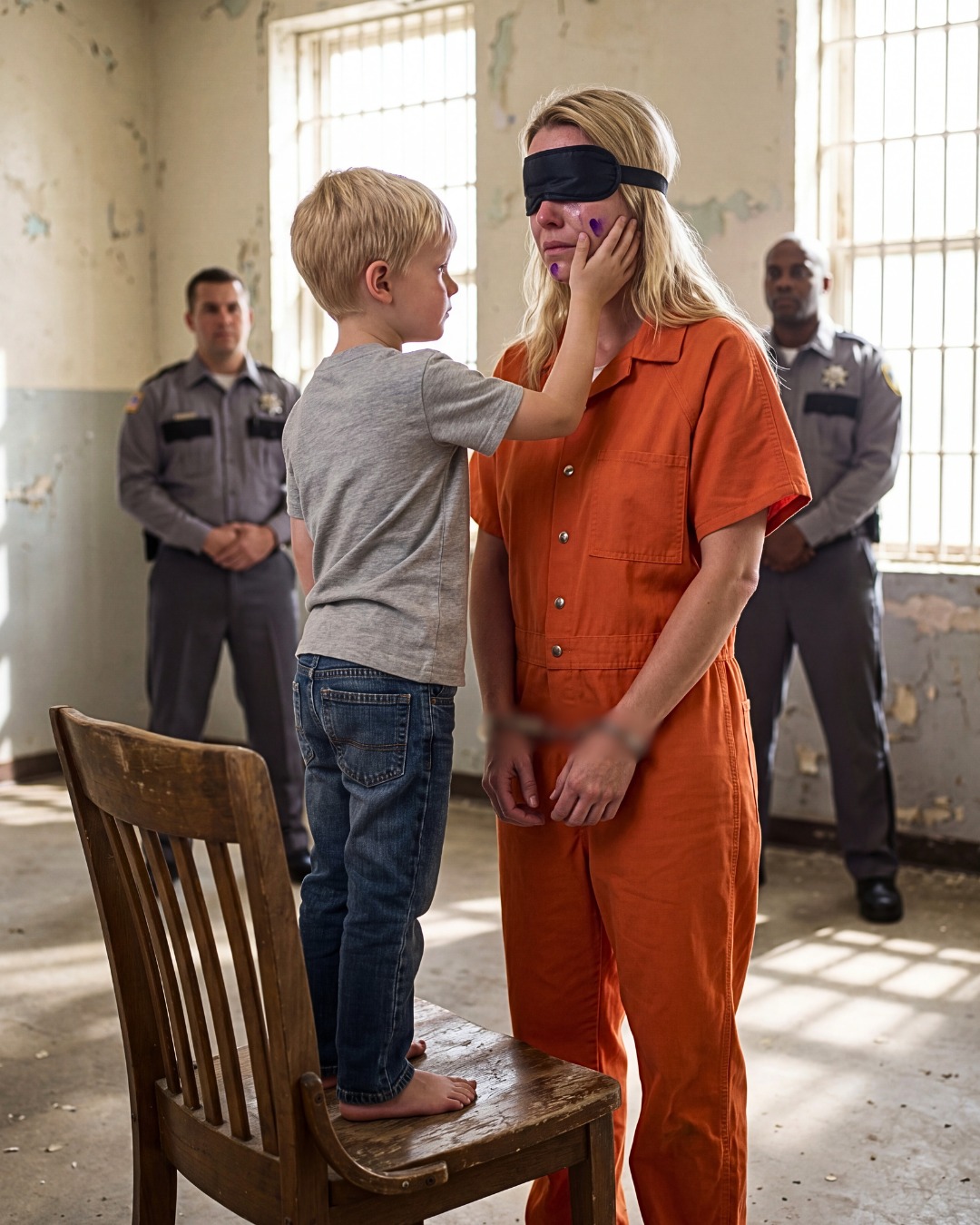
My mother, Helen, stood in her white death-row uniform with her hands cuffed in front of her. She looked smaller than the woman I remembered, thinner, worn down by years of concrete walls and fluorescent lights. But when Noah pointed at my uncle, her eyes changed.
For the first time in six years, I saw my mother again.
“Noah,” she whispered, her voice breaking. “Look at me.”
My little brother’s face crumpled. “I saw him, Mom. But he said if I told anyone, he’d put Claire in the pit. He said nobody would believe me because I was just a baby.”
My blood went cold.
Claire.
Me.
For six years, I had lived with the shame of doubting my own mother. But I had never imagined Noah had been carrying a truth worse than mine. He had been two years old when our father died. Two years old, and already threatened into silence.
The warden’s voice cut through the room.
“No one leaves.”
Uncle Victor gave a dry, ugly laugh. “Come on, Warden. The boy was two. He’s repeating something someone put in his head.”
“Who?” I asked. “Who would have put it there?”
Victor looked at me with the same false pity he had used on me since Mom’s conviction.
“Claire, don’t make this worse. Your mother has accepted what happened.”
Mom lifted her head.
“I never accepted anything.”
Victor spread his hands. “Helen, I raised your children. I paid lawyers. I buried my own brother. And now you’re accusing me?”
Noah screamed, “You killed Dad!”
The room froze.
The goodbye room was small, cream-walled, with a bolted metal table, a box of tissues, a Bible, and a pitcher of water no one had touched. Behind the glass, the clock kept moving toward the execution hour.
Every minute felt alive.
Hungry.
The public defender, Martin, stepped forward. “Warden, this requires an immediate stay.”
“The order came from the governor,” the warden said. “But if there is a new minor witness and possible hidden evidence, I will not send this woman to the chamber.”
Victor’s face changed.
“You can’t do that.”
“I can delay for procedural safety,” the warden replied. “And you are staying here.”
Victor moved toward the door. Two guards blocked him.
“I want a lawyer.”
“And my mother deserved a fair trial,” I said.
Everyone looked at me.
Even Mom.
For six years, I had said nothing brave. I had said, “I don’t know.” “I don’t remember.” “It was confusing.” “Maybe she snapped.”
Fear can dress itself up as caution. A broken seventeen-year-old can be convinced that blood tells the truth.
But now I understood.
Blood could be placed.
Stories could be arranged.
And silence could be trained into children.
The warden called for a recorder, a social worker, and a prosecutor on duty. Words began filling the air: suspension, witness statement, coercion, evidence, execution, chain of custody.
Noah held on to Mom’s uniform like if he let go, the state would take her away.
The warden lowered his voice. “Noah, I need you to tell us exactly what you remember.”
Noah looked at Mom. “Are they still going to kill you?”
No one answered.
That was the cruelest part.
Mom kissed his forehead. “Tell the truth, sweetheart. Whatever happens, tell the truth.”
Noah swallowed hard.
“That night, I heard Dad scream. I went downstairs. The kitchen light was on. Dad was on the floor. Uncle Victor was standing over him. There was blood on his shirt. Mom wasn’t there. Then he saw me and told me to go upstairs.”
His voice shook, but he kept going.
“He picked up the knife with a cloth. I followed him because I wanted Dad. He went into Mom’s room and put the knife under her bed. Mom was asleep, or she looked asleep. Then he rubbed something on her robe. When he saw me, he covered my mouth and said if I talked, Claire would disappear like Max.”
I covered my mouth.
Max.
Our dog.
One week before Dad was murdered, Max disappeared. Dad told us maybe the gate was left open. I cried for days. Uncle Victor bought me a stuffed animal and told me bad things happened sometimes.
Now I knew.
It had been practice.
A warning.
Victor began sweating. “This is insane. You’re believing a traumatized child?”
Noah placed the plastic bag on the table. Inside was a small key.
“Dad told me about the drawer. He said if Mom was ever in danger, I had to tell Claire to find the secret drawer. But I didn’t know how to open it. The key was inside my blue teddy bear.”
My knees nearly gave out.
The blue bear.
The one Noah had kept since he was a baby. The one I had almost thrown away three different times. For six years, the key to my mother’s life had been sitting in our closet.
At 6:00 p.m., the prosecutor arrived.
The execution was scheduled for 7:00.
The warden made call after call, his voice growing sharper each time.
“I will not carry out an execution while physical evidence is waiting to be recovered,” he said into the phone. “A minor witness has just named the victim’s main financial beneficiary.”
Financial beneficiary.
The words landed hard.
Victor had taken the house. Dad’s auto shop. The accounts. The truck. Everything he claimed he was “managing” for us because I was underage and Noah was a toddler.
He always said Mom destroyed us.
But it had been him.
At 6:37 p.m., the warden received the call.
He closed his eyes.
“Yes, Judge,” he said. “It is stayed.”
Mom made a sound I will never forget. Not a sob. Not relief exactly. It was like her soul had suddenly returned to her body.
Stayed.
Not free.
Not cleared.
But alive.
My mother would not die that night.
I fell to my knees in front of her.
“Mom…”
There were six years between us. Six years of short visits, unanswered letters, glass barriers, chains, and shame.
“Forgive me,” I whispered. “Forgive me for doubting you.”
She touched my face with her cuffed hands.
“Oh, Claire. You were a child.”
“I should have known.”
“They broke your life too.”
That was when I finally cried. Not like I had at Dad’s funeral, when I was too confused to grieve properly. I cried because now I knew what had really happened.
Dad had been murdered.
Mom had been buried alive.
And we had been raised inside a lie.
Two patrol cars went to the old house with Noah’s key, the prosecutor, Martin, and an emergency warrant. They would not let us go.
While we waited, Mom told us what we had never been allowed to hear.
“That night, your father argued with Victor. I had a headache, and Victor made me tea. I became so sleepy I could barely move. I woke up to police, blood on my robe, and Daniel dead. In the patrol car, Victor leaned close and said, ‘If you talk about the accounts, your children will have no one left.’”
“What accounts?” I asked.
Mom’s eyes filled with pain.
“Your father had discovered Victor was using the shop for illegal money. Fake invoices, stolen parts, loans, deliveries. Daniel found documents. He planned to report him.”
Then I remembered something I had buried.
Dad coming into my room that night. His hand on my hair. His whisper.
“Take care of your mom, Claire.”
I had thought it was a normal goodnight.
It was goodbye.
At 9:20 p.m., the prosecutor returned with an evidence box.
Victor stood. “That house is in my name.”
The prosecutor looked at him coldly. “We’ll be reviewing that too.”
My heart pounded. “Did you find it?”
“We found the secret drawer,” he said. “Documents, a notebook, a USB drive, and photographs.”
Then he pulled out a clear evidence bag.
Inside was the photograph.
Victor stood beside a man in a white shirt and hat, next to a black SUV. Behind them, half-hidden, was my father, as though he had taken the photo secretly.
On the back, in Dad’s handwriting, were the words:
“Commander Blake and Victor. Proof of deliveries. If I turn up dead, it wasn’t Helen.”
Mom covered her mouth.
The prosecutor continued. “The USB contains videos of Victor receiving money from former Commander Blake, who is currently under investigation for extortion and disappearances. There are also audio recordings. One appears to contain a threat against your father.”
When Noah was taken to another room with a psychologist, the prosecutor played the recording.
Dad’s voice came first.
“I have copies, Victor. Tomorrow I’m going to Internal Affairs.”
Victor answered, low and furious. “You have no idea who you’re dealing with.”
“I’m dealing with you. You used my shop.”
“You’d have lost that shop without me.”
“You dragged my family into this.”
Then a colder voice spoke.
“Daniel, think about your children. Accidents happen.”
Dad said, “If anything happens to me, Helen knows.”
The recording ended.
Mom whispered, “But I didn’t know where the papers were.”
The prosecutor turned to Victor.
“An arrest warrant has been requested for Victor Parker for first-degree murder, evidence tampering, threats, obstruction, and financial crimes.”
Victor exploded.
“Helen planted it! She always wanted everything!”
I stared at him.
“My mother was one hour from execution. When exactly did she hide evidence in a house you kept locked for six years?”
He went silent.
For the first time, the cuffs went on his wrists instead of hers.
As the guards led him away, Victor looked at me.
“You don’t know anything, Claire.”
“I know enough.”
“Your father wasn’t innocent either.”
Mom stood. “Don’t you dare.”
Victor smiled with hatred.
“Daniel was going to ruin us all. Some deaths are necessary.”
No one spoke.
He had confessed without saying the word.
The next morning, the news spread everywhere.
Execution stayed.
New evidence found.
Child names uncle as real killer.
I hated the cameras outside the prison. I hated the reporters saying my mother’s name like entertainment. But Grace Nolan, from an innocence organization, came to help us. She told me Mom had written to them years earlier.
“She never stopped fighting,” Grace said. “Even when no one answered.”
I looked away.
No one.
Including me.
The following weeks were a storm. Investigators reviewed the original case. The knife had never been properly photographed. The blood on Mom’s robe looked transferred, not splattered. No one tested her tea for sedatives. A neighbor had reported hearing a man’s voice, but the file called it a domestic dispute.
The truth had always been there.
Buried beneath the easiest story.
Wife kills husband.
Case closed.
A week later, Mom appeared in court. She was still thin, still cuffed, still in prison clothes, but she held her head higher.
Noah sat beside me clutching the blue bear.
“Is she coming home today?” he whispered.
“Today they start listening,” I said.
“They should have listened before.”
“Yes.”
“You too.”
He didn’t say it cruelly.
That made it hurt more.
The judge ordered an indefinite stay, reopened the case, and transferred Mom out of death row while the conviction was reviewed.
It still wasn’t freedom.
But it was no longer death.
Outside the courthouse, a reporter asked me, “Did you always believe your mother was innocent?”
I could have lied.
But lies had already stolen enough from us.
“Not always,” I said. “And I’ll regret that forever. But now I’m going to do what I failed to do at seventeen. I’m staying with her until she walks free.”
Freedom did not come quickly.
Justice had run toward conviction, but crawled toward repair.
Months passed. Commander Blake was arrested on a ranch while trying to flee. In his house, investigators found weapons, cash, files, and photographs of missing people. One photo showed Dad entering an Internal Affairs office the night before he died.
The man who should have protected him had betrayed him.
Victor tried to bargain. He blamed Blake. Then Dad. Then Mom. But the recordings trapped him. In one, Victor said, “If Helen goes down, the kids stay with me. The house too. No one will look.”
Mom heard it in court and did not cry.
Afterward, she told me, “Your father knew Victor was dangerous. But I don’t think he believed his own brother could use his children.”
“Do you hate him?” I asked.
“Victor? Yes.”
“And me?”
Mom stopped.
“How could you ask that?”
“Because I doubted you.”
She held my hands.
“Guilt is a prison, Claire. Don’t lock yourself in one while I’m trying to get out of mine.”
I leaned into her and hugged her. For the first time in six years, I could smell her hair without glass between us. It smelled like cheap prison soap.
And somehow, it smelled like home.
Freedom arrived on a gray Tuesday.
No music.
No miracle light.
Just a judge reading for forty-seven minutes about fabricated evidence, withheld proof, failed forensics, coerced silence, and a conviction that could not stand.
Then he said the words.
“Immediate release.”
Noah jumped up. “Now?”
The judge looked over his glasses.
“Yes, son. Now.”
Mom did not move at first. It was as if freedom was a language she had forgotten.
Then the guard removed her handcuffs.
She stared at her bare wrists, looked at me, looked at Noah, and collapsed to her knees.
“Daniel,” she whispered. “It’s done.”
She did not say, “I won.”
She spoke to Dad.
As if for six years she had promised him she would survive long enough to clear his name.
We ran to her, and the three of us cried on the courtroom floor.
Justice did not sound glorious when it arrived.
It sounded like a mother breathing without chains.
Going home was harder.
The house was legally tied up as evidence. Victor had changed the floors, sold Mom’s wardrobe, painted the kitchen an ugly color, removed Dad’s pictures, and turned my room into storage.
But in the hallway, the pencil marks were still there.
Claire, age 10.
Claire, age 12.
Noah, age 1.
Mom touched them like holy things.
“I thought I would never see this again.”
Noah pointed toward the kitchen. “Is that where Dad died?”
Mom closed her eyes. “Yes.”
“Can we put a plant there?” he asked. “So it’s not just where he died. So something grows.”
Mom pulled him close.
“Yes, sweetheart. We’ll put a plant.”
We lived for a while in a borrowed apartment. Mom had nightmares. She woke at the sound of keys. She saved food in napkins. She asked permission to shower. Some mornings she sat frozen, unsure what to do with time that belonged to her.
“I don’t know how to use mornings,” she told me once.
“So we’ll start small,” I said. “Eggs.”
“What if I burn them?”
“Then we eat bread.”
She burned them.
We ate bread.
It tasted like freedom.
Noah changed too. He stopped wetting the bed, but anger took its place. If anyone touched his blue bear, he panicked. If a man raised his voice near Mom, Noah stepped in front of her.
One afternoon, Mom knelt before him.
“Noah, you saved me. But you are not my guard. You are my son. Your job is homework, dirty sneakers, and asking for extra ice cream.”
“What if Uncle Victor comes back?”
“He won’t.”
“But I’m the man of the house.”
“No,” Mom said firmly. “You are the child of the house. That matters more.”
That was when I understood freedom was not just Mom leaving prison.
It was Noah leaving fear.
It was me leaving guilt.
It was Dad leaving the false story they had buried him inside.
Victor’s trial started a year later.
By then, Mom had cut her hair, started wearing bright blouses, and taken a job in a school kitchen. She said hearing children argue over dessert reminded her the world was alive.
I began studying law at night. After seeing how bad paperwork nearly killed my mother, I wanted to learn how every word could save or destroy a life.
When I testified, Victor tried to smile.
“Claire, sweetheart—”
“Don’t call me that.”
I told the court everything. The guardianship. The money. The threats. The way he discouraged visits because they “reopened wounds.” Noah testified by video. He spoke about the knife, the robe, the drawer, and Max.
Mom testified last.
Victor would not look at her.
She looked straight at him.
“You killed your brother. You buried me alive. You stole Noah’s childhood. You planted guilt in Claire. You used Daniel’s name to steal from his children. I don’t know what punishment is enough, but I know this: I am not afraid of you anymore.”
Victor finally raised his eyes.
“Helen, I lost my brother too.”
Mom leaned toward the microphone.
“You didn’t lose him. You left him bleeding in our kitchen.”
That was all she needed to say.
Victor was convicted.
First-degree murder. Evidence fabrication. Threats. Obstruction. Financial theft.
Commander Blake was sentenced separately. Some officers were investigated. Some were punished. Others simply retired early.
Justice was not complete.
But at least it no longer stood on my mother’s body.
When reporters asked Mom if she could forgive Victor, she answered, “I didn’t come here to forgive. I came here to live.”
Recovering the house took time.
When we finally got the keys, we entered alone. The air smelled of dust and old grief. In the kitchen, a dark stain remained in the corner, though everyone said it was only moisture now.
Noah brought a potted rue plant.