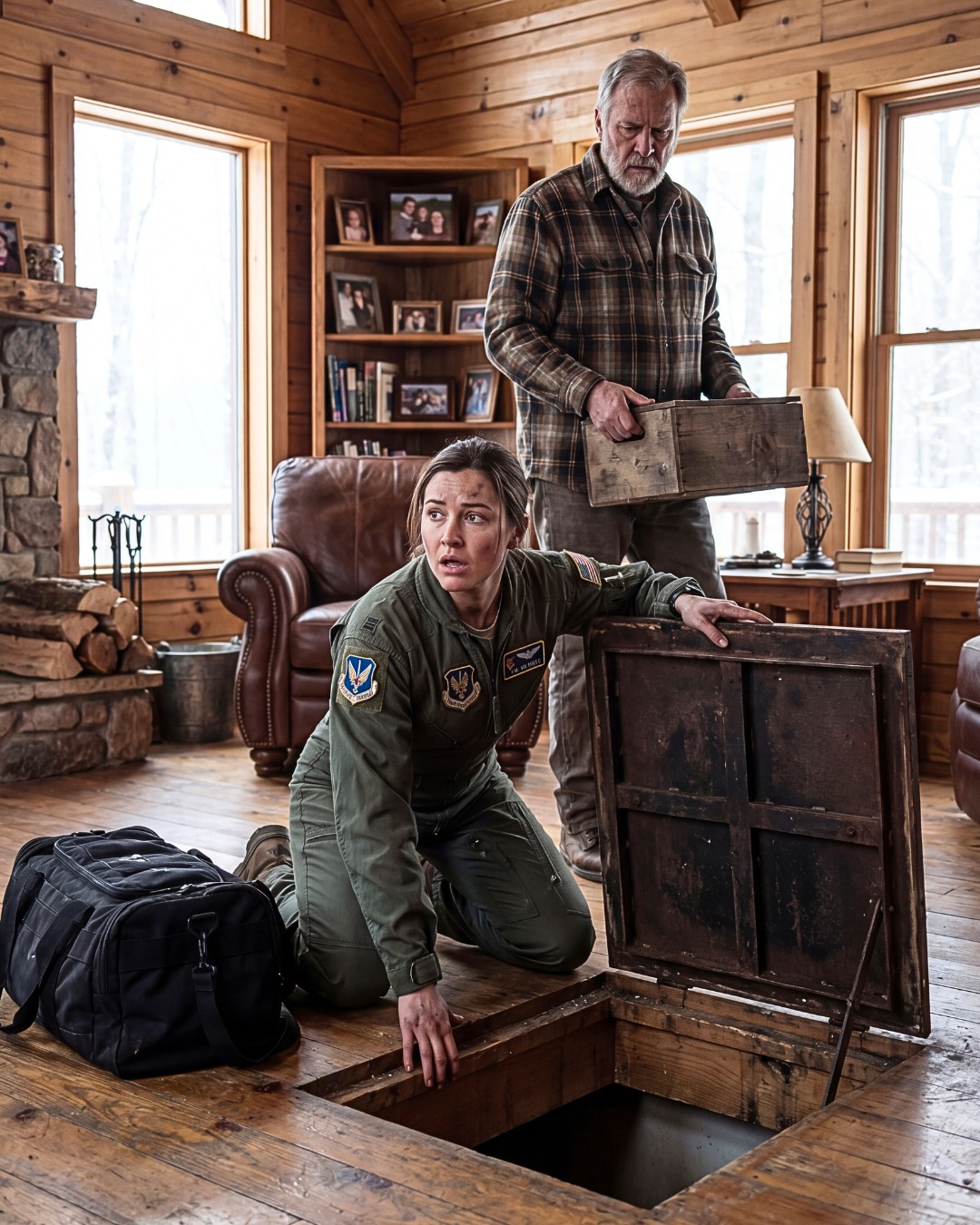
I inherited an old cabin in the mountains while my sister received a luxury apartment in Miami.
When she laughed in my face and said, “That place suits you perfectly, you filthy soldier,” I decided to spend one night there just to clear my head.
But when I arrived and opened the door, I froze.
Because my father had left me far more than a cabin.
The church still smelled of old wood, wilting flowers, and too much perfume when my father’s funeral finally ended. By the time we returned to my mother’s house in Syracuse, everyone looked exhausted, though most of them were still hovering around the dining room pretending grief tasted like reheated casserole.
I sat in the corner in my uniform. Not because I wanted attention, but because I had flown straight in from Fort Liberty and hadn’t had time to change. My younger sister, Lauren, however, looked almost radiant. She moved through the room like she was hosting an event, whispering to relatives, accepting sympathy, making sure everyone noticed how well she was “holding things together.”
Lauren had always been that way. Smug. Polished. Convinced the world owed her better lighting and nicer things.
I ignored her until the lawyer arrived.
Mr. David Park had been one of my father’s closest friends. When he walked in with a black briefcase, the room changed. Conversations died. Forks stopped scraping plates. Grief stepped aside and something uglier took its place.
Money.
Property.
Inheritance.
Everyone gathered around the dining table. My mother, Carol, sat stiffly with her hands folded tight in her lap. Lauren leaned forward, almost smiling.
David opened the folder and began reading.
“To my daughter Lauren, I leave the Miami apartment and a minority share in Parker Development.”
Lauren’s smile widened.
Of course it did.
The Miami apartment overlooked Biscayne Bay and was worth millions. The kind of place she could photograph from every angle and post online until people got tired of pretending to be happy for her.
Then David turned the page.
“To my daughter Erin, I leave the family cabin and the surrounding two hundred acres of land in the Catskills.”
Silence.
A cabin.
My father had given Lauren glass walls, ocean views, and city money.
He had given me an old wooden house in the woods.
I kept my face still. The Army teaches you that. Never let them see the first reaction.
Lauren had no such discipline.
She leaned back, crossed her arms, and smirked.
“A cabin suits you perfectly, you filthy soldier.”
She said it loudly enough for everyone to hear.
A few relatives gasped. My mother looked down at the table. David shifted uncomfortably but kept his voice steady, as if the best way to survive cruelty was to pretend it had not entered the room.
I clenched my jaw.
I had been insulted before. I had heard worse from men who wanted me dead. But this was my sister, sitting in our father’s house, spitting on me while his body was barely cold.
Lauren gave a soft laugh.
“Come on, Erin. You live out of a duffel bag anyway. That shack is perfect for you. Rustic. Lonely. Disposable.”
I looked at my mother.
She said nothing.
No correction. No defense. Not even my name.
That silence hurt worse than Lauren’s insult.
David closed the folder.
“That concludes the reading of the will. Your father’s wishes are legally binding.”
Lauren stood like she had just won a prize.
“I’ll start talking to people at Harborline Realty about managing the Miami property,” she said. Then she glanced at me. “Good luck chopping firewood alone.”
I grabbed my jacket and stood.
Years in the Army had taught me when to engage and when to walk away. That day, walking away was the only thing keeping me from turning my father’s dining room into a battlefield.
But Lauren followed me into the hallway.
“Don’t be mad,” she said, heels clicking behind me. “It’s not like you ever cared about this family. You were always off playing soldier while I stayed here and handled things.”
I turned around.
“You mean you handled yourself. Dad built this family. You just used it.”
Her smile sharpened.
“And now I get rewarded. Enjoy your little shack. Maybe you can use it for target practice.”
I left without another word.
Outside, the cold Syracuse air hit my face, sharp and clean. I stood on the porch, listening to muffled voices inside the house. Lauren’s laughter carried through the walls.
A few minutes later, my mother appeared at the door.
“Lauren didn’t mean it,” she said quietly. “She’s under stress.”
I almost laughed.
“She inherited a two-million-dollar apartment. What exactly is stressful?”
Mom looked away.
Then she stepped back inside and shut the door.
That told me everything.
She wasn’t with me. Not with the daughter who had spent years overseas carrying the family name into combat zones. She was with Lauren—the daughter who stayed close, dressed well, and never sacrificed anything.
That night, I drove back to my small apartment near base. It was barely a home, more like a place where I slept between assignments. I dropped my bag on the floor and sat on the edge of the bed, hearing Lauren’s voice over and over.
A cabin suits you perfectly.
The next morning, Mom showed up without warning.
She walked in before I invited her, pearl earrings in place, purse tucked under one arm.
“Erin,” she began, “Lauren feels terrible about what she said.”
I laughed once.
“Does she feel terrible, or do you feel terrible that people heard it?”
Mom’s mouth tightened.
“That isn’t fair. She’s handling the estate. She has responsibilities.”
“She inherited a penthouse. She’ll survive.”
Mom sat down.
“That apartment is an investment. Something for the family’s future. And the cabin… well, maybe Lauren should help manage that too. She has real estate connections. You have the Army. You don’t need to worry about property.”
I stared at her.
“So Dad left me something, and less than twenty-four hours later, you’re suggesting I give it to Lauren.”
“It would be simpler,” she said. “She sees it as a family asset.”
“No. She sees it as hers. And apparently, so do you.”
Mom stood, offended.
“I’m trying to keep this family together.”
“No, Mom. You’re trying to keep Lauren happy.”
She left soon after, telling me to “think about it.”
I did.
For a week, I threw myself into work. Training schedules. Supply checks. Meetings. Anything that kept my mind moving. But at night, Lauren’s smirk came back.
Then she texted.
How’s life in your shack?
I deleted it.
A few days later, Mom called.
“Erin,” she said carefully, “maybe you should go to the cabin. Stay there a night. Clear your head.”
I almost smiled at the manipulation.
“Lauren wants me out of the way, and you’re helping her.”
“That’s not true. The cabin is yours legally. No one is taking it. But Lauren thinks you’re holding on just to spite her.”
“She humiliated me in front of everyone, and now I’m the problem?”
Mom sighed.
“Please. Go see it. For your father.”
That stopped me.
For Dad.
That was the only reason I agreed.
So I packed a bag—clothes, boots, gear, flashlight, basic supplies. A cabin in the mountains didn’t scare me. What scared me was realizing my own family saw me as something disposable.
The drive north took hours. Roads narrowed. Forests thickened. The city faded behind me. By the time I turned onto the dirt road leading to the property, anger had cooled into determination.
My headlights caught the outline of the cabin: sagging roof, shuttered windows, dark porch.
My worthless inheritance.
I stepped out, boots crunching on gravel. The air was cold and still. The porch groaned under my weight, but the key turned smoothly in the lock.
I expected mildew.
Instead, I smelled pinewood, old leather, and faint coffee.
I flipped the switch.
Warm light filled the living room.
I froze.
Someone had been caring for this place.
The floors were clean. The furniture was old but solid. Firewood was stacked beside a stone fireplace. Blankets were folded over the couch. This wasn’t a shack.
It was waiting.
Then I saw the photo on the mantel.
My father, young and broad-shouldered, stood in front of the same cabin with an older woman I didn’t recognize. On the back, in his handwriting, were the words:
With Aunt Ruth, 1965. The place where everything began.
Aunt Ruth.
Dad had never mentioned her.
A knock at the door made me reach instinctively for a weapon that wasn’t there.
An older man stood on the porch holding a covered dish.
“Captain Bennett?” he called.
I opened the door cautiously.
“That’s me. Who are you?”
“Sam Walker,” he said. “Two cabins down. Marine Corps, retired. Your father asked me to check on you when the time came.”
He handed me the dish.
“Beef stew. Figured you’d be hungry.”
“You knew my father?”
Sam nodded.
“He came up here a week before he passed. Spent three days organizing things. Said his daughter might show up one day looking like the world had turned on her.”
My throat tightened.
“He said that?”
“Clear as daylight.” Sam started to leave, then paused. “He also said to check under the kitchen floorboard when you’re ready.”
Then he tipped his cap and walked away.
I shut the door and stood there with the stew in my hands.
Dad had known.
I set the dish down, went to the kitchen, and dropped to my knees. The pine floorboards were worn and scuffed. I ran my fingers along the seams until one plank shifted.
I pried it up with my pocketknife.
Underneath sat a metal box wrapped in oilcloth.
I carried it to the table and opened it.
Inside were photographs, land deeds, old letters, and a sealed envelope with my name on it. But beneath them was a geological survey.
My eyes moved quickly over the pages.
Granite.
Feldspar.
Lithium.
High-yield deposits.
Estimated commercial value: substantial.
I sat down hard.
Lauren thought Dad had given me scraps.
He had given me land sitting on mineral rights worth more than her Miami apartment could ever be.
Hands shaking, I opened the letter.
My dearest Erin,
If you’re reading this, then I was right about Lauren. I prayed I would be wrong, but I saw the way she looked at our family assets. I saw how she dismissed you when she thought I wasn’t listening.
You need to know about Ruth. She wasn’t my blood aunt, but she took me in after my parents died. This cabin was hers. This land was hers. She studied it for years and knew what was beneath it. She made me promise to protect it until someone strong enough could use it wisely.
That person is you.
I read the words until tears blurred them.
Dad had trusted me.
Not Lauren.
Me.
My phone buzzed.
Lauren.
“How’s the shack? Still smell like mold?”
For the first time all week, I almost laughed.
If only she knew.
I spent the night going through the box. Deeds. Bank records. Mineral surveys. Notes from Dad. The deeper I dug, the clearer it became. This land wasn’t just property.
It was leverage.
It was power.
And I was the one holding it.
The next morning, I finished Dad’s letter over instant coffee.
Erin, Lauren would only see money. You’ll see what Ruth wanted. Security. Independence. A place to build something for people who have been pushed aside. Don’t sell it. Protect it. Build something. I’ve already spoken to David Park. He has the documents proving your rights. Call him when you’re ready.
A knock came at the door.
Sam was back with a toolbox.
“Figured you’d need some basics if you’re staying.”
I let him in.
He glanced at the papers on the table.
“You found it.”
“I found enough to know this cabin isn’t worthless.”
Sam smiled slowly.
“Your Aunt Ruth was sharper than most geologists. Folks around here thought she was just stubborn. She knew exactly what she had.”
“If Lauren finds out,” I said, “how bad does this get?”
Sam didn’t hesitate.
“Bad. Families rip each other apart over less. Developers will circle fast. You’ll need a good lawyer and thicker skin than you already have.”
“Thicker than the Army gave me?”
He looked at me.
“Blood cuts deeper than bullets.”
He was right.
That afternoon, Lauren called.
“Well,” she said sweetly, “how’s our little shack treating you?”
“Our?”
She laughed. “Don’t be difficult. Mom and I think it makes sense for me to help manage the property. You’re always deployed. I know real estate. You can still visit sometimes.”
“No.”
Her tone sharpened.
“Dad didn’t leave it to you because you’re capable. He probably just felt guilty.”
“He left it to me,” I said. “That’s all that matters.”
I hung up.
The next morning, I woke to tires crunching on gravel.
A black SUV sat at the end of the drive. Two men with clipboards stood near the tree line.
“Can I help you?” I called.
One smiled too quickly.
“We’re from Harborline Realty. Just checking property lines.”
“Who gave you permission?”
“Your sister said it was a family holding.”
I crossed my arms.
“Then you can get off my land before I call the sheriff.”
They left quickly.
Lauren had already sent people.
I called Mom.
“Did you know Lauren sent realtors to my cabin?”
“She’s just making sure everything is in order.”
“She doesn’t own it.”
“She’s trying to help. You’re a soldier, Erin, not a landowner.”
“She’s trying to steal it.”
“Don’t be dramatic,” Mom snapped. “She’s thinking of the family.”
There was that word again.
Family.
Always meaning Lauren.
Never me.
The next day, I drove to David Park’s office with the metal box in my bag. His office overlooked the river, all glass walls and quiet efficiency.
“Captain Bennett,” he said, shaking my hand. “Your father trusted you would come.”
I slid the papers across the table.
He scanned the documents, stopping at the mineral survey. His eyebrows lifted.
“This is not just a cabin,” he said. “These mineral rights could be worth tens of millions.”
“I figured Lauren would want it if she knew.”
“She already does,” he said calmly. “Your father expected that.”
He handed me a thick folder.
“Deeds. Titles. Mineral rights. All signed, notarized, and filed. You are the sole legal owner. No one can touch it unless they want to waste years in court and lose.”
Those words settled over me like armor.
David leaned back.
“Your sister may try to bait you. Don’t bite.”
I almost smiled.
“That’s her specialty.”
“Then make restraint yours.”
When I returned to the cabin, Sam was chopping wood.
“So?” he asked.
“Dad made it airtight.”
Sam grinned.
“Good. Because Lauren’s people came by again. I told them to leave.”
“They’ll be back.”
“Then don’t quit.”
That night, I wrote a plan in a spiral notebook.
Secure the land. Strengthen legal position. Develop future use. Don’t let Lauren control the story.
It felt like an operations order.
Only this time, the battlefield was my own bloodline.
A week later, I drove back to Syracuse to face Mom and Lauren. Lauren’s Lexus was in the driveway. They were waiting in the dining room like judges.
Lauren sat with a glass of white wine.
“Still enjoying your shack?” she asked.
“I know what it’s worth.”
Her smile thinned.
“Then you understand why it should be handled by someone with experience. I’ve already had buyers drafted.”
“You went behind my back to appraise my property?”
“Our property,” she corrected.
I slammed my hand on the table.
“No. Mine. Dad’s will was clear.”
Mom snapped, “Don’t raise your voice in my house.”
I looked at her.
“Your house or Lauren’s? It’s getting hard to tell.”
Lauren leaned forward.
“You think papers make you untouchable? Courts can be persuaded. Judges can be convinced. You’re unstable from deployments. You don’t have the time to fight this.”
I smiled coldly.
“Try me.”
For once, her mask slipped.
“This won’t end well for you.”
“Neither will underestimating me.”
I left before they could drag me into another circle of lies.
Back at the cabin, Sam handed me a beer.
“They’re not backing down,” I said.
“Neither are you.”
That night, by the lake, I whispered into the cold air, “I won’t let them take this.”