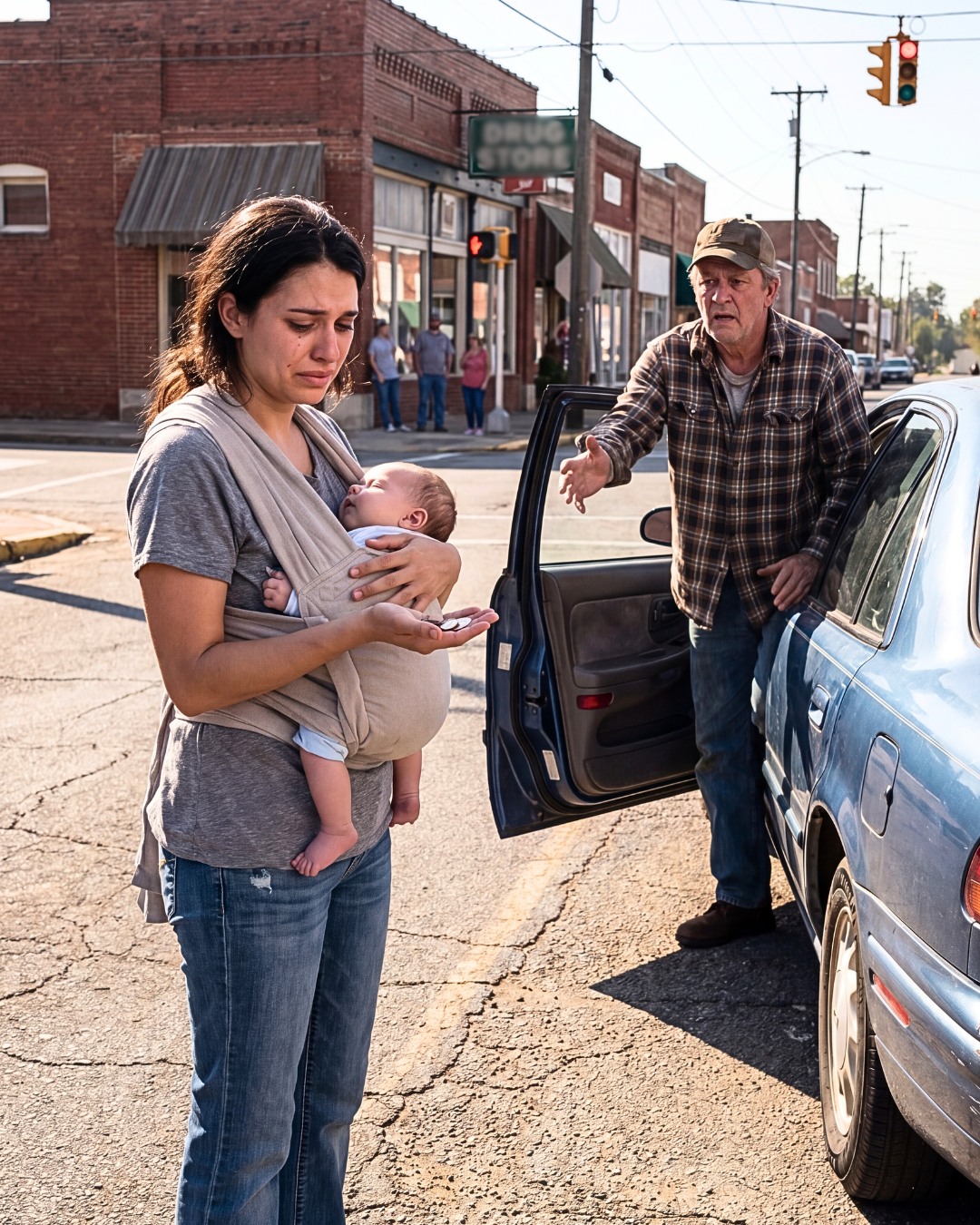
I spotted my daughter standing on the side of the road asking strangers for money while holding her baby, and for several terrifying seconds I couldn’t decide if I was seeing reality or some nightmare pulled straight from my deepest fears.
The heat slammed against the windshield mercilessly.
The air downtown was thick with exhaust, horns, sweat, and motorcycles darting through traffic like panic itself had somewhere urgent to be.
I was driving home from the clinic after what should have been a routine appointment, and the doctor’s warning still echoed in my mind, telling me to stay away from stress.
At sixty-six, I already knew better.
Stress always finds you.
It just changes its face.
That afternoon, it wore my daughter’s face.
I stopped at a crowded intersection packed with vendors, windshield cleaners, and people moving between cars asking for spare change.
I glanced impatiently at the dashboard clock, thinking about the files waiting at my office.
Then I noticed a young woman weaving through traffic barefoot, carrying a baby tightly against her chest.
Her clothes were dirty.
Her hair was knotted and messy.
One hand stretched outward while the other gripped a few coins she counted over and over with frantic precision, as if every penny was either survival or defeat.
The baby’s cheeks were flushed bright red from the heat.
She barely moved.
First I felt sympathy.
Then came horror.
The woman raised her head.
It was Isabella.
My daughter.
I rolled down the window so quickly I nearly broke the button.
“Isabella.”
She stopped walking instantly.
For a moment, I thought she might run.
Not because she didn’t want to see me, but because shame hit her before relief could.
She partially covered her face with her hand, but I had already seen too much: hollow eyes, burned skin, cracked lips, and shoulders bent beneath exhaustion.
And little Lily, my granddaughter, limp against her chest like a flower wilting beneath the sun.
“Get in the car,” I told her.
“Dad… please, not here,” she whispered, glancing nervously at the drivers staring from nearby cars.
“Just let me finish.
I…”
“Get in. Right now.”
My tone came out harder than I intended, but Isabella recognized that voice.
It was the voice I used when danger left no room for discussion.
She opened the door slowly and climbed in, holding Lily tightly.
The traffic light remained red while horns exploded behind us.
I ignored them.
The second the door shut, the city noise faded.
But something worse remained inside the car: the sound of the coins still trembling in my daughter’s hand.
I couldn’t stop staring at them.
“What are you doing out there, Isabella?”
She stayed silent.
Her thumb gently brushed Lily’s cheek.
The baby whimpered weakly.
Isabella lowered her face, and tears dripped onto her stained dress.
I inhaled slowly.
My pulse hammered in my head.
I remembered the doctor warning me about my blood pressure and almost laughed at the absurdity of telling someone not to worry.
Then I asked the question tearing through me.
“What happened to the house and the car we gave you?”
Isabella closed her eyes.
That hurt more than any answer.
It was the expression of someone preparing to destroy the last fragile thing holding them together.
“Daniel kept the keys,” she finally whispered.
“He said I didn’t need to drive anymore.
That I had nowhere to go.
Then his mother started taking my bank cards.
At first she claimed she was helping me manage money.
Then she never gave them back.”
I stared at her silently.
“Carol controls everything now, Dad.
The groceries, my phone, Lily’s formula, even when I’m allowed to shower.
She says I’m a terrible wife.
A terrible mother.
Daniel used to stay quiet.
Now he repeats everything she says.”
Her voice cracked, but she kept talking.
Maybe because once the truth starts spilling out, it can’t be forced back inside.
She told me Daniel lost his job months earlier.
At first she supported him.
She used her savings to cover bills.
She secretly sold small belongings because she didn’t want me worrying.
Then Carol arrived carrying a suitcase, saying she only planned to stay temporarily while Daniel recovered emotionally.
Temporary became permanent.
Control became cruelty.
Carol inspected receipts.
Criticized Isabella’s clothes.
Said married women shouldn’t leave the house unnecessarily, even though Isabella only wanted to take Lily to appointments or visit friends.
Eventually Daniel started sounding exactly like his mother.
“They called me useless,” Isabella whispered.
“They said I lived off your money.
Off the house in my name.
Off everything you gave me to keep me secure.”
My grip tightened around the steering wheel.
“And the house?”
Isabella swallowed hard.
“They changed the locks two days ago.”
The light turned green.
I didn’t move immediately.
Someone behind us shouted angrily.
I barely heard it.
I could only stare at my daughter, trying to see the little girl who once crawled into my lap during thunderstorms hidden inside this broken woman.
“Where did you sleep last night?”
Her eyes dropped again.
“On a bench outside a church.
A woman let me use the restroom so I could clean Lily and change her clothes.”
Something inside me turned ice cold.
Not explosive anger.
Not the kind that screams.
Something far worse.
Calm certainty.
A decision.
“Why didn’t you call me?”
Isabella wiped her face roughly.
“They took my phone.
And when I finally borrowed one, Daniel answered before I could talk.
He said if I contacted you, he’d convince you I was unstable.
That I couldn’t care for Lily.”
“And you believed him?”
For the first time, she looked directly at me.
“Dad… when someone tells you every day that you’re crazy, worthless, and alone…
eventually you start wondering if they’re right.”
That sentence shattered me.
I didn’t cry.
I couldn’t.
My daughter had already cried enough for both of us.
I drove straight to a pharmacy.
I bought water, diapers, wipes, formula, baby food, medicine, clean clothes for Lily, and a simple dress for Isabella.
The cashier looked at my daughter with quiet sympathy.
Isabella lowered her head again.
I paid without speaking.
Then I drove them to a private clinic.
I demanded they examine Lily immediately.
When the pediatrician checked her breathing and temperature, Isabella couldn’t stop apologizing for every little thing—the baby’s crying, the heat, the hours outside.
“It’s not your fault,” I told her.
She shook her head weakly.
“A good mother wouldn’t end up like this.”
“A good mother climbed into a car and protected her child even while drowning in shame.
That’s exactly what you did.”
She looked at me like she didn’t know how to accept kindness anymore.
The doctor confirmed Lily was dehydrated but stable.
She needed fluids, rest, and monitoring.
While the nurse explained instructions to Isabella, I stepped into the hallway and called my attorney.
“I need you at Isabella’s house today,” I said.
“What happened?”
“Daniel and his mother threw her out.
They kept her phone, money, documents, and car.
They also threatened to take the baby.”
Silence followed.
“I’m leaving now.”
Then I called my accountant.
After that, the manager who handled vehicle contracts for my company.
The answers confirmed everything.
The car Daniel proudly drove belonged to a contract I paid for.
The house was legally Isabella’s.
The accounts I funded for her showed suspicious withdrawals she never made.
Every conversation tore another hole through their lies.
When I returned to the room, Isabella sat quietly beside Lily’s bed.
A nurse had cleaned her face and tied back her hair.
She looked older and younger all at once.
I sat beside her.
“Listen carefully,” I said.
“You are never begging on the street again.
You are not returning to that house alone.
And nobody is taking your daughter from you.”
She cried silently.
“I never wanted you to see me like this.”
I held her hand.
“I’m your father.
If the world abandons you on the street, it’s my responsibility to find you.
The only thing I regret is not finding you sooner.”
She tried to hold herself together.
Then she completely broke apart.
Later that afternoon, before we went to the house, she gave me everything she still carried: the coins, a wrinkled piece of paper with an address, and an old copy of her ID hidden inside the diaper bag.
Then she admitted something else.
“Daniel recorded me crying,” she whispered.
“He’d provoke me, take Lily away, insult me, and when I snapped, he’d start filming.
Then he’d threaten to use the videos to prove I was unstable.”
My attorney looked up immediately.
“Do you still have any messages?”
She hesitated.
Then nodded.
“I emailed screenshots to an old account before they took my phone.
I thought maybe one day I’d need them.”
For the first time all day, I felt hope.
“That day is today,” I said.
At six-thirty that evening, we drove to the house.
I left Isabella at the clinic with a trusted assistant while Lily rested.
I refused to let Daniel or Carol intimidate her again.
Not while she was vulnerable.
Outside the property, my lawyer, a locksmith, and two officers responding to the domestic abuse and withheld-property report were already waiting.
The sunset reflected warmly across the windows, making the house appear peaceful from the outside.
It offended me.
I helped buy that house so my daughter could feel safe.
I painted Lily’s nursery myself.
I carried furniture inside while Isabella laughed at me for getting lost in the kitchen.
And inside those walls, they had slowly turned her into a prisoner.
I rang the bell.
Daniel opened the door wearing a clean button-up shirt, hair perfectly styled.
He looked like a man who had rehearsed his innocence.
When he saw me, he smiled.
“Mr. Victor, what a surprise.
Isabella isn’t here.
She left on her own.
We’ve been extremely worried.”
Carol appeared behind him.
Arms folded.
Eyes cold.
“Your daughter needs psychological help,” she said.
“She left emotionally unstable with the baby and wasn’t thinking clearly.”
I stayed silent long enough for the officers to step forward.
Long enough for Daniel to notice the attorney.
Long enough for Carol to see the locksmith.
Their confidence cracked instantly.
“Isabella did not leave voluntarily,” I said calmly.
“You threw her out.
You took her money, phone, documents, and keys.
You threatened to take her child.”
Daniel laughed nervously.
“That’s ridiculous.
She exaggerates everything.
You know how emotional she gets.”
“No,” I replied.
“What I know is this house belongs to her.”
My attorney opened the file and showed the deed.
Carol stepped forward angrily.
“They’re married.
Daniel has rights.”
“He also has legal responsibilities,” my attorney answered.
“And changing the locks on the homeowner was not very smart.”
Daniel stopped smiling.
One of the officers requested entry so Isabella’s belongings could be recovered.
Daniel tried blocking the doorway.
“You can’t just enter my house.”
My attorney stayed calm.
“We can do this peacefully, or we can request a warrant using the messages, medical records, and abuse statements.
Your choice.”
Carol looked toward her son.
For the first time, uncertainty crossed her face.
We walked inside.
The smell of fresh coffee and dinner filled the house.
That detail hit me harder than anything.
While my daughter begged under the burning sun to buy milk, they were comfortably eating in her kitchen.
Shopping bags sat in the living room.
New clothes still carried store tags.
On the table, I spotted Isabella’s bracelet—the one I gave her when she graduated college.
Carol saw me looking and quickly covered it.
“That’s mine,” she snapped.
“No,” I said quietly.
“It isn’t.”
The officer wrote it down.
Upstairs, Isabella’s belongings had been thrown carelessly into boxes.
Wrinkled clothes.
Photos turned face down.
Documents mixed with garbage and baby items.
Inside a drawer we found her passport, insurance papers, and bank cards hidden inside an envelope.
Daniel tried explaining himself.
“She loses things constantly.
I was protecting her.”
My attorney looked directly at him.
“Were you protecting her when you texted that begging for money would teach her humility?”
Daniel went pale.
That was when I realized he knew the evidence still existed.
Carol finally exploded.
“That girl manipulates everyone.
She’s weak.
My son ruined his life marrying her.”
I stepped closer.
Still calm.
“My daughter gave your son a home, a car, stability, and love.
And he repaid her by stripping away her dignity.”
Before Carol could answer, one officer discovered Isabella’s phone hidden inside a kitchen drawer wrapped in a napkin.