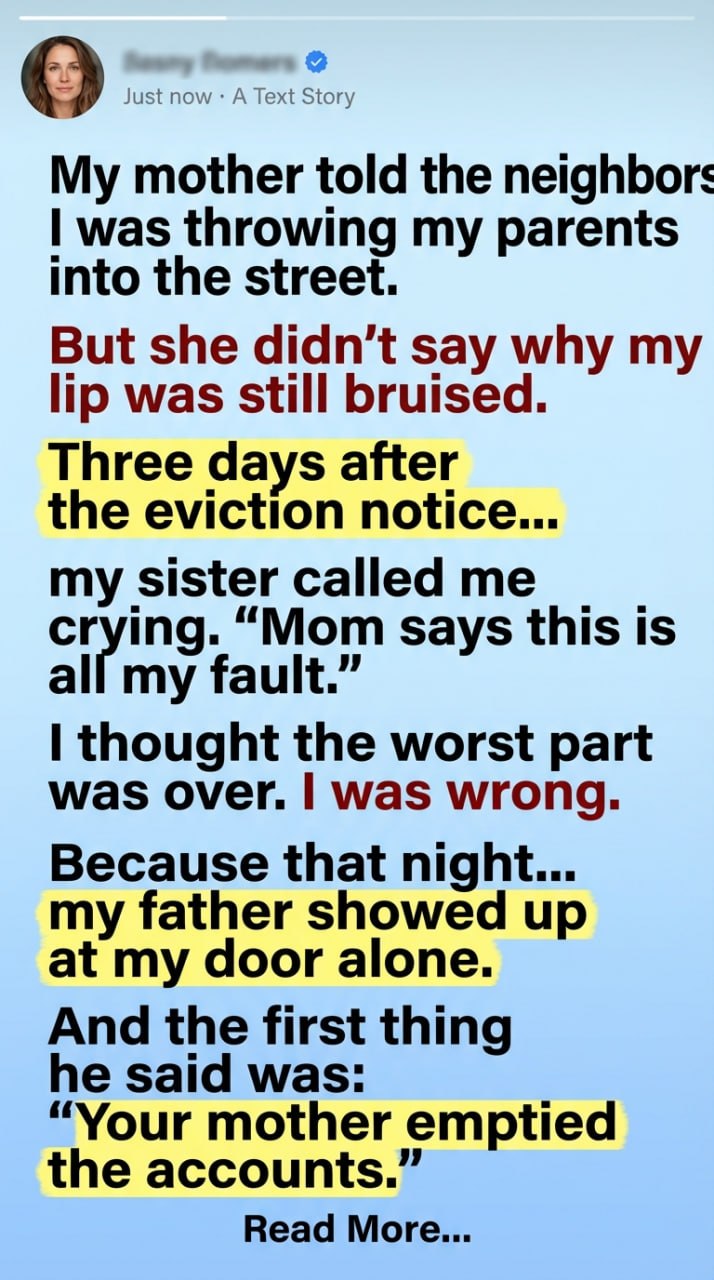
The morning after that dinner, I woke up with a swollen lip, a bruise along my jaw, and six missed calls from my mother.
No apology.
No “Are you okay?”
Just voicemail after voicemail growing sharper each time.
The first was offended.
“Call me back. We need to discuss your little stunt.”
The second was angry.
“You are not throwing your family out over one misunderstanding.”
By the fourth, her voice had turned venomous.
“If you do this, don’t expect any of us to forgive you.”
I listened to all of them while standing in my bright, quiet kitchen, coffee warming my hands, and for the first time… I didn’t call back.
Instead, I called my lawyer.
I had kept him updated for years, mostly as a precaution. Back when I bought the house through Carter Holdings, he’d asked me more than once if I wanted to stay anonymous forever.
At the time, I’d said yes.
That morning, I said, “Send everything.”
By noon, the formal notice had been delivered again—this time by courier and email. Legal, clean, undeniable.
Thirty days.
No extensions.
No negotiations outside counsel.
My father called within minutes.
I picked up on the third ring.
“You’re humiliating us,” he said, skipping hello.
“No,” I said. “You did that yourself.”
“You’re really going to make your own parents homeless?”
I looked out the window at the neat row of townhouses across the street, at the quiet little world that had no idea what had happened at that dinner table.
“You had years to prepare,” I said. “Years while I paid more than you knew. Years while Lila drained you dry and you still demanded more from me.”
His breathing sharpened.
“This is because I disciplined you?”
I almost laughed.
“You smashed my face into a table.”
He was silent.
Then, coldly, he said, “You always were dramatic.”
And there it was.
No regret. No shame. Just the same old script.
I hung up without another word.
Two days later, the neighborhood found out.
Not because I told them.
Because my mother told everyone before I could.
But of course, she didn’t tell the truth.
According to her, I had become greedy. Heartless. Corrupted by money. She told anyone who would listen that I was “abandoning” my family after they had “given me everything.”
She cried on porches.
She clutched her chest dramatically at the mailbox.
She told Mrs. Donnelly next door that I’d “changed since getting rich.”
That part almost made me smile.
Changed?
No.
I had just stopped kneeling.
Still, I knew how these things worked. In neighborhoods like theirs, stories spread fast, and the first version often stuck.
So I drove over that Saturday afternoon, not to argue, but to collect a few personal documents I’d left in a locked file cabinet in the study years ago.
As I stepped out of my car, curtains twitched.
Mrs. Donnelly was watering her flowers but not really watering them.
Mr. Ruiz across the street stood with a rake in his hands for an absurdly long time.
Everyone was watching.
And right on cue, my mother came flying out the front door.
“Oh, so now you show up?” she shouted.
I kept walking.
She followed me down the path, voice rising louder with every step.
“You think because you have money you can treat us like dirt?”
I turned then, calm enough to make her angrier.
“You called the neighbors, didn’t you?”
Her mouth tightened.
“I told the truth.”
From the porch behind her, Lila folded her arms and smirked.
I looked from one to the other.
“No,” I said evenly. “You told your version.”
That drew more attention. A front door opened down the block. Someone stepped outside pretending to check their mail.
My mother pointed a shaking finger at me.
“You’re throwing your own mother into the street!”
I glanced around, then said in a clear voice, “Should I also tell them why?”
Her face changed instantly.
Just slightly.
But enough.
She hadn’t expected that.
The front door creaked wider behind us, and Mr. Ruiz finally wandered a little closer, concern written all over his face.
Everything about my mother’s performance depended on me staying quiet. On me being the obedient daughter who took the blame to keep the peace.
But peace had already ended when my father slammed my face into that table.
So I reached into my purse and took out a folded tissue.
The blood was gone now, but the cut along my lip was still visible. The bruising had darkened into shades of purple and yellow.
Mrs. Donnelly gasped.
My mother froze.
“She slipped,” Lila snapped from the porch.
I looked right at her. “Did I?”
No one answered.
Mr. Ruiz slowly lowered his rake.
And then, before my mother could invent something new, my father appeared in the doorway.
For one second, I saw it in his eyes.
Fear.
Not of losing the house.
Of losing the story.
He came down the porch steps with forced calm, like he could still control the scene.
“Let’s not do this outside,” he said through clenched teeth.
I met his stare.
“You should have thought of that before doing it inside.”
The silence that followed was brutal.
Neighbors weren’t pretending anymore. They were openly listening.
My mother tried to recover first. “Families have disagreements.”
“Yes,” I said. “But most disagreements don’t end with blood on the floor.”
That landed.
Hard.
Mrs. Donnelly covered her mouth.
Mr. Ruiz’s expression shifted from curiosity to disgust.
Lila stepped forward, suddenly shrill. “You’re exaggerating! Dad barely touched you!”
I turned to her.
“Fifty thousand dollars,” I said. “That’s what this was over, right? You wanted me to hand it over, and when I refused, Dad attacked me and Mom laughed.”
“No!” my mother shouted too quickly.
But fast denials often sound the most guilty.
My father’s voice dropped low. “Enough.”
I nodded. “Yes. It is.”
Then I walked past them, unlocked the front door with my own key, and stepped inside my own house.
That was when the whispering started outside.
Not loud.
Just enough.
Enough for my mother to hear.
Enough for my father to realize the neighborhood would never see them the same way again.
Inside, I went straight to the study.
My hands trembled only once I was alone.
I hated that.
Not because I was scared of them anymore, but because some small part of me still ached. Some part of me still wanted parents who would run after me with ice and apologies instead of insults and threats.
But grief has a way of showing up late, after anger has done its work.
I opened the cabinet, took my passport, old tax records, and the original purchase file for the property.
Then I noticed something odd.
One of the drawers was half-open.
Inside was a stack of overdue notices.
Credit cards. Store accounts. Personal loans.
Most were in my mother’s name.
Some in my father’s.
One in Lila’s.
The totals made my stomach turn.
They weren’t just irresponsible.
They were drowning.
And suddenly, their desperation at dinner made perfect sense.
They hadn’t wanted help.
They’d wanted rescue.
And they had expected me to be too frightened, too loyal, too trained to say no.
I closed the drawer slowly.
Not my problem, I told myself.
Not anymore.
When I came back outside, the crowd had thinned, but the judgment in the air had not.
My mother stood stiffly near the porch. Lila was crying now, though whether from rage or panic I couldn’t tell.
My father looked older than he had a week earlier.
Good, a cruel little voice in me whispered.
Let him feel it.
I stopped at the bottom of the steps.
“You have twenty-eight days now,” I said. “Use them.”
My mother’s eyes filled with tears. “How can you be so cold?”
I almost answered with the truth.
You taught me.
But instead I said, “I learned from experts.”
Then I walked back to my car.
This time, no one stopped me.
That night, my phone buzzed nonstop.
Unknown numbers.
Old family friends.
Two cousins I hadn’t heard from in years.
Apparently my mother had widened her campaign.
Some messages called me cruel.
Some begged me to reconsider.
One aunt wrote, Whatever happened, they are still your parents.
I stared at that sentence for a long time.
Then I typed back:
And I was still their daughter when he hit me.
After that, the messages slowed.
Truth does that.
It clears the room.
Three days later, I got the first sign that things inside that house were starting to crack.
Lila called me.
Not texted.
Called.
The moment I answered, she was already crying.
“You don’t understand,” she said. “They’re blaming me for everything.”
I leaned back on my couch, expressionless.
“Are they wrong?”
“That’s not fair!”
A bitter laugh escaped me. “No, Lila. Fair would have been you getting a job five years ago.”
She sniffed loudly. “Mom says you’ve always hated me.”
I closed my eyes for a second.
“I never hated you,” I said. “I hated what they turned you into.”
That shut her up.
Then, quietly, almost childlike, she asked, “Are you really not going to help?”
I thought about the boutique. The designer bags. The smug little smile at the dinner table.
And then I thought about blood hitting tile.
“No,” I said.
And I hung up.
By the second week, the story had changed in the neighborhood.
Not publicly.
No one came to me with gossip.
But I noticed the shift.
Mrs. Donnelly no longer waved to my mother.
Mr. Ruiz started parking his truck farther from their driveway.
A woman from two houses down—someone I barely knew—stopped me at the grocery store and touched my arm gently.
“I’m sorry,” she said.
That was all.
But it meant everything.
Because for once, someone had seen me.
Not as the difficult daughter.
Not as the selfish one.
Not as the family bank.
Just as someone who had finally been hurt one time too many.
Then came the knock at my door.
Late evening. Rain tapping the windows.
I opened it, and there stood my father.
Alone.
No anger this time.
No performance.
Just a man looking wet, tired, and suddenly unsure of his power.
“I think we should talk,” he said.
I looked at him for a long moment.
Then at the bruise his hand had left on my face in the mirror across the hall.
And I realized this wasn’t over.
Not even close.
Because men like my father never came to apologize first.
They came when they wanted something.
And the look in his eyes told me exactly that.
Something had happened.
Something big.
Something he could no longer hide.
I stepped back just enough to keep the chain on the door.
“Talk,” I said.
His jaw tightened.
Then he said five words that made my stomach drop.
“Your mother emptied the accounts.”
next Part 3: click here>>>The Truth He Couldn’t Hide<<<