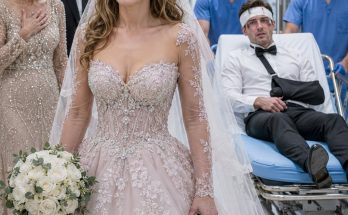
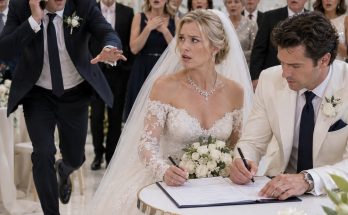
The night before my wedding, my sister sliced my gown into ribbons and sent me a text that said, “Oops. Guess the ugly dress finally matches the ugly bride.”
My mother looked at the ruined dress, looked at me, and said I was being dramatic.
So I didn’t cry.
I called my insurance company.
By lunchtime the next day, two uniformed officers were standing on my sister’s front porch.
My name is Avery Beaumont. I am thirty-one years old. Six months ago, my sister destroyed my wedding dress the night before I was supposed to walk down the aisle. She sent me proof of the damage with one sentence attached, cruel enough to be remembered exactly.
“Oops. Guess the ugly dress finally matches the ugly bride.”
My mother told me to stop overreacting.
She still believes I should have swallowed it for the sake of family. She still has not understood that what my sister did to the dress was never the worst thing that happened that night.
If you work in insurance long enough, you stop believing in accidents as easily as other people do. You start seeing patterns. You learn to read a room the way an auditor reads a financial statement. You look for what doesn’t belong. You look for what has been moved, edited, staged, rewritten.
My family had been rewriting me for twenty-nine years.
I simply had not started keeping receipts until that November.
Before I tell you about the dress, you need to understand the house I came from.
The Beaumont name meant something in coastal Massachusetts. Old money, quiet manners, polished tables, private schools, and family secrets pressed flat beneath linen napkins. My grandmother, Adeline, still lived in the Marblehead house my grandfather Charles bought in 1964. My father, Richard, died of a stroke in 2019 at fifty-nine.
My mother, Meredith, had been the head of a private academy in Brookline for over twenty years before she retired early and devoted herself to deciding which of her daughters deserved tenderness on any given week.
It was rarely me.
My younger sister, Sloane, was three years behind me and had always been the sun in my mother’s sky. I was the gray forecast nobody wanted to hear before breakfast.
When I was sixteen, my grandmother gave me a pair of small Victorian pearl earrings that had belonged to her mother. Sloane borrowed them at nineteen and “lost” them at twenty. My mother told me to stop making Sloane feel guilty.
Eleven years later, Sloane wore those earrings to my rehearsal dinner.
I noticed the second she walked in.
I said nothing.
That is the first thing you should understand about me. I notice everything, and I say almost nothing until saying something becomes the same as filing something.
I became a senior underwriter at Whitmore & Vale Mutual in Boston eight years after graduate school. I write policies for high-value personal articles: engagement rings, couture gowns, fine art, rare instruments. I sell paper that says if the world breaks something you love, this is what the world must pay to repair it.
Two weeks before my wedding, I wrote the rider on my own gown.
$18,500.
Scheduled. Appraised. Photographed.
The veil had a separate rider: ivory Chantilly lace, heirloom piece, appraised at $6,200. It had belonged to my grandmother. My mother had refused to wear it in 1989 because she said it looked “too old-world.” I loved it for that exact reason.
My fiancé, Elliot Grayson, was a corporate litigator in Boston. He was quiet in a way people often mistook for softness. He listened for nearly a full minute before speaking, then said exactly what needed to be said.
We chose the Whitcomb Estate in Cape Cod for the wedding: a coastal property with a small chapel, a main house, and a bridal suite on the second floor of the east wing facing the water.
The rehearsal dinner was Friday, November 21st, 2025.
The wedding was Saturday, November 22nd.
My grandmother Adeline, eighty-two, missed the rehearsal because of a late-season flu. Her doctor told her to stay home until morning. She sent a cotton-wrapped box to my suite with a note on top.
Open only if you need to.
I did not open it that night.
Sloane gave the rehearsal toast. She was good at toasts in the way cruel people are good at weddings. She stood in a champagne silk dress, lifted her glass, and said, “To my big sister, finally doing the one thing I thought she’d never do—letting someone else make the rules.”
Half the room laughed.
Elliot’s eyebrow moved a fraction.
My mother smiled the way she always did when Sloane landed a blade she considered clever.
During the toast, Sloane glanced toward the east wing, toward the bridal suite.
Only for half a second.
Nobody else noticed.
I did.
My mother spent the evening rearranging seating cards and repeating in her old headmistress tone, “We do not make scenes.” She said it to Elliot’s parents. She said it to my cousin Hallie when Hallie asked why Grandmother Adeline wasn’t there. She said it to me when I asked if she had seen Sloane.
“Avery, sweetheart,” she said, touching my arm, “a daughter’s wedding is a mother’s reward.”
Remember that part.
She had a black leather clutch in her hand with gold trim. The silver edge of a keycard was sticking out of the top.
A keycard to the bridal suite.
A keycard she had no reason to have.
I told myself I was being paranoid. Eight years of underwriting teaches you to distrust your first suspicion, because most claims are not fraud. Most damage is accidental. Most sisters do not actually do the awful thing your instincts tell you they might do.
I told myself my mother was holding the keycard because she had offered to have housekeeping steam the gown one last time before morning.
I told myself a lot of things that night.
At 11:44 p.m., I left the bar and walked down the east wing hallway to check the gown before bed. The carpet had a soft, expensive hush under my heels. I remember the smell of cedar from the linen closet and salt air from the cracked windows.
Suite 214.
I had turned the lights off at 9:30.
The lights were on.
I remember exactly what I thought.
Don’t step in farther than you have to.
Eight years of photographing damaged property had taught me one rule above all others.
Preserve the scene before you feel anything.
The door was open three inches. I pushed it with the back of my hand, not my palm, not my fingertips, and stood at the threshold.
My gown was on the bed.
I say on the bed because I still cannot say it the way it truly was.
It had been arranged.
Someone had taken time with it.
The bodice was cut from neckline to waist. The skirt had been opened along every seam from hip to hem. The train lay in pieces. A pair of fabric shears rested on the armchair by the window, placed at a clean angle, as if whoever left them wanted me to know they had been selected with care.
The veil, my grandmother’s veil, hung from the mirror on its satin hanger. It had been cut vertically down both sides.
One drop of ivory candle wax sat on the carpet below the chair leg from the rehearsal dinner table.
I counted the cuts because counting is what my brain does when catastrophe walks into the room.
Forty-one.
I counted again.
Forty-one.
Not random.
Every cut followed a seam.
Whoever did it knew where fabric was weakest.
Rage makes a mess.
This was a blueprint.
I pulled out my phone. My hand was steady. That surprised me. I took one photograph, then another.
Behind me, footsteps stopped.
Marissa Cole, my maid of honor and former colleague at Whitmore & Vale, stood at the threshold. She did not come in.
“Avery,” she said quietly. “Don’t touch anything. I’ll get Daniel.”
Daniel Price was the estate’s overnight suite manager.
Marissa looked at her watch and tapped the screen once.
11:51 p.m.
We had both learned the habit at the firm: log the minute you arrive at a scene.
My phone buzzed.
11:52 p.m.
Sloane.
Oops. Guess the ugly dress finally matches the ugly bride.
I screenshotted the message before reading it a second time.
Then I watched the typing bubble appear under her name.
Disappear.
Appear again.
Disappear.
She was waiting for me to fall apart.
I turned my phone on airplane mode for ninety seconds.
Let her imagine whatever she needed to imagine.
Then I turned it back on.
My mother arrived before Marissa returned. She held a glass of Sauvignon blanc and had already had too much of it. She stood in the doorway, looked at the dress, looked at me, and said, “Sweetheart, it’s fabric. Don’t be dramatic.”
That is exactly what she said.
Not “What happened?”
Not “Who did this?”
Not “Are you okay?”
A mother who walks into a room where her daughter’s wedding gown is in pieces and never once asks who did it is not reacting to an event.
She is completing one.
She stepped into the room. She did not look at the floor. The keycard still flashed from her clutch.
“We are not calling anyone,” she said. “We are going to sleep. In the morning, your sister will apologize, and we will move on.”
She came back minutes later with chamomile tea. The cup was Wedgwood. The spoon was hers, engraved MB. She traveled with her own silver spoons.
“Drink this,” she said, “and sleep.”
I said, “Okay, Mom.”
I took the tea.
I did not drink it.
The moment my mother believed she had quieted me was the moment she lost the night.
If she had sat beside me, if she had asked one honest question, if she had looked at the shears and named what Sloane had done, she might have saved something.
Not from the law. That was already moving.
She might have saved herself from me.
From the version of me who opened the navy leather binder on the nightstand as soon as her footsteps disappeared down the hall.
The binder bore the Whitmore & Vale seal. I carried it on every trip. Marissa had mocked me for it for years.
“Avery, nobody brings a claims binder to her own wedding.”
I had laughed.
I had brought it anyway.
I opened it to the tab marked AB-25-1107.
My own policy.
Custom silk charmeuse gown, appraised at $18,500.
Chantilly lace heirloom veil, appraised at $6,200.
Rider active. Scheduled personal article. Signed by me, countersigned by my supervisor, timestamped in the carrier system.
The binder was not a weapon.
It was a spine.
Inside the back pocket was a Post-it from Marissa, written years earlier after a difficult claim.
If you ever need me, call before you cry.
I folded it and put it in my pocket.
Then I called the Whitmore & Vale after-hours line.
It was 12:06 a.m.
I gave the agent my name, employee ID, policy number, nature of damage, and probable intent. I spoke in forty seconds. She asked three questions. She issued the claim reference number.
WVM-AB-2025-11-884.
I wrote it in black ink on the first page of the binder.
Then she asked, “Do you want this flagged for SIU review?”
Special Investigations Unit.
The quiet hallway between insurance and law enforcement.
I said, “Yes.”
After a pause, she said, “Avery, you do not have to be the one who pulls the trigger. We can do it for you. All you have to do is say yes.”
I said yes.
Daniel Price arrived at 12:18 a.m. He had worked at the Whitcomb Estate for twelve years. He had seen broken glass, stolen deposits, screaming fathers, runaway grooms.
He had never seen a bride’s own sister take scissors to the gown.
He did not ask if I was okay.
He said, “Ms. Beaumont, I can pull the keycard logs and lobby cameras. Do you want me to seal the room?”
“Yes.”
He produced an incident report from a leather folio, logged the time, and sealed the door at 12:24 a.m. with silver tape across the frame. He initialed each strip and handed me a copy.
“If law enforcement gets involved,” he said, “we cooperate fully.”
“They will,” I said.
Elliot came down five minutes later. Marissa had called him.
He did not rush me. He did not smother me. He stood in the adjacent sitting room, took off his watch, set it on the table, and rolled up his sleeves.
“Do you want me to call Malcolm, or do you want me to stand here?” he asked.
Malcolm Reed was his attorney in Boston.
“Call Malcolm,” I said. “And stand here.”
It was the first time that night I used the word we.
From 12:30 to just after 3:00 a.m., Marissa and I photographed everything. Daniel loaned us a mirrorless camera from the estate office. We used an Allen key as scale reference in every frame. Eight shots per grid. Five rows. Forty-one photos, one per cut. We named the files sequentially and uploaded them to the carrier portal.
On photograph twenty-eight, I noticed something I had missed in person.
A cut shaped like the letter A in the underskirt.
Not a seam.
A signature.
By 3:30 a.m., Daniel had the keycard logs.
He read them aloud.
9:04 p.m. — M. Beaumont issued replica key.
11:13 p.m. — S. Beaumont entry.
11:36 p.m. — S. Beaumont exit.
Next entry: Avery Beaumont, 11:44 p.m.
Then he pulled the lobby camera.
Grainy, but clear.
My mother in the parking area near the east wing at 11:11 p.m., handing a keycard to Sloane.
Sloane nodding.
Sloane walking toward the suite.
My mother returning to the bar and ordering a second Sauvignon blanc while my gown was being destroyed seventy feet away.
I did not cry.
At 3:41 a.m., I emailed the Whitmore & Vale SIU liaison, Juliette Kane, with a full chain-of-custody document, signed affidavits from Marissa and me, the photos, the keycard logs, and the lobby footage.
In the material-witness field, I wrote one name in pencil on the printed form.
Meredith Beaumont — pending.
I was not ready to elevate her.
Not because I didn’t want to.
Because I wanted to be correct.
At 4:02 a.m., Malcolm replied to Elliot’s email thread.
Filing by dawn.
At 4:20 a.m., I closed the laptop. The chamomile tea still sat cold on the nightstand. The spoon had not moved.
I washed my face in the suite bathroom. In the mirror, I did not look like a bride.
I looked like what I was.
A woman who built files for a living.
A woman whose family had handed her the cleanest file she would ever build.
At 5:40 a.m., I walked across the wet lawn toward the cottage where my mother was staying. I had meant to call my grandmother. I had meant to ask whether to postpone.
I had not meant to enter the cottage.
But the door was unlocked, and inside, the family iMac glowed awake.
My mother’s Gmail was open.
I did not touch the mouse.
A draft sat at the top of the inbox.
Subject line: RE: Lesson Plan.
Recipient: sloane.b.private@proton.me.
Dated October 28th, 2025.
Three weeks before my wedding.
I took out my phone and photographed the screen externally, so the provenance stayed clean. Then I read the thread without clicking.
Six emails.
October 28th. October 29th. November 5th. November 14th. November 18th. November 20th.
October 28th, my mother to Sloane:
She needs a lesson. Something she can’t insure her way out of. Don’t make it look like you. Make it look like her.
October 29th, Sloane:
How far are we going?
November 5th, my mother:
As far as it takes to remind her she is not the center of this family.
November 14th, Sloane:
The shears arrive Wednesday. I’ll make sure she finds it first.
November 18th, my mother:
Don’t leave a trail.
November 20th, Sloane:
No trail. Just the dress.
I read the emails twice.
The sun was coming up over the lawn. Somewhere in the main house, a housekeeper was starting coffee. A gull cried over the water.
My mother had not wanted only to ruin my dress.
She had wanted to break the part of me that knew how to protect myself.
Something she can’t insure her way out of.
She had chosen the language of my career and turned it into a weapon.
A door opened behind me.
I turned.
My grandmother Adeline stood there in a camel coat over her pajamas, holding the cotton-wrapped box.
She looked at the computer.
She looked at me.
She read the screen for four seconds.
Then she reached over and powered the machine down.
“I’ve been waiting for her to put it in writing for thirty years,” she said.
I said nothing.
“Call Clara Wynn,” she said. “Tell her to open the atelier at 6:45. Tell her we’re bringing the 1964.”
Inside the box was my grandmother’s wedding dress.
Acid-free cotton. Cedar-lined. A hand-stitched label inside that read:
Quiet strength. AB. 1964.
She had kept it for sixty-one years. She had offered it to my mother in 1989. My mother had laughed and bought a sleek salon gown in Boston instead.
“Who is Clara Wynn?” I asked, though I knew.
“My dressmaker,” Grandmother said. “She has the last bolt of lace. She will alter it in four hours. Do not argue.”
I called Clara at 5:58 a.m.
She answered on the first ring.
“Adeline called Tuesday,” she said. “She said you might need a dress on Saturday. I ordered silk thread and pulled the lace from climate storage. If she was wrong, I would have put it back.”
She was not wrong.
At 6:11 a.m., I forwarded the email screenshots to Malcolm and Juliette Kane at SIU with one note:
Author: my mother. Recipient: my sister. Dates October 28th to November 20th. Please advise whether the mother’s role elevates this beyond single-actor vandalism.
Malcolm called back in nine minutes.
“Massachusetts recognizes conspiracy to commit malicious damage,” he said. “It stacks. Do you want her included in the affidavit or held back for leverage?”
“Include her,” I said. “No leverage. No deals.”
“Your wedding is in six hours.”
“I know.”
“You’re sure?”
“I’m sure.”
Grandmother had me in the car by 6:20. She drove herself, one hand on the wheel, the other on my knee.
“Listen to me,” she said. “Your grandfather built this family on four things: a name, a house, a trust, and the expectation that the people who inherit those things do not destroy one another. Your mother broke that expectation.”
“What about Sloane?”
“Sloane chose poorly,” she said. “Your mother designed the room she made that choice in. That is different.”
Clara Wynn’s atelier in Falmouth opened at 6:45 a.m. on a Saturday for the first time in forty years. Clara, her daughter Ruth, and a junior tailor named Beth were waiting.
They fitted the 1964 gown on me at 6:55.
Silk dupioni. Bateau neckline. Three-quarter sleeves. Hand-beaded lace at the bodice. A faint cream color from decades of careful storage.
It almost fit.
The bust needed half an inch.
The waist needed a quarter.
They worked in silence for three and a half hours.
At 10:15 a.m., Clara stepped back.
“That’s your dress,” she said.
My grandmother took off the silver oval locket she had worn every day of my life. The back was engraved with the same words hidden inside the gown.
Quiet strength. AB. 1964.
She placed it around my neck.
“This stays with you today,” she said. “And when you hand it to your own daughter, you’ll understand why I waited.”
I returned to the bridal suite at 10:50 a.m.
Marissa helped me into the gown. She did my hair in eighteen minutes and my eyeliner with the confidence of a woman who had once done stage makeup in college.
When she finished, she stepped back.
“Your grandmother’s dress looks like it was sewn for today.”
Maybe it was.
My phone buzzed.
Elliot: Malcolm confirms warrant signed. Service window 11:30 to 12:30.
I put the phone face down.
At 12:04 p.m., Detective Nolan and Officer Reeves knocked on Sloane Beaumont’s condo door in Boston.
I know the time because Malcolm’s office received confirmation within ninety seconds.
Sloane opened the door in a silk robe, holding her phone sideways, halfway through filming a morning makeup story for her private Instagram list.
The video lasted eleven seconds before she stopped recording.
Eleven seconds of my sister opening a door and going silent as two uniformed officers entered the frame.
Detective Nolan was a thirty-year veteran with the patience of a man who had executed hundreds of warrants without raising his voice.
“Miss Beaumont,” he said, “I’m Detective Nolan with Cape Cod Police. This is Officer Reeves. We have a warrant for your arrest in connection with an incident last night at the Whitcomb Estate. You can come with us voluntarily, or we can proceed otherwise. Your choice.”
Sloane was wearing the pearl earrings.
My grandmother’s pearl earrings.
The ones she had “lost.”
She said one thing.
“My mother will handle this.”
She went voluntarily.
At 12:09 p.m., my mother’s phone rang upstairs at the estate while a planner’s assistant was fitting her into a champagne gown. The ceremony was at one.
She answered.
Listened for six seconds.
Stood.
“Ten minutes,” she told the assistant. “Tell no one.”
Her dress was still open halfway down the back. She put a coat over it, took the service stairs, demanded her car, and drove out through the estate gates at 12:14 p.m.
Forty-six minutes before my wedding.
Marissa saw the car from the window.
“Avery,” she said, “your mother just left.”
“I know.”
There was nothing else to say.
Grandmother came upstairs in a silver-gray dress. She was nobody’s official role that day, and somehow the entire bride’s side of the family.
She sat in the chair where my mother should have been.
“Hair up,” she said. “Hands still. This is a wedding, not a trial.”
“Both can happen on the same day,” I said.