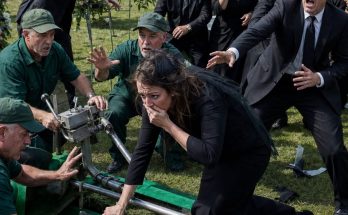
“But what Michael said next into that microphone made Damien’s new wife lower her head in front of everyone.
He stood at the podium in his blue cap and gown, one hand gripping the edge like he was holding himself back from shaking, and he looked straight at the front row.
“My mother didn’t end up in the back today because there weren’t seats,” he said. “She ended up there because someone decided her place could be taken.”
The applause faded into a heavy silence.
Bianca’s face changed first. The smooth, practiced smile she wore like expensive lipstick disappeared, and beneath it was something small and startled, something that had never imagined being named in public. Damien leaned toward her, whispering quickly, but Michael kept talking before either of them could recover.
“I saved two seats,” he said. “One for my mom and one for my aunt Patricia. I wrote their names myself on the list I gave the office. So if they were told to stand in the back, I want everyone to understand that wasn’t a mistake.”
The principal, Dr. Elaine Mercer, stood beside the stage with her hands clasped tightly in front of her navy blazer. Her eyes moved from Michael to the front row, then to the young usher standing frozen near the side aisle. The usher looked like he wished the floor would open under him and offer a professional exit.
My heart pounded so hard that I could hear it in my ears.
Patricia was crying openly now, one hand over her mouth, the bouquet of sunflowers crushed against her chest. Around us, people had turned in their seats. Some looked shocked. Some looked embarrassed, as if they had been caught witnessing something private. A few mothers were crying too, the way women cry when another woman’s hidden pain suddenly becomes visible and recognizable.
I wanted to disappear.
I wanted to run to my son.
I wanted to stop him from saying more, because he had worked too hard for this day. He had earned every shining moment, every camera flash, every proud handshake. I did not want my humiliation to become the memory attached to his graduation.
But Michael was not looking at me like he needed saving.
He was looking at me like he had finally decided to save me.
He turned back to the auditorium, his voice steadier now.
“There are people in this room who know my mother as the woman who came to parent conferences in scrubs. Some of you saw her sitting in the back of soccer games after twelve-hour shifts. Some of you saw her car in the parking lot before sunrise because she had dropped me off early so she could make it to work on time. Some of you probably never noticed her at all.”
A quiet ripple moved through the room.
“I noticed,” he said.
My knees almost gave out.
“I noticed when she pretended she wasn’t hungry so I could have seconds. I noticed when she worked holidays because the pay was better. I noticed when she smiled at people who looked down on her because she didn’t want me to feel embarrassed. I noticed when she paid tuition bills in installments and called it ‘being organized,’ even though I knew she was scared.”
A sound broke from my throat. I tried to swallow it down, but Patricia wrapped an arm around my waist.
“Let him say it,” she whispered through tears. “For once, let somebody say it.”
Michael’s eyes shifted to his father.
Damien had gone stiff in his seat. His expensive gray suit looked suddenly too tight around the shoulders. He was the kind of man who loved attention when it came with applause, but not when it came with truth. Bianca sat beside him, her phone dark in her lap, her lips pressed together so hard they had lost color.
Michael did not raise his voice. He did not insult them. That made it worse for them and more powerful for everyone else.
“My father is here today,” he said. “And I’m glad he came. But I will not pretend that the person who showed up today is the person who got me here.”
Someone in the second row gasped softly.
Damien’s jaw moved, but no sound came out.
Michael looked back toward me, and the whole auditorium seemed to turn with his gaze.
“The person who got me here is standing in the back in a blue dress. And before I receive anything on this stage, I want her where she should have been from the beginning.”
Then he stepped away from the podium.
For one frozen second, no one seemed to know what to do.
Then Dr. Mercer moved.
She walked down the steps from the stage and into the center aisle, her expression calm but firm. She looked toward the front row and said, in a voice that carried clearly, “Please make room.”
Bianca blinked. “Excuse me?”
Dr. Mercer’s face did not change. “Mrs. Rivers, those seats were reserved for Mrs. Salazar and her guest. Please make room.”
It was the first time all morning that someone with authority said my name like it belonged.
Bianca opened her mouth, closed it, then looked at Damien. Damien did not move quickly enough. Maybe he was calculating. Maybe he was furious. Maybe he was realizing that the room had turned against him and that charm had no place to stand.
Patricia muttered, “Now he’s quiet.”
A woman in the row behind Damien leaned forward and said, not very softly, “Sir, your son is waiting.”
That did it.
Damien stood. His face was dark with embarrassment, but he stood. Bianca followed, movements sharp and stiff. Her mother gathered her purse with wounded dignity, as if she had been the injured party. The two men I didn’t recognize shuffled out with the awkwardness of people who had accepted seats in a story they did not understand.
The front row opened.
But I still could not move.
The aisle stretched in front of me like a river I did not know how to cross. Everyone was standing. Everyone was watching. Their applause had softened, no longer explosive, but steady and warm, like rain on a roof. I had spent so many years making myself small so Michael could have room that being seen felt almost unbearable.
Patricia turned me gently by the shoulders.
“Walk,” she said.
“I can’t.”
“Yes, you can. You walked through worse for eighteen years.”
My feet moved.
At first, each step felt impossible. I held my purse in one hand and Patricia’s arm in the other, the sunflowers between us trembling as she cried. People stepped back to make room. A teacher I recognized from Michael’s freshman year touched her hand to her heart. One father nodded at me with tears in his eyes. A woman whispered, “God bless you,” as I passed.
I kept my eyes on my son.
Michael stood near the podium, still in his cap and gown, tears shining on his cheeks now. He did not wipe them away. My serious boy. My beautiful, stubborn boy who had once hidden his report card under his mattress because he got a B in chemistry and thought he had disappointed me. My boy who had saved coins in a jar when he was nine because he wanted to buy me a washing machine after ours broke. My boy who had learned too young that money had moods and adults could vanish and love sometimes had to be built by the person who stayed.
When I reached the front row, I stopped.
The seat was there. Empty. Waiting.
A white paper with my name had been taped to the back.
MARIANA SALAZAR.
The letters blurred.
I touched the paper with my fingertips. It was real. My son had written my name. Not Rivers. Not guest. Not standing room.
Salazar.
Mine.
Dr. Mercer gestured kindly. “Please, have a seat.”
But Michael stepped off the stage before I could sit.
The auditorium inhaled.
He came straight to me, ignoring the program, the principal, the schedule, the eyes of hundreds of people. For a moment, he was not the honor graduate or the scholarship student or the young man about to leave home for college. He was my little boy crossing a room because his mother was crying.
“Mom,” he said.
I tried to speak, but nothing came out.
He wrapped his arms around me, cap brushing my hair, gown rustling against my dress. He was taller than me now. Stronger. But the way he held on was the same as when he was small and feverish, when he would press his face into my shoulder and trust me to make the world less frightening.
“I’m sorry,” he whispered.
“No, baby,” I managed. “No. This is your day.”
“It’s ours,” he said.
That broke me.
I held him in front of everyone, crying into the blue fabric of his gown, and for once I did not apologize for the tears. I did not worry that I was taking up space. I did not smooth my dress or hide my face or turn away so nobody would see what a lifetime of exhaustion looked like when it finally met recognition.
The auditorium rose again, louder this time. Not polite applause. Not ceremony applause. Something deeper. People clapped like they were trying to repair something with their hands.
Michael let go first, but only enough to look at me. He took the sunflowers from Patricia, who surrendered them with a trembling laugh, and placed them in my arms.
“These were for you,” he said.
Patricia cried harder. “They were for you, mijo.”
He smiled at her. “I know. But today she gets flowers.”
Then he returned to the podium.
I sat in the front row with Patricia beside me, the bouquet on my lap, my hands shaking around the stems. The chair did not fix the years. It did not erase every birthday Damien missed or every late child-support check or every time Bianca had smiled at me like I was an old stain on their new life.
But it meant something.
A chair can mean something when people have spent years trying to prove you do not deserve one.
Michael unfolded his speech again, but he did not read from it. He looked over the auditorium with a calm I had seen in him only a few times before, usually when he had already made a decision no one could change.
“I was supposed to give a speech today about ambition,” he said. “About hard work, leadership, and the future. I wrote all the right things. My English teacher helped me make it sound impressive.”
A soft laugh moved through the room. A woman on the faculty side wiped her eyes.
“But standing here, I realized the most important lesson I learned in high school didn’t come from a classroom. It came from watching my mother live with dignity in situations that tried to take it from her.”
He paused.
“My mom never had the luxury of being bitter. She had bills. She had work. She had a kid who needed shoes, braces, school lunches, science fair supplies, a laptop, rides to practice, and someone to believe he could become more than what life handed him.”
I looked down at the flowers because if I looked at him too long, I would fall apart completely.
“She taught me that sacrifice is not loud. Sometimes sacrifice sounds like an alarm going off at 4:45 in the morning. Sometimes it looks like a woman eating toast over the sink because she has ten minutes between jobs. Sometimes it is a mother who has every reason to speak badly about someone and chooses not to because she wants her child’s heart to stay clean.”
Damien lowered his head.
Bianca sat two seats away from him now, no longer in the front row, but at the edge of the aisle where the usher had placed them after moving the other guests. She looked smaller without the stage of that front seat. Her champagne dress caught the light, but not beautifully anymore. It looked too bright for the moment, too polished for the truth.
Michael continued.
“I know my mom isn’t perfect. She burns rice when she’s distracted. She thinks every password needs an exclamation point. She keeps birthday cards forever and says she’s ‘organizing’ when she’s really just moving piles from one place to another.”
Laughter rose again, warmer this time.
I laughed through my tears. “That’s not necessary,” I whispered.
Patricia leaned over. “It is accurate.”
“But my mother showed up,” Michael said. “Every time. Even when she was tired. Even when she was scared. Even when other people made her feel like she should stand in the back. So this honor is not mine alone.”
He looked toward Dr. Mercer.
“When you call my name for the diploma, I want my mother beside me.”
The principal did not hesitate. “Of course.”
A murmur of approval swept through the auditorium.
Michael looked at me again. “And I want my father to hear this too.”
The room went still.
Damien lifted his head slowly.
Michael’s voice softened, and that somehow made it more devastating.
“Dad, I wanted you here. I still do. But I need you to understand something. Showing up for the picture is not the same as showing up for the life. I hope one day we can have a real relationship. But it has to start with honesty. Not money. Not appearances. Not letting someone disrespect my mother so you can avoid an uncomfortable moment.”
Bianca stared at her lap.
Damien’s face looked gray.
I did not feel joy seeing him embarrassed. That surprised me. For years, I had imagined him finally understanding what he had done. I thought if that day ever came, I would feel victory. Instead, I felt tired. Sad. Relieved, maybe. But not cruel.
Because the truth was, I had not wanted Damien destroyed.
I had wanted him to be a father.
Michael took a breath.
“That’s all,” he said. “Thank you.”
The auditorium came to its feet again.
This time, I stood too.
Not in the back.
In the front.
The rest of the ceremony moved like a dream after that. I heard names called, saw caps, flowers, flashing cameras, but everything felt slightly distant, as if my heart had stepped outside of time and was watching from the aisle. When Michael’s name was finally announced, Dr. Mercer paused and looked at me.
“Mrs. Salazar,” she said gently, “would you join us?”
My legs trembled when I climbed the stage steps.
Michael stood beside me as the diploma was handed to him. The photographer lifted her camera. I tried to step aside, but Michael caught my hand.
“Stay,” he whispered.
So I stayed.
The camera flashed.
In the photo, which I would later frame and place above the little table in our hallway, Michael is holding his diploma in one hand and my hand in the other. My eyes are swollen. His cheeks are wet. My blue dress is wrinkled from standing in the back too long. The sunflowers are on a chair below the stage, bright as small suns.
It is the most beautiful picture ever taken of me.
After the ceremony, families spilled into the courtyard under the hot Arizona sun. The air smelled like asphalt, perfume, and graduation flowers. Students shouted for friends. Parents adjusted caps for photos. Younger siblings complained about being hungry. Everywhere, there were balloons, hugs, tears, and the strange, shining relief of a chapter ending.
I found myself surrounded by people.
Michael’s English teacher, Mrs. Hayward, hugged me first. She was a tall woman with silver hair and red glasses, the kind of teacher students feared until they realized her standards were just another form of love.
“Mariana,” she said, holding both my hands, “I have wanted to meet you properly for four years.”
I wiped my face quickly. “I’m sorry. I’m usually running from work.”
“I know,” she said. “Michael wrote about you in nearly every personal essay he ever turned in. You raised an extraordinary young man.”
The words entered me like water after drought.
“Thank you,” I whispered.
Other parents came too. Some I recognized. Some I didn’t. They congratulated me, hugged me, told me Michael’s speech had moved them. A father in a navy suit said, “I need to call my mother after that.” A woman I had seen at school fundraisers, always perfectly dressed and distant, squeezed my arm and said, “I’m sorry if I ever made you feel unseen.”
I didn’t know how to answer that, so I simply said, “Thank you.”
Patricia, meanwhile, had appointed herself my security and public relations manager.
“She is accepting compliments,” she announced to one woman, “but no nonsense. It has been a long day.”
Michael laughed when he heard that and hugged her. “Tía, please don’t scare my principal.”
“Your principal seems smart. She’ll survive.”
For a while, we were happy.
Then Damien approached.
The crowd seemed to sense it before I did. Conversations dipped. People looked away with the exaggerated politeness of those listening carefully while pretending not to.
Damien came alone at first. Bianca stood several yards behind him with her mother, arms crossed, sunglasses covering her eyes even though we were in the shade of a mesquite tree.
Michael’s shoulders tightened.
I touched his arm. “You don’t have to do this now.”
He looked at me, and I saw the little boy again, the one who used to sit by the window waiting for headlights that did not come.
“I know,” he said. “But I want to.”
Damien stopped in front of us. Up close, he looked older than I remembered. Not old, exactly. Just worn in places his confidence usually covered. There were lines around his mouth, a tightness near his eyes. For years I had seen him only in quick exchanges, school events, court hallways, and the occasional holiday drop-off where he arrived smelling like expensive cologne and impatience. He always seemed untouched by the damage he left behind.
Now he looked touched.
“Michael,” he said.
“Dad.”
Damien glanced at me, then away. “Mariana.”
I nodded once.
He cleared his throat. “That was quite a speech.”
Patricia made a small sound under her breath. I stepped lightly on her foot.
Michael did not smile. “It was true.”
Damien looked around at the courtyard, at the people pretending not to watch, and lowered his voice. “I wish you had talked to me privately.”
“I tried,” Michael said.
Damien blinked.
“I texted you three days ago and asked if the front-row seats were still set for Mom and Tía Patricia. You replied, ‘Handled.’”
Damien’s mouth tightened.
“I asked you last night if Bianca had invited extra people, and you said not to worry about adult details.”
My stomach dropped. Michael had known enough to be concerned. Not everything, but enough.
Damien glanced toward Bianca. “There was a misunderstanding.”
“No,” Michael said. “There was a decision.”
The words landed between them.
Damien’s expression hardened out of habit. I knew that look. It was the look he used when shame tried to enter and pride slammed the door.
“You’re young,” he said. “One day you’ll understand that things are complicated.”
Michael’s eyes sharpened. “I understand complicated. I grew up in it.”
I wanted to stop him, but I didn’t. He was not being cruel. He was finally being honest.
Damien looked at me then, and something like resentment flickered. “You never told me he felt this way.”
I almost laughed. “You never asked long enough to hear the answer.”
His face reddened.
Michael stepped slightly in front of me, not to protect me because I was weak, but because he had chosen where he stood.
“Don’t put this on her,” he said. “Mom never turned me against you. She defended you more than you deserved.”
Damien looked stunned.
Michael’s voice grew quieter. “Do you know what she used to say when you didn’t come?”
Damien did not answer.
“She’d say, ‘Your dad loves you in his own way.’ I hated that sentence. I still do. But she said it because she didn’t want me to feel unwanted.” His jaw trembled. “I figured that out when I was twelve.”
The courtyard noise seemed far away.
Damien looked down.
For one second, I thought he might apologize. Really apologize. Not perform. Not dodge. Just let the truth strike him and stay.
But Bianca walked over before the moment could breathe.
“We should go,” she said, voice clipped. “This is turning into a spectacle again.”
Patricia’s eyes flashed. “Again?”
Bianca ignored her and looked at Michael. “I understand you were emotional, but humiliating your father publicly was unnecessary. He came here for you.”
Michael stared at her.
So did I.
For years, I had taught myself to stay calm around women like Bianca. Women who did not raise their voices because they didn’t need to. Women who could make cruelty sound like etiquette. Bianca had entered Damien’s life when Michael was eight, though I later learned she had been around before Damien officially left. She had never called me by my name if “your mother” could be made to sound like an inconvenience. At school events, she smiled at teachers and positioned herself in photos. She volunteered for committees I couldn’t attend because I was working, then made sure I heard about all the things “involved parents” did.
I had swallowed all of it.
Not because I was afraid of her.
Because I was afraid my anger would cost Michael something.
But he had graduated now. The boy had stepped into manhood on a stage and told the truth to a room full of people.
Maybe it was my turn.
I looked at Bianca. “You told the usher my son didn’t want me sitting up front.”
Her lips pressed together. “I told him what I understood.”
“What you understood,” I repeated.
Damien shifted. “Mariana—”
“No.” My voice surprised me. It was calm. Clear. “For eighteen years, I have avoided scenes. I have smiled through disrespect. I have let things go because my son deserved peace more than I deserved the last word. But today you tried to take the seat he saved for me. You didn’t take it by accident. You didn’t misunderstand. You saw my name, and you decided you had the right to move me.”
Bianca’s chin lifted. “I was trying to prevent drama.”
“You caused it.”
Her face flushed.
Patricia whispered, “Finally.”
I kept my eyes on Bianca. “You don’t have to like me. You don’t have to respect my sacrifices, though it would say more about you if you did. But you will not tell my son, my family, or any stranger with a seating chart that I matter less. Not anymore.”
Bianca looked away first.
It was small. Almost nothing.
But after years of her looking straight through me, it felt like a door closing on an old humiliation.
Damien said softly, “Mariana, I’m sorry.”
The words were so unexpected that I turned to him.
He looked uncomfortable. Embarrassed. Not transformed, not suddenly noble, but cracked enough for something human to show.
“I should have handled it,” he said. “I should have made sure your seat was there.”
“You should have done a lot of things,” I said.
He nodded once. “I know.”
Michael looked at him with guarded hope, and that hurt more than anger. Hope is dangerous when it has been disappointed too many times.
Damien opened his mouth as if to continue, but Bianca touched his arm. “We’re leaving.”
He looked at her hand, then at his son.
A choice passed across his face.
For once, he did not move immediately in the direction she pulled.
“I’d like to take you to dinner,” he said to Michael. “Maybe this week. Just us.”
Michael studied him.
“Maybe,” he said. “But not tonight.”
Damien nodded. “Okay.”
“Tonight I’m taking Mom to dinner.”
I blinked. “You are?”
Michael looked at me like I had missed something obvious. “I made reservations.”
Patricia gasped. “Reservations? My nephew has become fancy.”
“At a normal place,” he said quickly. “Not too fancy. Tía, you’re coming too.”
“I better be.”
Damien gave a small, sad smile. “Congratulations, son.”
“Thank you.”
For a second, neither of them moved. Then Damien stepped forward and hugged Michael. It was awkward. Too brief. Full of everything unsaid. Michael let himself be hugged, but he did not fold into it the way he folded into me.
That was the cost of absence. The body remembers who held it when it mattered.
Bianca did not congratulate me. She did not apologize. She turned and walked toward the parking lot, her heels sharp against the pavement. Her mother followed, whispering furiously. Damien watched them go, then looked back at Michael.
“I’ll call you,” he said.
“Okay,” Michael answered.
We both knew okay was not forgiveness. It was only a door left unlocked.
That evening, Michael took us to a small Mexican restaurant in downtown Phoenix with orange walls, papel picado hanging from the ceiling, and the smell of roasted peppers and warm tortillas drifting through the air. It was not fancy in the way Damien would have chosen, with white tablecloths and valet parking. It was fancy in the way that mattered: a reserved table, cold water waiting, a waitress who congratulated Michael and brought extra napkins because all three of us looked like we might cry again.
Patricia placed the sunflowers in an empty water pitcher in the middle of the table.
“They need to be seen,” she said.
Michael grinned. “Like Mom.”
I shook my head. “You two are going to be impossible now.”
“Now?” Patricia said. “Please. I was born impossible.”
We ordered too much food: enchiladas, carne asada, rice, beans, guacamole, and flan because Patricia said graduation required dessert even if everyone was full. For the first time all day, I began to breathe normally. Michael took off his cap and set it beside him. His hair was flattened on one side, making him look younger.
“You should have told me,” I said softly when Patricia went to the restroom.
He looked up from his plate. “About what?”
“That you were worried about the seats.”
He sighed. “I didn’t want you stressed.”
“I’m your mother. Stress is included.”
That made him smile, but it faded quickly. “I knew Bianca was acting weird about the guest list. She kept saying Dad’s family should be represented. I told Dad I saved the front seats for you and Tía. He said he’d make sure. I believed him.”
“That’s not your fault.”
“I know.” He looked down. “But when I walked in and saw you in the back…”
His throat worked.
I reached across the table and covered his hand. “You were supposed to be thinking about graduating.”
“I was thinking that I let them do it again.”
“Again?”
He looked at me then, and there was an old sadness in his eyes. Older than eighteen. Older than any child’s sadness should be.
“They’ve been doing it for years, Mom. Making you seem like the extra parent. Like Dad and Bianca were the polished version and you were the… I don’t know. The practical one. The one for emergencies.”
The words pierced something tender.
“I never wanted you to feel caught in the middle.”
“I know. That’s why I didn’t tell you half of it.”
I froze. “Half of what?”
He pulled his hand back and rubbed his thumb along the edge of his napkin.
“Michael.”
He exhaled. “Dad told people at school he was paying most of my tuition.”
The restaurant noise seemed to drop away.
“What?”
“He didn’t say it to me directly. I overheard him at a donor breakfast sophomore year. He told some parent that between his contribution and my scholarship, it was covered. Bianca said something like, ‘We believe in investing in excellence.’”
Investing in excellence.
My cheeks burned.
I thought of all the nights I had sat at our little kitchen table with a calculator, figuring out which bill could wait and which could not. I thought of the clinic administrator letting me pick up extra weekend shifts. I thought of selling my mother’s gold bracelet after the transmission failed on my car. I thought of Michael watching me mark tuition deadlines in red ink on a calendar and pretending not to know what those red circles meant.
“Why didn’t you tell me?” I whispered.
He looked ashamed. “Because I knew you’d be hurt. And because I was afraid if I said something, Dad would stop helping at all.”
I sat back. “Helping?”
Michael winced. “Sometimes he paid for things. Not tuition, mostly. Camps. A laptop. Some fees.”
“Yes,” I said carefully. “When the court reminded him.”
Michael gave me a sad look that told me he knew more than I had hoped.
Patricia returned and immediately sensed the shift. “What did I miss?”
I looked at my son. “How much did you know?”
He hesitated.
“How much, Michael?”
He sat straighter, no longer able to hide behind childhood because he had chosen truth on a stage and now truth had followed us to dinner.
“I found the folder when I was fifteen,” he said.
My stomach twisted. “What folder?”
“The court papers. Child support records. The letters from your lawyer. The overdue notices.” His voice grew quieter. “The scholarship renewal forms. The payment plans.”
Patricia sat down slowly. “Ay, mijo.”
“I wasn’t snooping,” he said quickly. “I was looking for my birth certificate for soccer registration. The folder was in the file box.”
I remembered that year. The year he became quieter. The year he stopped asking for new shoes until the old ones were nearly torn. The year he started working at the library on weekends and told me it was “for college experience.”
I had thought he was growing up.
He had been learning the price of being raised.
“I didn’t want you to know,” I said.
“I know. That’s why I pretended I didn’t.”
The two of us stared at each other across the table, both guilty of the same love in different directions.
“I thought protecting you meant hiding how hard it was,” I said.
He shook his head. “Mom, I lived in the same apartment. I knew.”
Patricia reached for the napkins again.
Michael leaned forward. “But I need you to know something. I was never ashamed of you. Not once.”
I closed my eyes.
“I was angry sometimes,” he admitted. “Not at you. At everything. At Dad. At money. At the fact that other kids had parents who just wrote checks and showed up in pairs and didn’t make everything feel like a negotiation. But I was never ashamed of you.”
A tear slipped down my cheek.
“Today, when Bianca said you should be used to the back…” He stopped, jaw tight. “I heard about it from the usher right before I went onstage. He came backstage and asked if there had been a seating change because he felt bad. He said you didn’t make a scene. That you just walked to the back.”
“He told you?”
Michael nodded. “I almost walked out right then.”
My breath caught.
“But Mrs. Hayward grabbed my arm and said, ‘Use your moment. Don’t lose it.’ So I did.”
Patricia raised her glass. “God bless that teacher.”
“Amen,” I said.
Michael smiled faintly. “I didn’t plan the queen line.”
“You scared me with that one,” I admitted. “Your grandmother would have fainted from pride.”
My mother, gone six years now, had adored Michael with the fierce devotion of a woman who believed her daughter deserved gentleness and had not gotten enough of it. She used to say Michael had an old soul and Mariana had old feet from working too much. Then she would soak my feet in warm water when I came home from the clinic.
Michael’s face softened. “I wish Abuela had been there.”
“She was,” Patricia said firmly, pointing upward with her fork. “And she was probably telling everyone in heaven, ‘That’s my grandson. Move aside.’”
We laughed through tears.
After dinner, Michael insisted on paying with money from his part-time job. I objected. He insisted harder. Patricia said letting a young man pay for one dinner would not destroy motherhood. So I let him, even though my hands twitched when the check came.
Outside, the desert heat had softened into evening. The sky was streaked purple and gold, the kind of Arizona sunset that makes even parking lots look forgiven. Michael loosened his tie and looked suddenly nervous.
“There’s one more thing,” he said.
Patricia narrowed her eyes. “If you hired a mariachi band, I need warning.”
“No.” He laughed, then looked at me. “I wanted to tell you before anyone else.”
My heart jumped. “What?”
He reached into the inside pocket of his jacket and pulled out an envelope. It was thick, cream-colored, with the logo of a university printed in the corner.
I recognized it immediately.
“Michael,” I whispered.
He handed it to me. “Open it.”
My fingers trembled as I slid the paper out.
Arizona State had already offered him a strong scholarship, and he had planned to live at home the first year to save money. We had made spreadsheets. We had discussed bus routes. We had agreed that debt was not a mountain we wanted him climbing before he had even started.
But this letter was not from Arizona State.
It was from Northwestern University.
In Illinois.
My eyes flew over the words.
Full tuition.
Housing grant.
Research stipend.
Honors program.
I could not speak.
“I got the final award package yesterday,” he said. “I didn’t want to say anything until graduation because I didn’t want to make the day more emotional.”
Patricia stared at him. “More emotional? Michael, your mother almost became a public monument today.”
I pressed the letter to my chest. “Northwestern?”
He nodded, watching my face carefully. “I know it’s far.”
Illinois. Chicago. Snow. A plane ride away. A whole life beyond the apartment, the clinic, the familiar streets where I knew every grocery sale and bus route.
My son was leaving.
Pride and grief rose together so fast I felt dizzy.
“It’s not too far,” I said, though my voice shook. “It’s exactly as far as your future needs to be.”
His eyes filled again. “You’re sure?”
“Baby, I didn’t work all those shifts so you could stay small for me.”
He hugged me in the parking lot, and this time I held on with everything in me. Letting go is also a kind of motherhood. Nobody tells you that when they hand you a baby. Nobody says that one day the whole point will be to raise someone strong enough to leave you standing there with love in both hands and no child to carry.
“I’m going to call every day,” he said into my shoulder.
“No, you’re not. You’re going to study, make friends, forget to do laundry, and call me when you need recipes.”
“I already know how to do laundry.”
“Then call me to brag.”
He laughed.
For two weeks after graduation, the story followed us.
A parent had recorded Michael’s speech and posted part of it online. It spread through the school community first, then through local pages. People called it inspiring. They called me a queen, which made me want to hide under the bed. Coworkers at the clinic left a paper crown on my locker with a note that said, “Recognize royalty.” I threatened to resign if anyone made me wear it, which only made them laugh harder.
But attention has shadows.
Damien called Michael twice. The first call was stiff and short. The second lasted nearly an hour. Michael did not tell me everything, and I did not ask. He deserved a relationship with his father that was not filtered through me.
Bianca did not call.
Then, one afternoon, she came to the clinic.
I was at the front desk checking patient forms because two staff members were out sick. The waiting room smelled like hand sanitizer and coffee. A toddler cried near the fish tank. The air conditioner rattled above us, fighting the June heat with all the strength of a tired machine.
When Bianca walked in, the room seemed to sharpen.
She looked different without Damien beside her. Less polished, though still beautiful. Her hair was pulled back, and she wore a white blouse and beige pants, expensive but simple. She held her purse in front of her with both hands.
For a second, I thought something had happened to Michael.
I stood too quickly. “Is he okay?”
Her face shifted. “Yes. Michael is fine.”
Relief came first. Then irritation.
“I’m working,” I said.
“I know. I’m sorry. I didn’t want to come to your home.”
My coworker Rosa, sitting beside me, looked from Bianca to me and whispered, “Need me to call security?”
“No,” I said. “But give me five minutes.”
Rosa’s expression said she would give me exactly five and then become a problem.
I led Bianca outside to the shaded walkway near the parking lot. Heat rose from the pavement in shimmering waves. A palo verde tree offered a thin patch of shade.
“What do you want?” I asked.
She swallowed. “To apologize.”
I waited.
She looked down at her hands. “I was cruel at graduation. Deliberately cruel. I could say I was stressed or embarrassed or trying to manage things, but that would be dishonest. I knew those were your seats.”
Hearing her admit it did not feel as satisfying as I expected. It felt like watching someone place a broken dish on the table and finally stop insisting it was whole.
“Why?” I asked.
She looked up, eyes bright but not crying. “Because I wanted to matter.”
I almost laughed, not kindly. “By making me matter less?”
“Yes,” she said, and the honesty was ugly enough to be real. “Damien always made me feel like I was competing with a ghost version of the family he failed. You and Michael had history. Pain, yes, but history. I had the house, the ring, the dinners, the nice photos. But you had the part of him that could still make him feel guilty. And Michael…” Her voice softened. “Michael loved you in a way that made everything I did feel temporary.”
“So you punished me for being loved by my own son.”
Her face crumpled. “Yes.”
The word sat between us.
“I am not asking you to forgive me,” she said quickly. “I don’t deserve that. I’m apologizing because Michael came to our house last week and told us he would not visit if I couldn’t acknowledge what I did. He said respect for you was not optional. Damien agreed.”
That surprised me.
“Damien agreed?”
She gave a small, sad smile. “Eventually.”
I looked toward the clinic windows. Rosa was watching us through the blinds with absolutely no subtlety.
Bianca followed my gaze and almost smiled. Then she grew serious again.
“I don’t have children,” she said. “I thought loving Damien meant helping him become the version of himself he wanted to present. I’m realizing maybe real love would have asked him to become the version who told the truth.”
I studied her face.
There was no way to know whether she would change. Apologies are seeds, not trees. Some never grow. Some grow crooked. Some need years of proof before they deserve shade.
“Michael deserved better from you,” I said.
“I know.”
“So did I.”
“Yes.”
I took a breath. “I accept the apology. That does not mean I trust you.”
“I understand.”
“And I don’t want another performance. Not kindness in public while you whisper behind closed doors. Not polite smiles while you push me out of rooms. If we are at the same event, you will treat me with respect or you will stay away.”
She nodded. “I will.”
I believed that she meant it in that moment. I also knew meaning something once did not guarantee living it later.
As she turned to leave, she paused. “For what it’s worth, the speech was right. You raised him beautifully.”
I did not thank her. Not because I wanted to be cruel, but because some compliments arrive too late to be received comfortably.
“I know,” I said.
She nodded, accepted that, and walked away.
When I returned inside, Rosa stared at me. “Well?”
“She apologized.”
Rosa narrowed her eyes. “Do we like that?”
“We are evaluating.”
“Good. Because I was ready to throw tongue depressors.”
Life after that became a season of preparation.
Michael had to get ready for Northwestern. There were forms, housing applications, orientation schedules, immunization records, flight options, winter coat research that made both of us nervous. Patricia claimed no Arizona child should be sent to Illinois without a survival committee and immediately began buying scarves in July.
The apartment slowly filled with boxes.
Michael pretended not to be excited because he thought excitement might hurt my feelings. I pretended not to be sad because I thought sadness might limit his joy. We were both terrible actors.
One night in August, I found him sitting on his bedroom floor surrounded by old notebooks. He had been packing for hours, but very little had actually entered the boxes.
“You okay?” I asked from the doorway.
He held up a construction-paper card. The edges were bent, the marker faded.
It was the note he had left on my pillow when he was little.
Mom, don’t cry. When I grow up, you’re going to rest.
I leaned against the doorframe.
“I kept it,” I said.
“I know.” He looked up at me. “I found it in your drawer when I was looking for tape.”
“Nosy.”
“Sentimental.”
“Also nosy.”
He smiled, then looked back at the card. “I meant it.”
“I know you did.”
“I still mean it.”
I sat beside him on the floor. His room smelled like cardboard, laundry detergent, and the faint dusty scent of old books. On his wall, the small glow-in-the-dark stars we had stuck there when he was eight still clung stubbornly to the ceiling. He had outgrown them years ago but never asked me to take them down.
“I don’t need you to rescue me,” I said.
His brow furrowed. “That’s not what I mean.”
“I know. But listen to me anyway.” I took the card gently from his hand. “You are not responsible for paying me back for being your mother. You don’t owe me a life that makes my sacrifices worth it. They were already worth it because you were worth it.”
His eyes filled.
“I want you to study what you love. Build a life you’re proud of. Call me when you can. Forget to call sometimes because you’re busy being young. Make mistakes that won’t ruin you. Eat vegetables occasionally. That’s how I rest.”
He laughed through tears. “Vegetables?”
“Occasionally.”
He leaned his head on my shoulder like he used to when he was small. “What will you do when I’m gone?”
The question had been following me for months, quiet and heavy.
“I’ll work,” I said.
“Mom.”
“I’ll sleep more.”
“Mom.”
I smiled sadly. He knew me too well.
“I don’t know yet,” I admitted. “Maybe I’ll take that nursing administration course Rosa keeps pushing. Maybe I’ll paint the kitchen. Maybe I’ll learn what I like when I’m not planning life around school pickup and tuition deadlines.”
He lifted his head. “That sounds good.”
“It sounds terrifying.”
“Good things can be terrifying.”
“Listen to you, graduation speaker.”
He grinned.
The night before his flight, Damien came over.
Not inside. Michael met him in the courtyard of our apartment complex, under a palm tree wrapped in white lights the landlord never took down after Christmas. I watched from the kitchen window, pretending to wash a mug.
They talked for nearly forty minutes. Damien handed Michael an envelope. Michael looked inside, then shook his head at first. Damien said something. Michael listened. Then he nodded and hugged his father.
When he came back upstairs, I was still washing the same mug.
“He gave me money for books,” Michael said.
“That’s good.”
“He said it’s not a favor. It’s overdue.”
I looked at him.
Michael’s expression was careful. “He apologized again.”
“To you?”
“Yes.”
“Good.”
“He said he wants to apologize to you too. Properly. Not today. When you’re ready.”
I dried the mug slowly. “I don’t know when that will be.”
“He said he knows.”
That, more than anything, made me think maybe Damien had begun to understand. People who truly apologize stop demanding deadlines for forgiveness.
The next morning, the airport was crowded and too bright.
Patricia came with us, of course, carrying a bag of snacks large enough for a family road trip. Rosa and two coworkers had sent a travel-size first aid kit, three pens, and a note that said, “Make your mother proud, but not so proud she cries at work again.” Michael wore a Northwestern hoodie despite the Phoenix heat, because pride makes people unreasonable.
At the security line, I held myself together until the last possible second.
Then Michael hugged Patricia, who sobbed and told him to beware of snow, dishonest roommates, and bland food. Then he turned to me.
My boy.
My whole world once, now becoming his own.
“I packed the recipes,” he said.
“Good.”
“And I’ll text when I land.”
“You better.”
“And I know how to budget.”
“Do you?”
He gave me a look. “Who raised me?”
I smiled, but tears spilled anyway.
He pulled me into his arms. “Mom.”
I held him tightly. For years, I had held him through nightmares, fevers, disappointments, hunger, fear, and the quiet ache of a father’s empty chair. Now I had to hold him through departure, which was somehow the happiest pain of all.
“I’m proud of you,” I whispered. “Not because of the honors. Not because of the scholarship. Because of your heart.”
He pulled back, eyes wet. “I learned from you.”
“No,” I said. “You made it your own.”
He kissed my forehead, the way I used to kiss his. Then he picked up his backpack and walked toward security.
He turned back twice.
The second time, he raised his hand in the same little wave he had given me on his first day of kindergarten, when his backpack was bigger than his body and I had cried behind sunglasses in the parking lot.
I waved until he disappeared.
Patricia put her arm around me. “You did good, hermana.”
I leaned into her. “He did good.”
“You both did.”
When I got home, the apartment was too quiet.
His room was clean in a way it had never been while he lived there. The bed was made. The glow-in-the-dark stars still held to the ceiling. On the desk, he had left a folded note with my name on it.
Mom,
I know you’re crying. Drink water.
I laughed and cried at the same time.
Thank you for standing in the back all those years so I could move forward. I know you don’t want me to think of it that way, but I do. Not because I owe you. Because I honor you.
Now it’s your turn to move forward too.
Take the course. Paint the kitchen. Buy the shoes you keep saying are too expensive. Rest without feeling guilty.
And please stop eating cereal for dinner when I’m not there.
I love you more than any speech could say.
Michael
I sat on his bed and held the letter to my chest.
For so many years, I had believed my life was something I had to endure quietly. I thought dignity meant not reacting, not asking for too much, not letting pain spill where others could see it. I thought being a good mother meant absorbing every insult before it reached my son.
But Michael had taught me something on that stage.
Sometimes dignity means standing quietly in the back.
Sometimes it means walking to the front while everyone watches.
And sometimes it means teaching your child so well that he stands at a microphone and refuses to let the world mistake your silence for weakness.
In September, I enrolled in the nursing administration course.
In October, I painted the kitchen a warm yellow that made the whole apartment feel like morning. Patricia said it looked like a mango and immediately bought matching dish towels. Rosa helped me update my résumé and told everyone at work I was “entering my leadership era,” which made me threaten again to resign.
Damien did apologize.
It happened in November, after Michael came home for Thanksgiving break. Damien asked if he could stop by the apartment. I said yes, but only for coffee and only if Michael wanted him there. Michael did.
Damien arrived with pastries from the bakery near our old neighborhood. Not expensive. Not showy. The kind we used to buy when Michael was little and money was tight but Sunday needed sweetness.
He sat at my kitchen table, the newly yellow walls glowing around us, and looked more nervous than I had ever seen him.
“I don’t expect forgiveness,” he said. “I want to start there.”
I folded my hands around my coffee mug.
“I failed Michael,” he continued. “And I failed you. I made you carry the hard parts while I kept the easy title. I let Bianca disrespect you because it was convenient not to confront what I already knew—that you had done the work I avoided.”
Michael sat beside me, silent.
Damien looked at him. “I’m sorry, son.”
Then he looked at me.
“And Mariana, I’m sorry for leaving you to explain my absence kindly. I didn’t deserve the grace you gave me.”
The apology did not rewrite history. It did not pay old bills or return lost weekends or erase the nights Michael waited by the window.
But it was specific. It was sober. It asked for nothing.
“Thank you,” I said.
Damien nodded, eyes damp.
After he left, Michael asked, “Are you okay?”
I thought about it.
“Yes,” I said. “I think I am.”
By Christmas, Michael had survived his first semester, learned to tolerate snow, and developed strong opinions about Chicago pizza. He came home taller somehow, though that made no medical sense. He brought gifts he could barely afford: a Northwestern mug for Patricia, a cactus ornament for Rosa, and for me, a framed copy of the graduation photo.
In the picture, we stood on the stage together, his diploma in one hand, my hand in the other.
Under the frame, he had added a small engraved plate.
THE FRONT ROW WAS ALWAYS YOURS.
I cried, of course.
Patricia accused me of ruining Christmas with feelings.
Michael said, “She’s crying with class.”
And I was.
A year later, when I accepted a promotion at the clinic as patient services coordinator, Michael flew home as a surprise. He walked into the break room carrying sunflowers, and every nurse, receptionist, and medical assistant burst into applause because Rosa had no respect for privacy.
I stood there in my scrubs, older than I had been, stronger than I knew, and looked at my son.
He was no longer the boy who needed me to make the world survivable.
He was a young man who had shown me I deserved to live in it fully.
That evening, after the celebration, I drove home through Phoenix at sunset. The sky burned pink and orange over the mountains. My phone buzzed with a text from Michael.
Proud of you, Mom. Front row forever.
I pulled into my parking space and sat there for a moment, smiling through tears.
For years, I had thought the back of the room was where life had placed me. The quiet mother. The tired mother. The one who made do. The one who stood behind the people with louder names and cleaner stories.
But I knew better now.
I had never been in the back because I belonged there.
I had been there holding the door open, making a path, giving my child the strength to walk forward.
And when the time came, he turned around, saw me, and called me by my true name in front of everyone.
Not abandoned.
Not invisible.
Not less.
Mother.
THE END.