Part 2
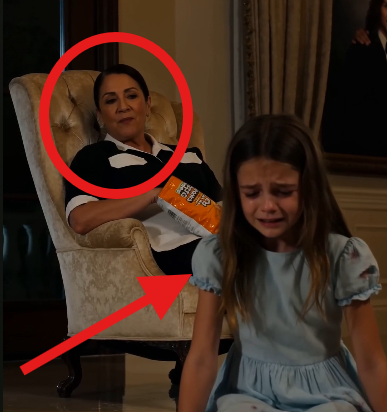
For three seconds, the whole foyer froze. The chandelier hummed softly above them. Rain tapped against the tall glass windows. The yellow mop lay crooked across the marble, still dripping water in a thin, trembling line. The man in the doorway did not move. His dark coat was wet from the storm. His tie was loosened. His face was calm in a way that made the maid’s smile vanish completely. “Mr. Whitmore,” the maid stammered. “Sir, I can explain.” Daniel Whitmore’s eyes never left the little girl on the floor. His daughter. Seven-year-old Ella. She was still on her knees, both hands wrapped around the mop handle like it was the only thing keeping her safe. Her pale-blue dress was ripped near the hem. Her cheeks were wet. Her knees were red against the cold white marble. Daniel took one step forward. The maid immediately backed away. “Ella,” he said softly. The little girl’s face crumpled. “Daddy.” That one word broke through every wall Daniel had built around himself. He crossed the foyer in three long strides and dropped to his knees in front of her. He reached for her carefully, as if she were made of glass. “Are you hurt?” Ella tried to shake her head, but her chin trembled too hard. “I slipped,” she whispered. Daniel looked at her knees. Then at the mop. Then at the bucket beside her. Then at the maid’s snack bag spilled across the marble floor. His jaw tightened. “Why was my daughter cleaning the foyer?” The maid swallowed. Her eyes darted toward the security camera above the chandelier, then back to Daniel. “She made a mess,” she said quickly. “I was teaching her responsibility.” Daniel slowly turned his head. The look in his eyes made her voice shrink. “Responsibility?” “Yes, sir,” the maid said. “Children need discipline. She was being difficult all morning.” Ella flinched at the word difficult. Daniel felt it. He felt the tiny movement against his arm. The way his daughter’s body tightened like she expected the room to believe the adult over her. His voice dropped. “What did she do?” The maid opened her mouth. Nothing came out. Daniel looked toward the staircase. His old phone was still glowing on the step. The call was still connected. He had heard everything. He had been in the back seat of his car, halfway across town, when the call came through. At first, he thought Ella had dialed him by accident. Then he heard crying. Then the maid’s voice. Cold. Bored. Cruel. **Get up.** Then the sound of the mop hitting the floor. Then Ella trying not to sob. Then the sentence that made his blood go cold. **Your father won’t believe you.** Daniel had told his driver to turn around so sharply the tires screamed against the wet road. Now he was here. And the woman who had been smiling over his daughter’s pain was standing ten feet away, trying to turn cruelty into discipline. Daniel lifted Ella into his arms. She clung to him instantly, burying her face against his shoulder. He stood, holding her carefully. “Samuel,” Daniel said. A voice answered through the small speaker near the hallway. “Yes, Mr. Whitmore.” The maid’s face drained of color. Daniel’s home security chief had been listening too. “Save the last two hours of footage from every camera in this house,” Daniel said. “Send copies to my attorney, my private account, and the police.” The maid’s mouth fell open. “Sir, please. That’s not necessary.” Daniel did not look at her. “It is necessary.” “Mr. Whitmore, she exaggerates. She’s emotional. Ever since her mother passed, she—” “Stop.” The word cracked through the foyer like thunder. Ella pressed closer to him. Daniel lowered his voice again, but somehow that made it worse. “You will not use my wife’s death to excuse what you did to my child.” The maid’s eyes filled with panic. “I didn’t hurt her.” Daniel looked down at Ella’s knees. Then back at the maid. “You watched her fall. You watched her cry. You told her I wouldn’t believe her.” The maid’s lips trembled. “I was frustrated.” “No,” Daniel said. “You were comfortable.” That silenced her. Because it was true. She had not looked frightened until the door unlocked. She had not looked sorry until the camera turned. She had not cared about Ella’s tears until she realized someone powerful had heard them. Daniel turned toward the hallway. “Call the police.” The maid gasped. “Please, sir. I need this job.” Daniel finally looked directly at her. “And my daughter needed safety.” The maid began to cry then, but the sound did not move him. Not because Daniel was heartless. Because he could tell the difference between remorse and fear. She was not crying for Ella. She was crying because the house had cameras. Within minutes, two security guards entered the foyer. One stood near the doorway. The other stood beside the maid. She looked around wildly, as if someone might save her. No one moved. Mrs. Bell, the house manager, appeared at the edge of the hallway with one hand over her mouth. “I didn’t know,” she whispered. Daniel looked at her. His eyes were tired. “Neither did I.” That hurt him to say. Because for months, he had missed the signs. Ella had stopped running to the door when he came home. She had started eating dinner quietly, eyes on her plate. She had bruises she explained as playground accidents. She had begun saying “sorry” before anyone accused her of anything. And Daniel had told himself grief made children fragile. He had told himself time would heal her. He had filled the mansion with staff because he thought help could replace presence. But now, holding his daughter in the middle of the marble foyer, he understood the truth. He had built a beautiful house. But he had not protected the child inside it. The police arrived through the private gate fifteen minutes later. The maid tried one more time. “She’s lying,” she said, pointing at Ella. “She wants attention.” Ella’s fingers tightened around Daniel’s collar. Daniel did not argue. He simply nodded toward Samuel. “Show them.” Samuel opened a tablet. The footage played. Ella carrying the bucket. The maid sitting in the velvet chair. Ella scrubbing. The maid eating. Ella slipping. The mop flying. The maid smiling. The sentence. **Your father won’t believe you.** No one spoke after that. One officer looked at Daniel. “We’ll need a statement.” “You’ll have it,” Daniel said. The maid’s face twisted. “Ella,” she snapped suddenly. “Tell them I didn’t mean it.” Daniel turned so fast the officer stepped between them. “Do not speak to my daughter.” The maid was escorted out through the front door. The same door Daniel had entered through moments earlier. Only this time, she was the one shaking. Ella watched from her father’s arms. “Is she coming back?” she whispered. Daniel held her tighter. “No.” “Promise?” He closed his eyes for half a second. When he opened them, his voice was steady. “I promise.” Later that evening, after the police left, after a doctor checked Ella’s knees and said they would heal, after every staff member in the house had been sent home pending review, Daniel carried his daughter upstairs. Her room was soft and pink, filled with stuffed animals, books, and night-lights shaped like stars. But Ella still looked scared. Daniel sat on the edge of her bed. “You can tell me anything,” he said. Ella looked down at her blanket. “She said you were too busy.” Daniel’s chest tightened. Ella continued, barely above a whisper. “She said if I told you, you would send me away because I was making trouble.” Daniel went completely still. The words cut deeper than anger. They cut into guilt. Because Ella had believed it was possible. That was the part that almost broke him. He had been absent enough that a cruel woman could make his daughter doubt him. Daniel took her small hands in his. “Ella, look at me.” She slowly lifted her eyes. “You are not trouble,” he said. “You are my daughter. You are the most important person in my life.” Her lip trembled. “But you’re always working.” Daniel swallowed. There was no defense. Only truth. “I was wrong,” he said. “I thought giving you this house, this room, this life, meant I was taking care of you.” He looked around at the expensive furniture, the silk curtains, the toys still arranged too neatly on the shelf. “None of it matters if you feel alone.” Ella stared at him. Children know when adults are performing. They also know when adults are finally telling the truth. “Are you staying tonight?” she asked. Daniel nodded. “I’m staying.” “In the chair?” “On the floor, if you want.” Ella looked at the thick rug beside her bed. “Okay.” So Daniel Whitmore, the man who had spent years sleeping in luxury hotel suites and private penthouse rooms, took off his jacket, folded it into a pillow, and lay down on the floor beside his daughter’s bed. At midnight, Ella woke from a nightmare. Her hand reached down. Daniel caught it immediately. “I’m here,” he whispered. She blinked in the dark. “You stayed.” “I told you I would.” Ella held his hand until she fell asleep again. And Daniel stayed awake for hours, staring at the ceiling, making a silent list of every way his life was about to change. By morning, the mansion was no longer the same. At eight o’clock, Daniel called an emergency meeting in the foyer. Every employee stood in a line beneath the chandelier. No one smiled. No one whispered. Ella sat upstairs with Mrs. Bell and a therapist Daniel had called before sunrise. Daniel stood where his daughter had fallen. “This house failed my child,” he said. The words echoed against the marble. “And because I own this house, that failure begins with me.” Several staff members lowered their eyes. Daniel continued. “But silence also has consequences. Anyone who saw something, heard something, suspected something, and said nothing will be dismissed.” Mrs. Bell, standing near the staircase, began to cry quietly. Daniel looked at each person one by one. “From today forward, there will be new rules. No child in this house will ever be ordered to clean as punishment. No staff member will discipline my daughter. No report of mistreatment will be dismissed. And if Ella says something happened, she will be believed first.” He paused. “Understood?” Everyone answered. “Yes, Mr. Whitmore.” But Daniel was not finished. He looked up at the security camera above the chandelier. “And every blind spot in this house ends today.” Over the next week, everything changed. The cold marble foyer was covered with a soft runner so Ella would not have to step on the place where she had fallen. The staff was reduced. The remaining employees were retrained. The old phone was replaced with a child-safe device that had one large button on the screen. **Call Daddy.** Daniel canceled three business trips. Then five. Then an entire month of evening events. His assistant tried to explain that investors were confused. Daniel said, “Let them be confused.” For the first time in two years, he picked Ella up from school himself. At first, she was quiet in the car. Then slowly, day by day, words returned. She told him about a girl named Mia who traded stickers. She told him she hated peas. She told him the art teacher smelled like peppermint. She told him she missed Mommy most when other kids brought two parents to school concerts. Daniel listened to every word. He did not check emails. He did not take calls. He did not say, “Tell me later.” One afternoon, as they drove home through the rain, Ella looked out the window and asked, “Daddy?” “Yes, sweetheart?” “If I call, will you always come?” Daniel glanced at her in the rearview mirror. Her face was small beneath the hood of her yellow raincoat. He understood what she was really asking. Not about phones. Not about emergencies. About whether she mattered enough. “Yes,” he said. “I will always come.” Ella nodded. Then she looked back out at the rain. “Okay.” It was the smallest word. But to Daniel, it sounded like the beginning of forgiveness. Three months later, the foyer no longer looked like a museum. The marble was still there in places, but warm rugs softened the floor. A small wooden bench sat near the stairs where Ella could put on her shoes. Her drawings were framed on the wall beside expensive oil paintings. One drawing showed a little girl holding a mop. Another showed a security camera. The last showed a tall man standing in an open doorway. Under it, Ella had written in uneven letters: **Daddy heard me.** Daniel kept that drawing in his office for the rest of his life. Not because it reminded him of the worst day. Because it reminded him of the day he finally became the father his daughter needed. And Ella? She never touched a mop again. She never had to bite back her crying in that house again. And whenever someone asked Daniel why he walked away from so many late-night meetings, why he stopped living like work was the only thing keeping the world standing, he gave the same answer. “My daughter called once,” he said. “And I almost missed it.” Then he would look at the little drawing behind his desk. The girl. The door. The words. **Daddy heard me.** And he would remember the promise he made in the marble foyer. A promise no maid, no mansion, no business deal, and no amount of money would ever come before again.