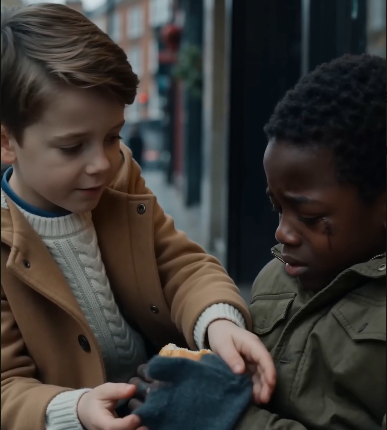
The mother stopped moving.
Her anger disappeared so fast it left only shock behind.
She looked at the torn trash bag.
Fresh loaves.
Golden crusts.
Soft rolls.
Bread her son had been buying inside while another child slept hungry beside the wall.
The bakery manager appeared at the door, face tight.
“Madam, please come inside. He does this for attention.”
The seated boy pulled the half piece of bread to his chest.
Like even now someone might take it back.
The standing boy looked at his mother.
“Why would they throw it away?”
She couldn’t answer.
Because she didn’t know.
Or maybe worse.
Because she had never asked.
The manager stepped closer.
“It’s old stock. We can’t give it out. It creates problems.”
The hungry boy whispered, “My mom asked once.”
The mother turned to him.
“What happened?”
He lowered his eyes.
“She worked here.”
The manager’s face changed.
Just for one second.
But the mother saw it.
The boy continued, voice breaking.
“She gave bread to people after closing. He said she was stealing.”
The mother looked at the manager.
“You fired her?”
The boy shook his head.
“She got sick after that. We couldn’t pay rent.”
The standing boy grabbed his mother’s hand.
“Mom…”
The bakery bell behind them rang softly as the wind pushed the door.
The mother looked through the window.
Warm lights.
Full shelves.
Clean tables.
People eating slowly, leaving crumbs on plates.
Then she looked at the child on the pavement.
Dirty hands.
Wet shoes.
A piece of bread held like treasure.
Her voice went quiet.
“What was your mother’s name?”
“Amara.”
The mother covered her mouth.
She knew that name.
Not from payroll.
From a note her late husband had written before he died.
Always keep bread by the side door. No child near our bakery should sleep hungry.
She turned to the manager.
“My husband left a policy.”
The manager swallowed.
“That was old-fashioned.”
The mother’s eyes filled, but her voice hardened.
“No. It was human.”
She walked to the trash bag, reached inside, and lifted one warm loaf.
Then another.
Then another.
Customers inside began watching through the glass.
The mother handed the first loaf to the seated boy.
Not as charity.
As an apology.
“I am sorry,” she whispered. “This should have reached you before the trash did.”
The boy stared at her.
His lips trembled.
“My mom said this place used to smell like kindness.”
That broke her.
She turned to the manager.
“You are done here.”
He stepped back.
“Madam, you can’t—”
“I can.”
She looked at the spilled bread.
“And I should have done it sooner.”
Then she opened the bakery door wide.
To the sidewalk.
To the cold.
To the people who had been walking past hunger because the light inside looked too expensive to enter.
Her son stood beside the hungry boy and held his hand.
The mother looked at both children.
“From tonight on, nothing edible goes in the trash.”
The seated boy’s eyes filled.
“Every night?”
She nodded.
“Every night.”
He looked down at the bread in his hands.
Then whispered,
“My mom would’ve liked that.”
And for the first time, the warm light from the bakery reached all the way to the wall where he used to sleep.