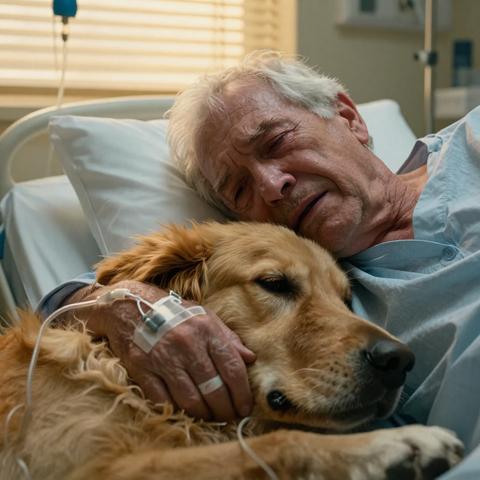
My knuckles were the color of the hospital sheets—a bleached, sickly white that spoke of old age and the sudden, terrifying strength of a man with nothing left to lose. I had the young doctor by his collar, the fabric of his expensive shirt bunched in my trembling fist, and for the first time in thirty-five years, the world didn’t feel like a series of mechanical failures I couldn’t fix. It felt like a war. I was Arthur Whitman, seventy-nine years old, and my heart was currently a ticking time bomb inside my chest, but I didn’t care about the monitors screaming at the nurses’ station or the security guard unholstering his radio. All I cared about was the Golden Retriever standing at the foot of my bed. I never wanted to be the neighborhood’s resident ghost, the man who spent his retirement glinting behind a screen door like a jagged piece of glass. For four decades, I lived by the logic of the garage—steel, oil, and torque. If a machine broke, you replaced the part. If a heart broke, you simply walled it off. I had walled mine off so tightly that even my daughter, Emily, couldn’t find a way through the stone. I had spent half my life hating dogs, calling them dirty, loud, and useless. I told everyone they were just heartbreaks waiting to happen, but the truth was much uglier. I hated them because they remembered. They felt. And I couldn’t afford to do either. Last Tuesday, my heart finally gave out under the weight of all that silence. I woke up in Room 412 of St. Jude’s, hooked to a dozen tubes, watching the late afternoon sun slice through the blinds. The room smelled of death and antiseptic. I was counting the drops in the IV line, waiting for the end, when the door nudged open. It wasn’t a specialist. It was him—a massive, golden animal with eyes that looked like they’d seen every secret I’d ever buried. He didn’t bark. He just stood there, tilting his head in a way that made thirty-five years of armor vanish in a single second. It was the same tilt Scout used to have. When the doctor rushed in, seeing the ‘stray’ in my room, he reached out to drag the animal away by its therapy vest. That’s when the mechanic in me came back to life. I didn’t see a doctor; I saw someone trying to take away the only mirror I had left. I lunged. I grabbed him. My voice, which usually sounded like crushed gravel, came out as a desperate, guttural command: ‘He stays.’ The guard was shouting, the nurse was frozen, and the monitor was one long, flat tone of panic, but the dog didn’t move. He walked forward, ignoring the chaos, and rested his chin on my blanket. In that silence, the smells of the hospital disappeared. I wasn’t an old man dying in a bed; I was a father standing on a lawn thirty-five years ago, watching a dog named Scout wait for a boy named Daniel who was never coming home. I closed my eyes, my hand still tight on the doctor’s collar, and let the first tear I’d shed since the funeral finally fall.
CHAPTER II
The air in room 412 smelled of stale bleach and the metallic tang of my own fear, but beneath it all, there was a new scent—the faint, earthy musk of the dog. My hand was still white-knuckled on Dr. Aris’s sleeve, my breath coming in ragged, shallow hitches that made the monitors behind me chirp in a frantic, rhythmic protest. The doctor didn’t move. He didn’t shout for security, though I saw the guard at the door shift his weight, his hand hovering near his belt. Aris looked at me—not as a patient who had just committed a battery, but as a man looking at a car wreck, trying to find the source of the leak before the whole thing ignited.
“Mr. Whitman,” he said, his voice dropping an octave, hushed and cautious. “Let go of my arm.”
I looked down at my own hand. It looked like a claw, spotted with age and IV bruising, clamped onto his white coat like a drowning man to a piece of driftwood. I released him slowly, my fingers trembling so violently I had to tuck them under the thin hospital blanket. The dog—a golden retriever with eyes the color of burnt sugar—didn’t flinch. She simply sat there, her tail giving a single, soft thud against the linoleum floor. It was that sound, that rhythmic *thump*, that cracked the dam I’d spent thirty-five years reinforcing with bitterness and silence.
Emily was standing by the window, her hands pressed over her mouth. She had seen me angry before; she had seen me silent and cold. But she had never seen me break. To her, I was the man who had turned our home into a fortress of quiet after her brother died. I was the man who had buried every photograph, every toy, and every memory of Daniel under a layer of grease and hard work in the garage. Seeing me now, reaching out toward the very thing I had taught her to fear and despise, was a tectonic shift in the only world she knew.
“Dad?” she whispered, her voice cracking. “What are you doing?”
I couldn’t answer her. The present was blurring at the edges, the sterile white walls of St. Jude’s dissolving into the vibrant, suffocating green of a humid July afternoon in 1989.
In my mind, I was no longer seventy-nine and failing. I was forty-four, my back was strong, and my hands were perpetually stained with the oil of a hundred different engines. Daniel was ten then, a boy who seemed to be made entirely of knees, elbows, and a laugh that could jump-start a dead battery. And then there was Scout.
Scout was a Golden Retriever, much like the one sitting at my bedside now, though his coat was darker, the color of a penny left in the sun. I had bought him for Daniel’s eighth birthday, a decision I would come to regret every waking second for the rest of my life. They were inseparable. Where the boy went, the dog followed. They were a single unit, a frantic blur of blond hair and golden fur racing across the three acres of land we owned on the edge of the county line.
I remembered that final Saturday with a clarity that felt like a physical weight on my chest. The humidity was so thick you could feel it in your lungs. I was in the garage, hunched over the carburetor of an old Chevy, frustrated by a recurring stall I couldn’t pin down. Daniel had come in, Scout at his heels, asking if they could go down to the creek.
“Stay away from the old mill, Dan,” I had grunted, not looking up from the engine. “The rains last night made the banks soft. You hear me?”
“I hear you, Dad,” he’d said, already halfway out the door.
I didn’t look up. I didn’t give him a hug. I didn’t tell him I loved him. I just listened to the screen door slam and the sound of Scout’s paws skidding on the gravel driveway. That was the last time I saw my son alive.
An hour later, the silence of the afternoon was shattered. It wasn’t a scream. It was Scout. He was barking—a sharp, frantic, hysterical sound that echoed through the woods behind the house. I remember wiping my hands on a red rag, a sense of cold dread pooling in my stomach that had nothing to do with the summer heat. I ran. I ran toward the sound, calling Daniel’s name, my heart hammering against my ribs like a trapped bird.
I found Scout at the edge of the ravine near the old mill. The ground had given way, a massive shelf of mud and rock sliding down into the swollen, churning waters of the creek below. Scout was pacing the edge, his fur matted with mud, barking at the brown water that was swallowing everything in its path. He looked at me, his eyes wide and panicked, and he lunged toward the water, only to pull back at the last second.
Daniel was gone. We didn’t find him for three days.
In the aftermath, the grief was a hole in the center of my life that nothing could fill. I needed someone to blame. I couldn’t blame the rain. I couldn’t blame the earth for being soft. And I couldn’t—absolutely would not—blame myself for not fixing the fence I’d promised to secure months prior, or for being too busy with a stranger’s car to walk my son to the water.
So, I blamed the dog.
I told myself Scout had led him there. I told myself the dog was supposed to protect him, to keep him away from the edge. Every time I looked at Scout, I didn’t see a pet; I saw the witness to my son’s death. I saw the creature that had stood on the bank and watched my boy drown while he remained safe on the shore. Within a week, I had taken Scout to a shelter three counties away. I didn’t look back as I drove away, leaving him barking behind a chain-link fence. I went home and scrubbed every trace of him and Daniel from the house. I banned dogs from my sight, my property, and my life. If I could eliminate the reminder, I thought, I could live with the guilt.
But the guilt didn’t leave. It just curdled into a hard, cold knot of hatred.
Now, thirty-five years later, that knot was unraveling in a hospital room. The therapy dog, sensing the change in the air, took a step closer to the bed. She rested her heavy, warm chin on the edge of the mattress, right next to my hip.
“Dad, please,” Emily said, stepping forward, her hand reaching for my shoulder. “You’re getting worked up. The doctor needs to check your vitals. Let the dog go.”
“No,” I rasped, the word tearing at my throat. I looked at the dog’s eyes. They were so similar to Scout’s in those final moments—full of a desperate, wordless plea for help. “She stays. I… I never let him stay.”
Dr. Aris gestured for the security guard to wait outside. He pulled a stool closer, his professional mask slipping just enough to show the man underneath. “Mr. Whitman, you’re having a memory. A flashback. It’s common after a cardiac event, especially with the medications we’ve given you. But you need to breathe. You’re putting too much strain on your heart.”
“It wasn’t his fault,” I whispered, tears finally spilling over and tracking through the deep wrinkles on my cheeks. I wasn’t talking to the doctor. I was talking to the ghost of the man I had been in 1989. “It wasn’t Scout’s fault.”
Emily froze. “Scout? Dad, you haven’t mentioned that name since I was a child. You told me never to speak it.”
“I lied, Em,” I said, my voice trembling. I reached out, my fingers hovering just inches from the dog’s golden head. For thirty-five years, I had convinced myself that dogs were the heralds of tragedy, that their presence was a curse. But as my hand finally made contact with the soft, velvet fur of the dog’s ear, I didn’t feel a curse. I felt a warmth that had been missing from my life since the day the screen door slammed shut for the last time.
“I was supposed to fix the fence,” I confessed, the words coming out in a rush, a secret I had kept buried deeper than Daniel’s casket. “The post by the mill. It was rotted. I knew it was rotted. I told your mother I’d fix it on Saturday. But I stayed in the garage. I wanted to finish that Chevy. I told myself it could wait one more day.”
The room went deathly quiet. Even the hum of the air conditioning seemed to fade away. Emily’s face went pale, her eyes searching mine for some sign that I was hallucinating, that this wasn’t the truth. But she saw it in my eyes—the raw, bleeding honesty of a man who no longer has the strength to carry his own lies.
“You blamed the dog because you couldn’t look at yourself,” she said, her voice a flat, hollow realization. It wasn’t an accusation; it was a discovery.
“I hated them because they remembered,” I said, stroking the dog’s head now, my movements mechanical and rhythmic. “Every dog I saw had Scout’s eyes. They all knew what I’d done. They all saw me standing there while the water took him.”
“Dad, the dog didn’t know,” Emily said, moving to the bedside and taking my other hand. “Scout didn’t blame you. Daniel wouldn’t have blamed you.”
“I blamed him,” I said, looking at the therapy dog. “I sent him away to die alone in a cage because I was a coward. I couldn’t bear to see the love in his eyes when I knew I didn’t deserve it.”
This was the triggering event, the irreversible break. The secret was out, the old wound was ripped open in front of the very person I had tried to protect from the truth. Emily had grown up in the shadow of my resentment, believing that dogs were dangerous, unpredictable creatures. I had poisoned her childhood with my own misplaced guilt.
I looked at Dr. Aris. He was watching the monitor, his brow furrowed. My heart rate was stabilizing, but the emotional cost was visible in the way my body seemed to shrink into the pillows.
“The dog stays for five more minutes,” Aris said quietly, signaling the handler, who had been standing silently in the corner. “But then, Mr. Whitman, you have to rest. Truly rest. We can’t help you if you won’t let us.”
I nodded, unable to speak anymore. I just kept my hand on the dog’s head. The moral dilemma that had defined my life—the choice to live in a comfortable lie or face a devastating truth—had been decided for me by a heart attack and a random visit from a golden retriever. I had chosen the truth, and it felt like a house of cards was collapsing around me.
Emily didn’t leave. She sat on the edge of the bed, her hand tight in mine, watching me pet the dog. There was a distance between us now, a new kind of silence. It wasn’t the cold silence of the past, but the heavy, uncertain silence of a family that has just discovered its foundation was built on a ruin.
As the handler finally stepped forward to lead the dog away, the animal did something unexpected. She leaned her entire weight against my leg for a brief second, a firm, grounding pressure, and then she licked my hand. A quick, wet flick of a tongue across my knuckles.
I watched them leave, the yellow tail disappearing behind the heavy oak door. I felt a sudden, terrifying emptiness. The secret was gone, the hate was gone, and all that was left was the 79-year-old man who had wasted half a century being angry at the world because he couldn’t forgive himself.
“Dad?” Emily asked, her voice small.
“I’m so tired, Emily,” I said, closing my eyes. “I’m so incredibly tired.”
I drifted into a fitful sleep, but for the first time in thirty-five years, I didn’t dream of the brown, churning water of the creek. I dreamt of a boy and a dog, running through a field of tall grass, their shadows long and golden in the late afternoon sun, waiting for a man who was finally, painfully, coming home.
CHAPTER III
The silence in Room 412 didn’t just hang there; it weighed a ton. It was the kind of silence you only find in a machine shop after the power goes out—heavy, smelling of oil and sudden, sharp stillness. I had finally said it. The words were out, hovering like toxic fumes between me and my daughter. I didn’t fix the fence. I chose the carburetor over my son’s safety. I blamed a dog for thirty-five years because it was easier than looking in the mirror.
Emily didn’t scream. I almost wished she would. She just sat there, her hands frozen on the edge of the plastic hospital chair. Her knuckles were white, the same shade as the tiles. She looked at me, but I could tell she wasn’t seeing the man who raised her. She was seeing a stranger. A liar. A mechanic who let the most important part of his life break because he was too lazy to pick up a hammer.
Dr. Aris stayed by the door. He was a professional, but I saw his gaze shift to the floor. Even the man who seen a thousand deaths looked uncomfortable with this kind of honesty. It was too raw. It was the kind of truth that doesn’t set you free; it just burns everything down so you can see the ruins clearly.
“You let me hate him,” Emily whispered. Her voice was thin, like a wire about to snap. “Every time I saw a dog on the street, every time I thought about Daniel, you let me think it was Scout’s fault. You told me the dog lured him away. You made me afraid of animals for my entire childhood, Dad. Why?”
I tried to swallow, but my throat was a desert. “Because if it wasn’t the dog, it was me,” I said. It sounded pathetic. Even to my own ears, it was the confession of a coward. “I couldn’t live with that. I thought I could build a wall out of anger and stay safe behind it. I thought if I hated the world enough, the world wouldn’t notice what I’d done.”
Emily stood up. The screech of the chair legs against the floor made me flinch. She didn’t come closer. She moved toward the window, looking out at the parking lot. The sun was setting, casting long, jagged shadows across the asphalt. “Thirty-five years,” she said, more to herself than me. “Thirty-five years of lies. I mourned Daniel by hating something innocent because you told me to.”
Just then, the door creaked open. It wasn’t a nurse. It was the handler, Marcus, with that golden retriever, Bodie. They had been scheduled for a follow-up visit. Marcus saw the tension in the room and paused, his hand tightening on the leash. Bodie, however, didn’t sense the malice. He just wagged his tail, the soft *thump-thump* hitting the doorframe.
“I’m sorry,” Marcus said, looking between us. “Is this a bad time?”
I looked at Bodie. The dog’s eyes were the same deep, soulful brown as Scout’s. My heart did a strange, fluttering dance in my chest—a warning sign I knew well by now. “Come in, Marcus,” I said, my voice cracking. “It’s the only time we have left.”
Marcus walked in, but he wasn’t looking at me the way he had before. He had been standing in the hallway. He had heard. The walls in St. Jude’s are thick, but guilt has a way of carrying. He sat on the small stool by the bed, letting Bodie rest his head on the mattress. Marcus looked at the chart, then back at me. His expression was unreadable, a mix of pity and something harder, something like judgment.
“You mentioned a dog named Scout earlier,” Marcus said quietly. “From the old mill area?”
I nodded. “The dog I blamed. The dog I dumped at the county shelter the night of the funeral. I didn’t even look back. I just unclipped the lead and walked away while he was still wagging his tail.”
Marcus took a deep breath. He ran his hand over Bodie’s ears, a rhythmic, soothing motion that seemed to steady him. “My father ran that shelter back in ’89,” he said. The room went cold. I felt the air leave my lungs. “He didn’t talk much about work, but he talked about that dog. A black and white mix, right? Had a notched ear?”
I couldn’t speak. I just nodded again. The coincidence felt like a physical blow, a hammer coming down on a thumb.
“That dog didn’t just sit in a cage, Mr. Whitman,” Marcus continued, his voice steady but heavy. “My father said Scout was the most depressed animal he’d ever seen. He wouldn’t eat. He wouldn’t bark. He just watched the door. But there’s something else you should know. When the police found Daniel… they didn’t tell you everything, did they?”
Emily turned away from the window, her eyes wide. “What are you talking about?”
“My father worked with the recovery team back then,” Marcus said, looking at Emily now. “He told me that when they got to the creek, the dog wasn’t ‘leading’ anyone anywhere. Scout was in the water. He was trying to hold the boy’s collar above the current. He stayed in that freezing water for three hours until his own muscles gave out. He didn’t lead Daniel to the mill. He tried to pull him out of it.”
The revelation hit the room like a bomb. I felt my heart monitor start to beep faster, a frantic, rhythmic ticking that mirrored the panic rising in my gut. Scout hadn’t been the killer. He had been the hero I was too blind to see. I had discarded the only thing that had tried to save my son.
“You lied about that too?” Emily’s voice was a low growl. She stepped toward the bed, her face contorted with a grief that had been repurposed into rage. “Did you know he tried to save him?”
“I… I didn’t want to know,” I stammered. “The police said the dog was there. I assumed… I needed to assume…”
“You needed a villain,” Emily spat. “And you picked the one creature that loved Daniel as much as we did. You threw him away like trash because he was a witness to your failure.”
Before I could answer, the door swung open again. This time, it wasn’t a doctor. It was a man in a dark suit, carrying a leather briefcase. He looked out of place in the sterile, white room. He introduced himself as Mr. Henderson, a representative from the hospital’s legal and ethics board. Behind him stood a woman from the County Social Services department.
“Mr. Whitman,” Henderson said, his voice clipped and formal. “Based on the statements you made earlier to Dr. Aris and your daughter—statements regarding criminal negligence and the potential for a historical cover-up involving a minor’s death—the hospital is required by law to file a formal report. We have also contacted the District Attorney’s office to review the 1989 case files.”
The institutional weight of the world was finally crashing down. The secret wasn’t just a family tragedy anymore; it was a legal reality. The ‘social authority’ had entered the room, and they didn’t care about my heart condition. They cared about the fact that a man had admitted to a crime that had been buried under thirty-five years of bitterness.
“Are you charging him?” Emily asked. She sounded breathless, caught between the desire to see me punished and the instinct to protect her father.
“That’s for the DA to decide,” Henderson said. “But we are here to ensure that all further statements are recorded. Mr. Whitman, you are not under arrest, but given your medical state, we need a formal deposition before… well, before your condition worsens.”
They thought I was going to die. And looking at the monitor, seeing the erratic spikes of my heart rate, I realized they were probably right. The stress was tearing the old muscle apart. The ‘Old Wound’ wasn’t just a memory; it was the physical reality of my chest caving in.
I looked at Marcus. He was still petting Bodie. The dog looked at me with such simple, uncomplicated kindness that it hurt worse than the needles in my arm. I had spent a lifetime hating his kind, and here he was, offering the only comfort left in a room full of lawyers and ghosts.
“I want to tell the truth,” I said, gasping for air. The monitors were screaming now. Nurses began to flood the room, pushed by the urgency of the alarms. Dr. Aris was shouting orders, but his voice felt miles away.
Everything moved in slow motion. I saw Emily reach out her hand, then pull it back, the conflict written in every line of her face. I saw the lawyer opening his briefcase, his pen ready to catch my last words. I saw Marcus lead Bodie toward the corner to get out of the way of the crash cart.
“I let him die,” I whispered into the oxygen mask they shoved over my face. “The fence. The dog. I killed them both. I killed my family because I wanted to fix a car.”
The pressure in my chest was immense. It felt like the old mill was finally collapsing, the timber and stone crushing the life out of me. I looked at Emily. She was crying now, deep, silent sobs that shook her shoulders. She looked so much like her mother. She looked so much like Daniel.
I reached out my hand toward her, a silent plea for something I didn’t deserve. Forgiveness was too big a word. I just wanted her to not hate me when the lights went out. I wanted her to know that the wall was gone. The mechanic had finally run out of parts to swap. The engine was dead.
“Dad,” she said, her voice barely audible over the sirens of the machines. She took a step toward me, her hand hovering over mine.
But the choice wasn’t hers anymore. The institutional machine was in motion. The legal system was circling. And my heart—the thing that had carried all that hate for so long—was finally giving up the ghost. I felt a coldness creeping up my legs, a numbness that started at my toes and moved toward my center.
I looked at the ceiling, the fluorescent lights blurring into white streaks. I thought of Scout in the water. I thought of him holding Daniel’s collar, his paws paddling against the current, waiting for a master who would never come to help. I had been the one who let go. Scout had held on until he couldn’t anymore.
“I’m sorry,” I choked out. It was a pathetic, small sound. It was the last thing I had to offer.
As the doctors crowded around me, pushing Emily and the lawyers back, I saw Marcus. He was looking at me, and he did something I didn’t expect. He unclipped Bodie’s leash. The dog didn’t run. He walked slowly to the side of my bed, past the wires and the tubes, and rested his chin on my hand.
In that final, blurred moment, I wasn’t a mechanic. I wasn’t a grieving father. I was just a man being held by the very thing he had tried to destroy. The dog’s warmth was the last thing I felt before the world turned to gray. The moral landscape wasn’t just altered; it was gone. I had confessed, I had been judged by my daughter and the state, and I was left with nothing but the truth and the weight of a golden head on my palm.
The monitors flatlined with a long, steady tone. The race was over. The lie was dead. And for the first time in thirty-five years, the fence was finally being fixed, even if there was nothing left to protect.
CHAPTER IV
The air in the intensive care unit doesn’t move. It stagnates, heavy with the scent of antiseptic and the low-frequency hum of machines that are the only things keeping the silence from becoming absolute. When the alarms first went off—that high, panicked shrieking of the monitors signaling that my father’s heart had finally given up under the weight of his own words—I didn’t scream. I didn’t even move. I stood by the window and watched the medical team swarm in like a well-oiled machine, their movements clinical and devoid of the messy emotions currently tearing me apart.
They pushed me out. That’s what hospitals do. They push the living into the hallway so they can wrestle with the dying. I sat on a plastic chair that felt like ice against my skin, my hands folded in my lap, looking at Marcus. He was still there, his hand resting on Bodie’s harness. The golden retriever sat perfectly still, his eyes fixed on the door where my father was being pounded back into existence. Marcus didn’t say anything. He didn’t offer a platitude. He just existed in that space with me, a witness to the wreckage of a thirty-five-year-old lie.
My father survived. The “Second Climax,” as the nurses probably didn’t call it, ended with a rhythm—weak, erratic, but there. They brought him back. But as I sat there in the gray light of the early morning, I realized that I wasn’t sure if that was a mercy. To wake up after confessing to a lifetime of cowardice is its own kind of hell. He had tried to check out, to leave the mess for me to clean up, but the universe, in its dark sense of irony, had slammed the door in his face.
By 8:00 AM, the world had changed. It started with a phone call from the hospital’s risk management department. Dr. Aris had been required to file a report. When a patient confesses to criminal negligence involving a death—even one three decades old—the gears of the institution begin to grind. They don’t care about the poetry of a dying man’s soul; they care about liability, protocols, and the police.
I met the Sheriff in the cafeteria. His name was Miller, a man who looked like he was carved out of old oak, with eyes that had seen too many car wrecks and domestic disputes. He had been a deputy in 1989. He remembered the drowning at the old mill. He remembered the grieving father and the “vicious” dog that everyone whispered about.
“Emily,” he said, his voice a low rumble as he stirred a cup of black coffee. He didn’t look at me. “Your father’s statement… it’s caused quite a stir downstairs. We’re looking at the old files. There was a report back then about the fence, but it was dismissed because your father swore it was sound. He blamed the dog for jumping it. If he’s saying now that the fence was rotted… if he’s saying he knew…”
“He’s seventy-nine, Sheriff,” I said, though my voice lacked conviction. “He’s confused. His heart failed.”
“He wasn’t confused about the dog,” Marcus said, appearing at the edge of the table. He had left Bodie with a volunteer. “He was very specific about what Scout did. And I think you know he was telling the truth.”
Miller looked from Marcus to me. The public fallout was already beginning. Within hours, the local news caught wind of a “major development in a cold case.” In a small town like Blackwood Creek, tragedy is a currency that never loses its value. People started calling. My phone buzzed in my pocket like a trapped insect. My aunt, my father’s old colleagues from the mill, people who had spent decades pitying Arthur Whitman for his tragic loss.
The reputation he had built—the stoic survivor, the man who lost his son to a beast—was dissolving in real-time. I felt a sick sense of exposure. It wasn’t just his reputation; it was our family’s foundation. My entire childhood had been shaped by the shadow of Daniel’s death and the ghost of a dog I was taught to hate. If the dog wasn’t the monster, then what was my father? And if my father was a liar, who was I?
The personal cost was an exhaustion that felt like lead in my bones. I went back to the house that afternoon to grab a change of clothes, and the silence there was different. It wasn’t the peaceful quiet of an empty home; it was the suffocating silence of a crime scene. I stood in the kitchen and looked at the spot where Scout’s bowl used to be. I remembered my father kicking it out the back door the day after the funeral, his face a mask of cold fury. I had cheered him on. I was six years old, and I had cheered as the man I loved discarded the animal that had tried to save my brother.
I went up to the attic. I needed to find something—anything—that made sense. I pushed aside boxes of old holiday decorations and dusty furniture until I found a small wooden trunk tucked under the eaves. It was locked, but the wood was old and brittle. I pried it open with a screwdriver.
Inside, I found the “New Event” that would ensure there was no easy way out of this. It wasn’t a confession note or a secret diary. It was a stack of receipts and a series of photographs. The receipts were dated June 1989—two weeks before Daniel died. They were for lumber and hardware, marked ‘Fence Repair.’ They were unused. My father had bought the materials to fix the fence, had sat them in the garage, and had simply… forgotten? Or delayed?
But the photographs were worse. They were Polaroids taken at the mill, likely for insurance purposes years later, but hidden away. In one of them, you could clearly see the rotted post where the fence had given way. And there, in the corner of the frame, was a small, bloody handprint on the wood. It wasn’t Daniel’s. It was too large. It was the shape of a dog’s paw, frantic and sliding.
Scout hadn’t just held Daniel up. He had tried to pull him out. He had fought the current and the rot, and when he couldn’t do it, he stayed until his heart nearly burst. My father had seen this. He had taken the pictures. He had seen the evidence of the dog’s heroism and he had chosen to bury it under a mountain of blame so he wouldn’t have to look at his own reflection.
The realization hit me like a physical blow. This wasn’t just a mistake or a moment of panic. This was a calculated, lifelong execution of an innocent soul’s character.
I drove back to the hospital in a daze. The media was already outside—two local news vans and a handful of people with cameras. They wanted to know about the ‘Deathbed Confession.’ I ignored them, my head down, pushing through the sliding doors into the sterile sanctuary of the lobby.
I found Dr. Aris in the hallway near my father’s room. She looked tired. “He’s awake, Emily. He’s asking for you. But I have to tell you, the District Attorney’s office has been in touch. They want to speak with him as soon as he’s stable. They’re talking about obstruction of justice, maybe more. It’s been a long time, but the statutes on certain types of negligence are… complicated when fraud is involved.”
“I don’t care about the law right now,” I whispered. “I care about the fact that I’ve spent thirty years mourning the wrong things.”
I walked into his room. My father looked small. He was hooked up to a dozen tubes, his skin the color of parchment. He looked at me, and for the first time in my life, I didn’t see a pillar of strength. I saw a terrified old man who had run out of places to hide.
“Emily,” he rasped.
“I found the trunk, Dad,” I said. The words were quiet, but they cut through the room like a blade.
He closed his eyes. A single tear tracked through the deep wrinkles on his cheek. “I couldn’t… I couldn’t be the man who let him die. I had to be the man who was betrayed. It was the only way I could keep breathing.”
“So you let Scout take the fall,” I said. My voice was trembling now. “You let me grow up believing the world was a place where love could turn into a monster at any second. You let me hate the only thing that actually tried to help him.”
“I loved that dog,” he whispered, a pathetic, hollow sound.
“No, you didn’t,” I said. “You don’t throw what you love into a storm to save yourself.”
I left him there. I couldn’t stay. The moral residue was thick in the air, a sense of justice that felt entirely too late and far too expensive. If he went to jail now, what would it accomplish? If he died now, what would it solve? The truth had come out, but it didn’t feel like a victory. It felt like a second drowning.
I found Marcus in the waiting room. He was sitting on the floor with Bodie, the dog’s head in his lap. Marcus looked up as I approached.
“What happens now?” he asked.
“I don’t know about the law,” I said, sitting down on the floor next to them. Bodie immediately shifted his weight, leaning his warm, heavy body against my leg. I let my hand sink into his soft fur. “But I know what I have to do for Scout.”
“The shelter?” Marcus guessed.
“Worse,” I said. “I have to go back to the mill. I have to find out where he really is.”
My father had always said he’d taken Scout to a shelter in the next county, that the dog had been put down there. But after seeing the trunk, I didn’t believe a word he said. I spent the next few hours on the phone, tracking down records from 1989. I called the shelter my father had named. They had no record of a dog matching Scout’s description ever being brought in by an Arthur Whitman.
I went back to the old house one more time. I walked out to the edge of the property, where the woods thickened and the sound of the creek became a steady roar. There was a patch of ground near a cluster of silver birches, far from the house, far from the path we usually took. It was a place Daniel used to love because the fireflies were thickest there in July.
I started digging. I didn’t have a shovel; I used a garden trowel and my bare hands, tearing at the earth until my fingernails were black and bleeding. I didn’t know what I was looking for until I hit something hard.
It was a rusted metal box. Inside, wrapped in a rotting piece of Daniel’s old blue blanket, were the remains of a dog. And there, glinting in the twilight, was a leather collar with a brass tag that read: *Scout. Brave Boy.*
My father hadn’t sent him away. He hadn’t even given him the dignity of a proper burial. He had killed him—not with a needle at a shelter, but with his own hands, or a gun, or a stone—and buried him in the dark like a piece of evidence.
I sat on the ground and howled. I cried for my brother, who died because of a rotted fence. I cried for my father, who was a ghost of a man. But mostly, I cried for Scout. I cried for the dog who had stayed in the freezing water, holding a boy’s head up while his own lungs burned, only to be dragged into the woods and erased from history.
As the sun went down, I realized that the public fallout was just the beginning. The community would tear my father apart. The lawyers would pick over the bones of his confession. But the real cost was here, in the dirt.
The cycle of hatred hadn’t just been misplaced; it had been manufactured. And as I looked at the brass tag in my hand, I knew that the only way to survive this was to make sure that for the first time in thirty-five years, someone told the story of the dog who didn’t bite, but who held on until the very end.
I stood up, the metal box heavy in my arms. I wasn’t going to leave him here. I wasn’t going to let him be a secret anymore. I walked back toward the car, my footsteps heavy on the damp earth. The hospital was waiting. The police were waiting. The world was waiting to judge a dying man.
But I was done with judgment. I was looking for a way to carry the weight without breaking. And as I drove away from the house, I saw the lights of the town in the distance—noise, judgment, and chaos. In the backseat, the small box sat like an anchor.
There is no such thing as a clean ending. There is only the messy, agonizing process of moving the truth from the dark into the light, one handful of dirt at a time. My father was alive, but the man I thought he was was dead. Scout was dead, but for the first time, he was finally, truly seen.
The weight of the silence was gone, replaced by the deafening sound of everything that should have been said a long time ago. And as I pulled back into the hospital parking lot, I saw the reporters’ flashes going off in the distance. They were waiting for a monster. They wouldn’t know what to do with the truth.
CHAPTER V
The dirt under my fingernails wouldn’t come out. I spent an hour in the bathroom of the old house, scrubbing my hands with a stiff-bristled brush until the skin was raw and weeping, but the ghost of that forest floor remained. It wasn’t just the soil from the shallow, hidden grave I’d uncovered; it was the weight of thirty-five years of sediment. Every lie my father had told, every performance of grief he’d staged, every moment he’d let me believe that a loyal creature was a monster—it was all there, etched into the lines of my palms.
I didn’t go back to the hospital that first night. I couldn’t. The Sheriff had left hours ago, taking the physical evidence of the rotted fence boards I’d found in the trunk, but he’d left me with the bones. He’d been surprisingly gentle about it, knowing that the legal case against a dying man was a formality, a ghost-hunt for justice that the clock would soon render moot. He told me he’d have to file the report, that the District Attorney would likely charge Arthur with animal cruelty and filing a false police report, even if he never lived to see a courtroom. I didn’t care about the charges. I cared about the small, heavy box sitting on my kitchen table.
The house felt different now. For my entire life, this place had been a shrine to Daniel’s absence. Now, it was a museum of a different kind of death—the death of the man I thought my father was. I walked through the hallway, looking at the framed photos. There was Arthur in 1990, looking hollowed out, receiving the town’s sympathy. I looked at his eyes in the pictures and realized I wasn’t seeing grief. I was seeing the panicked, vibrating stillness of a man who had committed a second crime to cover the first.
He hadn’t just neglected the fence. He hadn’t just let his son drown. When he saw that Scout had tried to pull Daniel out—when he saw the marks of the dog’s struggle and realized that the world would ask why the dog was there and why the fence had failed—he had made a choice. He had looked at the one witness to his negligence, a dog who loved him, and he had silenced it. He had buried the truth in the woods and then spent three decades feeding me the poison of that lie.
I didn’t sleep. I sat in the dark, watching the headlights of occasional cars pass by. The town knew. The news had spread with the predatory speed of small-town gossip, though now it carried the heavy weight of local news reports and social media outcries. The man they had pitied for thirty-five years was now a pariah. I saw a car slow down in front of our gate, then speed off. The silence of the neighborhood felt like a collective indrawn breath, waiting for the final act.
By the second morning, the hospital called. Dr. Aris’s voice was weary, stripped of the professional distance he’d tried so hard to maintain.
“Emily,” he said. “He’s conscious. Not for long, I think. But he’s asking for you.”
“Is he?” I asked. My voice sounded thin, like paper tearing.
“He knows the police were here,” Aris said. “He knows what you found. He’s… he’s ready to go, Emily. But he’s waiting.”
I looked at the box on the table. I wrapped it in a clean white cloth, something soft and dignified. I didn’t know if I was going there to forgive him or to watch the life leave the man who had murdered my childhood. I just knew that the story had to end in the same room where the truth had started to leak out.
The hospital was a gauntlet. The nurses wouldn’t look at me, or they looked too hard, their eyes full of that complicated, messy pity that people give to the families of villains. I walked past the waiting room where I’d sat with Marcus and Bodie just days ago. Marcus wasn’t there today, but I could still feel the phantom presence of that dog, the way he’d leaned against my leg when the truth first began to crack the surface.
When I entered Arthur’s room, the smell of ozone and antiseptic hit me like a physical wall. He looked impossibly small. The tubes and wires seemed to be the only things holding him to the mattress. His skin was the color of old parchment, translucent and fragile. When he heard the door click, his head turned slowly. His eyes were clear—terrifyingly clear.
“You found it,” he whispered. It wasn’t a question.
I didn’t sit down. I stood at the foot of the bed, the wrapped box held against my chest like a shield. “I found all of it, Dad. The wood. The bones. The truth.”
He closed his eyes, and a single tear tracked through the deep canyons of his wrinkles. “I couldn’t let them think… I couldn’t let them see me that way. A father who let his boy… I was supposed to fix that fence, Emily. I told your mother I’d fixed it.”
“So you killed the only thing that tried to save him,” I said. My voice was flat, devoid of the heat of anger. The anger had burned out hours ago, leaving only a cold, crystalline clarity. “You let a hero rot in the dirt and called him a killer for thirty-five years. You let me grow up fearing dogs. You let me grow up thinking the world was a place where loyalty was rewarded with betrayal.”
“I loved that dog,” he wheezed, his chest rattling with a sound like dry leaves.
“No,” I said. “You loved your reputation. You loved the pity. You loved being the victim because it was easier than being the man who failed. You didn’t love Scout. You used him. You used his death to bury your shame.”
He didn’t argue. He didn’t have the strength left for more lies. He just lay there, the monitors beeping in a rhythmic, indifferent count-down. I looked at his hands, the ones that had tucked me into bed, the ones that had held the shovel in the woods. I realized then that the man I had loved was a fiction I had co-authored. I had wanted him to be the grieving hero, so I hadn’t looked too closely at the gaps in his stories. We had lived in a house of glass, and I had been the one cleaning the windows, making sure the light didn’t hit the cracks.
“I’m sorry,” he whispered.
“It’s too late for that to matter to me,” I told him. “But it matters for Scout.”
I stayed for three hours. I didn’t hold his hand. I sat in the vinyl chair by the window and watched the sun move across the floor. We didn’t speak again. The silence wasn’t a peace; it was a reckoning. It was the sound of a debt being called in. When his breathing finally changed—that jagged, hollow gasping that signals the end—I stood up. I watched the line on the monitor flatten. I watched the light leave his eyes.
I felt no surge of grief. I felt a profound, exhausting sense of relief. The weight was finally off my shoulders, because the man who had placed it there was gone. I walked out of the room before the nurses arrived. I had one more thing to do, and it didn’t involve doctors or death certificates.
The following week was a blur of logistics and quiet defiance. I refused a public funeral. There would be no eulogies for Arthur Whitman, no gathering of the town to celebrate a life built on a foundation of bones. I handled the cremation privately. But for Scout, I had a different plan.
I went to the local newspaper, the one that had run the original headline in 1989 about the ‘vicious’ family dog. I met with the editor, a woman younger than me who looked at the evidence I brought—the photos of the fence, the vet records I’d unearthed from an old filing cabinet in the basement, and the sheriff’s statement—with a grim, focused intensity.
“You want to run a correction?” she asked.
“No,” I said. “I want to run the truth. I want people to know that for thirty-five years, this town blamed a hero for a tragedy caused by a man’s pride. I want Scout’s name back.”
The article ran on the Sunday edition. It didn’t pull any punches. It detailed the negligence, the cover-up, and the ultimate sacrifice of a dog who had died twice—once in the woods, and once in the memory of the public. I also announced the establishment of the ‘Scout’s Honor’ fund, a donation I made from the sale of my father’s house to the local animal shelter where Marcus worked. It was enough to build a new wing, a place for the ‘difficult’ dogs, the ones the world was quick to give up on.
The reaction was a storm. There were letters of apology, flowers left at the gate of the house I was packing up, and a deep, collective shame that settled over the town. People realized they had been complicit in the lie, preferring the easy narrative of a ‘bad dog’ to the uncomfortable reality of a ‘bad man.’
Finally, on a Tuesday morning when the air was crisp and smelled of coming rain, I went to the cemetery.
Daniel’s grave sat under a sprawling oak tree. It was clean, the stone polished, the grass trimmed. For decades, it had been a place of solitary mourning. I had the box with me, the one wrapped in white cloth. I’d had the remains processed by a specialist who understood that these weren’t just bones; they were the fragments of a broken promise.
I didn’t hire anyone to dig the hole. I brought my own shovel.
I started digging right next to Daniel’s headstone. The earth was soft here, well-tended. As I worked, I thought about that day in 1989. I imagined the water, the cold, the panic. I imagined Scout, not as the monster my father described, but as the frantic, loyal friend who had jumped into that millrace without a second thought. I imagined him reaching for Daniel’s collar, his lungs burning, his heart bursting with the singular, pure drive to save his person.
He had succeeded in reaching him, the marks on Daniel’s clothing had proven it years ago, but the current had been too strong. They had gone down together. And then, Scout had crawled out, exhausted and grieving, only to be met with the shovel of the man he trusted.
I placed the box in the earth.
“I’m sorry it took so long,” I whispered. “I’m sorry I believed him.”
I covered the box with the dark, rich soil. I packed it down firmly. I had a small stone made, no larger than a brick, to be placed at the foot of the plot. It didn’t have any dates. It just had one word: *HERO*.
I sat on the grass for a long time. For the first time in my life, I felt like I was sitting with my brother. The gap between us, that vast, terrifying space filled with my father’s lies, had finally closed. They were together now. The boy and the dog. The truth had reunited them, and in doing so, it had finally set me adrift.
I was leaving the town the next day. I’d sold the house and most of the furniture. I was moving to a place where no one knew the name Whitman, where I could walk through a park and see a dog without feeling a phantom chill of fear. I was forty years old, and I was finally starting my life from a place of honesty.
As I walked back to my car, I saw a figure standing by the gate. It was Marcus. He didn’t have Bodie with him this time. He just stood there, his hands in his pockets, looking out over the rows of headstones.
“I read the article,” he said when I reached him.
“Thank you for helping me see it,” I said. “I don’t think I would have had the courage to look if it weren’t for that day in the hospital.”
Marcus nodded slowly. “Truth is a hard thing to carry, Emily. Most people drop it because it’s too heavy. You didn’t.”
“I had to,” I said. “I couldn’t let him be the last word.”
“What now?” he asked.
“Now I go,” I said. I looked back at the oak tree. The sun was dipping lower, casting long, elegant shadows across the graves. “I think I might get a dog. Eventually. A big one. Maybe a golden retriever.”
Marcus smiled, a small, genuine thing. “They’re good listeners. And they never forget who they are.”
I drove away from the cemetery, and I didn’t look in the rearview mirror. I thought about my father, dying in that sterile room, and I realized that I didn’t hate him anymore. Hate requires a connection, a tether of shared emotion. What I felt was a vast, cool distance. He was a man who had chosen a lie, and the lie had eventually consumed him until there was nothing left but the shell of a father.
I thought about Scout. I thought about the way dogs live entirely in the present, their loyalty unburdened by the complexities of human ego. Scout hadn’t died for a cause or a reputation. He’d died because his person was in the water, and there was nowhere else in the world he was supposed to be.
I pulled over to the side of the road near the old mill. The building was a ruin now, the wood grey and sagging, the water of the creek moving sluggishly over the rocks. It didn’t look like a place of tragedy anymore. It just looked like a part of the landscape, old and tired and finished.
I stood by the water for a moment, listening to the sound of it. It was just water. It wasn’t a monster. It wasn’t a secret. It was just the world, moving on as it always does, indifferent to our stories but holding them all the same.
My life had been a long, quiet haunting. I had lived in the shadow of a dead brother and a murderous lie, trying to be the perfect daughter to a man who didn’t exist. But as I stood there, the wind picking up, I felt a strange, new lightness. I was no longer the keeper of the Whitman secret. I was just Emily.
I got back in the car and started the engine. I had a long drive ahead of me, hours of open road and unfamiliar towns. I didn’t know exactly where I was going, but for the first time, I wasn’t running away from the dark. I was simply moving toward the light.
I thought about the small stone in the cemetery, the one that finally told the truth after thirty-five years of silence. It was a small thing, a piece of granite in a field of thousands. But it was the only thing in my life that felt absolutely, unshakeably solid.
We spend our lives trying to build monuments to ourselves, trying to control how the world sees us, how the world remembers us. We stack lie upon lie like bricks, hoping the structure is strong enough to hide the rot in the foundation. But the earth always reclaims what belongs to it. The dirt always finds its way back to the surface.
My father had spent his life trying to bury his failure, only to have it become his only legacy. Scout had simply lived, and in his living, he had left behind a truth that no amount of dirt could ever truly hide.
As the sun finally set, painting the sky in bruises of purple and gold, I turned onto the highway. The path ahead was dark, lit only by my own headlights, but I wasn’t afraid. I knew now that the monsters aren’t in the woods or in the water or even in the dogs we fear.
The only real monsters are the things we tell ourselves to keep from looking in the mirror.
END.