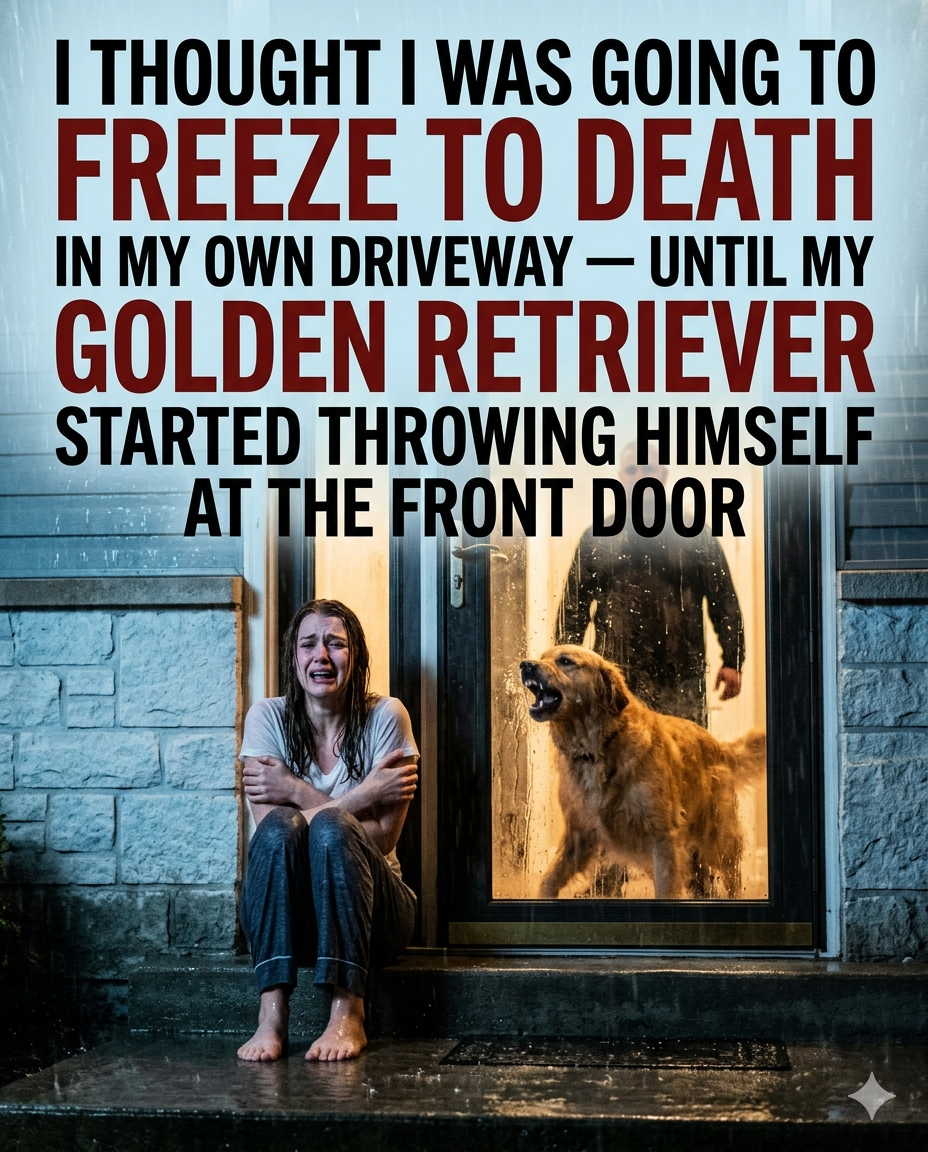
The rain didn’t feel like water. It felt like needles of ice, stitching my thin cotton t-shirt to my shoulder blades. I heard the click—that heavy, mechanical thud of the deadbolt sliding home—and I knew the world had just ended for me. Through the frosted glass of the front door, Julian’s silhouette was a dark, jagged shape. He didn’t walk away. He stood there, watching me through the narrow sidelight, his face twisted into something I didn’t recognize as human.
‘You’re useless, Elara!’ his voice had boomed moments before, echoing off the high ceilings of the house our father had built. ‘You’ve been a parasite since the day you moved back. Get out and see how the world treats a girl with nothing to offer.’
I hadn’t even had time to grab my shoes. My bare feet were already turning a ghostly, numb white against the wet concrete of the porch. I hammered on the wood, my knuckles blooming into a dull red ache. I begged him. I told him I’d leave tomorrow, that I’d go to a shelter, anything—just let me get my coat. But the shadow behind the glass remained motionless. He was enjoying the silence that followed my screams.
Julian had always resented the space I took up. Since our parents passed last winter, the house had become a battlefield of subtle cruelties. A missed message here, a hidden bill there. But this was different. This was the finality of a man who believed the walls belonged to him by right of strength, not law.
Then, I heard it. A sound from inside that wasn’t Julian’s laughter. It was a low, vibrating growl that seemed to shake the very foundation of the porch. Barnaby. My Golden Retriever, usually the gentlest soul to ever walk this earth, was making a sound I’d never heard. It wasn’t a bark. It was a roar of ancient, protective fury.
I looked through the lower pane of the door. Barnaby wasn’t cowering. He was standing between Julian and the door, his fur bristling, his teeth bared in a way that stopped Julian’s smug leaning. My dog looked at me through the glass, his amber eyes wide with a terrifying intelligence. He knew. He knew I was dying out here in the cold.
Suddenly, the dog launched himself. All seventy pounds of him slammed into the front door. The wood groaned. Julian stumbled back, shouting in shock, but Barnaby didn’t stop. He threw his body against the door again and again, his paws raking the wood, his barks becoming a rhythmic, deafening siren that echoed through the quiet suburban street.
I collapsed against the porch railing, the hypothermia starting to pull a heavy, grey curtain over my vision. I watched the houses across the street. Usually, they were dark, indifferent. But Barnaby’s rage was impossible to ignore. A light flickered on at the Millers’ house. Then the Grahams’.
Julian was screaming at the dog now, trying to grab his collar, but Barnaby was a whirlwind of golden fur and defiance. He wouldn’t let Julian near the door, and he wouldn’t stop the noise. He was calling for help in the only language he had left.
The last thing I remember before the world turned black was the reflection of blue and red strobing against the raindrops on the window. The sound of a heavy boot hitting the door frame. And Barnaby’s barking—no longer a roar, but a frantic, desperate whimpering as he licked the glass where my hand had been.
CHAPTER II
The first thing I remember was the sound of a machine. It was a rhythmic, artificial chirp that seemed to echo inside my skull, matching the sluggish thud of my heart. Everything felt heavy, as if my limbs had been replaced by wet sand. My skin didn’t feel like skin; it felt like a thin, brittle layer of parchment stretched over ice. I tried to move my fingers, but they were encased in something thick and warm. A Bair Hugger, I would later learn—a forced-air warming blanket that hummed like a distant jet engine, trying to coax the life back into my core. The hospital room was a blur of sterile whites and bruised shadows, the smell of bleach and sharp antiseptic cutting through the fog of my mind. It was a cold that didn’t just go away because I was indoors. It was a cold that had moved into my bones, a permanent resident that reminded me of the rain, the locked door, and the look on Julian’s face when he turned the bolt.
Officer Halloway was sitting in a plastic chair in the corner of the room. He was a man who looked like he had seen too many nights like this—tired eyes, a jaw that seemed perpetually set against a bitter wind. He didn’t jump when I shifted; he just leaned forward, his uniform crinkling. He told me I was lucky. He told me that if it weren’t for Barnaby, the neighbors wouldn’t have looked twice at the ‘domestic disturbance’ unfolding on the porch. Barnaby had barked until his voice went hoarse, a sound so primal and desperate that Mrs. Gable from two doors down had actually come out with a flashlight. Halloway’s voice was low, almost a whisper, as he explained the scene they found: me, blue-lipped and curled in a ball on the welcome mat, and Julian inside the house, drawing the curtains. The officer’s presence was a weight, a reminder that my private shame was now a matter of public record. He asked me if I wanted to make a statement, and for a long time, I just stared at the IV drip, watching the clear liquid fall drop by drop, wondering how the person I shared a childhood with could have watched me freeze.
The peace of the recovery ward didn’t last. The triggering event—the moment that shattered any hope of a quiet resolution—happened three hours later. Julian didn’t stay away. He didn’t hide in shame. Instead, he arrived at the hospital with the calculated bravado of a man who believed he could still win. He didn’t come to my room; he made his stand in the public waiting area, loud enough for the nurses and the families of other patients to hear. I heard his voice before I saw him—that high, frantic pitch he gets when he’s lying to himself. He was telling a nurse that it was all a ‘horrible misunderstanding,’ that I had been ‘unstable’ and had locked *myself* out in a fit of hysterics. He claimed he didn’t realize I was still on the porch. But then, as Halloway intercepted him, Julian did the one thing I can never forgive. He didn’t just lie about me; he attacked the only thing I had left. He made a formal, recorded complaint to the police and animal control, claiming that Barnaby was a ‘vicious, untrained animal’ that had cornered him and bitten him. It was a lie—Barnaby is a dog that apologizes to the furniture when he bumps into it—but Julian knew the law. A reported bite meant a mandatory quarantine, and given Julian’s ‘fear for his life,’ he was pushing for the dog to be put down. The paperwork was signed, the report was filed, and just like that, the situation was irreversible. He wasn’t just taking my home anymore; he was aiming for Barnaby’s life to cover his own tracks.
Lying there, listening to the muffled chaos in the hallway, an old wound began to throb—an emotional injury far older than the hypothermia. I remembered the summer our father died. Julian had always been the golden child in his own mind, the one who deserved the world simply for existing. But Dad had seen the cracks. I remembered the day the lawyer, Mr. Henderson, read the will in that stuffy office that smelled of old leather and tobacco. Julian’s face had turned a sickly shade of grey when he realized the house hadn’t been left to him entirely. Dad had left it to both of us, but with a specific, stinging clause: Julian could only stay if he maintained the property and paid his share of the taxes from his own earnings. If he failed, the house reverted to me entirely. Julian saw it as a betrayal, a final insult from a father who didn’t trust him. For years, I had carried the guilt of being the ‘preferred’ child, trying to smooth things over, paying his share of the bills secretly just to keep the peace. That was my old wound—the exhaustion of being the guardian of a man who hated me for my stability. I had enabled his resentment, thinking love could fix a soul that only valued equity.
But there was a secret I had uncovered just weeks before the eviction, something I hadn’t even told the police yet. While cleaning out the attic, I found a series of registered letters addressed to Julian. He had been taking out high-interest personal loans using the house as collateral—forging my signature on documents to prove he had the authority to do so. He was in deep with people who didn’t use lawyers to collect. That was why he was so desperate to get me out. He didn’t just want the house; he needed me gone so he could sell it quickly, pay off his debts, and disappear before the bank or I realized the titles had been tampered with. The ‘misunderstanding’ on the porch wasn’t an accident; it was a desperate attempt to create a narrative where I was mentally unfit, allowing him to take full control of the estate. If I exposed the forgery, he would go to prison. If I didn’t, he would sell the roof from over my head and kill my dog in the process. The secret was a ticking bomb, and the fuse was already short.
As the night deepened, a profound moral dilemma settled over me. Halloway came back into the room, his expression grim. He told me that because of Julian’s report, animal control would be picking up Barnaby from the neighbor’s yard within the hour. I had a choice, and neither path was clean. I could tell the truth—all of it. I could hand over the forged documents, tell them about the loans, and watch my stepbrother be led away in handcuffs. It would save the house. It would save Barnaby. But it would also destroy the family name, dragging our father’s legacy through a public fraud trial. Julian would lose everything, and despite the cold still in my blood, a part of me didn’t want to be the one to pull the trigger on his life. Alternatively, I could try to negotiate. I could offer to sign the house over to him in exchange for Barnaby’s safety and his silence. I could walk away with nothing but my dog and my life, leaving the house I grew up in to be gutted by creditors. Choosing the ‘right’ thing—justice—felt like an act of ultimate cruelty, but choosing the ‘merciful’ thing felt like a betrayal of myself and my father’s memory. Every option felt like a different kind of freezing.
I looked at Halloway, my voice finally finding its way through my parched throat. I told him about the letters in the attic. I told him about the forgery. I saw the look of surprise, then the hardening of his professional gaze as he started taking notes. There was no going back now. By choosing to protect Barnaby and the house, I was effectively ending Julian’s life as he knew it. I felt a wave of nausea, a realization that in the battle for survival, there are no heroes, only survivors who are left to carry the weight of what they had to do. The neighbor, Mrs. Gable, arrived shortly after, bringing a small bag of my clothes and the news that Julian had tried to break back into the house after leaving the hospital, claiming he had lost his keys. The police had intercepted him. The public facade was crumbling, and as the morning light began to gray the hospital windows, I knew the real fight hadn’t even started. The legal system was a slow, grinding machine, and Julian, cornered and desperate, was at his most dangerous. I wasn’t just fighting for a house anymore; I was fighting to keep the darkness of his choices from swallowing me whole. I closed my eyes, the warmth of the Bair Hugger finally reaching my heart, but the chill of the upcoming trial remained, a ghost in the room that wouldn’t be banished by any machine.
CHAPTER III
The air outside the hospital didn’t feel like recovery. It felt like a suspended sentence. Officer Halloway drove in silence, his hands steady on the wheel of the cruiser, while I sat in the passenger seat, my fingers tracing the hospital ID band I’d forgotten to cut off. The car heater was humming, a sound that should have been comforting but instead felt like a low-frequency warning. My body was back from the brink of the frost, but my mind was still out there in the snow, watching Barnaby disappear into the white.
“He’s at the shelter, Elara,” Halloway said, his voice cutting through the hum. “They’re holding him under a ‘dangerous dog’ observation because of Julian’s report. But I’ve seen the footage from the neighbor’s Ring camera. Barnaby didn’t attack. He was protecting you. He was keeping you warm. That report won’t hold water once I file my statement.”
I nodded, but my throat was too tight for words. I wasn’t just worried about the dog. I was going back to the house—the site of my near-death, the monument to a family that had finally, violently, collapsed. We were meeting Mr. Sterling, the family lawyer, and Julian. The loan documents I had found in the hospital records, the ones Julian had forged my name on, were sitting in a manila envelope on my lap. They felt heavier than the house itself.
When we pulled into the driveway, the Victorian looked like a carcass. The snow had partially melted, revealing patches of dead brown grass and the trash Julian had let accumulate on the porch. Julian was standing by the front door, a cigarette dangling from his lip. He looked haggard, his eyes darting between me and Halloway. He didn’t look like the man who had kicked me out into a storm; he looked like a cornered animal realizing the fence was electrified.
Inside, the house was freezing. Julian hadn’t paid the heating bill. We sat in the parlor—the room where our father used to read to us, where the piano stood silent and covered in dust. Mr. Sterling was already there, his briefcase open on the coffee table. He looked at me with a pity that made me want to scream.
“Let’s get this over with,” Julian spat. He didn’t look at me. “You’re back. Great. Now tell the officer to drop the investigation so we can sell this dump and move on. The bank is breathing down my neck.”
I didn’t say a word. I reached into the envelope and pulled out the predatory loan agreement. I slid it across the table toward Mr. Sterling.
“I didn’t sign this,” I said. My voice was surprisingly steady. It was the voice of someone who had already felt the worst cold the world had to offer. “Julian forged my signature. He used my half of the inheritance as collateral for a quarter-million-dollar loan. He spent it all. And then he tried to kill me by proxy so the title would pass to him automatically.”
The silence in the room was absolute. Even the house seemed to stop settling. Mr. Sterling adjusted his glasses and pulled a magnifying glass from his kit. He compared the signature on the document to my signature on the hospital release forms.
Julian laughed. It was a dry, hacking sound. “You’re delusional, Elara. You signed that months ago. You were drunk, or tired, or whatever. You wanted to help me with my business ventures.”
“What business ventures, Julian?” I asked. “The ones that don’t exist? The shell companies? I’ve seen the bank statements now. You’ve been bleeding this estate dry since the week Dad died.”
Officer Halloway stepped forward, his hand resting near his belt. “Julian, we’ve already contacted the notary listed on these papers. He’s a friend of yours, isn’t he? He’s already admitted to the fraud under questioning this morning. He didn’t want to go down for a felony. He told us everything.”
Julian’s face went from pale to a sickly, mottled gray. The cigarette fell from his mouth and sizzled on the hardwood floor. He didn’t pick it up. He looked at the three of us—the law, the legacy, and the victim—and something in him finally snapped. The mask of the grieving, struggling brother fell away, leaving only a raw, jagged desperation.
“You think you’re so righteous?” Julian whispered, his voice trembling. “You think this house is a prize? You think Dad was some saint who left you a gift?”
He stood up, kicking his chair back. It hit the wall with a dull thud. He began pacing the room, his movements erratic.
“Tell her, Sterling,” Julian barked. “Tell her about the ‘Family Trust’. Tell her why there was no money for the taxes when Dad passed. Tell her where the ‘heritage’ actually came from.”
Mr. Sterling looked down at his papers, refusing to meet my eyes. My heart began to pound—a different kind of cold creeping into my chest. “What is he talking about?” I asked.
“Dad didn’t make his money in real estate,” Julian sneered, leaning over the table, his face inches from mine. “He was a liquidator for a firm that handled pension funds for factory workers. He didn’t just ‘liquidate’ the companies, Elara. He siphoned. He stole the retirement of five hundred families in the eighties. This house? This piano? Your private school tuition? It was all paid for with the life savings of people who are now living in trailers or on the street.”
I looked at Mr. Sterling. “Is it true?”
“There were… settlements, Elara,” Sterling said quietly. “Your father spent the last decade of his life paying off the whistleblowers to keep the story out of the papers. That’s why there was nothing left. The house is the only thing he managed to keep, and even that was technically under a lien that he hid through a series of offshore accounts. Julian discovered it after the funeral.”
Julian grinned, a terrifying, broken expression. “I wasn’t just ‘wasting’ money, sister. I was trying to pay off the last of the blackmailers who came out of the woodwork when they saw the obituary. I was trying to save the ‘family name’ you care so much about. I forged your name because you would have gone to the police. You would have given it all back to be ‘moral’, and we would both be in the gutter.”
The room felt like it was spinning. The walls I had loved, the history I had clung to—it was all rot. The warmth I remembered from my childhood was a hallucination built on the suffering of strangers. I looked at the fireplace, at the portrait of our father hanging above it. He looked noble. He looked like a lie.
“So go ahead,” Julian said, his voice dropping to a low hiss. “Call the cops. Send me to jail. But if I go, I’m taking the ‘legend’ with me. I’ve got the files, Elara. I’ve got the names of every family he ruined. I’ll leak it all. I’ll make sure the name ‘Vance’ is synonymous with ‘thief’ for the next fifty years.”
I felt the weight of the choice. To save the house, to save my father’s memory, I would have to be complicit in Julian’s crimes. I would have to let him go. I would have to let the fraud stand. If I pursued justice, I would lose everything—not just the roof over my head, but the very identity I had built my life around.
Julian saw me wavering. He moved toward the sideboard where he kept a bottle of scotch. He poured himself a glass, his hands shaking. “Just sign the papers to sell the house to the developers I found. We split the cash, I disappear, and the secrets stay buried. It’s the only way out, Elara. The only way you keep your dignity.”
“Dignity?” I whispered. I looked at my hands. They were still scarred from the frostbite, the skin peeling and red. I thought of Barnaby in a cage at the shelter, accused of being a monster because he tried to save a woman who was clinging to a haunted house.
“My dignity isn’t in these walls, Julian,” I said.
I turned to Officer Halloway. “Arrest him. I want to file the charges. Forgery, fraud, and whatever else you can find. And I want those files he’s talking about. Every single one.”
Julian’s face contorted. “You stupid… you’ll have nothing! You’ll be a pariah!”
He lunged—not at me, but at the sideboard. He grabbed a heavy metal lighter. With a manic scream, he flicked it open and held it over the stack of files he’d pulled from the drawer earlier—the proof of our father’s theft.
“If I can’t have the money, nobody gets the truth!” he screamed.
He dropped the lighter onto the papers. They were old, dry parchment. They didn’t just catch; they erupted. The flames licked up, catching the heavy velvet curtains behind the sideboard.
Everything moved in a blur. Halloway tackled Julian, pinning him to the floor as the smoke began to billow toward the ceiling. The fire alarm—the one I’d replaced only a year ago—began its piercing, rhythmic shriek.
“Get out!” Halloway yelled over the noise. “Elara, get to the door!”
I didn’t move toward the door. I moved toward the kitchen. The smoke was thickening, a black veil descending over the parlor. I could hear Julian sobbing as Halloway dragged him toward the porch. I ran through the hallway, my lungs burning, the heat of the fire radiating through the floorboards.
I reached the back door and threw it open. The cold air rushed in, fueling the fire behind me, but I didn’t care. I ran to the garage. The padlock was heavy, but I found the spare key hidden under the stone where Dad used to keep it. My hands were fumbling, my vision blurring from the smoke I’d inhaled.
I swung the door open. There, in the back of the garage, huddled in a crate Julian had used to hide him, was Barnaby. He wasn’t barking. He was waiting.
I fell to my knees and unlatched the crate. He burst out, his tail thumping against my chest, his tongue lashing my face. He didn’t know the house was burning. He didn’t know our father was a criminal. He only knew I was there.
“Come on, boy,” I choked out. “We’re going.”
We ran into the yard just as the first fire truck rounded the corner, its sirens screaming a duet with the wind. I stood on the sidewalk, Barnaby leaning against my leg, and watched the orange glow fill the windows of the second floor.
The neighbors were coming out of their houses now, their faces illuminated by the flickering light. They saw me—the woman who had almost died in the snow—standing with the dog they had been told to fear.
Julian was being shoved into the back of a second police car, his face pressed against the glass. He looked small. He looked like a ghost that had finally been exorcised.
Mr. Sterling walked over to me, his coat singed. He held a charred folder in his hand—one he had snatched before the flames took the sideboard.
“I saved some of it,” he said, his voice hoarse. “The names. The accounts. It’s not everything, but it’s enough to start the restitution process. But Elara… the house. It’s gone. The insurance won’t cover this. Julian’s actions, the fraud… you’re going to lose the property.”
I watched as the roof of the parlor collapsed, sending a plume of sparks into the winter sky. The portrait of my father was gone. The piano was gone. The ‘Family Trust’ was ashes.
“Let it burn,” I said.
I looked down at Barnaby. He looked up at me, his eyes bright and steady. He wasn’t cold. I wasn’t cold. For the first time in years, the weight was gone. The house hadn’t been a home; it had been a museum of secrets, a gilded cage built on a foundation of lies.
Officer Halloway walked over, wiping soot from his forehead. He looked at the house, then at me, then at the dog. He reached out and tentatively patted Barnaby’s head. Barnaby licked his hand.
“He’s a good dog, Elara,” Halloway said. “The best. I’ll make sure the shelter records are cleared tonight. He’s coming home with you.”
“Home isn’t there anymore,” I said, gesturing to the ruins.
“No,” Halloway agreed, looking at the neighbors who were now bringing over blankets and thermoses of coffee. “But I think you’ll find a place.”
As the fire department began to douse the flames, I realized the twist of it all. Julian thought he was destroying my life by burning those papers and the house. He thought he was taking my last shred of security. But he had accidentally given me the only thing I ever really needed: the truth, and the freedom to walk away from it.
I didn’t look back as the smoke cleared. I started walking toward the neighbors’ porch, toward the people who had actually saved me, with my dog by my side. The snow began to fall again, but this time, I didn’t feel the chill. I felt the light.
CHAPTER IV
The smell of woodsmoke didn’t leave me for weeks. It wasn’t the nostalgic scent of a winter hearth or a distant bonfire; it was a greasy, chemical stench that clung to the fibers of my coat and the pores of my skin. I woke up in the middle of the night in a cramped motel room on the edge of town, gasping for air, convinced the ceiling was about to cave in. Beside me, Barnaby would stir, his tail giving a single, heavy thud against the carpet, a reminder that we were both still alive. But being alive felt like a technicality. The house was gone. The name Vance was no longer a symbol of local prestige; it had become a slur whispered in grocery store aisles and typed in capital letters across local news banners.
In the immediate wake of the fire, the silence was the loudest thing I had ever heard. The sirens eventually faded, the red and blue lights stopped dancing against the blackened skeletons of the oak trees, and Officer Halloway finally stopped asking me questions. Julian was in custody, charged with arson and a growing list of financial crimes that the investigators were just beginning to untangle. I was technically free, but freedom felt like standing in the middle of an empty, frozen field with no compass and no coat. I had saved the ledger—that heavy, leather-bound confession of my father’s sins—but having it in my possession felt like holding a live grenade.
The public fallout was instantaneous. Within forty-eight hours of the fire, the local paper ran a front-page exposé titled ‘The House Built on Broken Promises.’ They had gotten hold of the initial reports regarding the pension fund theft. It wasn’t just a few thousand dollars shuffled between accounts; it was a systematic draining of the futures of three hundred factory workers who had spent thirty years believing their retirement was secure. My father, the man I had mourned as a stern but principled pillar of the community, had been a thief. And Julian, in his desperate attempt to maintain the facade, had turned into a monster.
I remember walking into the local diner three days after the arrest. I needed coffee, something to ground me. The bell above the door chimed, and for a split second, everything was normal. Then, the clatter of silverware stopped. A group of men in work shirts—men who had likely worked at the Vance Tool & Die plant—looked at me. It wasn’t a look of anger, which I might have been able to handle. It was a look of profound, weary exhaustion. It was the look you give a ghost you wish would just stay buried. I didn’t order coffee. I turned around and walked out, the cold air hitting my face like a physical slap. I realized then that I wasn’t just Elara anymore. I was the girl who lived in the house paid for by their stolen sweat.
The personal cost manifested in the smallest, most agonizing ways. I had no home, but I also had no history. Every memory I had of my childhood—the Christmas mornings in the parlor, the summer evenings on the porch, the way my father would sit in his study and talk about ‘legacy’—was now tainted. It was like looking at a beautiful painting and suddenly seeing the rot beneath the canvas. I felt a deep, hollow shame that I couldn’t scrub off. Even Barnaby seemed to feel it. He was quieter, his usual exuberance replaced by a watchful, anxious stillness. He didn’t want to leave my side, as if he sensed that the ground beneath us was still shifting.
Then came the legal summons. Not for Julian’s trial, but for a civil deposition. This was the new event that truly broke the last of my illusions. A group of the former factory workers had filed a collective suit, not just against the estate, but against me and Julian personally, seeking any remaining assets to compensate for the lost pensions. My lawyer, a man named Mr. Henderson who had worked for my father for years and now looked like he wanted to be anywhere else, met me in a sterile office downtown.
‘Elara,’ he said, his voice devoid of its usual warmth. ‘The insurance on the house is being contested because of the arson charges against Julian. The land is valuable, but with the environmental cleanup required after the fire, it’s a wash. The only real asset left is the small trust your mother left you. They’re coming for that too.’
I looked at him, feeling a strange sense of detachment. ‘Let them have it,’ I said.
Henderson paused, his pen hovering over a legal pad. ‘That’s your only safety net. You have nothing else. No home, no job, and your reputation is… well, you know. If you give that up, you’re starting at zero.’
‘I’m already at zero, Mr. Henderson,’ I replied. ‘I’m living in a motel with a dog and a suitcase of smoke-damaged clothes. That money isn’t mine. It was never mine.’
But the true weight of the situation didn’t hit me until the afternoon I was asked to meet with Mrs. Gable. She was the widow of one of the foremen, a woman I remembered seeing at my father’s funeral. She had requested to see me privately before the formal depositions began. We met in a small community center basement. There were no lawyers, just two folding chairs and a leaking radiator.
Mrs. Gable was small and brittle, her hands gnarled by years of work. She didn’t scream at me. She didn’t call me names. She sat down, sighed, and pulled a photograph from her purse. It was a picture of a modest house with a well-tended garden.
‘We lost it last year,’ she said, her voice a thin thread. ‘My Arthur worked for your father for thirty-two years. He died thinking I’d be taken care of. When the pension checks stopped coming, I didn’t know what to do. I’m living in my daughter’s basement now. She’s got three kids and a husband who just got laid off. I’m a burden, Elara. I’m seventy-four years old, and I’m a burden because your father decided he needed a bigger chandelier.’
I couldn’t look at her. The air in the room felt heavy, like I was underwater. ‘I didn’t know,’ I whispered, though it felt like the most pathetic excuse in the world.
‘I know you didn’t,’ she said. ‘But you lived there. You ate the food bought with Arthur’s heart medication money. You wore the clothes paid for by my granddaughter’s college fund. That’s the thing about blood money, dear. You don’t have to know it’s there for it to stain you.’
That conversation changed everything. I realized that justice wasn’t just about Julian going to prison. It wasn’t about the fire or the fraud. It was about the residue. It was about the fact that even if I gave away every penny I had, Mrs. Gable would still be seventy-four and living in a basement. The ‘right’ outcome—exposing the truth—didn’t fix the lives that had been dismantled over decades. It only highlighted the wreckage.
The moral residue was a bitter pill. I had thought that by saving the ledger, I was doing something noble. I thought I was the hero of my own story, the daughter who stood up for what was right. But as the weeks turned into a month, I realized I was just a survivor of a wreck I had inadvertently benefited from my entire life. There was no victory. Julian was facing twenty years, but he was still my brother, and the memory of him standing in the burning hallway, his eyes wide with a manic kind of grief, haunted my dreams. I hated him for what he did, but I also felt a terrible, soul-crushing pity for the person he had become in his attempt to please a dead man.
A new complication arose when the insurance company officially denied the claim. This meant that the ruins of the Vance estate would remain a blackened eyesore, a literal scar on the town’s landscape, unless someone paid for the demolition. The city council began sending me notices. They wanted me to take responsibility. They wanted me to clean up the mess. But I had no money left. I had instructed Henderson to transfer the trust to the victims’ fund. I was, for the first time in my life, truly destitute.
I spent my days walking Barnaby through the woods behind the motel, avoiding the paved roads where people might recognize me. The winter was fading into a grey, slushy spring. The world was waking up, but I felt like I was stuck in a permanent stasis. I had to find a way to move forward, but every path seemed blocked by the ghost of my father or the shadow of my brother.
one afternoon, while sitting on a park bench watching Barnaby chase a squirrel through the dead leaves, I saw Officer Halloway. He wasn’t in his squad car; he was in plain clothes, looking older than I remembered. He sat down at the other end of the bench.
‘Julian’s lawyer is pushing for a plea,’ Halloway said, not looking at me. ‘He’s trying to blame the whole thing on your father’s initial fraud, saying Julian was just a victim of circumstance. A man trying to save a legacy.’
‘Is that what he thinks?’ I asked.
‘It’s what his lawyers want the jury to think. But the fire… that’s on him. Arson is hard to hand-wave away. Especially with you as a witness.’
‘I don’t want to see him, Halloway. I don’t want to sit in a courtroom and look at him.’
‘You might have to. But that’s not why I’m here. I’m here because the town is angry, Elara. People want someone to pay, and since your father is dead and Julian is behind bars, they’re looking at you. You need to leave. For a while, at least.’
‘Leave? And go where? I have nothing.’
‘I have a cousin who runs a rescue shelter for animals three counties over. She needs help. Hard work, low pay, but it comes with a small cabin on the property. No one there knows who you are. No one cares about the Vance name.’
I looked at Barnaby, who had given up on the squirrel and was now resting his chin on my boot. The thought of staying here, being the ‘Vance girl’ in the diner, the girl whose father stole the town’s future, felt like a slow death. But leaving felt like running away from the debt I owed.
‘If I leave, I’m not running from what happened,’ I said, more to myself than to him.
‘No,’ Halloway said softly. ‘You’re just choosing which fire you want to stand in. The one that’s already burned out, or the one that’s still going.’
I spent that night in the motel room, looking at the ledger one last time. I had given the original to the police, but I had kept a few photocopies of the names—the people like Mrs. Gable. I realized that I couldn’t give them back their years. I couldn’t rebuild their houses. But I could spend my life making sure that the name Elara Vance stood for something else. Not for the wealth that was stolen, but for the labor of making things right, one small act at a time.
The next morning, I packed my single suitcase. I checked out of the motel, the clerk barely looking at me as he took the key card. I loaded Barnaby into the old, battered car I’d bought with the last of my cash—a car that rattled and smelled like damp upholstery, a far cry from the luxury sedans that used to line our driveway.
As I drove past the gates of the estate for the last time, I didn’t stop. I didn’t look at the charred remains of the house. I looked at the road ahead. The sky was a pale, uncertain blue. The ground was still cold, but the ice was melting. It was a messy, ugly transition, much like my own life. There was no clean resolution. There was no grand moment of forgiveness from the town or a sudden windfall to fix the damage. There was only the weight of the past and the quiet, desperate hope of the future.
I reached the animal shelter late that evening. It was a sprawling, chaotic place, filled with the sounds of barking and the smell of hay and wet fur. Halloway’s cousin, a stern woman named Martha, met me at the gate. She looked at me, then at Barnaby, then back at me.
‘Halloway says you’re a hard worker,’ she said, her voice gravelly. ‘And that you’re good with dogs.’
‘I am,’ I said, and for the first time in a month, my voice didn’t shake.
‘The cabin is small. The roof leaks a bit in the corner. You start at five a.m. Cleaning kennels, feeding, exercising the ones who can be exercised. It’s not pretty work.’
‘I don’t need pretty,’ I told her. ‘I just need to be useful.’
Martha nodded and handed me a rusty key. ‘Welcome to the middle of nowhere, Elara. Let’s see what you’re made of.’
That night, in the small cabin, I lay on a thin mattress with Barnaby curled at my feet. The air was cold, and the silence of the woods was different from the silence of the motel. It wasn’t the silence of hiding; it was the silence of a beginning. I thought of my father, and for the first time, I didn’t feel the sharp sting of betrayal. I felt a cold, hard clarity. He had built a monument to himself out of other people’s lives. I would build a life out of my own.
I thought of Julian, sitting in a cell, still clinging to the lie that he was a victim. I realized that the real victimhood was the belief that you are entitled to a life you didn’t earn. I had earned nothing so far. Not this cabin, not this job, not even the air I was breathing. But I would earn it. I would work until the smell of smoke was gone, replaced by the scent of earth and honest sweat. It wouldn’t be enough to balance the scales—nothing ever would be—but it was a start.
The moral residue remained, a bitter aftertaste that I knew would never fully go away. Justice felt incomplete because it was. You can’t undo thirty years of theft with one arson conviction or a donated trust fund. You can only live in the aftermath and try to be better than the ghosts who left you there. As sleep finally took me, I didn’t dream of fires. I dreamed of a garden—not a grand, manicured estate, but a small, messy plot of land where things grew because someone cared enough to plant them in the dirt.
CHAPTER V
I woke up before the sun reached the edge of the valley, my joints stiff from a day spent hauling bags of kibble and scrubbing concrete floors. The shelter wasn’t quiet in the mornings. There was always a low, vibrating hum of anticipation—a hundred dogs sensing the shift in the air, waiting for the first sound of a lock turning. My hands were different now. They were rough, the skin around the knuckles cracked from the winter air and the constant use of disinfectants. I looked at them in the grey light of my small room above the kennel office and realized I didn’t miss the softness. Softness was a lie I had lived for twenty-six years. These hands, calloused and sore, were finally telling the truth.
A letter had arrived two days ago. It was from a legal aid office, a formal notification that Julian’s trial had concluded. He’d taken a plea deal, though it didn’t spare him much. He was headed to a state facility three hours north. There was an invitation, or perhaps a demand disguised as one, to see him before his final transfer. I hadn’t wanted to go. I had spent months trying to scrub the smell of the Vance estate out of my lungs. I had given away the last of the money, moved into a place where nobody knew my surname, and started a life that required nothing of me but my labor. But as I sat on the edge of my narrow bed, I knew the thread wasn’t cut yet. You don’t just walk away from a fire; you have to wait for the embers to stop smoking.
The bus ride north was long and cold. I watched the landscape change from the muddy outskirts of the city to the bleak, skeletal forests of the interior. I felt like a ghost traveling through a world that had moved on without me. In the news, the ‘Vance Scandal’ had already been replaced by a new cycle of corporate greed and celebrity fallouts. We were old news. My father was a dead thief, Julian was a failed arsonist, and I was the girl who had disappeared. It was a relief to be irrelevant. There is a specific kind of freedom in being nothing to no one.
The prison was a sprawling complex of grey stone and chain-link fences that looked like it was trying to sink into the earth. Inside, the air tasted of floor wax and stale breath. I waited in a room that smelled of industrial soap, my back straight, my hands folded in my lap. I didn’t look like a Vance anymore. I wore a heavy thrift-store coat and work boots. When they brought Julian out, I almost didn’t recognize him. The arrogance that had been his skeleton for his entire life seemed to have collapsed. He looked smaller, his skin a sallow, sickly color under the fluorescent lights. But when he sat down and looked at me through the glass, I saw the old Julian flickering in his eyes—the one who believed the world was a game he was simply losing at the moment.
“You look terrible, Elara,” he said, his voice crackling through the intercom. He didn’t say hello. He didn’t ask how I was. He just pointed out my descent.
“I’m working, Julian,” I said. My voice was steadier than I expected. “It turns out it’s hard on the appearance.”
He let out a short, bitter laugh. “Working. For what? Minimum wage? While the lawyers and the victims’ fund picked the bones of our life clean? You were always the weak one. You handed them the keys. You let them take everything. We could have fought it. We could have buried the files.”
I looked at him, really looked at him, and for the first time in my life, I didn’t feel afraid of him. I didn’t even feel angry. I felt a profound, hollow pity. He was still talking about ‘our life’ as if it were a fortress we were supposed to defend, rather than a prison we were lucky to escape. He saw the loss of our father’s stolen wealth as a tragedy of the ego, not a restoration of justice.
“There was nothing to fight for, Julian,” I said quietly. “The money wasn’t ours. The house was built on the lives of people who worked until they died with nothing. Father didn’t build a legacy. He built a debt. You just tried to set it on fire so you wouldn’t have to pay it.”
“He did it for us!” Julian hissed, leaning closer to the glass. “He did it so we wouldn’t have to live like… like you are now. Scrubbing floors. Riding buses. You’ve disgraced the name more than he ever did.”
“The name is dead,” I told him. “I’m not a Vance anymore. Not the kind you mean. I’m just Elara. And honestly, I’ve never felt more like myself.”
Julian stared at me, his mouth twitching. He wanted to hurt me, to find the words that would make me crumble, but he had no leverage anymore. He had no money to withhold, no social standing to threaten. He was a man in a jumpsuit behind a thick pane of glass, and I was a woman who had nothing left to lose. The power dynamic that had defined my entire childhood had vanished. He was just a stranger with my eyes.
“I won’t be coming back,” I said, standing up. “I just came to tell you that I’m not carrying any of it anymore. Not the guilt, not the hatred, and certainly not the responsibility for you. You’re on your own now.”
“Elara, wait,” he said, a sudden flash of panic crossing his face. For a second, the bravado slipped, and I saw a scared boy who didn’t know how to survive without a butler or a bank account. “You can’t just leave me here. You’re the only one left.”
“I know,” I said. “And that’s why I have to go.”
I walked out of that building and didn’t look back. The air outside was freezing, but I filled my lungs with it until it hurt. It felt like a baptism. I was done with the ghosts. I was done with the wreckage.
I took the bus back, but I didn’t go straight to the shelter. I got off a few stops early, near the district where many of the factory workers had lived—the ones whose pensions had funded my private schools and my designer dresses. I had been visiting a small community center there, volunteering my time on Sunday afternoons. It wasn’t much, and I didn’t tell them who I was. To them, I was just Elara, the woman who helped organize the food pantry and cleaned the windows.
I walked toward a small, cramped apartment building where Mrs. Gable lived. She was the widow I had met months ago, the woman who had lost her husband and her security to my father’s greed. She had been the one who finally broke my denial. I had sent her a small portion of the money I managed to save from my first few paychecks—not as a Vance, but as an anonymous donor. It wasn’t much, but it was honest.
I saw her standing on the sidewalk, struggling with a heavy bag of groceries. I didn’t hesitate. I walked up to her and took the handles from her hands. She looked up, startled, her eyes squinting behind thick glasses. She recognized me, I could tell, but she didn’t see the daughter of the man who ruined her. She saw a tired girl in a worn-out coat who was reaching out to help.
“Oh, thank you, dear,” she said, her voice thin. “The stairs get longer every year.”
“I’ve got it,” I said. We walked together, slowly, into the dim hallway of her building. We talked about the weather, about the price of eggs, about the stray cat that hung around the lobby. These were the small, mundane textures of a real life. We weren’t talking about legacies or empires. We were talking about surviving the day.
When we reached her door, she turned to me. “You look different than the last time I saw you,” she said softly. “Your eyes are… quieter.”
“I think I’m just learning how to see,” I replied.
She reached out and patted my hand. Her skin was like parchment, but her grip was firm. “It’s a hard thing, losing what you thought you were. But sometimes, what’s left underneath is the only thing worth having.”
I left her there and walked back toward the shelter. The sun was setting, casting long, purple shadows across the street. I thought about the Vance estate, the way it had burned, the way the smoke had filled the sky. It felt like a dream now, or a story I had read in a book a long time ago. The girl who lived in that house was dead. She had died in the fire, or maybe she had died the moment she realized her father wasn’t a hero.
I thought about what I had learned. I used to think that justice was a grand, sweeping gesture—a court ruling, a check written for millions, a public apology. But those things don’t fix the hole in someone’s life. They don’t bring back a husband or restore the years spent in fear. True justice, I realized, was much smaller. It was the decision to stop the cycle. It was the choice to live a life that didn’t require someone else’s suffering. It was the calloused hands and the long bus rides and the honest work.
I arrived back at the shelter as the stars were beginning to show. The dogs were quiet now, settled in for the night. I walked through the kennels, checking the water bowls, whispering a few soft words to the nervous ones. This was my world now. It was small, and it was loud, and it smelled of wet fur and cedar chips, but it was mine. I didn’t have to apologize for being here. I didn’t have to hide where the money came from.
I sat on the back porch of the office, looking out at the dark silhouette of the mountains. I thought about Julian in his cell, clinging to a name that no longer meant anything. I thought about my father, buried in a plot he probably hadn’t even paid for with his own money. I felt a pang of sadness for them—not because of what they lost, but because they never got to feel this. They never got to feel the lightness of having nothing to hide.
My life wouldn’t be easy. I would probably work until my back gave out. I would never have the things I once took for granted—the silk sheets, the fine wine, the effortless respect of strangers. But I had something better. I had a clear conscience. I had the knowledge that I had faced the worst parts of my history and I hadn’t let them win. I was the first Vance to ever be a good person, and I was doing it by making sure the name Vance disappeared forever.
I stood up and went inside to finish my chores. There was a puppy in the end kennel that had been struggling with a cough, and I wanted to check on him one last time before I slept. As I sat in the straw with him, his small heart beating against my palm, I realized that I wasn’t waiting for a new chapter to begin. It had already started. The noise of the world had faded away, leaving only the steady, rhythmic pulse of the present moment.
I looked at the reflection of myself in the dark window of the kennel. I didn’t see a disgraced heiress. I didn’t see a victim. I saw a woman who had finally paid her debts and found that she still had enough left over to build something real. The legacy was gone, and in its place was a quiet, unshakable peace.
I was no longer the daughter of a ghost or the sister of a shadow; I was simply the person who showed up to do the work that needed doing.
END.