“This One’s The Real Lawyer. Not Her,” My Father Said To The Crowd At My Brother’s Law School Graduation. I Sat Quietly In The Back Row. The Dean Suddenly Stopped. He Looked Straight At Me.
“Your Honor… You’re Here?” The Room Fell Silent.
My Father Went Pale.
Part 1
The auditorium smelled like polished wood, fresh paper, and the lemony cleaner colleges always use when they’re trying to make old buildings feel important. Families had packed in early, the way people do when they think a ceremony is going to change their lives. There were women in bright dresses clutching bouquets wrapped in crackly cellophane, men in stiff jackets tugging at their collars, grandparents leaning into the aisle with phones already up. Everybody had that same shiny expression on their faces: relief, pride, hunger. Like they wanted to eat the moment before it disappeared.
I chose the back row.
It wasn’t secrecy. Not exactly. When you spend years on the bench, you develop habits. You like a wall behind you. You like a full view of the exits. You like seeing everybody else before they see you. Mostly, though, I chose the back row because I knew my father would be there, and my father had a way of turning even somebody else’s milestone into a stage for his own voice.
My brother, Tyler, sat near the front with the other graduates in his black robe and blue hood, tugging at the sleeves like they didn’t quite belong to him. He looked pale and keyed up, the way people do when they’ve been working toward one finish line for so long they don’t know what to do once they’re standing on it. For one quick second, seeing him there, I felt something soft in me. Not pride exactly. Something older. Recognition, maybe. I remembered the first week of my own 1L year, the way my stomach had burned from too much coffee and not enough money, the way I used to underline casebooks until my wrist cramped.
Then I heard my father.
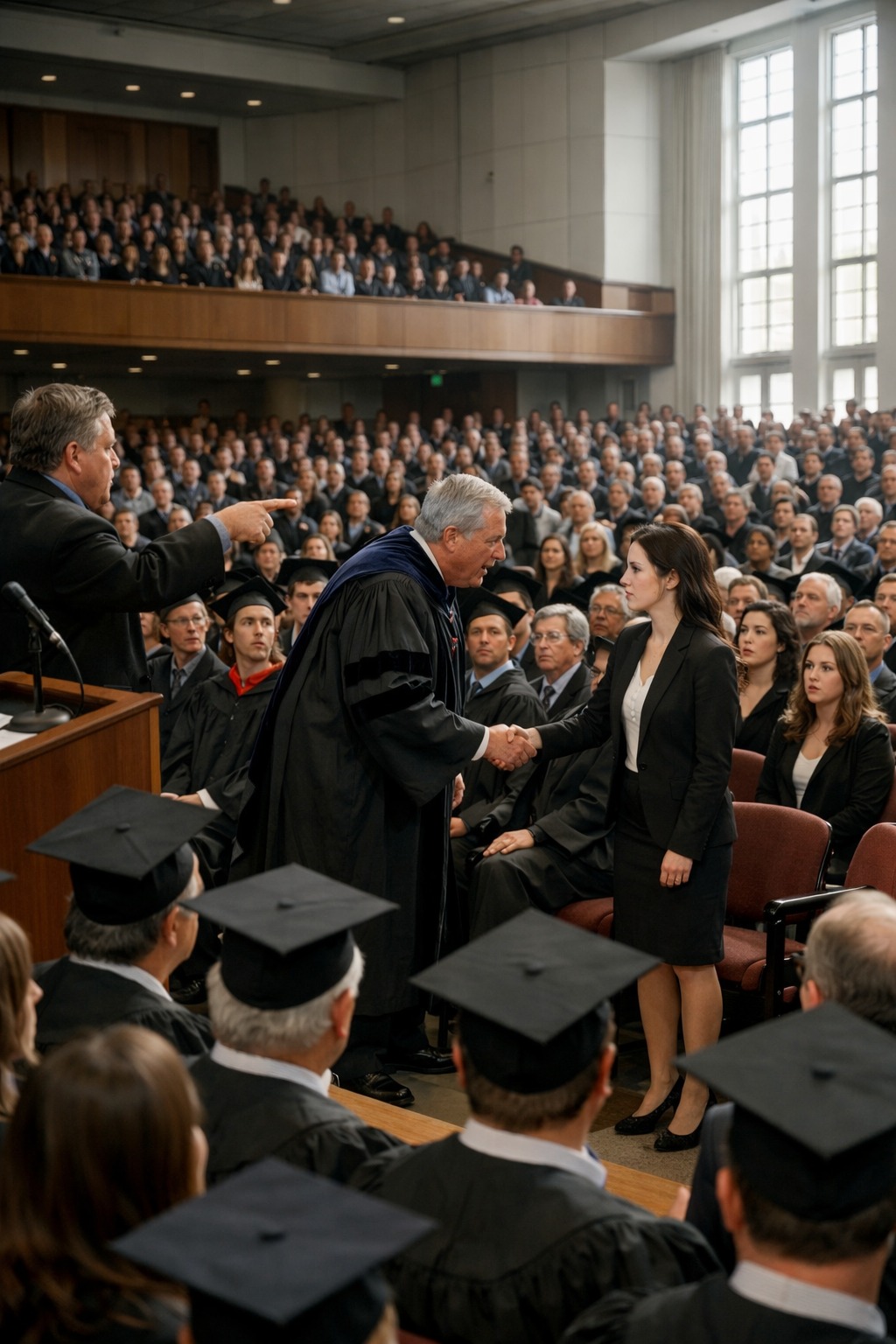
“That one right there,” he said, and his voice carried, because it always had. He was standing in the aisle two sections over, shaking hands with strangers like he was running for office. He had on a navy blazer, a bright tie, and that same broad grin he’d worn my whole life whenever there were witnesses. “That’s my son.”
A man beside him said something I couldn’t hear.
My father laughed, warm and loud. “This one’s the real lawyer,” he said, jerking his chin toward the stage.
A few people chuckled.
Then he added, quieter but not nearly quiet enough, “Not her.”
It landed exactly the way those lines always did: light enough for other people to treat it like a joke, sharp enough to slide cleanly between my ribs. Nobody turned to see if I’d heard. Why would they? I was just a woman in the back row in a gray suit with a folded program in her lap.
The funny thing about old wounds is how efficient they are. They don’t need a speech. They don’t need elaboration. A sentence like that can wake up twenty years in a heartbeat. My father laughing at the dinner table when I said I wanted to go to law school. My father introducing Tyler to neighbors as “the future attorney” while I was already a practicing litigator. My father calling my first judicial appointment “a nice government position,” like I’d been hired to stamp parking permits.
I sat still. The paper program softened in my hand where my thumb kept rubbing the same edge.
The ceremony started. Dean Robert Heller walked to the podium, silver-haired and straight-backed, his glasses flashing in the stage lights. There were speeches about resilience and service and justice. The graduates shifted in their chairs. Parents cried early. Somebody’s baby started fussing two rows ahead of me, and the mother bounced it with one arm while filming with the other.
When they started calling names, the room settled into that familiar rhythm of applause, footsteps, handshakes, camera clicks.
Tyler’s turn came halfway through.
My father shot up before the dean had finished saying his name. “That’s my boy!” he called, clapping so hard I could hear it from the back. A few people laughed again. Tyler smiled nervously, took his diploma cover, shook the dean’s hand, and turned for the camera.
Then Dean Heller looked up.
It took me a second to realize what had happened. His eyes swept over the audience, drifted past a few rows, then stopped on me. His expression changed in a way I knew well from the courtroom—recognition arriving half a beat before certainty.
He leaned toward the microphone.
“Your Honor,” he said, clear as a bell. “I didn’t realize you were here.”
The whole room shifted.
You can feel silence before you hear it. It moves like weather. Heads turned. Programs lowered. Conversations clipped off in the middle. People looked where he was looking, and because he was onstage under lights and I was a woman in the back row trying very hard to disappear, there was a split second where nobody understood what they were seeing.
Then Dean Heller smiled.
“It is an honor to have one of our distinguished alumni with us today,” he said. “Judge Nora Ward, thank you for joining us.”
The applause started thin, confused, then thickened as people caught up. Some people clapped because they understood. Some because everyone else was clapping. A woman in front of me twisted all the way around to stare. I gave the dean a small nod, the same one I use in court when an attorney makes a good point and I don’t want to encourage them too much.
Across the room, my father turned.
I watched recognition hit him in layers. First confusion. Then calculation. Then something I almost never saw on his face at all.
Panic.
It was brief. He covered it fast. He always had instincts for survival. But I saw it, and once I saw it, I couldn’t unsee it.
The ceremony resumed. Names kept being called. More applause, more gowns swishing up and down the steps. But the air had changed. People kept sneaking glances at me like they were trying to match the fact of me to whatever story they had already accepted five minutes earlier.
I sat through the rest of it, my spine straight, my hands folded over the program.
When it ended, the room burst open all at once. Families spilled into the aisles, flowers bobbing, phones up, voices rising. The whole place smelled suddenly like perfume, wool, sweat, and peonies. I stayed in my seat until the first rush thinned out. I had no desire to be trapped in a cluster of congratulations that weren’t really about me.
I had just reached the aisle when I heard my name.
“Nora.”
My father was standing near the row where he’d been sitting, one hand still gripping the back of a chair. Up close, he looked older than he had from across the room. The skin under his eyes had gone loose. There was a flush high on his cheeks that hadn’t been there earlier.
“You never told me,” he said.
There were about fifteen answers I could have given him. The newspaper announcement. The swearing-in. The framed photograph from my robing ceremony he’d walked past in my house twice without really looking at. The way I’d said “I have arraignments Monday” or “I had a long sentencing calendar” and he’d nodded like I worked in municipal zoning.
Instead I said, “I thought you knew.”
His mouth opened, then closed.
Behind him, Tyler was getting hugged by friends, his cap crooked, his smile stretched wide for pictures. For a second my father looked from Tyler to me like he was trying to solve an equation that should have been simple.
“Well,” he said finally, and his voice came out softer than I was used to hearing from him. “Congratulations.”
Not an apology. Not even close. Just a man testing a new tone because the old one had stopped working.
“Thank you,” I said.
I started toward the side doors.
“Nora,” another voice called.
I turned. Dean Heller was making his way down the aisle toward me, one hand raised. He was trailed by Professor Anika Rhodes from legal ethics, who looked sharper and less forgiving than she had when I was a student. She still wore her hair in the same neat twist at the nape of her neck, and she still looked like she could smell dishonesty from three hallways away.
“Judge Ward,” Dean Heller said when he reached me. “Would you have a few minutes after the reception? Professor Rhodes has been trying to track down the right way to contact you.”
I glanced at her. “About what?”
Professor Rhodes looked past me, over my shoulder, toward the crowd gathering around Tyler.
“About a paper,” she said. “One your brother submitted.”
Something cold and thin slid down my spine.
“A paper?” I repeated.
She held my gaze. “A paper with your fingerprints all over it.”
I looked across the room at Tyler, smiling for another picture with our father’s hand clamped proudly around his shoulder, and for the first time all afternoon, I felt something worse than insult.
I felt the floor move.
Part 2
The reception was in the law school atrium, where the light always came in a little too hard through the glass and made everybody look exposed. Round tables had been set up with white cloths and little vases of baby’s breath. There were trays of dry cookies, fruit skewers sweating onto silver platters, and coffee so burnt it smelled like hot pennies. Graduates drifted through in clumps, still wearing their robes open over dresses and shirtsleeves. Families hovered around them with that frazzled, determined joy that comes after a public ceremony, when everyone wants proof they were there.
I didn’t want cookies or coffee or pictures. I wanted clarity.
Professor Rhodes stood near one of the high-top tables by the windows, waiting with the kind of posture that made it clear she did not intend to waste a second of anyone’s time. Dean Heller had already been swallowed by alumni and donors. I took two steps toward her and got intercepted by Tyler.
“Nora.” He smiled, breathless and shiny-eyed. Up close I could see the sweat dried along his hairline. “You came.”
There was no accusation in it. Just surprise. That almost made it worse.
“I said I would,” I told him.
He looked embarrassed then, and maybe a little guilty, though I couldn’t tell guilty about what. Tyler had always had a softer face than mine or our father’s. He was the kind of man people assumed was kind before he’d done anything to earn it. It had carried him farther than it should have.
“Dad didn’t know,” he said quietly.
“I know he didn’t.”
Tyler glanced over his shoulder toward the room, as if making sure Frank Ward wasn’t materializing behind him. “He says stupid things when he’s showing off.”
“That one wasn’t new.”
His jaw tightened. He looked down, then back up with a weak attempt at a smile. “Still. I’m glad you’re here.”
For one small, stupid second, I almost believed him.
Then Professor Rhodes said, “Mr. Ward, I need your sister for a moment.”
Tyler turned. The second he saw her, the blood drained from his face so quickly it was almost theatrical. That answered one question for me.
Professor Rhodes didn’t invite either of us to sit. She didn’t bother with congratulations. She just set a manila folder on the table and opened it.
Inside were copies. Marked drafts. Highlighted passages.
“I’ll be direct,” she said. “Your brother’s capstone note was flagged by one of our adjunct reviewers because the structure and voice resembled an older unpublished student note in our archive.”
I stared at the pages.
My own handwriting looked back at me from the margins.
Not current handwriting. Younger handwriting. Tighter, more impatient. The kind I used when I still thought if I controlled every line hard enough, I could control the rest of my life.
I looked at Tyler. “What is this?”
He swallowed.
Professor Rhodes slid one page free and turned it toward me. My name sat at the top of the copied original in the archive notation: Nora Elise Ward, Juvenile Transfer and Discretionary Sentencing Reform. A note I had written during my third year. A note I had never published because life had blown a crater through that semester and I’d withdrawn from law review to work nights and help take care of my mother.
Tyler’s submission wasn’t identical. He’d changed the introduction, updated the cases, sanded off some of the older phrasing. But the bones were mine. Some paragraphs were so close they still carried my old rhythm. Worse, tucked into one footnote was a citation to a memorandum from a closed juvenile proceeding that had been sealed.
I felt my chest go hollow.
“Where did this come from?” I asked.
Tyler made a helpless movement with one hand. “I—”
Professor Rhodes cut in. “Before you answer, understand that the question is not only academic. That citation should not have been available to you.”
Tyler’s eyes flicked to me, then away.
I looked back at the pages. The sealed memo citation sat there in black type, innocent as a grocery list. I knew exactly what it was. Not because of law school. Because I had referenced the memo years later in a continuing education lecture I’d drafted for juvenile court judges. I had also used some of the note’s arguments as a foundation for my own thinking on sentencing reform. Which meant Tyler hadn’t just gotten into my old student work somehow.
He’d gotten into my professional work too.
“You used my writing,” I said.
“It wasn’t like that.”
I laughed once, short and ugly. “Really? Tell me what it was like, then.”
A couple at the next table turned at the sound of my voice. Tyler noticed and lowered his. “Dad gave me some old boxes. He said you wouldn’t care. He said it was family stuff. Research. He said—”
“What boxes?”
“Our storage unit. From Mom’s things. From your old apartment. I didn’t know it was a big deal.”
Professor Rhodes folded her hands. “Mr. Ward, you won the Benton Prize with this note. You were also recommended for the Talbot Fellowship. So yes, it is a big deal.”
Tyler’s face changed on the word won. That told me something too. He hadn’t just turned in a bad paper because he was drowning. He had ridden it upward.
“When were you planning to tell me?” I asked.
He looked genuinely stung. “I was going to rewrite more of it.”
The room around us kept moving. Laughter from the punch table. Ice clinking in plastic cups. Somebody calling for another family photo near the staircase. It all sounded absurdly far away, like I was listening through a closed car window.
Professor Rhodes flipped to another page and tapped a highlighted paragraph. “There’s more,” she said. “This section includes analysis from a bench memorandum generated in your chambers’ matter style. I’m not asserting misconduct by you, Judge Ward. I’m saying the language is close enough to require an answer.”
I stared at the paragraph. She was right. Not copied wholesale, but derived. Anybody who worked with judges long enough would recognize the cadence: clipped issue framing, neutral recitation, then the hidden lean.
My stomach turned.
I lifted my eyes to Tyler. “You took something from my chambers?”
“I didn’t take anything from your chambers.”
“But you had access to material from my chambers.”
He opened his mouth and shut it.
That was enough.
I stepped back from the table because suddenly I couldn’t breathe in that bright glass room full of celebration and fruit skewers and polite background music. I could smell citrus cleaner from the floors and frosting from a sheet cake somebody had cut too early. My own pulse felt loud in my ears.
“I need specifics,” I said. “Now.”
Tyler dragged a hand over his face. “Can we not do this here?”
“No,” I said. “We are absolutely doing this here.”
He looked around like maybe the ceiling would open and rescue him. Instead, my father walked up carrying two paper cups of coffee and wearing his public smile.
“There you are,” he said. “I’ve been looking all over—”
He stopped when he saw the folder.
There are moments when a person tells the truth without speaking. A whole confession can flash through a face before the mouth catches up. I saw it in him then. Not confusion. Not curiosity.
Recognition.
His eyes went straight to the copy of my old note and then to Tyler, who looked like a man who had just realized the floor under him was rotten.
“What did you do?” I asked.
My father set the coffees down too carefully.
“Let’s not make a scene,” he said.
That was the moment I knew it wasn’t one bad choice. It was a system. It had been a system for longer than I understood. And standing there with Professor Rhodes’ folder open between us, I realized the real question wasn’t whether my father knew.
It was how much he had done.
Part 3
We ended up in an empty classroom down the hall from the atrium, the kind with tiered seats and dry-erase markers rolling in the tray beneath the board. Somebody had left the projector on, so a pale blue square glowed against the screen at the front of the room. The hum of the building’s air system made everything feel colder than it should have. From the hallway, I could still hear distant bursts of laughter and applause from the reception, each one landing wrong.
Professor Rhodes closed the door behind us but stayed. I appreciated that. My father had always been more careful when there were witnesses he couldn’t charm.
Tyler stood near the first row, arms folded so tightly he looked like he was holding himself together. My father took the aisle seat and spread his knees like he was settling in for a negotiation. I remained standing.
“Start talking,” I said.
My father blew out a breath through his nose. “Nora, you’re overreacting.”
I actually smiled. Not because anything was funny. Because there was a point, with certain men, where predictability became almost elegant.
“I’m overreacting,” I repeated. “To my brother winning an academic prize with my unpublished work and language that appears to come from judicial material?”
“Your old school paper is not the nuclear codes,” he said. “You act like he robbed Fort Knox.”
Professor Rhodes spoke for the first time since we entered. “Mr. Ward, plagiarism and possible misuse of confidential legal analysis are not trivial matters.”
My father glanced at her, dismissed her, and looked back at me. “Tyler needed help. He was under pressure. Families help each other.”
That sentence did something ugly inside me, because I had heard versions of it all my life, and it had only ever flowed one direction.
I turned to Tyler. “Did you know it was mine?”
His eyes stayed on the carpet for a beat too long. “At first I thought it was notes. Old research. Dad said you’d left stuff behind and didn’t want it.”
“At first.”
He swallowed. “Then I knew.”
“When?”
His voice came out thin. “After I started using it.”
I nodded once. “And the sealed material?”
“That wasn’t sealed material,” my father snapped too fast.
I looked at him. “Interesting. I didn’t say which material.”
His jaw flexed.
Tyler spoke quickly, like he was trying to get ahead of the collapse. “Dad gave me a flash drive and some folders. He said you had old lecture materials and sentencing stuff that was public. He said judges talk about this all the time. He said none of it mattered because the case was closed.”
My vision narrowed.
“A flash drive,” I said. “From where?”
“From your old laptop. The one in storage.”
I knew that laptop. Gray, dented on one corner, half the battery dead. I had retired it years ago, but I also knew I had once transferred notes to it while working from home during a courthouse renovation. Most of the files were harmless. Some were not.
I turned to my father. “You went through my electronics?”
He raised both hands. “We were cleaning out storage. I was helping the family. You never get around to your boxes.”
“And you decided that entitled you to my work?”
His expression hardened a notch. “You always make everything sound so dramatic. Tyler wasn’t stealing your identity. He was trying to finish school. You already made it. What difference does it make if a few pages from an old note helped him over the line?”
There it was. The logic beneath the years. I had already made it. Therefore nothing of mine could still belong to me.
Professor Rhodes said, “This is not a private moral disagreement. The school will have to review this formally.”
Tyler flinched. “Professor, please.”
I ignored him. “What boxes?”
My father rubbed his forehead like I was exhausting him. “Storage unit off Route Nine. The yellow file was in one of them.”
“What yellow file?”
He looked at Tyler.
Tyler looked at the floor.
I walked over to the desk where the folder sat. Beside it, my father had dropped a leather tote when we came in. The side pocket gaped open. I saw the corner of a worn yellow folder sticking out.
For a second nobody moved.
Then I reached for it.
My father stood up so fast the chair legs scraped. “Nora—”
I already had it in my hand.
The cardboard was soft at the edges from age. My name was written across the tab in black marker. Not in my handwriting. In my mother’s.
A quiet came over me then, so sudden and complete it felt almost merciful.
I opened the folder.
Inside were copies of old transcripts, financial aid forms, a memo from law review, and one cream-colored envelope with the university crest. My fingers knew it before my brain did. Thick paper. Formal. The kind used for life-changing news.
I slid it out.
Federal Court of Appeals Chambers Selection Interview.
Dated twenty-two years earlier.
I stared at the page until the words stopped blurring. I had applied for a feeder clerkship my third year after Professor Adler pushed me to. I never heard back. When I called chambers months later, embarrassed and already overloaded with my mother’s treatments and my part-time job and Tyler’s tuition payment my father swore was temporary, I was told the interview schedule had long been filled. I had assumed I hadn’t made the cut.
Stapled behind the letter was the green certified mail receipt.
Signed: Frank Ward.
The room tipped.
I didn’t feel it in some grand cinematic way. It was smaller than that. More specific. Like the exact hinge my whole adult life had swung on had suddenly come loose, and I could hear it rattling.
“You signed for this,” I said.
Nobody answered.
I looked up at my father. His face had gone blank in that practiced way people use when they think silence might still save them.
“You signed for this,” I said again.
He shrugged, but there was no ease in it. “You were drowning back then.”
I laughed once, breathless. “Because Mom was sick and I was working nights and driving Tyler to practice and paying bills you kept promising to cover?”
“You’re rewriting history.”
“No,” I said. “I think I’m reading it for the first time.”
Tyler took a step toward me. “Nora, I didn’t know about that letter.”
I believed him. That was the worst part. This was bigger than his cowardice. Bigger than one stolen note. Something older had just pushed its way to the surface, and it smelled like paper dust and hospital coffee and the inside of that apartment I used to come home to at two in the morning after shift work, wondering why my life felt like it was happening to somebody else.
In the bottom of the folder was another envelope.
Unopened.
My mother’s handwriting again.
For Nora. After graduation.
My thumb stopped on the edge of the paper.
I looked at the date.
It was twenty-two years old.
And my father had kept that too.
Part 4
There are discoveries that break your heart cleanly, and then there are discoveries that split it into layers. The letter from my mother sat in my lap while I drove across campus to the faculty parking lot because I could not bring myself to open it in that classroom with my father breathing the same air. The envelope had yellowed at the corners. It smelled faintly like old paper and cedar, the way things do when they’ve sat in a box too long beside winter blankets.
I didn’t open it in my car either.
Instead I went back inside.
Shock had made me weirdly efficient. By the time most people would have been crying in a bathroom stall, I was standing in the administrative suite asking whether Margaret Sloane still came in on commencement days. If you’d told me that morning I would spend my brother’s graduation hunting through institutional memory for proof my father had edited my life behind my back, I would have called you melodramatic. By three-thirty, it felt like the only reasonable use of my time.
Mrs. Sloane was in alumni relations, retired technically, but brought back for big events because no database on earth could replace a woman who remembered everybody’s original mailing address and every scandal since 1989. She was smaller than I remembered and had traded her dark helmet of hair for a silver bob, but her eyes were the same sharp blue.
“Nora Ward,” she said, standing when she saw me. “No, excuse me. Judge Ward now.”
I shook her hand. It was cool and dry and steady. “Mrs. Sloane, I need to ask you something strange.”
Her mouth tightened in a way that said she had lived long enough to know strange rarely arrived alone. “Come in.”
Her office smelled like file folders, hand lotion, and peppermint. There were alumni newsletters stacked on every horizontal surface and a bowl of wrapped mints on the desk that probably had its own pension. I sat. She noticed the yellow folder in my hand immediately.
“That,” she said, very softly, “is not where that should have turned up.”
I looked at her. “You recognize it?”
She took off her glasses. “I made that folder.”
Something in my chest clenched.
“Why?”
“Because your professor was trying to locate you for months and because some of those documents should have been delivered personally years ago.” She paused. “I assumed they had been.”
I set the folder on her desk and slid the certified receipt toward her. “He signed for my interview letter.”
Mrs. Sloane read the signature and closed her eyes briefly. Not surprise. Confirmation.
“When the appeals chambers sent that,” she said, “Professor Adler called me because he was afraid you’d miss it. You weren’t answering your apartment number anymore.”
“I had moved to save money.”
“I know. We tried your emergency contact.”
“My father.”
She nodded once. “He said your mother was very ill and that you had decided to stay local. He said you were grateful but could not pursue anything that would take you out of state.”
The room felt suddenly airless.
“I never said that.”
“I suspected as much later.” Her voice had gone gentler, which almost made it harder to hear. “You had not struck me as someone who would vanish from a federal clerkship interview without even sending a note.”
I stared at the desk. There was a coffee ring on one corner of a donor report and a tiny chip in the wood by the stapler. I focused on those things because they were solid.
“What else?” I asked.
Mrs. Sloane looked at me for a long second. Then she reached into a cabinet and pulled out an old archive logbook, the real paper kind, cloth-bound and heavy. She opened it carefully and ran one finger down a page.
“After your mother passed,” she said, “Professor Adler sent a condolence card and another recommendation packet. A state judicial fellowship. You had been nominated.”
My head snapped up. “I never saw that.”
“No.” She tapped the line. “Because it was returned after a forwarding issue. We called again. Your father answered again.”
I could hear my own pulse.
“What did he say?”
She hesitated.
“Mrs. Sloane.”
“He said,” she replied slowly, “that you were overwhelmed, that the family needed stability, and that your brother’s education had to come first for a while.”
A very specific memory flashed through me then: my father standing in our kitchen in shirtsleeves, telling me Tyler needed one more tuition bridge because “he’s the one with the real trajectory.” My mother upstairs asleep from chemo. Me with grocery receipts in one hand and a legal aid job application in the other, thinking this was temporary, thinking all hardship was temporary if you could outwork it.
My mouth tasted metallic.
“I’m sorry,” Mrs. Sloane said.
I looked at the unopened envelope from my mother. “Did she know?”
Her eyes moved to the handwriting and then back to me. “Your mother came here once that spring. Very tired, but determined. She asked for stationery and a private room. She said she wanted to leave you something for after graduation because she was afraid the house was too noisy for serious things.”
The words house too noisy hit me like a hand to the sternum. That was exactly how my mother used to phrase it when my father filled every room with his opinions and Tyler turned the television up and I sat at the table pretending I could still hear myself think.
“She left that with you?” I asked.
“With me and Professor Adler, in trust.” Mrs. Sloane looked ashamed. “When he died two years later, some personal items from his office were boxed and misfiled. We found the envelope during archive digitization last winter. I’ve been trying to locate the best way to get it to you privately ever since.”
So that part, at least, hadn’t been another theft. Just institutional delay. A clerical accident laid over a family crime.
I let out a breath I hadn’t known I was holding.
Mrs. Sloane touched the edge of the folder. “Nora, there is one more thing.”
I braced.
“When your brother applied here, your father mentioned you in every conversation. Not with pride.” She chose the words carefully. “He said you had become impressive but difficult. He laughed about how serious you were. I thought it was insecurity talking. Now I think it may have been something else.”
I looked down at my hands. My knuckles had gone pale from gripping the folder.
When I finally stood to leave, Mrs. Sloane came around the desk and hugged me before I could object. She smelled like peppermint and starch and whatever hand cream older women always seem to have. It was such a motherly gesture that I almost came apart right there in alumni relations between the donor plaques and the copy machine.
I drove to my chambers after that because it was the one place in the city where silence still obeyed me. The courthouse was mostly empty by then. Evening light lay flat across my office carpet. My law clerk had left a yellow legal pad on the corner of my desk with tomorrow’s sentencing notes. The room smelled like paper, old books, and the faint cedar note from the drawer where I kept a sachet my mother had sewn thirty years ago.
I sat in my chair, closed the door, and opened the envelope.
The paper inside crackled softly. My mother’s handwriting leaned a little more than I remembered, as if even then her body had been tugging away from her.
Nora-girl,
If you are reading this, it means one of two things. Either everything worked exactly as I hoped and you are opening this after graduation, or the men in this family have delayed something important again.
I stopped.
My skin went cold.
I read that first sentence three times before the rest of the room came back into focus. Outside my office door, somebody’s footsteps passed and faded. In my hand, the page trembled.
My mother had known something.
Not everything, maybe. But enough.
And suddenly the question that had been stalking me all afternoon sharpened into something far more dangerous than hurt.
How long had she known?
Part 5
My mother’s letters always sounded like she was speaking just over your shoulder while doing something practical with her hands. Shelling peas. Folding towels. Peeling apples at the sink. Even dying, apparently, she had managed to sound like herself.
I read the letter once fast, then again slowly, then a third time with my fingertips pressed to my lips because I could not seem to trust my own breathing.
She wrote that she had been watching the currents in our house for years. Not big dramatic scenes. Smaller things. My father “forgetting” to tell me about a callback from a professor. Tyler “borrowing” my notes and returning them late. Family decisions being described as temporary until the temporary became the architecture of my life. She said she had started leaving messages with women instead of men whenever possible because information reached me more reliably that way. She wrote that she loved Tyler, but that he was being trained to assume the world would widen for him if he waited long enough.
Then came the line that made me put the paper down and stare at the wall for a full minute.
Your father admires your mind best when he can use it and least when other people can see it.
I laughed, and the sound that came out of me was all wrong.
She wrote that she had suspected—suspected, not proven—that at least one opportunity had been kept from me during her treatments, because she had seen my father open an official envelope at the kitchen counter and slip it into his briefcase when he thought she was asleep on the couch. She said she had confronted him, and he had told her he was protecting the family from “another one of Nora’s grand exits.”
I closed my eyes.
She had tried, she wrote. She had argued. She had made him promise to give me whatever else arrived. But by then she was weak, sometimes confused from medication, and the house had started operating around her illness like a machine that only pretended to care how much noise it made.
At the bottom of the second page, she had written:
If he ever makes you smaller to keep the family comfortable, do not call that love. Do not call it sacrifice. Do not call it misunderstanding. Call it what it is.
There was no dramatic flourish after that. No perfect final sentence. Just: I hope you leave before they convince you staying is virtue.
I sat there until the edges of the pages blurred.
Outside my chambers window, the sky was turning the flat purple-gray it always turned before rain. Somewhere down the hall, a cleaning cart rattled over the tile. The courthouse had its evening smell now: dust, copier toner, cold coffee, old stone cooling down.
My phone buzzed on the desk.
Professor Rhodes.
I let it ring once, then answered. “Judge Ward.”
“I’m sorry to call this late,” she said, sounding exactly like a woman who was not sorry enough to delay necessary work. “I wanted to make you aware before formal notices go out. We are initiating an honor code inquiry tonight.”
I leaned back in my chair and looked at the ceiling. “I figured.”
“There will also be a referral to the character and fitness committee if the findings support intentional misrepresentation.”
Meaning the bar admission process Tyler hadn’t completed yet could be affected. Meaning this could cost him not just an award or a fellowship, but the license he had been posing all day in a rented hood to celebrate.
I thought of him onstage smiling into camera flashes.
“I need a statement from you,” she said. “Not tonight. But soon. On authorship, access, and whether you knowingly provided any material.”
“I did not.”
“I assumed not. Still, I need it documented.”
There was a beat of silence.
Then she said, more quietly, “I also think you should speak with your court’s ethics counsel. If any internal judicial analysis made its way into that note, even indirectly, you need to get ahead of it.”
I appreciated the bluntness. It was the kindest thing anyone had said to me all day.
“I know,” I said. “I’m already thinking through how.”
“If you need copies of the drafts or the metadata the student turned in, I can have them ready tomorrow.”
“Please do.”
She hesitated. “For what it’s worth, I am sorry the timing is cruel.”
I looked at my mother’s letter on my desk. “I’m starting to think the timing is the point.”
After we hung up, I called my chief clerk and left a message saying I needed chambers IT first thing in the morning and would explain then. Then I sat in the growing dark without turning on the lamp.
Eventually my phone buzzed again.
Tyler.
I let that one go to voicemail.
Then my father.
Then Tyler again.
Finally, because I was tired of being hunted in my own silence, I answered Tyler’s third call.
“Nora,” he said immediately, voice raw. “Please don’t do this.”
I almost admired the grammar of it. Not please listen. Not please let me explain. Please don’t do this. As if truth were an attack I had launched.
“Do what?”
“Make this bigger than it has to be.”
I laughed softly. “Tyler, you submitted my work as your own.”
“It wasn’t all yours.”
That got my full attention. “Excuse me?”
“I changed a lot. I updated the cases. I fixed sections. And Dad said—”
“I don’t care what Dad said.”
“He said you were always like this,” Tyler snapped, and there it was at last, the thing under the soft face. “You get one title and suddenly everything is sacred. Every file, every opinion, every stupid old note. You act like nobody else bled to get here.”
My fingers tightened around the phone.
“No,” I said. “I know exactly who bled. That’s becoming the problem.”
He was crying by then, or close to it. I could hear him breathing too fast. “If this goes to character and fitness, I’m done.”
A month ago that sentence would have wrung me out. Twenty years of training had prepared me to hear my brother’s distress as an emergency and my own as weather.
Now I looked at my mother’s handwriting and felt something hardening into shape.
“You should have thought of that before you put your name on my work.”
“You don’t understand.”
“Then explain it.”
Silence. I could hear traffic through his end of the line. A car horn. Wind.
When he spoke again, his voice had dropped.
“Dad said you owed us.”
I shut my eyes.
There it was. The family religion in one sentence.
“Goodnight, Tyler.”
“Wait—”
I ended the call.
For a while I sat with the dead screen in my hand. Then I reached for my briefcase, pulled out a legal pad, and wrote three names across the top of a page: Frank. Tyler. Me.
Underneath, I started listing dates.
The yellow folder. The clerkship letter. My mother’s note. Law review withdrawal. Storage unit access. Old laptop.
By the time I stopped, rain had started tapping the courthouse windows in a fine steady hiss.
I gathered the letter and the folder, locked both in my desk, and stood to leave.
That was when my clerk’s voicemail transcription popped onto my screen from the message I’d missed during the ceremony.
Judge, one more thing. Chambers IT called back about your old archive account. They found a login from last Thanksgiving. It wasn’t from the courthouse.
I stared at the text until the words settled into place.
Last Thanksgiving.
At my house.
The year my father had insisted on “helping” me clean the study after dessert while Tyler fixed the storm window.
I felt the old pain inside me change shape again. Sharper now. Cleaner.
Because if that login was what I thought it was, then this wasn’t just about something stolen from a box twenty years ago.
It was recent.
It was deliberate.
And it had happened under my own roof.
Part 6
The storage unit sat at the back of a strip of low concrete garages behind a pawn shop and a tire place, the kind of property that always smells like wet cardboard and motor oil no matter the season. I went there the next morning before court opened, because once I had the IT note in my head, I could not bear the idea of waiting through calendars and motions and ordinary legal theater while my real life sat boxed under fluorescent lights.
The sky was washed-out white. Rain from the night before still clung to the chain-link fence in little dull beads. I punched in the access code from an old family email, half expecting it not to work.
It worked.
Inside, the air was cool and stale. Dust floated in the single strip of overhead light when the door rattled up. There were more boxes than I’d expected, stacked in sloppy columns that leaned toward one another like tired men at a bar. Some were labeled Christmas. Some Kitchen. Some Tyler Law. Mine said things like Nora Misc. or Office Old, which told its own story.
I stood there a second and just looked.
A person’s place in a family can be read in labels.
Tyler had banker’s boxes with clear marker: LSAT. Internships. Trial Ad Binder. My life—my actual life, the years I had worked and studied and paid and buried and clawed—had been reduced to Misc.
I started opening boxes.
The first held old textbooks with my tabs still sticking out in faded strips of pink and blue. The second had winter coats, a chipped lamp, my mother’s casserole dish wrapped in newspaper from the year she died. In the third, I found my old gray laptop bag, empty.
Not the laptop. Just the bag.
I set it aside and kept going.
The farther back I got, the stranger the sorting became. My high school debate trophies mixed with Tyler’s baseball cards. A stack of legal pads from my first clerk job bundled with my mother’s recipe binder. A framed photo of me receiving my oath, the glass cracked straight through my face.
I crouched on the concrete and stared at that for a long moment.
My phone buzzed.
Tyler.
I ignored it.
Then my father.
Ignored that too.
When I found the external hard drive, it was wrapped in one of my old silk scarves and shoved into a box marked Tax 2011. My pulse kicked. I slipped it into my briefcase without plugging it in.
Behind it, at the bottom of the same box, I found a slim red notebook. My chambers notebook. Not official, not formal, but the private kind judges keep for patterns and questions and wording fragments they don’t want to lose before they become opinions. I hadn’t seen it in over a year. I’d assumed I had misplaced it during the office shuffle when we renovated chambers.
I opened it with a care that felt almost ceremonial.
Half the pages were there.
The rest had been sliced out with something thin and sharp.
I sat back hard on my heels.
A forklift beeped somewhere on the far side of the lot. Outside, somebody coughed. The world went on being ordinary while I held evidence that my own family had handled my work like a buffet.
By the time I got back to the courthouse, my clothes smelled like dust and concrete and the metallic tang of old storage air. I carried the hard drive and notebook into chambers and shut the door.
Court IT sent over Luis Herrera, who had the patient face of a man who had been explaining passwords to judges for fifteen years and no longer believed anything could surprise him. It took him eight minutes with the hard drive to disprove that belief.
“The archive account was accessed remotely from a local residential network,” he said, looking at the screen. “Your home IP. Thanksgiving evening. Then files were copied to external media.”
“Which files?”
He clicked through the logs. “Old research folders, CLE draft materials, some archived bench memos from migrated backups.” He glanced at me. “Nothing from active encrypted case folders, but enough that this is a problem.”
I nodded. My mouth had gone dry.
“Can you tell who was on the machine?”
He gave me a look both apologetic and practical. “Not from this alone. But if you had guests, I can narrow the timing.”
I had guests.
My father in my study saying he wanted to look at the old family photo albums because “someone has to keep history.” Tyler upstairs allegedly checking the guest room window. Me in the kitchen rinsing cranberry sauce off serving spoons while football muttered from the television and my father’s voice rolled in and out from down the hall.
I could see it too clearly now.
A knock came at the door.
My clerk poked her head in. “Judge, your brother is here.”
I felt no surprise. Just fatigue.
“Send him in.”
Tyler entered looking wrecked. Same suit from yesterday, wrinkled now. No gown, no crowd, no father to stand beside. He looked younger without the ceremony around him. More like the boy who used to trail behind me into the kitchen asking if I could quiz him on vocab before a test.
Luis stood.
“I can come back,” he said.
“No,” I replied. “Stay for one minute.”
Tyler saw the notebook on my desk and the color left his face. “Nora—”
“Did you come here to tell the truth?”
He glanced at Luis, then at me. “Can we please do this privately?”
“No.”
He pressed the heels of his hands into his eyes. “I didn’t know Dad took pages out.”
That landed somewhere I hadn’t expected. Not because it absolved him. Because it meant there were layers even he had not controlled.
“Start at the beginning,” I said.
Tyler dropped his hands. “Thanksgiving. Dad said you had old sentencing notes that could help me shape my capstone. He said he’d already talked to you.”
“He had not.”
“I know that now.”
Luis, wisely, stared at the floor and became furniture.
Tyler went on. “Dad got into your study while you were cooking. He called me in to help with the computer. I copied folders onto the hard drive because he said you kept everything and wouldn’t miss it.”
“You accessed my judiciary archive.”
“I didn’t know that’s what it was. It looked like old files.”
I believed he hadn’t known exactly what he was looking at. I also knew that ignorance was now a luxury neither of us could afford.
“Then what?” I asked.
“I started reading. Some of it was too technical. Some was amazing.” His eyes lifted to mine, and shame flickered there. “Your writing was… God, Nora, it was incredible. Clean. Like every sentence knew where it was going. Mine never sounded like that.”
The compliment hit me like ash. Too late, too useful, too tied to theft to be tender.
“So you used it.”
“At first just structure. Then some language. Then Dad found your old law review note and said we could blend them.”
We.
I leaned back in my chair. “You and Dad.”
Tyler nodded miserably. “He said it was still family work. He said you got everything first and I was just catching up.”
My laugh this time had no sound in it at all.
Luis cleared his throat. “Judge, I should document that this conversation occurred in my presence.”
“Please do.”
Tyler flinched. “Nora, don’t.”
I looked at him for a long, exhausted moment. “Do you understand what happens now?”
His eyes filled. “I lose everything.”
Something in me wanted to answer, No. You lose the lie. But I couldn’t trust myself to say it without cruelty, and I had just enough discipline left not to feed on his panic.
Instead I asked the question that had been forming since last night.
“Who else saw the files?”
Tyler wiped at his face. “No one.”
I said nothing.
He looked away.
“Tyler.”
He swallowed hard. “Dad emailed one chapter to somebody.”
The room went still.
“To who?” I asked.
He closed his eyes.
“A lawyer at Keller & Voss. The firm that offered me the post-grad job. Dad said he wanted to make sure it sounded expensive.”
For the first time since the dean had said your honor into a microphone, I felt real fear.
Because Keller & Voss had attorneys with active juvenile sentencing appeals in my county.
And if one of them had seen language spun out of my chambers’ internal work, then this was no longer just a family betrayal or a school ethics case.
It was a threat to the integrity of my courtroom.
Part 7
The worst part of being a judge is not deciding hard things. Most of us know, by the time we put on the robe, that the work will require cuts. The worst part is realizing your own life can become evidence.
By noon I had self-reported to the presiding judge, ethics counsel, and court security. I said the words out loud in a conference room that smelled like old carpet and stale coffee: unauthorized access, possible derivative disclosure, family member, unknown distribution scope. Each word felt clinical. Necessary. None of them captured the particular humiliation of having to explain that the breach might have begun with Thanksgiving pie cooling on my counter while my father rooted through my study.
Chief Judge Medina listened without interruption. She was a compact woman with silver hair cut blunt at the chin and the stillness of somebody who had spent decades not wasting energy on theatrics.
When I finished, she folded her hands. “You did the right thing by coming immediately.”
“I’m not interested in credit.”
“I know.” Her dark eyes held mine. “I am interested in containment. We’ll wall off anything that may have been compromised. Security will analyze the transfer trail. You are recused from any Keller & Voss juvenile matter effective now.”
I nodded.
Ethics counsel, a narrow man named Feldman who always looked like he had slept in his tie, said, “We need proof the leak originated externally if this gets challenged by a litigant. Otherwise opposing counsel may argue systemic exposure.”
“I understand.”
Chief Judge Medina glanced at the printed timeline in front of her. “Your brother says your father emailed material to a lawyer. Do we know which lawyer?”
“Not yet.”
“Find out.”
That was it. No pity. No indulgence. Just the work. I was grateful for it.
By the time I got back to chambers, the courthouse had shifted into afternoon mode. Phones rang more sharply. Deputies moved faster. Lawyers in dark suits hovered near elevators with files tucked under their arms and that permanent expression of irritated urgency unique to litigators who bill by the hour. My office smelled like paper and the tea my clerk had made and forgotten to drink.
Tyler was waiting outside my door.
He stood when he saw me, then stopped himself from stepping closer. Good. At least somebody in this family was learning.
“You can’t keep showing up here,” I said.
“I know.” He looked awful. Red eyes, stubble, tie loosened. “I just needed to tell you before Dad changes it.”
“Changes what?”
He looked down the hallway, then back at me. “The story.”
I opened my office and let him in, against my better judgment. My clerk took one look at our faces and quietly vanished to the library.
Tyler remained standing after the door shut. “Dad called the lawyer from Keller & Voss because of Greg Holloway.”
I searched the name and found it. “The managing partner.”
“He knows Dad from Rotary or golf or one of those fake networking things old men use to pretend they like each other. When I got the offer, Dad wanted to be useful. He told Greg he’d look at my writing sample.”
I felt tired clear through my bones.
“So he used mine.”
Tyler nodded.
“Did Holloway know it wasn’t yours?”
“I don’t know. Dad forwarded a section and said, ‘Does this look polished enough for a top firm kid?’ Something like that.”
I closed my eyes briefly. Holloway might have treated it as harmless bragging. Or he might have recognized language from a pending issue and said nothing. Either possibility made me want to put my fist through a wall.
“Did you ever send the full note to anyone?”
“No.”
“Did Dad?”
“I don’t know.”
There was too much of that phrase in his mouth.
I moved behind my desk and sat because anger feels cleaner when you’re not trying to balance it. “Why did you come, Tyler?”
He looked at me then, really looked, without the ceremony or the panic or our father’s gravity bending him. For a second I saw the little boy who used to wait at the bottom of the stairs when I got home from late study sessions and ask if I had crackers because Dad forgot dinner again.
“I need you to know one thing,” he said.
I said nothing.
“I didn’t know about the clerkship letter. Or the fellowship. I swear to God I didn’t.”
I believed him. Again, that did not help.
“But you knew the note was mine,” I said.
He nodded.
“And you still submitted it.”
“Yes.”
His honesty hit me harder than excuses would have. There is something brutal about a person looking at the exact shape of their wrongdoing and naming it without flinching. It doesn’t erase anything. Sometimes it just makes the damage easier to measure.
“Why?” I asked.
He gave a crooked, exhausted laugh. “Because I was drowning. Because everybody thought I was doing better than I was. Because I got the job offer and then my grades slipped and I couldn’t write the note I promised and Dad kept saying I just needed one clean win. Because every time I opened a blank page I heard your voice in my head and knew mine was worse.”
I leaned back slowly.
That was new. Not that he had envied me. I’d known that in some dim sibling way. But I had also spent my whole life being told, directly and indirectly, that Tyler was the cherished one, the easy one, the son the family could present without complications. It had never occurred to me that being the golden child could come with its own warped hunger. Not enough to make me gentle. Enough to make me precise.
“So you stole from me,” I said, “because you thought I’d survive it.”
His face crumpled a little. “No. Because Dad said you always survive everything.”
That one lodged deep.
A knock came at the door before I could answer. My clerk opened it just enough to slide in a note. I unfolded it.
Security traced the outgoing email domain connected to the Thanksgiving transfer. Keller & Voss associate on juvenile panel cc’d. Need meeting 4:00.
I looked up.
“When Dad emailed Holloway,” I said, “who did he use?”
Tyler’s expression changed. It was small. Immediate. Fear layered with memory.
“My account,” he said.
Of course.
I could picture it now. My father, who still typed with two fingers and called every PDF “an attachment thing,” sitting beside Tyler, dictating confidence into the room while using Tyler’s email as a disguise.
“Did you know he cc’d anyone?” I asked.
Tyler shook his head.
My phone rang. Court security.
I answered, listened for less than thirty seconds, and felt the last soft place in this entire mess close up.
When I hung up, Tyler was watching me with eyes too wide.
“What?”
I set the phone down carefully.
“The associate your father cc’d,” I said, “represents the appellant in a resentencing matter that was reassigned out of my courtroom two months ago after a procedural issue.”
Tyler stared.
“The chapter your father sent included analysis that overlaps with questions raised in that appeal.”
“I didn’t know.”
“I know.”
My voice sounded calm. It frightened him more than shouting would have.
“Nora—”
I stood.
“Go home,” I said. “Do not call opposing counsel. Do not call the school. Do not call Dad and help him coordinate anything. If anyone asks, you tell the truth.”
His mouth opened.
“Every word,” I said. “Because if I find out you lie to contain this, I will make sure the record is complete enough to bury you.”
He nodded once, pale as paper.
After he left, I stood alone in my office with the late sun slanting across the floorboards and the courthouse noise muffled beyond the door. On my desk sat my mother’s letter, the sliced notebook, and the yellow folder that had rewritten half my life in a single afternoon.
I looked at them all, then reached for my coat.
If Keller & Voss had touched my work, I needed proof.
And proof, I was beginning to understand, was the only language my family had never managed to talk me out of speaking.
Part 8
Court security moved faster than grief, which was useful. By four o’clock I was in a secure conference room with Chief Judge Medina, ethics counsel, the head of IT, and an investigator named Sam Rivera, who gave the impression of having been born leaning against a file cabinet waiting for somebody to lie to him. Broad shoulders, tired eyes, dark suit with the jacket already off. He slid a printed packet toward me and tapped the top page.
“We’ve got preliminary logs,” he said. “Thanksgiving transfer from your home network to an external drive. Subsequent email from Tyler Ward’s account to Gregory Holloway at Keller & Voss with one attachment. Cc to associate Melissa Crane.”
I looked at the paper. My brother’s email address. Time stamp. Subject line: writing sample excerpt.
My chest tightened, but not from surprise anymore. Surprise had left the building. What remained was a colder thing. The discipline you reach for when emotion threatens to blur edges you cannot afford to lose.
“Did Crane open it?” I asked.
Sam flipped a page. “Yes. Holloway too.”
Chief Judge Medina said, “We are notifying the administrative office and the parties in any matter that may be affected. Narrowly. No broader than necessary until we know actual overlap.”
Necessary. Another clean word for a dirty process.
I scanned the attachment printout. Only ten pages had been sent. Enough to wound. Not enough to tell the full story. A section on juvenile transfer discretion. Policy analysis. A few polished paragraphs that had once been mine before they’d been spliced with current citations and turned into currency.
“Can we establish what portion derives from protected court material?” Feldman asked.
Sam nodded toward the next tab. “Possible derivative language from a chambers training memo and personal judicial notes. No active order text. But close enough that any decent appellate lawyer would recognize the lane.”
Chief Judge Medina looked at me. “Judge Ward, did anyone at Keller & Voss have reason to know you authored or sourced this?”
“Not from the email itself unless they recognized the style or the issue.”
“Would they?”
I thought of Holloway. Smooth, overconfident, one of those firm men who always acted like judges were old college classmates he just hadn’t seen lately. I’d met him at bar dinners, holiday events, one fundraiser where he’d tried to compliment my “practical temperament” in a tone usually reserved for horses.
“Yes,” I said. “Possibly.”
The room went quiet.
Medina gave one sharp nod. “Then assume they did.”
That should have been the only conversation. It wasn’t.
Because while we were still sorting the professional damage, my phone lit up with a text from my father.
Answer me. This has gone far enough.
I stared at it until Sam cleared his throat softly. “Family?”
I turned the phone face down. “Unfortunately.”
When the meeting ended, Sam asked if I had somewhere secure to spend the evening. I almost laughed. He meant because of evidence, retaliation, bad decisions, men with wounded pride. The answer was yes, technically. A judge’s life comes with secure addresses and courthouse deputies and protocols. What it doesn’t come with is a guide for how to go home after discovering your father has spent years prying open the seams of your life whenever he needed something.
“I’m fine,” I said.
He gave me a look that said he had been doing this too long to believe people who said that. “I’m sure you are. I’m still assigning a patrol check.”
Outside, dusk had started to settle over downtown, turning the courthouse steps the color of old nickels. The air smelled like rain-soaked concrete and food carts from two blocks over—fried onions, coffee, hot sugar. I stood under the portico for a second longer than necessary, breathing.
My father called.
I answered before I could talk myself out of it.
“Nora, finally.” No greeting. No apology. Just irritation sharpened by fear. “What exactly are you telling people?”
“The truth.”
He made a disgusted sound. “You always loved that word when it made you feel righteous.”
I looked out at traffic crawling past the square. “Did you intercept my clerkship letter?”
Silence.
Then: “That was twenty-two years ago.”
Not no.
A bus hissed to the curb across the street.
“Did you?” I asked again.
His voice came out flatter. “You were not in a position to run off to some fancy judge in another state.”
“My mother was dying.”
“Exactly.”
I shut my eyes. Not because I couldn’t bear hearing him. Because I wanted to hear him perfectly.
“I needed help,” he went on. “This family needed help. Tyler needed tuition. You had always been the strong one.”
There are things people say when they think they are explaining themselves that are, in fact, confessions dressed for church.
“You hid my life from me,” I said.
“I delayed one opportunity.”
“You hid multiple.”
He exhaled sharply. “You still became a judge. Look at you now. What are you complaining about?”
The words were so nakedly vicious in their logic that for a second I had no emotional reaction at all. Only comprehension. The clean kind. The kind that stops hope from pretending to be loyalty.
“What am I complaining about,” I repeated.
“I did what fathers do. I balanced priorities.”
“No,” I said. “You placed bets.”
He didn’t answer.
I could hear a television on his end, too loud. Dishes maybe. The familiar domestic soundtrack of a man who thinks if he keeps moving around his own kitchen, his lies remain ordinary.
“Listen to me,” he said. “Do not destroy your brother over a misunderstanding and some old resentment.”
“This is not old resentment.”
“He made a mistake.”
“You trained him into it.”
His voice hardened. “Watch yourself.”
I almost smiled. Even now. Even with the school inquiry, the court investigation, the exposure of his thefts. Somewhere inside him was still the father from my childhood, sure that a certain tone could make the room tilt his direction.
“No,” I said. “You watch.”
I ended the call.
When I got home, the house felt wrong immediately. Not broken into. Not disturbed. Just touched by memory in a way I could suddenly no longer tolerate. The study door stood open. My dining table still had a faint water ring from Thanksgiving under the runner. The lamp in the living room threw the same warm pool of light it always did, and I hated it for a second.
I walked straight to the guest room closet where I kept a small fireproof lockbox. Inside were copies of my mother’s letter, the certified receipt, and a few old estate documents I had never finished reviewing after my father insisted everything had already been handled when she died.
Tonight, I reviewed them.
At the bottom of the stack was a photocopy of a deed transfer for the lake cabin my mother’s parents had owned. I remembered that cabin in slices: the smell of pine sap in summer, minnows flickering near the dock, my mother reading mystery novels in a canvas chair. I had assumed it had been sold to cover medical bills. That was the story.
The document in my hand told a different one.
Transferred by quitclaim deed six months after my mother’s death from Marianne Ward Estate to Franklin Ward, trustee for Tyler Ward educational support.
I stared at the page until the letters blurred.
The cabin.
Another thing moved quietly off my life and into my brother’s future while I was working, paying, surviving, trusting.
My phone buzzed with a new message, this one from an unknown number.
Judge Ward, this is Melissa Crane from Keller & Voss. I believe we need to speak immediately. There are facts your father did not disclose.
I read it twice.
Then a second message arrived.
He told us the writing belonged to “the family” because you had abandoned the underlying project years ago. That appears to be false.
I stood in my quiet house with the deed in one hand and the phone in the other, and the scope of my father’s appetite finally revealed itself.
Not one letter. Not one paper. Not one season of my life.
Anything he thought he could convert, he had.
And now one of the lawyers he’d tried to impress was reaching out because even she could smell the rot.
Part 9
I met Melissa Crane the next morning in a coffee shop two blocks from the courthouse because she refused my suggestion of a conference call and I refused to walk into Keller & Voss on principle. The place smelled like espresso, toasted bagels, and damp wool from the morning crowd. Steam hissed behind the counter. People tapped laptops and wore expensive guilt. It was too normal for the conversation we were about to have.
Melissa Crane was younger than I expected, maybe thirty-two, with a navy suit, no nonsense haircut, and the alert, controlled face of a woman who had learned how to work in a big firm without letting men mistake politeness for softness. She stood when I approached.
“Judge Ward.”
“Ms. Crane.”
We sat in the far back corner, away from the grinder noise. She didn’t waste time.
“I’m here without my firm’s authorization,” she said.
“That seems unwise.”
“Yes,” she replied. “But less unwise than staying quiet.”
That earned my attention.
She slid a printed email chain across the table. “Your father contacted Greg Holloway from your brother’s account in November. Greg forwarded the excerpt to me because I handle juvenile appellate briefing and he wanted my opinion on whether the writing sounded sophisticated enough for a post-grad candidate.”
I looked at the printout. There it was again. Tyler’s account. My father’s swagger obvious even through typed sentences.
What do you think? Kid says he drafted this under pressure but I told him good writing reveals itself.
My stomach turned.
Melissa tapped the next page. “I recognized the issue framing. Not because I knew your specific work. Because the analysis tracked arguments developing in a pending resentencing appeal we were monitoring closely. I told Greg the sample was ‘surprisingly mature’ and asked if the student had clerked in juvenile court. Your father replied that your brother had ‘family access to the real thing.’”
I looked up. “He wrote that?”
“Those exact words.”
The coffee shop noise seemed to recede around us. Cups clinked. Milk frothed. Somebody laughed near the door. All of it sounded very far away.
Melissa continued. “At the time, I assumed he was bragging about growing up around lawyers and judges. It was gross, but not actionable. Then yesterday we got notice from the court’s administrative office about a potential confidentiality issue. I reread the chain and realized your father may have been more literal than I understood.”
“Did your firm use any of the material?”
“No.” The answer came fast and firm. “Not in any filed brief. I checked. Greg shared the excerpt only with me. I did not circulate it further. Once I understood the risk, I preserved everything and informed internal ethics.”
I believed her. Or rather, I believed she understood exactly how catastrophic it would be to lie to a sitting judge whose chambers had been compromised. Self-interest can still produce truth.
“Why contact me directly?” I asked.
Her mouth flattened. “Because Greg intends to say he viewed the exchange as informal networking and that your father misrepresented the source. That may be partially true. It is also incomplete. He knew enough to ask me whether the writing reflected inside-court perspective.”
I let that settle.
“And?”
“And he liked what it said.”
Honesty again. Sharp and useful.
I glanced down at the pages. In the margins of one printout, Melissa had underlined my father’s line about family access. Beside it she had written in neat pen: This is where it stopped being innocent.
I looked at her. “May I keep these?”
“Yes. I’ve also preserved the digital headers and can produce them if subpoenaed.”
She took a breath. “There’s one more thing. In a follow-up call, your father mentioned the lake cabin. He said he’d ‘already invested enough of your mother’s assets into one legal career’ and wouldn’t let the smarter child waste the younger one’s shot.”
For a second I forgot where I was.
The cabin. My mother’s assets. My father, folding money and inheritance and children into the same sentence with the same greasy confidence.
Melissa must have seen something change in my face because her tone softened. “I’m sorry.”
I folded the emails carefully. “No. I’d rather know exactly what he sounds like when he thinks he’s safe.”
When I left the coffee shop, the air outside had that sharp late-spring chill that sneaks under a coat no matter how fast you walk. I went straight to Sam Rivera’s office in court security. He was on the phone, one boot up on a drawer, reading from a screen. He pointed at a chair without interrupting whatever law enforcement alphabet soup he was handling. Ten minutes later he hung up and looked at my face.
“That good, huh?”
I handed him the printouts.
He read them once, then again slower. “Your dad’s either very confident or very stupid.”
“Both can live in the same zip code.”
He almost smiled. “We pulled more from the home network timeline. There was a thumb drive mounted two separate times last Thanksgiving. Once at 7:14 p.m. Once at 8:03.”
“Who had access to the study then?”
“You tell me.”
“My father. Tyler. Possibly me if I walked through.”
He nodded. “We also got a warrant assist on deleted mail from Tyler’s account after he signed a consent with the school inquiry. He tried to trash a draft message in January.”
I leaned forward.
Sam turned his monitor slightly so I could read.
Dad — this is too close to Nora’s stuff. If she ever sees it, she’ll know. Maybe I should just take the B and move on.
My throat tightened.
Below it was my father’s reply.
B is for people with no one behind them. Stop panicking and use what the family already paid for.
I sat back.
There it was. Not an excuse. Not a misunderstanding. Instruction.
Sam watched me, careful and unreadable. “This helps.”
“Does it?”
“It makes intent easier to prove. For the school, for the bar review, for anyone who thinks this was one sloppy mistake.” He tilted his head. “You okay?”
No one had asked me that in a way that seemed to allow a truthful answer all week.
“No,” I said.
He nodded as if that were the most ordinary and acceptable thing in the world. “Good. That means you still know what happened.”
I laughed then. Against my will. Short and rough, but real.
By afternoon, the law school had set the hearing date. Tyler. Honor code panel. Faculty review. Character and fitness notification pending findings. Professor Rhodes sent me the schedule with no commentary, which I appreciated more than she probably knew.
At six-thirty, my father showed up at my house.
I saw him through the side window before he rang the bell. He was holding no flowers, no bottle, no peace offering from a grocery store as if all emotional labor could be outsourced to cellophane. Just his car keys and his own anger, polished and ready.
I kept the chain on when I opened the door.
“We need to talk,” he said.
“We do not.”
His jaw jumped. “You are humiliating this family in public.”
I looked at him through the narrow opening. “You sold this family in private.”
He stared at me for a beat too long, then changed tactics so smoothly it would have impressed me if it hadn’t been nauseating.
“You think I didn’t sacrifice?” he said. “You think I don’t know what I did? I did what I had to do. Your mother was slipping away. Bills were everywhere. Tyler had one chance.”
“And I had what?”
His eyes flashed. “You had backbone. You always had backbone.”
The night air smelled like wet leaves and somebody grilling three houses down. A dog barked once and stopped.
“Do you hear yourself?” I asked.
“You still won.”
“No,” I said quietly. “I survived what you called love.”
For the first time since the auditorium, he looked uncertain again. Not repentant. Just off-balance because the script wasn’t working.
He reached into his jacket and pulled out an envelope.
“Your mother left more than one letter,” he said.
I froze.
“She didn’t tell you everything,” he added. “Read this before you decide what kind of daughter you want to be.”
He slid the envelope through the narrow gap before I could stop him.
Then he turned and walked back down the steps into the dark.
I stood there listening to his car start, the engine idle, then fade at the end of the block.
In my hand was another old envelope in my mother’s handwriting.
And after everything I had already uncovered, I still didn’t know whether opening it would break me further or finally set something right.
Part 10
I did not open the second envelope right away.
That would have been the old reflex: obey the urgency, let him control the timing, let the object in his hand dictate the weather in my body. Instead I set the envelope on the kitchen table, made tea I did not want, and stood at the sink watching steam climb into the light over the counter.
The house was quiet except for the hum of the refrigerator and a faint rattle from the old vent near the pantry. My mother used to complain about that vent. Said it sounded like a cicada trapped in the wall. She would be furious, I thought suddenly, to know how much of her voice I now had to retrieve from paper because the men she lived with had spent years talking over it.
When I finally sat down and opened the envelope, I recognized the stationery immediately. Not from home. From a lawyer’s office.
Inside was a copy of a handwritten statement and a draft amendment to a simple will.
The statement was from my mother.
It was dated three weeks before she died.
If Franklin presents my choices later as confusion, fear, or sentiment, know that I am writing this with full understanding. Nora is not to be burdened further for my sake. If there is a resource that helps her leave cleanly into her own life, I want it used for that purpose. Tyler is young enough to rebuild with less.
I read it once. Then I lowered the page and stared at nothing.
Beneath it was a note in my father’s handwriting clipped to the document.
Didn’t file. She was not in her right mind. Feverish.
A lie so ordinary it almost glowed.
Because attached behind the statement was the business card of the attorney who had witnessed it and signed beneath my mother’s name. There was also a draft amendment specifying that the lake cabin proceeds, if sold, were to be divided with priority share to me for postgraduate mobility and housing. My mother had tried to create an exit lane.
My father had buried it.
I laughed into the empty kitchen, and the sound that came back at me was so bitter it barely sounded human.
By the time the hearing day arrived, I was done mistaking revelation for pain. Pain still existed, of course. It showed up at inconvenient moments—when I passed a father helping his daughter parallel park outside the courthouse, when I found one of my mother’s old recipes folded into a cookbook, when I remembered Tyler at age ten asleep on my shoulder in the ER waiting room while our father paced the hall making calls about business. But underneath all of it was something steadier now.
Judgment.
Not the legal kind. The moral one. The kind people pretend is harsh because it deprives them of loopholes.
The honor code hearing was held in a wood-paneled conference room at the law school, all institutional dignity and hidden outlet strips. There were six faculty members at the table, Professor Rhodes among them, plus an administrative recorder tapping notes into a laptop. Tyler sat at one end in a charcoal suit. He looked like he hadn’t slept in a week. My father sat directly behind him, which surprised no one and irritated me instantly.
I took my seat when called.
The hearing was less theatrical than people imagine. Most serious institutional collapses are. No dramatic music, no gasps, no heroic speeches. Just documents, timelines, questions, and the exhausting accumulation of specifics.
Professor Rhodes laid out the textual similarities first. Side-by-side passages from my archived note and Tyler’s submission. Structural overlap. Shared idiosyncratic phrasing. Then the derivative language from my judicial materials. Then the email chain Melissa Crane preserved. Then the deleted draft exchange between Tyler and my father.
Every few minutes I could hear my father shifting behind his son. Tiny noises. Breath through his nose. Shoe scraping the floor. The irritation of a man discovering that institutions run on records, not tone.
When it was my turn, I testified plainly. I had not authorized Tyler to use my unpublished student work. I had not granted access to my chambers archive. I had discovered evidence that my father and brother accessed and copied materials from my home on Thanksgiving. I had self-reported to the court immediately upon learning of possible derivative disclosure. I had no interest in inflating the matter and every interest in accuracy.
“Did you believe Mr. Tyler Ward understood the material belonged to you at the time of submission?” one panelist asked.
I looked at my brother.
He was already looking at me.
“Yes,” I said.
He flinched like I’d touched him.
Then it was his turn.
And for one brief, almost dangerous second, I thought he might still lie.
Instead he said, quietly at first and then with increasing steadiness, “Yes. I knew.”
My father jerked behind him. “Tyler—”
The chair of the panel held up a hand. “Mr. Ward, your son is speaking.”
Tyler kept going. He admitted receiving the files. Admitted using my note. Admitted recognizing my voice in it and continuing anyway. Admitted his father had encouraged him repeatedly. When they asked about the email to Keller & Voss, he went pale but answered that too.
The room changed around that admission. Not noisily. Just in posture. Faculty who had still been entertaining the possibility of a panicked student mistake sat back and saw the shape for what it was.
At one point my father actually stood up.
“This is ridiculous,” he said. “You’re making a career-ending issue out of family collaboration.”
Professor Rhodes turned to him with the kind of calm that can cut steel. “Mr. Ward, if you speak again out of turn, you will be removed.”
He sat. Barely.
By the end of the hearing, Tyler looked hollowed out. Whatever story he had told himself about pressure, timing, desperation, paternal loyalty—it had not survived contact with the record.
When we filed out, no one spoke to us in the hallway. A few students looked up from benches and then away fast. The building smelled like old carpet and printer toner and the lemon oil they used on the display cases near the moot courtroom.
Tyler caught up with me at the stairwell landing.
“Nora.”
I turned.
His eyes were red again, but there was something different in him now. Less panic. More wreckage.
“I’m sorry,” he said.
I believed that too.
And still.
“I know,” I replied.
He opened his mouth as if he thought sorrow might be the beginning of repair.
It wasn’t.
Behind him, my father came through the doors hard enough that one banged the stopper.
“This isn’t over,” he snapped. “You don’t get to sit there and judge your own blood like strangers.”
I looked at him for a long moment.
“You’re right,” I said. “Strangers usually have better manners.”
Then I walked away.
That night, after the hearing but before the school issued findings, someone knocked on my door after eleven. Hard. Repeated. Angry enough that the glass beside the frame hummed.
I didn’t need to look to know who it was.
Still, I checked the peephole.
My father stood on the porch in the dark, shoulders wet from drizzle, one hand braced on the frame, the other gripping the old yellow folder like it was a weapon or a prayer.
And for the first time in my life, I understood that whatever happened next would not be reconciliation.
It would be the end.
Part 11
He knocked again.
The porch light flattened him in the peephole, took the warmth out of his skin, made the lines in his face look carved instead of aged. He looked less like my father and more like what remained after the performance had burned off.
I did not open the door.
“Nora,” he called. Not shouting now. Worse. Controlled. “I know you’re in there.”
I stood in the dark hallway, barefoot on the runner rug, phone in one hand. The house smelled like rain through the screens and the lavender drawer liners my mother used to buy in bulk. I could hear the little ticking noise the thermostat made before the heat kicked on. All the ordinary domestic sounds of a life I had built carefully, privately, away from his reach.
“I’m calling the police if you keep pounding on the door,” I said.
“You’d call the police on your own father.”
It wasn’t a question. It was an accusation presented as tragedy. He still thought blood should be a master key.
“Yes,” I said.
He laughed once, short and disbelieving. “Your mother would hate this.”
That did it.
I opened the inner wood door but kept the storm door locked between us. Glass, metal, distance. The rain had dampened the shoulders of his coat. He smelled faintly of cigarettes even though he’d quit years ago, which meant stress had stripped him down to older habits.
“Do not use her,” I said.
His face tightened. “I’m trying to stop you from making a permanent mistake.”
“No,” I replied. “You’re trying to stop consequences from landing where they belong.”
He held up the yellow folder. “There are documents in here that can still keep this from getting uglier.”
“It’s already ugly.”
“For Tyler, I mean.”
Of course he did.
I looked at him through the glass. This man had intercepted my clerkship interview, buried my mother’s instructions, converted a family cabin into my brother’s educational fund, mined my work to polish Tyler’s résumé, and showed up at my house after midnight still talking as if I owed him emotional moderation.
I felt something almost like peace.
“What’s in the folder?” I asked.
He hesitated, then slid out a packet of papers and pressed them against the glass so I could read the top page backward. A sworn declaration. Typed. Signed by him.
“I’m prepared to say Tyler didn’t know the material was yours.”
I stared at the page, then at him.
“That’s false.”
“It would help him.”
“And incriminate you.”
He smiled without humor. “I can survive more than he can.”
For a split second, I saw the appeal. Not because I wanted to save Tyler that way. Because sacrifice, even counterfeit sacrifice, can still mimic love if you’ve been starved correctly.
Then I saw the trap behind it.
If he took the whole intentional act onto himself, Tyler could still argue negligence, confusion, reliance. The bar committee might let him limp through later. My father would become the villain in a way he could dramatize and maybe even enjoy. He had always liked suffering when it made him central.
“No,” I said.
His expression changed. “Excuse me?”
“You don’t get to rewrite this either.”
“This is strategy.”
“This is editing.”
He slapped the papers lightly against the glass. “He is my son.”
“And I’m your daughter.”
He looked at me, and for the first time in my entire life, I watched him understand that line had finally stopped working as decoration.
“Nora—”
“No.” My voice stayed quiet. That mattered. “You are not going to confess selectively to save the version of him you like best. He made choices. You trained him into some of them. You made others easier. But he still made them.”
“You would watch your brother lose everything.”
I thought about the word watch. As if all I was doing was observing. As if I had not already lost opportunities, property, years, trust, and whatever childish animal in me had once waited for my father to say my name with uncomplicated pride.
“I watched him take from me,” I said. “This part is just visible.”
He went very still.
Then, because ugly people often save their ugliest truth for when charm finally dies, he said, “You were always easier to use than to love.”
I did not react outwardly. Years on the bench had taught me what to do with a face while a body absorbed impact.
Inside, something settled.
Not broke. Settled.
Like the final piece of evidence dropped into place.
I unlocked the door just long enough to take the yellow folder from his hand. Then I locked it again.
“Leave my property,” I said.
His nostrils flared. For one stupid second I thought he might shove the door. Instead he stepped back into the rain, looked at me through the glass with a hatred so pure it was almost cleansing, and said, “When this is over, don’t come asking what happened to your family.”
I met his eyes.
“It already happened,” I said. “You did it.”
I closed the inner door. Not slammed. Closed.
Then I called the non-emergency line and requested a trespass warning on record.
The findings came three days later.
The law school revoked Tyler’s Benton Prize, rescinded his fellowship recommendation, and reported the matter to character and fitness with findings of intentional plagiarism and misrepresentation. Keller & Voss withdrew his job offer before lunch. The court’s review concluded that while no active protected order had been disclosed, derivative language from internal judicial materials had been improperly accessed and shared without authorization. Additional administrative safeguards were imposed. My chambers survived. Barely.
My father, meanwhile, became a local weather system of self-pity and rage. He called relatives. He said I had become arrogant. Cold. Political. Unforgiving. He said Tyler had been sacrificed to my ego. He said the whole thing was exaggerated by institutions eager to ruin young men.
My aunt Linda left me a voicemail saying, “Honey, everybody’s made mistakes in this family,” which is the kind of sentence people use when what they really mean is Please return to your assigned role.
I didn’t call her back.
Tyler sent one email.
I know sorry is cheap now. I’m not asking you to fix anything. I just need you to know Dad told me for years that you didn’t care what happened to us as long as you got out. I built a lot of myself around that. It doesn’t excuse what I did. But I think I need to say it before I try to become someone who doesn’t.
I read it twice.
Then I archived it.
Not deleted. Not answered. Just placed where it belonged: preserved, not active.
A week later, the probate attorney whose card had been attached to my mother’s hidden amendment confirmed what I already suspected. The cabin transfer had been ethically dubious at best, fraudulent at worst. My mother’s signed statement and the surrounding records were enough to reopen aspects of the estate.
I sat in the attorney’s office listening to words like petition, constructive trust, tracing, remedy, and all I could think was how tired I was of using law to excavate love’s remains.
But I did it anyway.
Because tired is not the same thing as wrong.
Part 12
By late summer, the cabin was mine.
Not in some mystical moral sense. In the legal one. Recorded, stamped, boring, final. The deed correction came through after a months-long probate fight that would have made a lesser woman question whether justice was worth the filing fees. My father contested, of course. Said my mother had been confused, that memories were being manipulated, that I was twisting grief into acquisition. The judge on the probate matter did not enjoy being lied to any more than I did. Paper beat performance. Again.
I drove up there alone the first weekend after it was settled.
The road wound through tall pines and patches of late goldenrod. Sun flashed through the trees in clean slashes. When I pulled into the dirt drive, the cabin looked smaller than it had in childhood, which is true of most places and almost all fears. The porch needed paint. One shutter hung crooked. A wind chime my mother had made from old silverware still clicked softly near the door, somehow surviving everything.
Inside, the air smelled like cedar, lake water, dust, and the ghost of old coffee. I opened windows one by one and let the place breathe. Light moved slowly across the plank floor. In the back bedroom closet, I found a faded quilt my mother had sewn from my grandfather’s shirts. In the kitchen drawer, I found a deck of cards, two rusted bottle openers, and a note in her handwriting tucked under the liner:
Buy more cinnamon.
I sat down on the floor and laughed until I cried.
Not because of the note itself. Because grief is weird and domestic and humiliating. Because after all the letters and deeds and betrayals, there she was again in the most ordinary possible sentence, reminding me that love often survives in instructions nobody else would think to fake.
I did not forgive my father.
That is important enough to say plainly.
I did not forgive Tyler either.
Forgiveness is not the tax honest people owe to those who consumed them. It is not proof of moral sophistication. It is not a prize for whoever cries hardest after consequences arrive. Sometimes refusal is the only way to keep the truth from being reworded back into something comfortable.
My father sent two more messages that fall. One accusing me of poisoning the family. One offering, bizarrely, to “start fresh” if I would help Tyler with a delayed bar petition after two years. I answered neither. When he showed up once at my chambers garage, security walked him off the property. After that, communication came through lawyers where it belonged.
Tyler wrote one last time around Thanksgiving.
I’m in counseling. I got a job at a nonprofit intake desk. It’s honest work. I know you don’t owe me anything. I hope one day the worst thing I ever did won’t also be the truest thing about me.
That one sat in my inbox overnight.
In the morning, I moved it to the archive beside the first.
Still no reply.
That was not cruelty. It was boundary. People confuse the two when they benefitted from your lack of one.
Winter came. Hearings stacked. Sentencing calendars thickened. The city turned brittle around the edges. Life, blessedly, resumed its habit of demanding attention from things other than pain.
In February, with the probate recovery funds and the portion of the cabin settlement I chose not to keep, I established a scholarship through the law school.
Marianne Ward Mobility Grant.
For students—especially women—whose family obligations, housing instability, or caretaking burdens threatened to narrow opportunities they had already earned.
Dean Heller cried when I told him. Very discreetly, the way men in academia like to cry. Professor Rhodes simply nodded once and said, “Good. That’s where the correction belongs.”
The first spring they awarded it, they asked whether I would say a few words at a student reception.
I almost declined. Then I thought of my mother asking for stationery in a quiet room because the house was too noisy for serious things.
So I went.
The reception was held in the same glass atrium where my brother’s celebration had curdled into revelation. This time the light felt different. Or maybe I did. The tables held flowers that actually smelled like something. The coffee was still terrible. Students clustered in nervous little constellations, balancing plates and futures and the fear that one wrong choice might close a door forever.
I stood at the podium and looked out at them.
No back row this time.
I told them the truth, though not all of it. That talent is not always what gets protected first. That families can love you and still mistake your usefulness for your destiny. That the law is often discussed as if it lives in books and courtrooms, when in fact it also lives in kitchens, in caretaking, in who gets interrupted, in who gets mail handed to them unopened.
A few of them laughed in the right places. A few got very still.
When I finished, the room applauded—not because they had been told to, not because they suddenly realized there was a judge in the room, not because my father was standing somewhere claiming ownership of a story that was never his.
Just because I had said something true.
Afterward, a first-year student with ink-smudged fingers and a thrift-store blazer approached me clutching her scholarship letter like it might evaporate.
“My dad said law school was a selfish thing to want,” she blurted.
I looked at her. So young. So angry. So close to becoming something no one had planned for.
“What did you say?” I asked.
She gave a shaky little smile. “I said wanting my own life wasn’t selfish.”
I smiled back.
“Good answer.”
Later, when the room had thinned and the trays were mostly crumbs and melted ice, I stepped outside into the evening air. The campus lawn stretched green and gold in the lowering sun. Somewhere across the quad, graduates from another department were taking pictures, families calling names, cameras flashing, everybody trying to hold still inside time.
My phone buzzed once in my bag.
I didn’t need to check to know it might be blood.
I kept walking.
At the edge of the lawn, the wind moved through the trees with a sound like pages turning. I stood there a moment and let it touch my face. For years I had thought vindication would feel hot. Triumphant. Loud.
It didn’t.
It felt like a door closing softly in the right room.
Then I walked to my car, carrying nothing that wasn’t mine.
THE END!