The smell of black truffle, beluga caviar, and expensive Creed cologne hung so heavily in the air it felt like I was breathing through velvet.
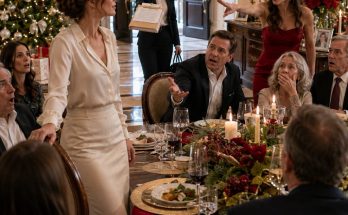
I stood at the top of the wide, polished walnut staircase inside my husband’s enormous Park City estate, listening to the dinner party below swell like a living thing. Somewhere in the grand dining room, a string quartet played Vivaldi with flawless restraint. Beneath the music came the sharp, arrogant clink of crystal champagne flutes, the deep laughter of senators, tech founders, hedge fund kings, and people who measured human worth by the price of a watch.
This was Nathaniel’s universe. A beautiful world with a rotten heart. A world built on status, cruelty, and the religious worship of appearances.
And that night, that world was killing my son.
I didn’t care about the guests. I didn’t care about the donors, the billionaires, or the senator Nathaniel had been trying to impress all month. I only cared about the small, wet, terrifying rattle coming from the baby pressed against my chest.
Oliver had been born seven weeks early. He had fought his way through the NICU, through tubes and monitors and whispered prayers, and only two days earlier, the doctors had finally allowed me to bring him home. I had been bathing him in the upstairs nursery when his breathing changed. One second he was blinking up at me with his soft dark eyes. The next, his little chest locked. His mouth opened, but almost no sound came out.
His lips began turning purple.
I ran.
I tore down the hallway barefoot, water soaking my shirt, my sweatpants clinging to my skin. Oliver’s tiny hands weakly grabbed at me, his face going pale, his lips darkening to a frightening violet. The estate was high in the mountains, at least thirty minutes from the nearest hospital on a snow-slick road. I couldn’t wait for an ambulance. I needed the reinforced SUV in the heated garage.
And Nathaniel had the keys in his tuxedo pocket.
I slammed through the heavy oak doors of the dining room.
The violin shrieked off-key. The quartet stopped. Thirty wealthy faces turned toward me, frozen between outrage and curiosity.
Nathaniel stood at the head of the candlelit table in a black custom tuxedo, one hand wrapped around a crystal flute of Dom Pérignon. He had been mid-toast, smiling at a visiting senator like a man born to own rooms.
The moment he saw me, his expression did not change into fear.
It changed into fury.
“Nathaniel!” I screamed, my voice breaking. “Oliver isn’t breathing! Give me the SUV keys now!”
He set his champagne down so hard it spilled across the white silk tablecloth.
Not once did he look at his son.
He looked at my wet clothes. My bare feet. The shocked faces of his guests. The public imperfection I had dragged into his perfect room.
Before he reached me, his mother stepped between us.
Vivian Donovan wore a glittering emerald gown and enough diamonds to ransom a city. In one arm she held her spoiled white Pomeranian like a royal artifact. With the other, she grabbed my bare arm, digging her manicured nails into my skin.
“You hysterical little embarrassment,” she hissed, her voice low but perfectly audible in the silence. “Have you lost your mind? The senator is here. You do not interrupt my son’s business dinner because you want attention.”
“He’s turning blue!” I sobbed, trying to push past her. I lifted Oliver so they could see him. “Look at him! He’s dying! I need the keys!”
Nathaniel reached us then. His fingers clamped around my other arm.
“I told you to keep him quiet upstairs,” he snarled. “You are ruining the most important night of my quarter.”
“Please,” I begged. “Please, Nathaniel. He needs a hospital.”
Together, my husband and his mother turned me away from the dining room.
Not toward the garage.
Toward the back patio.
I fought them, slipping on the polished floor, one arm locked around Oliver, terrified they would make me drop him. Outside the French doors, a brutal mountain storm lashed the glass. Rain had turned to sleet. Wind shook the trees beyond the terrace like something furious was coming through the dark.
Nathaniel unlocked the doors and shoved them open.
Cold air tore through the dining room, blowing candle flames sideways.
Then he pushed me out.
I fell hard onto the muddy stone patio, twisting my body so Oliver landed against my chest instead of the ground. Freezing rain hit us instantly. Mud soaked my knees. My bare feet scraped across ice and stone.
Vivian stood in the doorway, framed by warm golden light, holding her dog and smiling down at me.
“Sleep in the shed, street trash,” she said. “Maybe the cold will teach you manners.”
I looked up at Nathaniel.
He didn’t hesitate. He didn’t soften. He lifted his champagne glass in a mocking little salute, stepped back, and shut the doors.
The brass deadbolt slid into place.
I was locked outside in freezing mud, miles from help, with my dying infant in my arms.
Through the rain-streaked glass, I watched Nathaniel smooth his tuxedo and turn back to his guests as if he had simply taken out the trash. He raised both hands, smiling apologetically, already repairing the evening.
And in that frozen second, the frightened, obedient wife inside me died.
My tears stopped.
My breathing slowed.
My spine straightened into the rigid posture years of military discipline had carved into my bones.
Nathaniel and Vivian thought I was a harmless stay-at-home mother. A quiet former assistant Nathaniel had married because I looked good in photographs and asked few questions. They had no idea that Claire Mercer was not the woman they thought they had trapped.
They had no idea I was Major Claire Mercer, a deep-cover operator attached to a classified Joint Special Operations task force.
With numb fingers, I reached into the diaper bag hanging from my shoulder. Inside the false waterproof lining, my hand found cold metal. I pulled out a black encrypted device the size of a key fob.
I snapped the titanium pin.
A small LED blinked red once, then turned solid green.
The beacon was active.
The most dangerous men in the world were coming.
But even at maximum speed, they were still minutes away.
Oliver did not have minutes.
His chest barely moved. The purple around his lips had spread into his cheeks. I stripped off my soaked sweater with shaking hands, wrung out as much water as I could, wrapped him in it, then pressed his tiny body directly against my skin beneath my undershirt. I curled over him, turning myself into a shield against the sleet.
Then training took over.
I had kept men alive in deserts, jungles, burned-out compounds, and places no map admitted existed. I had sealed wounds with battlefield tape. I had breathed for soldiers whose lungs had collapsed under smoke and shrapnel.
I was not losing my son on a billionaire’s patio.
I tilted Oliver’s head back a fraction, sealed my mouth over his nose and mouth, and gave him the smallest controlled breath.
One.
Two.
Three.
Another breath.
Two fingers on his sternum. Gentle pressure. Tiny compressions. Perfect rhythm.
Inside the dining room, the party began to recover.
Nathaniel stood at the head of the table again, pouring fresh champagne. I could read his lips through the glass.
“I apologize,” he said with practiced sadness. “Postpartum issues can be unpredictable. She has been unstable lately. She just needs a few minutes outside to calm down.”
And they believed him.
The senator nodded. The CEOs looked uncomfortable but relieved. The music resumed, softer this time. Vivian sat back down and stroked her dog while my child fought for air ten feet away on the other side of the glass.
I breathed for Oliver again.
His chest rose weakly. A thin squeak escaped him.
“Stay with me,” I whispered. “Stay with me, baby. They’re coming.”
Minute four passed.
Minute six.
Ice formed on my shoulders. My hands went numb, but my rhythm never faltered.
At minute eight, the air changed.
It began as a vibration beneath the storm, so deep I felt it in my ribs before I heard it. The chandelier inside the dining room started trembling. Crystal prisms clicked together. Wine rippled in Vivian’s glass.
At minute nine, the night split open.
The heavy thunder of military rotors swallowed the storm.
Two matte-black Black Hawk helicopters dropped from the clouds above the estate, their downdraft tearing across the patio, launching chairs into the darkness and smashing ceramic planters against the walls.
Inside, the dinner party collapsed into chaos.
Guests screamed. The quartet scattered. Champagne spilled across suits. Nathaniel stormed toward the French doors, furious, clearly thinking some rich neighbor had ruined his evening with a flashy entrance.
He reached the glass and looked outside.
Three red laser sights appeared on his white shirt, centered over his heart.
His face went blank with terror.
A digitized voice boomed through the storm, amplified over the mountains.
“TARGET ACQUIRED. INITIATING BREACH.”
The French doors exploded inward.
Not cracked. Not shattered.
Exploded.
Glass burst into a glittering cloud across the dining room. In the same instant, armored operators in black tactical gear swarmed through the opening with suppressed rifles raised. A second team breached the front entrance, taking the oak doors off their hinges.
“ON THE GROUND! HANDS WHERE I CAN SEE THEM!”
Nathaniel’s private security guards were tackled and zip-tied before their hands reached their jackets. Politicians crawled beneath tables. Hedge fund managers flattened themselves on the floor, trembling. Vivian screamed and dropped her wine, the red liquid spreading across the floor like blood.
Nathaniel fell to his knees with his hands in the air, a laser fixed between his eyes.
But I wasn’t watching him.
Above the patio, a smaller military helicopter hovered low through the sleet. A pararescue medic fast-roped down and landed beside me, already opening a waterproof medical case.
“Major Mercer,” he said, calm as stone.
“Premature infant. Severe respiratory distress. Cyanotic. Needs airway support immediately.”
“I’ve got him, ma’am.”
Within seconds, he fitted a tiny oxygen mask over Oliver’s face and connected it to a portable high-flow tank. A pulse oximeter clipped onto my son’s foot. The medic watched the numbers on his wrist monitor.
I stared at Oliver’s chest.
One second.
Two.
Then the violet began to fade.
Pink returned slowly to his lips. His breathing steadied. The rattle softened, then disappeared.
Oliver opened his eyes and released a loud, furious cry.
It was the most beautiful sound I had ever heard.
The medic looked up and saluted. “He’s stabilizing, Major. Vitals are coming back. He’s going to be all right.”
For the first time that night, I nearly broke.
I kissed Oliver’s warm forehead, then wrapped him in the thermal blanket the medic handed me.
“Take him up,” I ordered. “Get him warm. I’ll follow.”
The medic secured Oliver to a tactical harness and gave the signal. The winch lifted them into the helicopter, carrying my son away from the mud, the cold, and the monsters behind the glass.
I stood alone on the patio.
My feet were bleeding. My clothes were soaked. Mud ran down my legs. But I felt nothing except a clean, white-hot rage.
I stepped through the destroyed French doors into the ruined dining room.
The JSOC operators did not aim at me. They lowered their rifles and moved aside, opening a path.
I walked past weeping billionaires and cowering politicians until I stood directly in front of my kneeling husband.
Nathaniel looked up at me, his tuxedo dusted with glass, his face stripped of arrogance.
“Claire,” he stammered. “What is this? Who are these people? Why aren’t they arresting you?”