Chapter 1: The Ledger of Conditional Love
My father didn’t shatter the dining room table with his fist when he casually erased my future. He didn’t raise his voice, nor did he hurl my college acceptance letter back at me in some volatile burst of rage he could later blame on a tough quarter at work.
That clinical tranquility was precisely what made the moment impossible to exorcise from my memory.
If he had screamed, I could have filed it away as a horrific domestic dispute. Instead, he deployed the same sterile cadence he reserved for loan officers and hesitant contractors—a steady, pragmatic drone, as if we were debating the durability of porcelain tile rather than the trajectory of the eighteen-year-old girl sitting across from him. My knuckles were white, my fingers digging into the paper of my college envelope like it was a life raft.
“We are funding Briarwood,” my father, Grant Parker, announced, anchoring his gaze firmly on my twin sister, Amber. “Tuition, room and board, meal stipends. The entire package.”
Amber inhaled sharply, pressing perfectly manicured fingers over her lips, though the glittering satisfaction in her eyes betrayed that she had anticipated this coronation. Beside her, our mother, Elena, emitted a soft, triumphant coo. She reached for Amber’s forearm, already practically vibrating with logistical euphoria. They were instantly submerged in a fantasy of dorm palettes, Greek life rush weeks, and alumni networking events. Grant’s mouth curved into that sparse, self-satisfied smile he reserved solely for moments when his pride required no effort.
Then, the temperature in the room plummeted as his eyes finally drifted to me.
“Maya,” he stated, his voice devoid of texture. “We’ve concluded that we will not be underwriting your enrollment at Northlake State.”
The air in my lungs turned to ash. For several agonizing seconds, his words refused to solidify into reality.
Northlake State was no Briarwood, certainly, but it was an institution of rigorous merit. It boasted a formidable economics program, sensible tuition rates, and the exact brand of pragmatic value my father had spent eighteen years preaching to us in our sprawling Denver, Colorado home. I hadn’t begged for ivy-covered prestige. I hadn’t demanded the luxury of a private enclave in California. I had simply asked for the same starting line.
“I don’t comprehend,” I stammered, the paper trembling in my grip.
Grant leaned back, steepling his fingers against his chest. He operated under the delusion that any atrocity could be rendered palatable if articulated with enough calm reasoning. He ran a commercial remodeling firm, and his entire parenting philosophy hinged on the doctrine that capital followed discipline, and emotions were the pathetic refuge of those who lacked data.
“Your sister possesses an exceptional aptitude for human capital,” he explained smoothly. “Briarwood is the optimal incubator for her. She instinctively understands networking. That specific ecosystem will yield her maximum potential.”
Amber lingered near the stone fireplace, her shoulder tilted toward the mantel mirror, admiring her own reflection. We shared the same hazel irises, the exact shade of honey-spun hair, and our birth certificates were separated by a mere sixty seconds. Yet, the universe had continually thrust us beneath drastically different filters. Amber’s audacity announced itself before she even crossed a threshold. My presence waited quietly in the corridor, hoping for an invitation.
“And my potential?” I whispered, my voice sounding dangerously thin.
My mother abruptly found the grain of the oak table fascinating, refusing to meet my eyes. Grant allowed a calculated pause, one just long enough to cultivate a pathetic sprout of hope in my chest before he crushed it.
“You possess intellect,” he conceded. “No one is debating your grades. But you do not command a room in the same capacity. We simply do not project the same long-term dividend.”
Dividend. That single, sterile noun severed something vital inside me. It wasn’t a careless slip of the tongue. It was a terrifyingly honest appraisal.
Amber was a blue-chip asset. I was a depreciating liability.
“So, the expectation is that I salvage this on my own?” I asked, my vision narrowing.
He offered a microscopic shrug—the casual dismissal of a man who has already outsourced his guilt. “You’ve always thrived on independence, Maya.”
A sharp buzz severed the silence. Amber’s phone illuminated. She beamed at the screen, her thumbs already flying across the glass to broadcast her triumph to the digital ether. Elena began murmuring something about luggage and deposit deadlines, but her voice sounded submerged underwater. The curated family portraits on the mantel suddenly looked like they belonged to strangers. I saw the pattern with sickening clarity: Amber blowing out the candles while I clapped in the periphery; Amber posing by her pristine new coupe at sixteen while I held the bulky, refurbished tablet Dad had discarded.
Independent. Low-maintenance. Easygoing. They had never been compliments. They had been alibis.
I retreated to my bedroom, a painfully mundane space adorned with thrift-store quilts and corkboards plastered with meticulous study schedules. The warm summer breeze drifted through the window, carrying the scent of a neighbor’s barbecue. Downstairs, laughter echoed, a soundtrack to my sister’s ascendance.
I waited for the tears to break. None came. The betrayal had bypassed sorrow and frozen into something infinitely denser.
At midnight, I booted up Amber’s discarded, wheezing laptop. The fan groaned like a dying lung. With fingers that felt detached from my wrists, I typed into the search engine: Full-ride merit scholarships for financially estranged dependents. The results were a labyrinth of impossibility. Deadlines had vanished months ago. Endless prompts demanded I monetize my trauma in five hundred words or less. The tuition figures glared at me, towering walls of insurmountable debt.
But beneath the icy dread, a tiny, jagged ember of absolute defiance sparked to life.
No one was coming up those stairs to rescue me. My father had closed the ledger.
I grabbed a worn notebook and uncapped a pen. I began drafting my own blueprint for survival. Budgets. Minimum wages. Federal grants. Sometime near 3:00 AM, my eyes bloodshot and burning, I stumbled upon a buried web page. The Hawthorne Fellowship. Twenty scholars nationwide. Full tuition coverage, a generous living stipend, elite mentorship, and the golden ticket: transfer eligibility to partner universities for a senior-year honors track.
It was a statistical impossibility. It was meant for students with political internships and aristocratic pedigrees.
I bookmarked it anyway. I stared into the darkness of my room, my heart hammering a new, terrifying rhythm against my ribs.
“This,” I whispered to the empty room, “is the invoice for my freedom.”
But freedom was going to demand blood, and the first payment was due at dawn.
Chapter 2: The Architecture of Exhaustion
My departure from Denver was a masterpiece of familial apathy. There were no emotional farewells. Grant cited an emergency with a contractor; Elena claimed she was still fatigued from accompanying Amber to Briarwood’s lavish orientation week. I dragged two scuffed suitcases to the Greyhound terminal alone.
Grant had slipped an envelope into my hand before he left for the office. Sitting on the plastic terminal chair, I tore it open. Two crisp hundred-dollar bills and a yellow Post-it note bearing his sharp scrawl: For emergencies only. Be pragmatic. I pocketed the cash. I shredded the note until it was yellow snow.
Northlake State welcomed me with an overcast sky and the brutal reality of poverty. Campus housing was a financial impossibility, so I had secured a room in a dilapidated Victorian house six blocks from the university gates. The listing had promised “rustic charm,” which translated to slanted floorboards, a radiator that clanged like a blacksmith’s anvil, and a kitchen permanently saturated with the stench of charred garlic.
My new reality was measured in minutes and caffeine.
My alarm shrieked at 4:30 AM every single morning. By 5:00 AM, I was sliding the key into the deadbolt of Sunrise Bean, an independent campus café that smelled perpetually of scorched milk and damp wool. I memorized complex espresso orders faster than I memorized macroeconomic formulas. I learned to smile through the ache in my arches, to smile when entitled sophomores barked about lukewarm foam, to smile when my brain felt like wet sand from studying until 2:00 AM.
After my shift, I sprinted to classes. I sat in the front row of Statistics, Public Policy, and Economics, taking frantic notes as if every syllable was a rope lowering me out of a canyon. On weekends, I swapped my apron for rubber gloves, scrubbing dormitory toilets and mopping up frat-party vomit in the residence halls.
Humiliation, I quickly discovered, loses its sting when the rent check is due on the first.
I never called my parents for help. I knew the script perfectly: they would weaponize my suffering, framing my exhaustion as proof that I had chosen an inferior path, rather than acknowledging they had shoved me onto it. Thanksgiving arrived, and the campus evacuated. I stayed behind, eating sodium-rich noodles in my slanted room, scrolling past Amber’s glossy social media posts of our family’s opulent turkey dinner, her caption declaring how blessed she was.
By February, the machinery of my survival began to fracture.
It happened during a morning rush at Sunrise Bean. I was steaming oat milk for a massive line when the fluorescent lights overhead suddenly smeared into a blinding streak. The hiss of the espresso machine faded to a dull roar. I reached for the stainless-steel counter to steady myself, but my fingers grasped empty air.
When I blinked my eyes open, I was staring at the water-stained ceiling tiles. My manager, Denise, was hovering over me, her face pale.
“You went down hard, kid,” she said, her voice tight. “When did you last sleep?”
I honestly couldn’t remember.
Denise confiscated my apron and threatened to terminate me if I showed my face before Monday. I slept for sixteen hours straight, waking up in a cold sweat, terrified of the lost wages.
That same semester, I enrolled in an advanced economics seminar taught by Professor Nathan Bell.
Professor Bell was a campus legend, infamous for obliterating GPAs. He was a man in his late forties with austere, wire-rimmed glasses, silver temples, and the intimidating stillness of an academic who did not require his students’ affection. He demanded absolute precision.
The assignment that altered my trajectory was a thesis on labor mobility and hidden socioeconomic subsidies. I wrote it in fragments—on the bus, in the café stockroom, wrapped in a blanket in my freezing bedroom. I poured my quiet fury into the data, arguing that “meritocracy” was largely a myth constructed by those who benefited from invisible safety nets: generational wealth, unpaid leisure time, and inherited social networks.
When the papers were returned, mine bore a stark, red A+ at the summit.
Beneath it, in his sharp handwriting: Please remain after the lecture.
When the amphitheater emptied, I approached his oak desk, my heart thumping.
“Miss Parker,” he said softly. “Take a seat.”
He tapped his index finger against my thesis. “The empirical analysis here is exceptional, but the underlying subtext is… personal. What is your support system outside of this institution?”
“Nonexistent,” I replied, too exhausted to lie.
Professor Bell possessed a rare talent for silence. He let the quiet stretch, creating a vacuum that compelled the truth to rush in.
“I hold down two jobs to cover tuition and rent,” I confessed, my voice barely above a whisper. “My parents fully funded my twin sister’s Ivy League education. My father explicitly told me she was an investment, and I was not.”
For a fleeting second, the professor’s composed mask slipped, revealing a flash of genuine, cold fury. “He utilized those exact terms?”
I nodded.
Professor Bell opened his lower drawer and extracted a heavy, cream-colored folder. He slid it across the polished wood toward me. The embossed gold letters read: The Hawthorne Fellowship.
“I am familiar with it,” I said, shrinking back. “They select twenty people. It’s a pipe dream. I don’t have the resume of a diplomat.”
“You possess something infinitely more compelling,” he countered, his voice like iron. “You have the unvarnished record of survival. Hawthorne specifically seeks out brilliant minds operating under crushing constraints. I am personally sponsoring your nomination.”
I stared at the gold lettering, terrified of the hope clawing at my throat.
“Miss Parker,” he leaned forward, his eyes locking onto mine. “Individuals like your sister are continually told the world is theirs for the taking. Individuals like you are conditioned to be grateful for whatever scraps fall from the table. Do not conflate their refusal to invite you with your inability to conquer the room. Open the folder.”
My hands shook as I flipped the heavy cover. The first essay prompt stared back at me, a question that felt like a blade aimed directly at my chest.
Describe the exact moment the architecture of your life collapsed, and how you engineered your own rescue.
Chapter 3: The Forging of the Key
The Hawthorne application was a descent into the darkest corners of my own psyche. It demanded financial audits, academic transcripts, and a personal statement that required me to bleed onto the page.
My initial drafts were sterile. I wrote polite, sanitized variations of my struggle, trying to sound resilient but agreeable. Professor Bell returned them bleeding with red ink.
Stop shielding the people who abandoned you, he wrote in the margins. This is cowardly. Tell the exact, brutal truth.
I sat in my freezing room, staring at the flashing cursor. And then, I let the dam break. I wrote about the suffocating calm of my father’s voice in the living room. I wrote about the agonizing silence of my mother. I detailed the exact sensation of scrubbing frat-house linoleum at midnight while my sister posted photos from a catered sorority gala. I dismantled the myth of my “independence,” exposing it as a convenient cloak my parents used to camouflage their neglect.
I stopped apologizing for my anger and started wielding it.
Denise, my manager at the café, insisted on penning a supplementary character reference. “You drag yourself in here looking like a ghost and still remember that the bio-chem professor is allergic to soy,” she muttered, fiercely typing on her phone. “The committee needs to know you have a spine made of titanium.”
I submitted the dossier on a rainy Tuesday in March. Then, the psychological torture of the waiting period began.
Spring bloomed across the Northlake campus, mocking my internal anxiety. I checked my email incessantly—between pulling espresso shots, between statistical models, while walking home in the dark.
The notification materialized at 5:08 AM. I was unlocking the front door of Sunrise Bean, the rain misting my face.
Subject: Hawthorne Fellowship – Finalist Status Update.
My thumb hovered over the screen, paralyzed. I tapped the glass.
Dear Maya Parker, It is our privilege to inform you that you have advanced to the final national interview round. Fifty finalists. Out of thousands.
I leaned my forehead against the cold glass of the café door and let out a single, breathless laugh. Denise arrived ten minutes later, found me hyperventilating by the pastry case, and screamed so loudly she startled a passing jogger.
The final interview was conducted via secure video link in Professor Bell’s private office. I wore a thrifted navy blazer that hung slightly too loose on my shoulders. Five stern faces stared at me through the monitor. They interrogated my economic models, probed my endurance, and tested my ambition.
For the first time in my life, I didn’t try to shrink to make others comfortable.
“Success,” I told a silver-haired panelist whose piercing eyes never left mine, “is not about proving my father’s ledger incorrect. That would still leave him as the focal point of my narrative. True success is engineering a reality where his valuation of me is entirely irrelevant.”
The silver-haired woman gave a slow, deliberate nod.
The final verdict arrived three weeks later, in late April. I was crossing the campus quad, holding a burnt coffee.
Subject: Hawthorne Fellowship – Final Decision.
The world muted. The chatter of passing students faded to static. I opened the message.
…we are thrilled to welcome you to the 2024 cohort of Hawthorne Fellows.
Full tuition. Unrestricted living stipend. Tier-one mentorship.
My knees gave out. I collapsed onto a concrete bench, burying my face in my hands as heavy, violent sobs tore from my chest. Years of carrying an invisible, crushing weight evaporated in a single second. A committee of elites had looked at the bruised, exhausted reality of my life and said: Yes. Her. She is the investment. I dialed Professor Bell, my voice shattering. “I got it.”
“I am aware,” he replied, a rare warmth in his tone. “The foundation notified the sponsors at dawn.”
“You let me wait?”
“It was your triumph to discover, Maya. Not mine to announce.”
Later that afternoon, I sat in his office as he outlined the next phase. The fellowship would eradicate my financial panic instantly. But the true leverage of the Hawthorne program was the transfer clause.
“Hawthorne Fellows are granted expedited transfer eligibility to our partner institutions for their senior honors year,” Professor Bell explained, sliding a laminated list across the desk. “It is designed to place exceptional minds in the most elite academic ecosystems.”
I scanned the list. My eyes snagged on a name halfway down the page, and the air rushed out of my lungs.
Briarwood University.
The ivory tower. The elite sanctuary my father had deemed a worthy investment for Amber, while banishing me to the margins.
“If you select Briarwood,” Bell noted quietly, watching my expression, “you enter directly into their honors echelon. Hawthorne scholars are frequently vetted for commencement honors there. Valedictorian is highly probable given your current GPA.”
I stared at the word Briarwood. I didn’t feel a surge of petty vengeance. I felt a cold, tectonic shift in the foundation of my reality. A heavy iron door had just swung wide open.
“You shouldn’t select it just to spite your family,” he warned softly.
“I know,” I replied, my eyes locked on the paper. “But I absolutely will not avoid it to protect them, either.”
I finalized the transfer paperwork that night. I didn’t breathe a word to Grant or Elena. For my entire existence, my worth had been measured against Amber’s shadow. This victory belonged exclusively to me, and I intended to weaponize my silence.
Chapter 4: The Infiltration
Senior year commenced under a sky so aggressively blue it looked like an expensive cinematic filter. I arrived at Briarwood in September, dragging the same scuffed suitcases, but I was no longer the frightened girl from Denver.
The campus was a breathtaking display of generational wealth—Gothic stone archways, manicured emerald lawns, and students draped in effortless, designer casualwear. The privilege in the air was so thick you could taste it; these were people who had never been asked to justify their presence in a room.
I infiltrated their ranks silently. I dominated the advanced policy seminars. I networked with department heads. I lived on the Hawthorne stipend, dropping my grueling café shifts and finally remembering what it felt like to sleep. The first time I bought a carton of fresh raspberries at the upscale campus market without frantically calculating my checking balance, I had to hide in the frozen foods aisle to wipe my eyes.
I managed to avoid Amber for six weeks.
The collision happened on a rainy Thursday in the campus library. I was entrenched at a massive oak table, dissecting a dense text on international trade subsidies, the Hawthorne lapel pin gleaming subtly on my sweater.
“Maya?”
The voice was a ghost from a past life. I lifted my gaze.
Amber stood a few feet away, clutching an iced matcha latte. She looked flawless—a cashmere cardigan, effortless waves, the quintessential Briarwood elite. But as she stared at me, sitting in the heart of her exclusive domain, her confident facade fractured.
“How… how are you sitting here?” she stammered, her eyes darting from my face to the towering stack of library books, to the Briarwood ID card resting on my notebook.
“I transferred,” I stated simply, not breaking eye contact.
“Mom and Dad never mentioned this.”
“They are unaware of my geographical location.”
Amber stepped closer, her brow furrowing in deep confusion. “They don’t know you go to school here? Maya, how are you possibly affording this? Tuition is astronomical.”
The unfiltered shock in her voice was the exact confirmation of my parents’ conditioning. She truly believed I was incapable of being here without Grant’s checkbook.
“I secured a fellowship,” I said, my voice smooth as glass.
“What fellowship?”
I tapped the small gold pin on my lapel. “The Hawthorne.”
I watched the realization detonate behind her hazel eyes. Even Briarwood students spoke of the Hawthorne Fellowship in hushed, reverent tones. It was the apex of academic conquest.
“You… you won the Hawthorne?” she whispered, sinking into the chair opposite me without waiting for an invitation.
“I did.”
Amber looked at me as if a stranger had stolen her sister’s face. “Maya, why on earth would you keep this a secret from us?”
I leaned forward, clasping my hands over my notes. “Because, Amber, I needed to possess something magnificent before Grant and Elena had the opportunity to dissect it, diminish it, or compare it to you.”
She flinched as if I had physically struck her. The defensive retort died on her lips. Instead, a heavy, profound shame settled over her features. “I… I didn’t know how bad it was for you,” she murmured.
“You knew exactly what you needed to know to stay comfortable,” I replied, gathering my textbooks.
Before the conversation could spiral into tears, my phone vibrated violently against the wood. The screen illuminated with a barrage of notifications.
Missed Call: Mom. Missed Call: Dad. Text (Amber): I just told them. Please answer. For eighteen years, the silence in our family had belonged to them. Tonight, I owned the silence. I flipped the phone face down and walked out of the library, leaving Amber staring at my empty chair.
The phone rang again the following morning as I crossed the sunlit quad. This time, I answered. I was no longer afraid of the wolf; I had outgrown the forest.
“Maya?” Grant’s voice cracked through the receiver, tight with suppressed panic.
“Hello, Grant.”
A pause. The use of his first name registered like a slap. “Your sister informed us you are enrolled at Briarwood.”
“Her intelligence is accurate.”
“You orchestrated a transfer without consulting us? Without telling your own family?”
“I operated under the assumption that it wouldn’t align with your financial projections,” I countered smoothly.
“Don’t be insolent,” he snapped, the facade slipping. “Of course I care. You are my flesh and blood.”
“Am I?” I stopped walking, letting the California sun warm my face. “Because I distinctly recall sitting in the dining room while you informed me I wasn’t worth the investment capital. Has your portfolio strategy shifted?”
I heard a heavy exhale on the other end of the line. I pictured him in his Denver office, surrounded by tile samples, desperately trying to regain control of a narrative that had slipped through his fingers.
“Amber said you won the Hawthorne,” he said, his tone shifting to something dangerously close to awe. “That is… highly competitive.”
“It is.”
Another agonizing pause. The calculator in his brain was whirring, trying to figure out how to reclaim credit for my ascent. “We require a face-to-face conversation. Your mother and I are flying out for Amber’s graduation ceremony next month regardless. We will speak then.”
Even in the face of my triumph, the calendar still revolved around Amber.
“I’ll see you at the ceremony,” I said, a cold smile touching my lips.
I hung up before he could respond. He thought he was coming to celebrate his prized investment. He had no idea I was about to foreclose on the entire bank. Earlier that week, Dr. Vivian Cole, my senior advisor, had slid a sealed envelope across her desk.
I was the Valedictorian of the Briarwood Class of 2025.
Chapter 5: The Reckoning
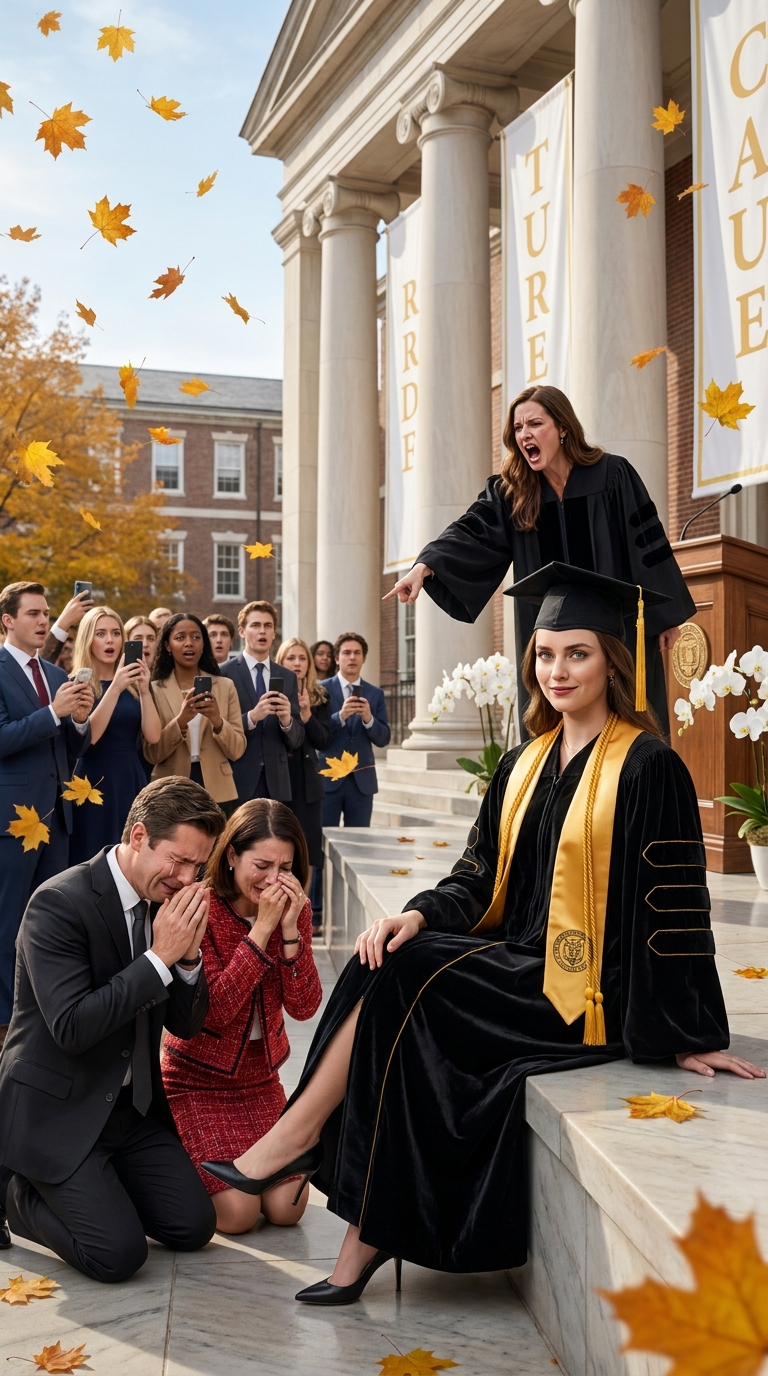
Commencement morning was a theater of absolute perfection. The sprawling university lawns were a sea of folding chairs, weeping parents, and the suffocating scent of expensive floral arrangements. I stood in the staging area, the heavy black velvet of my robe brushing my calves, the golden Valedictorian sash draped heavily across my shoulders, the Hawthorne medallion resting coldly against my sternum.
As I took my assigned seat on the sweeping stage, I scanned the front row.
They were there. Grant and Elena, sitting in prime VIP seats, radiating parental triumph. Elena wore a tailored cream dress, clutching a bouquet of imported white roses. Grant had a professional-grade camera resting on his knee. They were vibrating with anticipation, entirely convinced they were the architects of this beautiful day for Amber.
Amber was seated in the general graduating rows behind me. She caught my eye, offering a tight, nervous nod. She knew I had won honors, but I had explicitly forbidden the administration from leaking the valedictory title to the families prior to the printed program.
The orchestral swell faded. The University President stepped up to the grand podium, tapping the microphone.
“Distinguished faculty, proud families, and the phenomenal Class of 2025,” his voice boomed across the stadium. “It is my distinct privilege to introduce a student whose academic ferocity, extraordinary resilience, and commitment to shattering institutional barriers represents the absolute pinnacle of Briarwood’s ethos.”
In the front row, Grant hoisted his camera lens, aiming it toward Amber’s section in the crowd. Elena leaned forward, a tear of joy already forming.
The President smiled. “Please welcome your Valedictorian, and our distinguished Hawthorne Fellow… Miss Maya Parker.”
For one suspended, breathless second, the rotation of the earth seemed to halt.
I stood up.
The stadium erupted into a thunderous wave of applause, but my eyes were locked like laser sights on my parents.
Grant’s camera froze in mid-air. Slowly, agonizingly, he lowered the lens. The color completely drained from Elena’s face. Her mouth fell open in a silent gasp, the white roses dipping toward the grass as her grip failed.
The shock was absolute. It was followed instantly by a tidal wave of realization, confusion, and then, a devastating, paralyzing shame. They were watching the daughter they had discarded ascend to the throne they had paid for her sister to occupy.
I walked to the podium. I adjusted the microphone. I looked out over a sea of thousands, but I was speaking only to two people.
“Good morning,” I began, my voice ringing out with terrifying clarity. It did not shake.
“Four years ago, sitting at a dining room table in Denver, I was informed by someone I trusted that my future was a poor financial risk. I was explicitly told that my potential was not worth the investment.”
A hushed, electric silence ripped through the stadium. This was not the standard, platitude-filled address.
“I was eighteen years old. I was handed a narrative that my worth was contingent on my ability to perform loudly, to demand attention, to be a blue-chip asset for someone else’s pride. I was told that because I was quiet, because I survived without demanding rescue, I could simply be left to survive on my own.”
I gripped the edges of the podium. “I bought into that lie. I believed it when I woke at 4:00 AM to scrub espresso machines. I believed it when I cleaned vomit out of dormitory stairwells just to afford textbooks. I believed it when holidays passed in a freezing room while others celebrated family.”
I found Professor Bell sitting in the VIP faculty section. He offered a slow, validating nod.
“But poverty and exhaustion are brutal, effective teachers. They taught me that recognition and worth are not synonymous. Recognition is an external currency, often distributed by people who are looking at the wrong ledger. Worth is internal. It exists in the dark. It exists when no one is clapping.”
The crowd was utterly spellbound. In the front row, Elena was openly weeping, her hands covering her face. Grant sat rigidly, looking as though he had been impaled.
“I am standing before you today not because I was chosen by those who were supposed to protect me, but because I executed my own rescue. I stand here because a few brilliant mentors realized that the absence of a silver spoon does not equate to an absence of hunger.”
I stared directly into my father’s eyes.
“Do not construct your empire to prove your detractors wrong. That keeps them on the throne of your mind. Build your empire to render them irrelevant. Your intrinsic value does not ignite the moment someone decides to write a check for you. Your value ignites the exact second you stop begging for permission to invest in yourself.”
I stepped back from the microphone.
For a heartbeat, the silence was total. Then, the stadium exploded. It wasn’t polite applause; it was a visceral roar. The graduating class surged to their feet. Faculty members rose. The sound was a physical force, washing over the stage.
In the front row, Grant and Elena remained seated for three agonizing seconds while the world stood up around them. Finally, Elena stood, trembling violently. Grant followed, his camera forgotten on the folding chair. For the first time in my entire existence, they were looking at me, and they were utterly terrified by what they saw.
At the post-ceremony reception, the champagne flowed under white tents. I was surrounded by well-wishers, professors, and crying parents who thanked me for my words.
Then, the crowd parted. Grant and Elena approached slowly, navigating the space like trespassers walking through a minefield. Grant looked a decade older. Elena’s eyes were bloodshot.
“Maya,” Grant choked out. His voice was stripped of all its former arrogant authority.
“Grant. Elena.”
Elena reached out a trembling hand, but she aborted the movement before touching my robe. “We… we had absolutely no idea. The things you said up there… the jobs, the struggle…”
“You possessed all the variables to solve the equation, Elena,” I replied, sipping sparkling water. “You just chose not to run the math.”
Grant stiffened. “That isn’t fair, Maya. We made a miscalculation, yes, but—”
“A miscalculation is forgetting a decimal point,” I cut him off, my voice dropping to a lethal whisper. “You made a deliberate choice. You funded Amber’s ascension and handed me a two-hundred-dollar emergency fund. I survived because the alternative was starvation.”
Grant swallowed hard, the Adam’s apple bobbing in his throat. “I was wrong. I was arrogant, and I was entirely wrong.”
Before I could respond, a distinguished gentleman with silver hair and a bespoke suit materialized beside us.
“Miss Parker,” the man smiled warmly, extending a hand. “An absolutely staggering speech. The Foundation could not be prouder to have you in our ranks.”
“Thank you, Mr. Hawthorne,” I replied, shaking his hand firmly.
Grant’s eyes widened comically. He was standing face-to-face with the billionaire philanthropist whose name adorned half the buildings on campus, and the man was speaking to his discarded daughter as an equal.
“We are eagerly anticipating your arrival in New York next month,” Mr. Hawthorne continued. “The analyst desk at Hawthorne & Reed is ready for you.”
After Hawthorne departed, Grant stared at me, thoroughly dismantled. “New York? You have a corporate position?”
“I begin as a Senior Policy Analyst in three weeks.”
Elena stepped forward, her voice desperate. “But you’ll fly back to Denver first? For the summer? We need to fix this. We need to be a family.”
“I am not returning to Denver,” I stated clearly.
“Maya, please,” Grant begged, his corporate armor completely shattered. “Tell me what the invoice is. Tell me how to repair this ledger.”
I looked at the man who had quantified my worth in dollars and cents, and I realized the greatest triumph of the day. I felt no anger. I felt nothing but an immense, sprawling freedom.
“I don’t need you to repair my life, Grant,” I said softly. “I already renovated it myself.”
Chapter 6: The Dividends of Freedom
Three months later, I was standing in a shoebox apartment in New York City. The rent was extortionate, the radiator clanged exactly like the one in my Northlake slum, and my single window offered a sweeping view of a brick alleyway.
It was the most magnificent place on earth, because I held the deed to my own peace.
The letters from Denver began arriving in late August. Elena wrote long, meandering apologies on heavy cardstock. I realize now, she wrote in one, that we weaponized your resilience. We praised you for needing nothing, so we wouldn’t feel guilty for giving you nothing.
I wept when I read it, not because it healed the chasm, but because she had finally dared to look down into it.
I didn’t answer right away. They had made me wait eighteen years to be seen; they could wait a few seasons for my forgiveness.
Grant eventually called in November.
“I’m not asking for absolution,” his voice crackled over the line, sounding ragged and small. “I just wanted to say that I am profoundly proud of you. And I am profoundly ashamed of myself.”
“I hear you, Dad,” I replied, using the title cautiously.
“Can we attempt communication? On your terms?”
“Slowly,” I dictated. “And we never pretend that the past didn’t happen.”
“Agreed.”
Real redemption is not a cinematic embrace in the rain. It is a slow, grueling renegotiation of terms. It is a contract drawn up with boundaries made of steel.
Amber visited me in Manhattan that winter. We met for overpriced lattes in Bryant Park. The dynamic had shifted irreversibly. We were no longer the golden child and the shadow; we were two adult women trying to excavate a sisterhood from the wreckage of our parents’ favoritism.
“I used to think winning their approval meant I was the victor,” Amber confessed, wrapping her hands around her mug, her breath pluming in the cold air.
“And now?” I asked.
“Now I realize it just made me blind to the fact that you were freezing in the dark.” She looked up, her hazel eyes glistening. “I want to know you, Maya. Without the scoreboard.”
“I would like that too,” I smiled.
Two years after I delivered that speech, Hawthorne & Reed promoted me to Director of Policy Analytics. With my first major bonus, I endowed a quiet, anonymous emergency fund at Northlake State. It was specifically earmarked for independent students facing housing insecurity.
I didn’t require a plaque. I didn’t need a gala. I just wanted some exhausted girl, sitting in a slanted room at 3:00 AM, staring at terrifying numbers on a dying laptop, to open an email and realize she wasn’t breathing underwater anymore.
My father had once believed he held the gavel on my worth. He thought he could calculate my trajectory on a spreadsheet. He was fundamentally wrong.
You cannot engineer a life waiting for the people who undervalued you to suddenly discover their eyesight. The applause of the crowd is intoxicating, and the vindication of a stage is sweet, but they are fleeting.
The true foundation is forged in the silence. It is built in the frozen mornings, in the stubborn refusal to surrender, and in the quiet, terrifying moment you decide to become your own savior. They refused to invest in me. So, I bought out the entire market, and I kept all the dividends for myself.