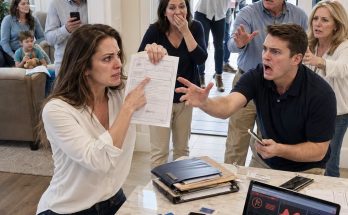
As I neared my due date, my husband suddenly knelt down beside my hospital bed. “Evelyn, I’ve told you three lies. I need to come clean.” Cold sweat poured down my face from the pain and I gripped the sheets tightly. “Wait until after I give birth.” But he continued regardless. “I’m sorry, when we did IVF I switched your eggs with my first love’s. She has a heart condition and pregnancy would be too risky for her, so I had to borrow your womb.”
The Child They Tried to Steal
### Part 1
The morning my labor started, the sky outside my hospital window was the pale gray color of dirty cotton.
I remember that because I kept staring at it between contractions, trying to focus on something that did not live inside my body. The monitor beside me kept making that steady little beeping sound, the kind of sound that should have been comforting, but after three hours it felt like a countdown. The sheets under my hands were already twisted into ropes. My hair stuck to my neck. Every breath tasted like metal and fear.
Nathan sat beside my bed in his navy suit, not hospital clothes, not the soft sweater a husband might wear while waiting for his child to arrive. A suit. Pressed, expensive, too neat for a delivery room.
He had been quiet all morning.
That was the first thing that frightened me.
Nathan Cooper was never quiet when he wanted people to see him as devoted. He usually knew exactly when to touch my shoulder, when to ask a nurse for water, when to lower his voice and call me sweetheart. He performed tenderness the way other men performed confidence.
But that morning, he sat with both hands clasped, one knee bouncing, eyes fixed on the tile.
Another contraction tightened through me. I gripped the rail and forced myself not to cry out. I had spent most of my life being trained not to show pain. Hart women were taught to bleed gracefully if bleeding was unavoidable.
Nathan suddenly stood.
Then he knelt beside my bed.
For one insane second, I thought he was praying.
“Evelyn,” he said, and his voice cracked in a way that sounded rehearsed. “I’ve told you three lies. I need to come clean.”
I turned my head slowly. Sweat rolled from my temple into my ear.
“Wait until after I give birth,” I said.
I meant it. Not because I wanted mercy from him, but because something in his face told me he had chosen this moment carefully. Men like Nathan did not confess when guilt became unbearable. They confessed when confession served them.
He swallowed, but he did not stop.
“I’m sorry,” he said. “When we did IVF, I switched your eggs with Diana’s.”
The room did not move.
The beeping continued.
Somewhere outside, wheels squeaked against the hallway floor.
“She has a heart condition,” he continued, faster now, as if speed could make the words less monstrous. “Pregnancy would have been too dangerous for her. I had to borrow your womb.”
Borrow.
That was the word he used.
Not steal. Not violate. Not betray.
Borrow.
A white flash of pain cut through my abdomen, so sharp I almost lost the room. My fingers dug into the sheet. I breathed through my nose and stared at the man kneeling beside me, the man who had slept beside me for three years, smiled at my parents over Sunday brunch, kissed my forehead after every hormone injection, and whispered that our baby would have my eyes.
His face was wet. Not with tears. With sweat.
He was afraid, but not of hurting me.
He was afraid I would not cooperate.
“For the sake of our marriage,” he whispered, “you’ll still deliver the baby safely, right?”
I stared at him.
Then, to his visible shock, I laughed.
It came out rough and low, almost ugly, but it was laughter. Nathan flinched like I had thrown a glass at him.
“That’s it?” I asked.
His mouth opened.
I smiled, even though another contraction was building. “Nathan, why now?”
“What?”
“Why tell me when I’m already in labor?”
His eyes shifted once toward the door. Just once. But I saw it.
“You know inducing labor now would risk both my life and the baby’s,” I said. “You know I can’t simply stand up and walk away. So you picked the one hour when my body was a locked room.”
His face paled.
There it was. Not guilt. Exposure.
He straightened slowly, his shame turning into anger because shame had nowhere else to go.
“You’re unbelievable,” he hissed. “Even now, you make yourself the victim. Giving birth is giving birth. You get to experience motherhood. Diana gets to have the child she never could carry. Everyone gets something.”
My hand moved before I fully decided to move it.
The slap cracked across the room.
Nathan’s head snapped to the side. A red mark bloomed on his cheek, bright and immediate.
Pain answered me instantly. A brutal spasm tore through my lower body, and I gasped so hard the edges of my vision darkened.
With one shaking hand, I pressed the call button.
When the nurse’s voice came through, I forced out three words.
“Get Diana. Now.”
The door opened less than a minute later.
Dr. Diana Monroe stepped in wearing a white coat, pearl earrings, and the expression of a woman who already knew too much.
And when her eyes landed on Nathan’s reddened cheek, she looked at me with disgust instead of concern.
### Part 2
Diana did not ask how far apart my contractions were.
She did not ask where the pain was strongest.
She did not check the monitor first.
Her eyes stayed on Nathan’s cheek, then slid back to me, cold and bright.
“Evelyn,” she said, like I was a child who had embarrassed her in public, “you shouldn’t have hit him.”
For a second, I thought the pain had made me hear wrong.
Nathan stood behind her with one hand pressed to his face. The red mark from my palm looked almost vulgar against his clean-shaven skin. He was breathing hard, but there was satisfaction under it now. Diana’s arrival had given him an audience, and Nathan had always been braver in front of someone who adored him.
I swallowed against the nausea rising in my throat.
“He told you,” I said.
Diana’s jaw tightened.
“He told you what he did,” I continued. “And this is your reaction?”
“What more do you want?” Her voice sharpened. “You’ve had everything since birth. Money, family, name, hospitals with your name on the walls. You never needed to fight for anything. Now one woman asks for one chance at motherhood, and you act like your world is ending.”
One woman.
I looked at the girl I had found years ago outside a grocery store in February snow, barefoot, underfed, picking through a trash bag behind the bakery.
She had been fifteen then. Her lips had been blue. Her coat had not closed.
I had given her my shoes first because they were the only thing I could remove quickly. Limited edition sneakers my mother had rolled her eyes at me for buying. I still remembered Diana staring at them as if I had handed her the moon.
Later, my parents brought her into our house. They did not adopt her legally, but we all treated her like family. My father paid for tutors. My mother bought her first winter coat. I wrote recommendation letters, called donors, pushed her medical school application to the top of every desk I could reach.
When she graduated, I was the one who spoke to the hospital director.
When she became the youngest attending physician in the maternity wing, she cried in my office and said, “I owe you my life.”
Apparently, some debts curdled.
“So,” I said slowly, “this is how you repay me.”
Her nostrils flared.
Nathan stepped forward at once, protective, possessive, placing himself half in front of her as if I might rise from active labor and attack.
“Diana is not that kind of person,” he snapped.
I laughed again, but this time it hurt.
“She’s exactly that kind of person.”
Nathan’s face twisted. “Fine. Since we’re telling truths, here’s the second one. Diana is my first love.”
The words landed softly, almost politely.
That was the worst part. There was no thunder. No dramatic shattering. Just the little hospital monitor beeping, Diana’s perfume mixing with antiseptic, and Nathan standing there as if announcing something inevitable.
“My first love,” he repeated. “The woman who understood me before you ever tried.”
Diana looked down, but she did not pull her hand away when he took it.
I stared at their interlocked fingers. Hers manicured, pale pink. His wedding ring still shining.
“You could have told me,” I said. “If you wanted Nathan, Diana, I would have given him to you.”
Nathan exploded.
“That. That right there.” He pointed at me. “That’s what I hate about you. That condescending calm. Like people are furniture you can give away. Like I’m some thing you bought.”
A contraction hit. I held the bed rail and let him speak because men like Nathan often revealed more when they thought they were finally being honest.
“You know what it’s like,” he said, voice rising, “to work every day and still know your wife’s family sees you as a charity case? I make fifty thousand dollars a month, Evelyn. Fifty thousand. And your father once spent more than that on a dinner for investors he forgot to attend.”
“That dinner saved a merger,” I said.
He ignored me.
“You buy paintings because they match rooms you don’t even enter. Diana knows what it means to struggle. She knows what it means to count money, to earn respect.”
Diana’s eyes softened on cue.
“She admires me,” Nathan said. “You never did.”
I looked from him to her.
It was almost funny. He thought he was confessing love. She thought she was collecting justice. Both of them were standing in a hospital owned entirely by my family, in a room where every wall had been built by the fortune they despised and wanted.
I turned my head toward the corner.
“Klein,” I said.
My secretary, Arthur Klein, had been standing near the door so quietly most people forgot he was there. Tall, narrow, always a little stooped, he clutched his tablet to his chest like a shield.
“Yes, Ms. Hart?”
“Notify HR. Nathan Cooper and Diana Monroe are terminated immediately. Notify Director Wilson I need a new attending physician within three minutes.”
Klein’s face went pale.
He did not move.
I looked at him harder. “Klein.”
He lowered his eyes. “Ms. Hart… you no longer have that authority.”
Nathan smiled.
And from inside his jacket, he pulled out a folder.
The moment I saw my own signature at the bottom of the first page, I knew the third lie had teeth.
### Part 3
Paper can look harmless in the wrong light.
The document Nathan held was printed on heavy white stock, clipped neatly, the top corner embossed with Hart Group’s internal seal. I recognized the formatting. I recognized the language. Most of all, I recognized my own name written at the bottom in the quick, slanted hand I used when I was tired.
Three days earlier, Nathan had come into our bedroom holding a stack of forms.
He had seemed excited, almost boyish.
“I got you into the best postpartum recovery center in the city,” he had said, laying the documents across my lap while I was propped against six pillows, my hips aching so badly I could barely sit up. “Private suite. Night nurse. Chef. Physical therapy. Everything. They need your direct signature because of the medical privacy forms.”
I remembered being irritated. Hot. Heavy. Exhausted from not sleeping. I remembered flipping through page after page while Nathan pointed to the tabs.
“Here. Here. Initial here. Full signature here.”
I had signed without reading.
That was the part I hated most. Not that Nathan had tricked me. That I had made it easy.
He held up the document now with the smile of a man revealing a magic trick.
“Voluntary transfer of assets,” he said. “Resignation from all board positions. Gift of shares, properties, accounts, voting rights. You signed everything over to me, Evelyn.”
The room shifted.
Not because I believed him.
Because he believed himself.
Klein stood frozen, his face gray. Diana’s eyes shone with a hunger she did not bother hiding. Nathan turned toward my secretary with theatrical authority.
“Mr. Klein, as the new controlling director of Hart Group, I appoint Dr. Diana Monroe as director of this hospital, effective immediately. Draft the notice.”
Diana actually gasped.
Not from shock.
From joy.
“Thank you,” she whispered, and pressed closer to him.
I watched her. That tiny movement told me more than her speeches had. Diana did not merely want Nathan. She wanted the floor under my feet. She wanted the name on the building, the elevator opening for her, the staff lowering their eyes. She wanted to wear my life until it fit.
Before I could speak, hurried footsteps echoed down the hallway.
Director Wilson appeared at the door, his white coat unbuttoned, his forehead wet with sweat. He was a broad man in his sixties, usually composed to the point of stiffness. Now he looked like someone had aged him overnight.
“Ms. Hart,” he said, then glanced at Nathan and corrected himself awkwardly. “Mrs. Cooper. We have an emergency.”
The title scraped across my skin.
“What emergency?” I asked.
He looked at Nathan again.
My stomach clenched, and this time it was not labor.
“Say it,” I ordered.
Director Wilson swallowed. “An elderly couple was brought into the ER after a severe car accident yesterday morning. Their vehicle was destroyed. The traffic police confirmed the plate.”
He gave the number.
For half a second, my brain refused it.
Then the sound of the monitor grew far away.
That was my parents’ car.
My mother had chosen the license plate because the numbers matched the date she and my father signed the first Hart Group incorporation documents. My father teased her about it every time they used that car.
I sat up too fast. Pain burst through me.
“When?” I said.
Director Wilson’s voice dropped. “Around ten yesterday morning.”
Yesterday.
A full day.
I looked at Nathan.
The red mark from my slap had faded into a dull shadow. His expression had not. He was watching me with something close to satisfaction.
“We sent critical notices,” Wilson said. “Three of them. We needed board-level approval to activate outside emergency transport and access the protected blood reserve. Mr. Cooper said you were about to give birth and should not be disturbed.”
The air went cold.
Nathan lifted both hands slightly. “I was protecting you.”
“You let them lie there for twenty-four hours?”
“Don’t be dramatic.”
“My parents,” I said, and my voice came out hoarse. “You withheld emergency approval from my parents.”
Diana stepped forward then, no longer pretending softness.
“Why should everything always bend for the Hart family?” she said. “Why should your blood matter more than anyone else’s?”
There she was.
The girl in the snow had disappeared completely. Or maybe this was who she had been all along, waiting for warmth to become entitlement.
Nathan pulled another document from the folder and placed it on the rolling table beside my bed.
A parental rights waiver.
“Sign it,” he said. “Deliver the baby safely. Give Diana what belongs to her. Afterward, I’ll still pay for the recovery center. I’m not heartless.”
The nurses in the doorway stared like they were watching a house burn from across the street.
Diana picked up a pen and held it out.
“If she refuses,” she said calmly, “we still have options.”
I understood what she meant.
So did every medical professional in the room.
For the first time that morning, Nathan looked uncertain. “Can she still deliver if she’s… unstable?”
Diana’s eyes stayed on mine. “We can make decisions for her if necessary.”
My body was shaking now, but not only from pain.
I took the pen from Diana’s hand.
Nathan smiled.
Then I dropped it onto the floor.
“You think I’m powerless,” I said.
Diana laughed softly. “Evelyn, you’re in labor, disinherited, and alone.”
“No,” I said. “I’m done waiting.”
Another contraction rose, enormous and merciless. I held on until it passed, then looked at the door.
“I have three confessions too.”
Footsteps approached from the hall.
A man in a dark suit entered carrying a sealed folder.
And Nathan’s smile died before the folder even opened.
### Part 4
The man in the suit was not one of Nathan’s people.
That mattered.
Nathan had spent three years learning the visible machinery of my life: the drivers, the assistants, the receptionists, the board members who smiled too much at galas. He knew the people who made wealth look smooth from the outside.
He did not know the people who protected it.
The man walked straight past Nathan, past Diana, past Director Wilson, and stopped at my bedside.
“Ms. Hart,” he said, “the urgent genetic analysis you requested.”
He handed me the folder with both hands.
Diana’s face changed first.
Doctors read rooms differently than executives. She knew from the seal, the chain-of-custody strip, the timing, exactly what kind of document it was before I opened it.
I did not rush.
I slid one finger under the tab and removed the report.
The paper trembled slightly in my hand, though whether from pain or adrenaline, I could not tell.
“DNA comparison confirms a biological mother-child relationship between Evelyn Hart and the fetus,” I read. “Probability exceeds ninety-nine point nine percent.”
Nathan stared.
Then he snatched the report from my hand.
“No,” he said.
Diana leaned over the page, scanning once, then twice, then again. Her pupils moved with terrifying speed. I watched the moment she stopped searching for a mistake.
I had known Diana for too long not to recognize devastation.
It was quiet in her. Deep. A sinkhole opening under the exact spot where she had planned to stand crowned.
“You were sedated,” Nathan said. “I was there during the procedure. I watched.”
“You watched what I needed you to watch.”
His head jerked up.
Another contraction tightened through me, and I pressed my palm flat to the bed, counting silently until my voice could come out steady.
“Seven months ago, I noticed inconsistencies in my IVF file. Not enough for a public accusation. Enough for me to stop trusting my husband.”
Nathan’s throat bobbed.
“I ordered independent verification before implantation,” I said. “The embryo transferred to me was mine. Diana’s was never implanted.”
Diana made a sound like air leaving a punctured tire.
“It was preserved,” I continued. “Documented. Placed under legal hold.”
“You had no right,” she whispered.
I looked at her then, really looked at her. “You tried to steal a child from my body, and you’re speaking to me about rights?”
Nathan took one step toward me.
Klein moved.
It was small, almost ridiculous. Klein was thin and nervous, the kind of man who apologized to revolving doors. But he stepped between Nathan and my bed.
“Don’t,” Klein said.
One word.
Nathan stopped.
The look he gave Klein was almost worth the pain. For years he had treated my secretary like office furniture with a pulse. Someone who fetched, scheduled, stammered, lowered his head. He had never bothered to ask what Klein did when no one was watching.
I had.
“Klein has spent six months documenting every irregularity you introduced into Hart Group operations,” I said.
Nathan turned slowly toward him.
Klein did not lower his eyes this time.
“My second confession,” I said. “You do not own Hart Group.”
Nathan’s hand tightened around the DNA report.
“I have your signature,” he said, but the certainty had drained from his voice.
“You have a document I allowed you to hide among my medical forms.”
The room held its breath.
“Yes,” I said. “I knew it was there.”
For the first time all morning, Nathan looked genuinely lost.
“Eighteen months ago,” I continued, “after certain private concerns arose, the Hart family trust was restructured. Real equity, voting power, and asset control require biometric confirmation from a three-member trustee board: my father, our legal counsel, and me. No transfer is valid without all three.”
“That’s impossible.”
“It’s standard protection when a family office suspects coercion.”
The elevator doors opened down the hall.
Four people entered.
Two attorneys. One auditor. One security liaison.
They moved with the calm of professionals arriving not at a crisis, but at an appointment.
Nathan looked from their faces to mine, then to Klein.
“Klein,” he said softly, “what did you do?”
Klein adjusted his glasses. “My job.”
The senior attorney placed a folder on the rolling table, beside the unsigned parental rights waiver.
“When Mr. Cooper attempted to activate the transfer,” the attorney said, “the fraud alert triggered automatically. Monitoring has been active since then.”
Nathan’s eyes sharpened. “You recorded me?”
“You consented to executive compliance monitoring when accepting your director role.”
His face flushed dark.
Diana backed away from him by half an inch.
It was the first crack between them.
Small, but real.
“You think this proves anything?” Nathan snapped. “This will be challenged. Every document, every recording—”
“Has already been reviewed,” the attorney said. “And preserved.”
I watched Nathan understand.
The hospital room he thought he had chosen because I was weak had never been a room at all.
It had been a trap with clean sheets.
He looked at me then, hatred and panic mixing in his eyes.
And I had one confession left.
### Part 5
Director Wilson was still standing in the doorway.
He looked like a man trying very hard not to be noticed by history.
I turned to him. “Tell them about my parents.”
Nathan went still.
The change was instant. His shoulders locked. Diana’s face, already pale, became almost gray.
Wilson wiped his forehead with a handkerchief. “The crash was real,” he said. “The injuries were real. But Mr. and Mrs. Hart were transferred yesterday within forty minutes of arrival.”
Nathan blinked.
I watched the words fail to reach him at first.
Then I helped.
“My parents are alive,” I said. “They are in a private surgical facility outside the city. My mother regained consciousness before dawn. My father is still sedated, but stable.”
Nathan looked at Wilson. “You told me—”
“I told you what their condition was when they came in,” Wilson said, voice shaking. “You assumed the rest.”
No. That was too generous.
“He hoped the rest,” I said.
Nathan’s mouth opened, but nothing came out.
“When the crash alert triggered on their vehicle, it also triggered the family protection protocol. You never knew about that system because you were never cleared for it. The request you ignored, the approval you suppressed, the helicopter you refused to authorize—all of that was documented.”
Diana whispered, “You set us up.”
“No,” I said. “You climbed in.”
The contraction that hit me then nearly bent me in half. For a moment the room blurred into bright panels and dark suits. A nurse moved toward me. Dr. Park, my replacement attending physician, arrived at the door with a file already in hand.
I had arranged his transfer three weeks earlier, just in case.
That phrase had become the shape of my life.
Just in case my husband tried to seize the company.
Just in case my attending physician was compromised.
Just in case the child inside me became evidence before he became a person.
Dr. Park’s voice was calm. “Ms. Hart, I need to examine you now.”
Diana snapped, “This is still my patient.”
The senior attorney looked at her. “You have been suspended pending investigation.”
Diana’s face twisted. “You can’t do that in the middle of—”
“I already did,” Director Wilson said quietly.
She turned on him with such raw fury that I saw, for one second, the fifteen-year-old girl again. Not helpless. Hungry.
Two private security officers appeared at the door.
Not hospital security. Not men who answered to whoever held a clipboard. These were from a firm my family had retained when I was in college after a kidnapping threat no one outside our circle ever learned about.
Nathan saw them and stepped backward.
“Evelyn,” he said.
My name in his mouth sounded different now. Smaller.
The attorney placed a temporary restraining order within my reach.
“You and Dr. Monroe are required to leave this wing immediately,” he said. “Further contact with Ms. Hart is prohibited.”
Nathan looked around the room as if searching for one person still on his side.
The nurses avoided his eyes.
Klein watched him without blinking.
Diana stared at Nathan, waiting for him to fix what he had promised was already won.
He could not.
As security moved closer, Nathan’s face changed again. The anger drained, leaving something uglier than remorse. A childlike disbelief that consequences could touch him.
“Evelyn, don’t do this.”
I almost laughed, but I was too tired.
“I didn’t do this,” I said. “I survived it.”
Diana walked out first. Her heels struck the floor in quick, hard clicks. She did not look at me.
Nathan stopped at the doorway.
For a moment, the hallway light framed him exactly as I had seen him on our wedding day: tall, handsome, practiced, beloved by cameras.
“I loved you,” he said.
A contraction rose like a wave breaking over bone.
I held the bed rail and looked at him.
“No,” I said. “You loved standing next to my power.”
His face flinched.
“You never loved me.”
The door closed behind him.
The silence afterward was not peaceful. It was stunned, surgical, full of things that had almost happened.
Dr. Park stepped beside my bed and looked only at the monitor, not the legal folders, not the security officers, not the ruin of my marriage spread across the room like broken glass.
“Ms. Hart,” he said gently, “it’s time to focus on the baby.”
Klein sat in the chair near the window. His tablet rested on his knees, both hands folded over it.
“My mother?” I asked.
“She’s awake,” he said. “She asked about you.”
“My father?”
“The surgeon expects improvement by morning.”
I closed my eyes.
For the first time all day, tears pressed behind them.
Not because Nathan had betrayed me.
Because my parents were alive.
Then Dr. Park said, “Push when I tell you.”
And four hours later, when my son screamed his way into the world, I finally broke.
### Part 6
People talk about birth like it is a glowing thing.
Maybe for some women it is.
For me, it was sweat, terror, fluorescent light, and the stubborn refusal to die before meeting the person I had protected for nine months without fully understanding how much protection would cost.
When my son cried, every sound in the room rearranged itself around him.
The monitor, the nurses, the wheels in the hall, the low murmur of Dr. Park giving instructions—all of it fell behind that furious little cry.
Then he was on my chest.
Warm. Slippery. Furious.
Alive.
I touched the back of his head with two fingers because I was suddenly afraid my hands were too rough for him. His hair was dark and damp, pressed in tiny swirls against his scalp. His mouth opened, offended by air, by light, by the entire rude world.
I had not cried when Nathan confessed.
I had not cried when Diana looked at me like I was an obstacle.
I had not cried when I learned my parents’ car had been destroyed.
I cried then.
“You crossed hell with me,” I whispered into his hair.
He screamed louder, unimpressed.
The nurse laughed softly, and that small normal human sound nearly undid me again.
I named him Caleb Hart.
Not Cooper.
Hart.
There was a discussion about that later, of course. Legal always has language for what the heart already knows. But in that first hour, before court filings and news coverage and statements from medical boards, Caleb was simply mine. He slept against me with one fist curled under his chin, trusting my body because he had never known any other shelter.
Klein came in after I was cleaned up and settled.
He stood near the doorway first, awkward and pale, holding three folders as if paperwork might be rude in the presence of a newborn.
“Come in,” I said.
His eyes moved to the baby and softened so quickly he looked embarrassed by it.
“He’s very small,” Klein said.
“He disagrees.”
Caleb made a sound like a tiny engine failing.
Klein cleared his throat. “Your mother is still asking for updates. I sent only what Dr. Park approved.”
“Good.”
“Your father is stable.”
“Good.”
He placed the folders on the table, but did not open them.
“Tomorrow,” I said.
He nodded, relieved.
Then he hesitated.
“I’m sorry,” he said.
“For what?”
“For letting you sit in that room with them as long as you did.”
I looked at him for a long moment. Klein had been with my family for eleven years. He had handled ransom insurance, proxy votes, emergency travel, my mother’s impossible charity seating charts, my father’s moods, my temper, and Nathan’s vanity. He was not family exactly, but he was something just as rare: a person who knew where the exits were and never confused access with ownership.
“You did what I asked,” I said.
His face tightened. “Yes.”
“That doesn’t make it easy.”
“No,” he said. “It doesn’t.”
The scandal broke while I slept.
By noon the next day, Hart Group’s communications team had released a statement so clean it felt almost merciless. By evening, the press had found everything else. The husband who tried to transfer his laboring wife’s assets. The doctor accused of conspiring to take another woman’s embryo. The suppressed emergency authorization. The recorded statement Diana made about what could happen to me if I refused.
People love betrayal when it happens to rich women.
They love it differently when the rich woman has receipts.
I did not watch the news at first. I fed Caleb. Slept badly. Woke sweating from dreams where Nathan stood beside the incubators with a pen in his hand. Asked for my mother. Asked for my father. Asked Dr. Park three times whether Caleb was breathing normally until he finally pulled a chair beside my bed and explained newborn breathing patterns with the patience of a saint.
My mother came two weeks later in a wheelchair.
She hated the wheelchair. I could tell by the way she held her handbag, too upright, as if elegance could overpower medical instruction.
When she saw Caleb, she stopped fighting it.
I placed him in her arms.
For a long time, she said nothing.
My mother had survived surgery, blood loss, broken bones, and the knowledge that the man she welcomed into our family had been willing to let her die in a hospital her own company owned. Still, the first tear fell only when Caleb yawned.
“He has your mouth,” she said.
“Poor thing.”
She laughed, then winced, then laughed again.
After a while, she looked at me.
“When did you know?”
The question had been waiting between us.
“Suspected?” I said. “Eighteen months ago.”
Her hand tightened slightly around Caleb’s blanket.
“Certain?”
“Twelve.”
“You carried that alone?”
I looked at my son, asleep in her arms, his face peaceful in the dangerous world that had already tried to claim him.
“I carried him too,” I said.
My mother closed her eyes.
That was the moment I understood she was not only grieving what Nathan had done.
She was grieving the daughter who had learned not to ask for help.
The next morning, a letter arrived through Nathan’s attorney.
He wanted permission to see the baby.
I read the request once.
Then I set it beside Caleb’s empty bottle and felt nothing but a clean, freezing certainty.
### Part 7
Nathan’s attorney used expensive paper.
Thick cream stationery. Deep blue lettering. Careful phrasing that tried to make an obscene request sound civilized.
Mr. Cooper respectfully requests a brief supervised visit with the child born during the marriage.
The child.
Not Caleb.
Not my son.
The child born during the marriage, as if a legal phrase could reach through the hospital room and place Nathan back where biology, decency, and God had already removed him.
I sat in the rocking chair by the window with Caleb asleep against my shoulder. Late afternoon light fell across the nursery wall, soft and gold. My body still ached in places I did not have names for. My hair had not been washed in two days. There was a burp cloth on my lap and a stack of corporate filings on the side table.
This was motherhood, apparently.
Milk, lawsuits, and rage.
Klein stood near the door, waiting.
“Do you want legal to respond?” he asked.
“No.”
He looked surprised.
I reached for a pen.
My handwriting was slower than usual. Cleaner.
Nathan,
You tried to steal my son before he was born. You lost the right to know his face.
Evelyn Hart
I folded the letter myself.
Klein took it without comment.
That was one of the reasons I trusted him. He knew the difference between silence and absence.
Nathan’s attorney sent another letter three days later. This one argued marital presumption, emotional bond, intent to parent, the sanctity of family relationships. My attorney responded with a stack of evidence so heavy the courier used both hands.
Nathan was not Caleb’s biological father. He had attempted to falsify reproductive records. He had conspired to coerce me into surrendering parental rights while I was in active labor. He had been recorded doing it.
There are many ways to lose a child.
Nathan had chosen all of them.
Diana did not write to me at first.
She was too busy trying to survive professionally.
The medical board moved fast because the public pressure was merciless. Nurses who had stayed silent in the room suddenly remembered details. Emails surfaced. Access logs showed Diana opening files she had no clinical reason to review. Camera footage placed her in restricted storage twice during the IVF cycle.
Her defense was predictable.
She was emotionally manipulated.
Nathan pressured her.
She never intended harm.
She only wanted to be a mother.
That last line appeared in one of the hearing summaries, and I stared at it until the words blurred.
Only.
How much cruelty hides inside that little word.
I only wanted love.
I only wanted respect.
I only wanted a child.
I only wanted what you had.
As if wanting could make theft holy.
The criminal proceedings unfolded in layers. First the fraud investigation. Then the medical conspiracy. Then the emergency care suppression. Nathan’s lawyers were aggressive, polished men who probably billed more per hour than Diana had once paid in rent. They argued consent. They argued confusion. They argued postpartum instability, which made my mother so furious she tried to stand without assistance and nearly scared her physical therapist to death.
But evidence has a way of being patient.
Recordings do not get tired. Documents do not flinch. Access logs do not care whether a man cries in court.
Nathan cried.
Of course he did.
At the first preliminary hearing, he turned toward the gallery, eyes shining, and said he had loved me.
I watched from a private video feed because my attorney did not want me in the courthouse yet, and because Caleb had a mild fever that morning and I was not leaving him for any man, least of all that one.
Nathan said Diana had exploited his insecurities.
Diana’s attorney responded the following week by submitting messages where Nathan described the plan in detail and called me “too arrogant to notice.”
They began eating each other alive before trial even started.
I had expected satisfaction.
Instead, I felt tired.
Not weak. Not uncertain. Just tired in the way a person feels after carrying a heavy box across a long room and finally setting it down.
One evening, after Caleb’s fever broke, I sat beside his crib and watched him sleep. His tiny chest rose and fell under a blanket patterned with blue whales. A night-light threw soft stars across the ceiling.
My phone buzzed.
Unknown number.
I should not have answered.
But some instincts are older than wisdom.
“Evelyn,” Diana whispered.
Her voice was raw.
I did not speak.
“I need to tell you something Nathan never told you,” she said.
Behind me, Caleb stirred in his sleep.
And for the first time since the hospital room, fear returned—not sharp, but cold and crawling.
### Part 8
I did not ask Diana where she got my private number.
That was a question for Klein, for security, for someone with spreadsheets and access logs. In that moment, standing barefoot in my son’s nursery at 2:13 a.m., I asked the only question that mattered.
“What do you want?”
Diana breathed shakily into the phone.
The sound irritated me. Once, that fragile breathing would have moved me. I would have imagined her alone, frightened, cornered by forces larger than herself. I would have remembered the girl in the snow.
I no longer trusted pity when it arrived wearing Diana’s voice.
“Nathan kept a second set of files,” she said. “Not company files. Personal.”
“Send them to my attorney.”
“No. Listen to me.”
Caleb shifted in his crib, mouth puckering, then settled again.
I lowered my voice. “You have thirty seconds.”
“He planned for you to survive.”
A strange sentence.
I waited.
Diana swallowed. “At first, he said it would be cleaner if you didn’t. Later he changed his mind. He said watching you live without the baby, without the company, without your parents would be better.”
My fingers tightened around the phone until my knuckles hurt.
Cruelty spoken plainly has a physical texture. It presses into the room. It changes the air.
“You’re telling me this because?”
“Because he’s blaming me for everything.”
“There it is.”
“I’m serious, Evelyn.”
“No,” I said. “You’re desperate.”
Silence.
Then she whispered, “There’s a storage unit in his cousin’s name. I know the address.”
I closed my eyes.
A storage unit could be real evidence. It could be a trap. It could be Diana trying to purchase mercy with breadcrumbs.
“I’ll send it,” she said.
“Send it to my attorney.”
“I want you to know I never wanted you dead.”
I almost laughed.
Instead, I looked at Caleb. His fist was curled beside his cheek, smaller than a plum.
“Diana,” I said, “there are doors that only open one way. You walked through yours.”
I hung up.
By morning, legal had the address.
By afternoon, investigators opened the unit with police present. I did not go. I had learned the difference between courage and self-harm.
Klein came to the house at six with a folder.
He had the expression he wore when he was about to hand me something ugly.
I was sitting at the kitchen island wearing leggings, slippers, and one of my father’s old college sweatshirts. Caleb slept in a bassinet near the breakfast nook. The house smelled like coffee, baby soap, and the chicken soup my mother insisted I needed even though I was not sick.
“What did they find?” I asked.
Klein placed photographs on the counter.
A crib.
A rocking chair.
Boxes of baby clothes with tags still attached.
A framed copy of one of Diana’s ultrasound images—the embryo transfer appointment she had believed would lead to her child. The photo was not a baby, not really, just a blur of hope in black and white. She had framed it anyway.
Then came the documents.
Draft press releases announcing Nathan Cooper as acting chairman of Hart Group following my “medical collapse.”
A prepared statement about my parents’ “tragic accident.”
A private security transfer form naming Diana as authorized guardian of a newborn male infant.
My stomach rolled.
Klein turned the next photograph.
It showed a nursery wall painted pale green, with wooden letters arranged over the crib.
Not Caleb.
The name was Oliver Cooper.
For several seconds, I could not breathe.
They had named him.
Before he was born. Before they had him. Before they knew whether I would survive labor or whether my parents would survive the road.
They had stood in some hidden little room and hung letters on a wall for a child they planned to take from my body.
I pushed back from the island so hard the chair scraped the floor.
Caleb woke and began to cry.
The sound broke whatever spell the photographs had cast.
I crossed the kitchen and lifted him. He rooted against my shoulder, angry and alive, and I held him close enough to feel his warmth through my sweatshirt.
“Destroy it,” I said.
Klein’s gaze rose.
“The nursery?” he asked.
“No,” I said. “Preserve every inch for evidence. Then destroy the fantasy.”
For the first time that day, his mouth tightened into something almost like approval.
“There’s one more thing,” he said.
I did not want one more thing.
But wanting had not mattered for a long time.
Klein slid a final photograph across the island.
It was a list taped to the inside of a storage cabinet.
Names. Dates. Payment amounts.
And halfway down the page, written beside a hospital access code, was Arthur Klein.
### Part 9
For one second, the kitchen disappeared.
Not dramatically. Not like fainting.
It simply narrowed until the only thing in the world was Klein’s name written in black marker on a strip of tape.
Arthur Klein.
Amount pending.
Hospital access: confirmed.
I looked up at him.
He did not look confused.
That was what frightened me.
Klein stood on the other side of the island, hands folded in front of him, his face pale but steady. Caleb fussed against my shoulder, unhappy with the tension in my body.
“Explain,” I said.
Klein nodded once, as if he had expected the word.
“Nathan believed I could be bought.”
“Could you?”
“No.”
The answer came too quickly to be theater.
I said nothing.
He reached into his briefcase and removed another folder, thinner than the others. “Six months ago, Mr. Cooper approached me after a board dinner. He said loyalty was complicated in families like yours. He implied I had been overlooked. Underpaid. Treated as furniture.”
The last word hit something old and sore.
Nathan had used that word himself, hadn’t he? Furniture. People he resented often became objects in his mouth.
“He offered me money,” Klein continued. “Then access. Then protection when your authority transferred.”
“And you didn’t tell me.”
“I did.”
He opened the folder.
Inside were dated memos. Security reports. Recorded call transcripts. My own signature appeared on the authorization page.
I remembered it then.
Not the details. The moment.
I had been in my second trimester, sitting in my office after a board review, exhausted and nauseated but pretending not to be. Klein had handed me a confidential monitoring request and said, very quietly, “Mr. Cooper has begun testing staff loyalty.”
I had signed the authorization without asking how bad it was because I had not wanted to know before I had proof.
The name on Nathan’s storage unit list was not evidence that Klein betrayed me.
It was evidence that Nathan thought he had.
The relief that moved through me was so strong it nearly made me angry.
“You could have led with that,” I said.
“I thought you might want to react honestly first.”
I stared at him.
Klein adjusted his glasses. “The kitchen is swept for recording devices, but habits matter.”
For the first time in weeks, I laughed.
It came out tired and cracked, but real.
Caleb stopped fussing, startled by the sound.
Klein’s shoulders lowered by maybe half an inch.
Trust, I was learning, did not return like a sunrise. It came back like a stray animal. Slow. Suspicious. Hungry. Willing to run at sudden movement.
I wanted to trust Klein.
I also wanted to verify every word he had ever spoken.
Both things could be true.
“From now on,” I said, “no more protective omissions.”
He bowed his head. “Understood.”
“I mean it. I have had enough men deciding what I can survive.”
His face changed at that. Pain flickered there, not for himself.
“You’re right,” he said.
The storage unit became a cornerstone of the prosecution. Nathan had been arrogant enough to preserve his own fantasy in labeled boxes. Diana tried to claim she had not known about the guardianship document, until her fingerprints were found on the folder. Nathan tried to say the nursery was symbolic. The prosecutor asked him why a symbolic nursery required forged medical transfer forms.
He had no answer.
The custody claim collapsed first.
The judge reviewed the genetic report, the recordings, the coercion attempt, the access logs, the storage unit evidence, and denied Nathan any contact with Caleb. Not limited contact. Not supervised contact.
None.
I received the order while feeding Caleb in the back seat of my car outside the courthouse because he had decided, with excellent timing, that legal history could wait for lunch.
My attorney turned around from the front seat, smiling.
“It’s done,” she said.
I looked down at Caleb.
He blinked up at me with dark blue newborn eyes that had not yet decided what color they wanted to be.
“No,” I said softly. “Now it begins.”
Because taking my son back legally was only one battle.
The next morning, I returned to Hart Group headquarters.
And the building that had always opened for me suddenly felt full of ghosts.
### Part 10
Hart Group headquarters had thirty-eight floors, three private elevators, and a lobby that smelled faintly of polished stone and white orchids.
I used to love that smell.
As a child, I thought it was what power smelled like. Clean. Expensive. Untouchable. My father would take my hand and walk me past the reception desk, and people would straighten when they saw him. Later, when they straightened for me, I pretended not to notice how much I liked it.
Now, walking in six weeks after giving birth, I smelled orchids and remembered Nathan holding a stolen document beside my hospital bed.
Power did not smell clean anymore.
It smelled like something people would kill themselves trying to stand near.
I arrived without announcement.
That was deliberate.
The lobby staff froze for one second too long. Not from guilt necessarily. From uncertainty. The last time most of them had seen my name, it was attached to headlines, legal alerts, rumors about embryos and fraud and a labor room confrontation people discussed online like it was a crime documentary.
I wore a black suit because my body was not ready for anything more complicated. My hair was pulled back. There were faint shadows under my eyes. Caleb had slept in two-hour stretches the night before, which people kept telling me was normal, as if normal were supposed to make it less brutal.
Klein walked beside me carrying a tablet and a diaper bag.
That was not originally in his job description, but he had adapted without complaint.
On the executive floor, conversations died as I passed.
Some people looked relieved.
Some looked frightened.
A few looked disappointed.
Those were the ones I noticed most.
Nathan had not worked alone. Not in the dramatic sense. There was no secret council of villains in a conference room. Real betrayal was usually smaller. An assistant who forwarded a calendar hold. A finance manager who processed a questionable reimbursement. A department head who chose not to ask why Diana needed access to restricted maternity data.
Tiny doors opened by tiny cowardices.
I called the first leadership meeting at nine.
At 9:03, I fired three people.
At 9:17, two more resigned.
By noon, legal had locked down eight internal accounts and frozen twelve pending approvals Nathan had touched. By three, the board had voted to expand compliance oversight. By five, I was leaking through my blouse because my body did not care that I was reclaiming a corporation.
I stood in the executive bathroom, pressing paper towels to my chest, and laughed until I almost cried.
Then I cried anyway.
Not loudly.
Just enough.
My mother called as I was fixing my jacket.
“You’re overdoing it,” she said before hello.
“I’m fine.”
“Every woman in this family says that right before collapsing.”
“I’m not collapsing.”
“You gave birth six weeks ago.”
“And someone tried to steal my company.”
“The company survived.”
“So did I.”
There was a pause.
Then my mother’s voice softened. “Surviving is not the same as being unhurt.”
I gripped the sink.
The bathroom lights were too bright. They showed every line in my face, every hollow, every place the last year had taken payment.
“I know,” I said.
It was the first time I had admitted it out loud.
That evening, I visited the maternity wing.
Renovations had already begun. The room where I gave birth was closed, stripped down to the studs. I stood in the doorway wearing a hard hat over my carefully pinned hair and watched two workers remove a section of wall.
Dr. Park joined me.
He did not ask if I was all right. I appreciated that.
“We’re rebuilding the verification system from intake through delivery,” I said. “No physician should be able to access reproductive records without two independent confirmations. No spouse should be able to override patient notification. No executive title should matter in an emergency room.”
Dr. Park nodded. “Good.”
“You think it’s enough?”
“No.”
I looked at him.
He met my eyes. “But it is more than most people do after surviving something. Most just try to forget.”
“I can’t forget.”
“No,” he said. “But you can decide what the memory builds.”
That stayed with me.
A week later, Diana’s medical license was suspended pending final revocation.
The day after that, I received a package.
No return address.
Inside was a tiny knitted baby hat.
Pale green.
The same green as the hidden nursery wall.
Under it was a note in Diana’s handwriting.
You still don’t understand what it feels like to lose a child.
For several seconds, I stood perfectly still.
Then I called security, legal, and the police.
Because Diana had mistaken grief for leverage, and I was done letting desperate people near my son.
### Part 11
The hat became evidence.
Everything became evidence.
The envelope, the stamp, the fibers, the handwriting, the camera footage from the courier desk. My life had narrowed into two categories: things that could harm Caleb and things that could be documented before they tried.
The police traced the package to a drop box near the apartment Diana had rented after her suspension. She denied sending it at first. Then she claimed it was an emotional gesture. Then, when prosecutors added it to the pattern of harassment, she cried and said no one understood her loss.
I understood loss.
That was the problem.
I understood it well enough to know it did not give you ownership of another woman’s child.
Diana’s final medical board hearing took place on a rainy Thursday in November. I attended in person because I wanted her to see me sitting upright, healed enough, alive enough, and entirely beyond her reach.
The hearing room smelled like wet wool and old carpet. Diana sat at the respondent table in a gray dress, her hair pinned back, no pearls, no designer bag. She looked smaller without the costume of success.
For years, I had believed achievement changed people.
I was wrong.
It reveals them.
The board reviewed the evidence with clinical precision. Unauthorized file access. Failure to disclose conflict of interest. Participation in attempted reproductive fraud. Statements made during my labor. The green hat incident was mentioned only briefly, but Diana flinched when they said it.
When she was allowed to speak, she stood with both hands gripping the table.
“I made mistakes,” she said.
A red flag of a phrase.
People who say they made mistakes often mean they got caught doing exactly what they intended.
“I was under emotional pressure,” she continued. “I wanted a family. I wanted a life that felt secure. Nathan told me Evelyn never appreciated what she had.”
She looked at me then.
I gave her nothing.
Her face trembled. “Do you know what it’s like to stand outside warmth your whole life and watch someone else take it for granted?”
The room was silent.
I remembered snow. Shoes. Her blue lips. My mother wrapping a blanket around her shoulders. My father calling three schools the next day. Me sitting beside her at the kitchen table, showing her how to fill out forms she was too embarrassed to admit she did not understand.
When it was my turn to give a victim statement, I stood slowly.
My body still carried pain in quiet corners. My hips ached when it rained. Some nights, I woke certain someone was standing over Caleb’s crib. Healing, I had learned, was not a straight line. It was a house with lights that flickered.
I faced the board, not Diana.
“Dr. Monroe was not a desperate stranger,” I said. “She was my physician. She was my family’s beneficiary. She had access to my body, my child, and my trust. She used all three.”
Diana began crying.
I kept speaking.
“I am not here because she envied me. Envy is not a medical violation. I am here because she chose to turn a hospital into a hunting ground.”
Someone behind me inhaled sharply.
Good.
Some truths should hurt the room.
The board revoked her license.
Diana sat down as if her knees had vanished.
When I left, she called my name in the hallway.
Against my attorney’s advice, I stopped.
She stood ten feet away, escorted by counsel, rainwater glittering on the windows behind her.
“I did love him,” she said.
“Nathan?”
Her face collapsed. “No. The baby I thought would be mine.”
I looked at her for a long moment.
“That baby was never yours,” I said.
“You don’t know what it’s like.”
“I know exactly what it’s like to have someone try to take my child.”
She flinched.
Then came the part I had expected sooner.
“I’m sorry,” she whispered.
There it was.
Late love. Late regret. Late apology.
All of it arriving after the knife failed.
“I hope someday you become the kind of person who understands what you did,” I said. “But you will not use my forgiveness to get there.”
I walked away.
Behind me, Diana sobbed.
I did not turn around.
Nathan’s sentencing came two months later.
He entered the courtroom in a dark suit that no longer fit him quite right, and when he saw me in the front row, his face filled with something almost tender.
That was when I knew he had prepared another performance.
### Part 12
Nathan had always been beautiful under pressure.
Some people sweat. Some shrink. Nathan sharpened.
Even in court, with two convictions already entered and sentencing pending on the largest counts, he managed to look like a man unfairly interrupted on his way to a better life. His hair was shorter. His cheekbones more pronounced. His suit hung slightly loose, but he wore it like suffering had tailored him.
The judge allowed him to speak before sentencing.
Nathan stood, buttoned his jacket, and placed one hand on the table.
Not both.
One.
A practiced gesture. Humble, but not weak.
“I loved my wife,” he began.
My mother made a sound beside me so small only I heard it.
My father’s hand moved over hers. He still used a cane. His recovery had been slow, frustrating, and full of arguments with doctors he suspected were underestimating him. But he had walked into that courtroom on his own feet because he wanted Nathan to see him alive.
Nathan continued.
“I was insecure. I admit that. I came from nothing. The Hart family world was difficult for me to understand. Diana manipulated old feelings. She made me believe Evelyn didn’t need what she had.”
I watched the judge’s face.
Unmoved.
“I never wanted anyone hurt,” Nathan said, voice breaking. “I wanted to build something of my own.”
There it was. The favorite confession of men who steal.
They do not say, I wanted what was yours.
They say, I wanted something of my own.
The prosecutor had already submitted the storage unit evidence. The forged guardianship plans. The draft statements. The suppressed emergency approvals. The recordings from my labor room.
Still, Nathan turned toward me.
“Evelyn,” he said softly, “I know you hate me. But I loved you in my way.”
In my way.
I almost smiled.
The judge asked whether I wished to speak.
I stood.
The courtroom was packed. Reporters filled the back rows. Nathan’s attorneys turned slightly, alert for any statement they could twist. Diana was not there; her case had split entirely from his by then. She had accused him. He had accused her. Their grand romance had ended in competing legal briefs.
I looked at Nathan, not the cameras.
“You loved proximity,” I said. “Not me.”
His mouth tightened.
“You loved my name when it opened doors. You loved my father’s approval when it made you feel chosen. You loved my mother’s kindness when it made you feel refined. You loved my body when you thought it could be used. You loved my child when you thought he could be transferred.”
The courtroom was very quiet.
“But love does not forge signatures. Love does not suppress emergency care. Love does not kneel beside a woman in labor and tell her she has been reduced to a vessel.”
Nathan looked away first.
I turned to the judge.
“I am not asking this court for revenge. Revenge would require me to keep Nathan Cooper at the center of my life. I am asking for consequence. I am asking the court to recognize that this was not one mistake, or one affair, or one moment of panic. It was a plan.”
I sat down.
My father squeezed my hand.
The sentence was long.
Long enough that Nathan’s face finally lost its shape.
The judge described the crimes as “calculated, intimate, and unusually cruel.” He spoke of financial fraud, medical coercion, and the attempted exploitation of a vulnerable patient during childbirth. He mentioned my parents by name and noted that emergency systems had prevented a potential tragedy Nathan appeared willing to allow.
Nathan stared straight ahead.
No tears now.
Performances end when the audience stops believing.
After court, his attorney approached mine about one final personal letter.
My attorney asked if I wanted to receive it.
“No,” I said.
Nathan had given me enough words to last several lifetimes.
That night, I went home and found my parents in the nursery.
My father sat in the rocking chair with Caleb on his chest, both of them asleep. My mother stood nearby, pretending she was not taking pictures.
The room was warm. A humidifier whispered in the corner. The mobile above the crib turned slowly, tiny wooden moons and stars drifting in circles.
No green walls.
No stolen name.
No Cooper.
Just Caleb Hart, sleeping with his mouth open on my father’s sweater.
My mother touched my arm.
“It’s over,” she said.
I looked at my son.
“No,” I said gently. “It’s finished. That’s different.”
Because over meant erased.
Finished meant it had happened, and I had survived, and it would not get to keep happening forever.
One year after Caleb’s birth, we reopened the maternity wing.
The invitation list was long. Donors, doctors, legal advocates, journalists, women from the new patient protection fund, families who had already used the redesigned system.
I stood backstage holding my speech cards while Caleb’s nanny sent me a photo of him asleep with applesauce on his sleeve.
Klein appeared at my side.
“They’re ready,” he said.
Through the curtain, I could see my parents in the front row.
Alive.
Waiting.
And for the first time in a year, the room ahead of me did not feel like a battlefield.
It felt like mine.
### Part 13
The rebuilt maternity wing no longer looked like the place where my old life ended.
That had been deliberate.
We changed the lighting first. I never wanted another woman in pain staring up at cold white panels while people discussed her body as if she had already left it. The new rooms had warmer lamps, larger windows, call buttons placed within easy reach, and doors with patient-controlled privacy settings.
The legal changes mattered more.
No spouse could override patient notification.
No physician could access reproductive files without independent verification.
No embryo transfer could proceed without biometric confirmation at multiple stages.
No emergency involving a registered family, donor, staff member, or patient could be delayed by one administrator’s preference, title, fear, or ambition.
Systems cannot make evil impossible.
But they can make it harder to hide.
That was enough to begin.
The gala took place in the central atrium, where white orchids climbed the walls and the glass ceiling reflected the city lights. A year earlier, I would have looked at the room and calculated donor levels, press angles, board politics. Now I noticed smaller things.
A nurse adjusting her badge with nervous fingers.
A young woman from the legal fund standing near the back, holding a paper cup of water with both hands.
My father tapping his cane lightly against the floor, impatient for the speeches to end before they began.
My mother wearing the diamond earrings she wore only when she wanted the world to understand she had survived something elegantly.
Klein stood near the side entrance with his tablet.
He had tried to resign three months after the trial.
I had refused.
Then he had asked for a raise, six weeks of vacation, and formal authority to tell me when I was being unreasonable.
I approved all three.
Some loyalty should be rewarded before it becomes martyrdom.
I stepped to the podium.
Camera lights blinked. Conversations faded. The microphone smelled faintly of metal and disinfectant, and for one brief second, my body remembered another room, another monitor, another man kneeling beside my bed with a confession shaped like a weapon.
Then I looked at my parents.
My mother smiled.
My father nodded once.
I began.
“One year ago,” I said, “I gave birth in this hospital under circumstances that have already been discussed publicly more than enough.”
A few people shifted. Good. Let them be uncomfortable.
“I will not retell the scandal tonight. Scandals make villains seem larger than they are. What happened here was not large. It was small. Small choices. Small cowardices. Small signatures. Small moments when someone with power thought a woman in pain would be easier to control.”
The room was silent now.
I saw Dr. Park near the second row, hands folded, expression calm as ever.
“I survived because people did their jobs,” I said. “Some late. Some imperfectly. Some bravely. I survived because evidence was preserved, because protocols existed, because my family had resources most women do not have.”
The young woman at the back looked up.
I thought of the note she had given me months earlier.
I didn’t know someone would believe me.
“This wing is not rebuilt for my family,” I said. “It is rebuilt for every woman who has been told to calm down while someone else makes decisions over her body. It is rebuilt for every patient whose fear was dismissed as emotion. It is rebuilt for every child who deserves to enter the world without being treated as property.”
My voice did not shake.
That surprised me.
“People asked me if I forgive Nathan Cooper.”
Several heads lifted.
My mother’s face went still.
“I do not.”
The words landed cleanly.
“I do not forgive Diana Monroe either. Forgiveness is not a debt victims owe to make other people comfortable. What I have chosen is better for me than forgiveness. I have chosen distance. I have chosen consequence. I have chosen to build a life so full that neither of them can stand at the center of it.”
My father smiled then.
Small, proud, dangerous.
I finished the speech. People stood. Applause rose through the atrium, but it reached me strangely, as if traveling through water. I stepped down, accepted hands, answered questions, smiled for photographs.
Later, when the formal part ended, I walked alone into the new delivery room at the end of the hall.
It was empty.
Warm light. Fresh sheets. A folded blanket at the foot of the bed. Outside the window, the city moved in glittering lines.
I stood where the old bed had been and let myself remember.
Nathan kneeling.
Diana’s cold eyes.
The waiver.
The lie about my parents.
The first cry of my son.
For a long time, I thought healing meant the memories would stop hurting.
Now I understood healing differently.
The memories still hurt.
They just no longer gave orders.
My phone buzzed.
A photo from home.
Caleb standing in his crib, one hand gripping the rail, hair sticking up wildly, mouth open in a delighted shout. Behind him, my mother’s hand hovered just out of frame, ready to catch him if he fell.
I smiled so hard it hurt.
Klein appeared in the doorway but did not step inside.
“Your father is threatening to give a second speech,” he said.
“That sounds dangerous.”
“He has statistics.”
“Then we should hurry.”
I took one last look at the room.
Nathan and Diana had wanted my company, my child, my parents, my name, my body, my silence. They had wanted to step into my life and call it justice. They had mistaken kindness for weakness, pregnancy for helplessness, and patience for surrender.
In the end, they got none of it.
My parents were alive.
My son was mine.
The company was mine.
My future was mine.
And somewhere beyond the reach of my pity, two people who once believed they could hollow me out were learning the slow shape of consequence.
I turned off the light and walked back toward the sound of applause, my heels steady on the new floor.
They tried to make me a borrowed womb.
Instead, they made me a mother who knew exactly what she could survive.
And I had never been more dangerous.
THE END!
Disclaimer: Our stories are inspired by real-life events but are carefully rewritten for entertainment. Any resemblance to actual people or situations is purely coincidental.