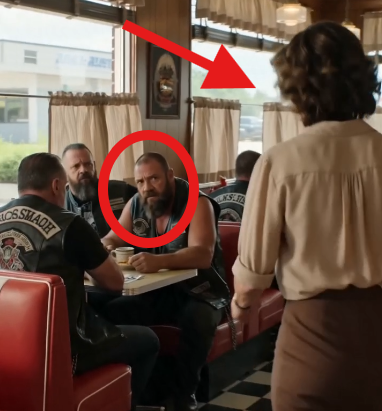
Ruth covered her mouth with one trembling hand.
“No…”
The other three bikers rose from the booth.
One by one, they removed their bandanas and stepped into the warm diner light.
Time had changed them into hard men with broad shoulders and weathered faces.
But suddenly Ruth saw four starving boys again.
Four little brothers sleeping behind the laundromat across the road.
Four children who used to wait near the diner kitchen because she always slipped them soup, clean socks, and whatever coins her husband did not need for rent.
The biggest biker’s voice cracked.
“I’m Ben.”
Ruth let out a broken sob.
“Little Benny?”
He smiled through tears.
“You used to tell me I ate like a bear.”
She reached toward his face, stopping before she touched him, as if he might disappear.
“I thought the state took you away.”
“They did,” Ben said. “We spent years trying to find the woman who kept us alive before that.”
The man in the black suit stared at them, stunned.
“This is ridiculous. She is my mother, not yours.”
Ben turned slowly.
“Then why does she shake when you walk into a room?”
Ruth’s son flushed with anger.
“She’s unstable. That is exactly why I’m taking control of her property.”
He grabbed the legal papers and shoved them toward her.
“Sign.”
Ruth flinched again.
This time, Ben caught her shaking hand before it reached the pen.
“No, Mom,” he said gently. “You don’t sign anything while you’re afraid.”
The word Mom shattered what little strength she had left.
She began to cry.
Her son slammed his palm onto the counter.
“You don’t get to call her that! Where were you when she was sick? Where were you when she needed someone?”
Ben’s eyes filled with pain.
“Looking for her.”
His brother reached into his leather vest and placed a worn metal lunch tin on the table.
The lid was dented and faded, but Ruth recognized it instantly.
She had once packed it with four sandwiches and a note written in blue ink:
You boys matter. Don’t let the world teach you otherwise.
Ben opened it.
The note was still inside.
Covered in creases.
Protected for thirty years.
Ruth’s knees weakened.
“You kept that?”
“You were the first person who ever said we mattered,” Ben whispered. “We built our business together because of you. Every shelter we fund, every hungry kid we feed… it started with this lunch tin.”
Her real son’s face changed.
Not with guilt.
With calculation.
“Business?” he asked quickly.
Ben gave him a cold look.
“That is what you heard?”
Ruth wiped her tears with trembling fingers.
Her son stepped closer, lowering his voice.
“Mother, these men are manipulating you. Come with me now.”
He grabbed her wrist.
She winced.
The four bikers moved at once.
Ben gently removed the man’s hand from Ruth’s arm.
“Touch our mother like that again,” he said quietly, “and the whole diner will testify to what we just saw.”
Several patrons had already risen from their booths.
The waitress behind the counter held a phone in her hand.
Ruth’s son went pale.
“You would choose strangers over your own child?”
Ruth looked at the man she had spent her life defending.
The son whose debts she paid.
Whose lies she forgave.
Whose cruelty she called stress because admitting the truth felt like admitting she had no family left.
Then she looked at Ben and his brothers.
At the men who had carried her kindness through thirty years of their own pain.
“You are my child,” she said softly. “That is why I kept hoping you would stop hurting me.”
His mouth tightened.
“But you did not.”
He reached for the papers again, but Ruth placed her palm over them first.
“I will not sign.”
Her son stared at her.
“You’ll regret this.”
Ruth’s voice trembled, but she did not look away.
“No. I regret waiting this long to say it.”
He turned for the door, furious and humiliated.
Ben’s youngest brother lifted his phone.
“Your threats are recorded. So is the attempt to force her signature.”
The man stopped, then walked out without another word.
Only after the door closed did Ruth begin shaking again.
Ben pulled out a chair for her, but she suddenly reached up and touched the scar along his cheek.
“What happened to my little boys?” she cried.
He covered her hand with his.
“We grew up.”
His voice softened.
“But none of us forgot the woman who fed us when she had almost nothing herself.”
Ruth looked toward the untouched plates on their table.
“I only gave you soup.”
Ben shook his head.
“You gave us proof we were worth saving.”
She broke then, folding against his leather vest as all four brothers gathered around her.
For years, Ruth had believed old age meant becoming easier to discard.
That the only son she had left was the one who made her afraid.
But in the little roadside diner where she once fed four hungry boys through a kitchen window, those boys came back as men.
Not to pretend to be her family.
To remind her they already were.