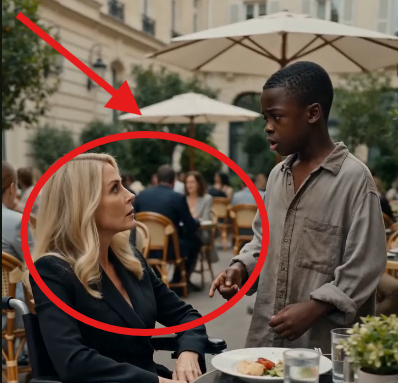
For one long second, nobody in the café moved.
Not the servers.
Not the patrons.
Not even the woman in black.
Because the hunger in the boy’s face had just changed shape.
This wasn’t about leftovers anymore.
This was memory.
The woman stared down at him, her face drained of color, because somewhere underneath the shock in her leg was an older shock — one that had been buried for years and had just opened its eyes.
“What did you say?” she whispered.
The boy was still holding her legs, trembling now from effort and fear.
He swallowed hard.
“My mama said you’d know me if your legs remembered first.”
That line hit harder than the movement.
Because years ago, before the wheelchair, before the money hardened around her like armor, there had been another life she had erased piece by piece.
A poor quarter.
A one-room apartment.
A woman who worked with herbs, pressure points, and old healing traditions people laughed at in public and paid for in secret. A woman she loved until ambition became more important than loyalty. When that woman got pregnant, the rich family stepped in. Money was offered. Silence was demanded. And she left.
Or at least that was the story the woman in black told herself.
Now the child kneeling before her had her old lover’s eyes.
And the same unbearable calm.
The boy’s voice shook.
“She told me not to beg. She said if I found you and touched your legs, the truth would come first.”
The woman gripped the sides of the wheelchair.
Not because she was afraid of falling.
Because she was afraid he was right.
Years earlier, the woman he called Mama had once healed the stiffness from her legs after a riding accident with just her hands and pressure and patience. She used to laugh and say, your body listens before your pride does.
Now a hungry child had put her foot to the ground and her body had answered before her lies could.
The woman looked at the plate on her table.
Then at the boy.
Then at the faces around them, frozen in curiosity and judgment.
But none of that mattered anymore.
Only him.
“Where is your mother?” she asked, and the question sounded more frightened than angry.
The boy’s lip trembled.
“She’s sick.”
A pause.
“She said she didn’t want your money. She wanted to see if your legs still remembered her before your mouth denied us.”
That broke something in the woman.
Not publicly at first.
Just enough.
Enough for her hand to shake.
Enough for everyone to see that this wasn’t a trick.
This was debt.
Love-debt.
Truth-debt.
The kind that stays in the body when the mind spends years trying to run from it.
The boy looked exhausted now, but he didn’t let go.
He had come for food.
But he had also come carrying his mother’s final test.
Then he asked, very softly:
“If you can feel me… why didn’t you ever come back?”
That was the cruelest part.
Not the accusation.
The innocence.
Because children ask questions that land where adults hide.
The woman looked at him and, for the first time in years, saw not inconvenience, not danger, not a stain from the past —
but her son.
Hungry. Brave. And still willing to ask for bread before revenge.
She looked down at the plate on the table, pushed it toward him with shaking fingers, and then reached for him with a hand that no longer felt fully numb.
And suddenly the whole café understood:
the boy had not walked up to a rich woman’s table just to ask for food.
He came to make her body confess
what her life had been lying about for years.